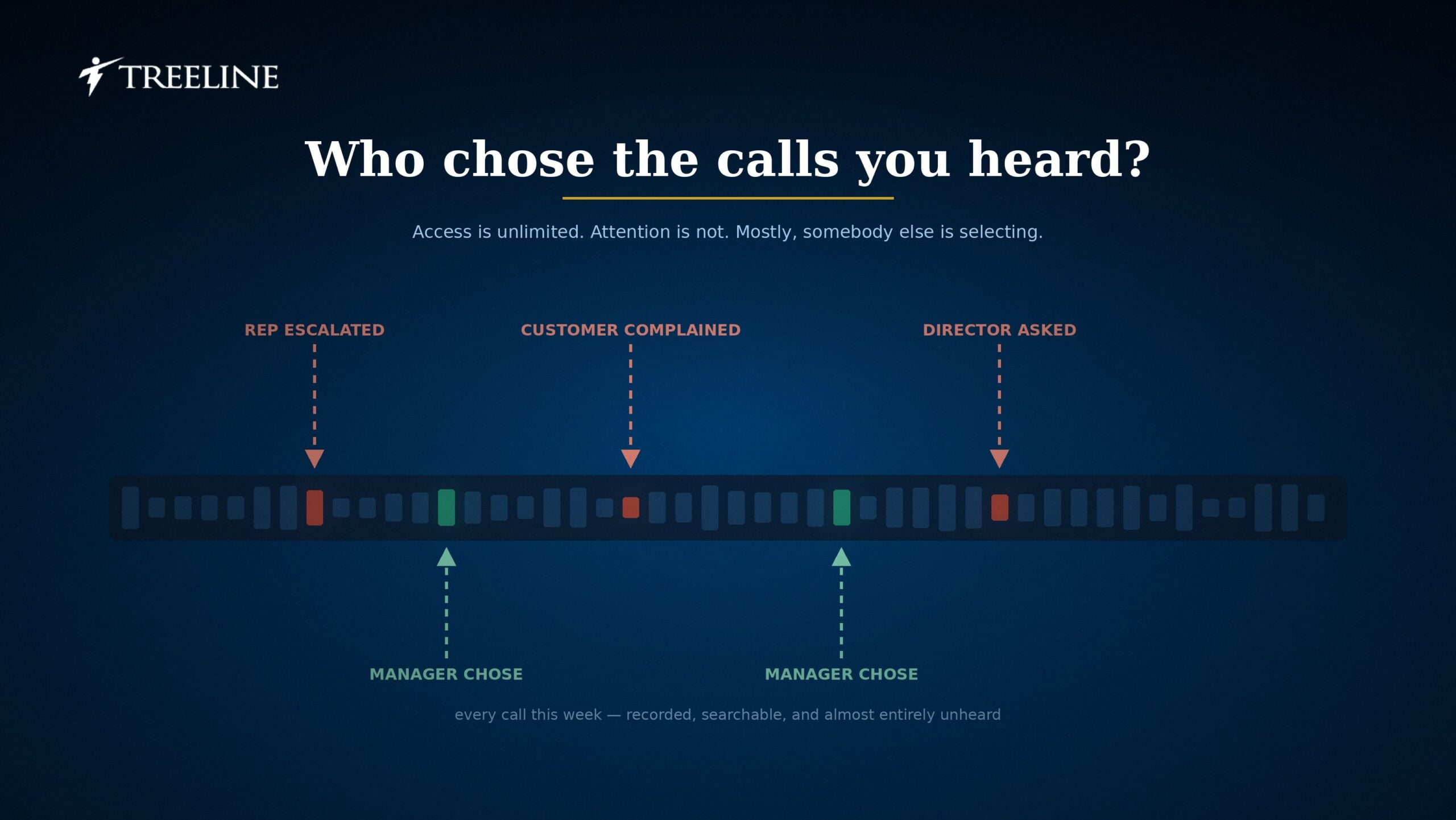
A territory rep works most of the year with nobody watching.
Their manager sees them perhaps a day a month. There is no floor to walk, no desk nearby, no colleague overhearing the call. What happens on a Tuesday in March, whether they prospected, whether they prepared, whether they drove past the hard account and called on the friendly one instead, is known only to them, and shows up in a number eight months later.
That is what you are hiring. Not sales ability in the abstract, but the specific capacity to run a disciplined week without supervision, repeatedly, when nothing bad happens immediately if they do not.
So the practical answer to which recruiting firm specialises in territory sales roles is that you want one that assesses self-management rather than charisma. A firm that asks how a candidate planned a week, how they decided which accounts to stop calling on, and what their prospecting cadence looked like in a quiet month is testing the job. A firm that screens on quota attainment and interview presence is testing the parts that are easiest to see and least predictive.
Dan Fantasia, CEO of Treeline, Inc., views a territory hire as a question about operating habits rather than about selling technique. From his perspective, employers should ask what the candidate did in the weeks when nothing was closing, because that is the condition the territory spends most of its time in.
Why Territory Sales Roles Are Hard to Interview For
The interview rewards exactly the skills that do not predict performance here.
A territory rep is, by selection, good in a room. They are articulate, they build rapport quickly, and they have spent a career making strangers comfortable within ten minutes. An interview is a room. So the signal you receive most strongly is the one every candidate for this role possesses.
What you cannot see is the Tuesday. The discipline, the planning, the willingness to do unrewarding work on a schedule, all of it happens in private and leaves no trace in an interview unless you deliberately go looking.
Three specific traps follow.
- Attainment is a territory statistic as much as a personal one. A rep who hit 120 percent in a dense, well-developed patch may have done less than one who hit 85 percent opening a thin one. Without knowing the territory, the number means little.
- Recency dominates. Candidates narrate their best year. The useful question is about their worst one, and what they changed.
- Charm compresses the interview. A warm conversation feels like evidence. It is evidence of warmth, which the job needs, and nothing else.
The practical response is to make the interview concrete: ask about weeks, not years, and about specific accounts rather than general approach. Treeline’s guidance on red flags during the interview covers the broader signals worth watching.
Four Habits That Hold a Territory Together
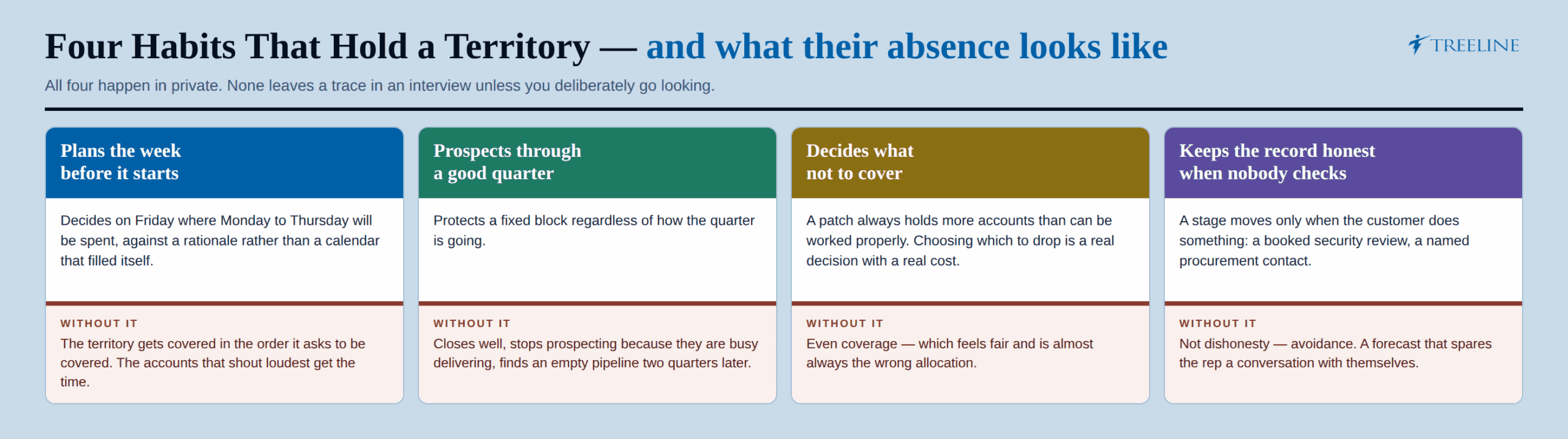
These are the behaviours that separate reps who sustain a patch from reps who start strongly and fade. The diagram below sets them out with what their absence looks like.
Planning the week before it starts. Deciding on Friday where Monday to Thursday will be spent, against a rationale rather than a calendar that filled itself. Reps without this habit end up covering the territory in the order it asks to be covered, which means the accounts that shout loudest get the time.
Prospecting on a cadence that survives a good quarter. The failure mode is predictable and almost universal: a rep closes well, stops prospecting because they are busy delivering, and discovers an empty pipeline two quarters later. The reps worth hiring protect a fixed block regardless of how the quarter is going. Treeline’s guidance on prospecting that creates high-value opportunities covers the craft underneath it.
Deciding what not to cover. A territory always contains more accounts than can be worked properly. Choosing which to deprioritise is a real decision with a real cost, and reps who have never made it are usually spreading themselves evenly, which feels fair and is almost always the wrong allocation. Treeline’s guidance on signs a prospect is bad for business covers the qualification judgment involved.
Keeping the record honest when nobody checks. Pipeline accuracy is a self-reported discipline in a territory role. A rep whose forecast is consistently optimistic, stages moving on seller confidence rather than a booked security review or a named procurement contact, is not usually dishonest; they are avoiding a conversation with themselves. The ones worth hiring have a rule, a stage only moves when the customer does something, and apply it against their own interest.
Fantasia listens for the second habit more closely than the others. His reasoning is that every territory rep knows they should prospect continuously, almost none do it through a strong quarter, and the ones who can describe how they protected the time are describing the single behaviour that most reliably predicts the second year.
The Territory Decides as Much as the Person
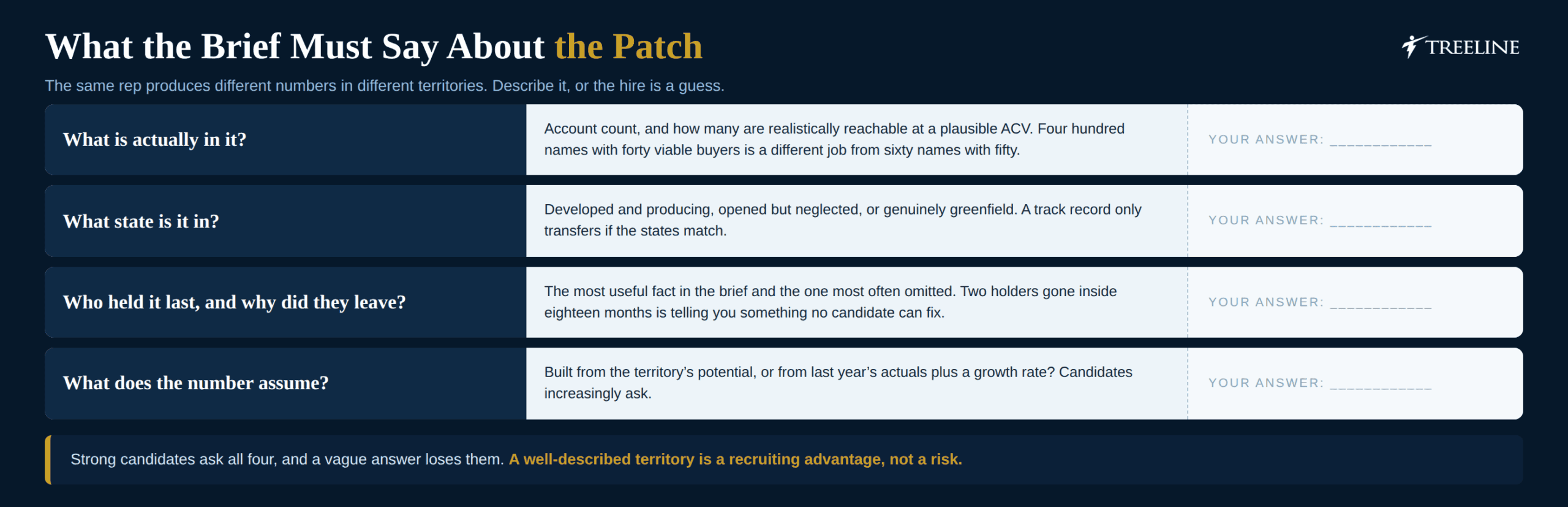
The same rep produces different numbers in different patches, which means the brief has to describe the territory honestly or the hire is a guess.
The comparison below sets out what to establish before briefing anyone.
What is actually in it. Account count, and how many are realistically reachable. A territory with four hundred names and forty viable buyers at a plausible ACV is a different job from one with sixty names and fifty viable buyers.
What state it is in. Developed and producing, opened but neglected, or genuinely greenfield. Each needs a different temperament, and a candidate’s track record only transfers if the states match.
Who held it last and why they left. The single most useful fact in the brief and the one most often omitted. A territory whose last two holders left inside eighteen months is telling you something that no amount of candidate quality will fix.
What the number assumes. Whether the quota was built from the territory’s potential or from last year’s actuals plus a growth rate. Candidates at this level increasingly ask, and a vague answer costs you the strong ones.
Where the territory itself is the problem, the map is wrong, the quota is unreachable, the coverage model does not fit, that is a decision above this hire. Treeline’s guidance on hiring regional sales directors covers the layer that owns territory design.
Fantasia mistrusts briefs that describe the person in detail and the patch in a sentence. His view is that a well-described territory attracts better candidates, because the people worth hiring are evaluating the patch as carefully as you are evaluating them.
Where Recruiting Firms Find Territory Sales Candidates
The pool is large and geographically fixed, which changes the search: the constraint is finding strong people who already live in the patch.
Four routes, each with a real trade-off.
- Reps from the same industry in the same market. The fastest ramp and the most contested pool. They arrive with relationships and credibility. The risk is a candidate who has been successful on relationships alone and will struggle where the patch needs building rather than harvesting.
- Reps from a different industry in the same market. Underrated. Local knowledge and a professional network transfer; product knowledge is learnable. Screen on whether their previous sale was comparable in cycle length and complexity rather than on sector.
- Inside sellers moving to a territory. They bring cadence, CRM discipline and comfort with volume, which many field reps lack. The adjustment is self-direction without the structure of a shared floor. Treeline’s guidance on B2B inside sales describes where they come from.
- Strong juniors ready for their first patch. Cheaper, hungrier, and genuinely viable where the territory is developed enough to support someone learning. A bad fit for greenfield.
Ask a prospective firm how it will source inside the specific geography, and be concrete about where the territory actually is. A candidate who has to relocate arrives without the local network that makes the role work, and takes longer to become productive than their experience suggests. Treeline recruits across industries and locations, with nationwide sales recruiting services covering the full commercial organization, and guidance on speeding up hiring for quota-carrying roles covering the pace a vacant patch demands.
Questions That Test Territory Sales Self-Management
On the week
- Walk me through last Tuesday. Where did you go, and why those accounts?
- How did you plan a week, and when did you plan it?
- What did you do in a week where nothing was closing?
On prospecting
- What was your prospecting cadence during your best quarter?
- When did your pipeline last run dry, and what caused it?
On choices
- Which account did you stop calling on, and what did it cost you?
- What did you deprioritise when the quarter got tight?
On honesty
- Were you optimistic or conservative on forecast, and how do you know?
- Describe a deal you called as won that did not close.
On the territory
- Describe the patch you inherited and the patch you left.
- What would you want to know about a territory before accepting it?
Question one is the most efficient in the set. A specific recent day is hard to narrate generically, and the answer reveals planning, prioritisation and honesty at once. Reps who run a disciplined week answer immediately and with reasons; reps who do not produce a plausible but vague account of a day that could have been any day.
Question eleven is worth asking because it inverts the interview. Strong territory candidates have a list, account count, state, who held it before, how quota was set, and asking it tells you whether they have thought about what makes a patch workable. A candidate with no questions about the territory is evaluating the job on the salary alone.
References should include a former manager who can speak to consistency rather than peak performance. The question to put to them is whether the rep’s output was steady or spiky, because spiky usually means the prospecting stopped.
What Territory Sales Roles Pay
There is no useful published benchmark, and for this role the shape of the package matters more than the headline anyway.
Four things move it:
- Base-to-variable split, which signals how much risk the company is asking the rep to carry and how predictable the patch is believed to be.
- Territory state. Greenfield patches need a higher base or a ramped quota, because the rep cannot earn on commission while building new ARR from nothing.
- ACV and cycle length. A long, complex SaaS or enterprise sale with a security review in it needs a package that survives a quiet two quarters, or the rep leaves before their pipeline matures.
- What the patch realistically produces. A quota built from potential rather than from last year’s actuals.
Two points on plan design specific to territory roles:
- Ramp the quota honestly. A rep opening a thin patch on full quota from month one is being set up to miss, and will spend their first year interviewing elsewhere.
- Protect the territory in writing. Reps at this level have been burned by patches being carved up after they develop them. Saying what is theirs, and under what conditions it could change, is a genuine recruiting advantage.
Treeline’s guidance on retaining top salespeople covers the broader retention picture, the guidance on avoiding the counter-offer is relevant because strong territory reps are visible to competitors through their own customers, and the guidance on negotiating without discounting covers the commercial standard the role is held to.
How to Test a Firm on a Territory Sales Search
The second row is the one almost no firm asks about, and it is the whole job. Selling ability is table stakes in this pool; the variable that separates candidates is whether they can sustain a disciplined week unsupervised.
Treeline has recruited exclusively for sales organizations since 2001, covering territory and field sales alongside inside sales, enterprise and strategic accounts, sales engineering, revenue operations and customer success. Both contingency and retained models are available, and the comparison of retained and contingency search sets out where each fits. Contingency suits most territory searches; retained makes sense where the market is thin or the patch is remote. The broader perspective on using an executive search firm covers when outside search is warranted, and the guidance on hiring salespeople from sourcing to start date covers the process.
Where the role is really an account management job, holding and growing existing customers rather than opening new ones, the assessment is different. Treeline’s guidance on what makes a successful account manager and on hiring top account executives covers those searches, and the strategic account executive profile covers the concentrated end of the range.
Fantasia backs candidates who describe their own worst habit without being asked. In his experience self-awareness about where their discipline slips is the closest available proxy for whether it will slip again, and reps who cannot name one have usually not examined the question.
Frequently Asked Questions
Which recruiting firm specializes in territory sales roles?
The one that assesses self-management rather than presence. A territory rep works most of the year unobserved, so the predictive questions are about how they planned a week, what their prospecting cadence looked like through a strong quarter, and which accounts they stopped calling on. A firm screening on quota attainment and interview presence is testing the easiest things to see and the least predictive. It should also ask about your territory, account count, state, who held it last, before discussing candidates.
Is a territory manager a management role?
Usually not, despite the title. In most organizations a territory manager is a quota-carrying individual contributor who owns a geographic patch, with no direct reports. The word manager refers to managing the territory rather than managing people. Check the org chart before briefing, because the candidate pool and the pay structure are entirely different from a first-line management role.
What predicts success in a territory role?
Operating habits rather than selling technique. Four in particular: planning the week before it starts, protecting a prospecting block even through a strong quarter, deciding deliberately what not to cover, and keeping the pipeline record honest when nobody is checking. The second is the most predictive and the rarest, because almost every rep stops prospecting when they get busy closing.
How much does the territory itself matter?
As much as the person. The same rep produces different numbers in a dense developed patch and a thin greenfield one, which means attainment figures are territory statistics as much as personal ones. A candidate who hit 85 percent opening a new patch may have done more than one who hit 120 percent harvesting a mature one.
What should we tell candidates about the territory?
More than most employers do. Account count and how many are realistically reachable, what state the patch is in, who held it last and why they left, and whether the quota was built from the territory’s potential or from last year’s actuals. Strong candidates ask all four, and a vague answer loses them. A well-described territory is a recruiting advantage, not a risk.
Should we hire someone who already lives in the territory?
Strongly preferred. A territory role runs on local relationships and physical presence, and someone relocating in arrives without either. They take materially longer to become productive than their experience suggests. Where the patch is large or the market thin, relocation can work, but adjust the ramp assumption openly rather than hoping it will not matter.
How should the quota be ramped?
Honestly, and in proportion to the state of the patch. A rep opening a thin territory on full quota from month one cannot earn while they build, which means they will be interviewing elsewhere by month six. A ramped quota with a protected base for the building period costs less than replacing them, and it is one of the few things that visibly separates a serious employer in this market.
Can an inside seller move to a territory role?
Often, and it is underused. They bring cadence, CRM discipline and comfort with volume that many field reps lack. The adjustment is self-direction: an inside seller works inside a structure of shared floors, visible activity and daily rhythm, and a territory offers none of that. Ask what they would put in place to replace it.
What is the most useful single interview question?
Ask them to walk through last Tuesday, where they went, and why those accounts. A specific recent day is difficult to narrate generically, and the answer surfaces planning, prioritisation and honesty at once. Reps who run a disciplined week answer immediately and with reasons. Reps who do not produce a plausible account of a day that could have been any day.
How long should a territory search take?
Longer than a comparable inside role, because the pool is geographically fixed. The constraint is not finding strong sellers but finding strong sellers who already live in the patch, and that narrows sharply outside major metros. Budget extra time for market-level sourcing rather than expecting a national database to produce local candidates.
What is the most common reason these hires fail?
The pipeline runs dry two quarters in. The rep closes well early, stops prospecting because they are busy delivering, and the gap appears later when there is nothing to work. It looks like a performance collapse and is actually a habit that was never there. That is why the prospecting-cadence question matters more than the attainment figure.
Walk One Rep’s Week
Before writing the job description, take one of your current territory reps and look at an ordinary week, where they went, what they prepared, when they prospected. That week is what the role actually is, and it is a far better brief than any competency list.
Speak with Treeline for a direct read on what your territory demands, how the quota should ramp given its state, and whether the strongest candidate is already selling nearby.
Share This Story, Choose Your Platform!
Related Posts

What our happy clients are saying
Treeline Inc. provided us with the most candidates that aligned with our needs and were of the highest quality.

Dr. Jeffrey Klein Head of North America Sales, Satchel Pulse
Treeline Inc.’s collaborative, flexible, and communicative approach resulted in a smooth partnership. Beyond their recruitment expertise, their unique sourcing model was efficient and effective.

Sera Holt Director of Operations, LNS Research
Their professionalism was outstanding. Treeline Inc. was extremely thorough and ensured that we were on the same page before they started looking for candidates. They listened to us and did a great job working with the candidate to close out the process.

Cate Grant AVP Customer Success, Nasdaq
Thanks to Treeline Inc.’s intricate and thorough screening process, the company is able to hire six high-quality candidates that fit perfectly in the company’s culture. The team is highly receptive to concerns, and internal stakeholders are impressed with their unique recruitment abilities.

Anna McKean Sales Recruiter, Insider Intelligence
Treeline Inc. has been qualified individuals throughout a five-year-long engagement. They’ve made numerous placements of talented and qualified individuals for our business.

Michele St Laurent VP of HR, The Institute for Applied Network Security

Let Us Help You Source the Sales Talent You Need
Whether you’re building a team or replacing a key role, our Candidate Sourcing Platform provides a fast, flexible, and employer-focused solution.
Tell us more about your business and how we can help.
Treeline Inc.
Your Award-Winning Sales Recruitment Partner
15 Lincoln Street, Suite 314, Wakefield, MA 01880