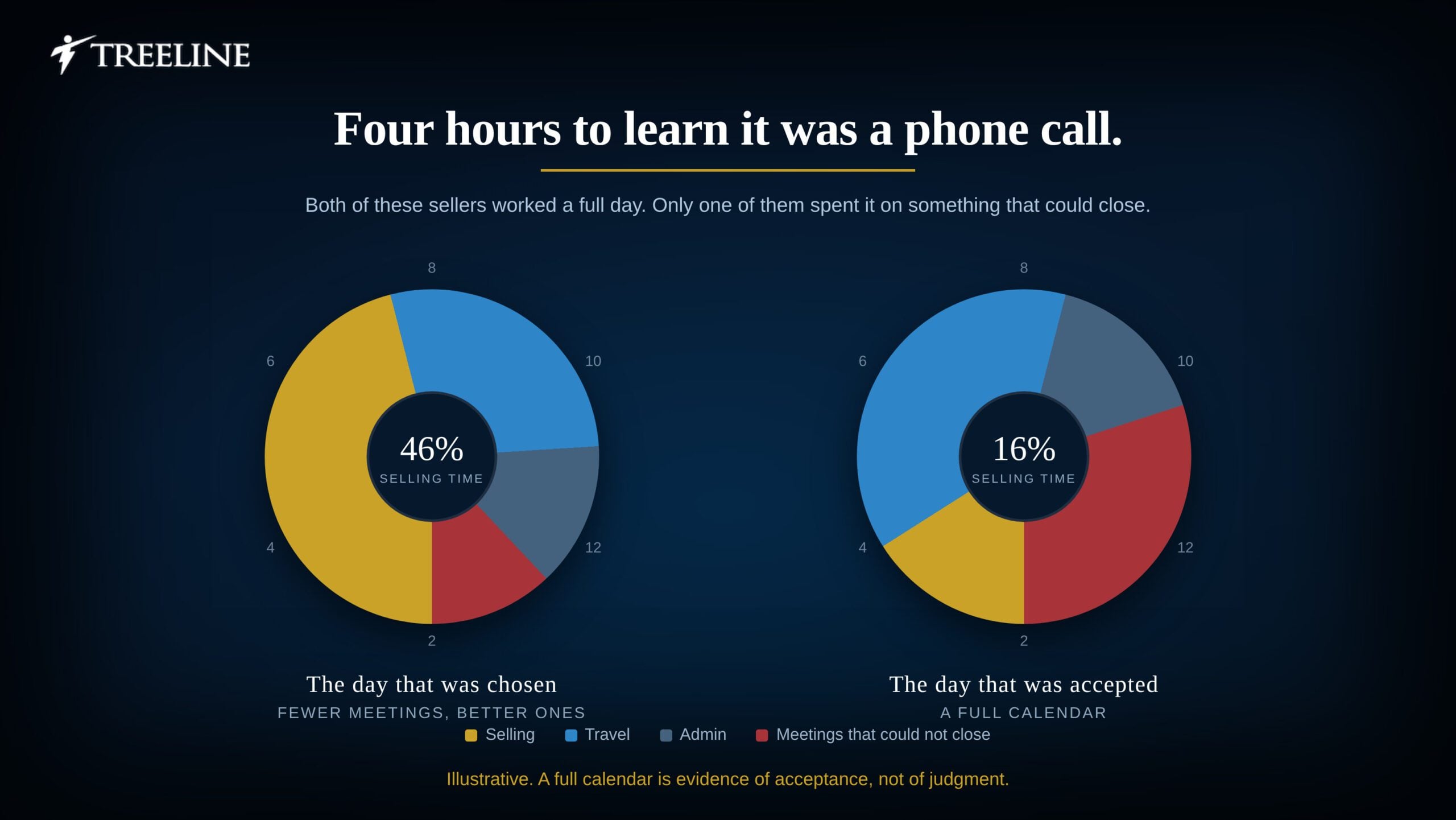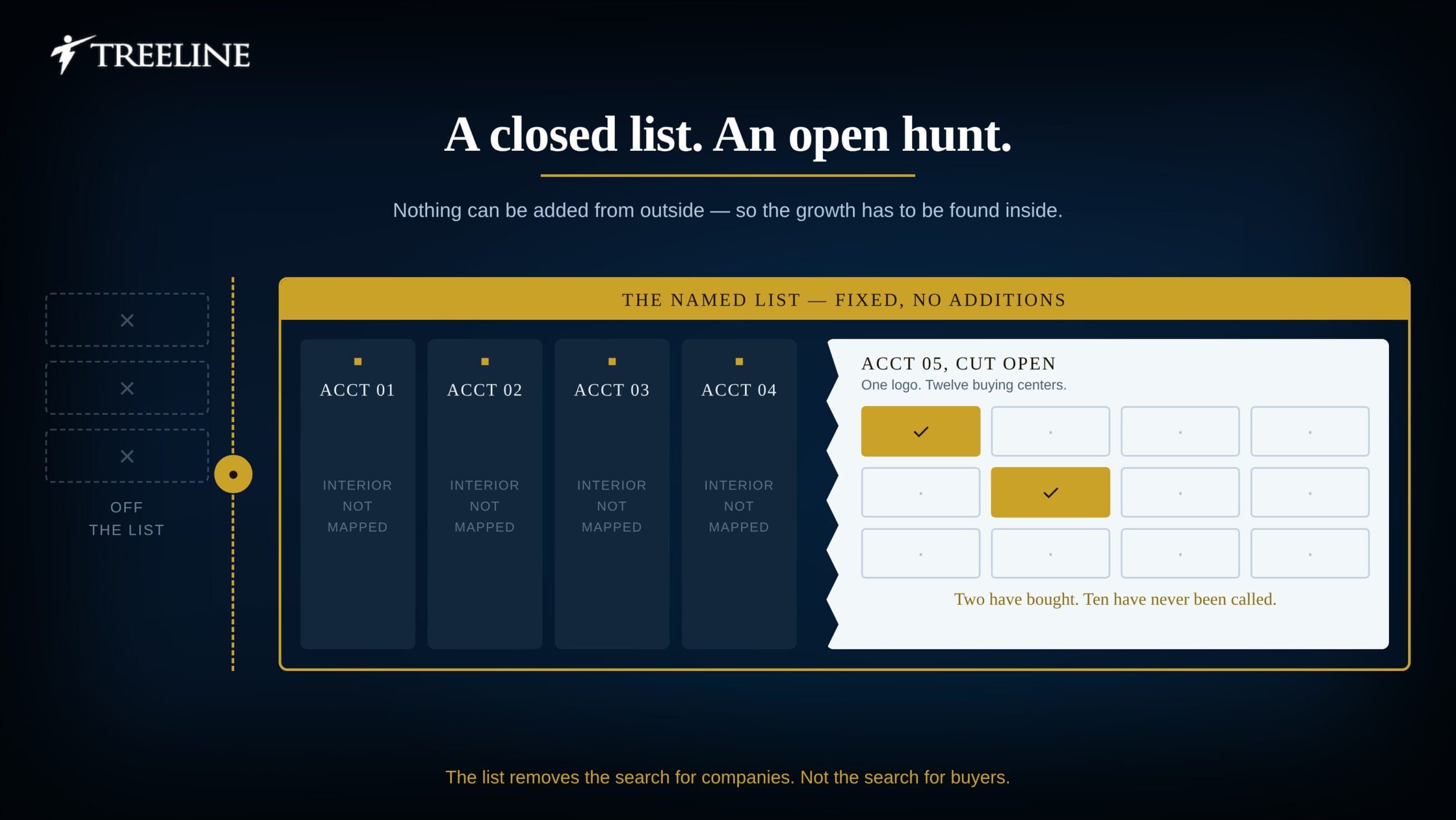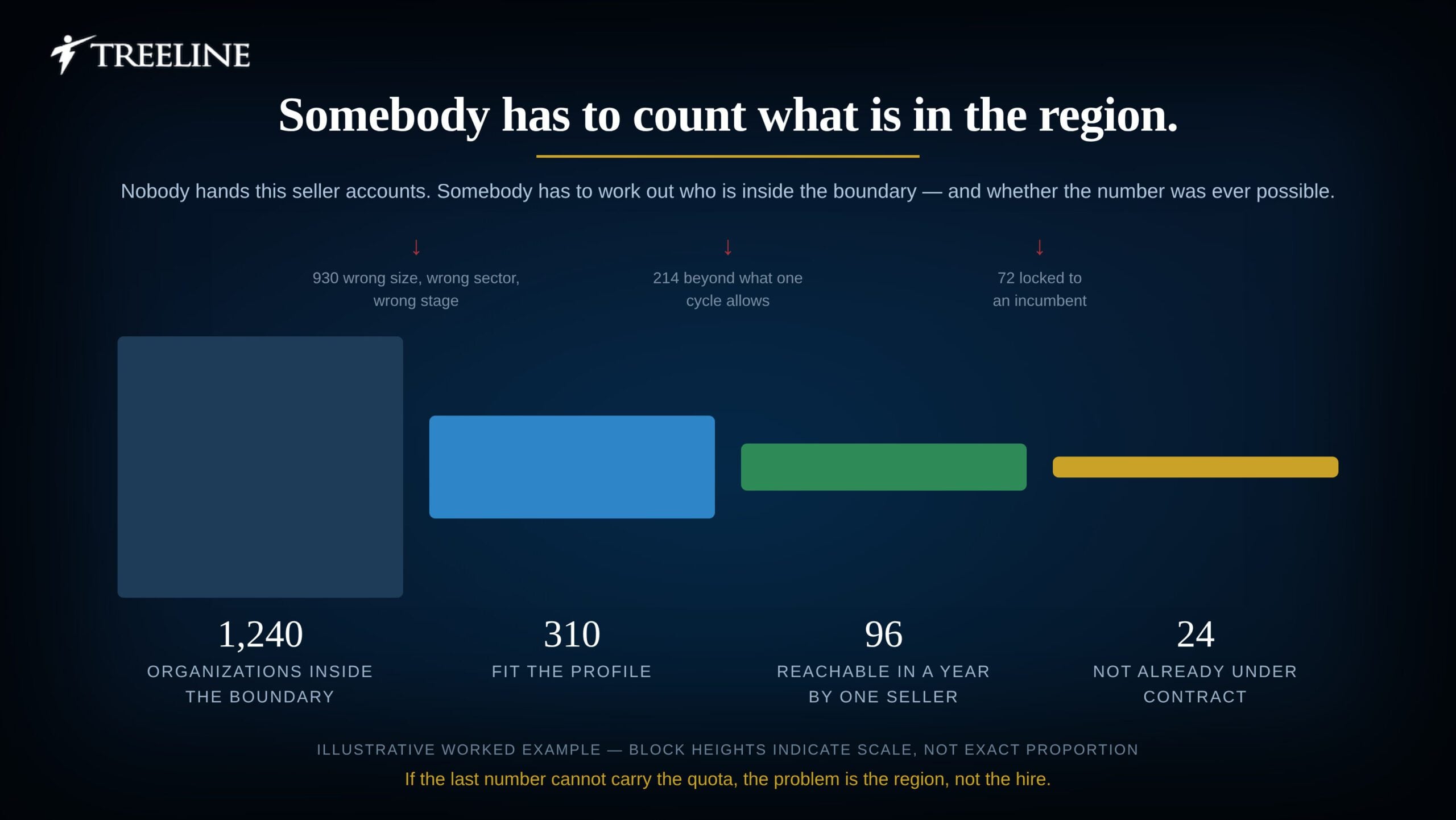
Start with what this person is actually handed on their first morning, because it is less than most hiring managers remember.
A named-account seller gets a list. An inside seller gets a queue. A regional account executive gets a boundary on a map and a number at the bottom of a page, and the space between those two things is the job.
Nobody tells them which companies inside the region exist. Nobody tells them how many of those could plausibly buy, or which ones already have a competitor’s contract, or whether the number at the bottom of the page was arrived at by counting anything at all. Before this seller can work a pipeline they have to build the universe the pipeline will come out of, and that work is invisible, unrewarded in the first quarter, and almost never assessed in an interview.
So the practical answer to which recruiting firm specializes in regional AE roles is: one that asks candidates how they have built a target list from nothing, rather than how they have worked one they were given. Treeline’s writing on hiring top account executives and on the account executive role covers these seats generally; what follows is specific to the ones defined by a line on a map.
Dan Fantasia, CEO of Treeline, Inc., views regional seats as the ones where the quota is most often set before anyone has counted what is inside the boundary. From his perspective, the first question an employer should answer is how many companies in this region could buy at all, because that number decides whether the search is for a seller or for a different region.
What a Regional Account Executive Is Actually Given
Four things, and only two of them are usually written down.
A boundary. Sometimes a state, sometimes a group of counties, sometimes a postcode range that was drawn to balance headcount rather than opportunity.
A number. Derived, in most organizations, from last year plus a growth assumption, rather than from anything inside the boundary.
No list. This is the part that gets assumed. There may be a CRM full of lapsed records, a conference attendee export and some inherited relationships, but there is no agreed set of accounts that constitutes the job.
No answer to how many there are. Which is the thing that determines whether the number is achievable, and which almost nobody has calculated.
Our writing on territory-based selling and on building a pipeline the way you would run a business deals with what happens after those four things are settled. This article is about what happens before.
A Map Is Not a List
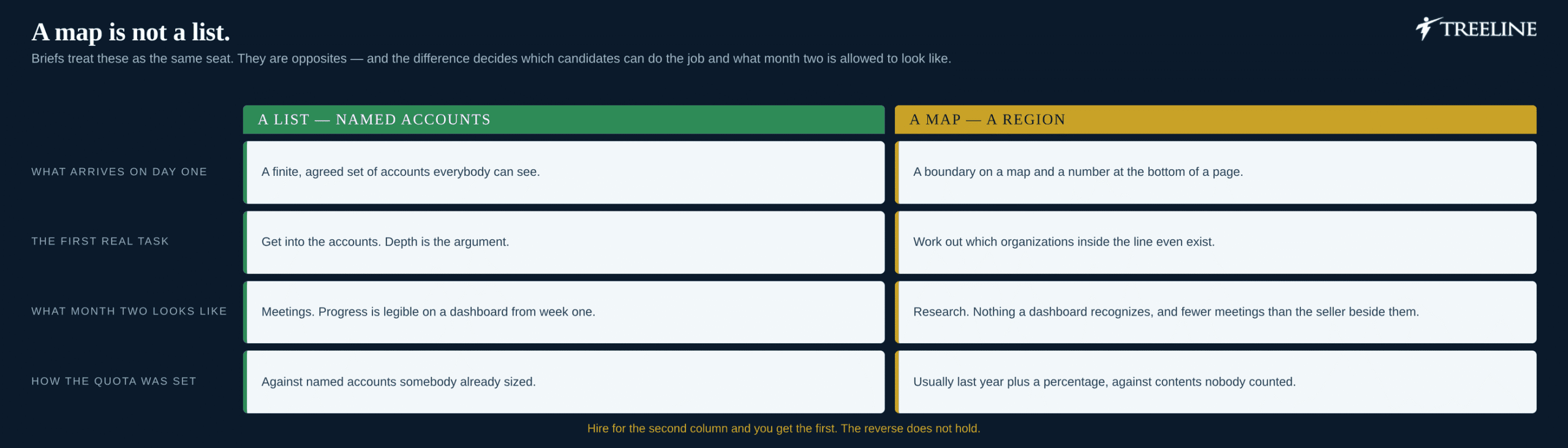
Worth saying plainly, because the two get treated as interchangeable in briefs and they are opposites.
A list is finite, known and agreed. Everyone can see it. Progress against it is measurable from week one, and the argument is about depth, how far into each account the seller has got.
A map is a constraint with unknown contents. The first real task is enumeration: which organizations inside this boundary are of the right size, in the right sector, at the right stage, with the right problem. That work is research, not selling, and it produces nothing a dashboard recognizes.
Three consequences follow for the hire.
The first quarter looks wrong. A seller doing the enumeration properly has fewer meetings in month two than one who started calling whoever was already in the CRM, and a better pipeline by month five. Managers who cannot tell these apart will fire the right person.
Research quality is a sales skill here. Knowing how to find the forty companies in a region that match a profile, from associations, filings, supplier lists, local press, hiring patterns, is the difference between a territory with forty prospects and one with eight.
The seller discovers the quota’s honesty before anyone else does. They will know by month three whether the number was counted or assumed, and strong candidates leave when they find out it was assumed.
Fantasia weighs a candidate’s description of how they mapped a territory more heavily than their attainment history. His argument is that attainment in an inherited book says mostly what the book was, while an account universe someone built themselves is the clearest available evidence of how they think.
The Arithmetic Nobody Does Before Setting the Quota
It is four lines long and it changes the entire search.
How many organizations inside the boundary fit the profile? Not the population of the region. The count of plausible buyers.
What proportion of those are reachable in a year? One seller running a full cycle can work a finite number of accounts seriously. Everything beyond that is a list, not a plan.
What is the realistic win rate against that reachable set? Including the ones already under contract elsewhere.
What does that multiply out to against average contract value? If the answer is below the number at the bottom of the page, the problem is the region, and no hire will solve it.
Employers who have done this arithmetic run faster searches, because they can tell candidates something true and specific. Employers who have not tend to describe the role in terms of the product and the person, and then wonder why strong candidates do not progress.
Where Regional Account Executive Candidates Come From
Four pools, in rough order of hit rate.
Sellers who have opened a region rather than inherited one. The strongest signal in this search, and worth more than logo quality. Ask what the territory looked like when they arrived and what it looked like when they left.
Inside sellers with research habits. Often excellent at enumeration, it is adjacent to the prospecting they already do, and motivated by the autonomy. Our page on the inside sales account executive seat is useful background on what they bring and what they are leaving.
Sellers from adjacent industries in the same geography. Underrated. Someone who has spent six years selling a different product into the same regional buyers already knows which organizations exist, who runs them and how they purchase, which is the part that takes longest to acquire.
Account managers moving to new business. They understand the regional customer base and often know it better than anyone. The question is whether they have ever worked a company that was not already a customer, which is a different activity from growing one that is. Our note on what makes a successful account manager sets the baseline.
Fantasia separates these pools by whether the candidate has ever had to decide who to call rather than being told. His position is that the deciding is the scarce skill, because an organization can supply a list but cannot easily supply the judgment that produces one.
Two Hires That Stall Once the Obvious Accounts Run Out
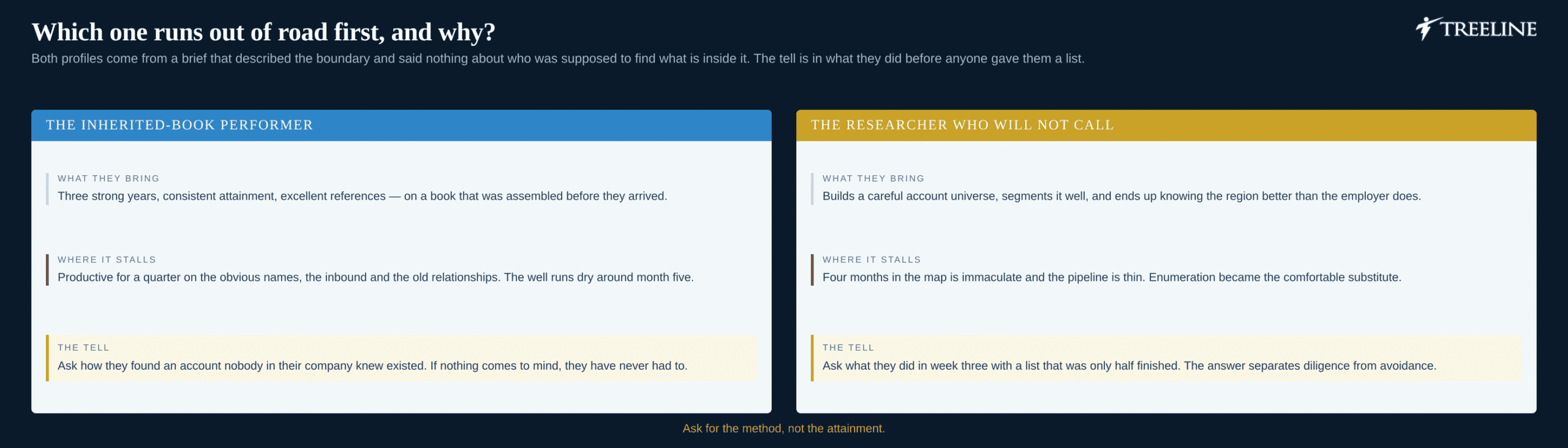
The inherited-book performer. Three strong years, consistent attainment, excellent references. Their book was assembled before they arrived, and they are genuinely good at working it. Put into an empty region they are productive for a quarter, the obvious names, the inbound, the old relationships, and then the well runs dry around month five, because nobody ever asked them to find the non-obvious accounts and they have no method for it.
The researcher who will not call. Builds a beautiful account universe, segments it carefully, knows the region better than the employer does. Four months in, the map is immaculate and the pipeline is thin, because enumeration became the comfortable substitute for the uncomfortable part. This failure is rarer and harder to spot, because the work product looks like diligence.
Both are defensible hires. Both come from a brief that described the boundary and said nothing about who was supposed to find what is inside it.
Questions That Test Whether Someone Has Built a List From Nothing
Six questions that are difficult to answer from a script.
How did you work out which companies in your region were worth approaching? Walk me through the sources.
How many plausible buyers were in your last territory, and how do you know that number?
Name an account you found that nobody in your company knew existed. How did you find it?
What did your first ninety days look like, and how much of it was selling?
Which part of your region did you decide not to work, and why?
When did you conclude a territory could not produce the number, and what did you do about it?
Candidates who have opened a region answer with sources, counts and decisions about where not to go. Candidates who have worked an inherited book answer with accounts and relationships. Both are legitimate careers; only one of them is this job.
What Regional Account Executive Roles Pay
No published band exists on our board for this title, so this is a qualitative account of what moves the number rather than a quoted figure.
Density of qualified buyers inside the boundary. The dominant variable, and the one most often ignored in benchmarking. Two regions with the same headcount and the same product can carry different achievable numbers by a factor of two.
Whether the territory is new or inherited. Opening a region is a different job from running one, takes longer to produce, and is priced accordingly, usually through a longer guarantee rather than a higher base.
Average contract value and cycle length. These decide how many accounts the seller can work seriously, which is the real cap on the number.
Whether research support exists. A seller doing their own enumeration is spending selling time on it, and the compensation plan either recognizes that in the ramp or does not.
Treeline’s material on sales compensation plans, on the levers that matter and on hiring speed for quota-carrying roles is worth reading before this search, because a guarantee structure is frequently what decides whether a strong candidate takes an unopened region.
How to Brief a Regional Account Executive Search
Four things, written down before the first candidate conversation.
The boundary, and whether it is final. Candidates will ask whether the region is being split next year. Answer honestly; they will find out either way.
Your own count of qualified organizations inside it. If you do not have one, say so, that is itself useful information, and a good candidate will take it as an invitation rather than a warning.
What exists already. Inherited accounts, lapsed records, inbound volume, marketing coverage in the region. Quantify each, because “some” is not a brief.
Where the number came from. Last year plus a percentage, or a count of what is reachable. Strong candidates ask this question in the second interview and judge the role by the answer.
Fantasia warns that the most common failure in this search is a brief that describes the product and the person and omits the region’s contents, which produces candidates assessed against a job nobody has yet defined.
How to Test a Recruiting Firm on a Regional Account Executive Search
Four questions, before you engage anyone.
Ask what they will want to know about the region before they start. A firm that has run these searches asks about density and about what already exists; one that has not asks only about the product.
Ask how they will test for enumeration. The useful answer involves asking candidates for sources and counts, not asking whether they are self-starters.
Ask whether they can find candidates who already live inside the boundary, and what happens if they cannot.
Ask what they would say if the region cannot support the number. A firm that has never recommended against its own placement is not reading the mandate.
Our analysis of the account executive role in the software market and our page on territory-based roles are reasonable places to check whether a firm’s published thinking matches what it tells you on a call.
When the Region Is the Problem, Not the Hire
Sometimes the search should stop.
If the count of qualified organizations inside the boundary cannot support the number at any defensible win rate, the region needs enlarging or the number needs lowering, and a hire merely postpones the conversation by a year. If two previous holders have both left inside eighteen months, the third will discover whatever they discovered. If the region is scheduled to be split and nobody has told candidates, the offer will be accepted and the resignation will follow the announcement. And if the real intent is to cover a geography rather than grow it, the seat is a coverage role and should be scoped, paid and recruited as one.
Our pages on named-account coverage and on field selling deal with the two structures a region most often becomes once somebody has counted what is inside it.
Fantasia resists opening a regional search where nobody can say how many plausible buyers the boundary contains, on the view that hiring a seller to find out is the most expensive way to run that calculation.
Frequently Asked Questions
What is the difference between a regional account executive and a territory representative?
Mostly deal size and cycle length, which change what the boundary has to contain. A representative working transactional business needs volume inside the region; an account executive running longer consultative cycles needs fewer, larger, qualified organizations. The same geography can be viable for one and not the other.
Should I hire someone who already lives in the region?
It helps considerably, but not for the reason usually given. The value is not travel convenience, it is that they already know which organizations exist, who runs them and how they buy, which is the slowest part of the job to acquire.
How long before a regional account executive should be producing?
Longer than an inherited book and shorter than a new market. The useful question is what the first ninety days are supposed to produce, and whether that expectation is enumeration or pipeline. Briefs that expect both at once tend to get neither.
What if I do not know how many qualified companies are in the region?
Say so in the brief. It is a normal position to be in, and candidates who have opened regions before will treat it as the first piece of work rather than as a warning sign. What damages the search is presenting an uncounted number as though it had been counted.
Does industry experience matter more than regional knowledge?
Regional knowledge is usually harder to acquire and easier to underrate. Product and industry knowledge installs in a quarter; knowing which two hundred organizations in a geography are worth a conversation takes years, and transfers across products more readily than most employers expect.
Count the Companies Before You Set the Number
Everything difficult about this search is decided before anyone is contacted. Where the boundary is and whether it will move. How many organizations inside it could plausibly buy. What already exists in the CRM. Where the number came from.
Four answers, none of which require a recruiter, all of which decide whether the recruiter can help. A seller handed a map rather than a list will work out all four by month three. It is cheaper to work them out first.
Share This Story, Choose Your Platform!
Related Posts

What our happy clients are saying
Treeline Inc. provided us with the most candidates that aligned with our needs and were of the highest quality.

Dr. Jeffrey Klein Head of North America Sales, Satchel Pulse
Treeline Inc.’s collaborative, flexible, and communicative approach resulted in a smooth partnership. Beyond their recruitment expertise, their unique sourcing model was efficient and effective.

Sera Holt Director of Operations, LNS Research
Their professionalism was outstanding. Treeline Inc. was extremely thorough and ensured that we were on the same page before they started looking for candidates. They listened to us and did a great job working with the candidate to close out the process.

Cate Grant AVP Customer Success, Nasdaq
Thanks to Treeline Inc.’s intricate and thorough screening process, the company is able to hire six high-quality candidates that fit perfectly in the company’s culture. The team is highly receptive to concerns, and internal stakeholders are impressed with their unique recruitment abilities.

Anna McKean Sales Recruiter, Insider Intelligence
Treeline Inc. has been qualified individuals throughout a five-year-long engagement. They’ve made numerous placements of talented and qualified individuals for our business.

Michele St Laurent VP of HR, The Institute for Applied Network Security

Let Us Help You Source the Sales Talent You Need
Whether you’re building a team or replacing a key role, our Candidate Sourcing Platform provides a fast, flexible, and employer-focused solution.
Tell us more about your business and how we can help.
Treeline Inc.
Your Award-Winning Sales Recruitment Partner
15 Lincoln Street, Suite 314, Wakefield, MA 01880