where-to-find-senior-account-executive-candidates-featured.jpg
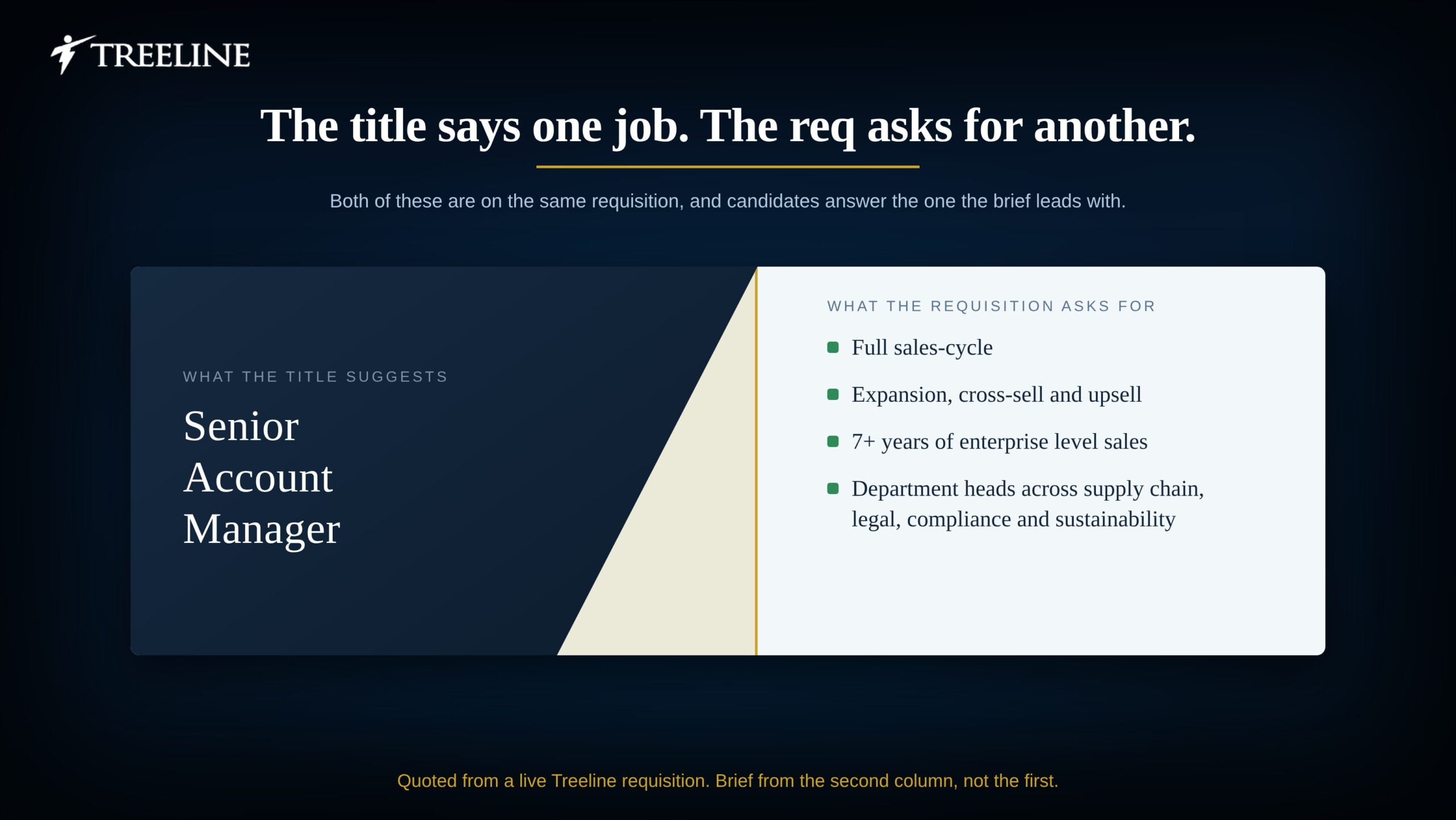
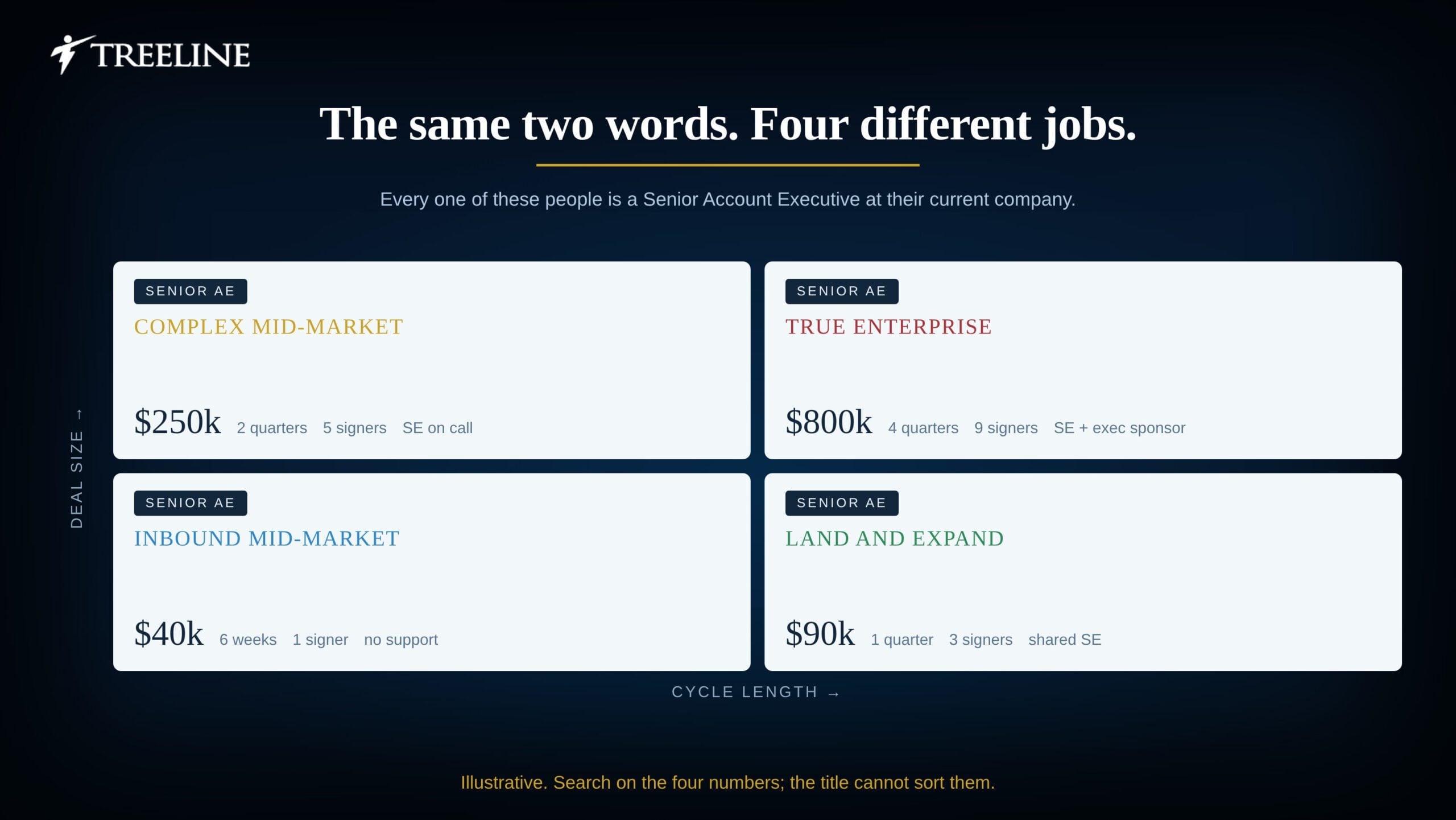
Two people apply for the same role. Both are called Senior Account Executive, both have held the title for three years, both are well regarded.
The first closes deals worth around forty thousand dollars in a six-week cycle, works a list of inbound leads, and has never met a buyer in person. The second closes deals worth several hundred thousand over four quarters, runs a security review and a procurement negotiation on every one, and brings a sales engineer and an executive sponsor into the room.
Same title. Same tenure. Different jobs, different skills, and only one of them can do the thing you are hiring for.
That is the whole problem with this search, and it is not a problem with either candidate. “Senior” is the only word in the title that describes the employer rather than the seller. It records where someone sits in one company’s banding structure, which is set by headcount, budget and internal politics, and it does not travel. Everything else in the title does: “account” and “executive” mean roughly the same thing everywhere.
So the practical answer to where you can find senior AE candidates is: nowhere, if you search on the word. Treeline’s general writing on hiring top account executives and on the account executive role covers these seats; what follows is specific to the one whose defining adjective means nothing until you define it.
Dan Fantasia, CEO of Treeline, Inc., views seniority on a résumé as a fact about a company rather than a fact about a seller. From his perspective, an employer should write down the four numbers that describe the seat before the first search string is typed, because those numbers travel between companies and the word does not.
What “Senior” Actually Means on a Résumé
Four different things, depending on who awarded it.
Tenure. The company promotes on years served. The title arrived on an anniversary and says nothing about the work.
Deal size. The company bands its sellers by contract value, and this person crossed a threshold. This is the most useful version and the least common.
Autonomy. The person stopped needing a manager in the room. Real and valuable, rarely written down anywhere.
Retention. Somebody was going to leave and the title was cheaper than the raise. Common enough that it is worth testing for rather than assuming against.
The four are not mutually exclusive, and a single promotion often carries two of them at once. What none of them carries is a description of the work, which is the only thing a hiring manager actually needs.
All four produce the same two words on a profile. None of them is visible from outside. This is why a search built on the title returns a list rather than a shortlist.
Where Senior Account Executive Candidates Actually Are
Four pools, and the sequencing matters more than usual here because the title cannot sort them.
Sellers sitting one level below your title at organizations with stricter leveling standards. The most productive pool and the least contested, because nobody searching on the word will find them. A seller carrying three-hundred-thousand-dollar deals at a company that reserves “senior” for seven figures is doing your senior job under a different name.
Sellers at the same band in the same market. The obvious pool. Contested, expensive, and the one where the title actually correlates with the work, provided the two companies band similarly, which is worth checking rather than assuming.
Sellers moving down in deal size for a better product or a better company. Underrated and often the strongest hire available. They arrive able to do the job on day one. The thing to probe is whether they will be bored in a year.
Specialists stepping into a quota-carrying seat. Sales engineers, consultants and clinical specialists who have been in every deal and never owned one. Our writing on enterprise sellers and on the enterprise account executive seat covers what the step involves.
Fantasia weighs the first pool most heavily, on the view that a seller already doing the work under a lesser title is both more available and easier to assess than one whose title already matches.
The Four Numbers That Define the Seat
the-four-numbers-that-define-the-seat.png
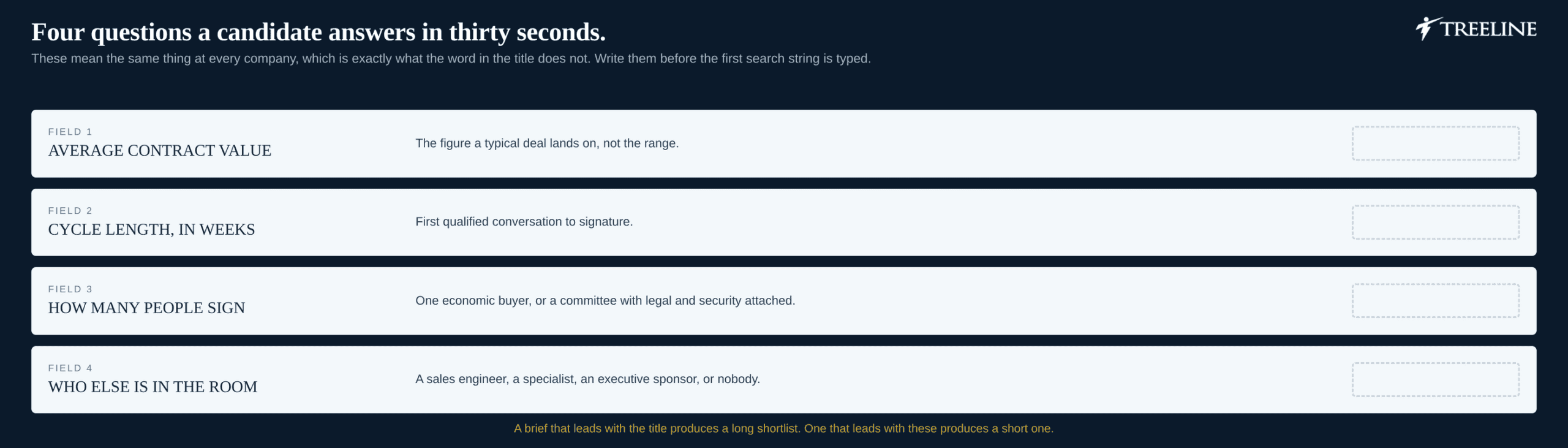
Write these down and the search becomes ordinary. Leave them out and no amount of sourcing will help.
Average contract value. Not the range. The figure a typical deal lands on.
Cycle length, in weeks. From first qualified conversation to signature.
How many people sign. One economic buyer, or a committee with legal, security and procurement attached.
Who else is in the room? A sales engineer, a specialist, an executive sponsor, or nobody.
Those four describe the work in terms that mean the same thing at every company. A candidate can answer them about their own seat in thirty seconds, and the comparison is immediate. The title cannot do that, which is why briefs that lead with it produce long shortlists and slow processes.
Why Title-Based Sourcing Returns a Pool That Is Not a Pool
Three consequences follow, and all three are expensive.
The shortlist is uncorrelated with the work. Everyone on it matches the search string. Some fraction matches the job, and you cannot tell which without a conversation, so the screening cost moves from the sourcing stage to the interview stage, where it is far more expensive.
The strongest available candidates are excluded by construction. The seller doing your job at a harder-banding company does not carry your word, and a string search will never surface them.
Offers fail late. A candidate from a softer-banding company accepts, arrives, and discovers a deal cycle three times longer than anything they have run. Nobody misrepresented anything. The title agreed; the work did not.
Treeline’s analysis of the account executive role in the software market is useful background on how widely the same label stretches across one industry.
What Moves a Senior Account Executive Who Is Not Looking
The people worth hiring are mid-cycle on deals they intend to close, and a recruiter’s call lands badly unless it carries something specific.
A bigger deal, described concretely. Not “enterprise”. The actual average contract value and the actual cycle length.
A product they will not have to apologize for. The most common reason a strong seller takes a call is that they have stopped believing their own pitch.
Fewer things between them and the number. Territory disputes, approval chains, a product gap that kills a quarter of their deals.
Support they do not currently have. A sales engineer, for a seller who has been doing that job themselves, is worth more than several thousand dollars of base.
A seller at this level has heard the generic version many times. The specific version is what gets a reply.
Fantasia resists opening an approach with compensation, on the grounds that a seller who moves for base alone will move again for base alone, and the seats worth filling are not ones you want to refill in a year.
Reading Four Deals Instead of One Title
reading-four-deals-instead-of-one-title.png
The screening method that replaces the word.
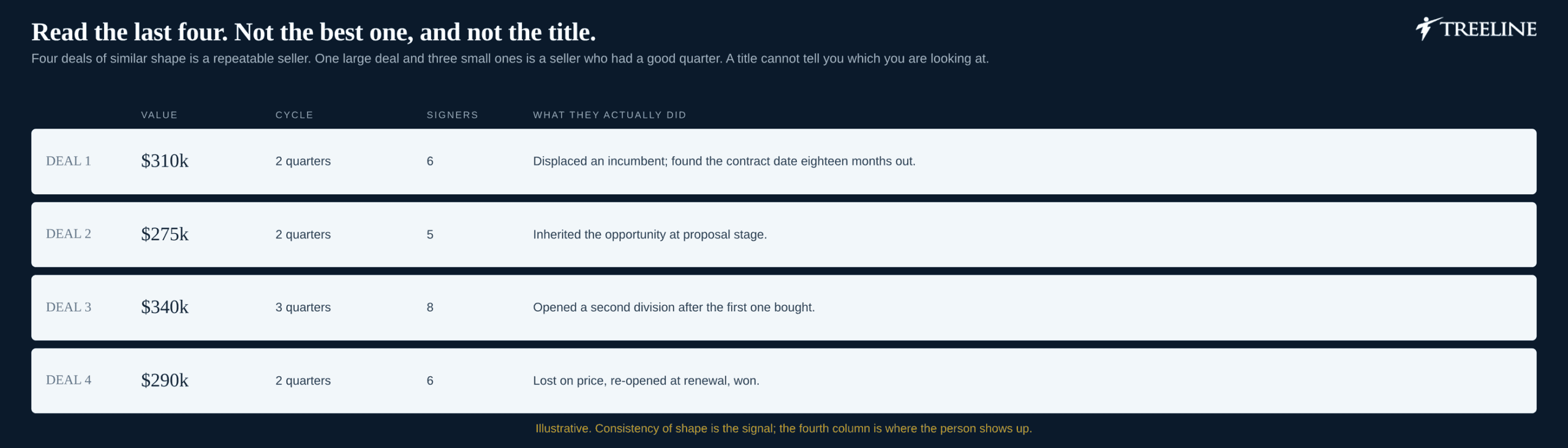
Ask the candidate to walk through their last four closed deals. Not the best one. The last four, in order. For each: the contract value, the cycle length, who signed, what nearly killed it, and what they personally did that a weaker seller would not have.
What this surfaces, and a title never will:
Consistency, or its absence. Four deals of similar shape is a repeatable seller. One large deal and three small ones is a seller who had a good quarter.
Where the difficulty actually sat. Procurement, security review, a competing incumbent, an internal champion who left.
What they own versus what they were handed. Inherited pipeline closes differently from self-generated pipeline, and both are legitimate, but they predict different things.
Whether the deal sizes match yours. The single most load-bearing fact in the whole conversation, available in the first thirty seconds, and routinely not asked until the third interview.
What Senior Account Executive Roles Pay
No published band exists on our board for this exact title, so this is a qualitative account of what moves the number.
Average contract value, more than anything else. It sets the plausible quota, which sets the plausible on-target earnings. Two seats with the same title and a fourfold difference in deal size are not comparable at all.
Whether the pipeline is self-generated. A seller building their own pipeline and one working marketing-sourced opportunities are doing different amounts of work for the same number.
What support comes with the seat. A sales engineer, a specialist and an executive sponsor are compensation in kind.
Where the band sits in the company’s own structure. The thing candidates are really asking when they ask about levelling is what comes after this seat.
Treeline’s material on building a compensation plan that works and on hiring speed for quota-carrying roles is worth reading before the search, because candidates at this level are usually mid-cycle and cannot leave at short notice.
How to Brief a Senior Account Executive Search
Four things, before the first candidate conversation.
The four numbers. Contract value, cycle length, number of signatories, who else is in the room.
What your own band means. Say plainly whether “senior” here is awarded on tenure, deal size, autonomy or retention. A firm that knows this can translate between your structure and a candidate’s.
Where the pipeline comes from, with proportions. Self-generated, marketing-sourced, inherited, partner-sourced.
What the seller will not have. No sales engineer, no executive sponsor on calls, no reference customers in the segment, whichever is true.
Fantasia warns that a brief leading with the title and the industry produces a shortlist assembled on the two facts that matter least, which is why these searches so often restart after the second round.
How to Test a Recruiting Firm on a Senior Account Executive Search
Four questions, before you engage anyone.
Ask what they need to know before they start. A firm that has filled this seat asks for contract value and cycle length in the first conversation; one that has not asks for the industry and the tech stack.
Ask how they will find people whose title does not say senior. If they have no answer, they are searching a string.
Ask how they screen. Reading four consecutive deals is a method. “We have a strong network” is not.
Ask what they would say if the seat is mis-banded. A firm that has never recommended against its own placement is not reading the mandate.
Our pages on the inside sales seat and on channel selling show where the same title covers quite different work.
When the Seat Is Not Actually Senior
Sometimes the search should stop.
If the four numbers describe a mid-market motion, the seat is a mid-market seat with a senior label, and advertising it as senior will attract candidates who leave within the year. If the band exists only to justify a counter-offer that was already made, the role will be filled internally before the search concludes. If there is no step after this one, say so early, sellers at this level ask. And if the real need is more capacity rather than more capability, two less expensive hires will outproduce one expensive one.
Our writing on territory-based selling and on building a pipeline covers the structural versions of this question.
Frequently Asked Questions
What does “senior” mean on an account executive’s résumé?
It means whatever the previous employer’s banding structure meant by it, tenure, deal size, autonomy, or a retention decision. It is set by that company’s headcount and budget, not by the seller’s capability, which is why it does not transfer between companies.
How do I find candidates who do the job but do not carry the title?
Search on the work instead of the word: contract value, cycle length, the kind of buyer. A seller carrying your deal size at a company with harder banding is doing your job under a lesser label, and almost nobody is competing for them.
Should I filter on years of experience?
Only loosely. Years correlate with exposure, not with capability, and the correlation weakens above about five. Four consecutive deals read properly tell you more than a decade on a profile.
Is a seller moving down in deal size a risk?
A manageable one, and often a bargain. They can do the job immediately. The question to ask is what makes this seat interesting enough to hold them for three years, and to be honest with yourself about the answer.
How long should this search take?
Longer than a mid-market search, mainly because the strongest candidates are mid-cycle on their own deals and will not leave before closing them. Searches also stall while the employer works out the four numbers, which is avoidable.
Can I hire from a smaller company into a larger-deal seat?
Frequently yes. The thing that does not transfer is comfort with a long committee cycle, procurement, security review, legal, rather than product or industry knowledge. Probe for the largest number of signatories they have handled.
What about the reverse, hiring from a larger company down?
Also common, and the failure mode is different: they may wait for support that does not exist here. Ask what they would do without a sales engineer, and listen for whether they have ever worked that way.
Does industry experience matter at this level?
Less than buyer-type experience. Selling to a security team transfers across industries; selling in an industry without ever facing that buyer transfers poorly.
How many candidates should I expect to see?
Fewer than for a mid-market search, and that is the correct outcome. A long shortlist for this seat usually means the search was run on the title.
Should the job advertisement say “senior”?
Yes, because candidates filter on it, but put the four numbers in the first paragraph. The word brings people to the advertisement; the numbers decide whether the right ones apply.
What is the most common mistake in this search?
Treating the title as a specification. It is a label from somebody else’s organization, and everything that makes the seat what it is has to be written down separately.
How do I compare two candidates whose titles match?
Put their last four deals side by side on contract value, cycle length and number of signatories. The comparison is usually obvious within a minute, and the titles become irrelevant.
Write the Four Numbers Down First
Everything difficult about this search is decided before anyone is contacted. What a deal is worth. How long it takes. How many people sign it. Who else is in the room.
Four numbers, none of which require a recruiter, all of which decide whether the recruiter can help. They mean the same thing at every company, which is exactly what the word in the title does not.
Production notes (not for publication)
Original Title from Column D, Row 65: Where Can I Find Senior AE Candidates?
Meta Title: Finding Senior AE Candidates: The Title Does Not Travel
Meta Description: Two people hold the same title and do different jobs. Sourcing on the word returns a pool that is not a pool.
Suggested URL: https://www.treelineinc.com/blog/where-to-find-senior-account-executive-candidates/
primary_keyword_exception: H1 is Column D verbatim and uses the abbreviation “Senior AE”. The primary keyword is the spelled-out “senior account executive”, carried in the slug, meta title and six H2s. Same treatment as Rows 24, 50, 52, 55 and 62.
title_validation: “Senior account executive” returns 2,410 occurrences across 46 distinct URLs, and 42 of those are templated city landing pages with zero editorial among them. The tracked keyword export does carry the term at volume 100–1K, with city variants beneath it. So the demand is real even though the site presence is a landing-page cluster, the same split as Row 62, and the opposite of Row 64 (see the note below).
row_64_flag: Row 64 (Senior Account Director) was NOT written and is referred back to Lee. It has no keyword row at all in the tracked export, 35 distinct URLs of which all 35 are templated city landing pages, and zero editorial. That is the precise profile of Row 63, which Treeline rejected as not making sense. It also overlaps Row 21 (account management leaders) and Row 43 (account director roles). Recommendation: drop it, or reframe it as senior account leadership if coverage is wanted.
scope_note: Row 44 owns generic account executive sourcing, the pools ranked by cost and how to reach people who are not looking. Row 50 owns the enterprise small-sample problem. Row 52 owns the promotion path from the development bench. Row 55 owns the mid-market seat with enterprise work and no support. Row 61 owns how a field seller spends the week. Row 62 owns the boundary with no list inside it. Unclaimed and taken here: “senior” is the only word in this title that describes the employer rather than the seller, so it does not travel between companies and cannot be sourced on. Corpus checks before drafting: “senior at what” 0, “the word senior” 0, “title inflation” 0, “one company’s senior” 0, “is a banding” 0. Row 54 uses the construction “X is a claim, not a record”, this article deliberately avoids that shape and opens on a concrete comparison instead.
pay_section_note: No published band exists on the board for this exact title, so the pay section is qualitative.
Share This Story, Choose Your Platform!
Related Posts
What our happy clients are saying
Treeline Inc. provided us with the most candidates that aligned with our needs and were of the highest quality.

Dr. Jeffrey Klein Head of North America Sales, Satchel Pulse
Treeline Inc.’s collaborative, flexible, and communicative approach resulted in a smooth partnership. Beyond their recruitment expertise, their unique sourcing model was efficient and effective.

Sera Holt Director of Operations, LNS Research
Their professionalism was outstanding. Treeline Inc. was extremely thorough and ensured that we were on the same page before they started looking for candidates. They listened to us and did a great job working with the candidate to close out the process.

Cate Grant AVP Customer Success, Nasdaq
Thanks to Treeline Inc.’s intricate and thorough screening process, the company is able to hire six high-quality candidates that fit perfectly in the company’s culture. The team is highly receptive to concerns, and internal stakeholders are impressed with their unique recruitment abilities.

Anna McKean Sales Recruiter, Insider Intelligence
Treeline Inc. has been qualified individuals throughout a five-year-long engagement. They’ve made numerous placements of talented and qualified individuals for our business.

Michele St Laurent VP of HR, The Institute for Applied Network Security

Let Us Help You Source the Sales Talent You Need
Whether you’re building a team or replacing a key role, our Candidate Sourcing Platform provides a fast, flexible, and employer-focused solution.
Tell us more about your business and how we can help.
Treeline Inc.
Your Award-Winning Sales Recruitment Partner
15 Lincoln Street, Suite 314, Wakefield, MA 01880