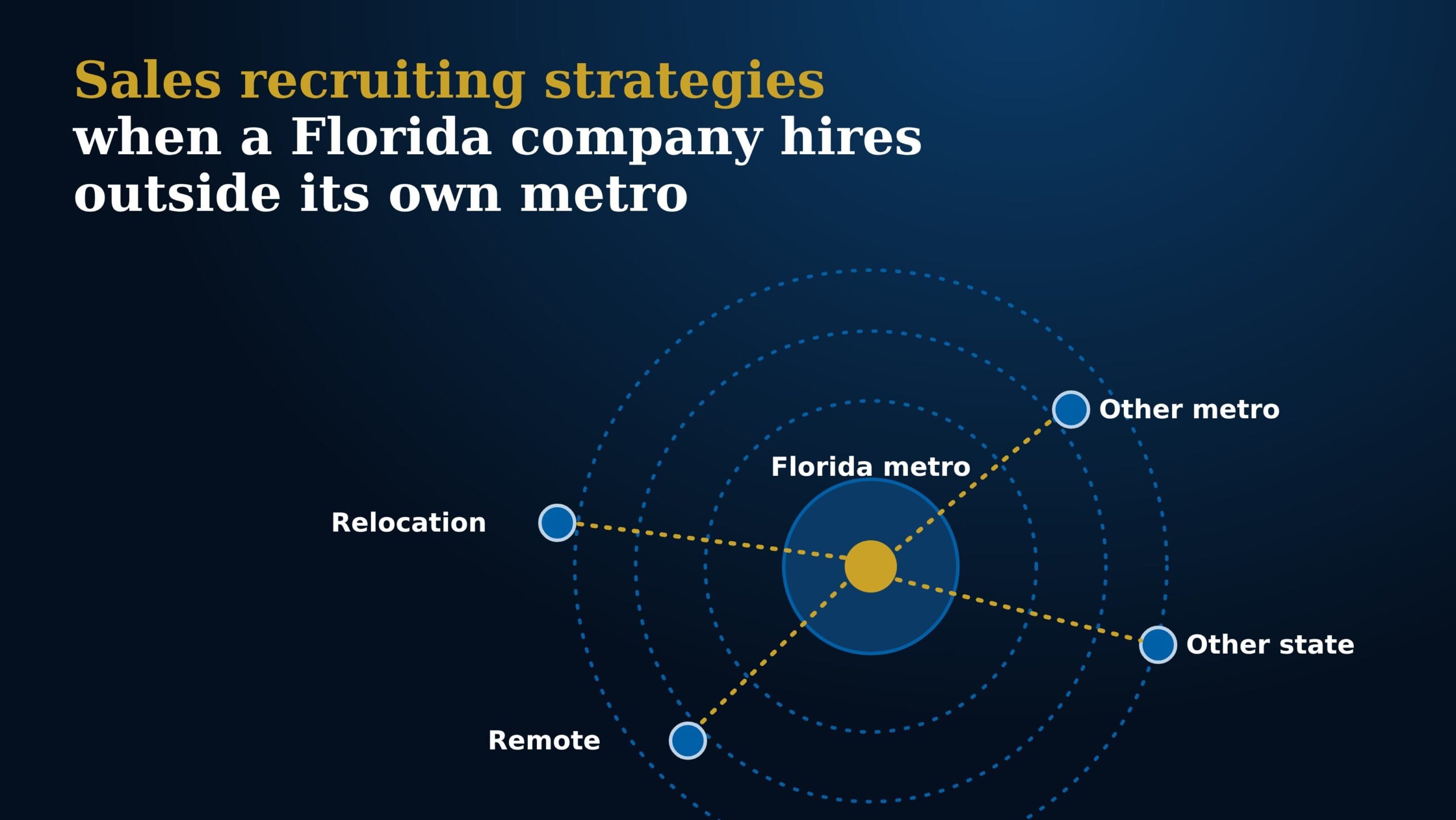
Florida map with a hiring search radius reaching beyond one metro area, headline Sales recruiting strategies when a Florida company hires outside its own metro
The sales recruiting strategies that work when a Florida company hires outside its own metro start with a decision made before any candidate is contacted: how far the search will reach, and what the company will offer a person who has to move, commute or work remotely to take the job. A company in Jacksonville, Tampa, Orlando or Miami that limits its search to its own metro is choosing from the sellers who already live nearby. A company that opens the search to other metros, other states and remote arrangements is choosing from a larger pool, but it takes on new questions about relocation, pay, legal terms and how to reach people who are not looking.
This guide covers those questions in the order a hiring team meets them. It is written for the company that needs a senior sales hire, such as a head of sales, a regional sales director or a senior business development leader, and cannot find the right person within driving distance. It is general information, not legal, tax or immigration advice, and the legal and tax points should be confirmed with counsel and a tax adviser.
Treeline, Inc. is a sales recruiting firm in Wakefield, Massachusetts that places salespeople permanently and serves clients nationally. Its Florida executive search page describes the firm’s approach to Florida clients, and its contingency recruiting service is the model under which it typically takes on a sales search.
Dan Fantasia, CEO of Treeline, Inc., would frame an out-of-metro hire as a question of what the company is truly selling to the candidate. From his perspective, a Florida employer that treats the search as “find someone like our last hire, only from farther away” will usually stall, because the best out-of-metro candidates are comparing the role against a life they already have. The strategy has to give those candidates a reason to move that goes beyond the job title.
Why Sales Recruiting Strategies Need to Look Beyond the Local Metro
A local-only search is the easiest to run, and for many roles it is the right one. Nobody has to relocate, interviews are simple to schedule and the hire can be in the office quickly. The limits show up when the role is specialized or senior.
- The local pool may not contain the experience. A company that sells a particular kind of product to a particular kind of buyer may find only a few people in its metro who have done that.
- The best local candidates may be known to everyone. If the same names circulate among the local employers, the company is competing for them with all of those employers.
- A senior role needs a fit that is hard to see locally. A head of sales needs experience at the right company stage, with the right sales motion, and that profile may sit in another metro.
- A narrow pool can hide a weak search. If a search has turned up few finalists after a reasonable effort, the pool may be the problem and not the process.
None of this means a Florida company should always search widely. It means the decision to hire outside the metro should be made deliberately, based on the role, and not as a reaction to a stalled search.
Questions to ask before widening the search
- What must this person have done before, and how many people in our metro have done it?
- Is the role genuinely tied to a Florida office, or could a strong seller do it from elsewhere?
- What would we be willing to pay or provide to move someone?
- How long can we wait, and what does each month without the hire cost the sales team?
The answers decide which of the options below is worth pursuing.
Sales Recruiting Strategies for Setting the Search Radius: Relocate, Hybrid or Remote
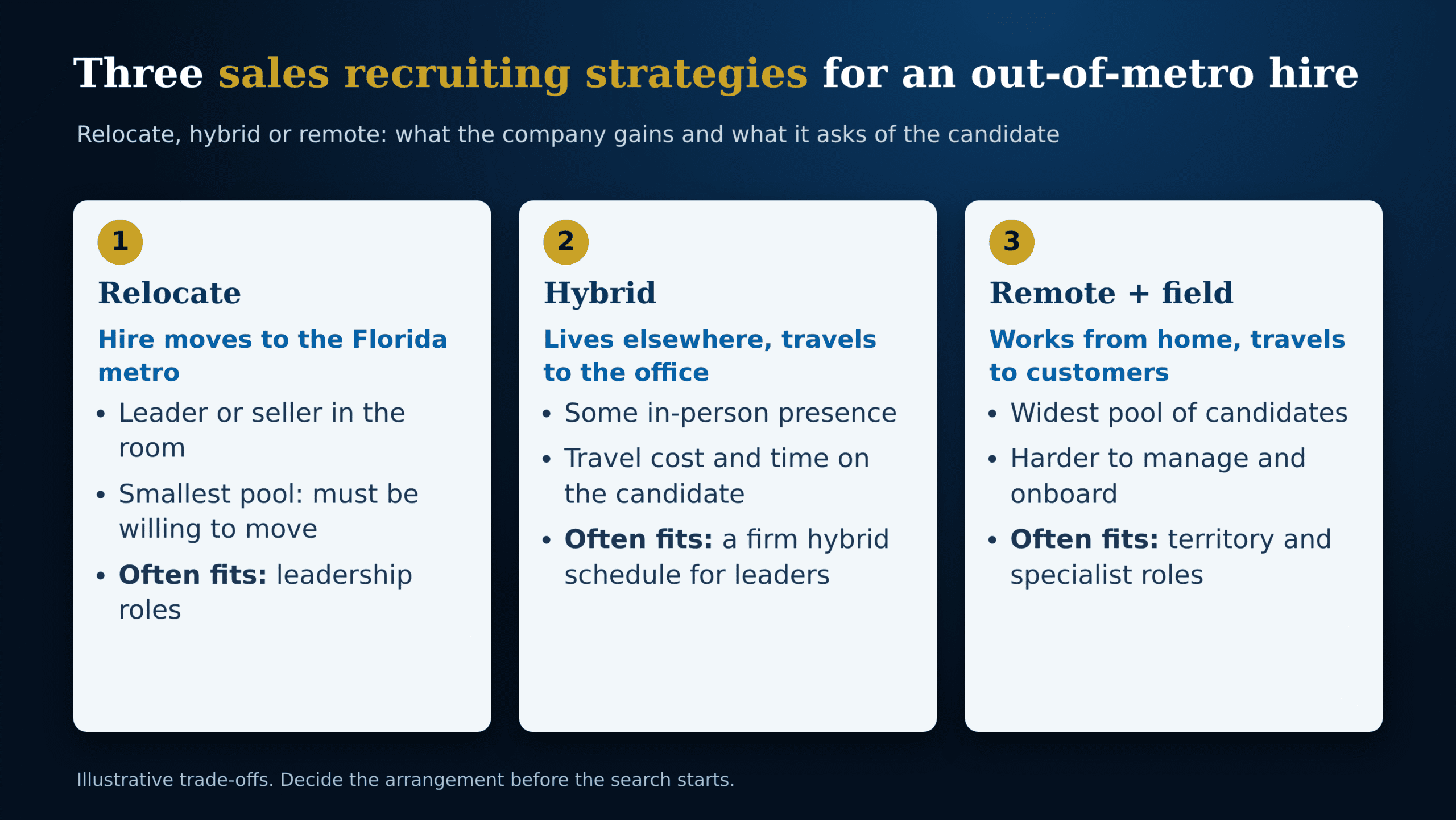
The first design choice is where the new hire will work. There are three common arrangements, and each changes who will say yes.
Three sales recruiting strategies for an out-of-metro hire: relocate to Florida, hybrid with regular travel to the Florida office, or remote with field travel
As the diagram shows, each arrangement trades something the company wants against something the candidate has to accept.
Relocation. The hire moves to the company’s Florida metro. It gives the team a leader or seller in the room, but it asks a candidate to uproot a household, and it shrinks the pool to people willing and able to move.
Hybrid. The hire lives elsewhere and travels to the Florida office on a set rhythm. It keeps some in-person presence, but it puts travel cost and time on the schedule and on the candidate’s home life.
Remote with field travel. The hire works from home and travels to customers and to the office as needed. It opens the widest pool, but the company must be able to manage, onboard and support a seller it rarely sees.
A company does not have to pick one for every role. A head of sales who sets the team’s rhythm may need to be in the office. A senior individual seller who covers a defined territory may do the job well from the territory.
Match the arrangement to the role
- Leadership roles that depend on daily coaching and team culture tend to favor relocation or a firm hybrid schedule.
- Territory roles that depend on being near customers can favor the candidate’s home market when it is also the customer’s market.
- Specialist roles that need rare experience may justify the widest remote reach, because the experience is worth more than the proximity.
These are judgment calls and not rules. What matters is that the company decides before the search starts, writes the decision into the role description and tells candidates early, so nobody invests time in a process that cannot work for them.
Using Florida’s Tax Position in Sales Recruiting Strategies Without Overselling It
Florida is often part of the pitch to an out-of-state candidate, and it is reasonable to mention it. A March 2026 TaxAct guide, which was last modified in July 2026, states that Florida does not impose a state personal income tax and lists Florida among nine states without one for tax year 2025. Treeline’s Florida page makes a related point, saying that Florida’s lower tax burden can make compensation packages more attractive.
That is a real feature of the state, and it is also easy to oversell. A fair way to use it in sales recruiting strategies is to follow these guidelines.
- State the fact, not a number. Say that Florida has no state personal income tax, and do not promise a specific take-home gain, because the effect depends on where the candidate lives now and on their whole tax situation.
- Do not give tax advice. Suggest that the candidate speak with their own tax adviser, since income tax is only one cost of living in a given place.
- Do not let it replace the rest of the offer. Housing, insurance, schools, family and career path all weigh in the decision, and some of them may favor the candidate’s current market.
- Be accurate about the rest. A candidate who moves will face other costs, and an employer who ignores them will lose credibility when the candidate discovers them.
Dan Fantasia, CEO of Treeline, Inc., sees the tax point as a conversation starter and not a closing argument. From his perspective, a sales leader who is deciding whether to move wants to understand the full picture, and an employer that gives a measured, accurate account of what Florida offers earns more trust than one that leans on a single advantage.
Sales Recruiting Strategies When the Candidate Is Bound by a Florida Restrictive Agreement
A Florida company that recruits sellers from other Florida employers needs to understand a law that took effect on July 1, 2025. A Shumaker, Loop & Kendrick client alert dated July 7, 2025 describes the Florida CHOICE Act. According to that alert, the Act applies to a “covered employee,” meaning an employee or individual contractor who earns, or is reasonably expected to earn, a salary above twice the annual mean wage of the county where the covered employer has its principal place of business. The alert says the threshold can be as low as $81,000 per year in some locations and that health care practitioners are excluded regardless of salary.
The alert also reports that the Act allows a covered noncompete of up to four years after employment ends and garden leave with up to four years of prior notice, and that the employee must be advised in writing of the right to seek counsel. It says courts must issue a preliminary injunction on a covered employer’s application in certain circumstances.
For a hiring company, the practical consequences are these.
- Ask early. Ask every finalist whether they have signed a noncompete, a garden leave agreement or a nonsolicitation agreement, and ask to see it.
- Do not assume an old form is harmless. A candidate’s agreement may have been signed or updated recently, and it may have terms that matter.
- Have counsel read it. Whether and how a given agreement applies is a legal question about that candidate, that employer and those facts.
- Plan the timeline. If a candidate is subject to a long restriction or notice period, the company should decide whether it can wait or whether to pursue other finalists.
What this means for out-of-metro candidates
The sources reviewed for this guide do not say how the Act applies to a candidate who lives in another state and works for an employer outside Florida. That depends on the candidate’s agreement, the governing law in it and the facts, and it is a question for employment counsel. The safe step is the same: ask for the agreement and have a lawyer review it before an offer is final.
Recruiters and hiring companies should also be careful not to encourage a candidate to breach a valid agreement, and not to ask a candidate to bring a former employer’s confidential information. Those are matters for counsel, and a clear instruction to candidates is a simple protection.
Sales Recruiting Strategies for Sourcing Candidates Who Are Not Looking
Most strong sellers are employed and not browsing job boards. Reaching them in another metro is a sourcing problem, and the sourcing methods that work locally do not always travel.
- Define the target profile precisely. A specific description of the product, buyer, deal size and sales cycle the candidate has handled makes outreach relevant and filters out poor fits.
- Reach people directly and with context. A short, specific message that explains the role, the company stage and why the person was approached gets more attention than a generic posting.
- Use referrals from people who know the work. A respected seller or customer who knows the target profile can point to candidates a database will not find.
- Look at where the right experience concentrates. Some sales experience clusters in particular metros or at particular companies, and a search can follow that pattern.
- Be ready to move quickly. A candidate who is not looking will lose interest if the process drags.
Many Florida companies lack the time or the network to do this while running a business. A recruiting firm can take over the search work, and Treeline’s Sourcing as a Service page describes its sourcing offering. Treeline’s Florida page states that the firm does not charge upfront fees and collects a fee only once a suitable candidate is hired, which is the firm’s own description of its terms and should be confirmed in an agreement.
Dan Fantasia, CEO of Treeline, Inc., regards the outreach itself as the part most companies underestimate. From his perspective, a message to a successful seller who is not looking has to earn a reply in a few lines, which means the company must know precisely what the role offers and who it is for before anyone writes the first note.
Choosing a recruiting partner for an out-of-metro search
If a company brings in a recruiter, it can test the fit with a few direct questions.
- How will you reach candidates outside our metro?
- Which sales roles and levels have you placed, and how recently?
- What will you need from us, and how fast can we respond?
- How are fees structured, and what happens if a hire does not work out?
These questions apply to any recruiting partner, not only to Treeline, and the answers should be written down before the search starts.
Sales Recruiting Strategies for Making the Offer Work for an Out-of-Metro Candidate
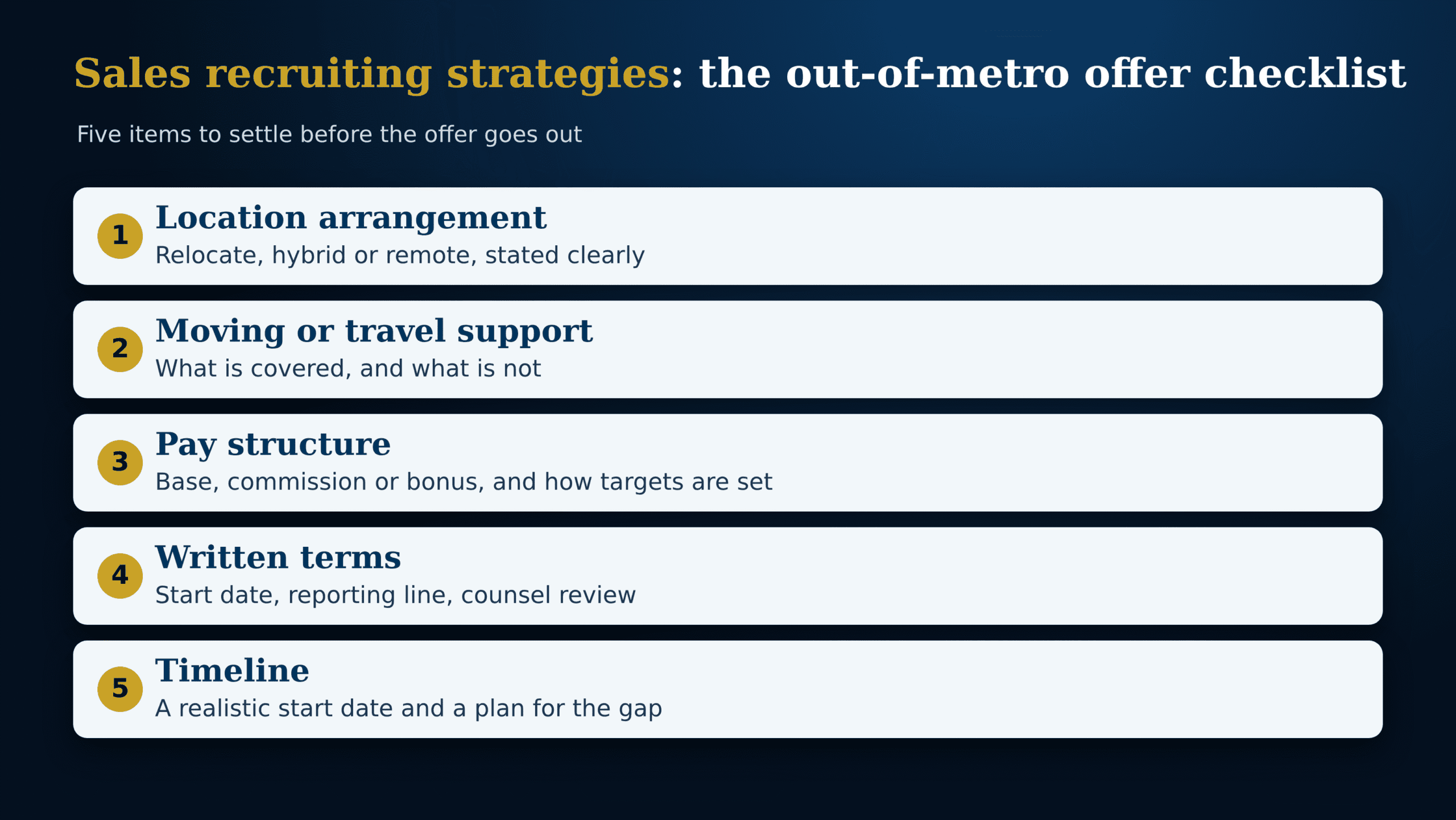
A strong candidate in another metro has more to weigh than a local one, and the offer conversation has to address it. Several points should be settled early.
Checklist of sales recruiting strategies for an out-of-metro offer: location arrangement, moving or travel support, pay structure, written terms and timeline
The checklist above lists the items to settle before an offer goes out.
Location arrangement. State whether the role is relocate, hybrid or remote, and what is expected on each. Ambiguity here costs the most.
Moving or travel support. If the company will help with relocation or travel, say what it covers and when it is paid. If it will not, say so. Candidates plan around this.
Pay structure. Describe base, commission or bonus, and how targets are set. Treeline’s Sales Compensation Assessment page describes a seven-step review of a sales compensation plan, which is a useful way to test whether the plan is clear before a candidate reads it.
Written terms. Put the arrangement in writing, including the start date, reporting line and any conditions. Have counsel review the offer and any restrictive covenants.
Timeline. Candidates who must give notice, sell a home or move a family need a realistic start date, and the company needs a plan for the gap.
Dan Fantasia, CEO of Treeline, Inc., stresses that an out-of-metro candidate is usually deciding with a spouse, a family or a life in mind and not only a job. From his perspective, a company that answers practical questions quickly and in writing signals the same discipline it expects of its sales team, and that signal often matters as much as the figures in the offer.
Common Mistakes in Sales Recruiting Strategies for Out-of-Metro Hires
These are the errors that most often undermine an out-of-metro search.
- Widening the search without deciding the arrangement. Candidates cannot tell whether the role is for them, and the process wastes time.
- Overselling the location. Leaning on weather or tax advantages without acknowledging cost and family concerns erodes trust.
- Ignoring restrictive agreements until late. A noncompete discovered after an offer can undo the hire.
- Moving slowly. A candidate who is not looking will accept a faster offer.
- Treating the hire as a copy of the last one. The out-of-metro candidate brings a different background, and the onboarding plan should reflect it.
- Skipping onboarding for a remote or hybrid seller. A person who is not in the office needs a deliberate plan for introductions, coaching and early wins.
After the hire
The search does not end at the offer. A new seller who has relocated or works remotely should have a clear first ninety days, a named person to ask questions, and early check-ins on pipeline and fit. Treeline’s fractional CRO service page describes an ongoing engagement that covers pipeline reviews, coaching and reporting, which is one option for a company that lacks sales leadership capacity to do this itself.
A Practical Sequence of Sales Recruiting Strategies
A company can turn the points above into a short sequence.
- Confirm the need. Check whether the local pool contains the experience, and decide whether to widen the search.
- Choose the arrangement. Decide relocate, hybrid or remote for this role, and write it down.
- Define the profile. Describe the product, buyer, deal size and sales cycle the candidate must have handled.
- Source widely. Use direct outreach, referrals and, if needed, a recruiting partner.
- Ask about agreements early. Request any restrictive agreements from finalists and involve counsel.
- Make a clear offer. Settle location, support, pay, written terms and timeline.
- Plan onboarding. Prepare the first ninety days before the start date.
Treeline’s locations page shows the states the firm lists for recruiting, which can help a Florida company see how a national search might be organized.
Frequently Asked Questions About Sales Recruiting Strategies for Out-of-Metro Hires
What are the best sales recruiting strategies for hiring outside your metro?
Decide the work arrangement first, define the target profile precisely, source candidates directly and through referrals, ask about restrictive agreements early, and make a clear written offer. These steps matter more than any single tactic.
Should a Florida company require relocation for a senior sales hire?
It depends on the role. Leadership roles that depend on daily coaching often favor relocation or a firm hybrid schedule, while territory or specialist roles can work remotely. The company should decide before the search starts and tell candidates early.
Does Florida have a state income tax?
A 2026 TaxAct guide states that Florida does not impose a state personal income tax. Candidates should still speak with their own tax adviser, because income tax is only one part of their overall cost and compensation picture.
What is the Florida CHOICE Act and why does it matter when hiring?
According to a July 2025 client alert from Shumaker, Loop & Kendrick, the Act took effect July 1, 2025 and allows covered noncompete and garden leave terms of up to four years for certain higher-paid workers. A hiring company should ask finalists about their agreements and have counsel review them. This is not legal advice.
How do you recruit sales candidates who are not looking for a job?
Use specific direct outreach that explains the role and why the person was approached, rely on referrals from people who know the work, and move quickly once there is interest. A recruiting partner can run this work for a company that lacks the time or network.
What should a company settle before making an out-of-metro offer?
The location arrangement, any moving or travel support, the pay structure, the written terms and a realistic start date. Counsel should review the offer and any restrictive covenants.
How does Treeline charge for a sales search?
Treeline’s Florida page says the firm does not charge upfront fees and collects a fee only once a suitable candidate is hired. That is the firm’s own description, and fee terms should be confirmed in a written agreement.
Share This Story, Choose Your Platform!
Related Posts

What our happy clients are saying
Treeline Inc. provided us with the most candidates that aligned with our needs and were of the highest quality.

Dr. Jeffrey Klein Head of North America Sales, Satchel Pulse
Treeline Inc.’s collaborative, flexible, and communicative approach resulted in a smooth partnership. Beyond their recruitment expertise, their unique sourcing model was efficient and effective.

Sera Holt Director of Operations, LNS Research
Their professionalism was outstanding. Treeline Inc. was extremely thorough and ensured that we were on the same page before they started looking for candidates. They listened to us and did a great job working with the candidate to close out the process.

Cate Grant AVP Customer Success, Nasdaq
Thanks to Treeline Inc.’s intricate and thorough screening process, the company is able to hire six high-quality candidates that fit perfectly in the company’s culture. The team is highly receptive to concerns, and internal stakeholders are impressed with their unique recruitment abilities.

Anna McKean Sales Recruiter, Insider Intelligence
Treeline Inc. has been qualified individuals throughout a five-year-long engagement. They’ve made numerous placements of talented and qualified individuals for our business.

Michele St Laurent VP of HR, The Institute for Applied Network Security

Let Us Help You Source the Sales Talent You Need
Whether you’re building a team or replacing a key role, our Candidate Sourcing Platform provides a fast, flexible, and employer-focused solution.
Tell us more about your business and how we can help.
Treeline Inc.
Your Award-Winning Sales Recruitment Partner
15 Lincoln Street, Suite 314, Wakefield, MA 01880