recruiting-firm-senior-account-managers-featured.jpg
Read one of our own live requisitions for this title before reading anything else about it.
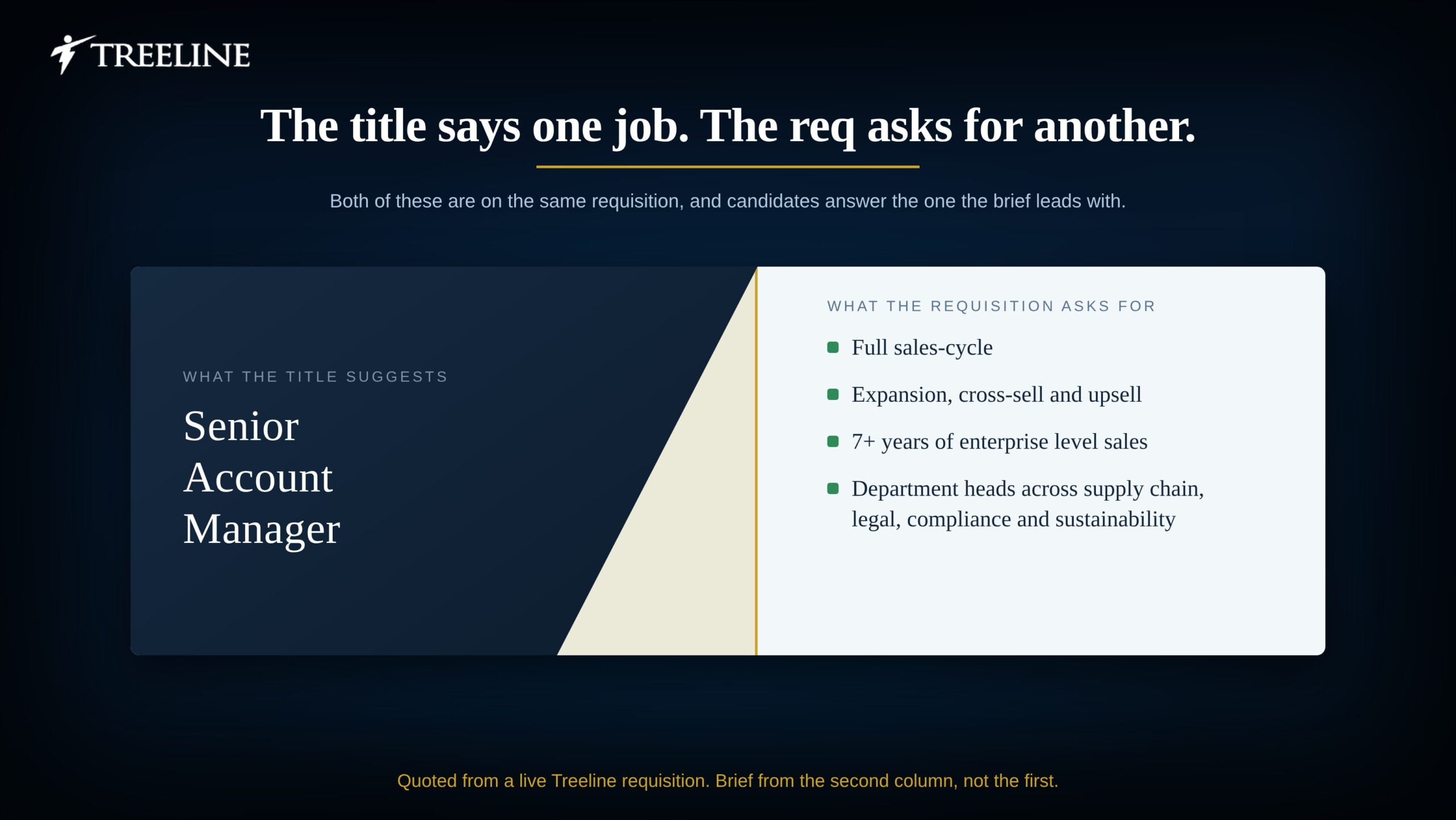
This Senior Account Manager will be responsible for full sales-cycle focused on expansion, cross sell and upsell business. Seven-plus years of enterprise level sales experience. The buyers named are department heads across supply chain, legal, compliance and sustainability. The company is early stage, so the person has to be comfortable without much around them.
Now notice what that is. Full sales cycle. A named revenue motion. Seven years of enterprise selling. Multi-function buying committees. That is a closing job. The only part of it that sounds like account management is the title.
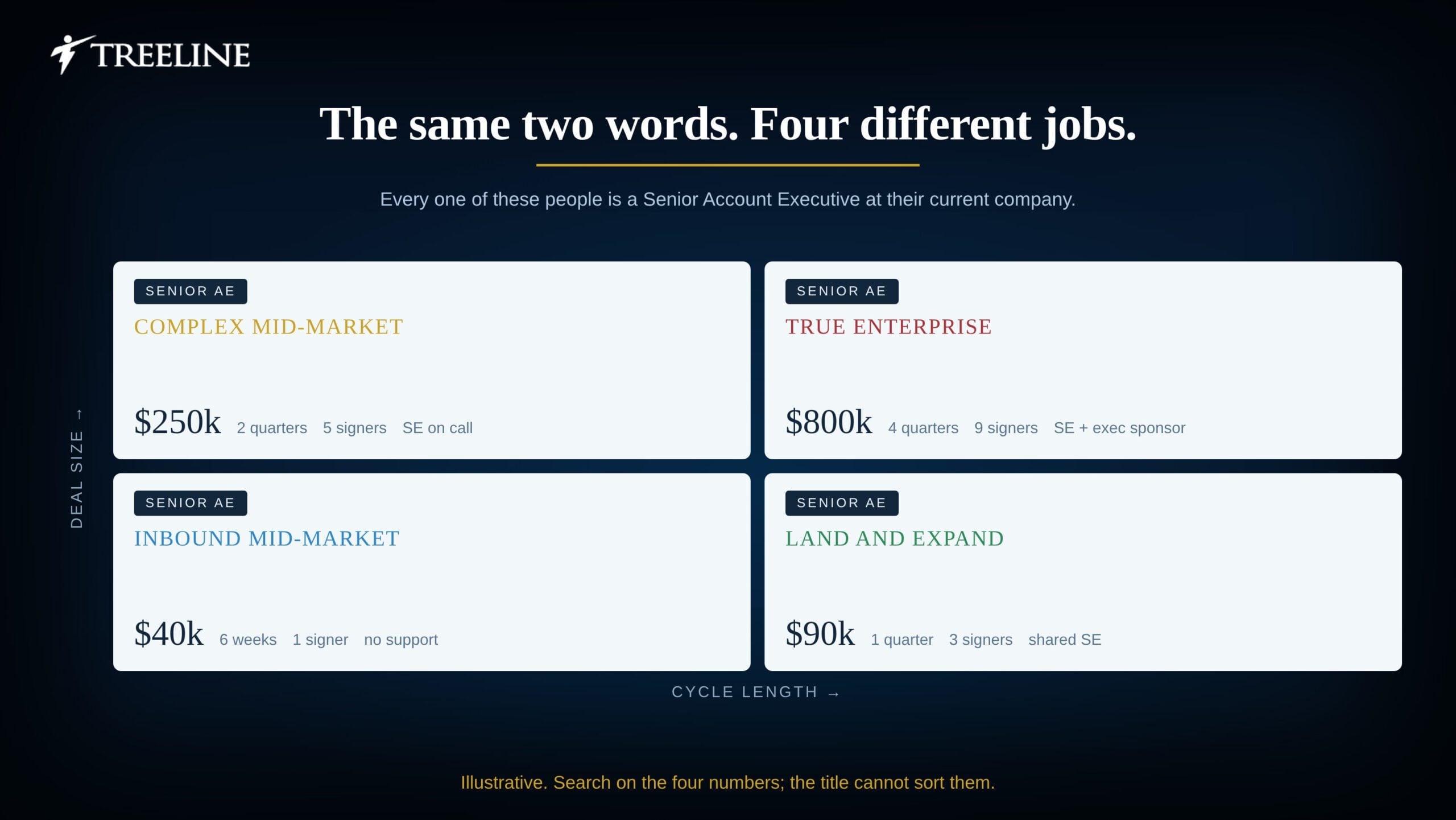
This is the central fact of the search and most briefs obscure it. The word “manager” in the title suggests stewardship, protect the relationship, keep the customer happy, renew on time. The requirement underneath it is to find, qualify and close new revenue inside accounts that already buy. Those two descriptions attract different candidates, and the gap between them is where the hire fails.
So the practical answer to which recruiting firm can help you recruit senior account managers is: one that reads your requisition before it reads the market. Treeline’s writing on what makes a successful account manager and on structuring these roles for retention and growth covers the stewardship end of the spectrum; this article is about the other end, where the number is the job.
Dan Fantasia, CEO of Treeline, Inc., views the title on this requisition as the least reliable thing in it. From his perspective, an employer should decide what proportion of the number has to be new before writing anything else, because that single figure determines which half of the candidate market is even relevant.
What a Senior Account Manager Requisition Actually Asks For
Four things, taken straight from the postings rather than from the title.
A full sales cycle. Qualification, multi-stakeholder evaluation, pricing, procurement, close. Not a handoff to a closer at the opportunity stage.
Expansion, cross-sell and upsell as the named motion. Three distinct activities. Expansion grows an existing use. Cross-sell opens a new one. Upsell changes the tier. They are not interchangeable and they do not require the same skills.
Seven-plus years of enterprise-level selling. A floor that excludes most people who have only ever carried a renewal book.
Buyers across several functions. Supply chain, legal, compliance and sustainability do not share a budget, a vocabulary or a decision process. Reaching four of them is a committee problem, not a relationship problem.
Our note on considerations when hiring account managers covers the general conditions of the role. The four items above are what makes this version of it a selling seat.
The Number Behind the Title
the-number-behind-the-title.png
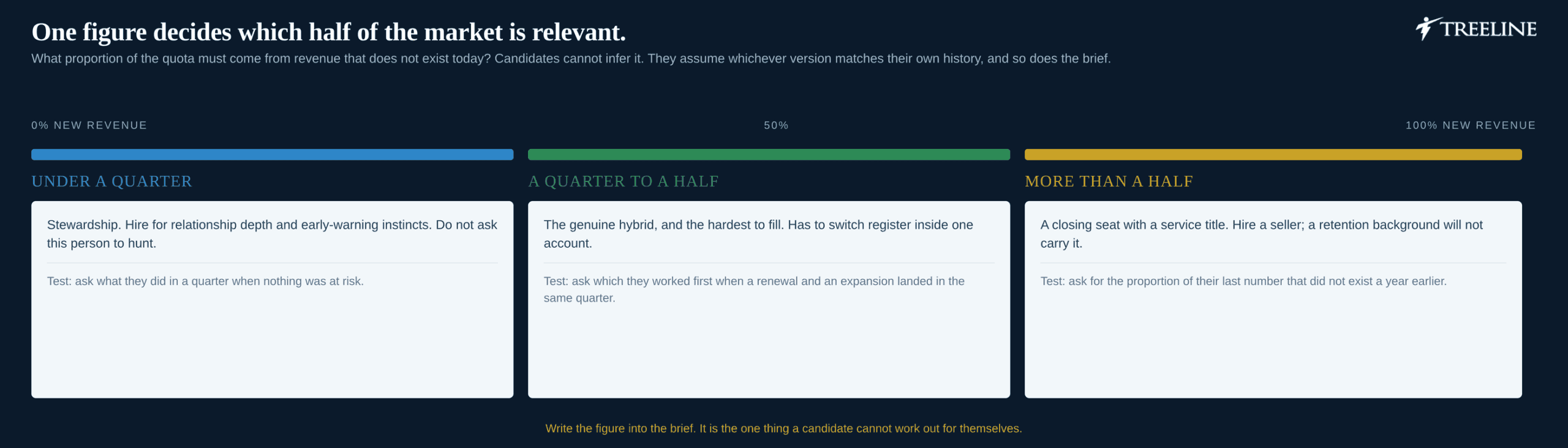
One figure settles most of this search, and it is rarely written down: what proportion of the quota must come from revenue that does not exist today?
Under a quarter. A stewardship seat. Hire for relationship depth, operational reliability and early-warning instincts. The people who do this well rarely enjoy hunting and should not be asked to.
A quarter to a half. The genuine hybrid, and the hardest to fill. The candidate has to be able to switch register inside a single account, protective one week, commercial the next.
More than half. A closing seat with an account-management title. Hire a seller. Candidates from pure retention backgrounds will struggle regardless of how senior they are, and the seniority of their title will disguise that during interviews.
The reason this figure matters more than the title is that it is the one thing a candidate cannot infer. They will assume whichever version matches their own history, and so will you, and the mismatch surfaces in month four.
Fantasia tests for the mismatch directly rather than taking a candidate’s self-description. He asks what proportion of their last number was new revenue and what they did to produce it, on the grounds that anyone who has carried an expansion quota answers in specifics and anyone who has carried a renewal book answers in adjectives.
Expansion, Cross-Sell and Upsell Are Three Different Skills
expansion-cross-sell-and-upsell-are-three-different-skills.png
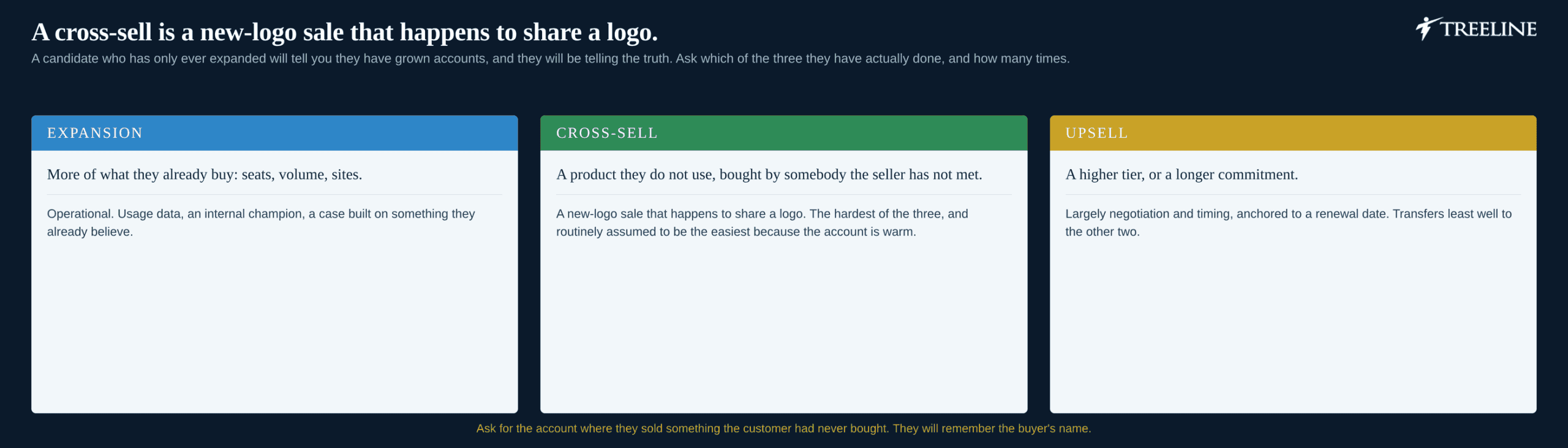
Worth separating, because the requisition names all three and most candidates are good at one.
Expansion means more of what they already buy, more seats, more volume, more sites. The work is operational: usage data, internal champions, a business case built on something the customer already believes.
Cross-sell means a product they do not use, bought by somebody they have not met. This is a new-logo sale that happens to share a logo. It is the hardest of the three and the one most often assumed to be easy because the account is “warm”.
Upsell means a higher tier or a longer commitment. Largely a negotiation and a timing problem, usually anchored to a renewal date.
A candidate who has only ever expanded will tell you they have grown accounts, and they will be telling the truth. Ask which of the three they have actually done, and how many times.
Where Senior Account Manager Candidates Come From
Four pools, in rough order of hit rate given a closing-weighted seat.
Account managers already carrying an expansion quota. The direct pool. The signal is not account growth but whether the growth came from cross-sell, which is the part that transfers.
Enterprise sellers who want fewer, deeper accounts. Frequently excellent here. They can run the committee and the procurement cycle. The gap is patience with the slower rhythm, and whether they will tolerate a number made up of several small wins rather than one large one. Our writing on enterprise sellers is useful background.
Solutions and technical specialists with commercial exposure. They know the product deeply, already sit in the buying conversations, and often have better credibility with department heads than a seller does. They need the commercial half, which installs faster than relationship capital does.
Customer success leads in commercial organizations. Mixed. The ones who have carried a number transfer well; the ones who have carried a satisfaction metric usually do not, and the distinction is not visible from the title.
Fantasia separates these pools by what each has been forced to practice. His position is that an organization can teach a product and cannot easily teach the willingness to ask a satisfied customer for more money, so the brief should say which gap it is prepared to carry.
The Two Hires That Stall in Month Four
The trusted steward. Eight years, three accounts, universally liked inside them. References are excellent. They stabilize the book immediately. By the second quarter the renewals are safe and the expansion number is untouched, because the behavior that makes them trusted is the same behavior that stops them pushing.
The enterprise closer who wants a quieter year. Strong on the committee, comfortable with procurement, visibly capable. They arrive, work the two accounts with obvious upside, close something good, and then find the remaining eleven accounts too small to be interesting. The number lands once and not again.
Both look like good hires on paper. Both come from a brief that named the title and not the proportion.
Questions That Separate Selling From Stewardship
Seven questions that are hard to answer from a script.
What proportion of your last number was revenue that did not exist a year earlier?
Describe a product you sold into an account that had never bought it. Who did you have to meet?
Tell me about a time you asked a happy customer for substantially more money. What happened?
Which of expansion, cross-sell and upsell have you actually done, and how many times each?
When a renewal was at risk and an expansion was available in the same quarter, which did you work first?
How many people signed your largest expansion, and what did each of them need?
What did you do in a quarter when there was nothing obvious left to sell?
Candidates from a closing background answer with deals, names and sequence. Candidates from a stewardship background answer with relationships and trust. Both answers are honest; only one of them matches a seat where most of the number is new.
What Senior Account Manager Roles Pay
No published band exists on our board for this exact title, so this is a qualitative account of what moves the number.
The proportion of new revenue in the quota. The dominant variable, and the one that should set the variable component. A seat that is mostly expansion should be paid like a selling seat.
Whether expansion and retention are paid separately. Combined into one figure, the holder does whichever is easier in the quarter, and retention is almost always easier.
Book concentration. Three accounts that carry most of the revenue is a different job from fifteen comparable ones, and candidates price the risk accordingly.
What support exists. A sales engineer, a customer success counterpart, a marketing program into the installed base. In an early-stage company the honest answer is often none of them, and saying so early filters well.
Treeline’s material on compensation plan levers and on determining sales compensation is worth reading before this search, because in a seat like this the plan is what tells the candidate which job it really is.
How to Brief a Senior Account Manager Search
Four things, written down before the first candidate conversation.
The proportion of the number that must be new. The single most useful line in the brief.
Which of the three motions matters most. Expansion, cross-sell or upsell. If the answer is cross-sell, say so loudly. It changes the pool.
Who the buyers are, by function. “Department heads in supply chain, legal, compliance and sustainability” is a brief. “Enterprise customers” is not.
What the seller will not have. In an early-stage company this list is usually long, and candidates who are right for it find that clarifying rather than discouraging.
Fantasia warns that the most common failure here is a brief written from the title rather than from the requisition, which produces a shortlist of people who are excellent at the job the title describes and not the one the requisition specifies.
How to Test a Recruiting Firm on a Senior Account Manager Search
Four questions, before you engage anyone.
Ask what they want to know first. A firm that has filled this seat asks what proportion of the number is new; one that has not asks about the industry.
Ask how they distinguish expansion experience from cross-sell experience. If the answer treats them as the same thing, they will send you stewards.
Ask what they will tell candidates about the support that does not exist. The ones who handle that honestly get better acceptance rates, not worse.
Ask what they would say if the seat should be split into a retention role and a selling role. A firm that has never recommended against its own placement is not reading the mandate.
Our analysis of the account executive role in the software market and our writing on approaching account management recruiting are reasonable places to check whether a firm’s published thinking matches what it tells you on a call.
When the Seat Should Be Two Seats
Sometimes the search should stop.
If the book needs genuine stewardship and the company needs genuine expansion, one person will do the first and defer the second, every quarter, and no amount of seniority changes that. If the accounts are large enough, splitting into a retention role and a selling role is cheaper than replacing a mis-specified hire twice. If the expansion opportunity is concentrated in two accounts, that is a pursuit, not a book. And if nobody can say what proportion of the number is new, the brief is not finished.
Our pages on goals and quotas and on building a pipeline deal with the measurement side of that decision.
Fantasia resists opening this search before the proportion is settled, on the view that the figure decides which half of the market is relevant and a search run without it is searching both.
Frequently Asked Questions
Is a senior account manager a sales role or a service role?
It depends entirely on the proportion of the quota that must come from new revenue, and that proportion varies enormously between companies holding the same title. Our own requisitions for the title specify a full sales cycle, which makes them selling seats.
What is the difference between expansion and cross-sell?
Expansion is more of what the customer already buys, worked through usage data and an existing champion. Cross-sell is a product they do not use, usually bought by somebody the seller has not met. Cross-sell is a new-logo sale inside a familiar logo, and it is much harder.
Can a customer success lead move into this seat?
Sometimes, and the deciding factor is whether they have carried a revenue number rather than a satisfaction metric. The title does not tell you which, so ask directly.
How many accounts should a senior account manager carry?
Fewer than most organizations assume, if real expansion is expected. The test is whether the person can run a genuine multi-stakeholder pursuit in one account without the others going unattended for a quarter.
Should expansion and retention be paid separately?
In almost every case, yes. A single combined number means the holder optimizes for whichever is easier that quarter, and retention is nearly always easier.
Does seven years of enterprise experience actually matter?
The number itself is arbitrary, but what it proxies is real: exposure to long committee cycles, procurement and legal review. Probe for that exposure rather than for the years.
How do I test for cross-sell capability specifically?
Ask for an account where they sold something the customer had never bought, and make them name the new buyer. Anyone who has done it remembers that person; anyone who has only expanded will redirect to a growth story.
What if the company is early stage and has no support functions?
Say so in the brief. It filters hard, and it filters correctly, some strong candidates specifically want that, and the ones who do not would have struggled anyway.
How long should this search take?
Longer than a renewal-focused search. The pool that fits a closing-weighted seat is smaller, and the strongest candidates are usually mid-cycle on expansions they want to finish.
What is the most common mistake in this search?
Writing the brief from the title. The title describes stewardship and the requisition describes selling, and the shortlist follows whichever one the brief leads with.
Decide What Proportion Is New
Everything difficult about this search is settled before anyone is contacted. How much of the number has to be revenue that does not exist today. Which of the three motions produces it. Who signs. What the seller will not have.
Four answers, none of which require a recruiter, all of which decide whether the recruiter can help. Your own requisition already says full sales cycle. The brief should say it too.
Production notes (not for publication)
Original Title from Column D, Row 66: Which Recruiting Firm Can Help Me Recruit Senior Account Managers?
Meta Title: Hiring a Senior Account Manager: Read the Job, Not the Title
Meta Description: Your own req says full sales cycle, expansion and cross-sell. That is a closing job wearing a service title.
Suggested URL: https://www.treelineinc.com/blog/recruiting-firm-senior-account-managers/
title_validation: “Senior account manager” returns only 29 occurrences across the site and 0 distinct slugs, far fewer than the neighboring rows, but the attribution inverts the usual pattern. Those 29 are not templated city pages. They are real job descriptions, including two with full requirement blocks. The tracked keyword export also carries “senior account manager” at volume 100–1K. So this row has the weakest count and the strongest evidence of the four in this batch, which is the Row 54 lesson running the other way: a small number attached to real reqs beats a large number attached to boilerplate.
evidence_note: The spine comes from Treeline’s own live postings for this exact title. One reads: “This Senior Account Manager Will Be Responsible for Full Sales-cycle Focused On Expansion | 7+ Years of Enterprise Level Sales Experience.” Another describes an enterprise team “focused on expansion, cross sell and upsell business,” selling to “Department Heads within Supply Chain, Legal, Compliance and Sustainability,” and notes the person “must be comfortable working in a start-up environment.” In-scope on every market test: enterprise, multi-stakeholder, selling to corporate department heads.
scope_note: Row 45 owns what an account manager inherits and cannot control. Row 51 owns the enterprise variant. Row 53 owns the portfolio reallocation at the junior end. Row 54 owns whether an account was ever truly important. Row 21 owns the coverage model and the authority gap. Row 63 was rejected and its argument, the organizational critique, is deliberately NOT repeated here. Unclaimed and taken here: Treeline’s own senior account manager reqs describe a full sales cycle, so the seat is a closing job wearing a service title, and the common failure is sourcing it from relationship-management pools. Corpus checks before drafting: “cross sell” 0, “closing job” 0, “quota-carrying account” 0, “title says account management” 0, “expansion quota” 0.
row_64_flag: Row 64 (Senior Account Director) was not written. See the note in Row 65’s front matter, no keyword row, 35 slugs all templated city pages, zero editorial, and overlap with Rows 21 and 43. Referred back to Lee.
Share This Story, Choose Your Platform!
Related Posts
What our happy clients are saying
Treeline Inc. provided us with the most candidates that aligned with our needs and were of the highest quality.

Dr. Jeffrey Klein Head of North America Sales, Satchel Pulse
Treeline Inc.’s collaborative, flexible, and communicative approach resulted in a smooth partnership. Beyond their recruitment expertise, their unique sourcing model was efficient and effective.

Sera Holt Director of Operations, LNS Research
Their professionalism was outstanding. Treeline Inc. was extremely thorough and ensured that we were on the same page before they started looking for candidates. They listened to us and did a great job working with the candidate to close out the process.

Cate Grant AVP Customer Success, Nasdaq
Thanks to Treeline Inc.’s intricate and thorough screening process, the company is able to hire six high-quality candidates that fit perfectly in the company’s culture. The team is highly receptive to concerns, and internal stakeholders are impressed with their unique recruitment abilities.

Anna McKean Sales Recruiter, Insider Intelligence
Treeline Inc. has been qualified individuals throughout a five-year-long engagement. They’ve made numerous placements of talented and qualified individuals for our business.

Michele St Laurent VP of HR, The Institute for Applied Network Security

Let Us Help You Source the Sales Talent You Need
Whether you’re building a team or replacing a key role, our Candidate Sourcing Platform provides a fast, flexible, and employer-focused solution.
Tell us more about your business and how we can help.
Treeline Inc.
Your Award-Winning Sales Recruitment Partner
15 Lincoln Street, Suite 314, Wakefield, MA 01880