Industrial plant floor with a sales leader’s desk and a map of Midwest states, headline What a sales executive recruiter looks for in Midwest manufacturing sales leaders
A sales executive recruiter who works with Midwest manufacturers and industrial companies looks for a particular kind of leader: someone who can earn the trust of engineers and plant managers, run long and technical sales cycles, manage channels and field teams across several states, and coach sellers who often know the product better than they know selling. Titles are only the starting point. Two candidates who have both been “VP of Sales” at a manufacturer can be very different hires, and the difference usually shows up in how they describe their deals.
This guide explains what a sales executive recruiter checks when searching for senior sales and business development leaders in Midwest manufacturing and industrial companies, and how a hiring company can prepare for that search. It is written for owners, presidents and sales leaders at manufacturers who need to hire a senior seller or a sales leader. It is general information, and the figures it cites come from the sources named in the text.
Treeline, Inc. is a sales recruiting firm in Wakefield, Massachusetts that places salespeople permanently. Its manufacturing sales recruiters page says the firm recruits for roles that include business development representatives, inside and outside sales reps, account managers, enterprise sales executives, inside sales managers, sales engineers and sales directors. Its contingency recruiting service is the model under which it typically takes on a search.
Dan Fantasia, CEO of Treeline, Inc., would describe the manufacturing search as a test of whether the candidate can sell something complicated to people who are hard to impress. From his perspective, a manufacturer that hires on a polished résumé alone often discovers too late that the leader cannot hold a technical conversation with a customer’s engineering team. A good recruiter’s job is to find that out before the offer.
Why a Sales Executive Recruiter Treats Midwest Manufacturing as a Distinct Search
The Midwest is a large part of the country’s manufacturing base, and the region’s own data shows why a sales hire there is not generic. A Bureau of Labor Statistics Monthly Labor Review article published on November 10, 2021, by Scott Arden and Christopher DeCarlo, uses the Census Bureau’s 12-state Midwest region: Illinois, Indiana, Iowa, Kansas, Michigan, Minnesota, Missouri, Nebraska, North Dakota, Ohio, South Dakota and Wisconsin.
According to that article:
- The Midwest’s share of national manufacturing employment grew from 29.1 percent in 1990 to 31.9 percent in 2019.
- The number of manufacturing jobs in the region shrank by 1.1 million, or 21.2 percent, over that period, while the nation lost 28.0 percent of its 1990 manufacturing jobs.
- Transportation equipment is described as a core part of Midwest manufacturing, with nearly a fourth of the region’s durable goods manufacturing employment.
- Machinery employment fell 22.3 percent in the 11 states with data, which the article says represents almost half the national decline.
- Food manufacturing is the exception, with steady growth.
These figures end in 2019, so they describe a long-run pattern and not today’s market. A February 3, 2020 Federal Reserve Bank of Chicago blog post by Patrick Szurkowski and Thomas Walstrum adds context, reporting that Midwest employment rose 3.3 percent between 2000 and the time of writing, compared with 21.5 percent in the rest of the country, and finding a strong negative relationship between manufacturing concentration and employment growth across states and metro areas.
What the data means for a sales search
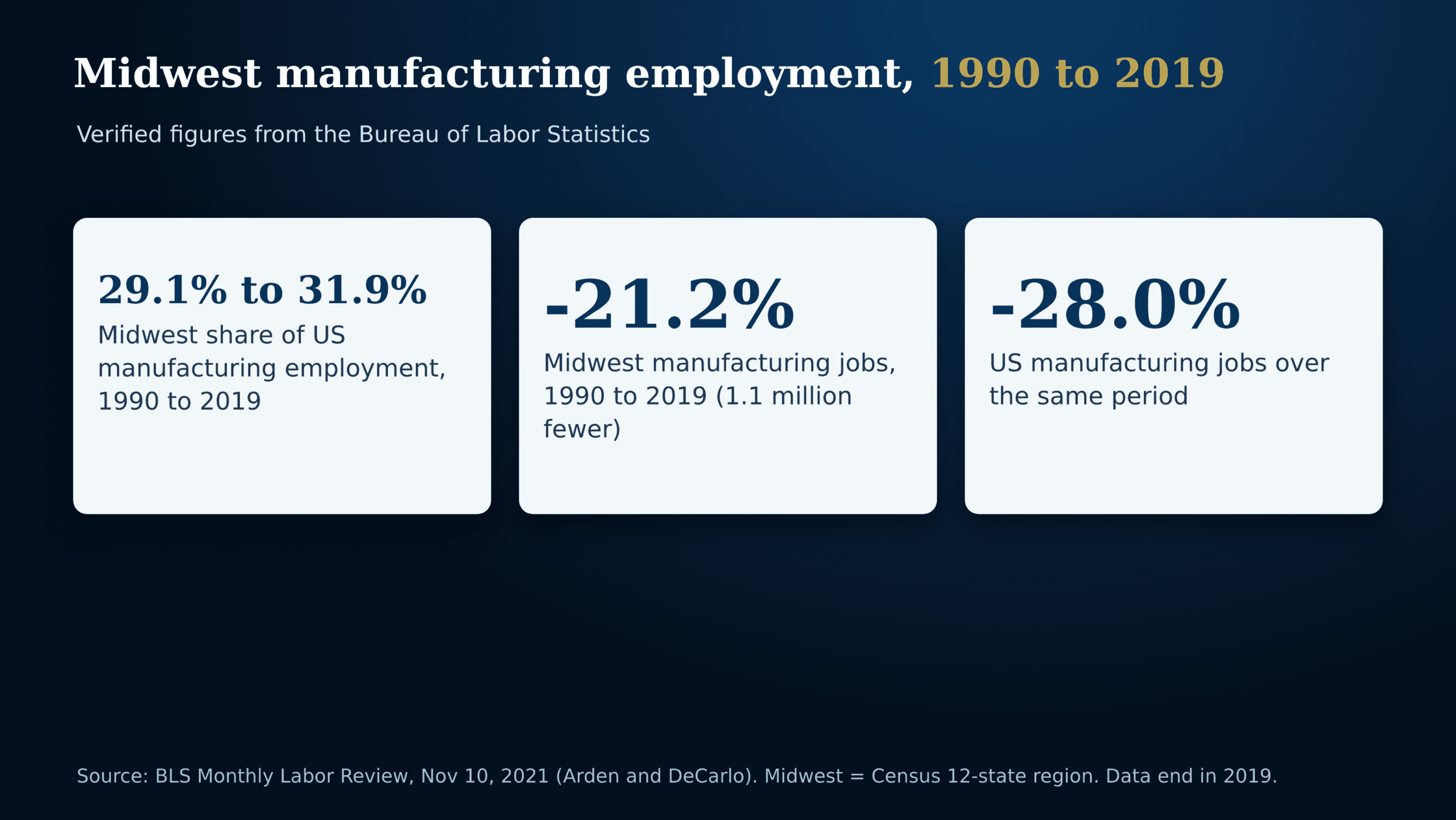
Verified figures on Midwest manufacturing employment from the Bureau of Labor Statistics: share of national employment in 1990 and 2019, and the change in jobs
The figures above tell a sales executive recruiter two things. The region is a major center of manufacturing, so there are many companies and many sales leaders to find. But the sector has also been through long contraction and change, so the sellers who succeeded in it have often had to win business in difficult conditions. A leader with that record can be more valuable than one who has only sold in a rising market.
This is an interpretation and not a finding of either source. The sources report employment, not sales performance, and neither says anything about the quality of any group of sales leaders.
What a Sales Executive Recruiter Looks For: Technical Credibility
The first thing a manufacturing sales leader needs is the ability to be taken seriously by technical buyers. In many industrial sales, the buyer is an engineer, a plant manager or a purchasing team that works from specifications and has seen many vendors.
A sales executive recruiter will check for signs of this.
- Fluency with the product and the application. Can the candidate explain how the product is used in a customer’s process, and what happens when it fails?
- Experience selling with engineers. Has the candidate worked with sales engineers or application specialists, and do they describe the partnership with respect?
- Comfort on the plant floor. Has the candidate spent time with customers where the product is used, and can they describe what they learned there?
- Clear explanations. Can the candidate describe a complicated product to a non-specialist without losing the detail that matters to a specialist?
A useful test in an interview is to ask the candidate to walk through one real deal from first contact to purchase order. A candidate with real technical selling experience can name the stakeholders, the technical objections and the decision criteria. A candidate who relies on generalities probably did not own the deal.
Dan Fantasia, CEO of Treeline, Inc., treats the deal walkthrough as the most revealing hour in a manufacturing interview. From his perspective, a candidate who can name the engineer who objected, the buyer who decided and the step that nearly lost the order is describing work they actually did, and that detail is difficult to rehearse.
How a Sales Executive Recruiter Evaluates Long, Multi-Stakeholder Sales Cycles
Industrial sales often involve many people and many months. A sales executive recruiter looks at how a candidate has handled that complexity.
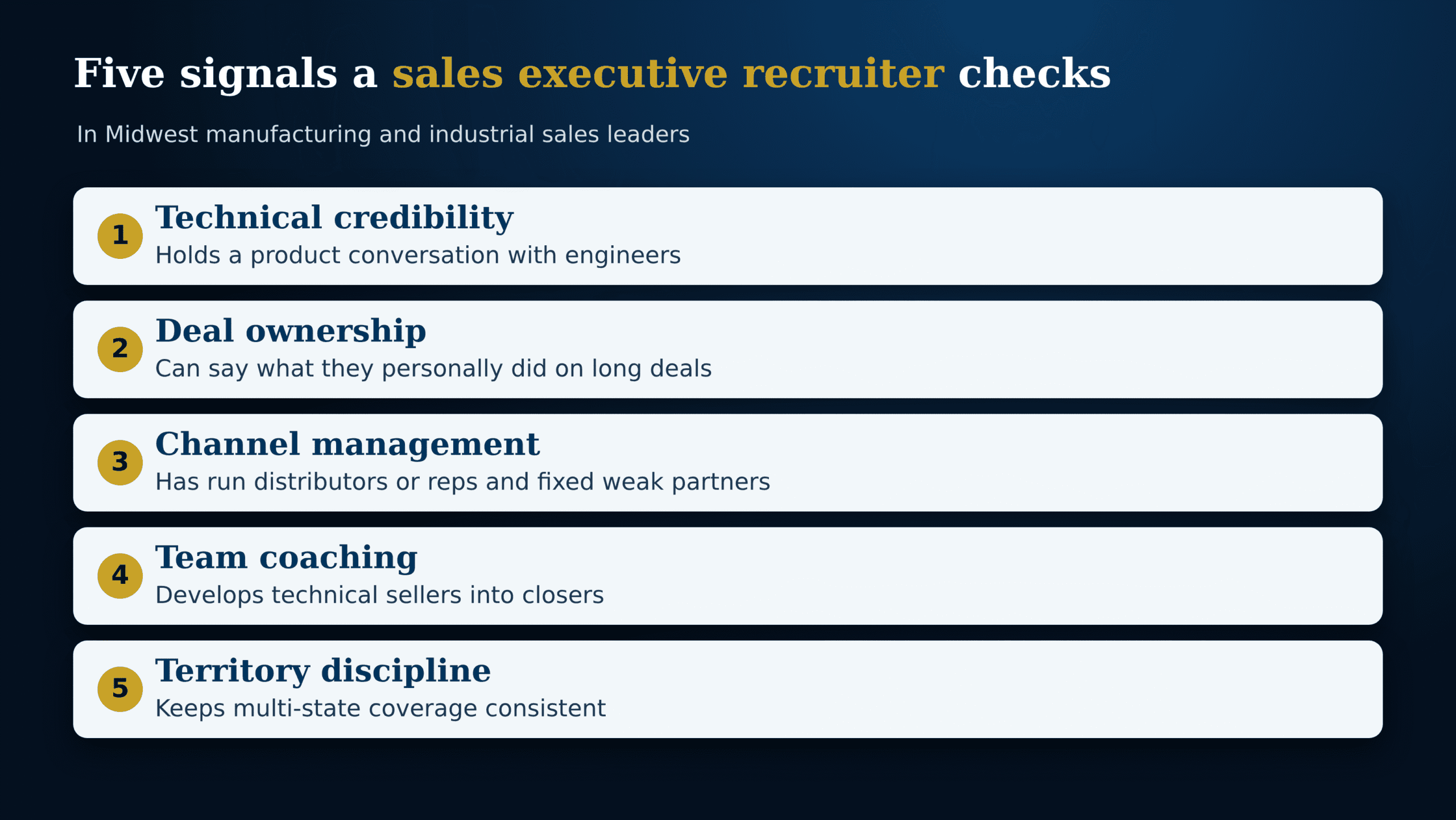
Five signals a sales executive recruiter checks in a Midwest manufacturing sales leader: technical credibility, deal ownership, channel management, team coaching and territory discipline
The five signals in the graphic are a working checklist and not a scorecard. The second signal, deal ownership, is worth explaining.
Deal ownership
Deal ownership means the candidate can say what they personally did to move a long sale forward. Strong answers describe the buying group, the sequence of steps, the obstacles and the candidate’s own actions. Weak answers use “we” for everything, so the recruiter cannot tell what the candidate contributed.
Questions that bring this out include these:
- Who else was involved in the decision at the customer?
- What was the longest stretch with no progress, and what did you do?
- What did you do when a competitor was already installed?
- What would you have done differently?
Patience without drift
A candidate for a manufacturing role needs patience for long cycles, but patience can slide into passivity. The recruiter listens for a rhythm of follow-up, a clear next step after each meeting and a habit of keeping the pipeline honest. A leader who cannot say what is expected to close next quarter, and why, may not run a disciplined forecast.
Dan Fantasia, CEO of Treeline, Inc., sees long cycles as a test of discipline. From his perspective, a manufacturing sales leader who has built a forecast process that the finance team trusts is worth more than one who tells good stories, because a leader who can show how deals move gives the owner something to plan around.
Sales Executive Recruiter Questions About Channels, Distributors and Territory
Many manufacturers sell through distributors, representatives or other partners, and many cover territory across several states. A sales executive recruiter checks whether the candidate has run that kind of go-to-market.
- Channel management. Has the candidate recruited, trained and held accountable distributors or representatives? Can they describe a time they changed a partner who was underperforming?
- Direct and channel balance. Does the candidate understand when a manufacturer should sell direct and when it should rely on partners, and can they explain the tradeoffs?
- Territory discipline. Has the candidate managed a team across several states, with travel, and kept the coverage consistent?
- Account selection. Can the candidate explain how they decide which accounts deserve attention and which do not?
For companies hiring in a specific state, Treeline has pages for Illinois, Ohio, Michigan, Indiana, Wisconsin, Minnesota and Missouri. Treeline’s site does not have a single page labeled Midwest, so a company in the region would look to the page for its own state.
What a Sales Executive Recruiter Looks For in Team Leadership
A senior manufacturing sales hire is often a leader of sellers, and many of those sellers came from technical roles. A sales executive recruiter looks at several leadership qualities.
- Coaching. Can the candidate describe how they developed a seller who was strong technically but weak at selling, or the reverse?
- Hiring judgment. Does the candidate know what to look for in a seller, and can they describe a hire that went wrong and what they learned?
- Working with engineering and operations. Can the candidate work with product, engineering and the plant to make commitments the company can keep?
- Compensation sense. Does the candidate understand how pay plans affect behavior in long-cycle sales, and can they explain a plan they designed or changed?
Compensation deserves attention because the way a plan pays can shape the whole team. Treeline’s Sales Compensation Assessment page describes a seven-step review of a compensation plan, and a hiring company can use a similar review to confirm that its plan makes sense for long cycles before it recruits.
How a Sales Executive Recruiter Works With a Manufacturing Hiring Team
A search goes better when the hiring company prepares as much as the recruiter does. A sales executive recruiter will usually ask the company for the following.
- The business problem. What should this leader change in the next year or two?
- The sales motion. Direct, channel or both, and what a typical sale looks like.
- The territory and travel. Which states or regions, and how much time on the road.
- The decision makers. Who will interview, who decides, and how quickly.
- The compensation range and structure. What is offered, and how it is paid.
- The deal-breakers. What would rule a candidate out.
Treeline’s manufacturing page says the firm will find “qualified, interested and available candidates within 3 days of your search.” That is the firm’s own statement of its process, and a company should ask how it applies to a senior role and what it includes. For senior roles, a company should also ask how the recruiter assesses technical credibility and not only availability.
Dan Fantasia, CEO of Treeline, Inc., believes the most important preparation is agreement inside the company about what the hire is for. From his perspective, a search with three decision makers who each want a different kind of leader will take longer and produce a weaker result than a search where the owner, the sales team and operations have settled on the outcome first.
Dan Fantasia, CEO of Treeline, Inc., adds that team leadership in these companies often means managing people who are proud of their technical skill. For him, the stronger candidates describe coaching as helping a technical seller learn to ask for the order, and not as replacing technical depth with sales technique.
Common Mistakes When Hiring Industrial Sales Leaders
A sales executive recruiter sees the same mistakes repeatedly.
- Hiring for industry only. Years in the industry matter, but they do not prove the candidate can sell, lead or manage a forecast.
- Skipping the deal walkthrough. Without it, the company cannot separate those who owned deals from those who attended them.
- Ignoring the sales engineer relationship. A leader who dismisses technical colleagues will lose them.
- Vague territory expectations. A candidate who learns about the travel after the offer may leave.
- An unclear plan for the first ninety days. A new leader needs introductions, customer visits and a set of priorities.
- Treating the search as a single event. The first year decides whether the hire worked, and the company should plan support.
For companies that need sales leadership while they search or onboard, Treeline’s fractional CRO service page describes an ongoing engagement that covers pipeline reviews, coaching and reporting.
A Short Checklist for a Sales Executive Recruiter Search in Midwest Manufacturing
A hiring company can use this list before it starts.
- Agree internally on the business problem the hire will solve.
- Describe the sales motion, territory and typical sale in writing.
- Decide the compensation range and how it will be paid.
- Plan a deal-walkthrough interview and include an engineer or operations leader.
- Decide how channel partners and field teams will be involved.
- Prepare a first-ninety-days plan before the offer goes out.
- Have counsel review the offer and any restrictive covenants.
Treeline’s industries page lists the industries it recruits for, including manufacturing and business-to-business sales.
Frequently Asked Questions About Hiring With a Sales Executive Recruiter
What does a sales executive recruiter do for a manufacturer?
A sales executive recruiter finds, screens and presents candidates for senior sales roles, and helps the company define what it needs. For a manufacturer, that includes checking technical credibility, experience with long sales cycles, channel management and team leadership.
What does a sales executive recruiter look for in a Midwest industrial sales leader?
Technical credibility with engineers and plant managers, real ownership of long deals, experience with channels and multi-state territories, and the ability to coach and manage a team. The deal walkthrough is one of the most useful interview tools.
Which states count as the Midwest?
The Bureau of Labor Statistics article cited here uses the Census Bureau’s 12-state Midwest region: Illinois, Indiana, Iowa, Kansas, Michigan, Minnesota, Missouri, Nebraska, North Dakota, Ohio, South Dakota and Wisconsin.
How important is Midwest manufacturing to the national economy?
The BLS article reports that the Midwest’s share of national manufacturing employment grew from 29.1 percent in 1990 to 31.9 percent in 2019, even though the region lost 21.2 percent of its manufacturing jobs over that period. Those figures end in 2019.
Should a manufacturer hire a sales leader with industry experience only?
Industry experience helps, but it does not prove sales or leadership skill. A company should also test deal ownership, forecast discipline, channel experience and coaching.
How should a hiring company prepare for a search with a sales executive recruiter?
Agree on the business problem, describe the sales motion and territory, settle the compensation range, name the decision makers and decide the deal-breakers. Preparing these points first usually shortens the search.
How does Treeline charge for a sales search?
Treeline’s Illinois and Florida pages say the firm does not charge upfront fees and collects a fee only once a suitable candidate is hired. That is the firm’s own description, and fee terms should be confirmed in a written agreement.
Share This Story, Choose Your Platform!
Related Posts

What our happy clients are saying
Treeline Inc. provided us with the most candidates that aligned with our needs and were of the highest quality.

Dr. Jeffrey Klein Head of North America Sales, Satchel Pulse
Treeline Inc.’s collaborative, flexible, and communicative approach resulted in a smooth partnership. Beyond their recruitment expertise, their unique sourcing model was efficient and effective.

Sera Holt Director of Operations, LNS Research
Their professionalism was outstanding. Treeline Inc. was extremely thorough and ensured that we were on the same page before they started looking for candidates. They listened to us and did a great job working with the candidate to close out the process.

Cate Grant AVP Customer Success, Nasdaq
Thanks to Treeline Inc.’s intricate and thorough screening process, the company is able to hire six high-quality candidates that fit perfectly in the company’s culture. The team is highly receptive to concerns, and internal stakeholders are impressed with their unique recruitment abilities.

Anna McKean Sales Recruiter, Insider Intelligence
Treeline Inc. has been qualified individuals throughout a five-year-long engagement. They’ve made numerous placements of talented and qualified individuals for our business.

Michele St Laurent VP of HR, The Institute for Applied Network Security

Let Us Help You Source the Sales Talent You Need
Whether you’re building a team or replacing a key role, our Candidate Sourcing Platform provides a fast, flexible, and employer-focused solution.
Tell us more about your business and how we can help.
Treeline Inc.
Your Award-Winning Sales Recruitment Partner
15 Lincoln Street, Suite 314, Wakefield, MA 01880