Sales recruiting strategies for Boston biotech start with one question: who is the buyer, and what do they need the seller to understand? A science-literate seller is a salesperson who can hold a credible conversation with a researcher, clinician or technical evaluator about how a product works and what the evidence shows, and who can still run a sales process to a signed order. Finding that person is harder than finding either a scientist or a salesperson, because the strongest candidates are rarely looking and rarely described accurately by their job titles.
This guide explains how to define the seller you need, where to look, how to test for scientific fluency without turning the interview into an exam, and how to close a candidate who has options. It is written for biotech and life sciences companies in the Boston area hiring commercial leaders and quota-carrying sellers. Treeline, Inc. is a sales recruiting firm that places salespeople permanently, and its biotechnology sales recruiters page is where the firm describes its work in the industry. Treeline’s contingency recruiting service is the way it typically takes on a search.
Dan Fantasia, CEO of Treeline, Inc., views a technical sales search as a matching exercise between the seller and the buyer’s vocabulary. From his perspective, the question is not whether a candidate has a science degree but whether the people they will sell to will take their calls, and that depends on specifics a job description rarely captures.
Why Boston Biotech Needs Different Sales Recruiting Strategies
Boston and Cambridge have one of the densest concentrations of life sciences companies in the United States. A 2018 WBUR report on Kendall Square cited a tally of well over 250 biotech companies in Cambridge, said buildings such as One Broadway and One Kendall Square each house more than 20 of them, and said Cambridge life sciences office space grew from about 3.8 million square feet in 2000 to about 8.8 million in 2018. Those figures are from 2018 and should be read as a description of a cluster that was already large, not as current counts.
Density matters for sales hiring in three ways.
Candidates are known to each other. In a tight cluster, sellers move between companies that share customers, advisers and investors. A seller’s reputation with a buyer travels faster than a resume.
Buyers are sophisticated. The people evaluating a product may include principal investigators, translational scientists, clinical operations leads, procurement specialists and regulatory staff, and each asks different questions.
Competition for candidates is local and specific. A company hiring in Kendall Square is competing for the same small pool of proven sellers as its neighbors, so generic outreach does not cut through.
A Boston Globe report from 2015 quoted a Massachusetts Biotechnology Council official saying that as life sciences companies mature and move toward commercialization, they increasingly need sales, advertising and regulatory affairs workers. The article is a decade old and does not give pay figures for sales roles. It is useful for one reason: it records that the move from laboratory to market has long been the point at which a biotech company needs commercial hires it did not need before.
Sales recruiting strategies for this market therefore have to answer two questions at once. Can the candidate speak to the science, and have they sold something like this to buyers like these?
Define the Buyer Before You Define the Seller
The most common error in a biotech sales search is to write the job description around the product and not the buyer. A product description tells a candidate what the company makes. A buyer description tells them who they will be calling, and that is what determines whether they are qualified.
Before opening a search, answer these questions in writing.
- Who signs the order? A department head, a core facility manager, a procurement office, a clinical operations lead or a business development team at a larger company.
- Who evaluates the product? Often a different person from the signer, and often a scientist with strong opinions.
- What do they need to believe? That the product works, that the data supports it, that it fits into an existing workflow and that the company will still be there in two years.
- How long is the cycle? Some purchases close in weeks, and others require pilots, validation and committee approval.
- What does the seller have to do other than sell? Run demonstrations, present data, answer technical questions, coordinate with scientific colleagues.
Once those answers exist, the candidate profile writes itself. A seller of a laboratory instrument to academic core facilities is a different person from a seller of a clinical-stage platform to pharmaceutical business development teams, even though both might be described as “biotech sales.”
The three seller profiles
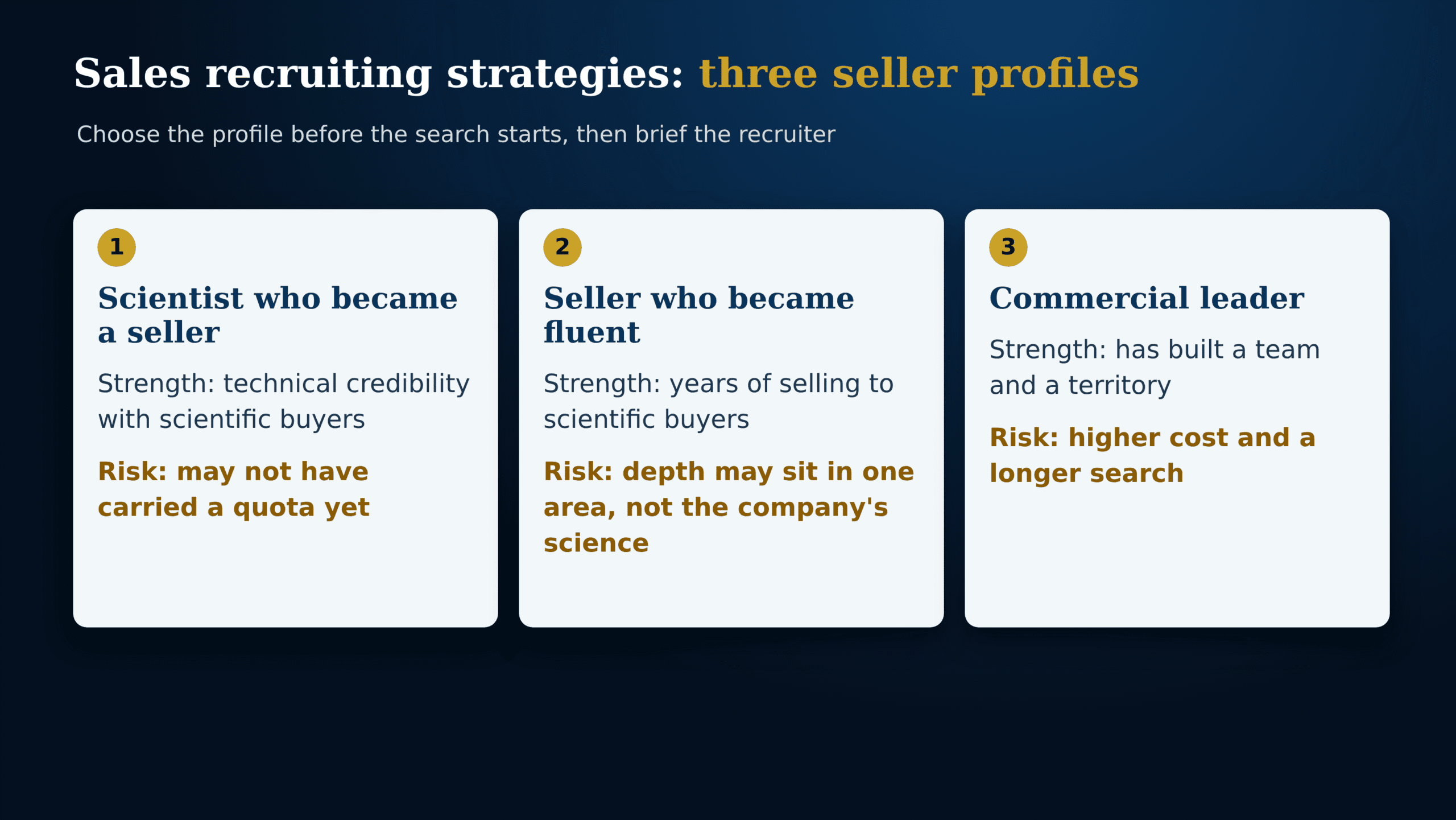
Most searches in this market resolve into one of three profiles. Knowing which one the company needs prevents the search from drifting. The graphic below sets the three side by side.
Three seller profiles for a biotech sales search: scientist who became a seller, seller who became fluent, and commercial leader, each with a strength and a risk
- The scientist who became a seller. Strong technical credibility, often a lab background, comfortable in a data discussion. The risk is that they have not yet carried a quota and may be uncomfortable asking for the order.
- The seller who became fluent. Years of selling into scientific buyers, with enough knowledge to be taken seriously. The risk is that their knowledge is deep in one area and shallow in the company’s.
- The commercial leader. Someone who has built a team and a territory and can hire scientists who sell. The risk is cost and a longer search.
Each profile suits a different stage of company growth. An early commercial team often needs the second profile to prove the market, then adds the first for technical depth and the third once there is a team to lead.
Fantasia sees the choice of profile as the decision that shapes everything after it. In his view, a company that cannot say which of the three it needs is not yet ready to brief a recruiter, and the first conversation in a search should settle it.
How Sales Recruiting Strategies Source Science-Literate Candidates
Sourcing is where most searches either succeed or stall. The candidates a Boston biotech company needs are usually employed, performing and not on job boards. Reaching them takes a method, not a posting.
Look at who the buyers already trust
A direct way to find strong sellers is to ask who the buyers talk about. Customers, advisers and investors often know which representative from a vendor was the useful one. A company can learn a great deal by asking its own early customers who they dealt with at a competing or adjacent supplier and what made that person credible.
Look at adjacent companies
Sellers who carry the right vocabulary often work at companies one step away: instrument makers, reagent suppliers, contract research and manufacturing organizations, diagnostics firms and software vendors that sell to laboratories. The product may differ, but the buyer and the conversation are similar. These candidates may be better targets than direct competitors, who are harder to hire and more likely to be bound by restrictive agreements.
Look at the people who left the bench
Some of the best sellers in technical markets started as scientists, technicians or field application specialists. A field application scientist who spends their days helping customers use a product has already practiced the dual skill the company needs. They may not have carried a quota, but they have the buyer’s trust.
Use a defined sourcing process
Treeline’s Sourcing as a Service offering is one way for a company to hand the identification and outreach work to a team that does it daily. Whether a company uses an outside firm or builds the capacity in house, the method should be written down: the target companies, the titles, the message, the follow-up cadence and the screening questions. Searches fail when the sourcing process lives in a recruiter’s head.
Treeline’s locations page presents the firm as recruiting across the United States, and its Massachusetts page is the place to start for the state. The point for a Boston company is that the best candidate may live outside the cluster and be willing to relocate or work in a hybrid arrangement, so the search should not be restricted to the immediate zip codes.
Sales Recruiting Strategies for Screening Scientific Fluency
Once candidates are in the pipeline, the company needs a way to tell who can actually have the conversation. The goal is a repeatable screen that does not depend on the interviewer being the company’s most technical employee.
Ask for the buyer conversation, not the credential
A degree shows what a candidate studied. It does not show whether a scientist will take their call. Better questions are specific to the sale.
- “Describe the last technical objection a scientist raised and how you handled it.”
- “Walk me through a deal that needed a pilot or validation. Who ran it, and what did you do?”
- “Tell me about a time you were wrong about the science. What did you do?”
- “How do you decide when to bring in a technical colleague, and when to answer yourself?”
A strong candidate answers with names of roles, details of the process and honest accounts of limits. A weak one talks about the product in general terms or claims to know everything.
Use a short technical scenario
Give the candidate a one-page scenario about the company’s category, written by a technical colleague. Ask them to explain how they would open a conversation with a specified buyer, what questions they would ask, and what they would want to learn before proposing a pilot. The aim is not to test their knowledge of the company’s product, which they cannot know, but to see how they reason about an unfamiliar technical problem.
Include a technical colleague, with a defined role
A scientist on the interview panel adds credibility, but only if their role is defined. The colleague should assess whether they would trust this person in front of a customer. They should not decide whether the candidate can sell, because that is a different skill. Without that division, panels tend to prefer candidates who sound like scientists over candidates who close.
Check references for the right things
For a technical seller, the most useful reference is a customer or a technical colleague, not only a former manager. Ask whether the candidate was credible with the buyer, whether they overpromised, and whether the customer would take their call again. Quota attainment is worth verifying, but credibility is what distinguishes sellers in this market.
Fantasia sees scientific fluency as something the interview should observe rather than infer. In his view, a candidate who can describe how they earned a skeptical scientist’s trust has told the company more than any credential could.
Sales Compensation and Offers in Biotech Sales Recruiting Strategies
Compensation is part of the recruiting strategy, not a separate step at the end. A seller in a long-cycle technical market is asking whether the plan will pay for the work the role requires, much of which happens months before a sale closes.
Questions to settle before the offer:
- How long is the cycle, and does the plan recognize it? A plan that pays only on closed orders may be difficult to accept if validation takes many months.
- What counts toward credit? If a scientific colleague supports the sale, say how credit is handled.
- What is the ramp? A seller joining a new product has to learn before they can sell, so the ramp period and quota relief should be explicit.
- How is quota set? A candidate will compare the quota to the territory and the pipeline they inherit.
Treeline’s Sales Compensation Assessment page describes a seven-step plan review and suggests reassessing a plan at 90 days. A candidate reviewing a Boston biotech offer is doing a version of the same review from the outside.
Fantasia also treats the compensation conversation as part of attracting the seller rather than a negotiation at the end. From his perspective, a plan that is explained early shows a candidate that the company has thought about how a long technical sale is actually won.
Build a Closing Plan Into Your Sales Recruiting Strategies
Candidates with the right profile usually have several offers. A company that treats the close as a final step often loses them to a competitor who prepared earlier.
Tell the story of the company’s science and commercial plan. A seller wants to know why the product will win and who will support them. Offer a conversation with the person who understands the data best.
Show the buyer list. Experienced sellers want to see the accounts they would call. A company that can describe the territory with specificity is easier to believe.
Address the risk directly. A seller leaving a stable role for a company that has not yet reached commercial scale is taking a risk. Explain funding, milestones and the support the sales team receives, within what the company can truthfully say.
Move at the pace of the candidate’s process. Delays give competing offers time to arrive. Agree a timeline early, and keep to it.
Prepare for the counteroffer. A current employer may try to retain the seller. Ask early what would make them stay, and respond to the real concern.
Fantasia describes the close as the point where preparation shows. For him, a candidate with several options chooses the company that made the commercial plan feel real, and that work has to be done before the offer, not during it.
Common Mistakes in Biotech Sales Recruiting Strategies
Hiring for the degree, not the conversation. A candidate with a doctorate who has never sold may struggle with the commercial side. A candidate who has sold to scientists for years may do better than the credentials suggest.
Writing the job description from the product sheet. Candidates respond to descriptions of the buyer and the problem, not lists of features.
Searching only inside the cluster. The immediate area has a limited number of strong sellers, and every competitor is calling them.
Skipping the compensation conversation. A candidate who does not understand the plan will assume it is unfavorable.
Letting the search run without a process. Without defined stages and owners, searches stall and good candidates accept other offers.
A Step-by-Step Approach to Sales Recruiting Strategies for a Boston Biotech Hire
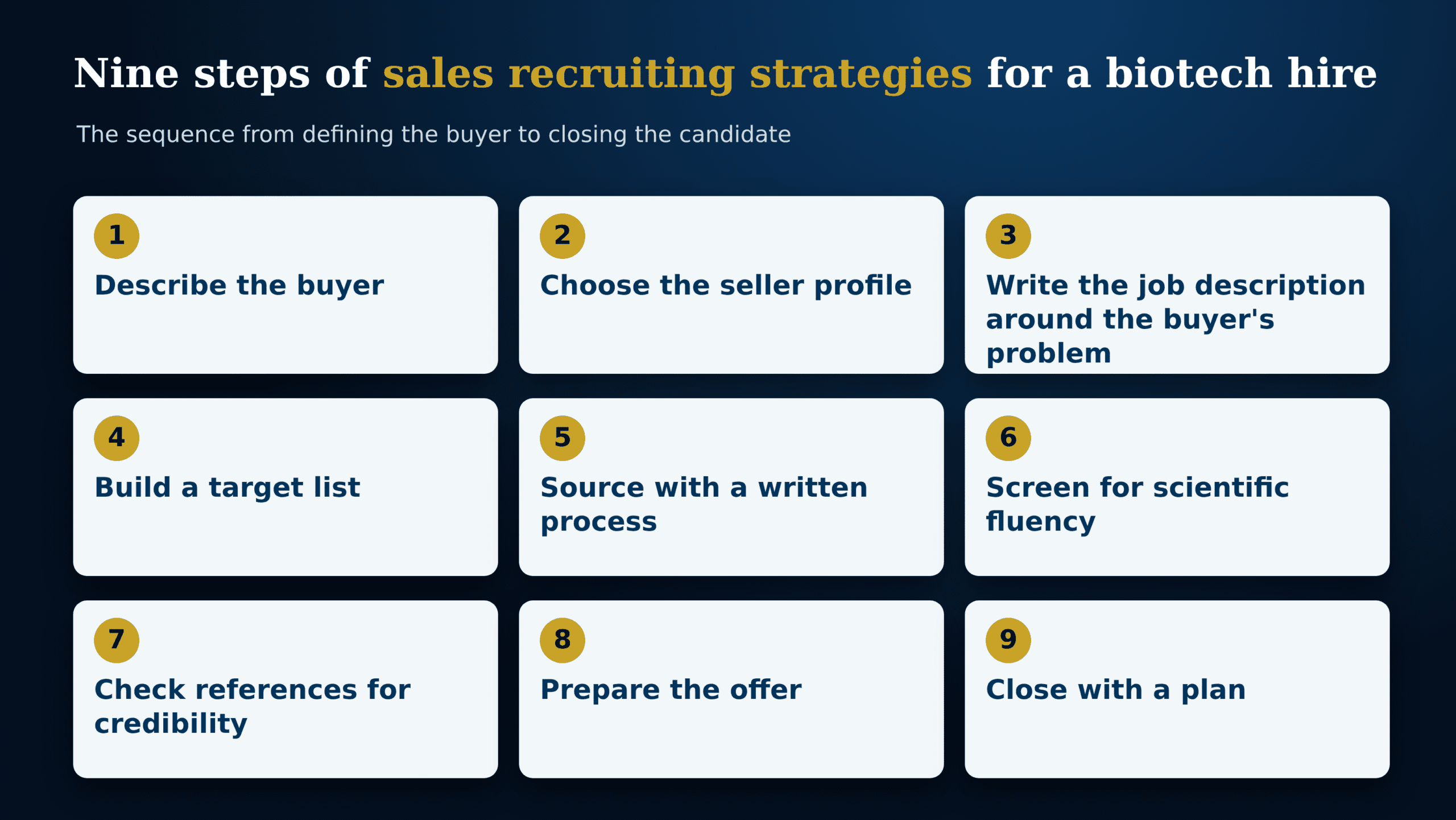
The infographic below summarizes the sequence.
Nine-step sequence of sales recruiting strategies for a Boston biotech hire, from describing the buyer to closing with a plan
- Describe the buyer. Who signs, who evaluates, what they need to believe and how long the cycle is.
- Choose the seller profile. Scientist who sells, seller who became fluent, or commercial leader.
- Write the job description around the buyer’s problem.
- Build a target list. Customers’ trusted vendors, adjacent companies and former bench scientists.
- Source with a written process. Names, message, cadence and screening.
- Screen for fluency. Buyer-conversation questions, a short scenario and a defined technical panel role.
- Check references for credibility. Customers and technical colleagues, as well as managers.
- Prepare the offer. Settle the plan, quota, ramp and credit rules before the final conversation.
- Close with a plan. Story, buyer list, risk discussion and a fixed timeline.
Frequently Asked Questions About Sales Recruiting Strategies in Boston Biotech
What does science-literate mean for a biotech salesperson?
It means the seller can discuss how a product works and what the evidence shows with a technical buyer, using the buyer’s vocabulary, without overstating what they know. It does not require a particular degree. It requires credibility with the people who evaluate the product.
Do biotech sales hires need a science degree?
Not always. Some searches require one because the buyer expects a technical background, and others succeed with a seller who has spent years selling to scientists. The better test is whether the candidate has handled technical objections in a real sale.
Where do companies find science-literate sellers?
Common sources are sellers at adjacent companies that sell to laboratories, field application scientists, former bench scientists who moved into commercial roles, and people customers already trust. Many are employed and not looking, so sourcing needs a defined outreach process.
How should a company screen candidates for scientific fluency?
Ask for specific buyer conversations, give a short technical scenario, and include a technical colleague with a defined role. The technical colleague should judge credibility, and the hiring manager should judge selling ability.
Should a Boston biotech company search only in the Boston area?
No. The cluster contains many strong candidates, but the best fit may live elsewhere and be open to relocation or a hybrid arrangement. Restricting the search to local zip codes limits the pool and puts the company in direct competition with its neighbors.
How does compensation affect biotech sales recruiting?
Candidates evaluate whether the plan pays for work that happens months before a sale closes. Settle the quota method, credit rules and ramp before the offer, and explain them clearly.
Does Treeline place salespeople in biotechnology?
Treeline’s industries page lists biotechnology sales recruiting alongside pharmaceutical, medical and healthcare sales recruiting. Treeline places permanent sales hires, and companies can find out more on its biotechnology sales recruiters page.
Share This Story, Choose Your Platform!
Related Posts
What our happy clients are saying
Treeline Inc. provided us with the most candidates that aligned with our needs and were of the highest quality.

Dr. Jeffrey Klein Head of North America Sales, Satchel Pulse
Treeline Inc.’s collaborative, flexible, and communicative approach resulted in a smooth partnership. Beyond their recruitment expertise, their unique sourcing model was efficient and effective.

Sera Holt Director of Operations, LNS Research
Their professionalism was outstanding. Treeline Inc. was extremely thorough and ensured that we were on the same page before they started looking for candidates. They listened to us and did a great job working with the candidate to close out the process.

Cate Grant AVP Customer Success, Nasdaq
Thanks to Treeline Inc.’s intricate and thorough screening process, the company is able to hire six high-quality candidates that fit perfectly in the company’s culture. The team is highly receptive to concerns, and internal stakeholders are impressed with their unique recruitment abilities.

Anna McKean Sales Recruiter, Insider Intelligence
Treeline Inc. has been qualified individuals throughout a five-year-long engagement. They’ve made numerous placements of talented and qualified individuals for our business.

Michele St Laurent VP of HR, The Institute for Applied Network Security

Let Us Help You Source the Sales Talent You Need
Whether you’re building a team or replacing a key role, our Candidate Sourcing Platform provides a fast, flexible, and employer-focused solution.
Tell us more about your business and how we can help.
Treeline Inc.
Your Award-Winning Sales Recruitment Partner
15 Lincoln Street, Suite 314, Wakefield, MA 01880