recruiting-firm-business-development-executives-featured.jpg
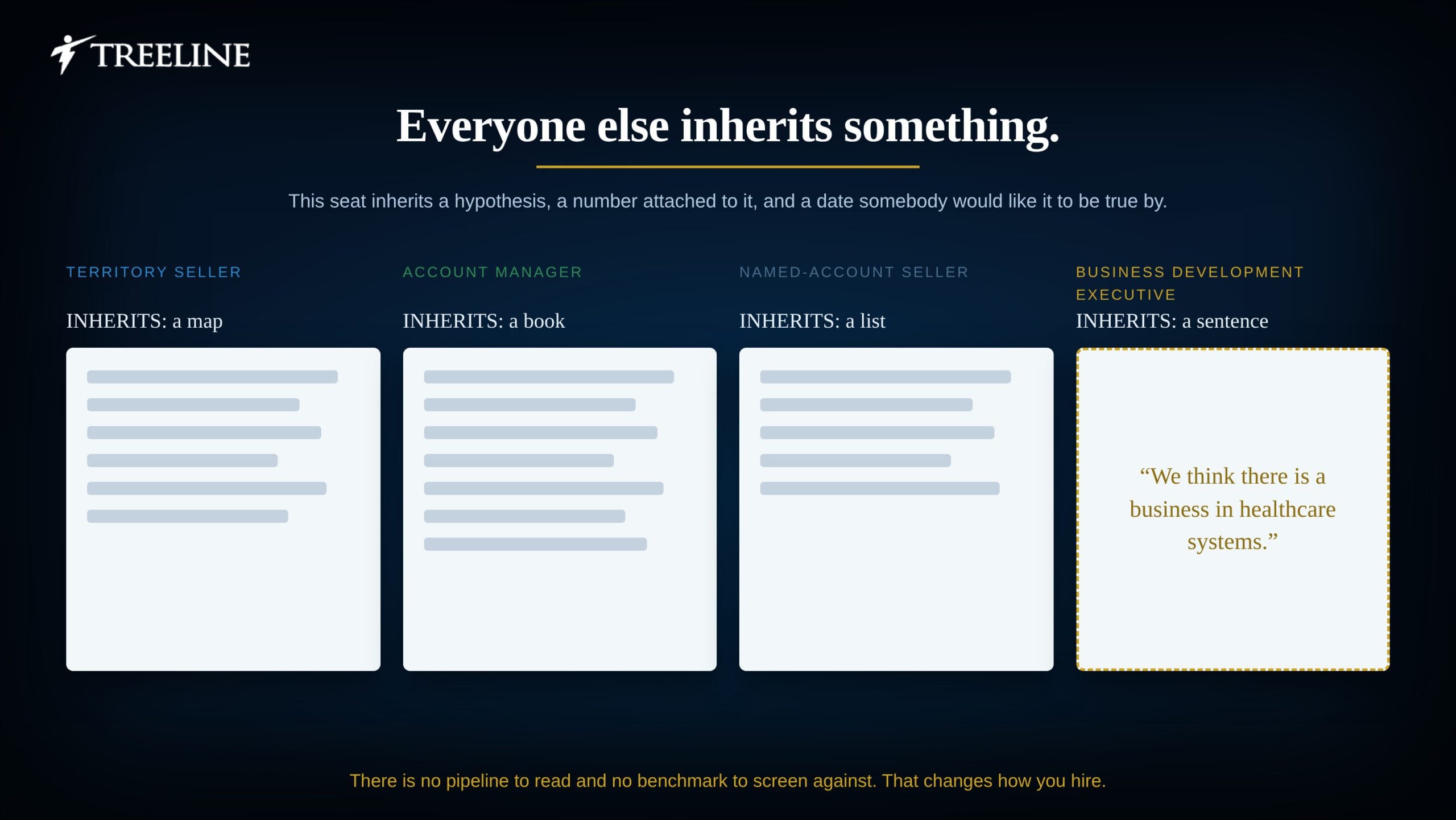
Every other quota-carrying hire arrives to something. A territory with accounts in it. A book with renewals on it. A list of named logos. A pipeline, however thin, that somebody built before them.
A business development executive at the senior level arrives to a sentence. We think there is a business in healthcare systems. We should be selling through integrators rather than direct. Our competitor has a partnership with a firm like that and we do not.
That is the entire inheritance: a hypothesis, a number attached to it, and a date by which somebody would like it to be true.
This changes the search more than most employers expect, and it changes it at the screening stage rather than the sourcing stage. The usual method for assessing a seller is to read their record against a benchmark, attainment, win rate, cycle length. None of those exist for a market nobody has sold into. You cannot ask what their win rate was in a segment that had no deals in it.
So the practical answer to which recruiting firm can help you recruit business development executives is: one that screens for evidence of opening something, rather than evidence of performing inside something. Treeline’s writing on hiring top account executives and on enterprise sellers covers the quota-carrying seats that inherit a structure; this article is about the one that has to build it.
Dan Fantasia, CEO of Treeline, Inc., views this role as the one where the brief is most often a wish rather than a mandate. From his perspective, an employer should be able to name the first three organizations they expect this person to be in a room with, because a hypothesis that cannot produce three names is not yet ready to be hired against.
What a Senior Business Development Executive Is Actually Hired to Open
what-a-senior-business-development-executive-is-hired-to-open.png
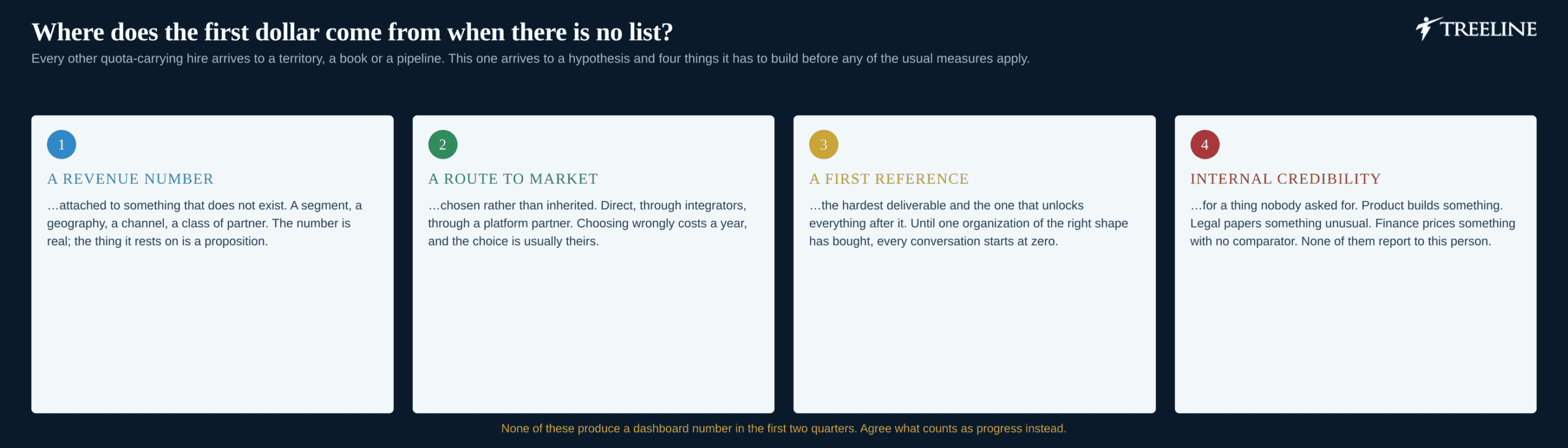
Four things, and only the first usually appears in a job description.
A revenue number attached to something that does not exist. A segment, a geography, a channel, a category of partner. The number is real; the thing it rests on is a proposition.
A route to market, chosen rather than inherited. Direct, through integrators, through a platform partner, through a professional services firm that already holds the relationship. Choosing wrongly costs a year, and the choice is usually the hire’s to make.
A first reference. The hardest deliverable and the one that unlocks everything after it. Until one organization of the right shape has bought and will say so, every conversation starts from zero.
Internal credibility for a thing nobody asked for. Product will be asked to build something. Legal will be asked to paper an agreement it has not seen before. Finance will be asked to price something with no comparator. None of them report to this person.
Our page on the go-to-market leadership seat covers the version of this problem one level up, where the person owns the whole function rather than one mandate inside it.
The Mandate Is a Market, Not a List
Worth stating plainly, because it is what separates this seat from every neighboring one.
A seller with a list is measured on conversion. A seller with a market is measured on whether the market turns out to exist. Those are different jobs with different failure modes, and the second one is far more often ended by a strategy change than by underperformance.
Three consequences follow for the hire.
There is no benchmark to screen against. Attainment figures from a mature segment tell you how someone performs when the path is known. They say little about whether that person can operate when it is not.
Early progress is unreadable from outside. The first two quarters produce conversations, a view of how the segment buys, and possibly a decision not to pursue part of it. None of that appears on a dashboard, and an organization that cannot tolerate that will replace a person who was doing the job correctly.
The holder needs a defensible way to say no. The fastest way to fail is to accept every adjacent opportunity that looks like progress. Half the value of a strong hire is the segments they rule out in the first quarter.
Fantasia weighs a candidate’s account of something they walked away from more heavily than their account of something they won, on the view that anyone who has genuinely opened a market has killed a promising direction and can explain exactly why.
Where Business Development Executive Candidates Come From
Four pools, in rough order of hit rate.
Sellers who were first into a segment at a company that later scaled it. The strongest signal available, and the hardest to find by title, because they are frequently called something else entirely. Ask who was first rather than who is biggest.
Partnership and alliance leaders. Directly relevant where the mandate is a route to market rather than a segment. They have built commercial relationships with organizations that were not obliged to cooperate, which is the same muscle.
Consultants and professional-services leaders from the target market. Underrated for large corporate partnerships. They know how those organizations buy, who signs, and what a credible proposal looks like, which is most of the problem. What they need is the commercial frame.
Operators from the target industry. Someone who has sat on the buying side of the relationship you are trying to build. Slower to ramp commercially, and occasionally the only person who can open the first door.
Fantasia separates these pools by whether the candidate has ever been accountable for something with no precedent inside their own company. His argument is that selling skill is widely available and tolerance for ambiguity is not, so the brief should be explicit about how much of the latter the seat requires.
Why Strategic Partnerships Change the Candidate Profile
why-strategic-partnerships-change-the-candidate-profile.png
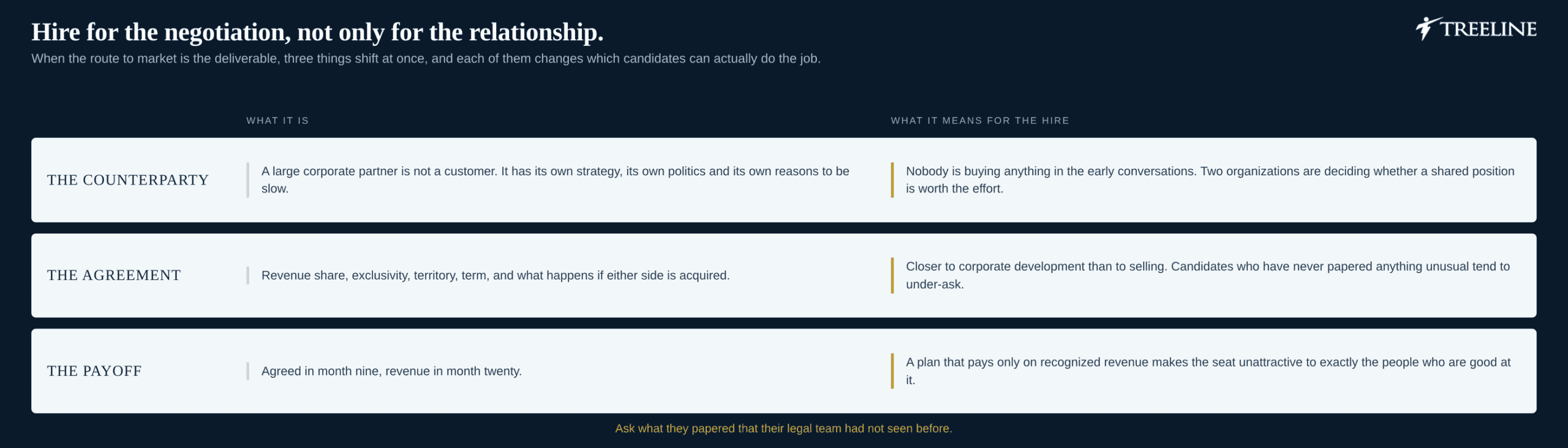
When the mandate is a partnership rather than a segment, three requirements shift.
The counterparty is not a customer. A large corporate partner has its own strategy, its own internal politics and its own reasons to be slow. Nobody is buying anything in the early conversations; two organizations are deciding whether a shared position is worth the effort.
The agreement is a negotiation, not a close. Revenue share, exclusivity, territory, term, what happens if either side is acquired. The commercial instinct required is closer to corporate development than to selling, and candidates who have never papered anything unusual tend to under-ask.
The payoff arrives long after the signature. A partnership agreed in month nine may produce revenue in month twenty. Employers who have not planned for that gap tend to lose the person who closed it.
Our writing on compensation plan levers is worth reading before this search, because the plan is where most partnership mandates quietly fail.
The Two Hires That Confuse Activity With Progress
The well-connected relationship builder. Knows everyone in the target industry, opens doors immediately, produces an impressive volume of senior conversations in the first quarter. By month nine none of them has converted, because the conversations were pleasant rather than commercial and nobody was ever asked for anything specific.
The strong closer from a mature segment. Excellent at converting, visibly capable, references well. Placed in front of a market with no established buying pattern, they apply a process that assumes one, qualify, propose, close, and conclude after two quarters that the market does not exist. Sometimes they are right. More often they ran the wrong play.
Both are defensible hires. Both come from a brief that described the number and not the ambiguity.
Questions That Test for Opening Something From Nothing
Seven questions that are hard to answer from a script.
Tell me about a segment or partnership you were first into. What did the first six months actually consist of?
What did you rule out, and how did you know?
Describe the first reference customer you landed. Why did they say yes when nobody else had?
Who inside your own company did you need, and what did you have to give them?
What did you negotiate that your legal team had not seen before?
How did you know whether you were making progress in a quarter with no closed revenue?
When did you tell leadership that a direction was not working, and what happened next?
Candidates who have opened something answer with sequence, names and abandoned directions. Candidates who have performed inside an existing structure answer with numbers and process. Both are legitimate records; only one predicts this seat.
What Business Development Executive Roles Pay
Our own board carries a senior tier for this title, posted separately, and one related requisition in sales and strategic partnerships lists a base of one hundred and twenty-five thousand dollars. That is a single live posting rather than a survey, and n is one.
Qualitatively, four things move the number.
How much of the outcome the holder controls. A mandate requiring product investment, legal novelty and executive sponsorship is one where the holder owns the strategy and not the result, and the plan has to reflect that.
The deferral between signature and revenue. Partnership mandates routinely produce nothing measurable for several quarters. A plan that pays only on recognized revenue makes the seat unattractive to the strongest candidates.
Whether the first reference exists. Opening a market with one credible customer already in it is a materially easier job, and prices differently, than opening one with none.
Seniority of the counterparty. Negotiating with a divisional leader at a large corporate partner is a different seat from selling to a department head, whatever the title says.
Treeline’s writing on determining sales compensation and on hiring speed for quota-carrying roles is relevant, because candidates at this level are frequently mid-negotiation and cannot leave quickly.
How to Brief a Business Development Executive Search
Four things, before the first candidate conversation.
The hypothesis, stated as a sentence somebody disagrees with. If everyone in the company already agrees the opportunity is obvious, somebody would have pursued it. The interesting mandates are contested.
Three named organizations you expect them to be in a room with. Not a profile. Names. If the list cannot be produced, the mandate is not ready.
What has already been tried, and what happened. Candidates will find out. Hearing it first from you is worth more than it costs.
How long before a judgment is made, and on what. Say what the first two quarters are supposed to produce if it is not revenue, and say who decides.
Fantasia warns that the most common failure in this search is a mandate that has not survived an internal argument, because the hire then spends their first two quarters having that argument on the company’s behalf, from the weakest position in the building.
How to Test a Recruiting Firm on a Business Development Executive Search
Four questions, before you engage anyone.
Ask what they will want to know about the mandate. A firm that has filled this seat asks what has already been tried; one that has not asks for the job specification.
Ask how they screen without attainment figures. If the answer leans on quota history from mature segments, they are assessing a different job.
Ask what they will tell candidates about the internal support. These mandates live or die on it, and strong candidates ask early.
Ask what they would say if the mandate is not ready. A firm that has never recommended against its own placement is not reading the mandate.
Our page on the account executive role and our analysis of that role in the software market are reasonable places to see how a firm distinguishes between seats that look similar from outside.
When the Mandate Is Not Ready
Sometimes the search should stop.
If nobody can name three target organizations, the hypothesis has not been worked through, and the first hire will do that work instead of selling. If product will not commit to building what the market needs, the holder is selling something that does not exist to people who will check. If the compensation plan pays only on recognized revenue and the mandate defers revenue past the plan year, the seat is unattractive to the right people and attractive to the wrong ones. And if leadership expects pipeline in the first quarter, the expectation is mismatched to the job and someone will be blamed for it.
Our writing on goals and quotas and on building a pipeline deals with the measurement side of that problem.
Fantasia resists opening this search where the mandate has not been argued internally, on the view that a hire cannot win an argument the company has not yet had with itself.
Frequently Asked Questions
What is the difference between this seat and a quota-carrying sales role?
Inheritance. A sales role arrives to a territory, a book or a list, and is measured on conversion within it. This seat arrives to a hypothesis and is measured on whether the opportunity turns out to be real, which is a different job with a different failure mode.
How do I assess someone with no comparable attainment figures?
Read what they opened rather than what they converted. The useful evidence is the first reference customer they landed, the directions they ruled out and why, and what they had to negotiate internally.
Should this person report into sales or into strategy?
Either works, provided the reporting line can protect a quarter that produces no revenue. Reporting into a sales organization measured weekly on pipeline tends to force the wrong behavior early.
How long before I should expect revenue?
Longer than for any comparable hire, and the honest planning assumption is that the first two quarters produce knowledge and relationships rather than bookings. The thing to agree in advance is what counts as progress instead.
What if the partnership never produces revenue?
That is a possible correct outcome, and a mandate that cannot accommodate it will punish accurate work. Some markets do not exist, and discovering that in three quarters for the cost of one salary is a reasonable result.
Do they need industry experience in the target market?
More than in most sales roles, because credibility substitutes for the reference customer they do not yet have. Where the mandate is a route to market rather than a segment, partnership experience matters more than industry.
Can a consultant move into this seat?
Frequently, and they are an underused pool for large corporate partnerships. They know how those organizations decide. What they usually need is the commercial frame, asking for the order, and negotiating terms rather than scope.
How does compensation work when revenue is deferred?
Most workable plans pay something against defined milestones such as a signed agreement, a first reference or a joint pipeline figure, alongside the revenue component. A plan tied exclusively to recognized revenue deters the strongest candidates.
What is the most common mistake in this search?
Hiring against a hypothesis the company has not finished arguing about. The person is then expected to deliver a number and settle an internal strategy debate at the same time, from the weakest position available.
Name the Market Before You Name the Person
Everything difficult about this search is settled before anyone is contacted. What the hypothesis is. Which three organizations you expect to be in a room with. What has already been tried. What the first two quarters are supposed to produce.
Four answers, none of which require a recruiter, all of which decide whether the recruiter can help. This seat inherits a sentence. Make it a good one.
Production notes (not for publication)
Original Title from Column D, Row 67: Which Recruiting Firm Can Help Me Recruit Business Development Executives?
Meta Title: Hiring a Business Development Executive: Open a Market
Meta Description: This seat is measured on revenue that does not exist yet, in a market nobody has sold to. That breaks normal screening.
Suggested URL: https://www.treelineinc.com/blog/recruiting-firm-business-development-executives/
seniority_scope: Written to the senior/strategic level required by Treeline’s standing rule, “We stay away from entry level business development roles”, and to their stated definition: “Sr Level Business Development Professional who are at a very high strategic level to leading the business toward large corporate partnerships.” The article contains no meeting-booking, appointment-setting or development-representative framing anywhere, and passes the business-development seniority gate in market_fit_check.py on both the density test and the heading-structure test.
title_validation: “Business development executive” returns 2,418 occurrences across 30 distinct URLs, and the attribution is unusually good, only one is a templated city page. The rest sit under /sales-job-recruiting/ as real postings, including a senior tier that Treeline posts under its own name: 303, 330, 375, 380 and 382 are all “Sr Business Development Executive”. The tracked keyword export carries 24 rows for the term, headed by “business development executive” at volume 100–1K, plus “business development executive search” (10–100) and “business development executive recruitment”. This is the strongest-evidenced row of the four in this batch.
evidence_caveat: Not all BDE postings on the board are at the senior tier, the full set skews toward hunting language, and one is an SMB-level req in a consumer-adjacent market. This article is deliberately scoped to the senior tier Treeline posts separately, to the advisory-services and BPO reqs that sell into large corporate clients, and to the “Sales & Strategic Partnerships” req carrying a base of $125,000. The lower-tier postings are not used as evidence. Same handling as Row 60, where the first-party evidence sat in an excluded market and the article was built structurally instead.
scope_note: Row 36 (Business Development Managers) is the delivered article that FAILS the seniority rule, it is built on meetings booked and a handoff contract. This row deliberately shares no argument with it and is not a rewrite of it. Row 29 owns the go-to-market leadership seat. Unclaimed and taken here: at this level the mandate is a market rather than a list, so the seat is measured on revenue that does not yet exist and there is no pipeline to inherit or benchmark to screen against. Corpus checks before drafting: “route to market” 0, “channel partnership” 0, “joint venture” 0, “business development executive” 1.
Share This Story, Choose Your Platform!
Related Posts
What our happy clients are saying
Treeline Inc. provided us with the most candidates that aligned with our needs and were of the highest quality.

Dr. Jeffrey Klein Head of North America Sales, Satchel Pulse
Treeline Inc.’s collaborative, flexible, and communicative approach resulted in a smooth partnership. Beyond their recruitment expertise, their unique sourcing model was efficient and effective.

Sera Holt Director of Operations, LNS Research
Their professionalism was outstanding. Treeline Inc. was extremely thorough and ensured that we were on the same page before they started looking for candidates. They listened to us and did a great job working with the candidate to close out the process.

Cate Grant AVP Customer Success, Nasdaq
Thanks to Treeline Inc.’s intricate and thorough screening process, the company is able to hire six high-quality candidates that fit perfectly in the company’s culture. The team is highly receptive to concerns, and internal stakeholders are impressed with their unique recruitment abilities.

Anna McKean Sales Recruiter, Insider Intelligence
Treeline Inc. has been qualified individuals throughout a five-year-long engagement. They’ve made numerous placements of talented and qualified individuals for our business.

Michele St Laurent VP of HR, The Institute for Applied Network Security

Let Us Help You Source the Sales Talent You Need
Whether you’re building a team or replacing a key role, our Candidate Sourcing Platform provides a fast, flexible, and employer-focused solution.
Tell us more about your business and how we can help.
Treeline Inc.
Your Award-Winning Sales Recruitment Partner
15 Lincoln Street, Suite 314, Wakefield, MA 01880