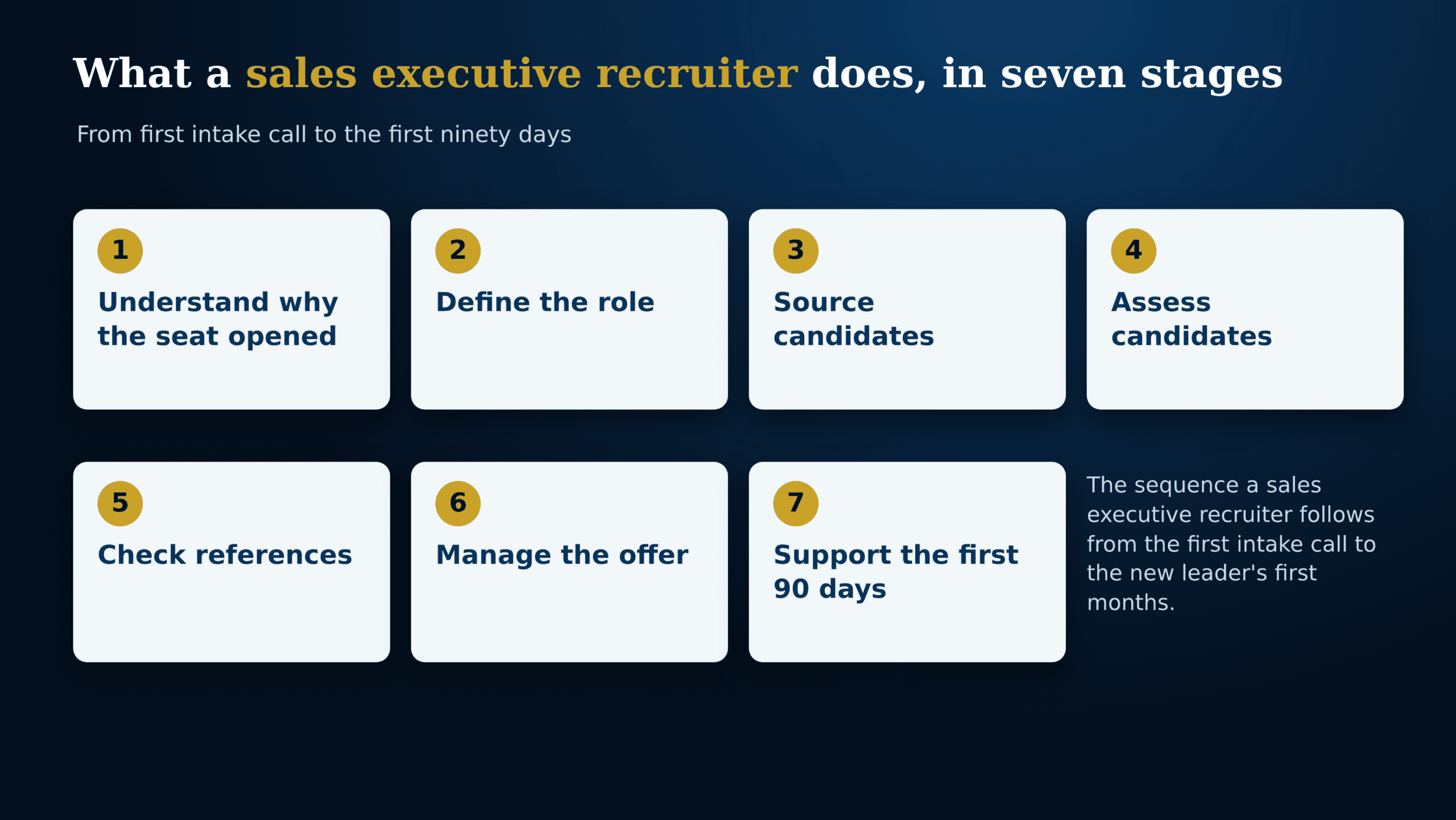
A sales executive recruiter is a recruiting professional who finds, assesses and presents candidates for senior sales roles such as head of sales, vice president of sales or chief revenue officer. When a Chicago company replaces its head of sales, the recruiter’s work runs through seven stages: understanding why the seat opened, defining the role, sourcing candidates, assessing them, checking references, managing the offer and supporting the first months. This guide explains what happens at each stage and what the company needs to do alongside the recruiter. The infographic below shows the seven stages in order.
Seven stages of a head of sales search run by a sales executive recruiter, from understanding why the seat opened to the first ninety days
Replacing a head of sales is different from filling an open seat on the team. The person leaving usually knows the pipeline, the forecast and the people. The team is watching how the company handles the change, and revenue does not pause while the search runs. A recruiter who has run these searches before can protect both the search and the sales organization during the gap.
Treeline, Inc. is a sales recruiting firm that places salespeople permanently. Its executive search page for Illinois describes the firm’s work with Illinois clients, and its contingency recruiting service is the way it typically takes on a search. Treeline states on that page that it charges no upfront fees and collects a fee only after a suitable candidate is hired. For a company that wants help with sales compensation before the search begins, Treeline’s Sales Compensation Assessment page describes a seven-step plan review.
Dan Fantasia, CEO of Treeline, Inc., views a head-of-sales replacement as a decision about what the company needs next rather than a search for a copy of the last leader. From his perspective, the first conversation with a recruiter should establish what the previous leader did well, what the company needs the successor to change, and what the company is prepared to give the new leader to do it.
What a Sales Executive Recruiter Does First: Understanding Why the Seat Opened
The first thing a sales executive recruiter does in a head-of-sales search is ask why the role is open. The answer shapes everything after it, and candidates will ask the same question.
The common reasons fall into a few groups.
- The leader left for a better opportunity. The company may want a similar profile, but it should still ask what pulled the person away.
- The leader was removed because results fell short. The company needs to be clear about why: the market, the product, the team, the plan or the leader. A recruiter who accepts “performance” without detail cannot brief candidates honestly.
- The company has outgrown the leader. The business has changed, and the role now needs a different skill set, such as building a second layer of management or opening a new segment.
- The company is acquiring or merging. The seat may be changing shape as two sales organizations combine.
- The seat is new or is being re-created. There may be no predecessor to compare against.
A recruiter will also ask what the company has told the sales team, who is covering the seat now and how long that arrangement can last. These are practical questions. If the team does not know what is happening, strong sellers start taking calls from other recruiters.
The interim question
Many Chicago companies will need someone to run sales while the search is under way. The options include promoting a team member, asking a senior executive to cover, or bringing in an interim leader. Treeline’s fractional CRO service is described on its site as an ongoing engagement that covers areas such as pipeline reviews, coaching and reporting, and it is one way to keep the sales organization led while a permanent search runs. A fractional leader is a bridge, not a substitute for the search, and the company should decide in advance how the two will overlap.
How a Sales Executive Recruiter Defines the Head of Sales Role
A job description for a head of sales is often a list of the previous leader’s duties. A sales executive recruiter works to replace it with a description of what the next leader has to accomplish.
The conversation usually covers:
- The outcomes. Revenue targets, retention, expansion into a new segment, improved forecast accuracy, or a rebuilt team. A candidate wants to know what they will be judged on.
- The scope. Which teams report to the role, which functions it influences without owning, and whether it includes sales operations, customer success or partnerships.
- The authority. Who sets quota, who approves hires, who controls pricing and who owns the compensation plan.
- The stage. Whether the company needs a builder who creates structure where there is little, an operator who improves a working machine, or a turnaround leader who repairs one.
- The market. Who the buyers are, how long the cycle is and what the company’s position is against its competitors.
A common mistake is to ask for all of the profiles at once. A leader who has built a team from nothing, run a mature operation and turned around a failing one is rare, and the company that insists on all three tends to lengthen the search and weaken the offer.
Builder, operator or turnaround leader
The table below sets the three profiles side by side as a working tool. It is a framework for discussion, not a classification of candidates.
Fantasia sees the choice of profile as the decision that determines whether a search stays on track. In his view, a company that cannot say which profile it needs is not yet ready to evaluate candidates, because every interview will pull the conversation toward a different answer.
The Chicago Market and a Sales Executive Recruiter’s Reach
Chicago is a large business market, and a company hiring there will see candidates from many industries. A Newmark piece on Chicago’s industry diversity describes a diversified local economy, naming manufacturing, logistics and a growing knowledge economy among its strengths. The piece is undated and cites 2022 figures, so it is useful as context and not as a current count. Treeline’s Illinois page also describes Chicago’s economy as diverse, citing financial services, healthcare and manufacturing.
For a head-of-sales search, diversity has two practical consequences.
The candidate pool crosses industries. A strong leader may come from a company that sells something different but sells to the same kind of buyer. A sales executive recruiter looks at the buyer, the sales cycle and the size of the deal before looking at the industry label.
The best candidate may not live in Chicago. Treeline’s locations page presents the firm as recruiting across the United States, so a Chicago company is not limited to local candidates. A search that considers relocation or a hybrid arrangement is larger than one that does not.
This guide does not claim that any Chicago industry has more or fewer qualified sales leaders than another, because the sources above do not say so.
How a Sales Executive Recruiter Sources Head of Sales Candidates
Senior sales leaders are rarely looking for a job. They are employed, usually performing and often well paid. A sales executive recruiter reaches them through direct approaches, informed by the company’s role definition.
Building the target list
The recruiter and the company agree on a list of companies where strong candidates may work: direct competitors where permitted, adjacent companies that sell to the same buyer, and companies at the stage the role requires. The list is a map, not a rule. A candidate from outside the list who fits the role should still be considered.
Making the approach
A good approach to a head-of-sales candidate says who the company is, what the role is, why it is open and what the next leader will own. It does not rely on a job title. The candidates the company most wants are the ones most likely to ignore a generic message.
Treeline’s Sourcing as a Service offering is one of the ways Treeline describes its candidate sourcing. Whichever method is used, the company should ask the recruiter to explain how candidates are found and how many will be approached directly.
Confidentiality
If the current head of sales is still in the seat, the search may need to be confidential. A recruiter should say what will be disclosed about the company at each stage and ask the company who inside the business knows about the search.
Assessing Candidates: What a Sales Executive Recruiter Looks For
A sales executive recruiter’s value is clearest at the assessment stage. A candidate for a head-of-sales role can be impressive in an interview and still be wrong for the job, and the recruiter’s task is to find the difference before the company makes an offer.
The assessment typically covers five areas.
- Results with context. Quota attainment matters, but so does the territory, the team, the product and the market the candidate worked in. A recruiter asks what the candidate inherited, what they changed and what happened after.
- Team building. Has the candidate hired, developed and removed sellers? Can they describe how they judge a hire? Can they name people they promoted?
- Forecasting and process. Does the candidate run a pipeline review that produces an accurate forecast? How do they handle a missed number?
- Compensation design. Can they explain how they have set quota and commission and what they changed? Treeline’s guide to determining sales compensation describes a sequence that starts with margin and ends with the structure of variable pay, which is a useful reference for the conversation.
- Fit with the company. Does the candidate’s style suit the founder, the board and the team they will lead?
Interviews that produce evidence
Open questions that ask for specific events produce better evidence than hypothetical ones. “Tell me about the last rep you let go and how you decided” shows more than “How do you handle underperformers?” A scenario built on the company’s actual situation, such as “Here is our pipeline by stage; what would you look at first?” shows how the candidate thinks.
Fantasia tends to treat the assessment as a test of how a candidate would lead this particular team. From his perspective, the strongest candidate is the one who asks the most precise questions about the company’s situation and who can say what they would not yet know.
Reference Checks and Restrictive Covenants
Reference checks for a head of sales should include more than former managers. Former direct reports, peers in other functions and customers can describe how the candidate led, how they worked with marketing and finance, and whether sellers stayed or left. A recruiter should ask each reference the same core questions so that the answers can be compared.
Restrictive covenants
A candidate leaving a competitor may be bound by a non-compete or non-solicit agreement. Before an offer is made, the company should ask the candidate what agreements they have signed and give them to counsel. Illinois has a statute that restricts these agreements. According to a Hinshaw & Culbertson summary from June 2021, the Illinois Freedom to Work Act, as amended, prohibits non-competes for employees at or below an earnings threshold, requires employers to give at least 14 days to review a covenant and to advise the employee in writing to consult an attorney, and applies to agreements entered into after January 1, 2022. The summary describes a bill that was awaiting signature when it was written, and the thresholds are scheduled to change over time. The facts of each candidate’s agreement and the current text of the law need to be checked by counsel. This guide is not legal advice.
The practical point is that a candidate’s covenant can change the start date, the role’s scope or the candidate’s willingness to move. It should be discussed early, not after the offer is accepted.
Managing the Offer and the Close
A head-of-sales candidate who has made it this far usually has other options. The offer is the point where a prepared company beats an unprepared one.
Before the offer, the company should settle:
- The compensation structure. Base, variable pay, on-target earnings, any equity, and how each is described in writing.
- The sales plan for the team. The candidate will want to know whether they can change it and how quickly.
- The authority. Hiring, firing, pricing and budget decisions.
- The start date and notice period. Including any covenant constraints.
- The first-quarter plan. What the company expects, and what support it will provide.
Fantasia regards the offer as the first test of how the new leader will be treated. From his perspective, a company that has settled its answers on pay, authority and support before the conversation signals that it will be organized once the leader arrives.
A sales executive recruiter acts as a go-between at this stage. The recruiter can learn what the candidate needs and relay it to the company, which is difficult to do directly when both sides are negotiating. The recruiter should also prepare the company for a counteroffer from the candidate’s current employer.
After the Hire: The First Ninety Days
A search that ends at the signed offer has not finished the job. The first months determine whether the new head of sales succeeds, and the company should plan them before the start date.
A reasonable plan includes:
- Introductions. The new leader meets the team, key customers, the board or executive group and the people in marketing, finance and operations they will work with.
- A review of the pipeline and the forecast. The new leader learns the numbers before changing anything.
- A decision on the plan. Treeline’s assessment page suggests reassessing a compensation plan at 90 days, and the same interval gives a new leader time to judge it.
- Clear checkpoints. Regular conversations with the CEO or other manager about progress against the outcomes agreed at the start.
If the company used an interim or fractional leader, the handover should be written and complete.
Who Does What: Company and Sales Executive Recruiter
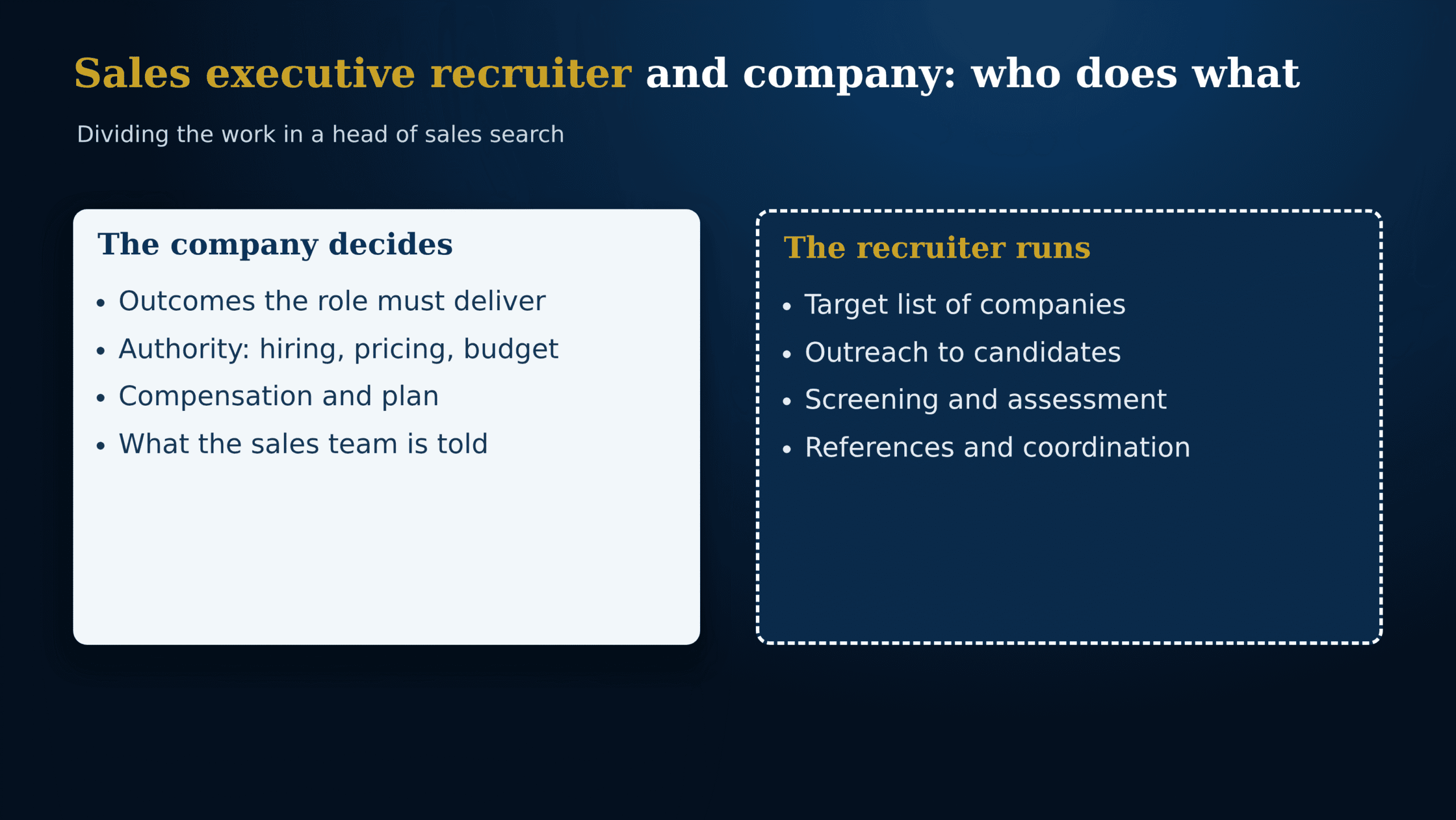
A head-of-sales search goes faster when each side knows what it owns. The comparison below separates the work.
Two-column comparison of what the company handles and what the sales executive recruiter handles in a head of sales search
The company owns the decisions that only it can make: the outcomes, the authority, the compensation and the internal communication. The recruiter owns the process: the target list, the outreach, the screening, the references and the coordination between the parties. When the two overlap, such as in defining the role, the recruiter should lead the questions and the company should make the decisions.
Fantasia notes that the most common cause of a stalled search is a company that expects the recruiter to decide what the role is. In his view, the recruiter can sharpen a role definition, but only the CEO can say what the company wants the sales organization to become.
Common Mistakes When Replacing a Head of Sales
Starting the search before agreeing the role. Candidates notice when the company cannot say what the next leader is for.
Asking for a copy of the predecessor. The person who left may have been right for the last stage and wrong for the next.
Hiding the reason the seat opened. Candidates will learn it, and discovering it late damages trust.
Leaving the sales team uninformed. Sellers who do not hear from the company will listen to other recruiters.
Treating the interview as a presentation. A head of sales is easy to like in a presentation. The evidence is in the specifics.
Waiting on the compensation conversation. A senior candidate will ask about the plan early.
Frequently Asked Questions About a Sales Executive Recruiter
What does a sales executive recruiter do?
A sales executive recruiter finds, assesses and presents candidates for senior sales roles. In a head-of-sales search the work covers understanding why the role is open, defining the role, sourcing candidates, assessing them, checking references, managing the offer and supporting the transition.
How is a sales executive recruiter different from a general recruiter?
A sales executive recruiter focuses on sales leadership and understands how to judge sales results, team building, forecasting and compensation. A general recruiter may handle many functions and be less able to assess those specifics.
When should a company hire a sales executive recruiter?
A company should consider one when the head of sales seat is open or about to open, when the best candidates are likely to be employed and not looking, or when the company has no internal capacity to run a confidential search.
How does a contingency search work?
In a contingency search, the recruiter is paid when a candidate is hired. Treeline states on its Illinois page that it charges no upfront fees and collects a fee only after a suitable candidate is hired. Companies should confirm the terms in writing before starting.
Do Chicago companies have to hire a head of sales from Chicago?
No. Treeline presents itself as recruiting across the United States, and a Chicago company can consider candidates who relocate or work in a hybrid arrangement. The right candidate depends on the buyer, the sales cycle and the stage of the company more than on location.
Should a company use an interim leader during the search?
It is often wise to keep the sales team led during the search. Options include promoting a team member, asking an executive to cover, or using a fractional CRO. The company should decide in advance how the interim leader will hand over to the permanent hire.
Can a candidate’s non-compete delay the hire?
Yes. A candidate leaving a competitor may be bound by a restrictive covenant. The company should ask early, have counsel review the agreement and consider the effect on the start date and the scope of the role. Illinois has a statute governing these agreements, and counsel should confirm the current requirements.
Share This Story, Choose Your Platform!
Related Posts

What our happy clients are saying
Treeline Inc. provided us with the most candidates that aligned with our needs and were of the highest quality.

Dr. Jeffrey Klein Head of North America Sales, Satchel Pulse
Treeline Inc.’s collaborative, flexible, and communicative approach resulted in a smooth partnership. Beyond their recruitment expertise, their unique sourcing model was efficient and effective.

Sera Holt Director of Operations, LNS Research
Their professionalism was outstanding. Treeline Inc. was extremely thorough and ensured that we were on the same page before they started looking for candidates. They listened to us and did a great job working with the candidate to close out the process.

Cate Grant AVP Customer Success, Nasdaq
Thanks to Treeline Inc.’s intricate and thorough screening process, the company is able to hire six high-quality candidates that fit perfectly in the company’s culture. The team is highly receptive to concerns, and internal stakeholders are impressed with their unique recruitment abilities.

Anna McKean Sales Recruiter, Insider Intelligence
Treeline Inc. has been qualified individuals throughout a five-year-long engagement. They’ve made numerous placements of talented and qualified individuals for our business.

Michele St Laurent VP of HR, The Institute for Applied Network Security

Let Us Help You Source the Sales Talent You Need
Whether you’re building a team or replacing a key role, our Candidate Sourcing Platform provides a fast, flexible, and employer-focused solution.
Tell us more about your business and how we can help.
Treeline Inc.
Your Award-Winning Sales Recruitment Partner
15 Lincoln Street, Suite 314, Wakefield, MA 01880