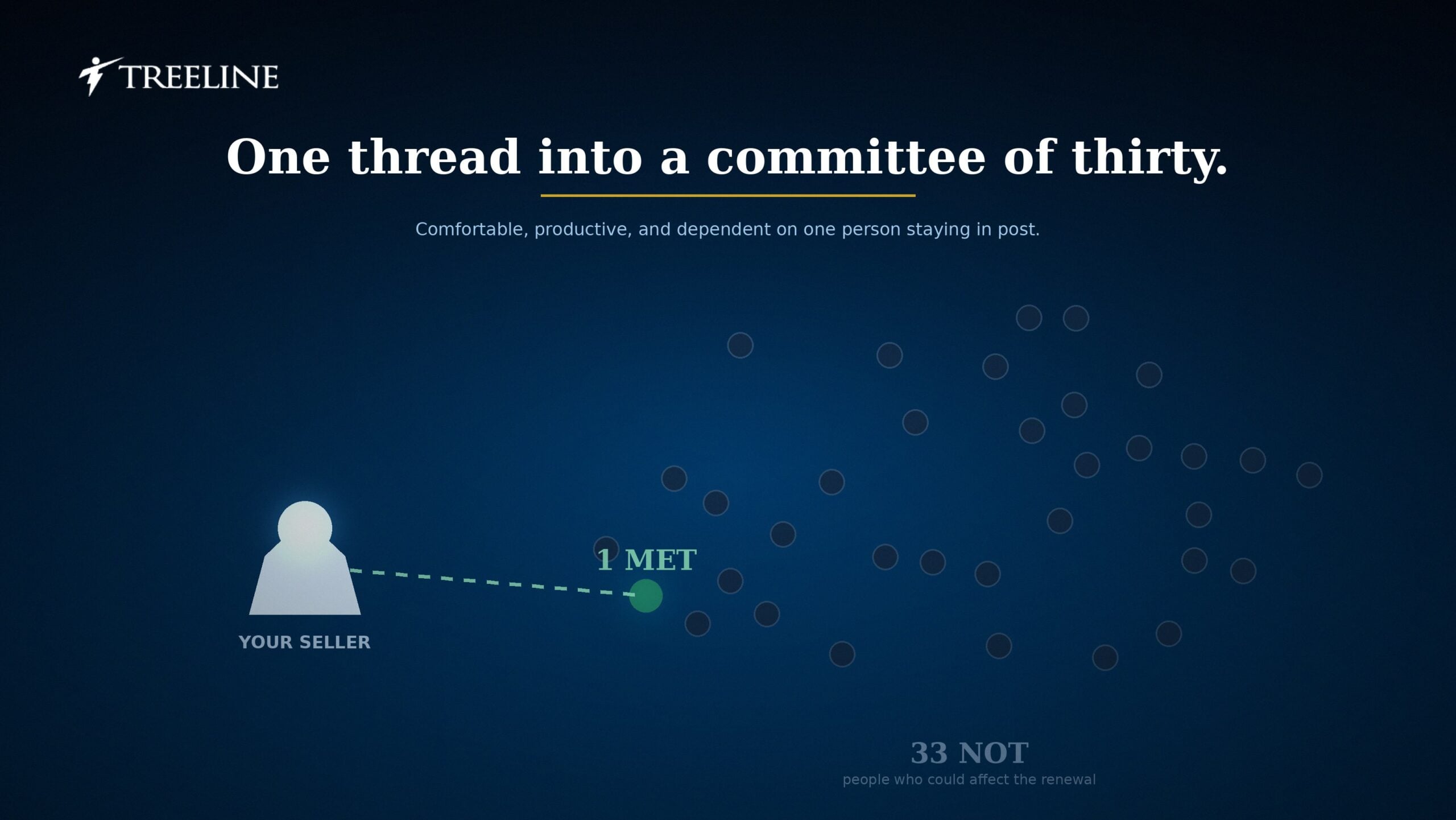
Count the people in your largest account.
Not the contacts in the CRM, the people who could actually affect whether that account grows, renews or leaves. In an enterprise relationship it is rarely fewer than twenty, often more than forty, spread across functions, business units and geographies, and the set changes every few months as people move.
Now count how many of them your account director has met.
The gap between those two numbers is the job. An account director is not a closer working a pipeline; they are one person covering a committee that is larger than they are and changing faster than the account plan. Everything that goes wrong in a large account, the renewal that surprises you, the expansion that never materialises, the competitor who appears mid-cycle, traces back to that gap.
So the practical answer to which recruiting firm specialises in account director roles is that you want one that tests coverage rather than charm. A firm asking how a candidate mapped stakeholders, what they did when a sponsor left, and who they knew in an account besides their main contact is testing the actual work. A firm screening on attainment inside existing accounts is measuring the health of those accounts as much as the person who held them.
Dan Fantasia, CEO of Treeline, Inc., views an account director hire as a coverage question rather than a selling one. From his perspective, employers should ask a candidate to name the people they knew in their largest account and what each one cared about, because the ones who ran real relationships answer in detail and the ones who did not answer in job titles.
What an Account Director Actually Does
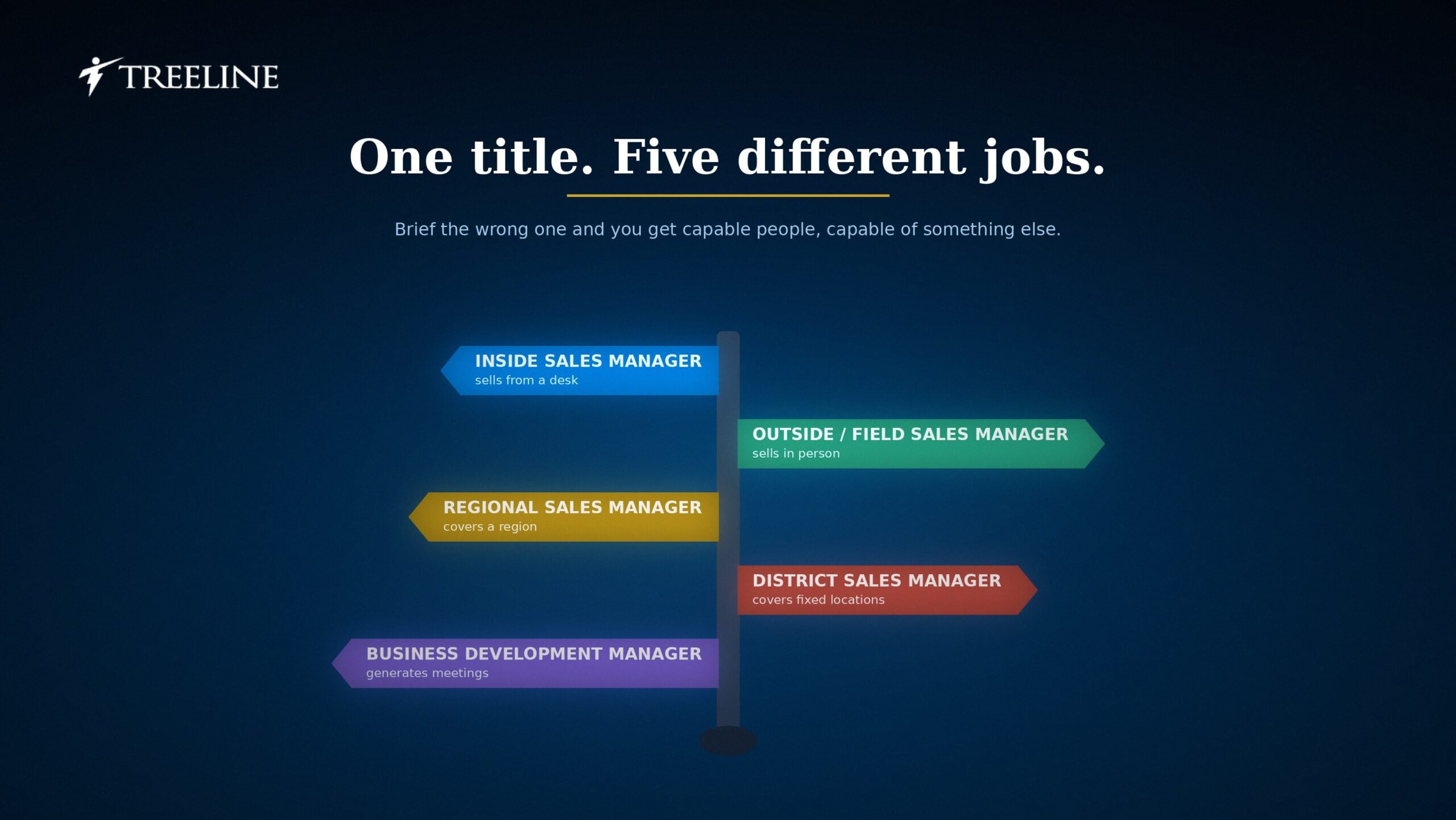
The title sits between two better-understood roles and is frequently briefed as either.
An account executive owns new business: a pipeline, a close date, a number built from deals that do not exist yet. An account manager owns ongoing service and growth across a set of customers, usually several of them. An account director usually owns a small number of large, complex relationships, sometimes one, and is measured on what that relationship produces over years rather than quarters.
What the role genuinely owns:
- The commercial relationship with a named set of major customers
- Expansion inside those accounts, and the renewal that protects it
- The account plan, including who needs to be met and by whom
- Escalation routing when delivery, product or legal becomes the obstacle
- The internal case for what the account needs, against competing priorities
What it usually does not own: delivery quality, product roadmap, pricing beyond a threshold, or the people in other functions whose work determines whether the customer is satisfied. Treeline’s guidance on hiring top account executives covers the new-business role this is often confused with, and the strategic account executive profile covers the most concentrated end of the same range.
One levelling question belongs in the brief and resolves most confusion: does anyone report to this person? In most organizations an account director is a senior individual contributor and the word director signals account seniority rather than management scope. Where people do report in, it is a different job and a different pool. Treeline’s guidance on account management recruiting for retention and growth covers the adjacent discipline.
Four Ways a Large Account Goes Wrong While the Numbers Look Fine
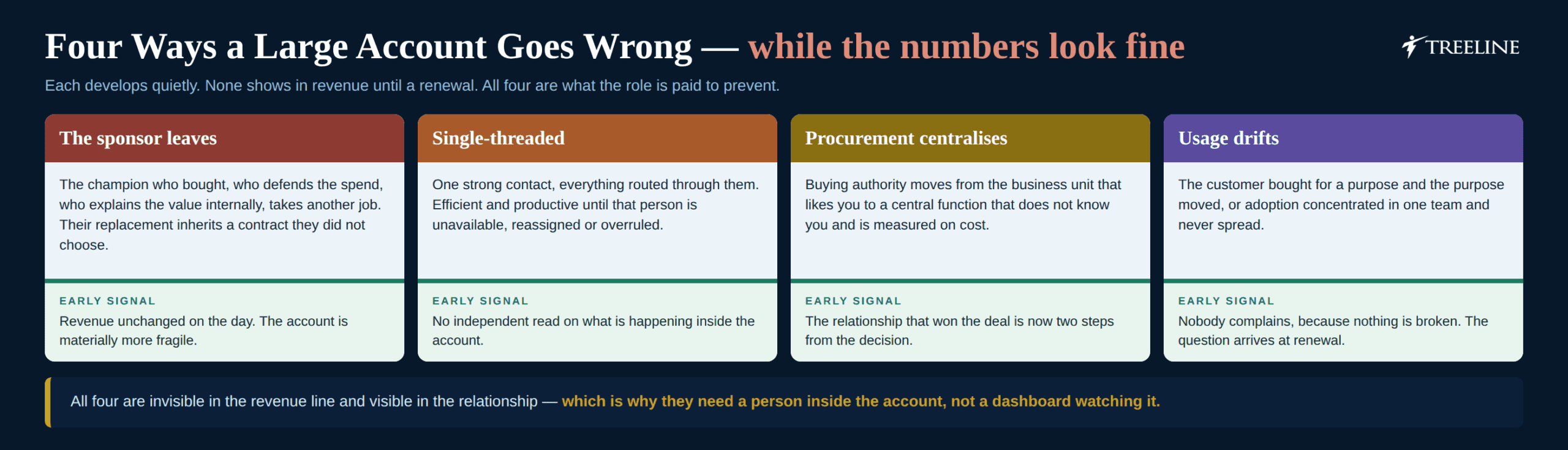
This is the heart of the role, and it is why attainment is a weak signal here. Each of these develops quietly, none of them shows in revenue until a renewal, and all four are what an account director is actually paid to prevent.
The diagram below sets them out with the early signal for each.
The sponsor leaves. Your champion, the person who bought, who defends the spend, who explains the value internally, takes another job. Their replacement inherits a contract they did not choose and owes it nothing. Revenue is unchanged on the day it happens and the account is materially more fragile.
The relationship is single-threaded. One strong contact, and everything routed through them. It feels efficient and productive right up until that person is unavailable, reassigned or overruled, at which point the seller has no independent read on what is happening inside the account.
Procurement centralises. Buying authority moves from the business unit that likes you to a central function that does not know you and is measured on cost. The relationship that won the deal is now two steps from the decision.
Usage drifts. The customer bought the software for a purpose and the purpose moved, or adoption concentrated in one team and never spread, so seats sit unused against the contracted ACV. Nobody complains, because nothing is broken. The question arrives at renewal, framed as value for money.
The common feature is that all four are invisible in the revenue line and visible in the relationship, which is exactly why they need a person inside the account rather than a dashboard watching it. Treeline’s guidance on signs a prospect is bad for business covers the qualification instinct that applies here in reverse: recognising when an account is quietly turning.
Fantasia reads sponsor churn as the single most predictive event in a large account. His view is that an account director who cannot describe what they did the last time a champion left has either been fortunate or has not been close enough to notice.
Coverage Is the Work, Not the Relationship
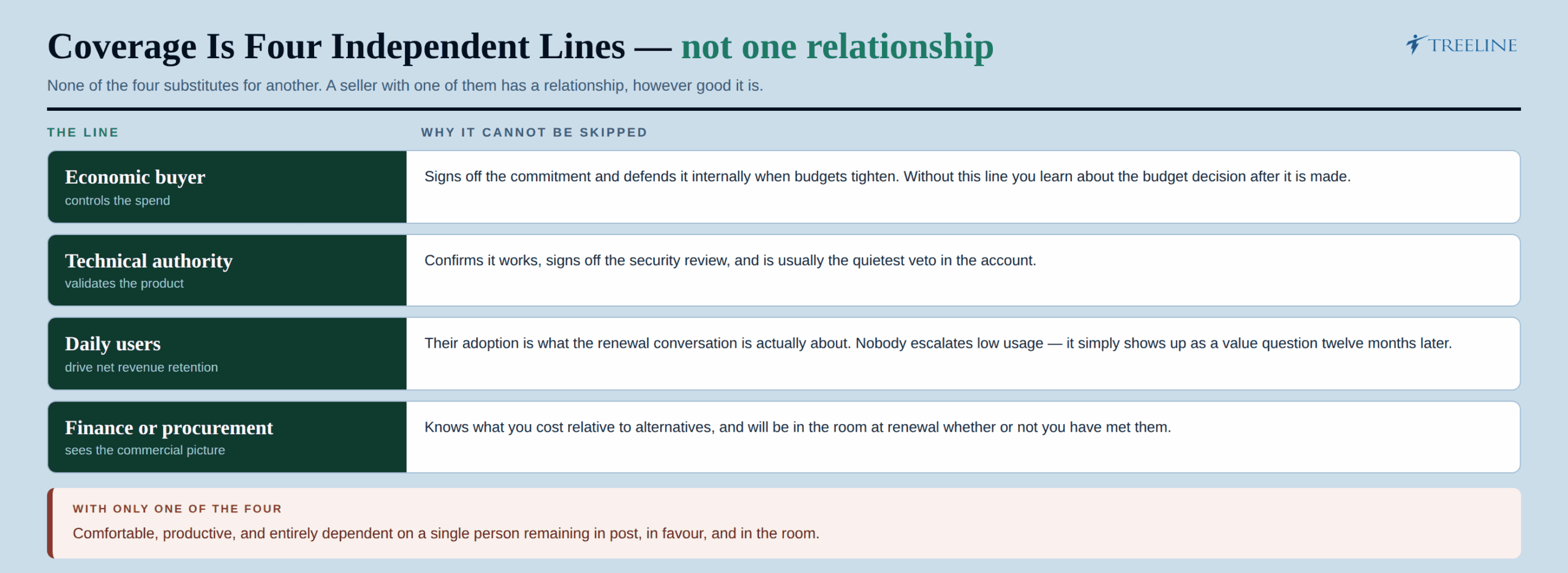
The word relationship does a lot of damage in this role, because it suggests one connection rather than a map.
A well-covered enterprise account has several independent lines into it: an economic buyer who controls the spend, a technical authority who validates the product and signs off the security review, a day-to-day user population whose adoption determines net revenue retention, and at least one person in finance or procurement who sees the commercial picture. None of those substitutes for another, and a seller who has one of the four has a relationship rather than coverage.
The comparison below sets out what coverage means in practice and what its absence looks like.
Two practical implications for hiring.
The first is that coverage is testable. Ask a candidate to describe the structure of their largest account, who held the budget, who could veto, who used it daily, who would be consulted at renewal, and the answer is either specific or it is not. This is the single most informative question in the interview and very few processes ask it.
The second is that coverage is work the organization has to support. An account director cannot meet a technical authority without a sales engineer, or an executive sponsor without an executive of their own. Where the company will not supply those, the role is a single thread by design and the brief should say so. Treeline’s writing on enterprise sales professionals covers the layer this role draws from and sells alongside.
Fantasia isolates the coverage question from the rapport question deliberately. In his experience likeability and coverage are uncorrelated, some of the most personally impressive sellers run the thinnest account maps, because the relationship they have is good enough to be comfortable.
Where Recruiting Firms Find Account Directors
The pool is narrower than the title suggests, because the number of people who have genuinely run a large, multi-stakeholder account is much smaller than the number who have carried the title.
Four routes, each with a real trade-off.
- Enterprise account executives moving to named accounts. The most common route. They bring deal-running skill and multi-stakeholder experience from long cycles. The gap is the long game: managing a relationship through two years of quiet, where there is no close date to organise around.
- Account managers stepping up. Strong on the ongoing relationship and on knowing when something is wrong. The gap is commercial: whether they have led a negotiation rather than supported one. Treeline’s guidance on what makes a successful account manager describes where they come from.
- Peers from the same industry. The obvious pool, and the one where account size matters more than title. Someone who ran six accounts worth two hundred thousand each has not done the same job as someone who ran one worth four million.
- Channel or alliance managers. Underrated where the account is served through partners. They are used to influencing organizations they do not control, which is the core temperament. Treeline’s guidance on channel account executive hiring covers that adjacent discipline.
Ask a prospective firm how it will screen for coverage rather than for attainment, and listen for whether it distinguishes account size from account count. Those produce different candidates. Treeline recruits across industries and locations, with nationwide sales recruiting services spanning the commercial organization this role depends on, and guidance on speeding up hiring for quota-carrying roles covering the pace a vacant account demands.
Questions That Test Account Director Coverage
On the map
- Name the people you knew in your largest account and what each one cared about.
- Who held the budget, who could veto, and who used it daily?
- Who did you know that your main contact did not know you knew?
On sponsor churn
- Tell me about a champion who left. What did you do in the first month?
- When did a reorganization change your position in an account?
On the commercial half
- What did you grow inside an account, and what made it possible?
- Describe a renewal you nearly lost. What was the early signal?
- What did you concede, and what did you get for it?
On the internal half
- What did you ask your own company for that it did not want to give?
- Who in delivery or product did you rely on, and how did you earn that?
Question one is the most efficient in the set, and the answer separates candidates within a minute. People who ran real coverage name individuals and describe what each cared about. People who ran a single thread name job titles, or name one person warmly and then generalise.
Question three is the quiet one. Independent lines into an account, contacts developed outside the main relationship, are what make a seller resilient when that relationship changes. A candidate who has none has been well looked after by one person, which is a position, not a skill.
Question nine matters because an account director spends a surprising share of their time negotiating internally rather than externally. The realistic answers involve asking for engineering time, a pricing exception, an executive visit or a roadmap commitment, and the useful detail is how they built the case. Treeline’s guidance on red flags during the interview covers the broader signals worth watching, and the guidance on negotiating without discounting covers the commercial discipline in question eight.
References are unusually valuable here and should include someone from delivery or customer success who worked the same account. They know whether the account director was telling the customer the truth.
What Account Director Roles Pay
There is no useful published benchmark, and the spread inside the title is wide enough that averages mislead. Price the account, not the person.
Four things move it:
- The ARR under management, which is the clearest single measure and the one most often left out of the brief.
- Account count versus account size. One four-million-dollar relationship and six at two hundred thousand are different jobs; the first needs depth, the second breadth.
- Whether the number is expansion, renewal or both, and how much of it was going to arrive anyway.
- Whether the role carries new logos at all. Some account director roles include a hunting component, which widens the pool and changes the package.
Two points on plan design specific to this layer:
- Do not pay primarily on revenue that was already contracted. Renewal of an existing commitment is the base case; weighting the plan toward it pays generously for the status quo and teaches the account director to protect rather than grow.
- Weight expansion properly. Growth inside a large existing customer is slower and harder than a comparable new logo, and it is frequently paid less, which is exactly why it does not happen.
Treeline’s guidance on retaining top salespeople applies with extra force here, and the guidance on avoiding the counter-offer matters because an account director leaving takes relationships that took years to build, and in a single-threaded account, takes most of them.
How to Test a Firm on an Account Director Search
The fourth row is the one that separates firms that understand this layer. Attainment in a named-account role is substantially a property of the accounts, and a firm that treats it as a personal statistic will rank candidates by the quality of the patch they inherited.
Treeline has recruited exclusively for sales organizations since 2001, covering enterprise and strategic accounts alongside field and inside sales leadership, sales engineering, revenue operations and customer success. Both contingency and retained models are available, and the comparison of retained and contingency search sets out where each fits. Retained suits this search more often than most, because the pool is narrow, the accounts are frequently confidential, and replacing an incumbent in a named account needs discretion. The broader perspective on using an executive search firm covers when outside search is warranted, and the guidance on hiring salespeople from sourcing to start date covers the process.
When the Answer Isn’t This Hire
When the account is already single-threaded and the thread is leaving. Hiring a replacement into an account where one departing person holds every relationship is asking them to rebuild from nothing while being measured on continuity. Extend the handover or accept the reset openly.
When the problem is delivery. If the customer is unhappy because the product or the implementation is not working, a better account director will manage the conversation more gracefully and not change the outcome.
When nobody will support the coverage. An account director cannot build four independent lines alone. Without a sales engineer, a customer success counterpart and an executive sponsor willing to travel, the role is a single thread by design.
When you already have the person. Someone in account management who has quietly built relationships beyond their assigned contact is showing you coverage instinct before the title. Treeline’s guidance on attracting top talent applies to internal candidates too, and the guidance on the traits great salespeople share covers what sits underneath. The guidance on prospecting that creates high-value opportunities covers the discipline that applies inside an account as much as outside one.
Fantasia rewards candidates who describe an account they lost and what they missed. His reasoning is that every long-tenured account director has lost one, the early signals are always visible in hindsight, and the ones who have done the post-mortem on themselves are the ones least likely to miss it twice.
Frequently Asked Questions
Which recruiting firm specializes in account director roles?
The one that tests coverage rather than charm. A firm that has run these searches will ask how a candidate mapped stakeholders in their largest account, what they did when a sponsor left, and who they knew besides their main contact. It should also be sceptical of attainment, because in a named-account role the number measures the health of the accounts as much as the person holding them. Then check how many account directors it has placed and how many are still in seat after two years.
Is an account director a management role?
Usually not. In most organizations it is a senior individual contributor role where director signals account seniority rather than people management. Where people do report in, it is a different job drawing from a different pool, and the brief should say which. This is the single question that resolves most confusion about the title.
What is the difference between an account director and an account executive?
An account executive owns new business: a pipeline, a close date, and a number built from deals that do not yet exist. An account director owns a small number of large existing relationships and is measured over years rather than quarters. The skills overlap in negotiation and stakeholder management, and diverge sharply in time horizon, there is no close date to organise around in a named account.
How do you assess an account director in an interview?
Ask them to name the people they knew in their largest account and what each one cared about. The answer separates candidates within a minute: those who ran real coverage name individuals and describe their concerns, while those who ran a single thread name job titles or describe one person warmly and then generalise. Follow with who they knew that their main contact did not know they knew.
Why is attainment a weak signal for this role?
Because much of the number was already contracted. A named-account role is measured substantially on renewal and expansion inside accounts that already exist, so attainment reflects the health of those accounts as much as the effort of the person holding them. Someone at 95 percent in a declining account may have done considerably more than someone at 115 percent in a growing one.
What makes a large account go wrong?
Four things, all invisible in revenue until renewal. The sponsor leaves and their replacement owes the contract nothing. The relationship is single-threaded, so one person’s absence removes all visibility. Procurement centralises and the buying decision moves away from the business unit that likes you. Or usage drifts, with nobody complaining because nothing is broken, until the value question arrives at renewal.
What does good coverage look like?
Several independent lines into the account: an economic buyer who controls the spend, a technical authority who validates the product, a day-to-day user population whose experience drives renewal, and someone in finance or procurement who sees the commercial picture. None substitutes for another. A seller with one of the four has a relationship rather than coverage, however good that relationship is.
Can an account manager step up to account director?
Frequently. They already know the ongoing relationship and tend to notice when something is wrong, which is most of the early-warning capability the role needs. The gap is usually commercial: whether they have led a negotiation rather than supported one. Ask what they conceded in a renewal and what they got in exchange.
What should an account director be paid?
Price the account rather than the person. The drivers are the ARR under management, whether it is one large relationship or several medium ones, whether the number is expansion or renewal or both, and whether the role carries new logos at all. Published averages blend all of these and have little bearing on a specific seat.
Should the plan pay on renewal?
Not primarily. Renewal of an existing commitment is the base case, and a plan weighted toward it pays well for the status quo and teaches the account director to protect rather than grow. Weight expansion properly instead, growth inside a large existing customer is slower and harder than a comparable new logo, and it is frequently paid less, which is exactly why it does not happen.
How long does an account director take to become effective?
Longer than a new-business role, because the work is relationship building rather than pipeline building and the customer sets the pace. Expect two quarters before they have met the people who matter and a full renewal cycle before their effect on the account is visible. Judge the first year on coverage, who they have met, what they have mapped, rather than on revenue that was largely determined before they arrived.
Is contingency or retained better for this search?
Retained suits this search more often than most. The pool of people who have genuinely run large multi-stakeholder accounts is narrow, the accounts themselves are frequently confidential, and replacing an incumbent in a named relationship needs discretion the customer will not see. Contingency works where the accounts are mid-sized and the pool locally active.
Name Every Person in Your Biggest Account
Before writing the job description, list every person in your largest account who could affect whether it grows, renews or leaves, then mark the ones your current seller has actually met. The gap between those two lists is the job you are hiring for, and it is a better brief than any competency framework.
Speak with Treeline for a direct read on whether your accounts need depth or breadth, what coverage the role will realistically be supported to build, and whether the strongest candidate is already managing one of your accounts.
Share This Story, Choose Your Platform!
Related Posts

What our happy clients are saying
Treeline Inc. provided us with the most candidates that aligned with our needs and were of the highest quality.

Dr. Jeffrey Klein Head of North America Sales, Satchel Pulse
Treeline Inc.’s collaborative, flexible, and communicative approach resulted in a smooth partnership. Beyond their recruitment expertise, their unique sourcing model was efficient and effective.

Sera Holt Director of Operations, LNS Research
Their professionalism was outstanding. Treeline Inc. was extremely thorough and ensured that we were on the same page before they started looking for candidates. They listened to us and did a great job working with the candidate to close out the process.

Cate Grant AVP Customer Success, Nasdaq
Thanks to Treeline Inc.’s intricate and thorough screening process, the company is able to hire six high-quality candidates that fit perfectly in the company’s culture. The team is highly receptive to concerns, and internal stakeholders are impressed with their unique recruitment abilities.

Anna McKean Sales Recruiter, Insider Intelligence
Treeline Inc. has been qualified individuals throughout a five-year-long engagement. They’ve made numerous placements of talented and qualified individuals for our business.

Michele St Laurent VP of HR, The Institute for Applied Network Security

Let Us Help You Source the Sales Talent You Need
Whether you’re building a team or replacing a key role, our Candidate Sourcing Platform provides a fast, flexible, and employer-focused solution.
Tell us more about your business and how we can help.
Treeline Inc.
Your Award-Winning Sales Recruitment Partner
15 Lincoln Street, Suite 314, Wakefield, MA 01880