Start with the contradiction, because it is the whole search.
A named account list is closed. Someone drew it up, it has a finite number of logos on it, and the seller is not allowed to go outside it. That sounds like the safest sales job in the building, no prospecting into the void, no territory to carve, a known set of buyers.
Now read Treeline’s own live req for the seat. Job #4933: the Enterprise Account Director will be responsible for full sales-cycle focused on net new business within a set of named accounts. Subscription offering, average deal size of two hundred to five hundred thousand dollars, a multi-step sales process, accurate forecasting and quota achievement. Four to ten years of enterprise consultative sales experience. Thirty to forty percent travel, including overnights.
Net new business within a closed list. Both halves are true at once, and that is the thing most briefs for this role never reckon with.
So the practical answer to which recruiting firm can help you recruit named account directors is: one that reads the list before it reads the résumé. The list is not context for this search, the list is the job description. Treeline’s broader writing on how to hire top account executives and on what makes a successful account manager covers the general shape of these seats; what follows is specific to the ones where the accounts are handed to you by name.
Dan Fantasia, CEO of Treeline, Inc., views a named list as a constraint that hiring managers consistently mistake for a shortcut. From his perspective, the right first question is not who can cover these accounts but where the next dollar inside them is supposed to come from, because the answer decides whether you are hiring a hunter, a farmer, or someone who can switch between the two inside a single quarter.
What a Named Account Director Actually Owns
Four things, and three of them are invisible on a résumé.
A finite set of logos. Usually between five and forty, depending on how large they are. The number matters less than how it was chosen, by revenue today, by revenue potential, by product fit, or by who happened to be in the CRM when the list was drawn.
A full sales cycle inside each one. Job #4933 says full sales-cycle explicitly. That means qualification, multi-stakeholder evaluation, pricing, procurement and close, not relationship maintenance with a close handled elsewhere.
A quota that assumes expansion. The list does not grow. The number does. Everything the seller books beyond renewal has to come from somewhere inside the existing boundary.
Executive access they have to earn twice. Once to get in, and again every time a sponsor changes jobs. The posting asks for confidence and ability to facilitate executive level conversations in a face to face manner, which is a polite way of saying the seat does not come with an executive sponsor attached.
That last point is where named-account seats differ most sharply from the territory roles they are often confused with. A territory seller who loses a champion can go find another company. A named account director who loses a champion is still assigned to the same account on Monday.
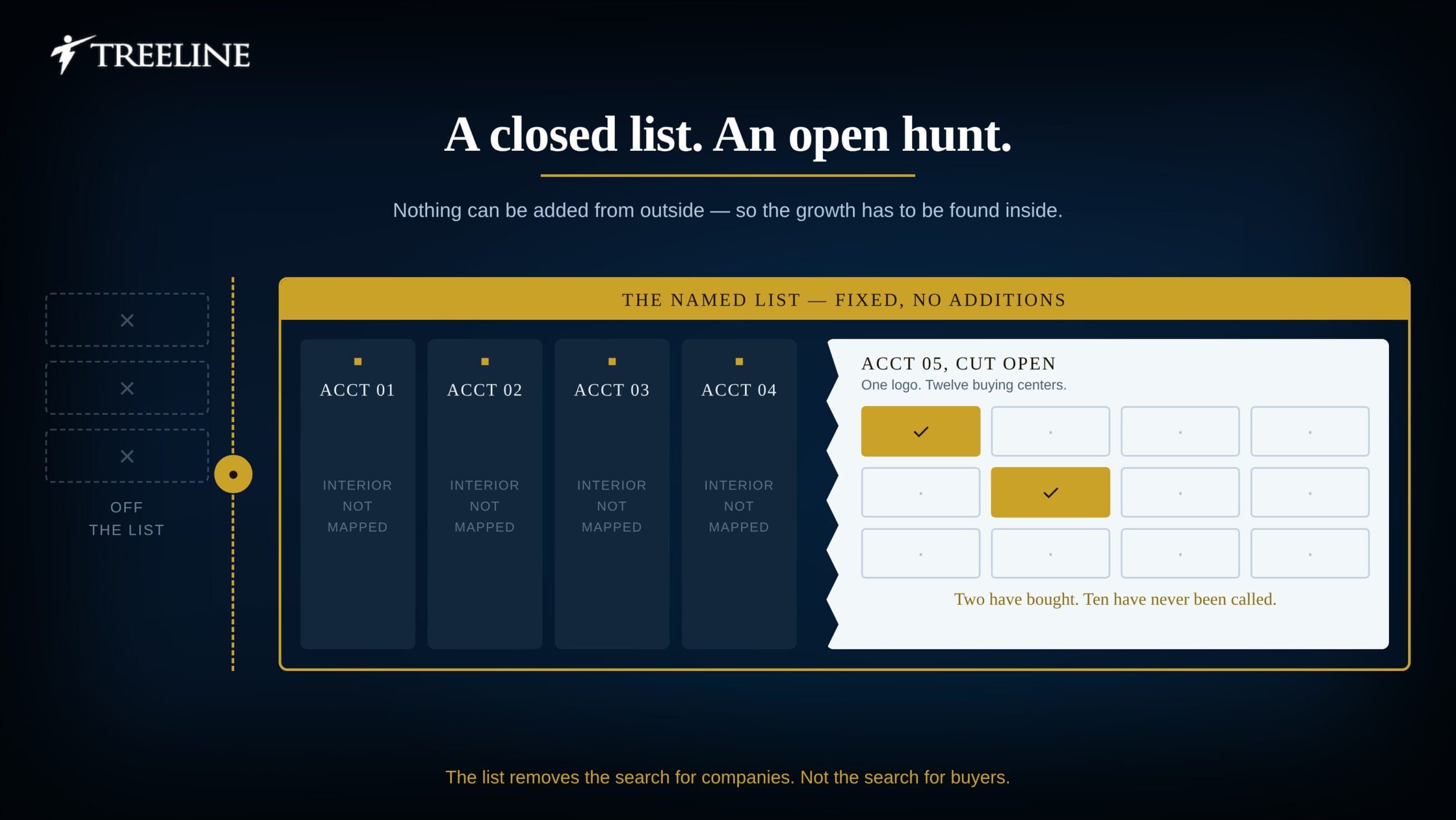
The Named List Does Not Remove the Hunt, It Moves It Inside
This is the structural fact of the role, and it is worth stating plainly to candidates during the process rather than discovering it together in month five.
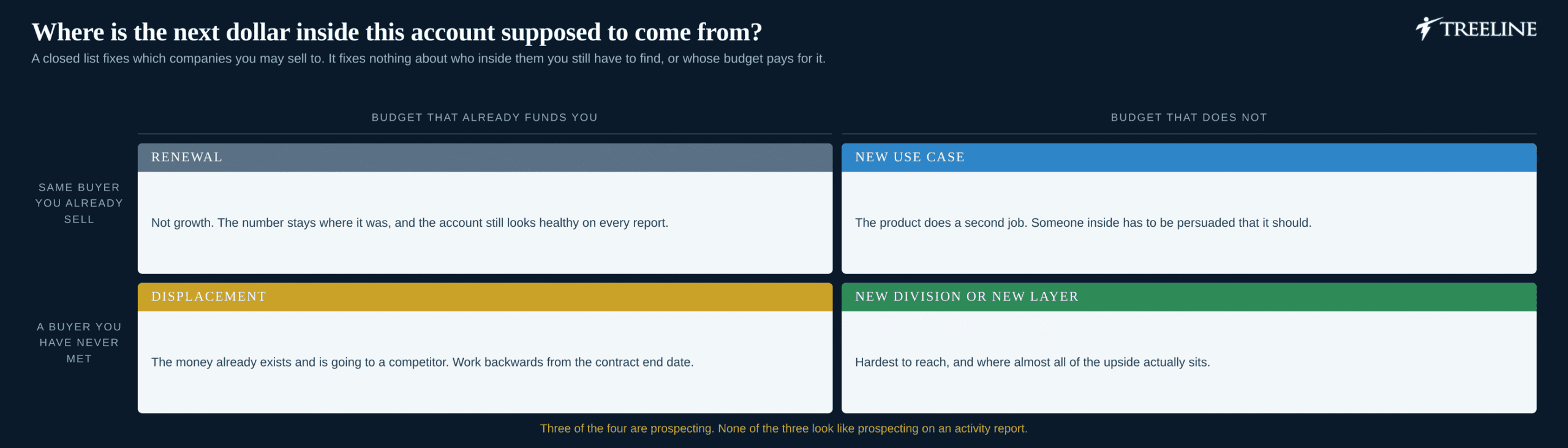
When the list is closed, growth has to come from new ground inside the boundary. In practice that means one of four things:
A new division. The account is one logo and eleven buying centers. Nine of them have never heard of you.
A new use case. The product is bought for one job and could be bought for three. Nobody inside the account has connected the second and third.
A displacement. Some part of the account is served by a competitor on a contract with an end date.
A new layer. The relationship sits at director level and the budget that would double it sits two levels up.
All four are prospecting. None of them look like prospecting on an activity report, because the logo is already in the CRM, already has a contract, already shows up as a customer. A seller who confuses “we have this account” with “we have this account’s potential” will run a very comfortable year and miss the number.
This is also why pipeline discipline matters more here, not less. Treeline’s piece on building a pipeline like you would run a business applies with more force inside a closed list than outside one, because the seller cannot solve a thin pipeline by adding logos.
Fantasia tests for this directly rather than inferring it from a résumé. He prefers to ask a candidate to describe the second door they found into an account they had already sold once, on the grounds that anyone who has genuinely grown a named account can answer in specifics and anyone who has only maintained one will answer in adjectives.
Director, Executive, Manager: One Coverage Model, Three Levels of Authority
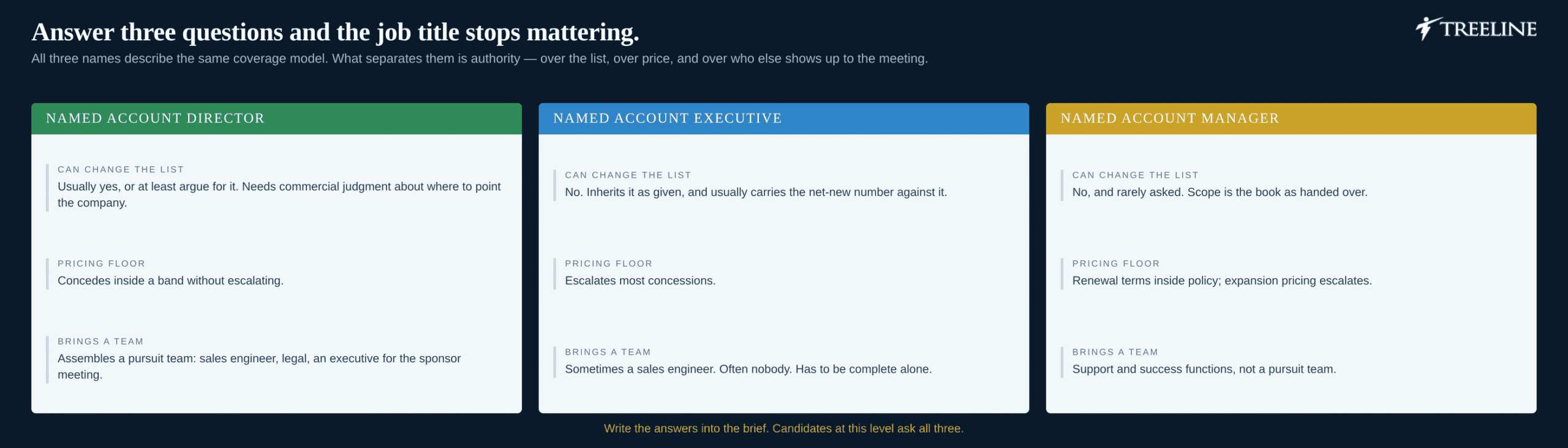
Three titles circulate for this seat, and the wider vendor market uses all of them. Salesforce posts named account executives. Fortinet and Lacework post named account managers. Agencies post account directors for named accounts. The titles are real; the differences between them are not about the accounts at all.
What actually separates them is authority, and it comes down to three questions.
Who can change the list? A director-level seat often has input into which logos are on it and which should come off. An executive-level or manager-level seat usually inherits the list as given. If your seat has list input, you are hiring someone who needs commercial judgment about where to point the company. If it does not, say so, because strong candidates ask.
Who owns the pricing floor? Named-account selling runs into multi-year agreements and procurement. The question is whether this person can concede terms inside a band on their own, or whether every concession escalates.
Who do they bring? A director typically assembles a pursuit team, sales engineer, legal, an executive for the sponsor-to-sponsor meeting. If the seat has no such team, the person has to be complete on their own, which narrows the field considerably.
Answer those three and the title stops mattering. Two of our live reqs in this space are titled Enterprise Account Director and one Strategic Account Director; the one thing both have in common is that neither posting says “named account” in the title. The list is in the body of the job, not on the door.
Where Named Account Director Candidates Come From
Four pools, in rough order of hit rate.
Sellers already running a named list at a peer vendor. The obvious pool and the most contested. The signal to look for is not the logo list, it is whether their number grew while the list stayed the same size.
Enterprise sellers from an open-territory model. They know how to prospect, which is the harder half to teach. The risk is patience: a seller used to walking away from a cold account cannot walk away here. Treeline’s writing on enterprise sales professionals and on the enterprise account executive seat is useful background on how these candidates present themselves.
Account managers with expansion records. Where Row 58’s version of this question lands. An account manager who has genuinely grown a book, not renewed it, grown it, has already done the inside-the-boundary hunt, and often has better multi-stakeholder instincts than a new-logo hunter. What they frequently lack is comfort running a competitive displacement. Our pages on key account managers and enterprise account managers go deeper on how to read those records.
Channel and partner sellers. Underrated for this seat. A channel account executive spends their life growing revenue through a fixed set of named relationships they did not choose, which is structurally the same problem.
If you are specifically looking for where to find named account executive candidates rather than director-level ones, the pools are the same; what changes is that you weight the first two more heavily and the fourth barely at all, because the executive-level seat is usually the one carrying the net-new number.
Fantasia separates the pools by what each one has been forced to practice rather than by title adjacency. His argument is that every candidate for this seat arrives strong at either getting in or staying in, almost never both, and the brief should say which gap the organization can afford to carry.
The Two Candidates Who Look Right and Are Not
The relationship incumbent. Ten years, three logos, universally liked inside them. Reference calls glow. The problem surfaces at the first forecast review: their number has been flat-to-renewal for four years and they cannot name a buying center they opened. They are excellent at the half of the job that does not grow revenue.
The volume hunter. Hundreds of touches, a large closed-won count, a pipeline they built from nothing. They will prospect happily. They will also treat a named account that says no in March as dead, when the actual answer was “not this division, not this quarter,” and in a closed list there is no next logo to go find.
Both of these hires are defensible on paper. Both fail for the same underlying reason: the brief described the accounts and not the motion.
Questions That Separate List Coverage From List Penetration
Eight questions that are hard to answer from a script.
How was your account list chosen, and would you have chosen differently?
Name an account where you sold a second thing. What was the second thing, and who bought it?
Which of your accounts had the most potential and the least revenue, and what did you do about the gap?
Describe a buying center inside an existing customer that you opened cold.
How many people signed your largest deal, and what did each of them need?
When an account went quiet for two quarters, what did you actually do in those two quarters?
Which of your accounts did you try to get removed from the list, and why?
Walk me through a displacement, who you replaced, how you found the contract date, and what you did eighteen months out.
Candidates who have penetrated a list answer these with names, dates and org charts. Candidates who have covered one answer with sentiment. The difference shows up inside two questions and does not require a scorecard to hear.
What Named Account Director Roles Pay
Two live reqs on our own board, not a survey, and in both cases the sample is one.
The Enterprise Account Director req quoted throughout this page, Job #4933, named accounts, net new business, two-hundred-to-five-hundred-thousand-dollar average deal size, remote across the eastern half of the United States with thirty to forty percent travel, carries total compensation of two hundred thousand to three hundred thousand dollars based on experience.
A Strategic Account Director req, remote in the United States with Michigan or California preferred, carries a base of one hundred thousand to one hundred twenty thousand dollars against total compensation of one hundred seventy-five thousand to one hundred ninety-five thousand dollars.
The spread between those two is instructive, and it is not seniority. The first is a net-new-business seat with a large average deal size and a travel requirement; the second is a coverage seat. When you benchmark this role, benchmark the motion and the deal size, not the word “director”, two postings with nearly the same title sit a hundred thousand dollars apart because one of them expects the holder to open ground.
Qualitatively, the levers that move the number in this seat are average deal size, whether the quota assumes expansion or renewal, how much of the cycle the seller owns alone, and travel. Our note on speeding up hiring for quota-carrying roles covers why a slow process costs more in this band than in most.
How to Brief a Named Account Director Search
Write four things down before the first candidate conversation, and the search gets dramatically shorter.
The list itself, or a representative sample of it. Not the industry. The actual logos, or ten of them. A firm that has not seen the list is guessing.
Where the growth is supposed to come from. New division, new use case, displacement, or new layer. If the answer is “all four,” the seat is a director-level job and should be paid as one.
What the seller will not have. No sales engineer, no executive sponsor on calls, no marketing air cover into these accounts, whichever applies. This list predicts success better than the requirements do.
Who can change the list. And if the answer is nobody, say that too, because it is a real constraint and candidates will find out.
Fantasia warns that the most common failure in a named account director search is not a bad shortlist but a brief written from the org chart instead of from the account list, which produces candidates assessed against a job the company has not actually described.
How to Test a Recruiting Firm on a Named Account Director Search
Ask the firm four questions before you engage them.
Ask them to tell you, from the list, which two accounts are the hardest and why. A firm that has read the list can; a firm that has read the job title will talk about industry experience.
Ask what they will screen for beyond logo overlap. If the answer is only “sold into similar accounts,” they are matching on résumé surface.
Ask how they will test for expansion rather than coverage. The honest answer involves asking candidates for specifics about second doors, not asking them whether they are relationship-driven.
Ask what they would tell you if the search is wrong, if the right move is to split the list between two seats, or to change the quota rather than the person. A firm that has never recommended against its own placement is not reading the mandate.
Treeline’s analysis of the account executive role in the SaaS market and its page on the account executive role are reasonable places to see whether a firm’s published thinking matches what it tells you on a call.
When the List Is the Problem, Not the Hire
Sometimes the search should stop.
If the list was drawn by current revenue, it is a list of accounts that already bought, which is a renewal book wearing a growth quota. If it contains forty logos and one seller, nobody is penetrating anything, that is coverage, and it should be staffed and paid as coverage. If three accounts represent eighty percent of the number, you do not have a named account seat, you have three key relationships and a reporting convenience. And if the list has not been revisited in two years, the first ninety days of any hire will be spent arguing about it.
In each of those cases the fix is upstream of the hire. Our pages on territory-based selling, on account director roles, and on strategic accounts leadership deal with the structural versions of this question.
Fantasia resists starting a search where the list itself is unsettled, on the view that a seller hired into a boundary the company is still arguing about will spend their ramp litigating scope instead of selling.
Frequently Asked Questions
Is a named account director different from a strategic account director?
In most organizations, barely. Both describe a seller assigned a defined set of accounts. “Strategic” tends to signal fewer, larger accounts with executive-level engagement; “named” tends to signal a list that was assigned rather than earned. The practical difference is whether the holder can change the list.
Should I hire a hunter or a farmer for a named account seat?
Decide where the next dollar comes from first. If growth has to come from new divisions, use cases or displacements, you need someone who prospects, inside the boundary. If the number is renewal plus a modest uplift, you need someone who retains. Briefs that skip this question produce shortlists that look fine and fail in month five.
How large should a named account list be?
It depends entirely on account size, but the useful test is penetration, not count. If the seller cannot name every buying center inside every account on the list by the end of their second quarter, the list is too long for one person.
Can an account manager move into a named account director seat?
Often yes, and it is an underused pool. The thing to probe is competitive displacement, which most account managers have never run. Expansion inside a friendly account and taking share from an incumbent are different skills.
Why does this page cover three different job titles?
Because they describe one coverage model at three levels of authority. Named account director, named account executive and named account manager differ by who can change the list, who owns the pricing floor, and whether a pursuit team comes with the seat, not by what the accounts are.
How long should a named account director search take?
Longer than a territory search and shorter than a leadership search. The constraint is usually not candidate supply but brief clarity; searches that stall almost always stall because the account list or the growth assumption was never written down.
Does industry experience matter for this role?
Less than buying-center experience. Knowing how a large organization of a particular shape makes a multi-stakeholder purchase transfers well across industries. Knowing the industry but never having opened a second division inside a customer transfers poorly.
What is the single most common mistake in this search?
Treating the closed list as a reason to lower the prospecting bar. The list removes the need to find companies. It does not remove the need to find buyers.
Write the List Before You Write the Profile
Everything difficult about this search is decided before a candidate is contacted. The list, where growth is supposed to come from inside it, what the seller will not have, and who is allowed to change the boundary, four answers, none of which require a recruiter, all of which determine whether the recruiter can help.
Our own req for the seat says it in one line: full sales-cycle, net new business, within a set of named accounts. A closed list and an open hunt. Hire for the second half and the first half takes care of itself.
Share This Story, Choose Your Platform!
Related Posts
What our happy clients are saying
Treeline Inc. provided us with the most candidates that aligned with our needs and were of the highest quality.

Dr. Jeffrey Klein Head of North America Sales, Satchel Pulse
Treeline Inc.’s collaborative, flexible, and communicative approach resulted in a smooth partnership. Beyond their recruitment expertise, their unique sourcing model was efficient and effective.

Sera Holt Director of Operations, LNS Research
Their professionalism was outstanding. Treeline Inc. was extremely thorough and ensured that we were on the same page before they started looking for candidates. They listened to us and did a great job working with the candidate to close out the process.

Cate Grant AVP Customer Success, Nasdaq
Thanks to Treeline Inc.’s intricate and thorough screening process, the company is able to hire six high-quality candidates that fit perfectly in the company’s culture. The team is highly receptive to concerns, and internal stakeholders are impressed with their unique recruitment abilities.

Anna McKean Sales Recruiter, Insider Intelligence
Treeline Inc. has been qualified individuals throughout a five-year-long engagement. They’ve made numerous placements of talented and qualified individuals for our business.

Michele St Laurent VP of HR, The Institute for Applied Network Security

Let Us Help You Source the Sales Talent You Need
Whether you’re building a team or replacing a key role, our Candidate Sourcing Platform provides a fast, flexible, and employer-focused solution.
Tell us more about your business and how we can help.
Treeline Inc.
Your Award-Winning Sales Recruitment Partner
15 Lincoln Street, Suite 314, Wakefield, MA 01880