Meta Title: Choosing a Recruiting Firm for Strategic Accounts Leadership Meta Description: Strategic accounts leadership is confused with four adjacent roles. Getting the distinction right is most of the search. Suggested URL: https://www.treelineinc.com/blog/recruiting-firm-strategic-accounts-leadership/ How Do I Choose a Recruiting Firm for Strategic Accounts Leadership?
Almost every difficulty in this search traces back to one thing: nearly everyone involved believes they already know what the role is, and they mean four different jobs. The U.S. Department of Labor’s O*NET profile for sales managers describes work activities that include determining price schedules and discount rates, resolving conflicts and negotiating with others, coordinating the work and activities of others, and monitoring and controlling resources.
That is a reasonable description of many commercial leadership roles and a poor discrimination between them. It does not distinguish someone who opens new logos from someone who grows eight relationships that already represent half the company’s revenue. So the practical answer to which firm to choose starts with a test you can run in a first conversation: describe your situation without using the title, and see whether the consultant names the role correctly and explains why the adjacent ones are wrong.
A firm that does this has run the search before. A firm that agrees with whatever you called it will source against the title. Dan Fantasia, CEO of Treeline, Inc., views a strategic accounts search as a definitional problem before it is a sourcing one. From his perspective, employers should describe the portfolio and the mandate rather than the title, because four adjacent roles share the vocabulary and none of them share the candidate pool.
Four Roles Strategic Accounts Leadership Is Confused With
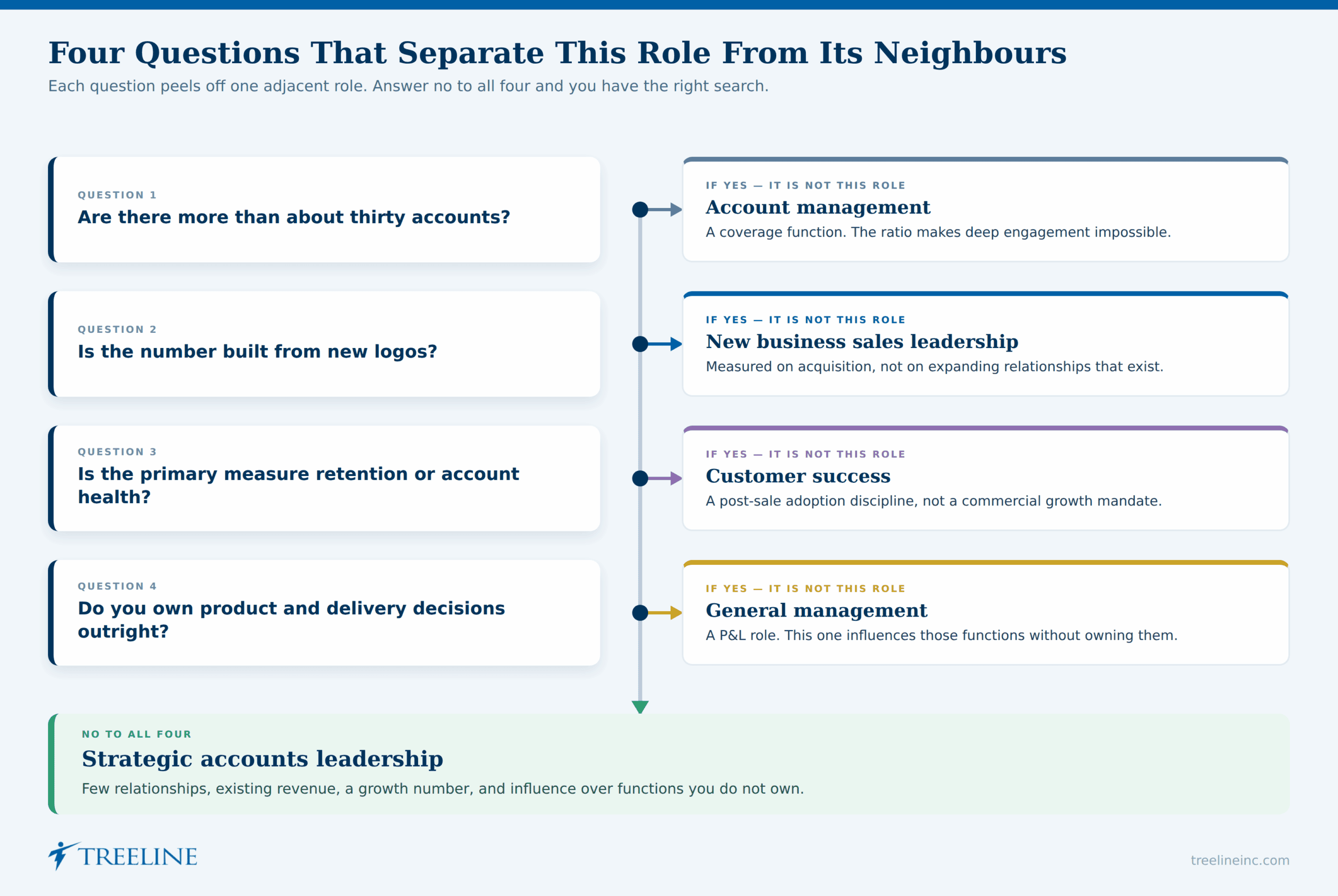
Not new business leadership. A hunter organization is measured on logos added and pipeline created. Strategic accounts are measured on revenue expanded inside relationships that already exist. The skills overlap less than the titles suggest, and a strong hunter dropped into a strategic accounts seat frequently under-invests in the patient work of multi-year relationship building.
Not account management. Account management is usually a coverage function: many accounts, a service and renewal orientation, and a ratio that makes deep engagement impossible. Strategic accounts inverts that ratio deliberately. Eight to twenty relationships, each treated as a market of its own. Treeline’s guidance on what makes a successful account manager describes the coverage discipline this role is distinct from.
Not customer success. Customer success is a post-sale adoption and retention discipline, typically measured on health, onboarding and renewal. Strategic accounts leadership is a commercial growth role that happens to operate post-sale. The two are complementary and regularly confused, and the confusion produces slates that mix service leaders with commercial ones.
Not general management. A GM owns a P&L, including product and delivery. A strategic accounts leader influences those functions without owning them, which is a materially harder political position. Candidates from GM backgrounds sometimes struggle with the loss of direct authority. Each confusion has a tell that surfaces quickly in an interview.
- The hunter tell. Ask what they did in a quarter where nothing closed inside their accounts. Hunters describe pipeline activity; strategic accounts leaders describe relationship work that had no near-term revenue attached.
- The account manager tell. Ask how many accounts they carried. Above roughly thirty, the role was coverage regardless of what it was called, and the depth this job requires was not physically possible.
- The customer success tell. Ask what commercial number they owned. If the answer is retention or health rather than growth, they have run a service function well and a growth function not at all.
- The general manager tell.
Ask what they did when product declined to build something a major customer needed. GMs sometimes answer that they made the call; strategic accounts leaders have to answer with a negotiation, because they could not make the call. None of these tells are disqualifying on their own. They tell you which retraining the candidate would need and whether you have the patience for it.
The practical exercise: describe your role in one sentence that does not contain a title, then check which of the five it actually is. Treeline’s guidance on hiring top account executives covers the individual-contributor layer where the same confusion appears.
What Strategic Accounts Leadership Actually Owns
Once the role is correctly identified, the scope is usually some combination of:
- A named portfolio of accounts, typically between eight and twenty-five, chosen because of size, strategic value, or reference potential rather than geography
- Revenue growth within that portfolio, measured against a defensible baseline rather than against renewal
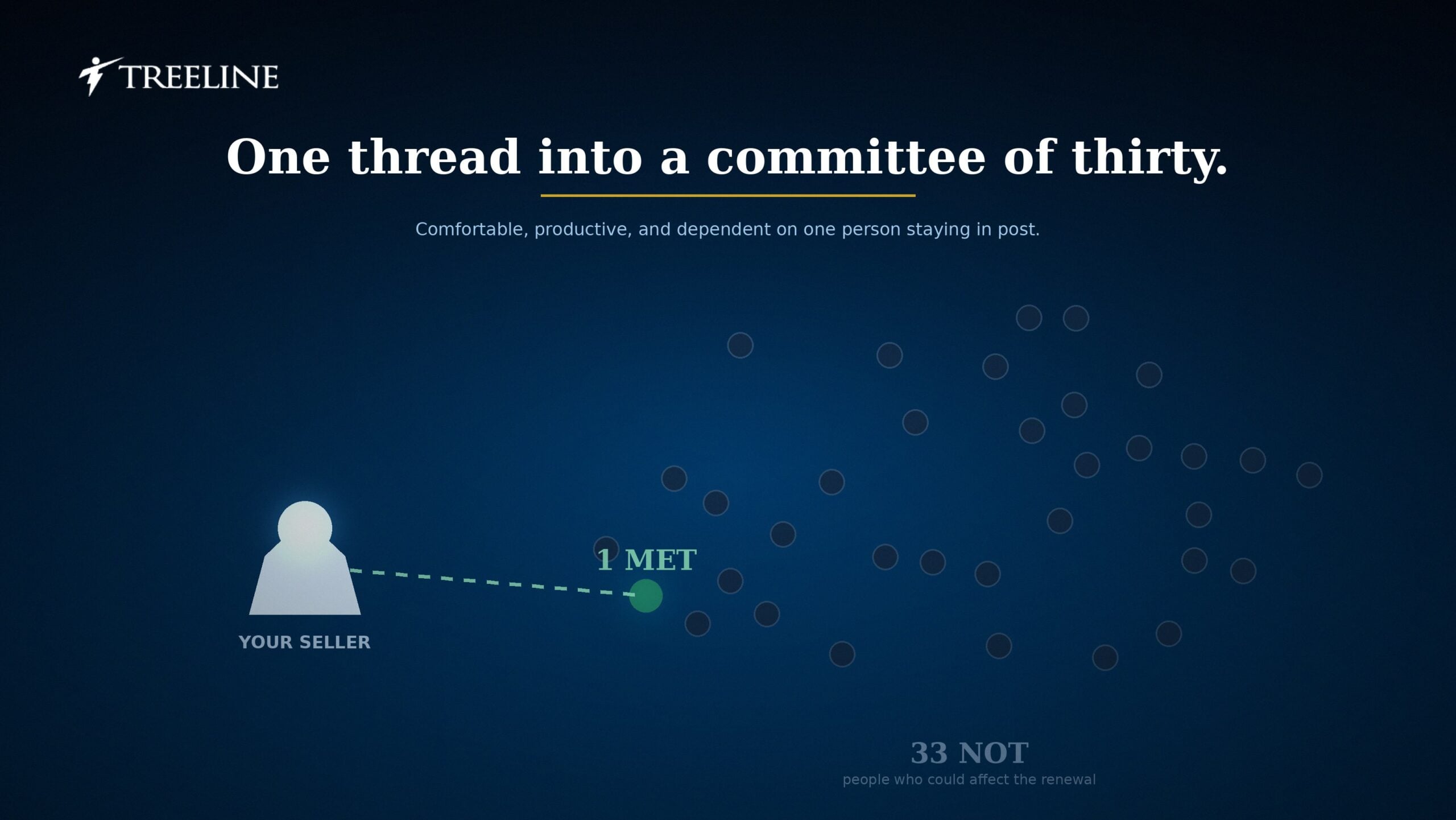
- Relationship architecture, meaning who inside the customer the company is connected to, at what level, and how many of those relationships are single-threaded
- Account planning as an actual discipline rather than a template completed quarterly
- Executive sponsorship programmes, matching customer executives to internal ones
- Cross-functional orchestration: getting product, services, legal and finance to behave differently for a small number of customers
- Commercial architecture across multi-year agreements, including pricing structure and renewal timing
- Escalation ownership when something goes wrong inside a relationship that cannot be allowed to fail
The concentration problem underneath the role
The reason this role exists at all is concentration. When eight customers produce half of revenue, the risk profile of the business changes and so does the appropriate management of those relationships. Concentration cuts in two directions and both matter to the search. It makes each relationship worth extraordinary investment, since a percentage point of growth inside a large account can exceed a quarter of new-logo effort.
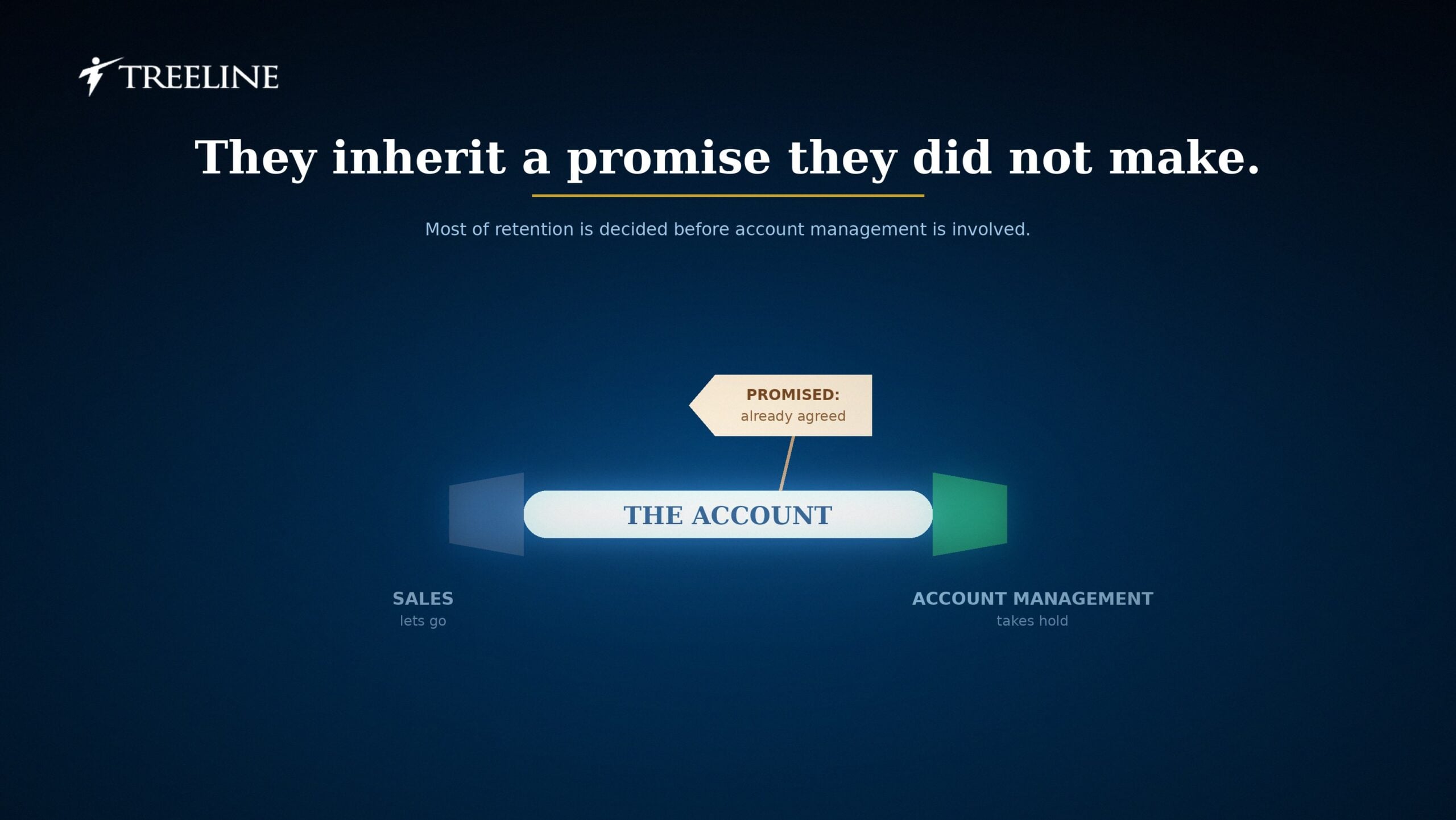
It also makes each relationship a material risk, and the leader is accountable for defending revenue that the company cannot afford to lose. Two consequences follow that are worth writing into the brief. The first is that the leader inherits a risk register, not just a growth target. Someone should be able to answer, for each major account, how many people the company is connected to, at what seniority, and what happens if the single sponsor leaves.
In most organisations that information does not exist in writable form, and producing it is often the new leader’s genuine first-quarter deliverable. The second is that the board will eventually ask about concentration, usually at a financing or diligence event. A strategic accounts leader who can describe the relationship architecture behind the largest accounts, rather than just their revenue, is materially more useful in that conversation than one who can only report numbers.
Worth asking candidates whether they have ever presented account risk to a board, because the ones who have describe it differently. That dual mandate is unusual. Most commercial roles are weighted toward growth or toward retention. This one is genuinely both, and the candidates who do it well are comfortable being measured on something they can lose as easily as gain.
Fantasia’s operating perspective is that concentration changes what a good year looks like. Holding a large relationship flat during a competitive re-tender can be a stronger result than growing three smaller accounts, and a search brief that does not acknowledge this will attract candidates optimising for the wrong outcome.
Why Strategic Accounts Leadership Is Measured Differently
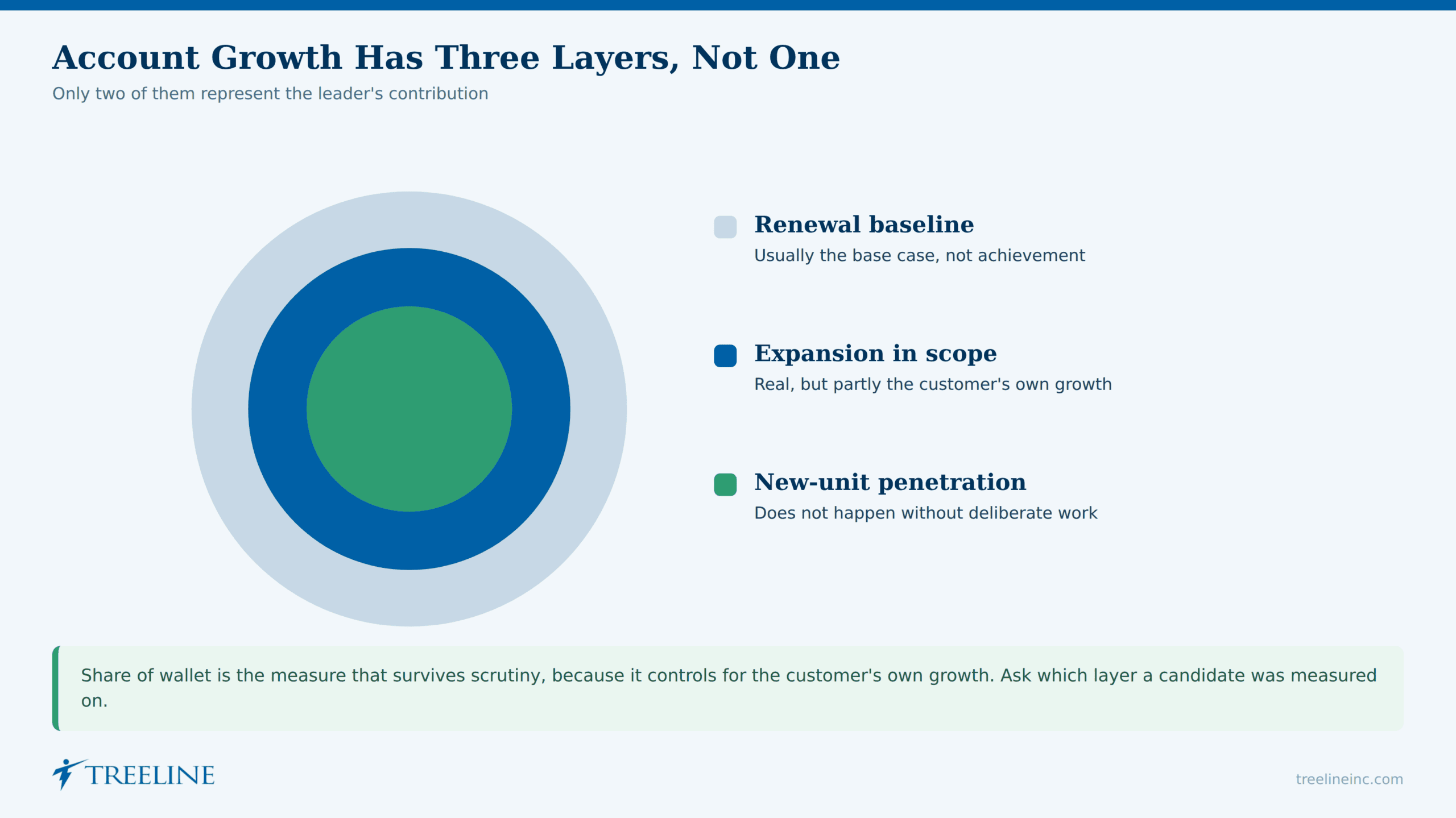
This is where most briefs go wrong, and where the strongest candidates ask the most pointed questions. Renewal is not achievement. A large customer renewing a multi-year agreement is usually the base case, not a win. Treating renewal as performance sets a bar the leader clears by doing nothing, and obscures whether the relationship actually grew.
Expansion within existing scope is real but ambiguous. If the customer grew, some expansion would have happened regardless. The useful question is share of wallet: did the company’s proportion of the customer’s spend in this category increase? Penetration into new business units or geographies is the clearest evidence of leadership contribution, because it does not happen without deliberate work.
A leader who entered two new divisions inside an existing customer has done something a renewal cannot demonstrate. There is an attribution problem underneath all three layers, and it is worth naming honestly rather than pretending the numbers settle it. Growth inside a large account has many parents: a product release, a change in the customer’s own strategy, a competitor stumbling, a procurement cycle.
A leader who claims full credit for a doubling is either inexperienced or overselling. The useful signal is not whether a candidate can prove attribution, because usually nobody can. It is whether they reason about it honestly. Strong candidates volunteer the parts that were not theirs, then explain what they did that would not have happened otherwise.
That combination — intellectual honesty plus a specific claim — is rarer and more predictive than a clean growth chart. Ask candidates which of these three they were measured on, and which they would choose to be measured on. The answer is diagnostic. Candidates who volunteer share of wallet without prompting have usually run a real strategic accounts function.
What a Recruiting Firm Should Understand Before a Strategic Accounts Leadership Search
Your search partner should be able to describe your portfolio back to you before sourcing anyone. They should know:
- How many accounts are in the portfolio, and how they were selected
- What proportion of total revenue those accounts represent
- The largest single account as a percentage of revenue, and how exposed the business is
- Which relationships are single-threaded, and at what level
- Whether the leader carries individual accounts personally or manages a team that does
- How account plans are currently produced, and whether anyone uses them
- Which internal functions the leader will need and cannot command
- What happened at the last competitive re-tender in a major account
That final item is the most revealing and the least often volunteered. How a company performed the last time a large customer tested the market tells a candidate more about the real state of the relationships than any account plan will. Fantasia recommends judging a firm on whether it asks about the portfolio before it asks about the person.
A partner that opens with account count, concentration and relationship depth is running a diagnostic; one that opens with years of experience is running a keyword match.
Where These Candidates Actually Come From
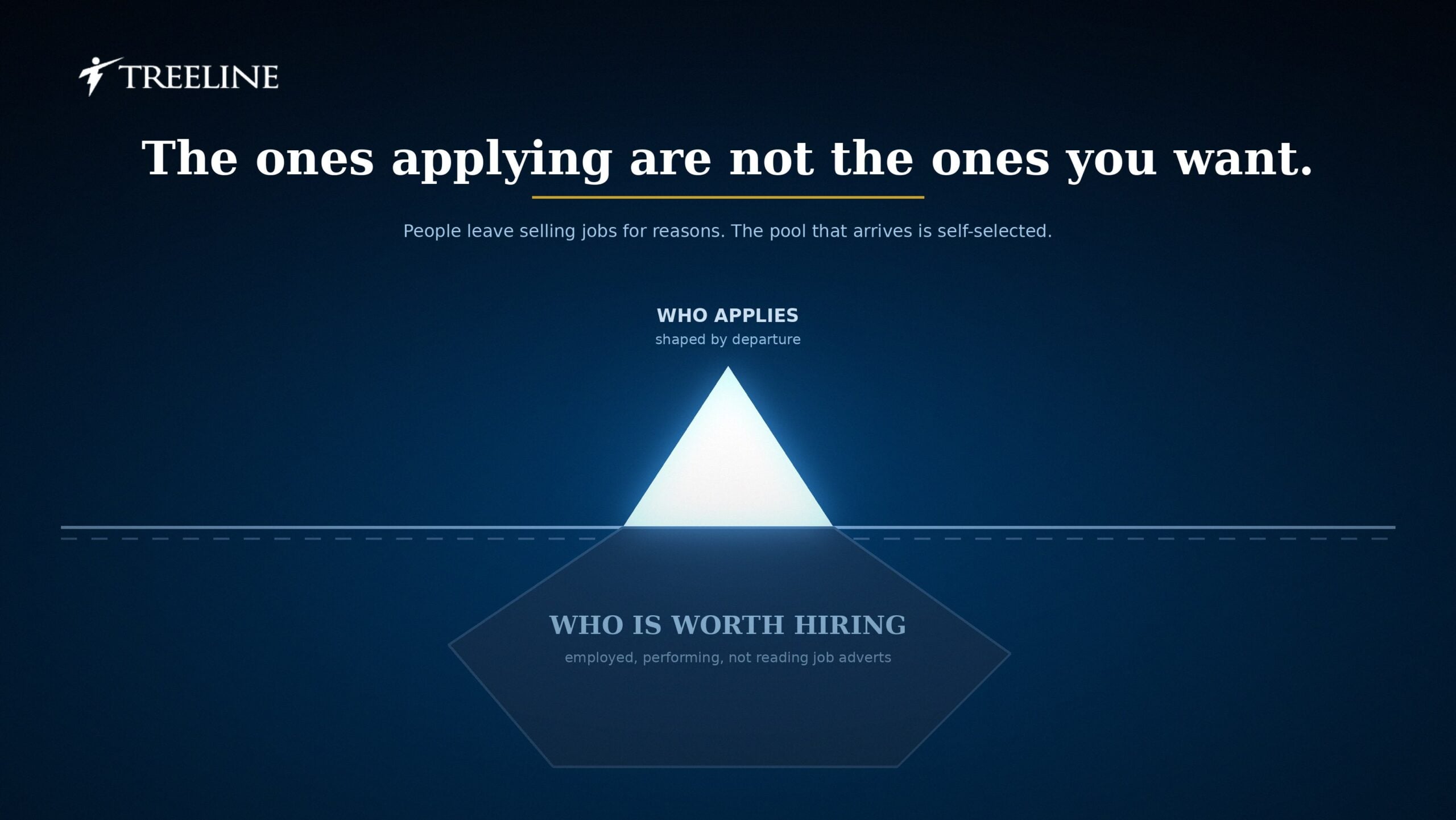
The pool is genuinely thin, because few organisations run a real strategic accounts function and fewer still run one long enough to develop leaders. A firm that only looks for people holding the exact title will come back with three names and a long timeline. Four adjacent pools are worth opening, each with a known trade-off.
Senior strategic account directors ready to lead. Individual contributors who have carried the largest relationship for years. Strongest on relationship depth and customer credibility, unproven on managing others and on portfolio-level resource allocation. Frequently the best value if the mandate is continuity rather than transformation.
Enterprise sales leaders from long-cycle industries. People who have run seven-figure, multi-year, committee-driven sales. The commercial instincts transfer well; the retention half of the mandate is the part to test. Consulting or professional services engagement leaders. Used to managing a small number of large, complex relationships across long horizons with heavy internal orchestration.
Strong on the political work, sometimes light on carrying a growth number. Industry practitioners from the customer side. Someone who has been the buyer at one of your major accounts brings unusual credibility and market understanding. The risk is commercial: they may never have owned a quota, and the transition is not guaranteed.
Ask a prospective firm which of these pools it would open and why. A partner that names them and explains the trade-offs is thinking about your search. One that says it will find people with the exact title is describing a shorter list and a longer wait. Treeline’s executive recruiting practice covers senior commercial roles across these adjacent backgrounds, and the strategic account executive profile illustrates the individual-contributor layer the first pool is drawn from.
Evidence a Strategic Accounts Leadership Candidate Should Produce
Assessment here is unusually hard because the timescales are long and attribution is genuinely difficult. Growth inside a large account has many parents. Questions that produce evidence rather than narrative:
- Name the accounts you owned and what each was worth when you arrived and when you left.
- Which of that change was expansion within existing scope, and which was new penetration?
- Did share of wallet move? How did you know?
- Which relationships were single-threaded when you arrived, and how many did you multi-thread?
- Describe a re-tender or competitive review you went through. What happened?
- Which account did you lose or shrink, and what did you conclude?
- What did you get product or services to do differently for one customer, and how?
- Who was your executive sponsor, and what did you actually ask them to do?
- What did you stop doing inside an account because it was not producing?
- What would your main customer contact say about you, unprompted?
Question six matters disproportionately. Anyone who has run strategic accounts for several years has lost or shrunk one. A candidate with an unbroken record of growth across every account either has a short tenure, a favourable market, or an edited narrative. Question seven tests the political capability that the role actually requires.
Getting a product organisation to prioritise one customer’s requirement is the daily work, and candidates who have done it describe the negotiation and what they traded. References should include a customer if at all possible. It is unusual to ask and occasionally awkward, but for this role specifically the customer’s view of the relationship is the most direct evidence available.
Where that is not feasible, a reference from a services or delivery leader who worked inside those accounts is the next best thing.
What Strategic Accounts Leadership Pays
Benchmark against senior sales leadership rather than against account management, because the accountability is commercial rather than service. The U.S. Bureau of Labor Statistics profile of sales managers reports a median annual wage of $138,060 as of May 2024, with the highest 10 percent above $239,200 and industry medians ranging from $173,230 in finance and insurance to $92,630 in retail trade.
For the individual-contributor layer beneath, the BLS profile of wholesale and manufacturing sales representatives reports a median of $100,070 for technical and scientific products. A VP of Strategic Accounts at a company where the portfolio represents a large share of revenue typically sits at or above the sales manager top decile before equity, and the variable structure usually differs from a new-business plan in three ways:
- A longer measurement period, because meaningful movement inside a large account rarely resolves inside a quarter
- A baseline that excludes renewal, so the plan pays for growth rather than for retention that was always likely
- A retention component, since defending concentrated revenue is genuinely part of the job and pretending otherwise produces the wrong behaviour
Getting the plan wrong here is more consequential than in most roles. A strategic accounts leader paid like a hunter will chase expansion at the expense of relationship health, and the damage surfaces at the next re-tender rather than in the next quarter.
What the First Ninety Days Should Produce
Onboarding for this role looks different from a standard sales leadership start, because the asset being inherited is a set of relationships rather than a pipeline or a team. A workable sequence:
- Meet the customers before restructuring anything internally. A new leader who reorganises the account team before meeting the accounts will make defensible decisions for reasons they cannot yet explain to the customer.
- Produce a relationship map per account. Who the company is connected to, at what level, how recently, and where it is single-threaded. This is usually the first artefact that did not previously exist.
- Establish the baseline honestly. Separate what the accounts will produce on current trajectory from what growth would require deliberate work. Companies routinely have an optimistic number here and a new leader who accepts it inherits someone else’s assumption.
- Identify the one account most at risk and say so.
Naming it early is a credibility move. Discovering it in month seven is not. The measurement conversation belongs in this window too. Agree what the leader is accountable for and over what period before the first quarterly review, not during it. Treeline’s guidance on hiring a vice president of sales covers the general onboarding disciplines that apply above this.
Choosing the Firm
With the role correctly defined, selection narrows to a few testable things.
| What to test | The question | A strong answer |
|---|---|---|
| Definitional precision | Which of the five roles is this, and why not the others? | Names it, and rules out the adjacent ones with reasons |
| Portfolio literacy | What do you want to know about our accounts? | Asks about count, concentration and threading, unprompted |
| Measurement fluency | How would you test a growth claim? | Distinguishes renewal, expansion and penetration |
| Comparable searches | How many strategic accounts leaders have you placed? | A number, plus how many are still in seat |
| Sourcing logic | Where do these candidates come from? | Names adjacent pools and explains the trade-offs |
| Pay guidance | What does this scope command? | An indicative band before the search opens |
| Search leadership | Who runs this day to day? | Named, available to meet before signing |
| Off-limits | Which companies can you not approach? | Disclosed in writing, unprompted |
Treeline’s perspective on using an executive search firm covers the broader question of when outside search is warranted, and its sales recruiting services span the individual-contributor layer this leader will be hiring into. A sales-specialist firm generally has the advantage here, because the evaluation problem is commercial rather than general.
Treeline recruits exclusively for sales organisations and has since 2001, covering sales leadership, enterprise and strategic account roles, sales engineering, revenue operations and customer success, with coverage across the industries where concentrated account portfolios are most common. Both retained and contingency models are available, and the comparison of the two sets out where each makes sense.
Retained tends to suit this search when the role is confidential or the pool must be built rather than activated, which is common given how few people have genuinely run a concentrated portfolio. The honest caveat: if your strategic accounts function is really a services or delivery organisation with a commercial label, a firm with operations depth may assess those candidates better.
Treeline is the stronger fit where the portfolio carries a growth number.
When the Answer Is Not This Hire
Three situations where a search is premature, and a firm worth engaging will say so. When the portfolio has not been chosen. If nobody has decided which accounts are strategic, a new leader will spend their first two quarters negotiating that internally. Choose the portfolio, then hire someone to run it. When the concentration is a product problem.
If your largest accounts are at risk because the product no longer fits their requirements, a relationship leader will delay the outcome rather than change it. When you already have the person. The capability this role needs — patient relationship building, internal political skill, commercial judgment across long horizons — is often already present in a senior individual contributor who has quietly held the largest relationship for years.
Promoting and supporting them frequently beats an external search, provided they have demonstrated the cross-functional negotiation the role requires rather than just the relationship. Fantasia emphasizes that the strongest internal candidate for this role is often the person who has been protecting the largest relationship without the title.
The test is whether they have changed how the company serves that customer, rather than simply serving it well themselves.
Frequently Asked Questions
How do I choose a recruiting firm for strategic accounts leadership?
Run one test in the first conversation: describe your situation without using the title and see whether the consultant names the role correctly and explains why the adjacent roles are wrong. Then check three things: whether they ask about account count, revenue concentration and relationship threading before asking about candidates; whether they can distinguish renewal, expansion and penetration when testing a growth claim; and how many strategic accounts leaders they have placed who are still in seat.
What is the difference between strategic accounts and account management?
Account management is usually a coverage function with many accounts, a service and renewal orientation, and a ratio that prevents deep engagement. Strategic accounts deliberately inverts that ratio, typically eight to twenty-five relationships each treated as a market of its own, with a commercial growth mandate rather than a service one. The candidate pools overlap far less than the titles suggest.
How should a strategic accounts leader be measured?
Separate three layers. Renewal is usually the base case rather than achievement, and treating it as performance sets a bar the leader clears by doing nothing. Expansion within existing scope is real but ambiguous, since some would have happened as the customer grew. Penetration into new business units or geographies is the clearest evidence of contribution. Share of wallet is the measure that survives scrutiny, because it controls for the customer’s own growth.
Can a strong new-business sales leader run strategic accounts?
Sometimes, but it should be tested rather than assumed. Hunter organisations reward speed, volume and logos added; strategic accounts rewards patient multi-year relationship building and internal political work. The common failure is under-investing in relationship architecture in favour of visible near-term expansion, which surfaces at the next competitive re-tender. Ask candidates from that background what they deliberately slowed down.
What should a VP of Strategic Accounts be paid?
Benchmark against senior sales leadership rather than account management. BLS reports a median annual wage of $138,060 for sales managers as of May 2024, with the top 10 percent above $239,200 and wide industry variation. A VP of Strategic Accounts at a company with meaningful revenue concentration typically sits at or above that top decile before equity. The variable plan should use a longer measurement period, a baseline that excludes renewal, and an explicit retention component.
Talk Through the Portfolio First
If you are considering a strategic accounts leadership hire, the useful first conversation is about the portfolio rather than the person. Speak with Treeline for a direct read on which of the five adjacent roles you are actually hiring, how the growth mandate should be measured, and what the scope commands in your industry, before any fee is discussed.
Share This Story, Choose Your Platform!
Related Posts
What our happy clients are saying
Treeline Inc. provided us with the most candidates that aligned with our needs and were of the highest quality.

Dr. Jeffrey Klein Head of North America Sales, Satchel Pulse
Treeline Inc.’s collaborative, flexible, and communicative approach resulted in a smooth partnership. Beyond their recruitment expertise, their unique sourcing model was efficient and effective.

Sera Holt Director of Operations, LNS Research
Their professionalism was outstanding. Treeline Inc. was extremely thorough and ensured that we were on the same page before they started looking for candidates. They listened to us and did a great job working with the candidate to close out the process.

Cate Grant AVP Customer Success, Nasdaq
Thanks to Treeline Inc.’s intricate and thorough screening process, the company is able to hire six high-quality candidates that fit perfectly in the company’s culture. The team is highly receptive to concerns, and internal stakeholders are impressed with their unique recruitment abilities.

Anna McKean Sales Recruiter, Insider Intelligence
Treeline Inc. has been qualified individuals throughout a five-year-long engagement. They’ve made numerous placements of talented and qualified individuals for our business.

Michele St Laurent VP of HR, The Institute for Applied Network Security

Let Us Help You Source the Sales Talent You Need
Whether you’re building a team or replacing a key role, our Candidate Sourcing Platform provides a fast, flexible, and employer-focused solution.
Tell us more about your business and how we can help.
Treeline Inc.
Your Award-Winning Sales Recruitment Partner
15 Lincoln Street, Suite 314, Wakefield, MA 01880