Meta Title: Hiring a VP of Sales, North America: Start With the Symptom Meta Description: Five symptoms that lead companies to open this search, what each one actually implies about the role, and how to brief a recruiter on the right one. Suggested URL: https://www.treelineinc.com/blog/vice-president-of-sales-north-america-sales-executive-recru iter/ Which Sales Executive Recruiter Can Help Me Hire a Vice President of Sales – North America?
Before the firm question, there is a diagnostic one, and it is the one that determines whether the search produces anything useful. What exactly is broken? Companies open this search from at least five different starting points, and the resulting job descriptions look nearly identical. The Government of Canada’s Job Bank reports that corporate sales managers across Canada typically earn between $36.54 and $112.00 per hour, while the same occupation near Toronto ranges from $38.46 to $147.06 per hour.
That spread inside a single country is a useful warning: North America is not one market, and a role described in generic terms will attract candidates who have solved entirely different problems. The five starting points below produce five different hires. A recruiter worth engaging will identify which one you are in before discussing candidates, and will say so out loud.
Dan Fantasia, CEO of Treeline, Inc., views this search as a diagnostic exercise before it is a sourcing one. From his perspective, employers should describe the symptom they are trying to fix rather than the title they intend to post, because the symptom determines which candidates are relevant and the title does not.
Five Symptoms and What Each One Implies
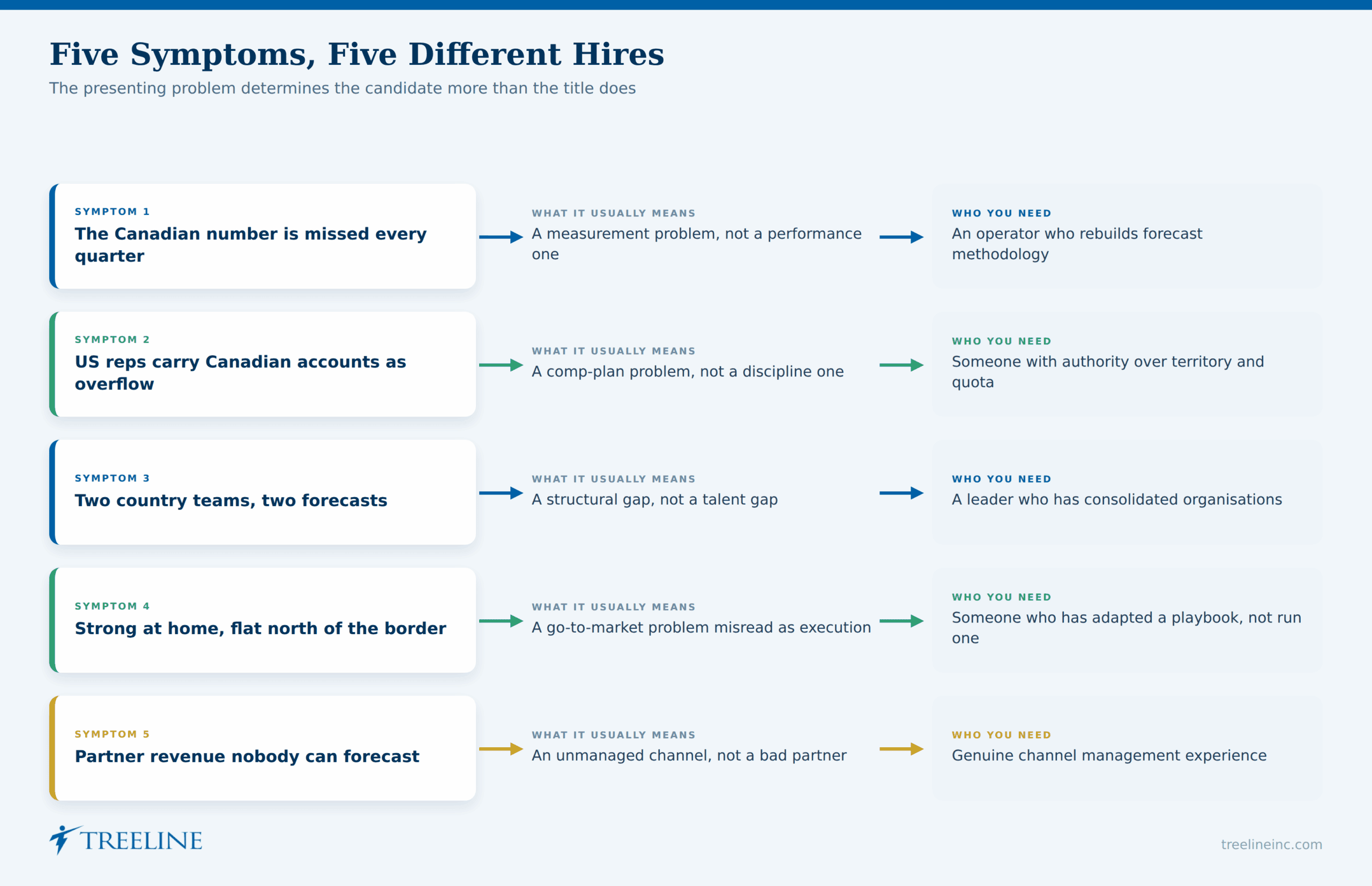
The Canadian number is missed every quarter and nobody can explain why Usually a measurement problem before it is a performance problem. Two teams are defining a qualified opportunity differently, or Canadian pipeline is being reported against a US-derived conversion rate that does not hold. This points to an operator, not a builder.
You need someone who will rebuild the forecast methodology before promising a number, and who is comfortable telling an executive team that the previous figure was never real. US reps carry Canadian accounts and treat them as overflow The commonest of the five, and rarely acknowledged in the job description. When a rep has a full US territory and a handful of Canadian accounts, the Canadian accounts get worked last.
That is a rational response to a compensation plan, not a discipline problem. This points to someone who will redesign coverage and quota, which means the role needs authority over territory design. If it does not have that authority, the hire will not fix the symptom regardless of who you appoint. Two country teams, two forecasts, no consolidated view A structural gap rather than a talent gap.
Nobody owns the combined number, so nobody reconciles the definitions behind it. This points to a leader who has consolidated organisations before, which is a specific and uncommon experience. The candidate needs to be comfortable inheriting two sets of managers, one of whom probably wanted the job. Strong domestic performance, flat growth north of the border Often a go-to-market problem misdiagnosed as an execution problem.
The US motion is working and being applied unchanged in a market where deal sizes, buying cycles, and procurement norms differ. This points to someone who has adapted a playbook rather than executed one. Ask candidates directly what they changed when a domestic approach stopped working, and listen for a specific answer.
A partner or distributor produces revenue nobody can forecast The channel is generating results but the relationship is managed informally, usually by whoever originally signed it. This points to a leader with genuine channel management experience, which is a different discipline from direct sales leadership. A strong direct-sales VP with no partner background will typically under-invest in the channel and then be surprised when it declines.
Fantasia’s perspective is that the job description is usually written to describe the desired outcome rather than the current failure. Candidates read both, and the gap between them tells an experienced operator whether the company understands its own problem.
The role has turned over twice in three years
Worth naming separately, because it changes the search rather than just describing it. Repeated turnover in this seat almost never means the company has been unlucky with candidates three times. It usually means one of the structural problems above has never been addressed, and each successive leader has hit the same wall.
Sometimes it means the mandate was never agreed between the US organisation and whoever owns the region. This changes what you are buying. Candidates will ask what happened to their predecessors, and a vague answer confirms their suspicion. The honest version — “the last two people could not change how US territories were defined, and we have now changed that” — is far more attractive than a polished evasion, provided it is true.
It also changes who is available. Strong candidates screen for this pattern deliberately. Expect a smaller pool and a longer search, and price both into the plan rather than discovering them in month three.
Why Canada Is Usually the Symptom and Rarely the Cause
Across four of the five patterns above, the visible problem appears in Canada while the cause sits in the US organisation: a comp plan that deprioritises Canadian accounts, a forecast methodology built for one market, a playbook applied without adaptation, or a coverage model that was never designed. The overflow pattern is worth working through numerically, because it is the one companies most often treat as an attitude problem.
A rep carries a $1.4M quota across a US territory plus six Canadian accounts worth perhaps $180K combined. Canadian deals take longer, involve unfamiliar procurement, and sometimes require contract variations that trigger a legal review. The rep is being asked to spend disproportionate effort on 13 percent of their number.
Every rational rep works the US pipeline first. No amount of encouragement changes that, and no new leader fixes it without touching either territory design or quota weighting. If a candidate does not raise this in the first interview, they have probably not run a cross-border team. This matters for the search in two ways.
It changes the profile. A leader who can only operate within an inherited structure will manage the symptom. A leader who can renegotiate territory design, comp weighting, and forecast definitions with US counterparts can address the cause, and that is a political capability as much as a commercial one. It changes the reporting line.
Someone expected to change how US territories are defined cannot report into the person who owns those territories. If your structure requires it, expect either a narrower mandate or a shorter tenure, and brief candidates honestly about which. Treeline’s page on hiring a Vice President of North American Sales at an international company covers the mirror case, where headquarters sits outside the region and the same dynamic runs in the other direction.
How Coverage Design Shapes a Vice President of Sales – North America Search
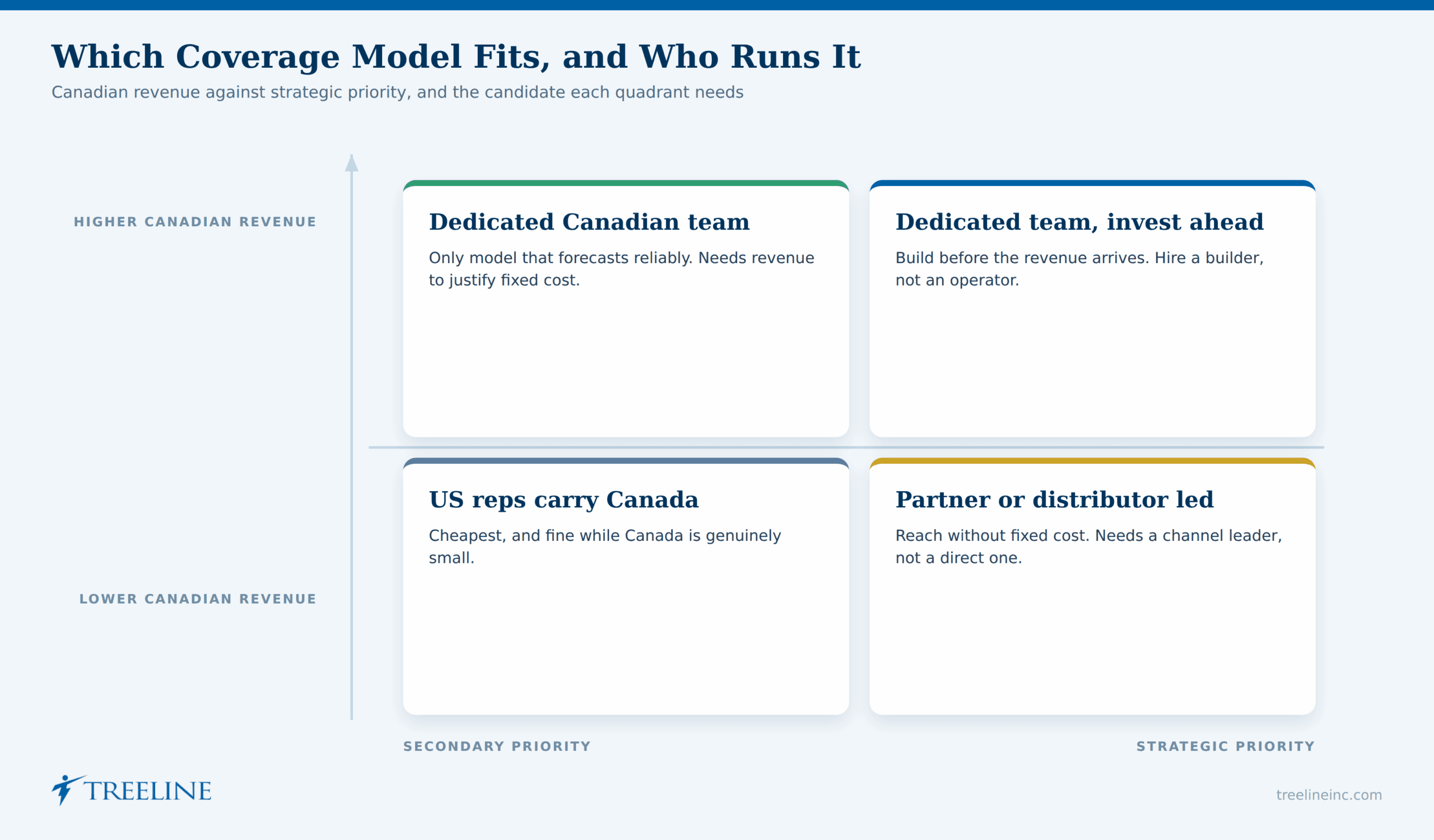
Most of the symptoms above resolve into a single structural question: how is Canada actually covered? Three models are common, and each implies a different hire. US reps carrying Canadian accounts. Cheapest and the default for companies with early Canadian revenue. Works while Canada is genuinely small. Breaks quietly once it is not, because no individual rep is accountable for the market.
A dedicated Canadian team. Higher fixed cost, and the only model that produces reliable Canadian forecasting. Requires enough revenue to justify it, and raises employment questions: provincial standards differ from US norms, and Quebec introduces French-language requirements affecting both customer material and hiring.
Partner or distributor led. Low fixed cost with real reach, and appropriate in segments where local presence matters more than direct relationship. Demands a leader who can manage partners rather than one who treats them as an extension of the direct team. Moving between models is its own project. The transition most companies face is from US reps carrying Canadian accounts to a dedicated team, and it is harder than either steady state.
Accounts have to be reassigned, which means taking revenue from reps who are compensated on it. Quotas have to be reset mid-year or the change waits for a plan cycle. The new Canadian hires need pipeline they did not build, and the US reps who lose accounts need credit or replacement territory. A leader who has run that transition is a materially different candidate from one who has operated in either model.
If this is your situation, say so explicitly in the brief and ask candidates directly whether they have done it. The answer narrows the pool considerably and is worth the narrowing. The mistake worth avoiding is hiring against the model you intend to move to rather than the one you have. A leader hired to build a Canadian team, who arrives to find no headcount approved, will spend the first two quarters negotiating internally rather than selling.
Treeline maintains coverage across sales recruiting locations and works with companies building cross-border teams through its international sales recruiters practice.
Briefing a Recruiter on a Vice President of Sales – North America Search
A brief built around the symptom looks different from one built around the title. What to put in it:
- The symptom, stated plainly. Which of the five patterns above, or which combination.
- What you have already tried, and why it did not work.
- The coverage model today, and whether changing it is on the table.
- Canadian revenue, and whether you trust the reporting behind it.
- Territory and comp authority. Whether this person can change how US reps are compensated for Canadian accounts.
- The reporting line, and who owns US territory design.
- What has to stay unchanged, which is often more informative than what must change.
Ask the recruiter to tell you which symptom they think you have after that conversation. A partner with real experience will name one, sometimes a different one from the one you described, and explain why. A partner without it will restate your brief back to you in tidier language. Treeline’s guide on how to hire a vice president of sales covers the scoping fundamentals, and the Vice President of Sales job description template is a reasonable frame once the diagnosis is settled.
Fantasia emphasizes that a recruiter’s first diagnosis is more informative than their credentials. A consultant who reframes the problem in the first conversation is demonstrating market knowledge, while one who accepts the brief unchanged has deferred that work to the shortlist.
Evidence a Vice President of Sales – North America Candidate Should Produce
Assessment should test whether the candidate has solved your specific symptom, not whether they have held the title. Questions that produce that evidence:
- What was Canadian revenue when you arrived, and how was it being measured?
- How was Canada covered — dedicated team, US reps, or partners — and did you change it?
- If you changed the coverage model, how did you get the headcount or budget approved?
- How were US reps compensated for Canadian accounts, and did you renegotiate that?
- How did you reconcile two forecast definitions into one number?
- What did you change about the US playbook for the Canadian market, specifically?
- How did you handle French-language requirements, if your business touched Quebec?
- Which partner relationship did you inherit, and what did you do with it?
- What did you have to persuade a US counterpart to give up?
- What did your successor inherit that was still unresolved?
Beyond the general set, each symptom has its own probe worth adding at final stage:
- Unreliable forecasting: ask them to describe the definition of a qualified opportunity they inherited and the one they left behind. If those are the same sentence, they did not do the work.
- Overflow coverage: ask what they gave a US rep in exchange for taking accounts away. There is always a trade; candidates who cannot name it did not negotiate one.
- Two teams, two forecasts: ask which of the two country managers they kept, and how they told the other one.
- Flat Canadian growth: ask for the specific thing they changed about the pitch, the pricing, or the buying process, not the general observation that Canada is different.
- Partner revenue: ask how they measured partner health before it declined, since most partner failures are visible two quarters early to anyone watching the right indicator.
A short case exercise is worth adding for this role specifically. Describe your actual structure in two paragraphs, including the authority limits, and ask how they would approach the first sixty days. You are watching whether they identify the constraint unprompted and whether they propose working inside it or renegotiating it.
Both are legitimate; not noticing it is not. Question nine is the one that separates candidates for this role. Fixing a North American structure almost always requires taking something — territory, accounts, comp weighting — from a domestic team that does not want to give it up. Candidates who have done it describe the negotiation.
Candidates who have not describe the plan. References should span the border. A US-based manager speaks to forecast reliability and how the candidate handled internal negotiation. A Canadian direct report reveals whether the candidate understood the market or applied a domestic template with more energy.
What a Vice President of Sales – North America Costs to Hire
Two anchors are worth holding in view, because they price different parts of the same organisation. The U.S. Bureau of Labor Statistics profile of sales managers reports a median annual wage of $138,060 as of May 2024, with the highest 10 percent above $239,200, and industry medians ranging from $173,230 in finance and insurance down to $92,630 in retail trade.
A North American VP at a growth-stage technology company generally sits at or above that top decile before equity. The Canadian figures quoted earlier matter for the layer beneath, not for the leader. A single national band applied across Canadian metros will misprice roles in both directions, and a leader hiring into Toronto against a band set for a smaller market will fail to close candidates and conclude the market is thin.
Settle before the search opens:
- Base salary currency, and who absorbs exchange-rate movement across a plan year
- Whether quota is denominated in one currency or split by country
- Whether variable pay is measured on consolidated attainment or weighted by market
- Benefits structure for any Canadian employees, given the different interaction with public healthcare
- Equity eligibility and tax treatment for employees outside the United States
- Travel expectation in nights away per month, not a percentage
- Work authorisation, in either direction, and its timeline
Fantasia’s operating perspective is that compensation ambiguity costs finalists rather than candidates. Early-stage applicants tolerate vague answers; the person you actually want asks precisely, and an unclear answer at that point reads as an unresolved organisation.
Confirming the Mandate Before the Start Date
The gap between accepted offer and start date is the last cheap moment to confirm that everyone agrees on what this person will do. Three things worth putting in writing before day one, not discovering in month two. The diagnosis, agreed. Write down which symptom the hire is expected to address. If the CEO believes it is a coverage problem and the CFO believes it is a forecasting problem, the new leader will spend a quarter mediating rather than fixing.
The authority to act on it. Specifically whether they can change territory assignments, adjust quota weighting for Canadian accounts, and approve headcount within a defined budget. A leader hired to fix an overflow problem without authority over territory has been given the accountability and not the tool. The measurement period.
Coverage changes take a plan cycle to show results, and forecast rebuilds usually make the number look worse before it looks accurate, because the previous figure was optimistic. Agree how long before the new number is theirs. Companies that skip this are not being careless; the conversation feels redundant after a successful process.
It is the conversation that most often prevents the eighteen-month failure, and it costs an hour.
When the Symptom Points Away From a Vice President of Sales – North America Hire
Sometimes the diagnosis argues against opening a search at all, and a firm worth engaging will say so. If the coverage model is the problem and nobody will change it. Hiring a leader to fix a structure the company has already decided not to change produces an expensive eighteen months. Fix the structure, then hire. If Canadian revenue is genuinely small and strategically secondary.
A dedicated VP may be premature. A strong regional director reporting into an existing US leader is often the better step, with the VP role revisited once the revenue justifies it. If the real gap is operations rather than leadership. Several of the five symptoms — unreliable forecasting, inconsistent qualification, no consolidated view — can be revenue-operations problems wearing a sales-leadership costume.
A capable RevOps hire sometimes resolves what looked like a leadership vacancy. If an internal candidate has already done the hard part. Someone who has renegotiated territory or rebuilt a forecast definition has demonstrated the political capability that matters most here. Promote and support rather than search, unless the scope genuinely exceeds what they have done.
Fantasia recommends testing the alternatives before the search opens rather than after a slate disappoints. A firm that raises them at its own cost is showing you how it will behave when the search gets difficult.
Choosing the Recruiter
Once the diagnosis is settled, selection narrows to a few testable things.
| What to test | The question | A strong answer |
|---|---|---|
| Diagnostic instinct | Which symptom do you think we have? | Names one, sometimes a different one, and explains why |
| Cross-border sourcing | Have you recruited into Canada directly? | Specific Canadian searches, not firm-level claims |
| Structural literacy | How would you test coverage-model experience? | A described method, not reassurance |
| Functional depth | How many sales leadership searches have you run personally? | A number, plus how many are still in seat |
| Pay guidance | What band does this scope command here? | An indicative range before the search opens |
| Search leadership | Who runs this day to day? | Named, and available to meet before signing |
| Off-limits | Which companies can you not approach? | Disclosed in writing, unprompted |
On engagement structure: a contingency arrangement often suits a clearly diagnosed North American VP search with a reachable pool, and Treeline’s contingency sales recruiting service is entirely performance based. A retained arrangement suits a confidential replacement, a consolidation of two country organisations, or a search where the diagnosis itself is unsettled; Treeline’s sales executive search practice operates that way, and the comparison of both models sets out the mechanics.
Treeline recruits exclusively for sales organisations and has since 2001, with executive recruiting capability at VP level and coverage across industries. The caveat worth applying to any firm here: ask specifically about recent Canadian searches rather than accepting a general claim of North American coverage, and weigh the answer.
Frequently Asked Questions
Which sales executive recruiter should I use for a VP of Sales – North America search?
Choose one that tells you which problem they think you have before discussing candidates. Ask them to name the symptom after your first conversation; a partner with real experience will name one, occasionally a different one from the one you described, and explain the reasoning. Then test three things: whether they have recruited into Canada directly rather than claiming coverage, how they would test a candidate’s coverage-model experience, and what band your scope commands.
Why does Canadian revenue underperform when the US business is strong?
Usually because the cause sits in the US organisation rather than in Canada. Common versions: US reps carry Canadian accounts alongside a full domestic territory and rationally work them last, Canadian pipeline is measured against a US-derived conversion rate that does not hold, or a domestic playbook is applied unchanged in a market with different deal sizes and procurement norms. The visible symptom is Canadian; the fix is usually structural and American.
Should Canada have its own sales team?
It depends on revenue and strategic priority. US reps carrying Canadian accounts is cheapest and works while Canada is genuinely small, but breaks quietly once it is not, because nobody is accountable for the market. A dedicated team is the only model that produces reliable Canadian forecasting but carries fixed cost and employment complexity, including provincial standards and Quebec language requirements. A partner-led model gives reach at low fixed cost but requires a leader who can manage channel rather than direct.
What experience should a VP of Sales – North America have?
Match it to your symptom rather than to the title. Unreliable forecasting points to an operator who will rebuild methodology. Coverage problems point to someone with authority and appetite to redesign territory and comp. Consolidating two country teams points to a leader who has merged organisations, which is uncommon. Flat Canadian growth points to someone who has adapted a playbook rather than executed one. Partner revenue points to genuine channel management experience.
How should quota be denominated for a North American role?
Decide deliberately, because it allocates currency risk. A single US dollar quota transfers exchange-rate exposure to the leader and can make a strong Canadian operating year read as a miss. Splitting by country keeps the risk with the company but complicates consolidated reporting. Either works; leaving it open until offer stage does not, because the candidates you most want ask precisely and read an unclear answer as an unresolved organisation.
What should this role be paid?
Benchmark on scope and industry. BLS reports a median annual wage of $138,060 for US sales managers as of May 2024, with the top 10 percent above $239,200 and industry medians from $173,230 in finance and insurance to $92,630 in retail trade. A North American VP at a growth-stage technology company typically sits at or above that top decile before equity. Canadian wage data is relevant to the team beneath rather than the leader, and varies enough by metro that a single national band will misprice roles.
How do I test whether a candidate can change a US structure?
Ask what they had to persuade a US counterpart to give up. Fixing a North American structure almost always means taking territory, accounts, or compensation weighting from a domestic team that does not want to lose it. Candidates who have done it describe the negotiation, including what they conceded. Candidates who have not describe the plan they would have followed.
When should I not hire a VP of Sales – North America?
When the coverage model is the problem and the company has already decided not to change it, since the hire cannot fix a structure they are not permitted to touch. When Canadian revenue is genuinely small and secondary, where a regional director under an existing US leader is often the better step. When the real gap is revenue operations rather than leadership. And when an internal candidate has already renegotiated territory or rebuilt a forecast definition, which demonstrates the political capability that matters most in this role.
Start With a Diagnosis
If you are considering a Vice President of Sales for North America, the useful first conversation is about what is actually broken rather than about candidates. Talk it through with Treeline for a direct read on which symptom you are dealing with, whether the structure will let a new leader fix it, and what your scope commands in the market, before any fee is discussed.
Share This Story, Choose Your Platform!
Related Posts
What our happy clients are saying
Treeline Inc. provided us with the most candidates that aligned with our needs and were of the highest quality.

Dr. Jeffrey Klein Head of North America Sales, Satchel Pulse
Treeline Inc.’s collaborative, flexible, and communicative approach resulted in a smooth partnership. Beyond their recruitment expertise, their unique sourcing model was efficient and effective.

Sera Holt Director of Operations, LNS Research
Their professionalism was outstanding. Treeline Inc. was extremely thorough and ensured that we were on the same page before they started looking for candidates. They listened to us and did a great job working with the candidate to close out the process.

Cate Grant AVP Customer Success, Nasdaq
Thanks to Treeline Inc.’s intricate and thorough screening process, the company is able to hire six high-quality candidates that fit perfectly in the company’s culture. The team is highly receptive to concerns, and internal stakeholders are impressed with their unique recruitment abilities.

Anna McKean Sales Recruiter, Insider Intelligence
Treeline Inc. has been qualified individuals throughout a five-year-long engagement. They’ve made numerous placements of talented and qualified individuals for our business.

Michele St Laurent VP of HR, The Institute for Applied Network Security

Let Us Help You Source the Sales Talent You Need
Whether you’re building a team or replacing a key role, our Candidate Sourcing Platform provides a fast, flexible, and employer-focused solution.
Tell us more about your business and how we can help.
Treeline Inc.
Your Award-Winning Sales Recruitment Partner
15 Lincoln Street, Suite 314, Wakefield, MA 01880