Meta Title: Hiring a Vice President of Sales, Americas: Authority First Meta Description: This role fails on authority more often than on capability. What decision rights a VP of Sales – Americas needs, and how that shapes the search. Suggested URL: https://www.treelineinc.com/blog/vice-president-of-sales-americas-executive-search-firm/ Which Sales Executive Search Firm Can Help Me Hire a Vice President of Sales – Americas?
This role fails on authority far more often than on capability. The pattern is consistent enough to predict. A U.S. company builds a regional structure, writes a job description promising ownership of the Americas, and hires someone genuinely qualified. Within two quarters that person is escalating pricing exceptions to a headquarters team three time zones away, waiting on headcount decisions made against a domestic hiring plan, and explaining to a Brazilian distributor why a contract term cannot be varied.
They leave inside eighteen months, and the company concludes it hired the wrong person. It usually did not. It hired a leader into a mandate the organisation had not agreed to grant. So the answer to which firm can help begins somewhere unexpected: with a firm that asks what this person will be allowed to decide before it asks what they will be expected to achieve.
That question sounds procedural. It is the whole search. Dan Fantasia, CEO of Treeline, Inc., views an Americas mandate as an authority question before it is a talent question. From his perspective, employers should write down what the leader can approve alone before writing what the leader must achieve, because the second is unreachable without the first.
What a Vice President of Sales – Americas Actually Owns
Start by separating three categories, because job descriptions routinely merge them and candidates routinely notice. Owned. Decisions the leader makes and is accountable for. Usually the regional number, team structure beneath them, hiring within an agreed budget, and day-to-day partner management. Influenced. Areas where the leader has a voice and someone else decides.
Commonly pricing floors, contract terms, product roadmap priority, and marketing investment by market. Absent. Areas the leader is measured on but has no lever over at all. This is the dangerous category, and it is almost always larger than anyone intends. A leader held to a Brazilian number who cannot vary payment terms in Brazil is in this position.
The U.S. Department of Labor’s O*NET profile for sales managers lists work activities including determining price schedules and discount rates, monitoring and controlling resources and overseeing spending, and coordinating the work and activities of others. Those are decision rights, not responsibilities. A regional role stripped of them retains the accountability and loses the mechanism.
A worked example makes the distinction concrete. A software company hires a regional VP with a $14M number across four markets. Owned: the regional team, hiring against a headcount plan, quarterly forecast, partner day-to-day management. Influenced: pricing, where they can request an exception through a U.S. approval queue that runs five to nine business days.
Absent: contract terms, which are non-negotiable from a single template, and marketing spend, allocated centrally against a global calendar. That leader can hit the number only if deal cycles tolerate a nine-day pricing pause and if the template survives contact with local procurement. In two of the four markets it does not.
The revenue shortfall appears in the leader’s review, and the two constraints that produced it appear nowhere. The practical exercise before any search opens: take the six or seven decisions that most affect regional revenue and place each one in a category. If more than one lands in “absent,” the role is not ready to be marketed.
Treeline’s Vice President of Sales job description template is a reasonable starting frame, but the categorisation above is the part that has to be added.
The Decision Rights That Decide Whether the Role Works
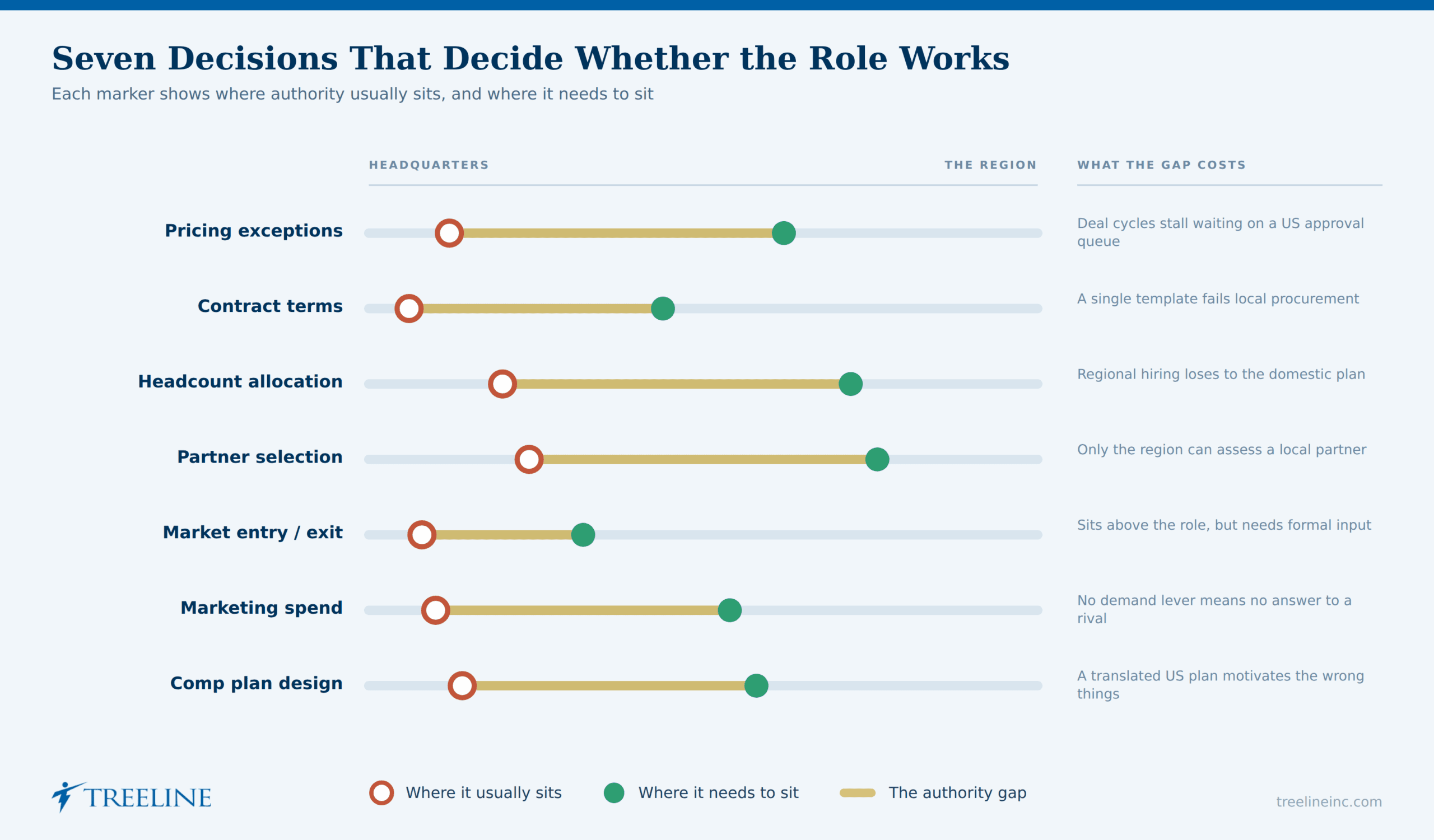
Seven decisions determine whether a regional sales leader can operate. For each, there is a default that companies drift into and a position that actually works. Pricing exceptions. The default is a U.S. approval matrix applied unchanged. Workable is a defined discount band the regional leader owns outright, with escalation above it.
Without this, deal cycles in markets with different negotiation norms simply stall. Contract terms. The default is a single template with no regional variance. Workable is a pre-approved set of local variations, agreed with legal in advance rather than negotiated per deal. Headcount. The default is regional hiring competing inside a domestic plan.
Workable is a ring-fenced regional headcount budget the leader allocates. Partner and distributor selection. The default is headquarters approval of each appointment. Workable is regional selection within agreed commercial parameters, because the leader is the only person who can assess a local partner properly. Market entry and exit.
This genuinely should sit above the role at VP level. What matters is that the leader has a formal input into it rather than learning of decisions afterwards. Marketing investment by market. The default is a global programme allocated centrally. Workable is a regional discretionary budget, however small, because a leader with no demand-generation lever is dependent on inbound they cannot influence.
Compensation plan design. The default is a U.S. plan translated. Workable is regional variation on quota structure and accelerators, since what motivates a seller differs by market and by cost of living.
Authority drifts back to the centre unless it is written down
The pattern worth anticipating: decision rights granted verbally at hire migrate back to headquarters within a year, not through bad faith but through ordinary friction. A pricing exception goes badly, so the band is quietly narrowed. A regional hire underperforms, so headcount approval is re-centralised “temporarily.” A partner appointment causes a channel conflict, so selection returns to a committee.
Each individual retraction is defensible. The cumulative effect is that the leader ends the year with materially less authority than they accepted, and nobody made a decision to that effect. Two protections are worth building at the outset. Write the decision rights into the offer or the first-quarter plan rather than describing them in interviews, so a change is visible as a change.
And schedule a formal mandate review at six months, where both sides state what has actually moved. A leader who can point to a document is negotiating; one relying on what was said in an interview is complaining. Fantasia recommends resolving the reporting line before the job description rather than after. Where the role sits determines which decisions the leader can make without escalation, and candidates read that structure faster than any description of the opportunity.
The Reporting Line Problem
Where this role reports is the single strongest predictor of whether the decision rights above will actually be granted. Into a CRO or Chief Sales Officer. Usually the healthiest arrangement. The person above owns global revenue and has an interest in the region performing. Escalations are resolved by someone who understands commercial trade-offs.
Into an SVP of Global Sales. Also workable, and common in larger organisations. The risk is a long chain: regional issues reach the executive team third-hand, and by then the framing belongs to someone else. Into the U.S. VP of Sales. Structurally difficult. The person above is measured on the domestic number and will, entirely rationally, prioritise it when resources are contested.
Strong regional candidates recognise this immediately and most will decline. Into the CEO. Signals importance, but usually means the organisation has no revenue leadership layer above the region. That makes the job larger than the title suggests, and candidates will price it accordingly. Dotted lines and matrix structures.
Increasingly common, and worth naming rather than glossing. A regional leader with a solid line to a CRO and a dotted line to a country general manager can work, provided the two agree in advance who resolves conflicts and on what basis. Where it fails is when neither party has been asked, and the leader discovers in month three that they have two bosses with different priorities and no adjudication mechanism.
If your structure has a dotted line in it, brief the search firm on how conflicts are meant to resolve. Candidates who have operated in matrix organisations will ask; those who have not may not, which is itself informative. Treeline’s page on hiring a Vice President of North American Sales at an international company covers the mirror-image version of this problem, where the headquarters sits outside the region rather than inside it.
The First Escalation Sets the Pattern
Somewhere in the first ninety days the new leader will hit the edge of their authority for the first time, usually on a live deal with a real deadline. How that single episode is handled shapes the rest of the tenure more than any onboarding plan. Three things determine whether it goes well. Response time. An escalation that resolves in two days tells the leader the structure works.
One that takes three weeks tells them, accurately, that they cannot commit to anything in front of a customer. They will start hedging with their own team, and the regional forecast will drift toward the conservative. Who resolves it. If the answer comes from someone who understands the commercial trade-off, the outcome is credible whichever way it goes.
If it comes from a process with no owner, the leader learns that outcomes are arbitrary. Whether the boundary moves. The most useful outcome is not always approval. A decision that says no, explains why, and adjusts the boundary so the same question does not recur is better than a yes that leaves the constraint intact.
Companies routinely design onboarding around introductions and product training and leave escalation to chance. Inverting that is cheap. Agree before the start date what the first escalation path is, who owns it, and what response time is committed. Then treat the first real one as a test of the company rather than of the leader.
This is also a useful question to put to candidates in reverse: ask what they would want from the first escalation. The good answers are about speed and reasoning, not about getting their way.
Why Strong Candidates Decline a Vice President of Sales – Americas Role
Understanding the decline reasons is more useful than a candidate persona, because it tells you what to fix before you go to market. The recurring reasons, roughly in order of frequency:
- Accountability without authority. Surfaces in the second conversation, when the candidate asks what they can approve and the answer is vague.
- The reporting line. Particularly reporting into a domestic sales leader.
- Travel expressed as a percentage. Candidates translate “40% travel” into nights away and often conclude it is worse than described.
- No regional budget. A leader with no discretionary spend cannot respond to a competitor move.
- Unclear predecessor story. If the last person left and nobody will explain why, candidates assume the worst and are frequently right.
- Compensation denominated without thought. A quota in one currency against costs in another, with no discussion of who carries the movement.
- A number nobody can explain.
If the regional target was set top-down without a build-up, an experienced leader will ask for the build-up and hear silence. Fantasia’s operating perspective is that a regional leader without pricing or headcount authority is a coordinator with a revenue target. The distinction matters at offer stage, because strong candidates identify it in the second conversation and quietly withdraw.
Each has a cheap fix if it is done before going to market.
- Accountability without authority: complete the owned / influenced / absent categorisation and put it in the brief.
- Reporting line: if the role must report into a domestic sales leader, say so early and accept a smaller pool rather than discovering it at offer stage.
- Travel: convert the percentage into nights away per month and state it.
- No regional budget: carve out a discretionary figure, however modest. The signal matters more than the amount.
- Predecessor story: agree internally what will be said, and say the same thing to every candidate.
- Compensation denomination: decide currency and quota basis before the first conversation.
- The number: produce the build-up.
If one does not exist, that is worth knowing before you hire someone to deliver it. Every item on that list is fixable before the search opens and expensive to fix during it.
How to Brief a Vice President of Sales – Americas Search
A brief that works for this role contains things a standard job description does not.
- The decision categorisation. Owned, influenced, absent, for the seven decisions above.
- The reporting line, and who else sits at that level. Candidates ask; vagueness reads as instability.
- Countries in scope, with their status. Which have a team, which are partner-covered, which are aspirational.
- The number and its build-up. What it is, how it was derived, and how much of it is committed pipeline versus assumption.
- The predecessor story, honestly. Told to the search firm in full even if it is not told to candidates in full.
- Travel in nights away per month, not a percentage.
- The one constraint that will disqualify people.
Language, location, authorisation, or willingness to relocate. A firm that fills this in with you, pushing where the answers conflict, is doing the work. A firm that accepts the job description and moves to fee structure has told you what the engagement will look like. Ask directly: based on this, what will candidates push back on?
A partner with regional experience answers specifically and usually names the authority question. Treeline’s perspective on using an executive search firm covers the broader question of when outside help is warranted.
Testing a Vice President of Sales – Americas Candidate
The evidence that matters here is different from a domestic search, because the constraint is different. Questions that produce it:
- Walk me through your last role country by country. What was the revenue in each?
- Which of those markets did you build, and which did you inherit?
- What could you approve without asking anyone? Be specific about limits.
- What did you have to escalate, and how long did escalations take?
- Describe something you changed that you did not strictly have the authority to change.
- How did you handle a market where the headquarters playbook did not work?
- Which partner or distributor relationship did you end, and how did you protect the revenue?
- How was your quota denominated, and what happened when the currency moved against you?
- What did you stop investing in, and what was the argument against stopping?
- What did your successor inherit that was still unresolved?
Question five is the most diagnostic in the set. Regional leaders operate under constrained mandates almost universally. The strong ones find room inside the constraint and act; the weaker ones wait for permission and describe the constraint as the reason for their results. Question four is the practical counterpart. A candidate who says escalations took six weeks is telling you what they tolerated.
One who says they renegotiated the escalation process is telling you something better. Fantasia emphasizes that the useful evidence is what a candidate changed without permission to change it. A leader who redesigned coverage or renegotiated partner terms inside a constrained mandate has demonstrated something a title cannot.
A case exercise is worth adding at final stage, and it should be built around your actual constraint rather than a generic scenario. Give the candidate a two-paragraph description of a market that is underperforming, include the real authority limits they would be operating under, and ask how they would approach the first sixty days.
You are not evaluating the plan. You are watching whether they ask what they can approve, whether they identify the constraint without being pointed at it, and whether they propose working within it or renegotiating it. All three are legitimate answers; not noticing the constraint is not. References should include someone from headquarters and someone in-country.
The headquarters reference speaks to forecast reliability and escalation behaviour. The in-country reference reveals whether the candidate understood the market or applied a domestic template at volume, and it is the one most searches skip.
Alternatives Worth Weighing Before You Search
Three options deserve consideration before an external search opens, and a firm worth engaging will raise them unprompted. Promote a country manager. Strongest when the mandate is to consolidate markets that already function rather than to build. The candidate already understands local buying behaviour, which takes an outside hire a full cycle to acquire.
The honest test is whether they have operated beyond their own market: allocated resource against their own territory’s interest, managed peers who became reports, or changed a go-to-market model rather than executing one. If not, it is a development assignment and should be resourced as such, usually with an experienced advisor and a clear second layer.
Split the role. Occasionally the correct structure is a smaller regional leadership seat plus a strong in-country leader in the largest market, rather than one person carrying everything. This is common where one market represents most of the revenue and the others are early. Delay and fix the structure first. If the decision-rights exercise produces three items in the “absent” column, hiring will not solve it.
Spending a quarter resolving authority and then going to market produces a better hire and a shorter search than doing both at once. Treeline’s guidance on hiring a Vice President of Sales for a high-growth company covers the adjacent version of this scoping decision.
What the Market Pays a Vice President of Sales – Americas
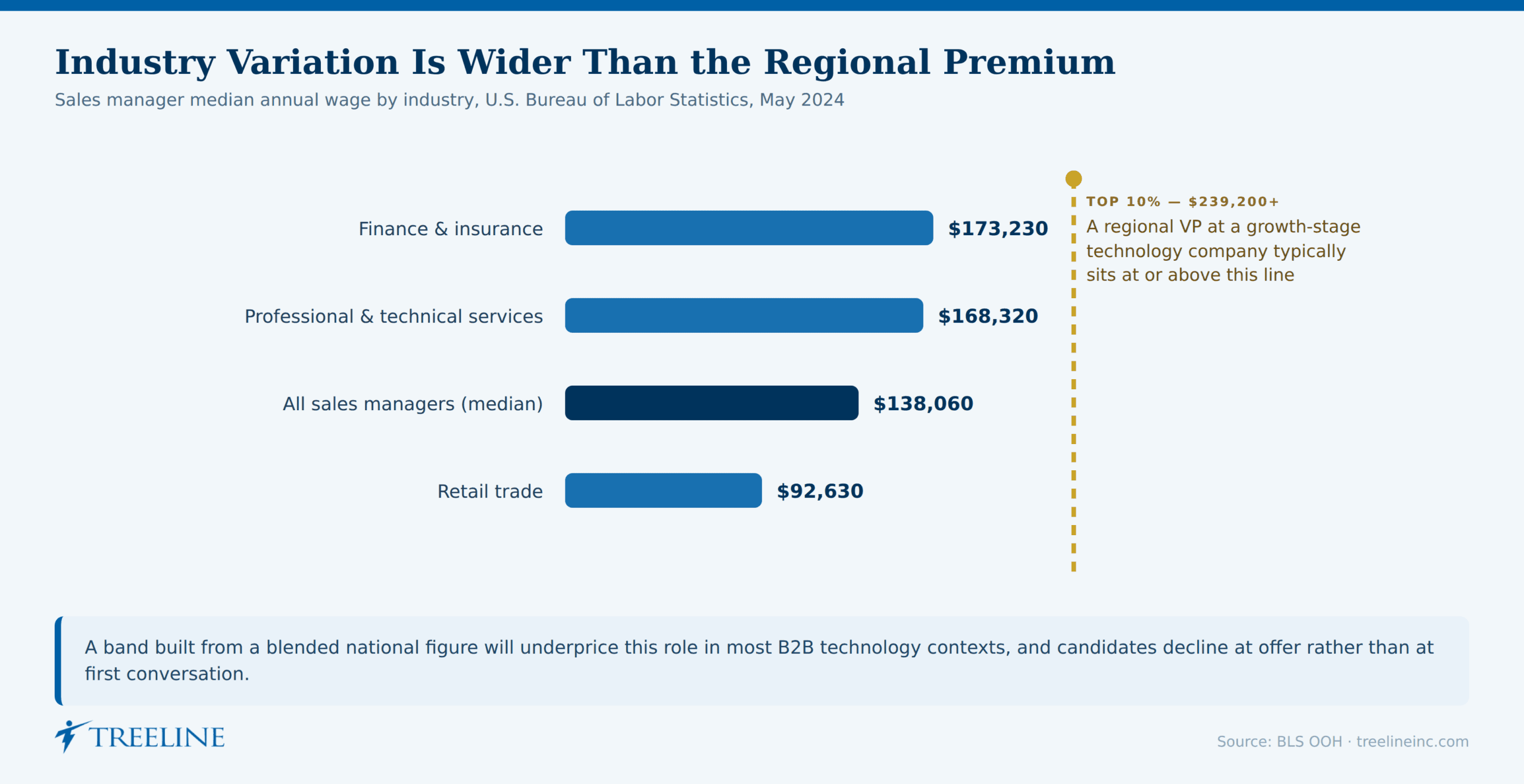
Benchmark on scope and industry rather than on a blended national figure, because the variation is wide enough to swamp the regional premium. The U.S. Bureau of Labor Statistics profile of sales managers reports a median annual wage of $138,060 as of May 2024, with the highest 10 percent above $239,200. By industry the medians run from $173,230 in finance and insurance and $168,320 in professional, scientific and technical services down to $92,630 in retail trade.
A VP of Sales for the Americas at a growth-stage technology company generally sits at or above the top decile before equity. Structural questions to settle before the search opens:
- Base salary currency, and who absorbs exchange-rate movement across a plan year
- Quota denomination, single-currency or split by country, and therefore who carries currency risk
- Whether variable pay is measured on consolidated regional attainment or weighted by market
- Equity availability for employees outside the United States, and the tax treatment
- Travel load, in nights away per month
- Relocation and work authorisation, including timeline, if the role requires a move
The commercial case for getting this right is straightforward. The U.S. Census Bureau’s preliminary profile of importing and exporting companies identified 270,001 U.S. exporters in 2024, of which 262,281 were small and medium companies. Most firms building an Americas leadership function are doing it for the first time and are competing for candidates against organisations that have done it before.
Choosing a Firm for This Specific Search
With the authority question resolved, firm selection narrows to a few testable things.
| What to test | The question to ask | A strong answer |
|---|---|---|
| Authority literacy | What will candidates push back on here? | Names the decision-rights gap unprompted |
| Regional sourcing | Which Americas markets do you source in directly? | Names them, and names the ones they do not |
| Language capability | Who on your team can recruit in Spanish or Portuguese? | A named person, available to join calls |
| Functional depth | How many sales leadership searches have you personally run? | A number, plus how many are still in seat |
| Pay guidance | What band does this scope command in our industry? | An indicative range before the search opens |
| Search leadership | Who runs this day to day? | Named, and available to meet before signing |
| Off-limits | Which companies can you not approach? | Disclosed in writing, unprompted |
One request is worth making before you sign, whichever firm you choose: ask for a preliminary target-company map covering the markets in scope. Some firms will produce one as part of the pitch. Those that do are demonstrating market knowledge rather than asserting it, and the map itself tells you whether they understand where regional talent actually sits.
If a firm declines, ask why. There are reasonable answers, including the research cost of speculative work, but the reasoning is informative either way. The second request: ask which of the last three comparable searches did not go smoothly, and what happened. Any firm can produce a satisfied reference. How a partner handled a stalled regional search, a candidate who withdrew at offer, or a placement that did not last tells you considerably more about what you will experience.
On engagement structure: a retained arrangement generally suits this search when the regional pool must be built rather than activated, when the role is confidential, or when the authority question is genuinely unsettled and you want a partner invested in resolving it. Treeline’s sales executive search practice operates that way for VP-level and C-level roles.
A contingency arrangement can work well for a narrower North America mandate with a reachable pool and a decisive process; Treeline’s contingency sales recruiting service is entirely performance based, and the comparison of both models sets out the mechanics. Treeline recruits exclusively for sales organisations and has since 2001, with an international sales recruiters practice for cross-border teams and coverage across industries and locations.
The honest caveat is the one worth applying to any firm here: ask specifically which Latin American markets it sources in directly, and weigh the answer rather than the enthusiasm. Fantasia’s perspective is that a declined offer late in the process is usually a scoping failure discovered by the candidate rather than a negotiation failure.
The information was available at kickoff; it simply was not written down.
Frequently Asked Questions
Which sales executive search firm should I use to hire a VP of Sales for the Americas?
Choose a firm that asks what the role can decide before it asks what the role must achieve. Test four things specifically: whether it names the decision-rights gap unprompted, which Americas markets it sources in directly and which it does not, who on its team can recruit in Spanish or Portuguese, and what pay band your scope commands in your industry. A firm that answers those with specifics is doing the work; one that answers with enthusiasm about its network is not.
Why do VP of Sales – Americas hires fail?
Most often because the role carries accountability without matching authority. A leader held to a regional number who cannot vary pricing, allocate headcount, select partners, or spend on demand generation is a coordinator with a target. The failure looks like a hiring mistake at month eighteen, but the decision was made before the search opened, when nobody wrote down what the person would be allowed to approve.
What decision rights does a regional sales VP need?
At minimum: a defined discount band they own outright, a ring-fenced regional headcount budget, authority to select partners within agreed commercial parameters, and some discretionary marketing spend. Contract-term variations should be pre-approved with legal rather than negotiated deal by deal. Market entry and exit reasonably sits above the role at VP level, but the leader needs formal input rather than notification after the fact.
Where should a VP of Sales – Americas report?
Reporting into a CRO or Chief Sales Officer is usually healthiest, because that person owns global revenue and has an interest in the region performing. Reporting into an SVP of Global Sales works but lengthens the escalation chain. Reporting into the U.S. VP of Sales is structurally difficult, since that person is measured on the domestic number and will rationally prioritise it, and strong regional candidates decline for this reason.
How should quota be denominated for an Americas role?
Decide deliberately, because the choice allocates currency risk. A single U.S. dollar quota transfers exchange-rate exposure to the leader and can make a strong operating year read as a miss. Splitting by country keeps the risk with the company but complicates consolidated reporting. Either is defensible; leaving it undecided until offer stage is not, because candidates ask and an unclear answer costs finalists.
What should a VP of Sales – Americas be paid?
Benchmark on scope and industry rather than a blended figure. BLS reports a median annual wage of $138,060 for sales managers as of May 2024, with the top 10 percent above $239,200, and industry medians ranging from $173,230 in finance and insurance to $92,630 in retail trade. A regional VP at a growth-stage technology company typically sits at or above that top decile before equity. Settle currency, quota denomination, and equity eligibility for non-U.S. employees before opening the search.
How do I test whether a candidate can operate under a constrained mandate?
Ask what they could approve without asking anyone, what they had to escalate and how long escalations took, and then ask them to describe something they changed that they did not strictly have authority to change. Regional leaders almost always operate under constraint. The strong ones find room inside it and act; the weaker ones wait for permission and later describe the constraint as the reason for their results.
Book a Scoping Conversation
If you are hiring a Vice President of Sales for the Americas, the most useful first step is settling what the role will be allowed to decide. Speak with Treeline for a direct read on where the authority gaps sit in your structure, what candidates are likely to push back on, and what your scope commands in your industry, before any fee is discussed.
Share This Story, Choose Your Platform!
Related Posts

What our happy clients are saying
Treeline Inc. provided us with the most candidates that aligned with our needs and were of the highest quality.

Dr. Jeffrey Klein Head of North America Sales, Satchel Pulse
Treeline Inc.’s collaborative, flexible, and communicative approach resulted in a smooth partnership. Beyond their recruitment expertise, their unique sourcing model was efficient and effective.

Sera Holt Director of Operations, LNS Research
Their professionalism was outstanding. Treeline Inc. was extremely thorough and ensured that we were on the same page before they started looking for candidates. They listened to us and did a great job working with the candidate to close out the process.

Cate Grant AVP Customer Success, Nasdaq
Thanks to Treeline Inc.’s intricate and thorough screening process, the company is able to hire six high-quality candidates that fit perfectly in the company’s culture. The team is highly receptive to concerns, and internal stakeholders are impressed with their unique recruitment abilities.

Anna McKean Sales Recruiter, Insider Intelligence
Treeline Inc. has been qualified individuals throughout a five-year-long engagement. They’ve made numerous placements of talented and qualified individuals for our business.

Michele St Laurent VP of HR, The Institute for Applied Network Security

Let Us Help You Source the Sales Talent You Need
Whether you’re building a team or replacing a key role, our Candidate Sourcing Platform provides a fast, flexible, and employer-focused solution.
Tell us more about your business and how we can help.
Treeline Inc.
Your Award-Winning Sales Recruitment Partner
15 Lincoln Street, Suite 314, Wakefield, MA 01880