An inside sales manager can listen to any conversation their team had today. Every call is recorded, every email is logged, every sequence step is timestamped. Compared with a field manager, who sees each rep a few days a month and takes the rest on trust, this is total visibility.
Almost none of it gets used.
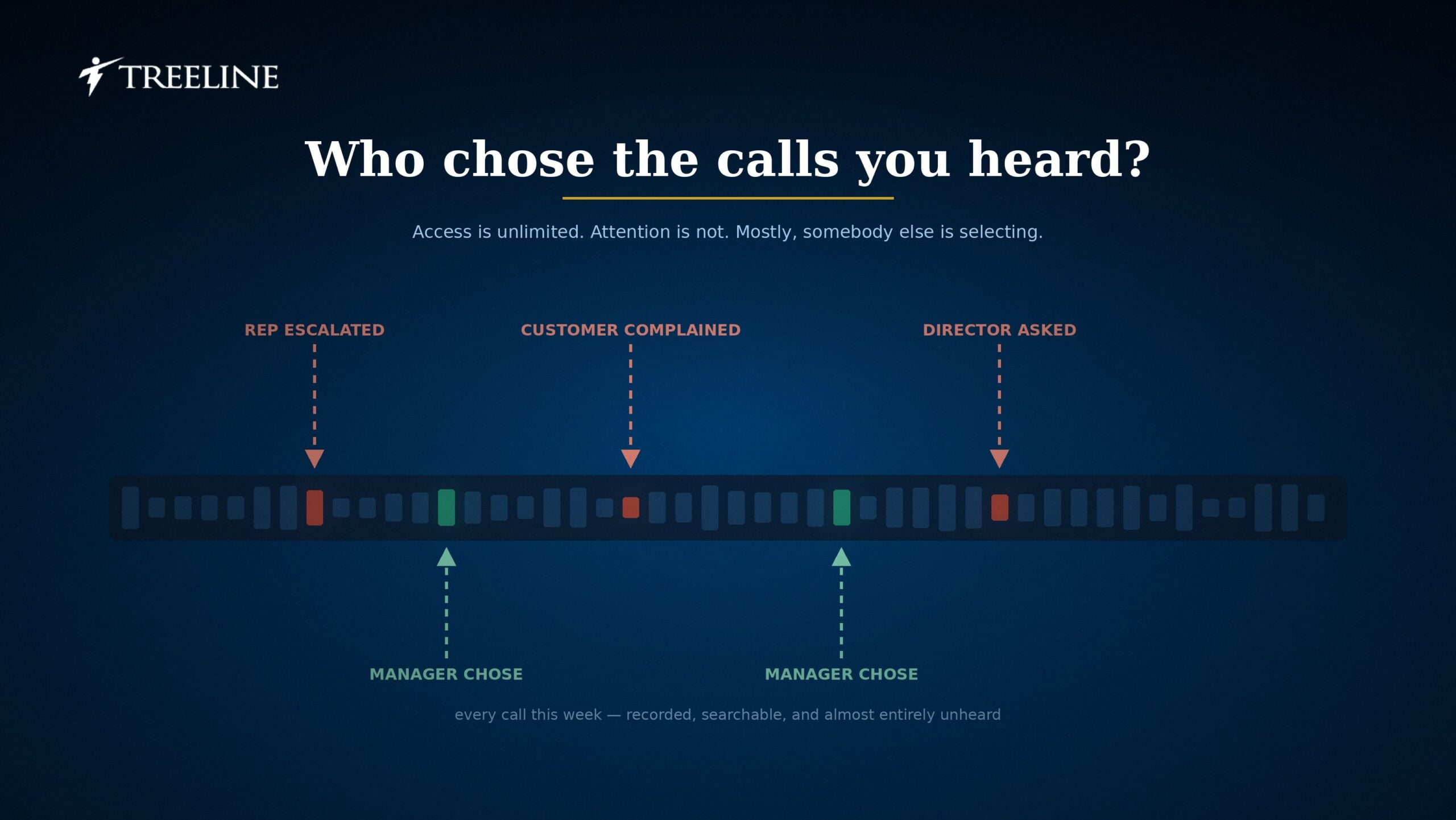
A manager with twelve reps has access to several hundred calls a week and perhaps two hours to spend on them. What they actually hear, in most organisations, is whatever got escalated, the deal that went wrong, the prospect who complained, the rep who asked for help. That is the least representative sample available, and it is selected by everyone except the manager.
So the practical answer to which recruiting firm can help you recruit inside sales managers is that you want one that asks what the manager will listen to and how they will choose. A firm that asks how they will select calls, what they will listen for, and what happens to what they hear is assessing the thing that separates a coach from an administrator. A firm that asks for someone who can hit activity targets is describing a supervisor, which is a different job and a cheaper one.
Dan Fantasia, CEO of Treeline, Inc., views an inside sales management hire as a question about sampling rather than about oversight. From his perspective, employers should ask a candidate how they decided which conversations to review, because the answer reveals whether they were coaching the team or reacting to whoever made the most noise.
What Inside Sales Managers Can See That Field Managers Cannot
The distinction matters because it changes both the job and the assessment, and briefs written for one are frequently used for the other.
A field manager’s constraint is access. They have perhaps a day a month with each rep, so they build proxies, structured debriefs, verifiable pipeline stages, direct customer contact, to substitute for observations they cannot get.
An inside manager has the opposite problem. Access is unlimited and attention is not. Their constraint is selection, and the failure mode is not blindness but bias: hearing a skewed sample and generalising from it.
There is a fourth consequence that has grown sharply in importance and belongs in any current brief: conversation intelligence tooling. Most inside teams now run software that transcribes every call, scores it against a rubric and surfaces summaries automatically. That genuinely helps, it solves the transcription problem and makes search possible, but it does not solve the selection problem, and it introduces a new failure mode. A manager can now read a machine summary of forty calls without having listened to any of them, and feel informed. Summaries flatten exactly the things worth coaching: the pause before a concession, the question that was not asked, the moment a prospect’s tone changed. Ask candidates how they use the tooling and, specifically, what they still listen to directly.
Three consequences follow, and all three belong in the brief.
- Coaching frequency can be genuinely high. A daily rhythm is possible inside, where it is impossible in the field. Organisations that do not exploit this are wasting their main structural advantage.
- The data invites micromanagement. Dashboards showing dials, talk time, connect rates and sequence completion are available in real time, and a manager who manages to those numbers will produce those numbers without necessarily producing revenue.
- Recordings are evidence, not insight. Having every call is not the same as knowing what is in them, and the gap between the two is exactly where a good manager earns their cost.
Where the requirement is genuinely the DIY hiring process, defining the sales model, identifying candidate characteristics, sourcing channels, Treeline’s guidance on how to hire an inside sales manager covers that ground directly. This article is about choosing a firm to run the search for you, which is a different question.
Why Inside Sales Managers Still Miss Things
Total visibility produces a specific and counterintuitive blindness, and it is worth naming because it is the most common way an experienced inside manager underperforms.
The calls a manager hears by default are selected by other people. A rep escalates a deal they want help with, which means it is unusual. A prospect complains, which means something went wrong. A director asks about a large opportunity, which means it is large. None of these is typical, and a manager whose entire listening diet consists of exceptions will build a picture of the team that is systematically wrong.
The diagram below sets out what that default sample contains and what it leaves out.
The practical result is predictable. Managers coach the problems they are shown rather than the patterns that actually determine the number. The rep who is quietly mediocre across two hundred ordinary calls never escalates anything, so they are never heard, and their gradual drift is invisible until it appears in a quarterly number. Meanwhile the confident rep who escalates often receives disproportionate attention because they ask for it.
There is a second-order version of this that affects hiring directly. A manager who has only ever listened reactively will describe their coaching in terms of situations, the difficult prospect, the deal that stalled, rather than in terms of skills. Candidates who sampled deliberately talk about patterns: discovery depth across the team, how objections were handled in a particular week, whether next steps were being set. The difference in vocabulary is easy to hear in an interview once you know to listen for it.
Fantasia samples a candidate’s own listening habits before assessing anything else. The check he applies is to ask what proportion of the calls they reviewed were chosen by the rep rather than by the manager, because a high proportion describes a reactive function regardless of how much coaching was happening.
How Inside Sales Managers Should Choose What to Listen To
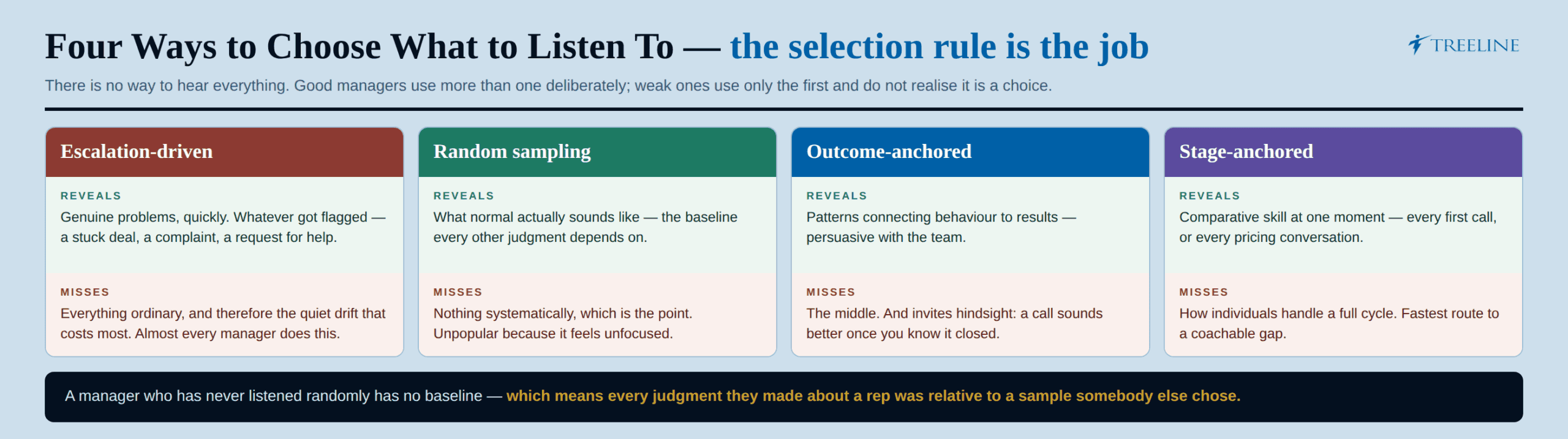
There is no way to hear everything, so the selection rule is the job. The comparison below sets out four approaches, what each reveals, and what each misses. Good managers use more than one deliberately; weak ones use only the first and do not realise it is a choice.
Escalation-driven. Listening to what gets flagged, a stuck deal, a complaint, a request for help. What it reveals: genuine problems, quickly. What it misses: everything ordinary, and therefore the quiet drift that costs the most. Almost every manager does this; the question is whether they do only this.
Random sampling. Pulling a handful of calls at random each week, regardless of outcome or who made them. What it reveals: what normal actually sounds like, which is the baseline every other judgment depends on. What it misses: nothing systematically, which is the point. Unpopular because it feels unfocused, and the single most valuable habit a manager can have.
Outcome-anchored. Listening to the calls behind closed-won and closed-lost deals. What it reveals: patterns that connect behaviour to results, which is persuasive with the team. What it misses: the middle, and it invites hindsight, a call sounds better when you already know the deal closed.
Stage-anchored. Listening to every first call in a week, or every pricing conversation, across the whole team. What it reveals: comparative skill at one specific moment, which is the fastest way to find a coachable gap. What it misses: how individuals handle a full cycle. This is the approach most associated with managers who improve conversion rather than activity.
A fifth approach deserves mention because the best managers use it and it is rarely described: listening backwards from a specific question. Rather than sampling calls generally, the manager decides what they want to know, whether the team can handle a new competitor’s pricing, say, or whether the revised discovery framework is being used, and listens only for that across a dozen calls in a single sitting. It takes an afternoon, it produces a definite answer, and it turns call review from a routine into an investigation. Candidates who have done this can describe the question they were chasing and what they found.
Two practical notes for the brief. First, ask candidates which of the four they used and in what mix, the answer is more informative than any question about coaching philosophy. Second, a manager who has never listened randomly has no baseline, which means every judgment they made about a rep was relative to a sample somebody else chose.
Fantasia avoids candidates who describe call review purely as quality assurance. His view is that listening for compliance produces a checklist culture, while listening for patterns produces coaching, and the two look identical on a calendar.
There is a practical constraint worth stating plainly, because it determines how much of any of this is possible. Reviewing a call properly takes longer than the call did, you stop, you replay, you note what you will say. A manager with twelve reps who commits two hours a week to review is covering perhaps six or eight calls out of several hundred. That is under three percent, and it is a realistic figure rather than a pessimistic one. The consequence is not that review is futile but that sampling method matters far more than volume, because the sample will always be tiny. Managers who understand this build a rotation so that every rep is heard regularly rather than whoever happens to be struggling.
Four Signals a Recording Gives You That the Dashboard Cannot
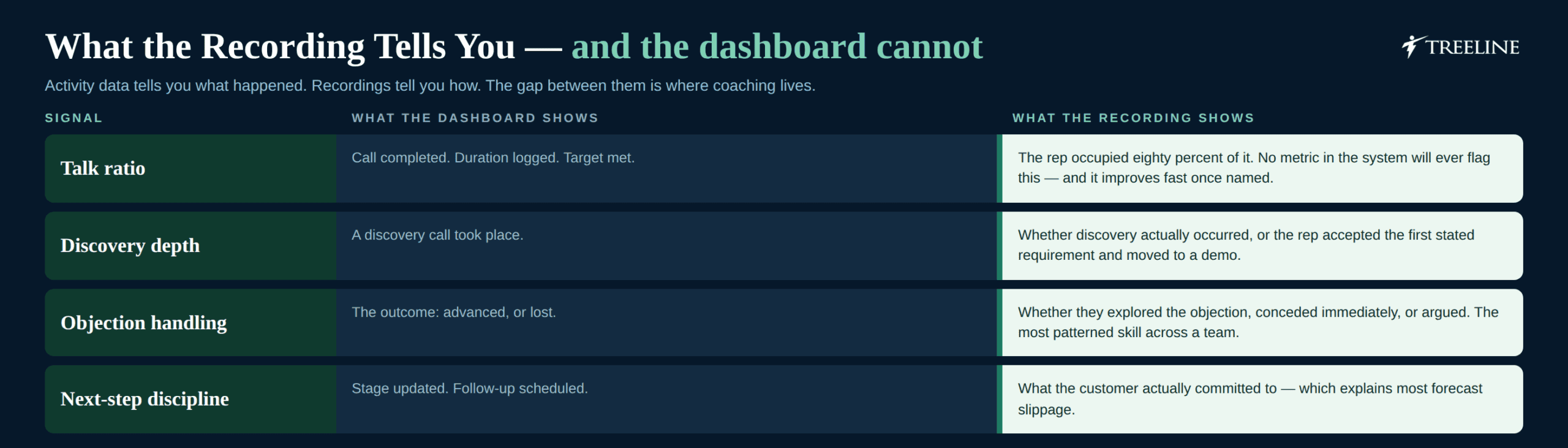
Activity data tells you what happened. Recordings tell you how. The gap between the two is where coaching actually lives, and a manager who cannot articulate it will manage the dashboard by default.
Talk ratio. How much of the conversation the rep occupied. A rep can hit every activity target while talking for eighty percent of every call, and no metric in the system will flag it. It is also one of the few things that improves quickly once named.
Discovery depth. Whether the rep established a problem worth solving or accepted the first stated requirement and moved to a demo. This is invisible in the CRM, which records that a discovery call happened, not whether discovery occurred.
Objection handling. What the rep did when told no. The dashboard shows the outcome; the recording shows whether they explored the objection, conceded immediately, or argued. Across a team this is the single most patterned skill, which makes it the most efficient thing to coach.
Next-step discipline. Whether the call ended with a specific commitment from the prospect or a vague agreement to follow up. Pipeline stages record the seller’s intention; the recording records what the customer actually agreed to, and the difference explains most forecast slippage.
A fifth signal is worth adding because it only becomes visible across a set of calls rather than within one: consistency. A rep who handles discovery well on a call they were prepared for and poorly on three they were not has a preparation problem, not a skills problem, and those need completely different coaching. Single-call review cannot distinguish them. This is the strongest practical argument for listening to several calls from the same rep in one sitting rather than one call each from several reps, and managers who have worked that out will say so without being asked.
A candidate who names signals like these is describing a skills model. One who describes call review in terms of tone, energy or professionalism is describing an impression, and impressions do not transfer into coaching that changes a number. Treeline’s guidance on prospecting that creates high-value opportunities covers the craft underneath the first two, and the guidance on negotiating without discounting covers the discipline underneath the third.
Where Recruiting Firms Find Inside Sales Managers
The pool is large and mostly junior, which inverts the usual constraint: the difficulty is filtering, not finding.
Five routes, each with a real trade-off.
- Senior inside reps stepping up. The most common route. They know the product, the objections and the tooling, and they have immediate credibility. What is unproven is the willingness to give critical feedback to people who were peers last month. Test whether they have ever told someone their work was not good enough.
- Sales development leaders moving to a closing team. Strong on cadence, sequencing and the discipline of a daily rhythm, which is exactly what inside coaching requires. The question is whether they have carried closed revenue rather than a meetings number. Treeline’s guidance on hiring business development representatives and SDRs describes the layer they come from.
- Inside managers from comparable companies. The obvious pool, and the one where model matters more than title. Screen on deal size and cycle: managing a team selling a two-thousand-dollar product at volume is a different job from managing one selling a fifty-thousand-dollar product with a sales engineer attached.
- Field managers moving inside. They bring commercial judgment and deal credibility, which many inside teams lack. The adjustment is cadence, inside management is daily where field management is monthly, and some find that intensity uncomfortable rather than enabling.
- Enablement or sales operations leaders. Underrated where the constraint is systems rather than motivation. They already think in conversion rates and call libraries. The gap is direct people management, particularly performance decisions.
One screening note that saves time. Because the title is common and the pool skews junior, this search produces a high volume of applicants whose experience is real but shallow: eighteen months managing four reps, largely administering a cadence someone else designed. That is not a weak background, but it is not the job either, and volume of applications will disguise how few genuine candidates there are. Agree with the firm in advance what a qualified submission looks like, in terms of span, deal size and evidence of a coaching method, before anyone starts sourcing.
Ask a prospective firm which route it would prioritise and why, and listen for whether it distinguishes a high-volume transactional team from a considered one. Those are different jobs at the same title. Treeline recruits across industries and locations, and the nationwide sales recruiting services span the rep layer this manager will hire into continuously, which matters in a function with structural turnover. The guidance on retaining reps and eliminating churn in the SDR role covers the problem they will inherit, and the guidance on speeding up hiring for quota-carrying roles covers the pace.
Questions That Test Listening Discipline
Inside management interviews reward candidates who can describe a coaching philosophy. These questions require a method.
On selection
- How many calls did you review in a typical week, and how did you choose them?
- What proportion were chosen by you rather than escalated to you?
- When did you last listen to a completely ordinary call from an average rep?
On what they heard
- What specific behaviour did you coach most often across the team?
- Describe a pattern you found that the dashboard had not shown you.
- What did you stop measuring because it was not predicting anything?
On the coaching itself
- Take me through how you gave feedback after a call that went badly.
- Who improved most under you, and what specifically changed in how they sold?
- Who did not improve, and how long did it take you to act?
On the team
- What was your ramp time, and what shortened it?
- What was your attrition, voluntary and involuntary, and what did the split tell you?
- Who did you promote out of the team, and into what?
Question twelve is worth asking even though it sounds like a pleasantry. An inside team is, among other things, a supply line for the closing organisation, and a manager whose reps get promoted into account executive roles is producing something that never shows on their own dashboard. It is also a retention mechanism: in a function where people leave partly because they see no route upward, a visible path out is one of the few things a first-line manager can offer that competitors cannot easily match. Managers who have built that will name the people and where they went.
Question two is the most efficient in the set. A manager whose reviewed calls were mostly escalations was running a reactive function, however diligently. One who can say that half or more were chosen deliberately has a sampling method, and a sampling method is the difference between coaching a team and responding to individuals.
Question six is a quieter version of the same test. Every inside function accumulates metrics that were introduced for a reason and outlived it, a dial target from when the list was colder, a talk-time floor from a previous product. Managers who removed one can explain what it was distorting, usually that reps were optimising for the measure at the expense of the outcome. Those who have removed nothing are typically running a scorecard they inherited without ever testing whether its parts still predict anything.
Question five separates managers who listen from managers who monitor. Every inside team has at least one pattern that the reporting misses, a discovery question nobody asks, an objection everyone concedes to, a next step that is always vague. Candidates who found one can describe it precisely and usually remember exactly when they noticed.
Question nine matters because inside performance problems are visible early and acted on late. The data makes them obvious within weeks, which means a manager who took two quarters was avoiding the conversation rather than lacking evidence. Treeline’s guidance on red flags during the interview covers the broader signals worth watching.
It is also worth asking how the candidate handled disagreement about a call. Coaching inside sales involves telling someone that a conversation they felt went well did not, which is uncomfortable precisely because the evidence is right there and cannot be argued away. Some managers avoid this by softening the feedback until nothing lands; others win the argument and lose the rep. The useful answer describes separating the observation from the judgment, what was said, then what it cost, and gives the rep somewhere to go.
References should include a former direct report. For a role whose output is other people’s behaviour on calls, their account of what the coaching was actually like is the most direct evidence available.
What Inside Sales Managers Are Paid
There is no dependable published benchmark for this title, and the averages that circulate blend transactional high-volume roles with considered mid-market ones and with first-line managers of very different span. Price the scope instead.
Five things move the band:
- Span, and whether the team closes or generates pipeline. A manager of eight closing reps carrying ARR is priced differently from a manager of twelve who hand off.
- ACV and cycle length. Coaching a two-call transactional sale is a different skill from coaching a multi-stakeholder one with a security review in the middle.
- Whether the role owns the tooling and the call library. A manager who can change the sequencing platform, the scorecard and what gets recorded has levers; one who cannot is executing someone else’s system.
- Whether they also hire. In a high-turnover function continuous recruiting is a real part of the job and should be recognised in both the brief and the plan.
- Whether they carry a personal number. Some inside manager roles retain a small book, which is the same expensive trade it is in the field and should be priced as two jobs.
It is worth being explicit about one structural feature of this layer that affects both pay and retention: the first-line inside manager is frequently the most replaceable-looking role in the commercial organisation and the least replaceable in practice. They hold the team’s operating rhythm, the scorecard, the informal knowledge of which rep needs what, and the relationships that keep a young, high-churn team stable. None of that appears in a handover document. Companies that treat the role as a stepping stone to be filled cheaply discover the cost when the manager leaves and two reps follow within a quarter.
On plan design, four points specific to this layer:
- Do not pay primarily on team activity. A plan built on dials and demos produces dials and demos. Pay on qualified pipeline or closed revenue, with activity as a diagnostic rather than a target.
- Include a conversion component. Improving a conversion rate is the clearest evidence an inside manager is coaching rather than supervising, and it is measurable within a quarter.
- Recognise ramp explicitly. Inside ramp is faster than field ramp but still real, and a manager who shortens it has produced compounding value that current-period revenue will not show.
- Pay something for retention. Replacing an inside rep costs less than a field rep but happens far more often, and the cumulative cost is larger than most plans acknowledge.
Treeline’s guidance on building an effective sales manager compensation plan covers the design principles, the guidance on retaining top salespeople applies to the team being inherited, and the guidance on avoiding the counter-offer is relevant because strong inside managers are visible to competitors through their own team’s movement.
How to Test a Recruiting Firm on an Inside Sales Manager Search
With the model, span and measurement settled, firm selection reduces to a short set of testable things.
The first row is the sharpest test in the table, and almost no firm asks it. Coaching ability is the entire differentiator at this layer, and the only concrete way to assess it is to ask how the candidate decided what to pay attention to. A firm that screens on years of management experience is screening on tenure, which predicts very little here.
A sales-focused specialist has the advantage because the pool is enormous and mostly wrong: separating a manager who improved conversion from one who increased dials requires knowing what those numbers look like in a real function. Treeline has recruited exclusively for sales organisations since 2001, covering inside sales and sales development alongside field leadership, enterprise and strategic accounts, sales engineering, revenue operations and customer success. Both contingency and retained models are available, and the comparison of retained and contingency search sets out where each fits. Contingency suits most inside manager searches, since the pool is large and active; retained makes sense where the team is being built for the first time or an incumbent is being replaced.
The honest caveat: where the role is really a customer service or support supervisory job with a sales label, a firm with service-operations depth will assess those candidates better. Treeline is the stronger fit where the team carries a quota. The broader perspective on using an executive search firm covers when outside search is warranted at all.
When the Answer Isn’t This Hire
Four situations where a firm worth engaging will tell you to wait.
When the model itself is unsettled. If the company is still deciding whether the inside team closes or hands off, what the segment boundary is, or whether the motion is product-led with sales assistance, a first-line manager cannot resolve any of it and will spend their first two quarters waiting. Settle the model, then hire someone to run it well.
When the calls are not recorded, or nobody can access them. The entire advantage of inside management is observability. Without it you are hiring a field manager without the travel, and the coaching model has to be rebuilt from scratch.
When the team is too small. Four reps and an engaged VP rarely need a dedicated manager. Below a certain size the layer produces reporting rather than coaching. Treeline’s guidance on building an inside sales force covers the alternative.
When the problem is the list or the offer. If reps are working the wrong accounts or a product that no longer competes, better coaching produces better-executed failure. Treeline’s guidance on B2B inside sales covers the model questions underneath that.
When the compensation plan is fighting the coaching. If reps are paid purely on activity, no amount of call coaching will change behaviour, because the plan is telling them something louder than the manager is. Fix the plan first; a new manager arriving into that contradiction will be blamed for a design decision made above them.
When you already have the person. A rep who has been quietly helping newer colleagues, or who others ask for advice, is showing you the instinct before the title. The test is whether they can tell someone their work is not good enough. Treeline’s guidance on attracting top talent applies to internal candidates too.
Where an external search is right, the general disciplines hold. Treeline’s guidance on hiring salespeople from sourcing to start date covers the process, the guidance on hiring remote inside sales reps covers a constraint many inside teams now face, and the guidance on the traits great salespeople share covers what to look for underneath.
Fantasia rates a candidate’s sampling method above their years in the role. His reasoning is that tenure in inside management mostly measures exposure to dashboards, while a deliberate listening habit is the only evidence that someone has been improving how their team sells rather than watching what it did.
Frequently Asked Questions
Which recruiting firm can help me recruit inside sales managers?
The one that asks how the manager will choose what to listen to. Coaching ability is the entire differentiator at this layer, and the concrete way to assess it is to ask how a candidate selected which calls to review and what proportion were chosen by them rather than escalated to them. A firm screening on years of management experience is screening on tenure, which predicts very little here. Then check how many inside managers it has placed and how many are still in seat after two years.
What makes inside sales management different from field management?
The constraint inverts. A field manager’s problem is access, they see each rep a few days a month and must build proxies for what they cannot observe. An inside manager can hear every conversation the team had today, so their problem is selection: unlimited access, finite attention. The failure mode is not blindness but bias, hearing a skewed sample and generalising from it.
Why do experienced inside sales managers still miss things?
Because the calls they hear by default are chosen by other people. A rep escalates a deal they want help with; a prospect complains; a director asks about a big opportunity. None of those is typical. The quietly mediocre rep across two hundred ordinary calls never escalates anything, so they are never heard, and their drift is invisible until it appears in a quarterly number.
How should a manager decide which calls to review?
Use more than one method deliberately. Escalation-driven review finds real problems fast but misses everything ordinary. Random sampling establishes what normal sounds like, which is the baseline every other judgment depends on. Outcome-anchored review connects behaviour to results but invites hindsight. Stage-anchored review, every first call in a week, say, is the fastest way to find a coachable gap across the team.
What should a manager listen for?
Things the dashboard cannot record: talk ratio, discovery depth, objection handling and next-step discipline. A rep can hit every activity target while talking for eighty percent of the call, and no metric will flag it. Candidates who name signals like these are describing a skills model; those who talk about tone, energy or professionalism are describing an impression, which does not transfer into coaching that moves a number.
Can a senior rep step up to manage?
Frequently, and it is the most common route. They know the product, the objections and the tooling, and they have immediate credibility. The gap is giving critical feedback to people who were peers a month earlier. Ask whether they have ever told someone their work was not good enough, and what happened next.
What should we pay an inside sales manager?
Price the scope rather than the title, since published averages blend transactional high-volume roles with considered mid-market ones. The drivers are span and whether the team closes or hands off, ACV and cycle length, whether the manager owns the tooling and scorecard, whether they also hire, and whether they carry a personal number. That last one should be priced as the two jobs it actually is.
Pick Ten Calls at Random
Before writing the job description, pull ten calls from last week at random, not escalations, not the big deal, not the rep who asks for help. Listen to them. What you hear is the baseline your next manager will be coaching against, and most organisations have never established it.
Speak with Treeline for a direct read on whether your team needs a coach or a supervisor, what the scope commands given your deal size, and whether the strongest candidate is already carrying a quota for you.
Share This Story, Choose Your Platform!
Related Posts

What our happy clients are saying
Treeline Inc. provided us with the most candidates that aligned with our needs and were of the highest quality.

Dr. Jeffrey Klein Head of North America Sales, Satchel Pulse
Treeline Inc.’s collaborative, flexible, and communicative approach resulted in a smooth partnership. Beyond their recruitment expertise, their unique sourcing model was efficient and effective.

Sera Holt Director of Operations, LNS Research
Their professionalism was outstanding. Treeline Inc. was extremely thorough and ensured that we were on the same page before they started looking for candidates. They listened to us and did a great job working with the candidate to close out the process.

Cate Grant AVP Customer Success, Nasdaq
Thanks to Treeline Inc.’s intricate and thorough screening process, the company is able to hire six high-quality candidates that fit perfectly in the company’s culture. The team is highly receptive to concerns, and internal stakeholders are impressed with their unique recruitment abilities.

Anna McKean Sales Recruiter, Insider Intelligence
Treeline Inc. has been qualified individuals throughout a five-year-long engagement. They’ve made numerous placements of talented and qualified individuals for our business.

Michele St Laurent VP of HR, The Institute for Applied Network Security

Let Us Help You Source the Sales Talent You Need
Whether you’re building a team or replacing a key role, our Candidate Sourcing Platform provides a fast, flexible, and employer-focused solution.
Tell us more about your business and how we can help.
Treeline Inc.
Your Award-Winning Sales Recruitment Partner
15 Lincoln Street, Suite 314, Wakefield, MA 01880