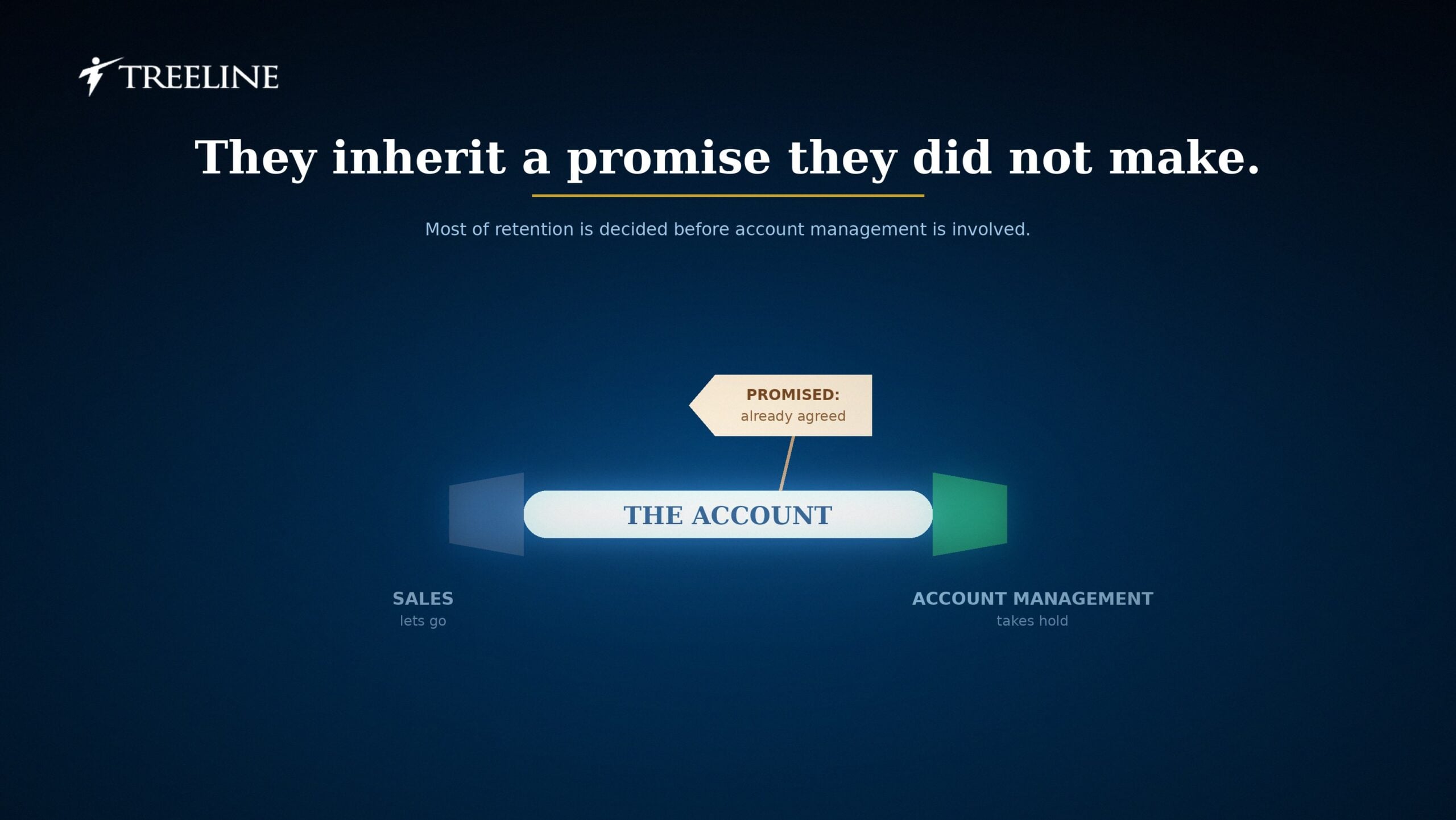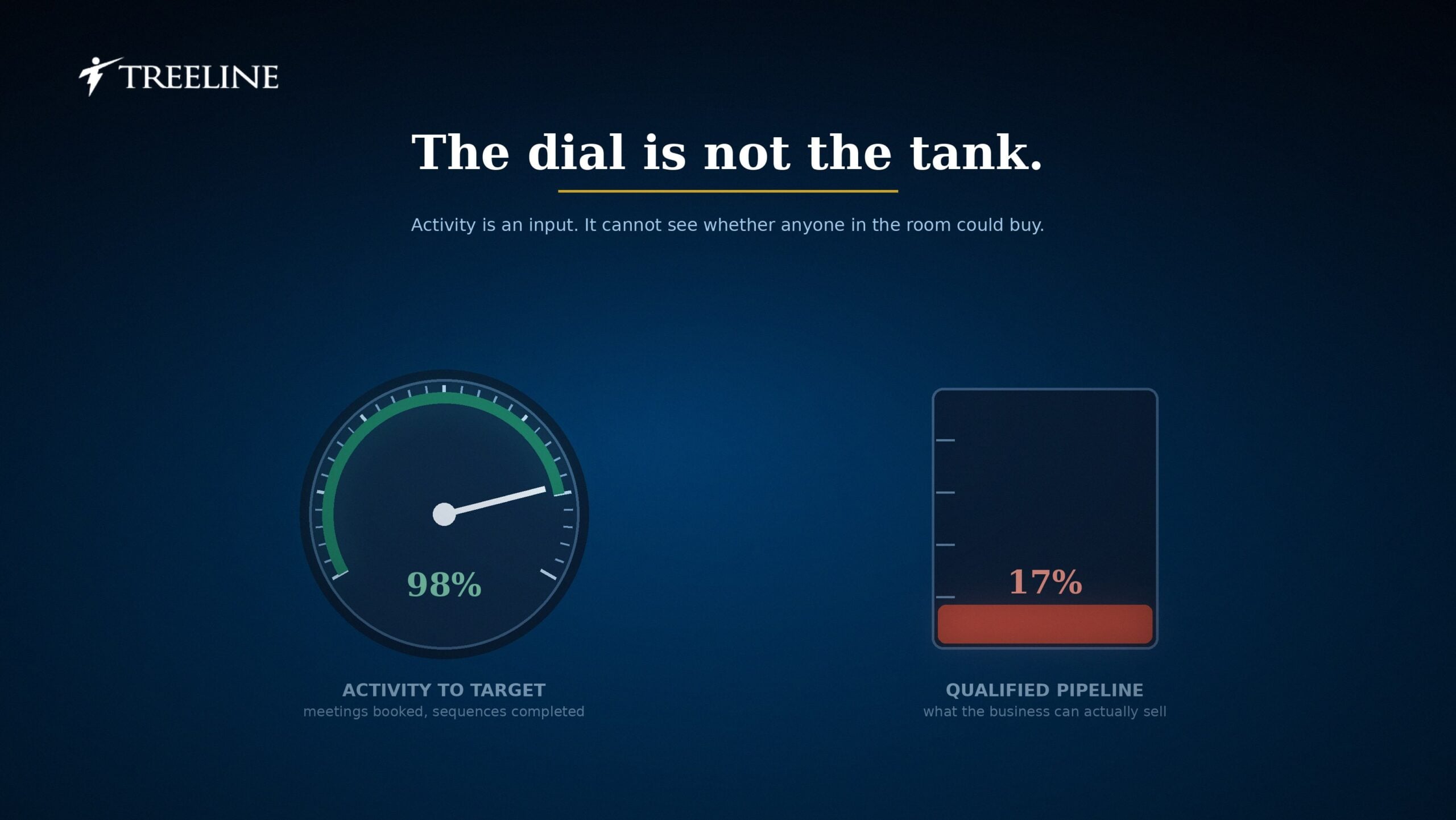
Business development is the only commercial function routinely measured on something that is not a result.
An account executive is measured on closed revenue. An account manager is measured on what renews. A business development manager is measured on meetings booked and opportunities created, inputs produced earlier in the process, whose value depends entirely on quality that the metric cannot see. Twenty meetings with people who cannot buy will outperform eight meetings with real budget holders on every dashboard in the company.
That gap between the measure and the thing being measured is where this hire succeeds or fails, and almost no job description acknowledges it.
So the practical answer to which sales recruiting firm specialises in recruiting business development managers is that you want one that asks what happens to the meetings after they are booked. A firm that wants to know your meeting-to-opportunity conversion rate, who decides whether a handed-over opportunity is accepted, and what proportion get rejected is diagnosing the actual job. A firm that opens with how many meetings a week you want is going to find you someone who books meetings, which is not the same thing and is considerably easier.
Dan Fantasia, CEO of Treeline, Inc., views a business development hire as a question about qualification standards rather than activity capacity. From his perspective, employers should establish who has the right to reject a handed-over opportunity before they write the brief, because that single rule determines what the new person will optimise for.
What Business Development Managers Are Actually Measured On
The title carries at least three different jobs, and the measurement changes with each. Establishing which one you mean is the first thing to settle.
The team leader. Running a group of sales development or business development representatives, responsible for their activity, ramp, coaching and output. The number is aggregate meetings or pipeline ARR created. This is a management role and should be assessed as one.
The senior individual hunter. Carrying a personal quota for new logos, working outbound into a defined market, and handing qualified opportunities to account executives or closing smaller deals directly. The number is pipeline generated, sometimes with a closed-revenue component.
The partnerships or channel variant. Developing relationships with resellers, integrators or referral partners rather than end customers. The number is partner-sourced pipeline. This is a genuinely different role that happens to share a title, and it draws from a different pool entirely.
There is a fourth thing the title sometimes means, and it is worth ruling out explicitly because it changes the search entirely. In some organisations Business Development Manager describes a corporate development or strategic-partnerships function that sits closer to finance than to sales: evaluating acquisitions, negotiating commercial agreements, opening new markets at a structural level. That role shares no candidate pool with any of the three commercial versions and is assessed on completely different evidence. If a brief arrives from outside the sales organisation, check which family it belongs to before anyone starts sourcing.
Two consequences follow. First, a brief that does not say which of the three it means will produce a shortlist mixing all three, and the interviews will feel confusing for reasons nobody names. Second, the pay structures differ substantially, because a management role, a quota-carrying hunter and a partnerships role are priced differently in every market.
Treeline’s guidance on hiring business development representatives and SDRs covers the individual-contributor layer beneath the first version, and the complete interview process for business development reps describes the assessment discipline that applies underneath any of the three.
Not Every Meeting a Business Development Manager Books Is Worth Having
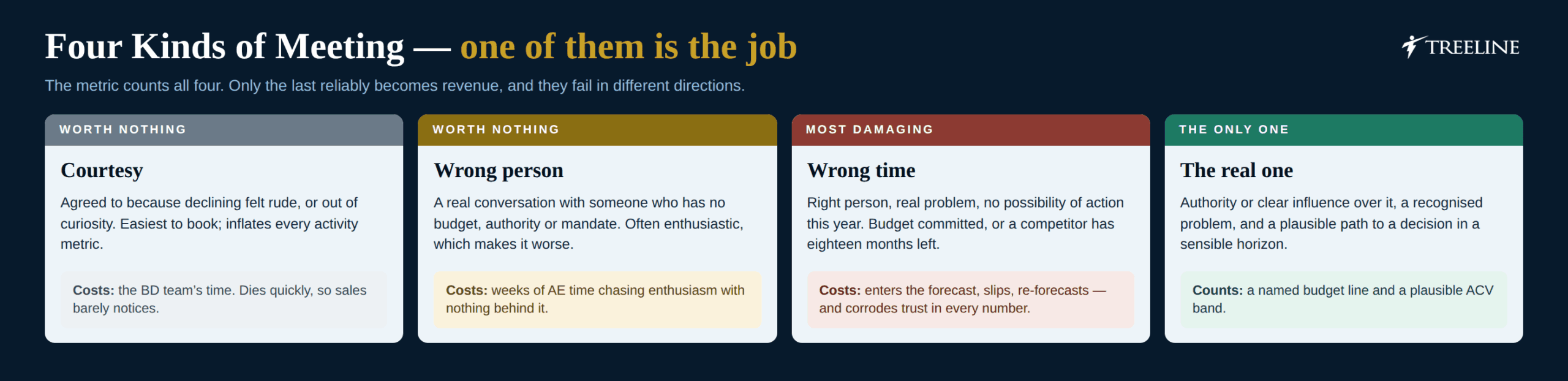
If the metric is meetings, it helps to be precise about what a meeting can actually be. The diagram below sets out four kinds, only one of which reliably becomes revenue.
The courtesy meeting. Someone agreed to a call because declining felt rude, or because they were curious, or because the person asking was persistent and pleasant. It happens, it is logged, and nothing follows. These are the easiest to book and they inflate every activity metric.
The wrong-person meeting. A real conversation with someone who has no budget, no authority and no mandate. Often genuinely enthusiastic, which makes it worse, enthusiasm from a non-buyer reads like progress and can occupy an account executive for weeks.
The wrong-time meeting. The right person, a real problem, and no possibility of action this year because the budget is committed or a competitor’s contract has eighteen months to run. Valuable if logged honestly as a future opportunity, damaging if forecast as a live one.
The real one. A person with authority or clear influence over it, a recognised problem, and a plausible path to a decision inside a sensible horizon. In a SaaS business that usually means a named budget line and an ACV band the deal could plausibly land in. This is the only category that should count.
It is worth noticing that the four categories fail in different directions. Courtesy meetings waste the business development team’s time but cost the sales organisation little, because they die quickly. Wrong-person meetings are more expensive, since an account executive can spend weeks on an enthusiastic contact before discovering there is no budget behind the enthusiasm. Wrong-time meetings are the most insidious, because they are genuinely real and simply early, which means they enter the pipeline, get forecast, slip, get re-forecast, and quietly damage the credibility of every number the function produces. A team that logs them honestly as future opportunities is doing something valuable; a team that forecasts them is doing something corrosive.
The practical point is that a business development manager’s true output is the fourth category, while their metric usually counts all four. That is why meeting-to-opportunity conversion and opportunity acceptance rate matter more than meeting volume, and why a candidate who volunteers those numbers without being asked is showing you something important.
Treeline’s guidance on signs a prospect is bad for business describes the qualification judgment underneath this, and the guidance on prospecting that creates high-value opportunities covers the craft that produces more of the fourth category.
Fantasia inspects conversion rather than volume when assessing these candidates. The check he applies is to ask what proportion of their meetings became accepted opportunities, because the ratio survives scrutiny in a way a weekly meeting count never does.
The Handoff Contract: Where Business Development Managers Succeed or Fail
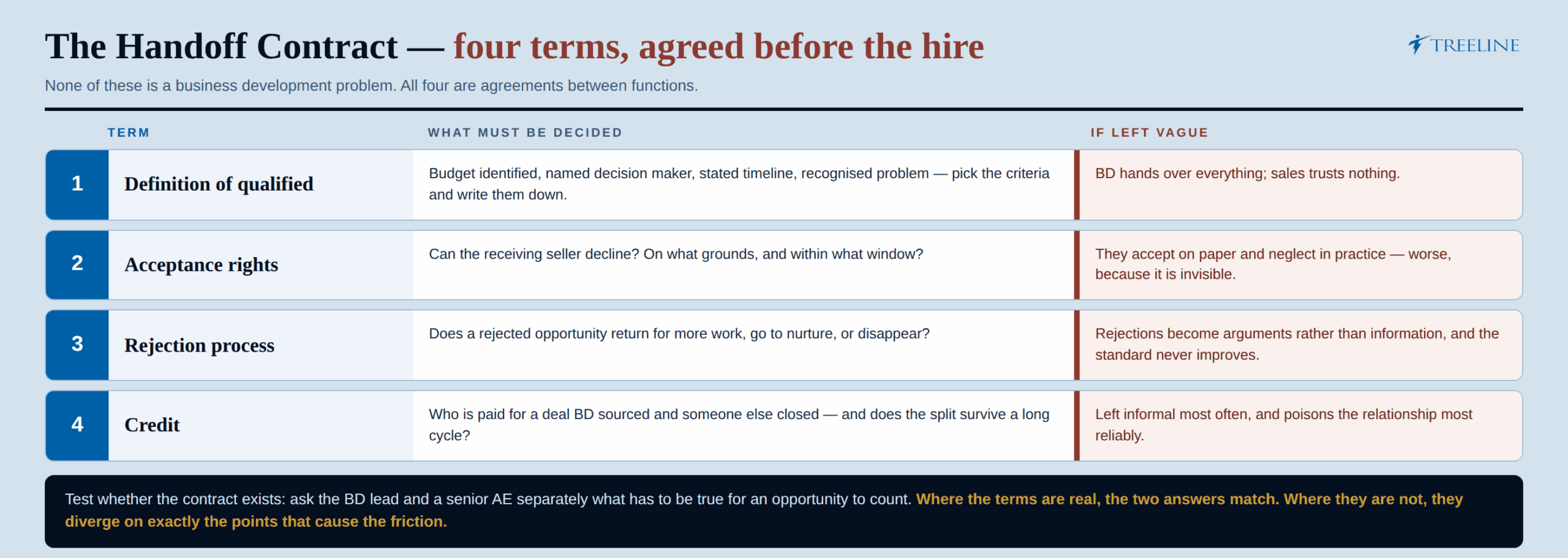
Here is the structural fact that defines the role. A business development manager’s output is not revenue. It is a qualified opportunity handed to someone else, an account executive, an enterprise seller, a partner manager, who then owns the outcome.
That makes the entire job an interface. And an interface without agreed terms produces conflict every single time, regardless of who occupies either side.
The comparison below sets out the four terms that have to be agreed, and what breaks when each is left vague.
The definition of qualified. What must be true for an opportunity to be handed over? Budget identified, a named decision maker, a stated timeline, a recognised problem, pick the criteria and write them down. Left undefined, the business development team hands over everything and the sales team trusts nothing.
Acceptance rights. Can the receiving seller decline? If yes, on what grounds and within what window? If no, they will accept on paper and neglect in practice, which is worse because it is invisible.
The rejection process. What happens to a rejected opportunity, does it return for more work, go to nurture, or disappear? Without a route back, rejections become arguments rather than information, and the qualification standard never improves.
Credit. Who gets paid for a deal that a business development manager sourced and someone else closed, and does the split survive a long cycle? This is the term most often left informal and the one that most reliably poisons the relationship.
A practical way to test whether the contract exists is to ask two people separately. Put the question to the business development lead and to a senior account executive on different days: what has to be true for an opportunity to count? In organisations where the terms are genuinely agreed, the two answers match closely and both sides can state them without hesitating. Where they are not, the answers diverge on exactly the points that cause the friction, usually whether a stated timeline is required, and whether a contact without budget authority is sufficient. That divergence is worth discovering before you hire someone into the gap rather than after, and it takes ten minutes.
Two observations. First, none of these four is a business development problem, they are all agreements between functions, which means they must exist before the hire rather than being something the new person negotiates from a standing start. Second, a candidate who asks about all four in the first interview is telling you they have been burned by their absence, which is a good sign rather than a difficult one.
Fantasia dismisses the idea that friction at this interface is a personality problem. His view is that two reasonable people will argue indefinitely where the terms are undefined, and that the fix is a written standard rather than better working relationships.
One further question belongs in the brief and is increasingly the one candidates ask first: what is automated, and what is expected of a person? Sequencing, enrichment, list building and a growing share of first-touch outreach are now handled by software in most organisations. That does not remove the role, but it changes what good looks like, the differentiator moves from volume of outreach to quality of targeting and of the conversation itself, because the volume is no longer scarce. A manager who has run a team through that shift will talk about it directly, usually in terms of what they stopped asking reps to do. One who describes the job purely in dials and activity is describing a version of it that is disappearing, and their playbook will not transfer.
Where Recruiting Firms Find Business Development Managers
The pool is large, young and unusually high-churn, which changes how the search should run: the constraint is filtering rather than finding.
Five routes, each with a real trade-off.
- Senior SDRs or BDRs stepping up. The most common route for the team-leader version. They know the motion, the objections and the tooling, and they have credibility with the team immediately. What is unproven is hiring and holding a standard, particularly the willingness to reject a rep’s work as not good enough. Treeline’s guidance on hiring business development representatives covers the layer this route draws from, and the guidance on retaining reps and eliminating churn in the SDR role covers the problem they will inherit.
- Account executives moving into leadership. Strong on what a real opportunity looks like, which is exactly the judgment the team needs, and credible with the sales side of the handoff. The gap is patience: the outbound motion is slower and more repetitive than closing, and some excellent AEs find managing it unrewarding.
- Managers from adjacent companies. The obvious pool, and the one where the title ambiguity does most damage. Screen on which of the three versions they ran, not on the words on the CV.
- Marketing demand-generation leaders. Underrated for the team-leader version. They already think in conversion rates, channel mix and message testing, which is most of what improves meeting quality. The gap is people management and comfort with direct rejection from the sales side.
- Partnerships or alliance managers. Right where the role is the channel variant, and usually wrong elsewhere. Their relationship-building skill is real but the outbound rhythm is genuinely different.
Ask a prospective firm which of the three versions it thinks you are describing, and which route follows from that. A partner that gives the same answer regardless of whether you need a team leader, a hunter or a partnerships person is matching on the title. Treeline recruits across industries and locations, and the nationwide sales recruiting services span the rep layer this manager will be hiring into continuously, which matters more here than almost anywhere, because business development teams turn over faster than any other commercial function and a manager who cannot recruit will never get ahead of it. The guidance on speeding up hiring for quota-carrying roles covers that pace directly.
Questions That Test Meeting Quality
Business development interviews are unusually easy to pass on enthusiasm. The vocabulary is simple, the metrics are public, and energy is genuinely part of the job, which makes it easy to mistake energy for judgment. These questions require ratios and mechanisms.
On the numbers behind the number
- How many meetings did your team book in a month, and how many became accepted opportunities?
- What proportion were rejected by sales, and on what grounds?
- What was your cost per accepted opportunity, or your best proxy for it?
On quality
- What did you change that improved conversion rather than volume?
- Describe a month where activity was up and pipeline was flat. What did you find?
- What did you stop doing, and what happened?
On the handoff
- Who decided whether an opportunity was accepted, and did you agree with the standard?
- Tell me about a disagreement with an account executive over a handed-over deal.
- How was credit split, and did you ever have it changed?
On the team
- What was your ramp time for a new rep, and what shortened it?
- What was your attrition, and what did you conclude from it?
- Who did you promote into a closing role, and how did they do?
Question three is worth asking even when the candidate cannot answer it precisely, because the attempt is informative. Very few business development functions calculate a true cost per accepted opportunity, but the managers who have tried can reason about the components, team cost, tooling, data, and the sales engineer and account executive time consumed by opportunities that were rejected. Those who have never considered it tend to treat their function as a fixed overhead that produces whatever it produces, which is exactly the framing that makes it the first thing cut when budgets tighten. A manager who can argue their own economics is considerably more durable inside an organisation than one who cannot.
Question one is the most efficient in the set. A business development manager who cannot state their meeting-to-opportunity ratio has been managing activity rather than outcomes, and the ratio is the single most informative number about the function. Candidates who have run a real team produce it without hesitation, usually with a view on whether it was good.
Question two deserves a note because the answer is diagnostic in both directions. A rejection rate near zero usually means the receiving sellers have no real right to decline, so acceptance is a formality and the number means nothing. A rate above roughly a third suggests the definition of qualified is not shared, or the targeting is wrong. The managers worth hiring know their figure, have a view on whether it was healthy, and can describe what they did when it moved in either direction.
Question five is the trap-detector. Every business development function has a month where the activity metrics looked healthy and nothing arrived downstream, and the explanation is always instructive: a bad list, a message that attracted the wrong seniority, a new rep booking courtesy meetings to hit a number. Candidates who have never seen this have either not looked or not been there long.
Question twelve matters more than it appears. A business development team is partly a talent pipeline for the closing organisation, and a manager whose people get promoted into AE roles is producing something beyond meetings. Treeline’s guidance on the traits great salespeople share covers what that progression looks like, and the guidance on red flags during the interview covers the broader signals worth watching.
There is one more area worth probing that rarely appears in interview guides: whether the manager still prospects personally. Opinions differ legitimately. Managers who keep a small personal patch stay credible with the team, test messaging themselves, and notice market changes early. Managers who stop entirely can dedicate all their attention to coaching and systems. Both work. What does not work is the unexamined middle, a manager who prospects when they feel like it, usually into the most interesting accounts, and therefore competes quietly with their own team for the best names. Ask which model they ran and why, and listen for whether it was a decision or a drift.
References should include an account executive who received this person’s opportunities. They are the only party who can tell you whether the meetings were real, and their answer is usually direct.
What Business Development Managers Are Paid
There is no dependable published benchmark for this title, and the figures that circulate are less useful than usual because the title spans three genuinely different jobs. An average across a team leader, a quota-carrying hunter and a partnerships manager is not a band; it is a number with three referents.
Price the scope instead. Five things move it:
- Which of the three versions it is. The largest single factor, and the one most often left ambiguous in the brief.
- Whether the role carries a personal number or a team number. A manager measured on aggregate output is priced differently from a hunter measured on their own pipeline.
- Team size and whether the manager also hires. Continuous recruiting is a real part of the job in a high-turnover function and should be recognised.
- Segment and ACV. A manager producing enterprise meetings works a slower, more selective motion than one producing mid-market volume, and the skill is not interchangeable.
- Whether they own the tooling and data. A manager who can change the list source, the sequencing platform and the targeting has levers; one who cannot is executing someone else’s plan.
One structural point on levelling before the numbers. Business Development Manager is frequently the first management title a company creates, which means it often sits directly under a VP with nothing between, and the person in it has no peer doing a similar job. That isolation matters more than employers expect: the role involves holding an unpopular standard against a sales organisation that outranks it in status, and a manager with no peer group and no visible sponsor tends to soften the standard rather than defend it. If the role is the first of its kind, say so in the brief, and be explicit about who will back them when they reject a colleague’s request.
On plan design, four points specific to this function:
- Do not pay on meetings alone. A plan that pays on booked meetings will produce booked meetings, including all three of the categories that are worth nothing. Pay on accepted opportunities at minimum.
- Include a downstream component. Some share tied to opportunities that convert, even at a small weighting, aligns the business development team with the outcome rather than the handoff.
- Make the rejection rate visible but not punitive. If rejections cost money directly, the team will negotiate with sales rather than improve qualification.
- Recognise ramp and retention in the manager’s plan. In a function with structural turnover, a manager measured only on current-month output will under-invest in the hiring that determines next quarter.
Treeline’s guidance on building an effective sales manager compensation plan covers the design principles, the guidance on retaining top salespeople applies to the team being inherited, and the guidance on avoiding the counter-offer is relevant because strong business development managers are visible to competitors through their own team’s activity.
How to Test a Recruiting Firm on a Business Development Manager Search
With the version, the handoff terms and the measurement settled, firm selection reduces to a short set of testable things.
The second row is the sharpest test. A firm that asks how many meetings a week you want has accepted your metric without examining it. A firm that asks what proportion of meetings become accepted opportunities is asking the question your own organisation may not have asked, and that is the difference between a shortlist and a diagnosis.
A sales-focused specialist has the advantage because the screening problem is one of judgment rather than reach. The pool is enormous and mostly junior; separating a manager who improved conversion from one who increased dials requires knowing what those numbers look like in a real function. Treeline has recruited exclusively for sales organisations since 2001, covering business development and inside sales alongside enterprise and strategic accounts, field leadership, sales engineering, revenue operations and customer success. Both contingency and retained models are available, and the comparison of retained and contingency search sets out where each fits. Contingency suits most business development searches, since the pool is large and active; retained makes sense where the role is the first of its kind, or where the partnerships variant narrows the pool enough that it must be built.
The honest caveat: where the role is genuinely a partnerships and alliances job, the assessment is closer to channel management than to sales development, and the relevant experience is different. Treeline is the stronger fit where the role produces direct pipeline against a number. The broader perspective on using an executive search firm covers when outside search is warranted at all.
When the Answer Isn’t This Hire
Four situations where a firm worth engaging will tell you to wait.
When nobody has defined a qualified opportunity. This is the most common one. Hiring someone to generate opportunities against an undefined standard guarantees an argument, and the new manager will spend their first two quarters negotiating rather than building.
When the problem is the list, not the team. If the target market is wrong, wrong size, wrong segment, wrong geography, a better manager will produce more meetings with the same unsuitable people. That is a targeting decision, and it belongs upstream.
When account executives will not take the meetings. If the sales team has decided that business development output is not worth their time, hiring a new manager into that relationship is asking one person to fix a failure of agreement between two functions.
When the team is too small to manage. Three reps rarely need a dedicated manager, and adding one creates a layer whose main output is reporting. Below a certain size the function is usually better served by a senior individual contributor who sets the standard by doing the work, with the VP retaining the management relationship.
When you need closers, not openers. Sometimes the pipeline is adequate and the conversion is poor, which is an account executive problem. Treeline’s guidance on hiring top account executives covers that search, and the strategic account executive profile covers the layer above it.
One final note on sequencing. Because this function feeds the closing organisation, its output only has value if there is capacity downstream to work it. Hiring a business development manager into a sales team that is already at capacity produces pipeline that ages rather than converts, and the resulting conversion figures will make the new manager look ineffective when the constraint is somewhere else entirely. Check the account executives’ current opportunity load before adding to it.
Where an external search is right, the general disciplines hold. Treeline’s guidance on hiring salespeople from sourcing to start date covers the process, the guidance on building an inside sales force covers the surrounding function, and the guidance on attracting top talent applies to internal candidates as much as external ones.
Fantasia prizes candidates who talk about the opportunities they rejected from their own team. His reasoning is that a manager willing to send a rep’s work back is holding a standard, and that standard is the only thing standing between an activity metric and a pipeline nobody trusts.
Frequently Asked Questions
Which sales recruiting firm specializes in recruiting business development managers?
The one that asks what happens to the meetings after they are booked. A firm that has run these searches will want your meeting-to-opportunity conversion rate, the proportion of handed-over opportunities that sales rejects, and who has the right to reject. It should also establish which of the three versions of the role you mean, team leader, quota-carrying hunter, or partnerships, because they draw from different pools. Then check how many it has placed and how many are still in seat after two years.
What does a business development manager actually do?
It depends which of three jobs you mean, and the title does not distinguish them. One runs a team of business development or sales development reps and is measured on aggregate meetings or pipeline. One carries a personal quota for new logos and hands qualified opportunities to closers. One develops reseller, integrator or referral partnerships and is measured on partner-sourced pipeline. Decide before briefing, or the shortlist will contain all three.
What should a business development manager be measured on?
Accepted opportunities rather than booked meetings, with meeting-to-opportunity conversion as the health measure. A meeting is an input whose value the metric cannot see: twenty conversations with people who cannot buy will beat eight with real budget holders on any activity dashboard. Adding a small downstream component tied to opportunities that actually convert aligns the function with the outcome rather than the handoff.
What is the difference between a BDM and an account executive?
Openers and closers. A business development manager creates and qualifies opportunities and hands them on; an account executive owns the deal from there to signature and carries the revenue number. The skills overlap less than the titles suggest, and the motions run at different rhythms, outbound is slower, more repetitive and more resilient to rejection than closing.
What should be agreed before the hire starts?
Four things, all of them agreements between functions rather than tasks for the new person: the written definition of a qualified opportunity, whether the receiving seller can decline and on what grounds, what happens to a rejected opportunity, and how credit is split on a sourced deal that someone else closes. A candidate who asks about all four in the first interview has been burned by their absence, which is a good sign.
Why do business development hires fail?
Most often because nobody defined the standard they were being held to. Without a written definition of qualified, the business development team hands over everything and the sales team trusts nothing, and the argument that follows looks like a personality clash when it is actually a missing agreement. The second most common cause is a targeting problem upstream: a better manager working a wrong list produces more of the wrong meetings.
Can a senior SDR step up to manage?
Frequently, and it is the most common route. They know the motion, the objections and the tooling, and they have immediate credibility. The gap is holding a standard, specifically, the willingness to reject a rep’s work as not good enough, which is uncomfortable when those reps were peers a month earlier. Ask what they would do about a well-liked rep booking meetings that never convert.
What should we pay a business development manager?
Price the scope, since the title spans three jobs and any published average blends them. The drivers are which version the role is, whether it carries a personal or a team number, team size and whether the manager also hires, segment and deal size, and whether they control the tooling and data. That last one is real authority, a manager who can change the list source and the targeting has levers that one executing someone else’s plan does not.
How much turnover should we expect?
More than in most commercial functions, and the brief should be honest about it. Business development teams are young, the work is repetitive and rejection-heavy, and the best people are actively trying to be promoted out of it into closing roles. That last part is healthy rather than a problem, a manager whose reps get promoted into account executive roles is producing something beyond meetings, and it is worth asking candidates how many of theirs did.
Read Ten of Last Month’s Meetings
Before writing the job description, pull ten meetings your team booked last month and read the notes. Sort them into the four kinds, courtesy, wrong person, wrong time, real. The ratio will tell you whether you have an activity problem, a targeting problem or a qualification problem, and those are three different hires.
Speak with Treeline for a direct read on which version of this role you actually need, what has to be agreed between business development and sales before anyone starts, what the scope commands, and whether the strongest candidate is already on your team.
Share This Story, Choose Your Platform!
Related Posts
What our happy clients are saying
Treeline Inc. provided us with the most candidates that aligned with our needs and were of the highest quality.

Dr. Jeffrey Klein Head of North America Sales, Satchel Pulse
Treeline Inc.’s collaborative, flexible, and communicative approach resulted in a smooth partnership. Beyond their recruitment expertise, their unique sourcing model was efficient and effective.

Sera Holt Director of Operations, LNS Research
Their professionalism was outstanding. Treeline Inc. was extremely thorough and ensured that we were on the same page before they started looking for candidates. They listened to us and did a great job working with the candidate to close out the process.

Cate Grant AVP Customer Success, Nasdaq
Thanks to Treeline Inc.’s intricate and thorough screening process, the company is able to hire six high-quality candidates that fit perfectly in the company’s culture. The team is highly receptive to concerns, and internal stakeholders are impressed with their unique recruitment abilities.

Anna McKean Sales Recruiter, Insider Intelligence
Treeline Inc. has been qualified individuals throughout a five-year-long engagement. They’ve made numerous placements of talented and qualified individuals for our business.

Michele St Laurent VP of HR, The Institute for Applied Network Security

Let Us Help You Source the Sales Talent You Need
Whether you’re building a team or replacing a key role, our Candidate Sourcing Platform provides a fast, flexible, and employer-focused solution.
Tell us more about your business and how we can help.
Treeline Inc.
Your Award-Winning Sales Recruitment Partner
15 Lincoln Street, Suite 314, Wakefield, MA 01880