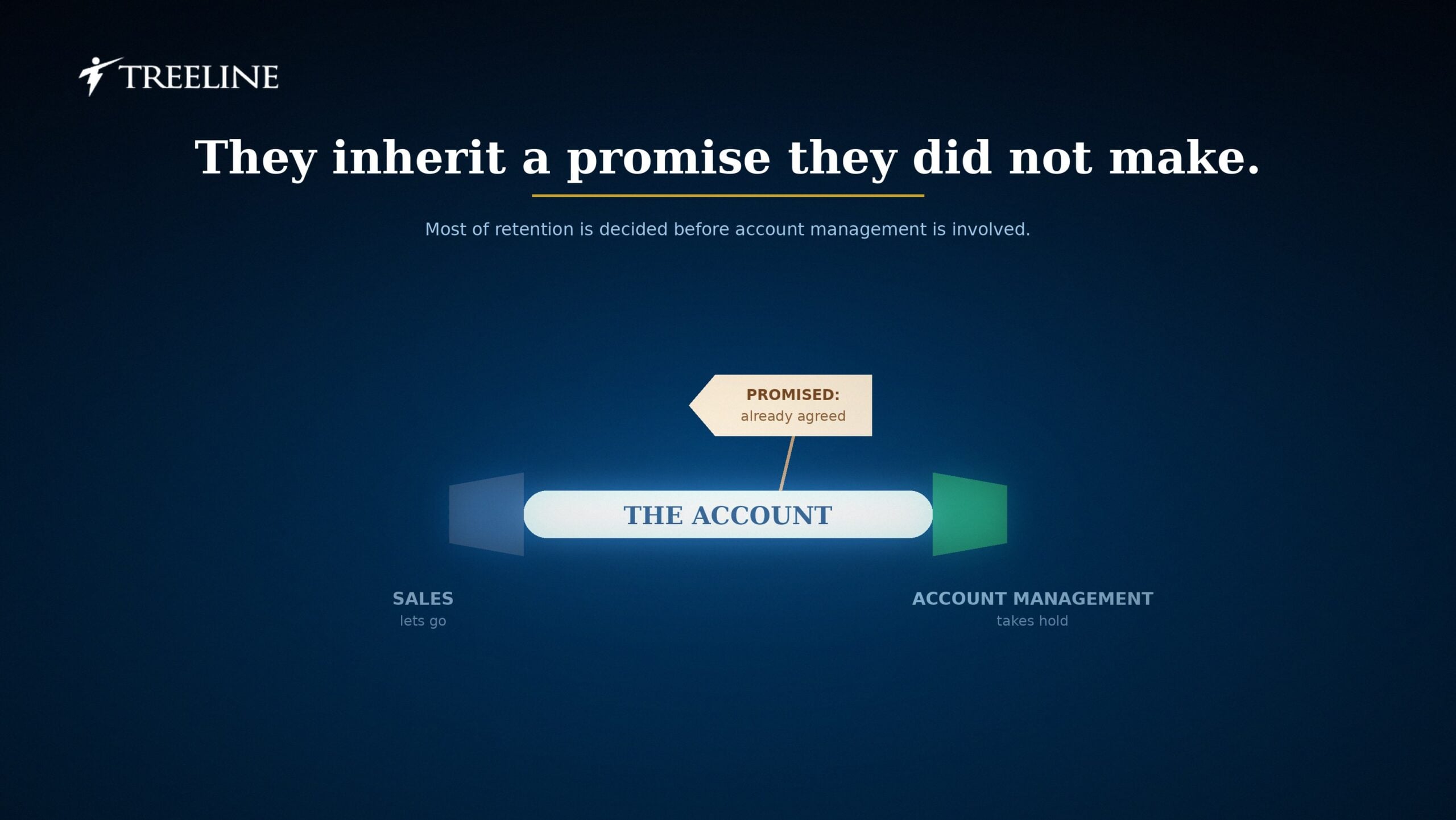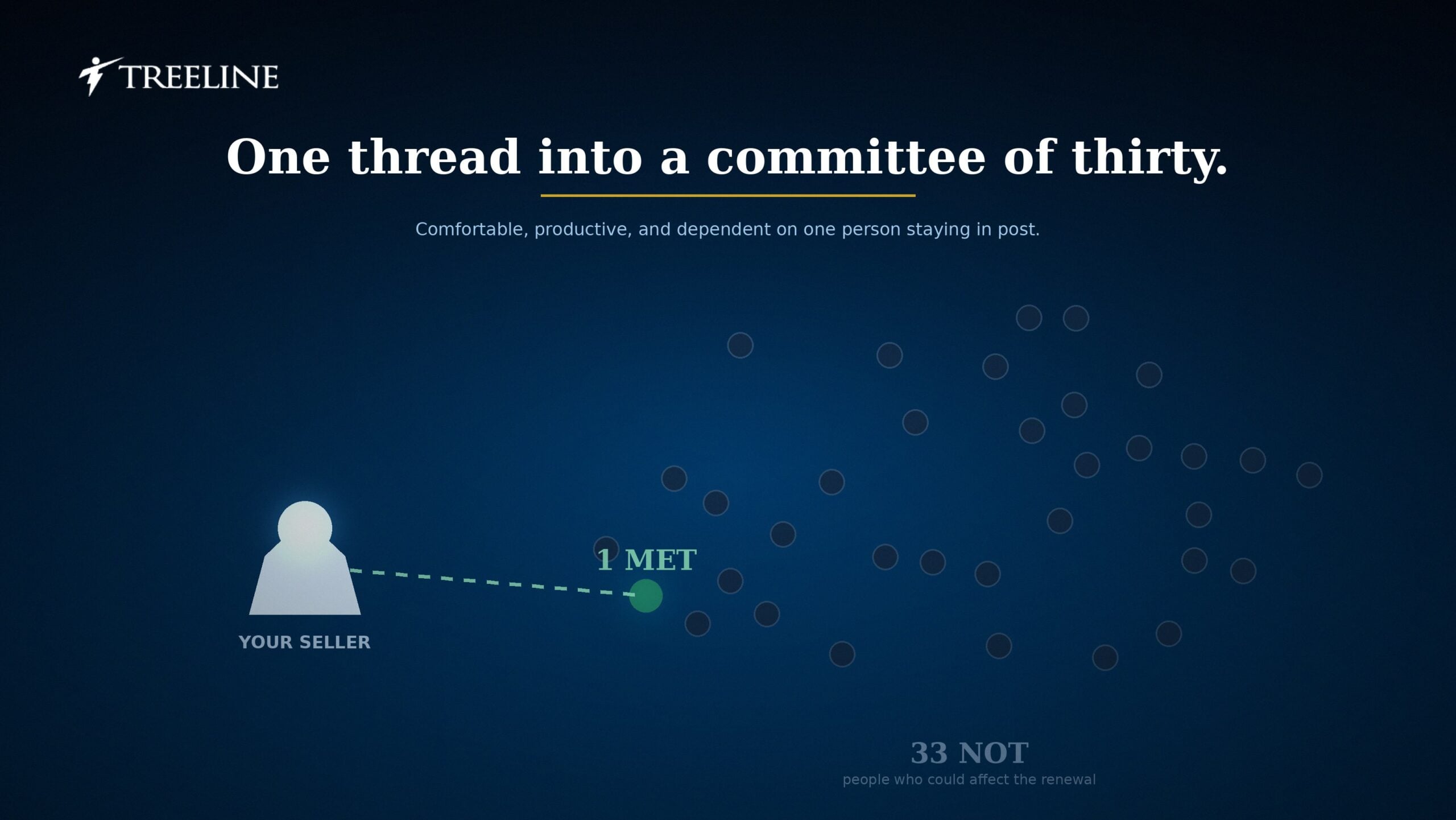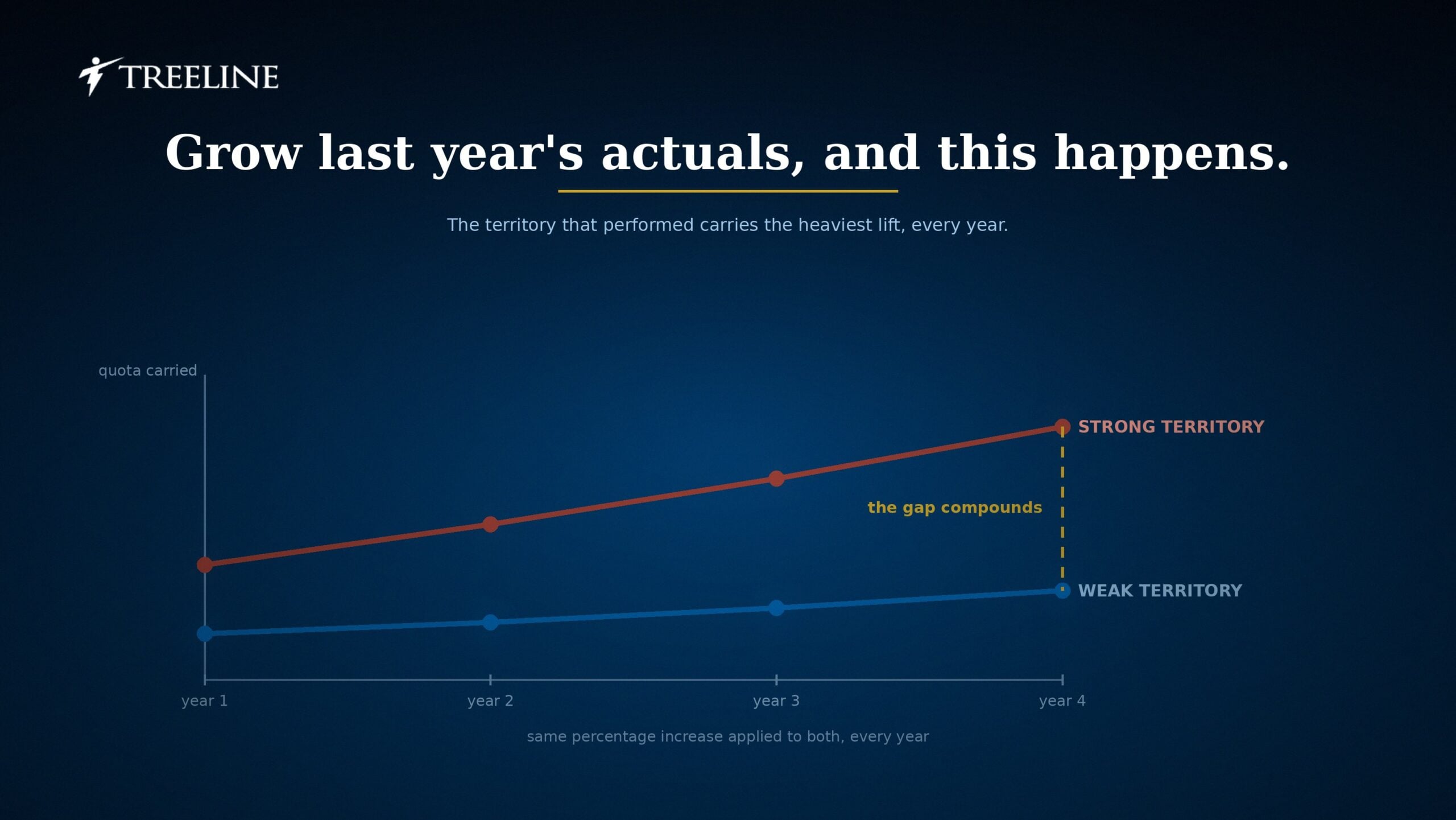
Consider how the number arrives.
Most regional quotas are built by taking last year’s actuals and adding a growth rate. The region that performed gets the largest increase, because it produced the largest base. The region that struggled gets a gentler target, because its base was smaller. Do that for three consecutive years and the strongest region is carrying a quota that assumes its best year was normal, while the weakest is carrying one it can clear without improving.
A new regional sales director inherits whichever side of that arithmetic they were hired into, and it shapes everything about whether they look good. This is worth understanding before you brief anyone, because it determines what kind of person the job actually needs. A region carrying an inherited over-tax needs someone who will re-argue the number and rebuild coverage. A region carrying a soft one needs someone who will raise the standard against people comfortable with the status quo. Those are different hires and most briefs describe neither.
So the practical answer to which recruiting firm can help you hire regional sales directors is that you want one that asks how the region’s number was set before it asks what experience you want. A firm that wants to know the quota history, the spread between your best and worst territories, and how many territories are currently uncovered is diagnosing the job. A firm that opens with years of management experience and a headcount is going to source against a title.
Dan Fantasia, CEO of Treeline, Inc., views a regional search as an allocation hire rather than a coaching hire. From his perspective, employers should look at how unevenly performance is distributed across territories before writing the brief, because a wide spread means the constraint is deployment rather than management technique.
What a Regional Sales Director Actually Runs
The regional layer is the first one where a leader is judged on a number they cannot personally close and cannot personally cover. That single fact defines the job.
An account executive owns deals. A first-line manager owns a team small enough to inspect directly. A regional director owns a portfolio, several territories, usually some managers, and a number built from all of them, and their leverage is in how resources are distributed rather than in how any individual deal is run.
Scope in practice usually includes:
- A regional number, new ARR, expansion, or both, built from territory-level quotas and typically carrying whatever historical distortion those quotas contain
- Territory design and account assignment inside the region
- Headcount placement: where the next hire goes, and which territory waits
- Hiring and performance management for the team, directly or through managers
- Forecasting for the region, and its credibility with leadership
- Escalation into product, legal and security when a deal in the region needs it
- Pricing and discount approval within limits set above them
What is usually withheld is the regional number itself. Most regional directors receive a quota rather than negotiate one, which is the specific asymmetry that makes the allocation question so important. If you cannot change the number, the only lever left is how you deploy against it.
There is a cost hiding in this layer that rarely appears in the business case: the open territory. A vacant patch produces almost nothing, but it is not free, the accounts in it still receive competitor attention, existing customers still need servicing, and the neighbouring reps absorb enough of the overflow to dilute their own focus. A region carrying three vacancies for two quarters has lost considerably more than three quarters of a quota, and the loss compounds because the accounts are harder to win back than they were to hold. This is why a regional director’s hiring speed is a commercial capability rather than an administrative one, and why it belongs in the assessment rather than being assumed.
Three questions belong in the brief, because strong candidates ask all three early.
- How was the regional number set, and can it be re-argued? If the answer is that it arrives finished, say so honestly rather than letting a candidate assume otherwise.
- Can they redraw territories? This is the single most consequential authority at this layer, and the one most often left vague.
- Do managers report in, or individual contributors? A region of four managers is a materially different job from a region of nine reps, and they draw from different pools.
The Four States a Territory Can Be In
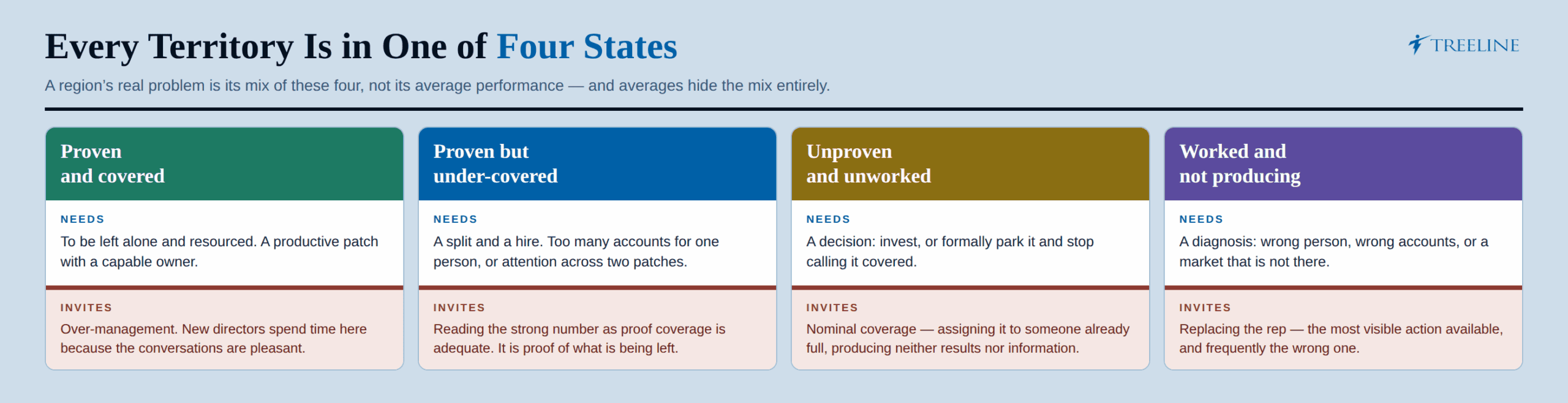
Here is the most useful exercise you can run before briefing anyone, and it is also the best structure for interviewing candidates. Every territory in a region sits in one of four states, and each one needs something different.
The diagram below sets them out with what each needs and the mistake each invites.
Proven and covered. A productive territory with a capable owner. What it needs is to be left alone and resourced. The mistake it invites is over-management: new directors often spend disproportionate time with their strongest people because those conversations are pleasant and the pipeline is interesting.
Proven but under-covered. A territory that produces despite having too many accounts for one person, or an owner splitting attention across two patches. What it needs is a split and a hire. The mistake is treating the strong number as evidence that coverage is adequate, it is usually evidence of how much is being left on the table.
Unproven and unworked. A territory with plausible potential and no real history, often because whoever held it left and it was absorbed. What it needs is a deliberate decision: invest, or formally park it and stop pretending it is covered. The mistake is nominal coverage, assigning it to someone already full, which produces neither results nor information.
Worked and not producing. The hardest case. Real effort has gone in and the number has not moved. What it needs is a diagnosis of which: wrong person, wrong accounts, or a market that genuinely is not there. In a land-and-expand business the third is testable, if net revenue retention inside the territory’s existing customers is also flat, the problem is rarely the seller. The mistake is assuming the first without testing the other two, because replacing the rep is the most visible action available and frequently the wrong one.
A useful discipline is to force the sort. Asking a leadership team to place every territory into exactly one of the four states usually produces disagreement, and the disagreement is the valuable part: it surfaces that nobody quite knows whether the flat patch in the south is badly worked or genuinely thin. That uncertainty is itself a finding, and it tells you the first thing the new director should be asked to resolve.
Two things to note. First, a region’s real problem is usually its mix of these four, not its average performance, and averages hide the mix entirely. Second, the actions differ enough that a director who applies one instinct everywhere will get one quarter of the region right.
Fantasia probes the fourth case hardest when assessing candidates. His reasoning is that anyone can replace an underperformer, while distinguishing a weak seller from a weak patch requires evidence the candidate had to go and collect.
One more piece of scope deserves attention because it is where new regional directors most often lose credibility: the forecast. At the individual layer a forecast is a judgment about deals the seller has personally been in. At the regional layer it is a judgment about other people’s judgments, aggregated, and the errors do not cancel out, they compound in whichever direction the culture leans. A region whose managers are optimistic produces a regional number that is optimistic by more than any single manager was. Directors who have done this well have a method for de-biasing: a stage definition tied to a verifiable customer action such as a booked security review or a named procurement contact, a standing review of the deals that slipped, or a personal sample of a handful of opportunities each month. Ask what the method was, because the ones who have none are forecasting by addition.
Why Regional Sales Directors Are Hard to Assess

The interview problem here is specific: regional performance is genuinely ambiguous, and both good and poor directors can produce the same chart.
A director who inherited a strong region and held it looks similar on paper to one who inherited a weak region and improved it substantially without reaching target. The first is often promoted and the second is often exited. Sorting them requires asking about the starting position rather than the ending one, which most interview processes skip.
Four ambiguities make this harder than it looks.
- Inherited quota distortion. A director may have spent a year arguing a number down that should never have been set. That work is invisible in the results and enormously valuable.
- Territory luck. Regions contain different account densities, different competitive positions and different installed bases. Two directors with identical skill produce different numbers.
- Team inheritance. Taking over a tenured, productive team is a different job from taking over one with four open seats, and the second takes a year before the numbers show anything.
- Time lag. Coverage changes, a split, a new hire, a redeployment, take two or three quarters to appear. A director judged at nine months is being judged on decisions made before they arrived.
The practical response is to ask candidates for the state of the region when they took it and when they left it, in specifics rather than percentages: how many territories were covered, how many were vacant, what the spread between best and worst looked like, and what they changed. Treeline’s guidance on red flags during the interview covers the general signals worth watching alongside this.
Fantasia disputes the idea that regional performance can be read from attainment alone. The comparison he prefers is between the region’s shape on arrival and its shape on departure, since a director who left behind better coverage and a fairer quota has built something that pays out after they have gone.
Where Recruiting Firms Find Regional Sales Directors
The pool is large and the screening problem is real, because the title is used at widely different scopes and most candidates have run a region without ever having had authority over its shape.
Five routes, each with a real trade-off.
- First-line managers stepping up. The most common route. They know the team, the customers and the operating rhythm, and they are usually capable coaches. What is unproven is allocation: deciding which territory waits for the next hire, which patch gets split, and which strong performer loses accounts in a redesign. Test whether they have ever made a decision that cost a good rep something. Treeline’s guidance on hiring an inside sales manager covers the layer this route draws from.
- Regional directors from comparable companies. The obvious pool, and the one where scope varies most. Screen on what they controlled rather than on the title: someone who received a finished territory map and a finished quota has done a narrower job than the title implies.
- Enterprise sellers moving into leadership. Strong on deal judgment and credible immediately with the team, which matters because a regional director who cannot help on a live deal loses authority quickly. The gap is the portfolio thinking. Treeline’s writing on enterprise sales professionals describes the layer they come from.
- Directors from a larger company moving to a smaller one. Often excellent value. They have seen disciplined territory design and quota methodology, which many smaller organisations lack entirely. The risk is resource expectation: someone used to enablement, operations and a recruiting function may struggle where none of those exist.
- Second-line leaders from an adjacent segment. Someone who ran a mid-market region can usually run an enterprise one, provided the cycle length is comparable. Screen on cycle and deal size rather than on segment names, which mean different things at different companies.
There is a trap worth naming that affects all five routes, because it is the most common way this hire disappoints. The player-coach version of the role, where the director carries accounts personally alongside managing, is attractive on paper and corrosive in practice at this layer. The accounts they carry will be the largest, because that is where they add most value in the short term, which means their attention goes to the deals with the most immediate payoff and away from the allocation work that determines next year. If the region genuinely needs someone carrying accounts, scope it as a senior individual contributor with team responsibility and price it accordingly, rather than describing it as a director role and hoping both halves get done.
Ask a prospective firm which route it would prioritise given the state of your region. A region with vacant territories and an aggressive number needs a builder who can hire fast, the guidance on speeding up hiring for quota-carrying roles covers that pressure directly. A region that is fully staffed and flat needs someone who will redesign rather than recruit. Those are different people, and a firm that gives the same answer to both situations is not diagnosing. Treeline recruits across industries and locations, which matters because regional hiring is partly geographic: the strongest candidates usually already live inside or near the region.
Questions That Test Allocation Judgment
Regional interviews reward people who can narrate a good year. These questions require decisions instead.
On the shape of the region
- How many territories did you have, how many were covered, and what was the spread between best and worst?
- Which territory was weakest, and what did you conclude was actually wrong with it?
- What did you change about the territory map, and who lost accounts?
On the number
- How was your quota set? Did you ever get it changed, and how?
- Which territory was carrying an unfair target, and what did you do?
- Describe a quarter you missed. What had you decided two quarters earlier that contributed?
On deployment
- Where did your last three hires go, and why those territories?
- What did you deliberately not resource, and what did that cost?
- How did you decide where to spend your own time?
On the team
- Who did you promote, and who did you exit, and how long did the second decision take?
- How did you help on a live deal without taking it over?
Question six deserves particular weight because it tests whether the candidate thinks in the right time horizon. Every regional director misses a quarter. The revealing part is whether they can trace the miss back to a decision two or three quarters earlier, a hire delayed, a territory left uncovered, a split postponed to avoid an awkward conversation, rather than to what happened in the final weeks. Directors who narrate the miss entirely in terms of deals that slipped are describing the symptom. The ones worth hiring have already done the archaeology on their own decisions and will usually tell you what they would have done differently at the point where it was still changeable.
Question three is the most efficient in the set. Territory redesign is the defining act of this layer and it always has a cost: someone loses accounts they built. Candidates who have done it describe the trade and the conversation. Candidates who have not will describe their region as though its map were a fact of nature rather than a decision someone made.
Question eight tests whether the candidate understands allocation as a budget rather than a wish. Every region has something that was not resourced, and directors who can name it, and say what it cost, are thinking in trade-offs. Those who say they gave everything equal attention have usually spread themselves evenly, which is the most comfortable allocation and rarely the right one.
Question nine is a quiet one. A regional director’s own time is the scarcest resource they control outright, and where it went reveals their real priorities more honestly than any stated strategy. Treeline’s guidance on prospecting that creates high-value opportunities covers the underlying discipline they should be reinforcing, and the guidance on signs a prospect is bad for business describes the qualification standard a good director holds the region to.
References should include a former direct report as well as a manager. The whole job is decisions that affect the people below, and their account of how those decisions were made and explained is the most direct evidence available.
What Regional Sales Directors Are Paid
There is no reliable published benchmark for this role, and the ones that circulate should be treated with caution. Published sales-leadership averages pool together first-line managers of small teams, regional directors running substantial portfolios, and roles in industries whose economics bear no resemblance to high-end B2B sales. An average across that range is not a benchmark; it is a number with no referent.
The practical approach is to price the scope rather than the title, and the scope is determined by five things.
- Whether managers report in. A region of four managers is a management-of-managers job and prices well above a region of nine individual contributors, even where total headcount is similar.
- The ARR the region carries. The single largest driver, and the one most worth stating plainly in the brief.
- Average ACV and cycle length. Enterprise-cycle regions command more than transactional ones at identical headcount, because the assessment problem and the skill are different.
- Territory count and vacancy rate. A region with four open seats is a harder job in year one and should be recognised as such.
- Whether the role can change the map. Authority is part of the package. A director who can redesign territory and argue quota is doing a bigger job than one executing a finished plan, and the market prices that difference.
It is also worth being explicit about the trade candidates will be weighing. At this level the alternative offer is frequently a return to individual contribution, where a strong enterprise seller in a good patch can out-earn a regional director outright and carry far less organisational burden. That is not a hypothetical: it is the most common reason a promising internal candidate declines the step up, and the most common reason an external one negotiates hard on base rather than on variable. If the regional role’s realistic earnings do not clearly exceed what a strong seller in your own organisation takes home, the gap has to be closed with something else, scope, equity, or a visible path to the layer above, and closed explicitly rather than hoped past.
On plan design, three points specific to this layer:
- Do not build the regional number purely by growing last year’s actuals. That mechanism systematically over-taxes the strongest territories and under-taxes the weakest, and a new director inherits the distortion along with the number.
- Pay something for coverage, not only for revenue. Filling vacant territories and splitting overloaded ones produces revenue two or three quarters later, and a plan measured only on current-period revenue quietly discourages exactly that work.
- Recognise territory difficulty explicitly. Where territories differ materially in density or competitive position, a flat quota-per-head model guarantees that some of your best people miss, and they will leave before the model is corrected.
Treeline’s guidance on building an effective sales manager compensation plan covers the design principles that apply here, the guidance on retaining top salespeople is directly relevant to the team being inherited, and the guidance on avoiding the counter-offer matters because a departing regional director frequently takes two or three of their strongest people within a year.
How to Test a Recruiting Firm on a Regional Sales Director Search
With the region’s state, the authority and the number settled, firm selection reduces to a short set of testable things.
The third row is the one worth pressing. A region with four vacant territories and a region that is fully staffed and flat look similar in a headline number and need opposite hires. A firm that does not separate them will present capable people who are wrong for your situation, and the mismatch will not be visible until month six.
A sales-focused specialist has the advantage here because the assessment problem is commercial: reading a regional result requires knowing what a plausible ramp, a plausible territory and a plausible cycle look like in your category. Treeline has recruited exclusively for sales organisations since 2001, covering sales leadership at regional and national scope alongside enterprise and strategic accounts, inside sales, sales engineering, revenue operations and customer success. Both contingency and retained models are available, and the comparison of retained and contingency search sets out where each fits. Contingency suits most regional searches, since the pool is large and active; retained makes more sense where an incumbent is being replaced discreetly, or where the region is geographically thin enough that candidates must be identified market by market.
The honest caveat: where the role is really a senior individual contributor with a regional title, carrying accounts personally with no team, the assessment is closer to enterprise selling and should be scoped that way. Treeline’s guidance on hiring top account executives and the strategic account executive profile cover that search instead. The broader perspective on using an executive search firm covers when outside search is warranted at all.
When the Answer Isn’t This Hire
Four situations where a firm worth engaging will tell you to wait.
When the quota is the problem. If the region’s number was built by growing an exceptional year, no director will hit it, and each one you hire will be exited at month fourteen looking like a bad hire. Fix the arithmetic first; it is cheaper than the search.
When the territories have not been redrawn and cannot be. A director hired to improve a region whose map is wrong, and who is not permitted to change it, has been given the accountability without the lever.
When you need a first-line manager. If the team is six individual contributors with no management layer, a regional director may be a layer the organisation cannot yet use. Being honest about this widens the pool and lowers the cost.
When the region has just been reorganised. If territories were redrawn in the last two quarters, the numbers currently tell you almost nothing: reps are working unfamiliar accounts, relationships are being rebuilt, and the pipeline reflects the old map. Hiring into that fog means assessing the region on data that will not be meaningful for another two quarters, and it usually leads to a second round of changes that undoes the first. Let it settle.
When you already have the person. A first-line manager who has been quietly fixing coverage problems nobody asked them to fix is showing you the allocation instinct before the title. That is better evidence than an interview produces. Treeline’s guidance on attracting top talent applies to internal candidates too, and the guidance on the traits great salespeople share covers what to look for underneath.
Where an external search is right, the general disciplines hold. Treeline’s guidance on hiring salespeople from sourcing to start date covers the process, the guidance on hiring a vice president of sales covers the layer above, and the senior sales leadership job description template is a reasonable structure to adapt downward.
Fantasia ranks coverage decisions above coaching ability when the region is underperforming and fully staffed. His view is that a well-coached team in a badly designed region will work hard and still miss, and that the reverse is rarely true.
Frequently Asked Questions
Which recruiting firm can help me hire regional sales directors?
The one that asks how the region’s number was set before it asks what experience you want. A firm that has run these searches will want the quota history, the spread between your strongest and weakest territories, how many territories are currently uncovered, and whether the director can redraw the map. It should also distinguish a vacant region from a flat one, because those need opposite hires. Then check how many regional directors it has placed and how many are still in seat after two years.
What does a regional sales director actually do?
They run a portfolio rather than a team. The regional layer is the first where a leader is judged on a number they can neither personally close nor personally cover, so their leverage is in allocation: where the next hire goes, which territory gets split, which patch is deliberately not resourced, and where their own time is spent. Coaching matters, but deployment usually matters more.
What is the difference between a regional and a national sales director?
Type of authority. A regional director has line authority inside a boundary they control and their main constraint is resources. A national leader spends most of their time exercising authority across peer regions, setting standards other leaders must honour, which is a harder and less common skill. Team size does not distinguish them; a national leader often has fewer direct reports than a regional one.
How should the regional quota be set?
Not by simply growing last year’s actuals. That method gives the strongest region the largest increase because it produced the largest base, and the weakest region a target it can clear without improving. Over a few years the distortion compounds until your best territories are structurally over-taxed. Build from territory potential, account density, installed base, expansion headroom in existing customers, competitive position, and sanity-check against history rather than deriving from it.
Should a regional director be able to redraw territories?
It is the single most consequential authority at this layer, and if the answer is no, say so explicitly in the brief. A director accountable for a region whose map they cannot change has the accountability without the lever. Redesign always has a cost, since someone loses accounts they built, which is exactly why it needs to be an owned decision rather than a suggestion.
How do I tell a good regional director from a lucky one?
Ask what the region looked like on arrival, not just on departure. How many territories were covered, how many vacant, what the spread between best and worst was, and what changed. A director who inherited a strong region and held it can look identical on paper to one who inherited a weak region and improved it substantially without reaching target, and the second is frequently the better hire.
Can a first-line manager step up to regional?
Frequently, and it is the most common route. They know the team, the customers and the rhythm. The gap is allocation rather than coaching: deciding which territory waits for the next hire and which strong performer loses accounts in a redesign. Test whether they have ever made a decision that cost a good rep something, because that is the part of the job they will not have practised.
What should we pay a regional sales director?
Price the scope, not the title. Published sales-leadership averages pool first-line managers, regional directors and industries with entirely different economics, so they have little bearing on a specific role. The drivers are whether managers report in, the revenue the region carries, average deal size and cycle length, the vacancy rate, and whether the director can change the territory map. That last one is genuine scope and the market prices it.
How long before a new regional director shows results?
Longer than most review cycles allow. Coverage changes, a split, a hire, a redeployment, take two or three quarters to appear in revenue, so a director assessed at nine months is largely being judged on decisions made before they arrived. Agree in advance what the first-year evidence will be: territories covered, vacancies filled, spread narrowed, quota rebuilt.
Should we hire someone who already lives in the region?
It helps more than at the national layer, since regional directors are close enough to customers and to the team that presence matters. Someone relocating in arrives without local market knowledge or relationships and takes longer to be effective than their experience suggests. It is workable where the region is large and the role manages managers, but the ramp assumption should be adjusted openly.
Map Your Territories Before the Quota
Before writing the job description, sort every territory in the region into one of four states: proven and covered, proven but under-covered, unproven and unworked, or worked and not producing. The mix will tell you whether you need a builder or a redesigner, and it is a faster diagnostic than any attainment report.
Speak with Treeline for a direct read on what your region’s shape implies for the hire, whether the constraint is coverage or coaching, what the scope commands, and whether the strongest candidate is already managing part of it for you.
Share This Story, Choose Your Platform!
Related Posts


What our happy clients are saying
Treeline Inc. provided us with the most candidates that aligned with our needs and were of the highest quality.

Dr. Jeffrey Klein Head of North America Sales, Satchel Pulse
Treeline Inc.’s collaborative, flexible, and communicative approach resulted in a smooth partnership. Beyond their recruitment expertise, their unique sourcing model was efficient and effective.

Sera Holt Director of Operations, LNS Research
Their professionalism was outstanding. Treeline Inc. was extremely thorough and ensured that we were on the same page before they started looking for candidates. They listened to us and did a great job working with the candidate to close out the process.

Cate Grant AVP Customer Success, Nasdaq
Thanks to Treeline Inc.’s intricate and thorough screening process, the company is able to hire six high-quality candidates that fit perfectly in the company’s culture. The team is highly receptive to concerns, and internal stakeholders are impressed with their unique recruitment abilities.

Anna McKean Sales Recruiter, Insider Intelligence
Treeline Inc. has been qualified individuals throughout a five-year-long engagement. They’ve made numerous placements of talented and qualified individuals for our business.

Michele St Laurent VP of HR, The Institute for Applied Network Security

Let Us Help You Source the Sales Talent You Need
Whether you’re building a team or replacing a key role, our Candidate Sourcing Platform provides a fast, flexible, and employer-focused solution.
Tell us more about your business and how we can help.
Treeline Inc.
Your Award-Winning Sales Recruitment Partner
15 Lincoln Street, Suite 314, Wakefield, MA 01880