Here is the situation that usually produces this hire, whether or not anyone says so out loud.
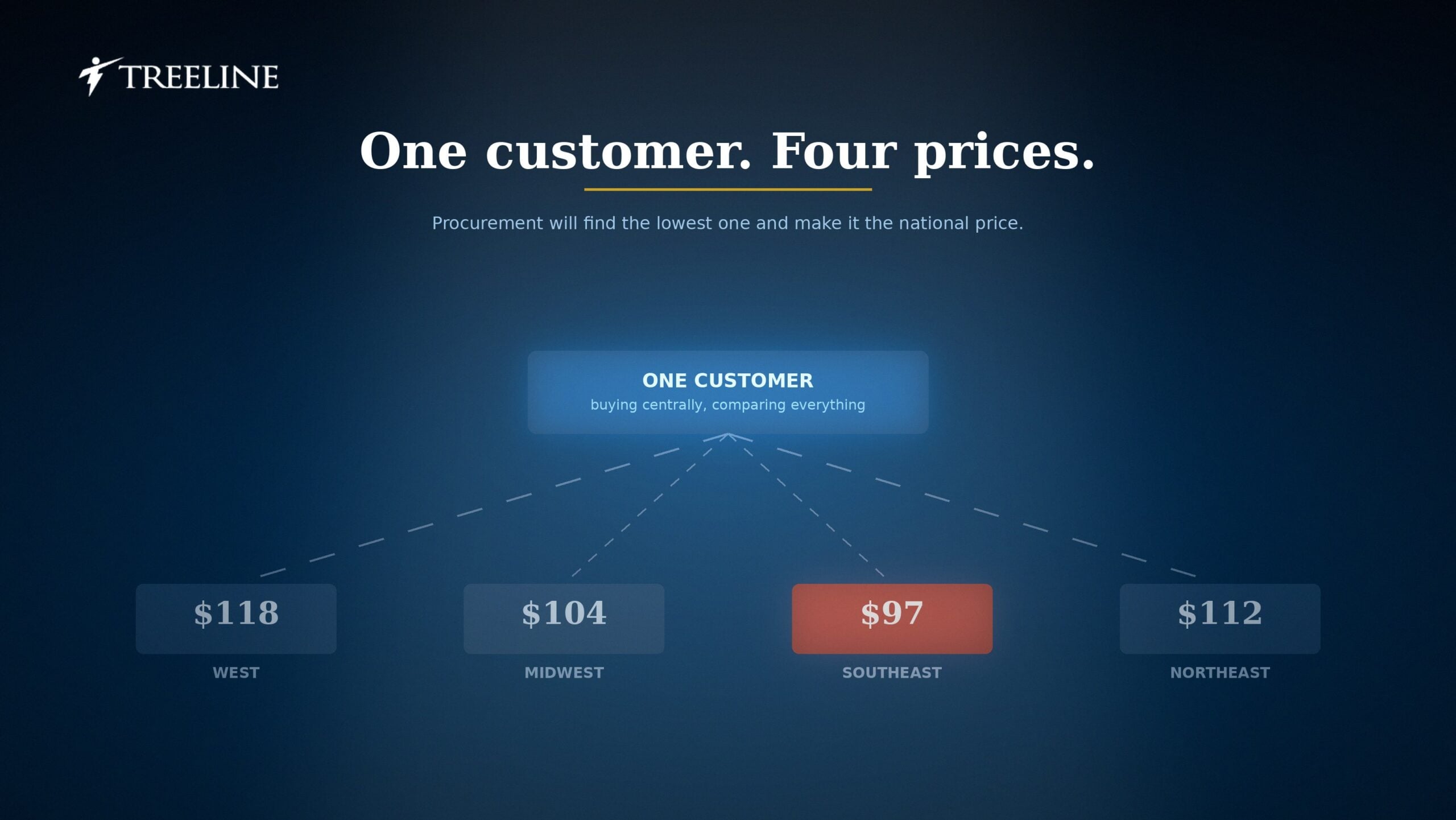
A customer with sites in four regions notices that your Midwest team quotes differently from your Southeast team. Procurement builds a spreadsheet. At the next negotiation they present it, ask why they are being charged three prices for the same product, and require the lowest one across all sites. Nobody in your company did anything wrong, each regional manager priced to their own market, their own competition and their own quota, and collectively they have just handed the customer a discount nobody approved.
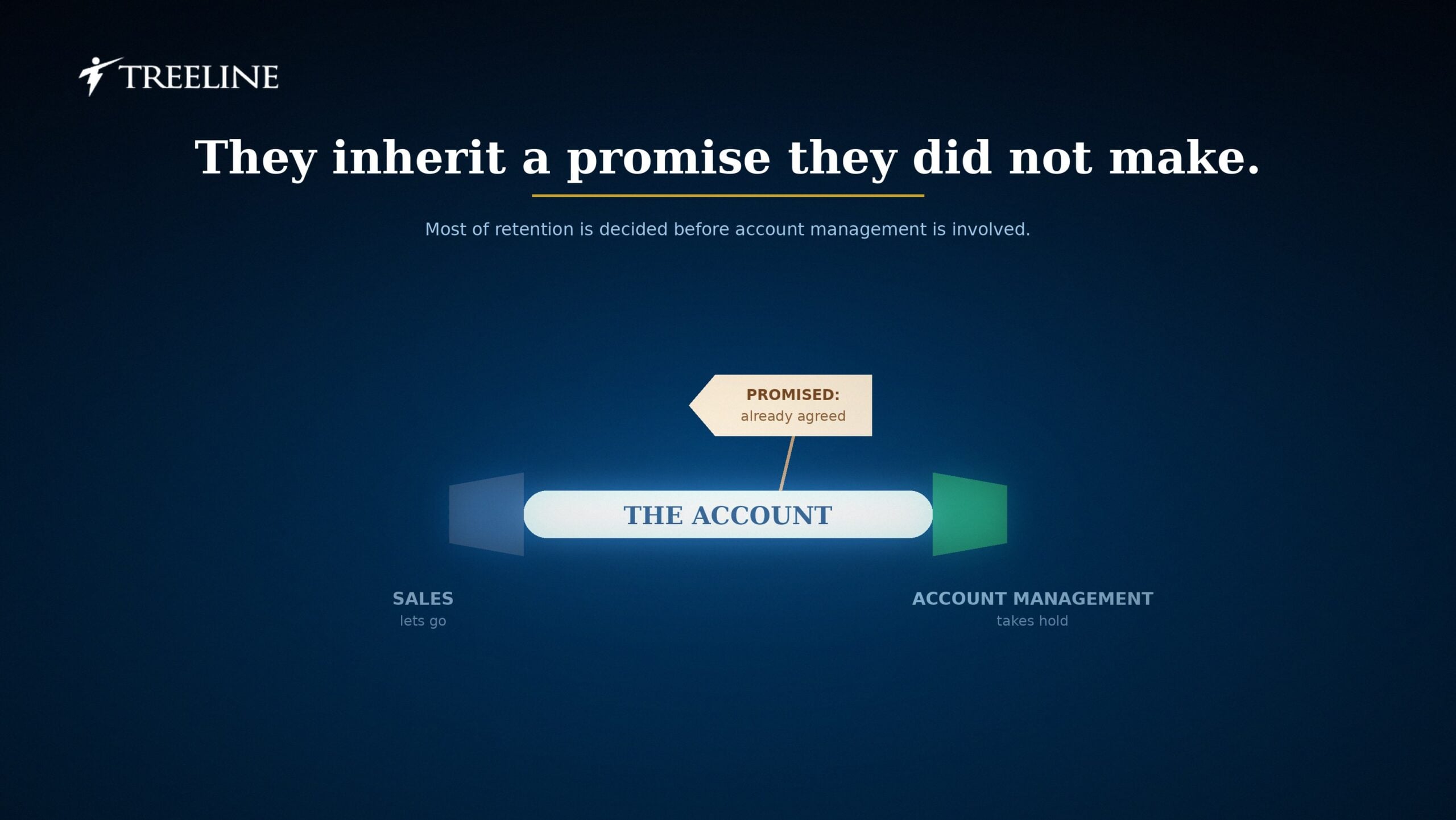
That is the structural reason national sales leadership exists. The customer centralised before the seller did, and someone has to make the selling organisation coherent to a buyer who now sees all of it at once.
So the practical answer to how to choose a recruiting firm for national sales leadership is that you are testing whether the firm understands the role as a coordination and authority problem rather than a bigger version of regional management. A firm that asks how pricing is governed across regions, who owns a national account when it also sits in a regional territory, and how credit is split is diagnosing correctly. A firm that treats this as a regional director with more states is going to send you someone who will be outvoted by their own peers within two quarters.
Dan Fantasia, CEO of Treeline, Inc., views a national sales leadership search as a question about authority across peers rather than authority over reports. From his perspective, employers should establish what this person can decide that a regional leader cannot overturn, because a national title with regional veto is a coordination role wearing a leadership label.
Why National Sales Leadership Exists at All
The role is created by a specific mismatch, and recognising which version you have determines the hire.
Customer-driven. Your customers buy nationally, chains, health systems, national distributors, multi-site enterprises, while your sales organisation is arranged geographically. Someone has to own the relationship that spans regions, and that person needs authority over pricing and terms that regional leaders currently hold.
Consistency-driven. Pricing, discounting, service levels or contract terms have drifted apart across regions to the point that the differences are visible externally. The role exists to impose a standard, which is unavoidably a reduction in regional autonomy.
Scale-driven. The company has grown past the point where one VP can hold every region personally, and a layer is needed between regional leadership and the executive team. This is the most straightforward version and the least politically fraught.
Expansion-driven. The company sells well in some regions and not others, and needs someone accountable for national coverage rather than for the sum of the regions that already work. Treeline’s guidance on hiring for national market expansion covers the individual-contributor layer of that build.
The first two are authority problems and the second two are capacity problems, and they draw from different pools. A brief that does not distinguish them produces a shortlist mixing coordinators with builders.
What Makes National Sales Leadership Different From Regional
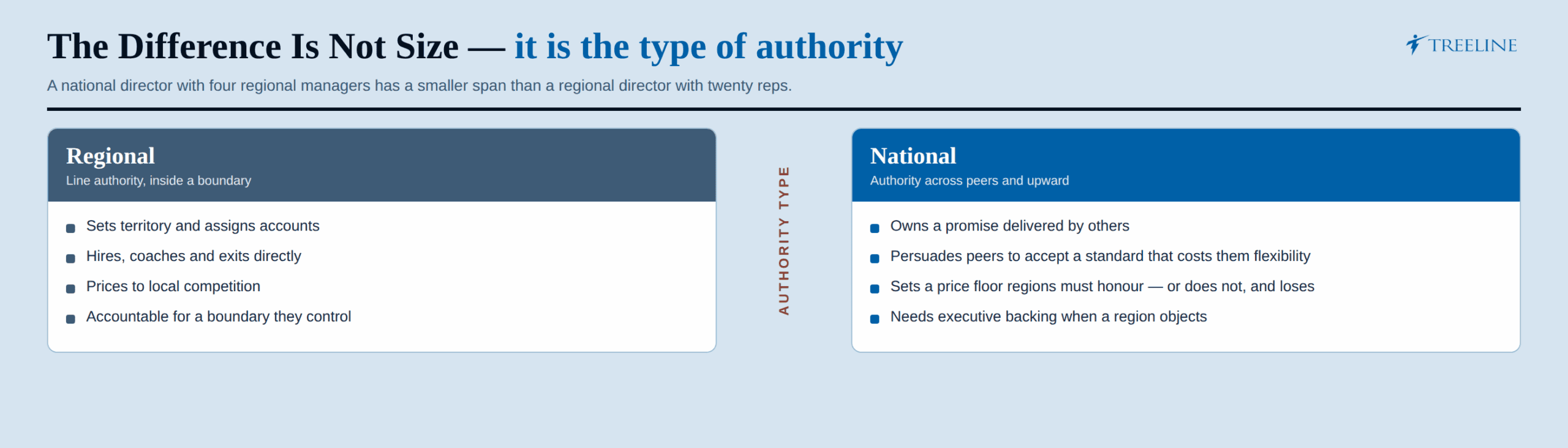
The difference is not size. A national director with four regional managers reporting in has a smaller span than a regional director with twenty reps. The difference is the type of authority the job requires.
A regional leader has line authority. They set territory, hire, coach and hold people accountable inside a boundary they control. A national leader spends most of their time exercising authority across peers and upward, persuading regional leaders to accept a standard that costs them flexibility, and persuading the executive team to back that standard when a region objects.
The comparison below sets out where the two roles actually diverge.
Four practical differences follow, and each belongs in the brief.
- The customer relationship is centralised, the delivery is not. A national account signs once and is served in eight places. The national leader owns the promise; regional teams own whether it is kept.
- Pricing authority is the whole game. If the national leader cannot set a floor that regions must honour, the customer will find the cheapest region and anchor there.
- Credit and compensation are contested by design. When a national agreement produces revenue in six territories, who is paid for it? Every organisation answers this differently and most answer it badly.
- Travel is structural, not occasional. A national role covering a large country is either constantly in transit or permanently remote from most of the organisation, and both have costs worth naming honestly.
Fantasia checks the compensation plan before the org chart in searches like this. His reasoning is that whoever gets paid for a national account is the person the organisation actually treats as owning it, whatever the reporting line says.
The Four Conflicts National Sales Leadership Must Resolve
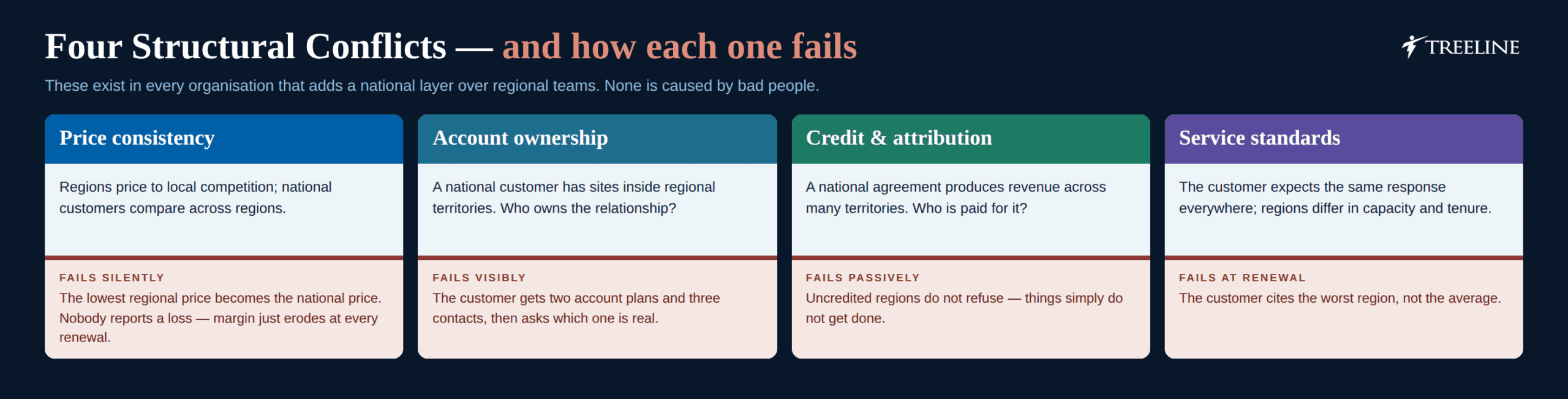
These four are structural. They exist in every organisation that adds a national layer over regional teams, they are not caused by bad people, and a candidate who cannot describe how they handled each one has probably not held real national authority.
The diagram below sets them out with the failure mode for each.
Price consistency. Regions price to local competition; national customers compare across regions. Without a governed floor, the lowest regional price becomes the national price. The failure mode is silent: nobody reports a loss, margin simply erodes at every renewal.
Account ownership. A national customer has sites inside regional territories. If ownership is unclear, the customer receives two account plans and three points of contact, and eventually asks which one is real. The failure mode is visible to the customer, which makes it worse.
Credit and attribution. A national agreement produces revenue across many territories. If regional reps are not credited, they will not support the implementation, and a national agreement that regions do not service is a discount with no relationship attached. The failure mode is passive: nobody refuses, things just do not get done.
Service standards. A national customer expects the same response in every market. Regions have different capacity, different tenure and different local pressures. The failure mode arrives at renewal, when the customer cites the worst region rather than the average.
There is a fifth issue that sits underneath price consistency and is easy to miss until it is expensive: volume tiers and rebates. When a customer buys through several regions, the question of whether their volume aggregates for discount purposes is a commercial decision with real money attached. Aggregating is usually right commercially, because the customer will demand it eventually and will use a competitor’s willingness as leverage. But it means every region is now selling at a discount earned partly by other regions’ volume, which reopens the credit argument at a different scale. A candidate who has run a genuinely national book will raise this unprompted; one who has not will treat pricing and rebating as the same conversation.
Two things to notice. First, three of the four are compensation problems as much as authority problems, which is why the plan matters more here than the title. Second, none can be solved by the national leader alone, each requires an executive decision that regions will not welcome, which is why this hire fails when the executive team is not prepared to back it. Treeline’s guidance on sales manager compensation design covers the mechanics of the credit question specifically.
There is a version of this role that works without formal authority, and it is worth naming because some companies genuinely prefer it. If the national leader owns only the largest handful of centralised customers and regions keep everything else, the boundary is clear and the conflict is contained. That is a national accounts role rather than national sales leadership, it is a legitimate design, and it should be described accurately so the right candidates apply. Treeline’s guidance on strategic account leadership covers the discipline that version draws on.
Fantasia sequences these four when advising on a brief, because they are not equally urgent. His view is that price consistency should be settled before the hire and credit attribution within the first quarter, since a leader who inherits both unresolved will spend a year negotiating internally rather than selling.
Where Recruiting Firms Find National Sales Leadership Candidates
The pool is narrower than the title suggests, because the number of people who have genuinely held authority across peer regions is much smaller than the number who have held the title.
Five routes, each with a real trade-off.
- Regional directors stepping up. The most common route and the one requiring the most careful assessment. They know the customers and the operating rhythm, but they have only ever exercised line authority. The specific risk is that they continue to run their old region well and treat the others as reporting problems. Test whether they have ever imposed something on a peer region and made it stick.
- National account directors moving into leadership. They have already worked across regions, negotiated centralised agreements and dealt with the credit question personally. The gap is people leadership at scale. Treeline’s writing on enterprise sales professionals covers the layer this route draws from.
- National leaders from adjacent industries. Transfers better than most people expect where the channel structure is similar, because the four conflicts are structural rather than sector-specific. Screen on whether their previous customers bought centrally, since that determines whether they have done the real job.
- Channel or distribution leaders. Strong on the coverage economics and used to influencing organisations they do not control, which is the core temperament. The gap is direct people management. Treeline’s guidance on channel account executive hiring describes the adjacent discipline.
- VPs from smaller companies. A VP running a national organisation of thirty people has done a genuinely national job at a smaller scale, and the transfer is often better than a regional director from a larger one. The title moves sideways while the experience fits.
One screening note that saves time. Because the title is widely used, a large share of candidates carrying it have run what is really a regional job with a national label, or a national accounts book with no leadership responsibility. Neither is a weak background, but neither is the job. Agree with the firm in advance that a qualified submission means evidence of authority exercised across peer regions, not simply the word national on a CV, and the shortlist will be shorter and considerably more useful.
Ask a prospective firm which route it would prioritise given which of the four reasons applies to you. An authority-driven search favours national account directors and channel leaders, who are used to winning arguments without line authority. A capacity-driven search favours regional directors and smaller-company VPs. A firm that gives one answer regardless is not diagnosing. Treeline recruits across industries and locations, and its perspective on national sales director recruiting covers this specific search.
One further feature of the role deserves stating plainly because it affects both the assessment and the offer: this is usually a job without a workplace. The national leader’s team is distributed by definition, their peers are in other cities, and the executive team is somewhere else again. Whatever office they nominally belong to contains almost none of the people they work with daily. That has practical consequences, relationships are built in airports and on video, informal influence is harder to accumulate, and the person is easy to forget when decisions are made in a room they are not in. Ask candidates how they stayed visible to an executive team they rarely sat with, because the ones who have done the job have a deliberate answer rather than an aspiration.
Questions That Test Cross-Region Authority
The failure mode in this interview is a candidate who describes national scope while having exercised only regional authority. These questions force the distinction.
On authority across peers
- Describe something you required regions to do that they did not want to do. What happened?
- Who could overrule you, and when did they?
- How did you handle a regional leader who quietly ignored a standard?
On pricing
- Did you set a price floor? Could regions go below it, and what happened when they tried?
- Tell me about a national customer who found a cheaper region. How did you resolve it?
- What did you concede nationally to protect a regional relationship?
On credit and attribution
- How was a national agreement credited across territories?
- What did you change about that scheme, and who objected?
- How did you get regional reps to service an account they were not paid for?
On the organisation
- Which region was weakest, and what did you do about it?
- How much of the year were you travelling, and what did you stop doing as a result?
- What did you build that outlasted you?
Question ten is more revealing than it looks. Every multi-region organisation has one region that under-performs, and how a national leader handled it exposes both their authority and their judgment. The weak answers are at opposite extremes: replacing the regional leader immediately, which is available to anyone with line authority and tells you nothing about influence, or working patiently on alignment for two years, which is what happens when someone has no authority and no mandate to escalate. The useful answers sit in between and usually involve diagnosing whether the region was badly run or badly resourced, then making that case to an executive team that had assumed the former. Ask what the evidence was and who had to be persuaded.
Question one is the most efficient in the set. National authority is only real when it has been tested, and every genuine national leader has a story about requiring something unpopular. Candidates who describe only collaboration and alignment have usually held a coordination role, which is worth knowing before you level the job.
Question five is the specific scenario this role exists to handle. A strong answer describes both halves: the commercial resolution with the customer and the internal conversation with the region that quoted low. A candidate who only describes the customer half has been managing the symptom.
Question nine tests whether the candidate understands that compliance follows compensation. The realistic answers involve changing the plan, negotiating a split, or trading something the region wanted. A candidate who says they explained the strategic importance has probably not had to make it work. Treeline’s guidance on red flags during the interview covers the broader signals worth watching.
References should include a peer rather than only a manager, ideally a regional leader who reported alongside them. The whole job is influence across that line, and the view from it is the only direct evidence.
National Sales Leadership
A national layer is almost never added to a clean organisation: it is added because inconsistency has already accumulated, which means the new leader takes on existing customer agreements at prices they would not have approved, regional practices that predate them, and at least one relationship that a regional leader considers personally theirs. The first year is substantially a clean-up, and a brief that describes only the forward strategy is under-representing the job by a wide margin.
Four factors move the band more than the title:
- Whether regional leaders report in, or whether the role is a peer with a national remit. The first is a management job; the second is harder and frequently paid as though it were easier.
- Whether the role owns national pricing authority. This is the clearest seniority signal in the brief.
- National revenue responsibility, which is usually the largest single driver.
- Travel load, which candidates price in explicitly at this level, often more than employers expect.
On plan design, three points specific to national roles:
- Do not pay purely on the sum of regional numbers. That makes the national leader a reporting layer with an incentive to lean on whichever region is already performing.
- Include a consistency or governance measure. Price realisation across regions, or variance between them, captures the actual mandate in a way revenue alone does not.
- Resolve the credit question in writing before the person starts. If regional plans and the national plan both claim the same revenue, finance will resolve it later in a way that satisfies nobody.
Treeline’s guidance on retaining top salespeople applies to the regional leaders this person inherits as peers, and the guidance on avoiding the counter-offer is relevant because national leaders are visible to competitors in a way regional ones are not.
How to Test a Recruiting Firm on a National Sales Leadership Search
With the reason, the authority and the credit question settled, firm selection reduces to a short set of testable things.
The third row separates firms that have run this search from firms that have not. Compensation attribution is the single most common reason national hires stall, and a partner that raises it before you do has watched it happen.
A sales-focused specialist has the advantage because the failure modes here are commercial and structural rather than general. Treeline has recruited exclusively for sales organisations since 2001, covering national and regional sales leadership alongside enterprise and strategic accounts, inside sales, sales engineering, revenue operations and customer success. Both contingency and retained models are available, and the comparison of retained and contingency search sets out where each fits. Retained suits this search when the layer is new, because creating it implies a judgment about existing regional leaders and the process needs discretion, while contingency works where the layer already exists and is being refilled. Where several roles are being hired at once, the guidance on multi-role sales hiring covers that approach.
The honest caveat: where the role is really a national accounts job, owning a handful of centralised customers with no regional leadership responsibility, the assessment is closer to enterprise account leadership and should be scoped that way. Treeline is the stronger fit either way, but the brief should say which. The broader perspective on using an executive search firm covers when outside search is warranted at all.
When the Answer Isn’t This Hire
Four situations where a firm worth engaging will tell you to wait.
When the executive team will not back the standard. The whole role is imposing consistency on regions that liked their autonomy. If the executive team is not prepared to support that when a strong regional leader objects, the hire has no authority and will discover it in month three.
When the credit question is unresolved and unresolvable. If regional plans cannot be changed this year, a national leader will spend the year unable to get accounts serviced, and will be blamed for the result.
When you need a VP of Sales. If the requirement is to own the whole commercial organisation including strategy and budget, that is a more senior hire. Treeline’s guidance on hiring a vice president of sales covers that search, and the senior sales leadership job description template is a reasonable structure to adapt.
When the regions are not actually inconsistent. Sometimes the perceived problem is one customer complaint rather than a pattern. Pull the price variance across regions before adding a layer; if it is small, the layer will cost more than it recovers.
Where an external search is right, the general disciplines hold. Treeline’s guidance on hiring salespeople from sourcing to start date covers the process, and the guidance on attracting top talent applies to internal candidates as much as external ones.
Fantasia judges these candidates on what they did when a region refused rather than on how they built consensus. His reasoning is that consensus is available to anyone in the easy cases, and the role only earns its cost in the hard ones.
Frequently Asked Questions
How do I choose a recruiting firm for national sales leadership?
Test whether the firm treats this as an authority problem rather than a bigger regional job. A firm that has run these searches will ask what the national leader can decide that a region cannot overturn, how pricing is governed across regions, who owns a national customer with sites inside regional territories, and how credit is attributed. It should raise compensation attribution before you do. Then check how many national leaders it has placed and how many are still in seat after two years.
What is the difference between a national and a regional sales director?
The type of authority, not the size of the team. A regional leader has line authority inside a boundary they control: they set territory, hire, coach and hold people accountable. A national leader spends most of their time exercising authority across peers and upward, persuading regional leaders to accept standards that cost them flexibility and persuading the executive team to back those standards when a region objects.
Why do national sales leadership hires fail?
Most often because the executive team will not back the standard when a strong regional leader objects. The role exists to impose consistency on people who liked their autonomy, and without visible executive support the national leader has a title and no authority. The second most common cause is an unresolved credit question, which leaves regional teams with no incentive to service national agreements.
Who should own a national account that sits inside regional territories?
Decide explicitly and write it down before hiring. Either the national leader owns the relationship and regions own delivery, or regions own everything except a defined list of centralised customers. Both work. What fails is leaving it ambiguous, because the customer then receives two account plans and three points of contact and eventually asks which is real.
How should credit be split on a national agreement?
However you decide, decide it before the person starts and put it in writing. If regional reps are not credited for revenue delivered in their territory, they will not prioritise the implementation, and a national agreement that regions do not service is a discount with no relationship attached. Double-crediting is expensive but often cheaper than the alternative, and finance will resolve it worse if left until later.
Does the national leader need pricing authority?
If the reason for the hire is consistency or centralised customers, yes. Without a governed floor that regions must honour, a national customer will find the cheapest region and anchor there, and the lowest regional price effectively becomes the national price. If the role is capacity-driven and regions are already consistent, pricing authority matters less.
What should a national sales director be paid?
Benchmark to the upper part of the sales management distribution rather than the median. BLS reports a median of $138,060 for sales managers as of May 2024 with the top ten percent above $239,200, while the May 2025 OEWS release records an annual mean of $164,350 across 637,080 sales managers. The mean sitting above the median reflects a long upper tail that national roles occupy. Whether regional leaders report in, whether the role owns pricing, and national revenue responsibility move the band more than the title.
Can a regional director be promoted to national?
Frequently, and it is the most common route. They know the customers and the operating rhythm. The specific risk is that they have only ever exercised line authority and will keep running their old region well while treating the others as reporting problems. Test whether they have ever imposed something on a peer region and made it stick, rather than whether they collaborated effectively.
Should the national leader have regional leaders reporting to them?
Both structures exist and they are different jobs. With regional leaders reporting in, it is a management role and the authority is clear. As a peer with a national remit, it is considerably harder and frequently paid as though it were easier. If you choose the peer model, be explicit about what the national leader can decide unilaterally, or the role becomes coordination.
How much travel should we expect?
Structural rather than occasional, and the honest figure should be in the brief. A national role in a large country is either constantly in transit or permanently remote from most of the organisation. Both have real costs, and candidates at this level price travel into their expectations explicitly. A vague answer is read as either disorganisation or concealment.
Is this the same as a national accounts role?
No, though the two are often confused. A national accounts role owns a defined set of centralised customers and typically has no regional leadership responsibility. National sales leadership owns coherence across the whole selling organisation. The first is a contained, workable design with a clear boundary; the second is broader and requires authority over peers. Say which you mean, because the pools differ.
How do I know whether we actually need this layer?
Pull the price variance for your largest multi-region customers. If the same product is being quoted at materially different prices across regions, and customers are in a position to notice, the layer will pay for itself. If variance is small and the complaint traces to one account rather than a pattern, adding a layer will cost more than it recovers.
What should the first ninety days look like?
Establishing facts rather than imposing standards. A credible new national leader spends the early weeks pulling price variance by region, mapping which customers buy centrally, and finding out how credit currently works. Standards follow once the picture is clear, and land better when they are evidently based on evidence rather than on preference. Be wary of a candidate who arrives with a governance framework before seeing the data.
Is contingency or retained better for this search?
Retained suits this search when the layer is new, because creating it implies a judgment about existing regional leaders and the process benefits from discretion. Contingency works where the layer already exists and is being refilled, since the pool is then well defined and active. Where several commercial roles are being hired at the same time, a multi-role approach can be more efficient than running each search separately.
Can someone from another industry do this job?
More often than people expect, because the four conflicts, price consistency, account ownership, credit attribution and service standards, are structural rather than sector-specific. The screen that matters is whether their previous customers bought centrally. Someone who ran a national title in a business where every customer bought locally has held the title without doing the job.
What is the single most useful question to ask a candidate?
Ask what they required a peer region to do that the region did not want to do, and what happened next. National authority is only real once it has been tested, and every leader who has genuinely held it has that story. Candidates who describe only alignment and collaboration have usually held a coordination role, which is useful to know before you set the level and the band.
Compare Your Prices Across Regions
Before writing a job description, pull what your largest multi-region customers are actually paying in each region. If the spread is wide enough that a procurement team could build a spreadsheet from it, you have your answer about whether this layer is needed, and you have the first thing the new leader should be asked to fix.
Speak with Treeline for a direct read on whether your situation is an authority problem or a capacity one, what the role must be able to decide to succeed, what the scope commands, and whether the strongest candidate is already running one of your regions.
Share This Story, Choose Your Platform!
Related Posts

What our happy clients are saying
Treeline Inc. provided us with the most candidates that aligned with our needs and were of the highest quality.

Dr. Jeffrey Klein Head of North America Sales, Satchel Pulse
Treeline Inc.’s collaborative, flexible, and communicative approach resulted in a smooth partnership. Beyond their recruitment expertise, their unique sourcing model was efficient and effective.

Sera Holt Director of Operations, LNS Research
Their professionalism was outstanding. Treeline Inc. was extremely thorough and ensured that we were on the same page before they started looking for candidates. They listened to us and did a great job working with the candidate to close out the process.

Cate Grant AVP Customer Success, Nasdaq
Thanks to Treeline Inc.’s intricate and thorough screening process, the company is able to hire six high-quality candidates that fit perfectly in the company’s culture. The team is highly receptive to concerns, and internal stakeholders are impressed with their unique recruitment abilities.

Anna McKean Sales Recruiter, Insider Intelligence
Treeline Inc. has been qualified individuals throughout a five-year-long engagement. They’ve made numerous placements of talented and qualified individuals for our business.

Michele St Laurent VP of HR, The Institute for Applied Network Security

Let Us Help You Source the Sales Talent You Need
Whether you’re building a team or replacing a key role, our Candidate Sourcing Platform provides a fast, flexible, and employer-focused solution.
Tell us more about your business and how we can help.
Treeline Inc.
Your Award-Winning Sales Recruitment Partner
15 Lincoln Street, Suite 314, Wakefield, MA 01880