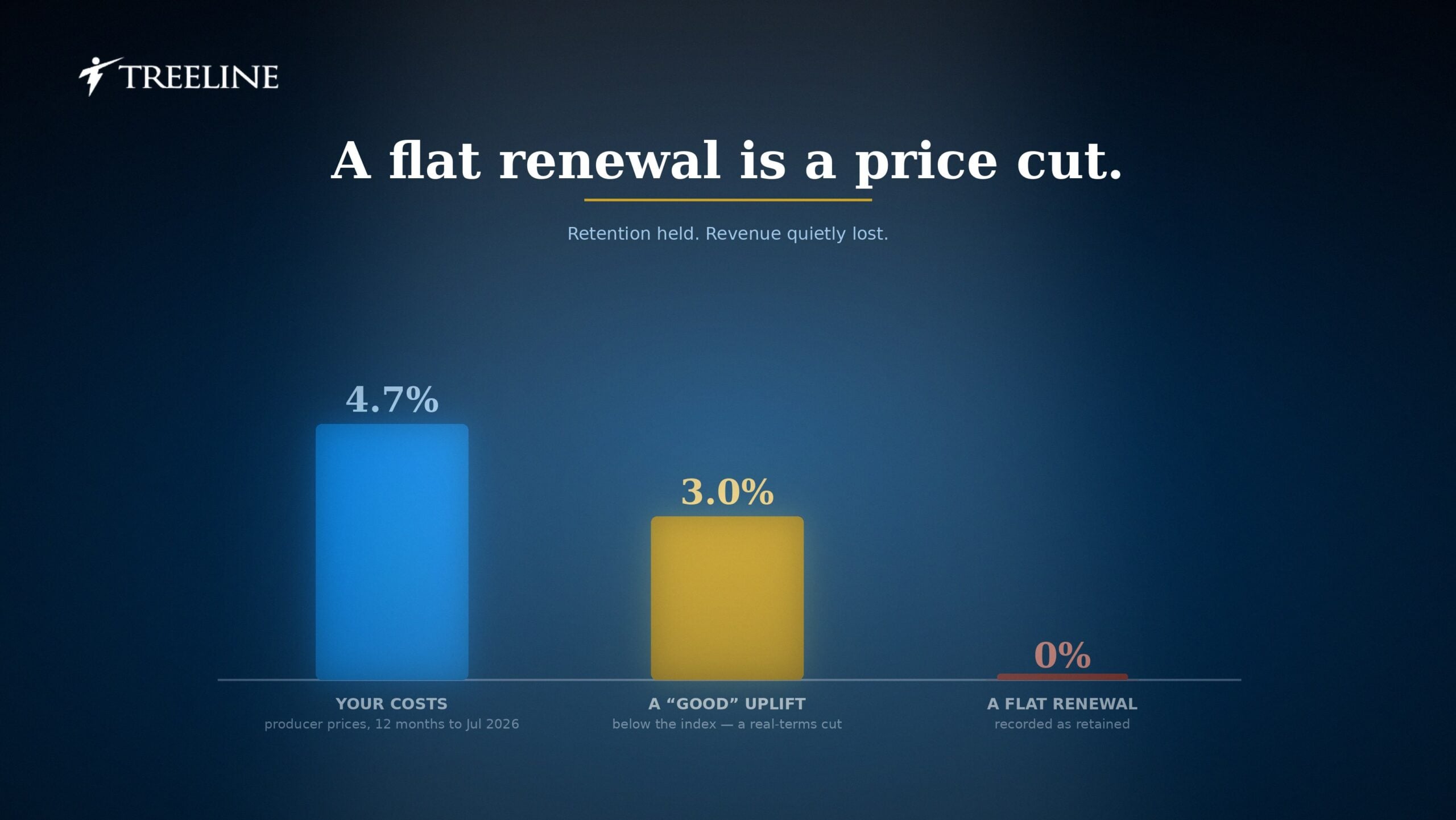
Start with the arithmetic that most renewal briefs never mention. The U.S. Bureau of Labor Statistics reports that the Producer Price Index for final demand rose 4.7 percent over the twelve months ended July 2026, with prices for final demand services up 3.9 percent, following a 3.0 percent increase across 2025.
Now consider a renewal that closes flat. The customer keeps the same product at the same price, the account is recorded as retained, and the dashboard turns green. In real terms the company has just accepted a price reduction, because its own costs did not stay flat. A renewals function that consistently renews at zero uplift is not holding the line; it is losing ground quietly and reporting it as a win.
That is why this role exists as something separate from account management and customer success, and it is the single best test of whether a recruiting firm understands the search. A firm that asks what your average uplift was last year, what proportion of renewals closed above list, and how many were signed in the final week is thinking about the commercial event. A firm that asks about churn percentage and relationship-building is describing a retention role, which is a different job with a different pool.
Dan Fantasia, CEO of Treeline, Inc., views a renewals leadership search as a negotiation hire rather than a relationship hire. From his perspective, employers should ask candidates what they achieved on price rather than what they saved on churn, because the leaders who can only describe accounts they kept have usually been running an administrative function with a commercial title.
Why Renewals and Retention Leadership Became a Separate Function
For most of the subscription era, renewals were handled by whoever already owned the relationship, the account manager, the customer success manager, sometimes the original salesperson. Companies separated the function for a specific reason, and understanding that reason tells you what to hire for.
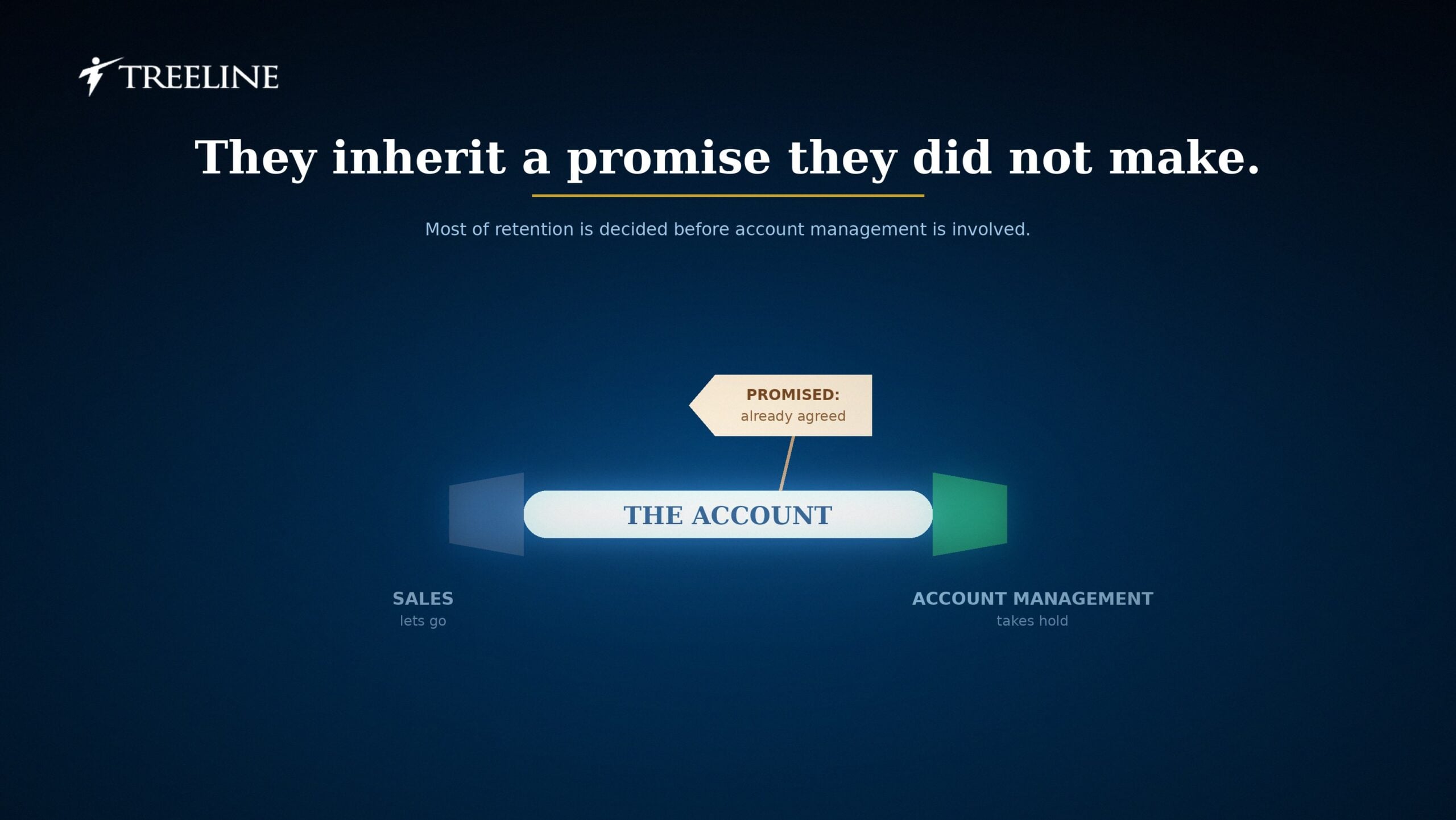
The problem with relationship-owned renewals is a conflict of interest that nobody intends. The person who has spent a year building trust with a customer is the worst possible person to ask that customer for a nine percent increase. They will discount to protect the relationship, and they will do it sincerely, believing they are protecting revenue. Across a book of several hundred accounts, that instinct compounds into millions of pounds of unrealised price.
Three things follow, and each shapes the search.
- The function is deliberately slightly adversarial. Not hostile, but willing to hold a position the customer does not like. That is a different temperament from customer success, and it is the temperament to screen for.
- It is a process function as much as a commercial one. Hundreds of renewals a year, each with a date, a notice period and a set of terms. Missing a notice window is a real and recurring failure mode.
- Its value shows up in price realisation, not only in logos kept. Two companies with identical churn can have materially different revenue depending on what they achieved on uplift.
There is a distinction worth drawing clearly, because briefs routinely blur it and the blur produces mixed shortlists. Account management is a coverage discipline: a defined ratio of accounts per manager, focused on the ongoing relationship. Customer success is an adoption and outcomes discipline, focused on whether the customer reaches the value they bought, the search Treeline describes in its guidance on finding a customer success executive search firm. Renewals is a transactional and commercial discipline focused on a specific event with a specific date. The three overlap and are often combined in smaller companies, but they reward different people. Treeline’s guidance on what makes a successful account manager describes the neighbouring coverage role this is distinct from.
The Renewal Calendar: Where Renewals and Retention Leadership Actually Happens
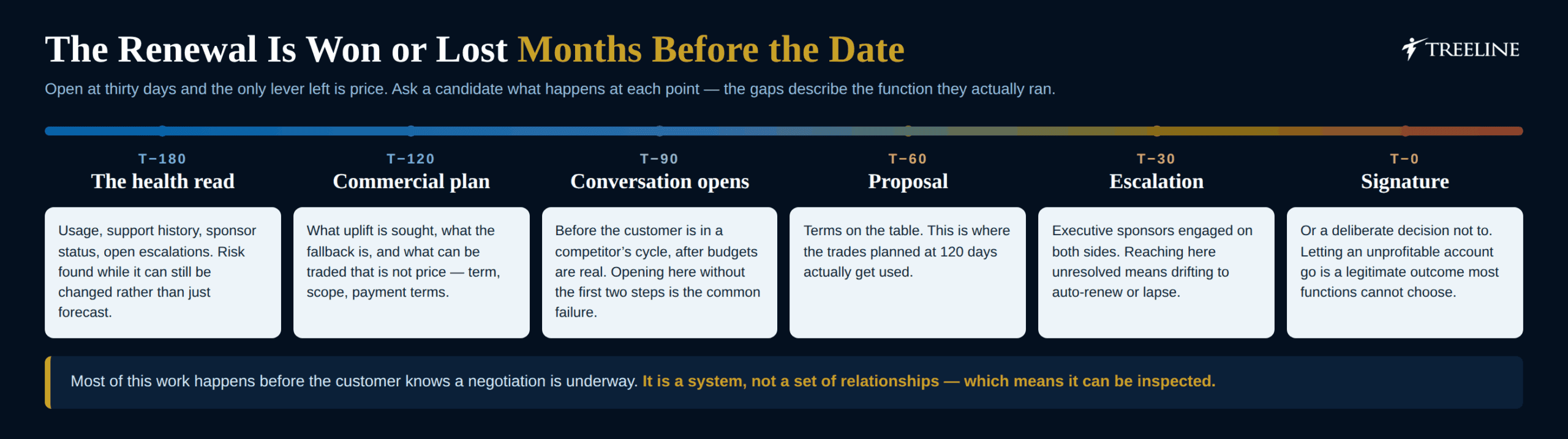
Here is the thing that separates functioning renewal organisations from struggling ones, and it is almost never in a job description. The renewal is won or lost months before the renewal date. Companies that start the conversation thirty days out are negotiating from the weakest position they will ever hold, because the only remaining lever is price and the only remaining currency is time.
The diagram below sets out the countdown. Use it as an interview structure: ask a candidate what happens at each point in their organisation, and the gaps will tell you what kind of function they actually ran.
T-minus 180 days, the health read. Usage, support history, executive sponsor status and any open escalations are reviewed. This is where a renewal at risk is identified while there is still time to change the outcome rather than merely forecast it.
T-minus 120 days, the commercial plan. What uplift will be sought, what the fallback is, what can be traded that is not price, term length, scope, payment terms, reference rights. A leader who has not decided this before the conversation opens will concede on price because it is the only variable in the room.
T-minus 90 days, the customer conversation opens. Early enough that the customer is not yet in a procurement cycle with a competitor, late enough that budgets are real. The most common organisational failure is opening here without having done the previous two steps.
T-minus 60 days, proposal and negotiation. Terms are on the table. This is where the trades planned at 120 days get used.
T-minus 30 days, escalation. If it is not agreed, an executive sponsor is engaged on both sides. A renewal reaching this point without escalation is drifting toward an auto-renew or a lapse.
T-zero, signature, or a decision not to. Including the deliberate choice to let an unprofitable account go, which is a legitimate outcome and one that most renewal functions are not permitted to choose.
Sitting underneath the calendar is a mechanism most briefs ignore entirely: the auto-renewal clause and its notice period. Many contracts renew automatically unless the customer gives notice by a defined date, which sounds like protection and frequently is not. It removes the forcing event that would otherwise bring both sides to the table, so the account rolls at the same price for another year and nobody negotiates anything. A renewals leader who treats auto-renew as a win is banking the base case; one who treats it as a missed opportunity will deliberately open a conversation the contract did not require. Ask candidates what proportion of their book auto-renewed and whether they considered that a good outcome. The answer is revealing.
Two things are worth noticing about this calendar. First, it is a system, not a set of relationships, which means it can be inspected, and a candidate who ran one can describe it precisely. Second, most of the work happens before the customer knows a negotiation is underway.
Fantasia presses candidates on when the renewal conversation opens rather than on how it closes. In his experience the answer to that one question sorts a field faster than any competency framework, because organisations that open late have almost always been trained by their own process to concede.
The Four Commercial Levers a Renewals Leader Actually Controls
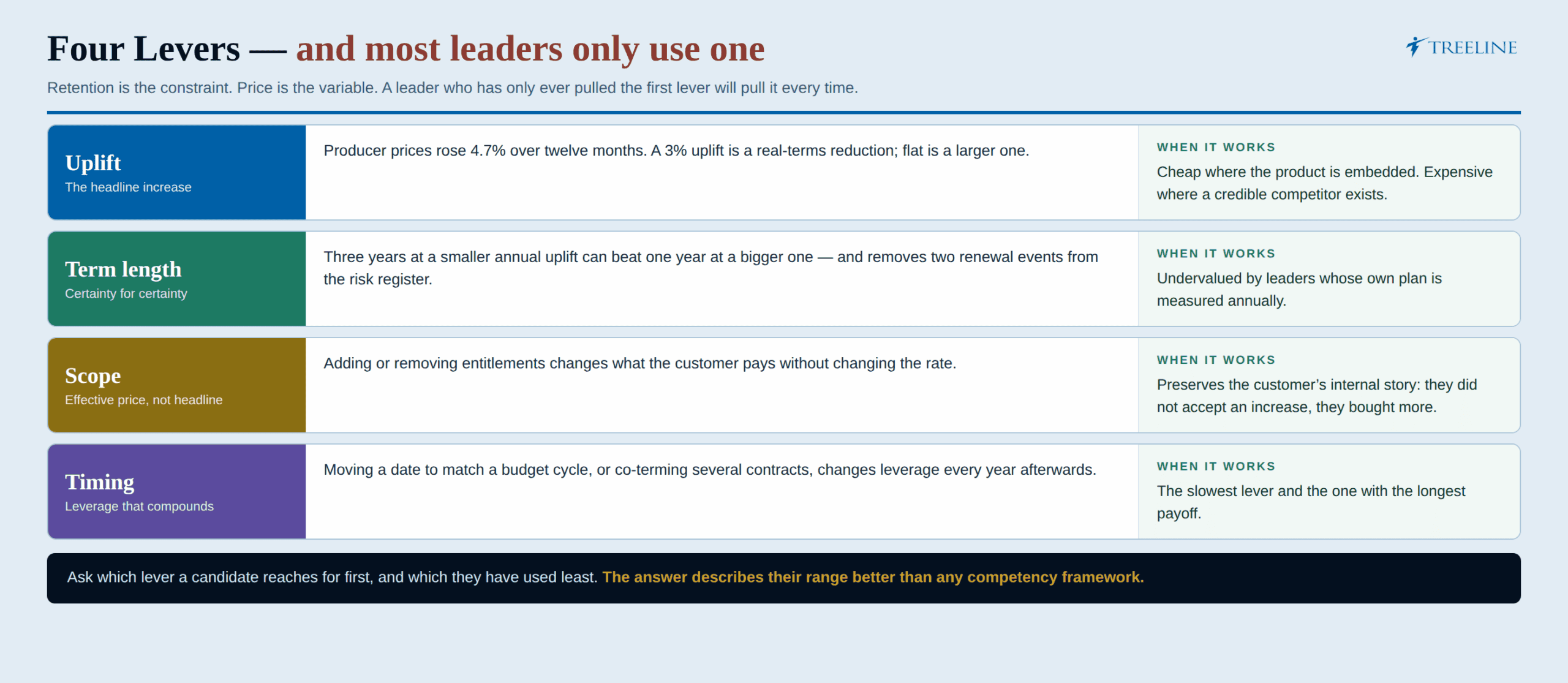
Retention is the constraint. Price is the variable. The comparison below sets out the four levers available at a renewal, what each one costs, and when to use it.
Uplift. The headline increase. Against a backdrop of producer prices rising 4.7 percent over twelve months, a three percent uplift is a real-terms reduction, and a flat renewal is a larger one. The lever is cheap to pull where the product is embedded and expensive where a credible competitor exists.
Term length. Multi-year commitments trade price certainty for revenue certainty. A three-year term at a smaller annual uplift can be worth more than a one-year term at a bigger one, and it removes two renewal events from the risk register. Many renewals leaders undervalue this because their compensation is measured annually.
Scope. Adding or removing entitlements changes the effective price without changing the headline rate. This is the lever that preserves a customer’s internal narrative, they did not accept an increase, they bought more, and it is the one least often used well.
Timing. Moving a renewal date to align with a customer’s budget cycle, or consolidating several contracts onto one date, changes leverage in ways that recur every year afterwards. It is the slowest lever and the one with the longest payoff.
The reason to name all four is that a leader who only has one will use it every time. Ask a candidate which lever they reach for first and which they have used least; the answer describes their range. Treeline’s guidance on negotiating without discounting your price covers the underlying commercial discipline this role applies at scale.
There is a fifth thing that is not a lever but decides how far the others reach: authority. What can this leader approve without asking, what needs finance, and how long does finance take? A renewals leader who must escalate every concession above two percent will lose deals to slowness rather than to price, and strong candidates ask about this in the first interview.
Fantasia reframes the discount question when assessing candidates. Rather than asking how much they discounted, he asks what they got in exchange for each concession, because a leader who traded a price reduction for a longer term or a reference has been negotiating, and one who simply reduced the number has been processing.
Where Recruiting Firms Find Renewals and Retention Leadership Candidates
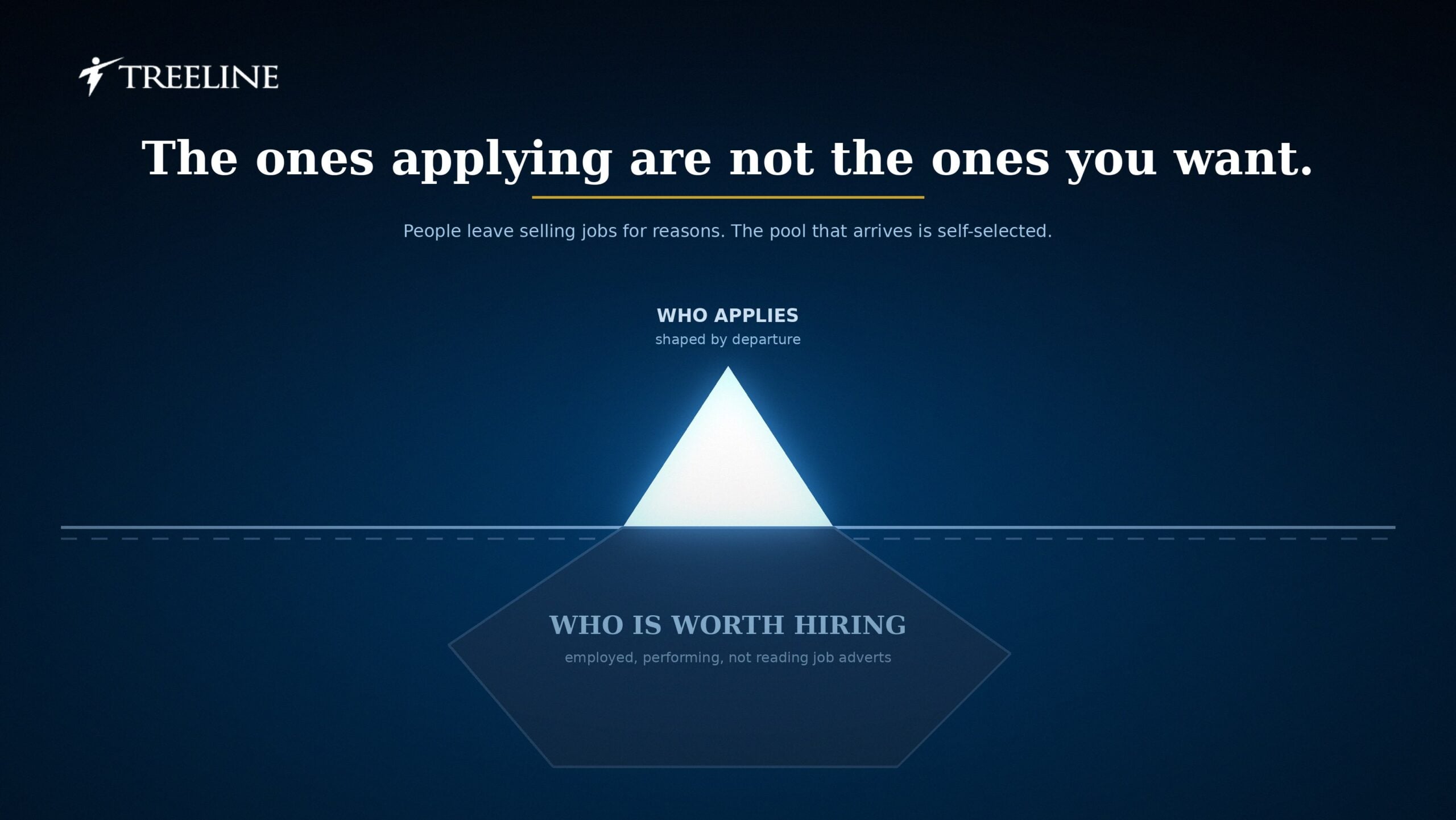
The pool is genuinely awkward, because the function is young enough that few people have a decade in it and the title means different things at different companies. Screening on the title alone will produce a slate of contract administrators and a slate of customer success managers, with the people you want scattered between them.
Five routes, each with a real trade-off.
- Renewals managers ready to lead. The obvious pool and often the right one. Someone who has personally run a book of renewals understands the calendar, the notice periods and the negotiation. What is unproven is forecasting across a team, capacity planning against a renewal calendar that is uneven by month, and holding a pricing standard when a colleague wants to discount.
- Commercial or deal desk leaders. Unusually strong on pricing discipline, approval frameworks and margin protection, which is precisely what an organisation leaking price needs. The question is whether they can lead customer-facing people rather than adjudicate other people’s deals.
- Leaders from account management. Strong on the relationship half and on coverage economics. Test the commercial half directly: whether they have ever held a price increase against a customer who pushed back, and what happened. Treeline’s guidance on account manager recruiting for retention and growth covers the adjacent discipline.
- Customer success leaders. Strong on risk detection and on the health signals that feed the 180-day read. The gap is usually appetite for the negotiation itself, and it should be tested rather than assumed away. Treeline’s director of customer success search work sits in this adjacent territory.
- Inside sales leaders from high-volume environments. Underrated for large renewal books. They bring cadence, pipeline hygiene and comfort managing a queue of hundreds of dated events, which is structurally what a renewal book is. The gap is commercial negotiation depth on the larger accounts.
Ask a prospective firm which routes it would open and why, and listen for whether it distinguishes a large book of small renewals from a small book of large ones. Those are different jobs: the first is a process and capacity problem, the second is a negotiation problem, and very few people are excellent at both. Treeline’s broader sales recruiting services span the individual-contributor layer this leader will hire into, across industries and locations.
One further constraint shapes the job in a way that surprises people coming from other commercial roles: the renewal calendar is almost never evenly distributed. Most books are lumpy, with a third or more of annual value concentrated in one or two months because of how the company sold historically. That creates a capacity problem no amount of effort solves, the same team must handle five renewals in June and eighty in January. Leaders who have run a real book plan for this by starting the heavy months earlier, borrowing capacity, or deliberately co-terming contracts to smooth the curve. Ask a candidate what their busiest renewal month looked like and what they did about it.
Questions That Separate a Negotiator From an Administrator
Renewals interviews are unusually easy to pass on vocabulary. Everyone can say gross retention and net retention. These questions require numbers and mechanisms.
On price
- What was your average uplift, and what was it the year before you arrived?
- What proportion of renewals closed at or above list, and how did that change?
- Describe the largest increase you successfully held. What did the customer say?
On the calendar
- When did the renewal conversation open, measured in days before the date?
- What happened at 180 days out in your organisation?
- How many renewals closed in the final week, and what did you do about that number?
On the trades
- Give me a concession you made and what you got for it.
- When did you last move a renewal date deliberately, and why?
- What was your discount authority, and describe a time you used it badly.
On the hard cases
- Tell me about an account you let go on purpose.
- Describe a renewal you lost that you thought was safe. What did you miss?
- When did you disagree with an account manager who wanted to discount, and how did that end?
Question ten deserves particular weight because it tests something most renewal functions are never permitted to do. Some accounts cost more to serve than they contribute, and a mature organisation lets them go deliberately rather than discounting to keep a logo on a slide. A candidate who has made that call can describe the analysis, the internal argument and who disagreed. A candidate who has never made it may simply have worked somewhere that forbade it, which is worth knowing, but the ones who have are demonstrating that they understand the book as a portfolio with a margin rather than a list of names to preserve.
Question one is the most efficient in the set. Average uplift is a number a real renewals leader knows without checking, and the comparison with the prior year is the closest thing to a clean measure of their contribution. Candidates who cannot produce it, or who redirect to churn, have been running a retention function rather than a commercial one.
Question six is the quiet one. A book where most renewals sign in the final week is a book being negotiated under time pressure, which means price is the only lever anyone is using. Leaders who have fixed that can describe what they changed upstream; leaders who have not will describe it as normal.
Question twelve tests the organisational courage the role actually requires. This function exists partly to hold a line that colleagues would rather not hold, and a candidate who has never had that argument has either been unusually fortunate or has been conceding. Treeline’s guidance on red flags during the interview covers the general signals worth watching alongside these.
References are worth designing. A finance or deal-desk partner will know whether the pricing discipline was real, and a former direct report will know whether the leader held the standard or quietly waived it under pressure.
What Renewals and Retention Leadership Pays
The federal reference points bracket rather than answer the question, because no occupation matches this title directly.
The O*NET profile for first-line supervisors of non-retail sales workers reports median wages of $87,520 a year on 2025 data, and its task list, monitoring staff performance against goals, negotiating, and performing budgeting and administrative duties, describes the operational core reasonably well. The Bureau of Labor Statistics reports median annual wages for sales managers at $138,060 as of May 2024, with the highest ten percent above $239,200. A Director of Renewals owning a substantial book with managers reporting in sits toward the upper figure; a first-line renewals manager sits closer to the lower one.
There is also a scope question that changes the pay band and is worth settling before you post. Director of Renewals can mean a first-line manager running six renewals specialists against a mid-market book, a manager of managers across segments and regions, or the person who owns the entire post-sale commercial motion including expansion. All three carry the title, and they draw from different pools at materially different prices.
Three factors move the band more than the title: the size of the renewal base in revenue terms, whether the role carries a commercial number rather than only a retention percentage, and whether it manages managers.
Plan design deserves more attention here than in most roles, because a badly designed renewals plan actively destroys value.
- Do not pay primarily on retention rate. Most of the base was going to renew. A plan built on retention pays handsomely for the base case and teaches the team that a flat renewal is a win.
- Pay on uplift and on price realisation. The measure that reflects the leader’s actual contribution is what the book is worth after the renewal compared with a defensible baseline, not how much of it survived.
- Reward multi-year terms explicitly. Otherwise an annually measured leader will never trade a point of uplift for a year of certainty, even where that trade is clearly right for the business.
Treeline’s guidance on building an effective sales manager compensation plan covers the general design principles, the guidance on retaining top salespeople applies to the team this leader inherits, and the guidance on avoiding the counter-offer is relevant because a renewals leader leaving mid-cycle strands a calendar that nobody else is holding.
How to Test a Firm on a Renewals and Retention Leadership Search
With the mandate, calendar and levers settled, firm selection reduces to a short set of testable things.
The fourth row is the most diagnostic. Candidates who describe saving relationships are describing customer success. Candidates who describe holding a price increase through an uncomfortable conversation are describing this job, and a firm that does not screen for that distinction will fill your shortlist with people who will discount their way to a green dashboard.
A sales-focused specialist has the advantage where the role carries a commercial number, because the evaluation problem is commercial. Treeline has recruited exclusively for sales organisations since 2001, covering renewals, account management and customer success alongside sales leadership, enterprise and strategic accounts, sales engineering and revenue operations. Both contingency and retained models are available, and the comparison of retained and contingency search sets out where each fits. Contingency suits this search when the book is mid-market and the model well defined; retained suits it when you are building the function for the first time, when an incumbent is being replaced, or when the book is concentrated enough that a mis-hire is expensive.
The honest caveat: if the role is really contract administration with a commercial label, processing renewals rather than negotiating them, a firm with operations and legal-ops depth may assess those candidates better and the band will be lower. Treeline is the stronger fit where the leader carries uplift as a number. The broader perspective on using an executive search firm covers when outside search is warranted at all.
When the Answer Isn’t This Hire
Four situations where a firm worth engaging will tell you to wait.
When nobody has decided who owns the renewal. If the account manager, the customer success manager and the new renewals leader all believe they own the conversation, the hire inherits a territory war rather than a book. Decide the ownership model first, in writing.
When the product cannot support an increase. If customers are renewing reluctantly because the product has not moved in three years, a renewals leader will extract price for one cycle and accelerate churn in the next. That is a roadmap problem wearing a commercial disguise.
When the leader will have no pricing authority. A renewals director who must escalate every concession is a coordinator. Strong candidates identify this in the second interview and withdraw, usually without telling you why.
When the book is too small to justify the function. Below a certain scale, renewals sensibly sit with account management, and creating a separate function adds a handoff without adding capability. Treeline’s guidance on hiring top account executives and on attracting top talent covers the alternatives.
Where an external search is right, the general disciplines hold. Treeline’s guidance on hiring salespeople from sourcing to start date covers the process, and the guidance on hiring a vice president of sales covers the layer this leader usually reports into.
Fantasia watches for candidates who talk about renewals as something that happens to the company rather than something the company does. The distinction shows up in the verbs: leaders who ran a real function describe deciding, opening, trading and holding, while administrators describe processing, tracking and chasing.
Frequently Asked Questions
How do I choose a recruiting firm for renewals and retention leadership?
Test whether the firm frames the role commercially. A firm that has run these searches will ask what your average uplift was, what proportion of renewals closed at or above list, how many days before the date the conversation opens, and how many renewals sign in the final week. A firm that opens with churn percentage is describing a retention role. Then check how many renewals leaders they have placed and how many are still in seat after two years.
What is the difference between renewals, account management and customer success?
Account management is a coverage discipline organised around a ratio of accounts per manager. Customer success is an adoption and outcomes discipline organised around whether customers reach the value they bought. Renewals is a transactional and commercial discipline organised around a dated event with a price attached. The three overlap and are frequently combined at smaller scale, but they reward different temperaments and draw from different pools.
Why separate renewals from the relationship owner?
Because of a conflict of interest nobody intends. The person who spent a year building trust with a customer is the worst-placed person to ask that customer for a nine percent increase, and will discount sincerely to protect the relationship. Across hundreds of accounts that instinct compounds into significant unrealised price. Separating the function puts the commercial conversation with someone whose job is the commercial conversation.
Is a flat renewal really a loss?
In real terms, usually yes. BLS reports that the Producer Price Index for final demand rose 4.7 percent over the twelve months ended July 2026, with services up 3.9 percent, after a 3.0 percent rise across 2025. If your costs move with those indices and your price does not, a flat renewal is a margin reduction recorded as a retained account. That does not make every flat renewal wrong, but it should be a deliberate decision rather than a default.
What should a renewals leader be measured on?
Price realisation against a defensible baseline, not retention rate alone. Most of the base was going to renew, so a plan built on retention pays generously for the base case. Measure what the book is worth after the renewal cycle compared with what it was worth before, separate uplift from expansion, and treat multi-year term wins as a distinct achievement rather than folding them into an annual number.
When should the renewal conversation open?
Considerably earlier than most organisations manage. A workable pattern is a health read at around 180 days, a commercial plan at 120, and the customer conversation opening at about 90 days out. Companies that start at thirty days are negotiating from their weakest position, because the only remaining lever is price and the only remaining currency is time.
What are the levers other than price?
Term length, scope and timing. A multi-year commitment trades a smaller annual uplift for revenue certainty and removes future renewal events from the risk register. Scope changes alter the effective price while preserving the customer’s internal narrative. Moving a renewal date to align with a customer’s budget cycle changes leverage in a way that recurs every year afterwards. A leader who only uses price has one lever and will use it every time.
Can a customer success leader run renewals?
Sometimes, and it should be tested rather than assumed. They bring strong risk detection and the health signals that feed the early stage of the calendar. The gap is appetite for the negotiation itself, whether they have held a price increase against a customer who pushed back, and what happened. Ask for that specific example rather than for a general view on commercial conversations.
Should the renewals leader own upsell and expansion too?
Both models exist and they define different jobs. Combining them gives one owner of the whole commercial conversation and makes the number cleaner. Separating them lets the renewals function specialise in the dated transaction while expansion sits with account management. The important thing is deciding before you brief, because combining them widens the pool toward commercial backgrounds and separating it narrows toward process depth.
What should a Director of Renewals be paid?
The nearest federal reference points bracket rather than answer it. O*NET reports a median of $87,520 for first-line supervisors of non-retail sales workers on 2025 data, while BLS reports $138,060 for sales managers as of May 2024 with the top ten percent above $239,200. A director owning a substantial book with managers reporting in sits toward the upper figure. Book size in revenue terms, whether a commercial number is carried, and management layer move the band more than the title does.
How much pricing authority should the role have?
Enough that most renewals can be closed without escalation. A leader who must escalate every concession above a token threshold will lose deals to slowness rather than to price, and experienced candidates ask about this early. State the approval threshold and the turnaround time for anything above it in the brief; a vague answer is read as a warning.
What does a bad renewals process look like?
Most renewals signing in the final week, no defined activity before sixty days out, discounting decided in the room rather than planned in advance, and no record of what was traded for each concession. Those four together describe an organisation that has trained itself to concede, and they are diagnosable from the data before you interview anyone.
Is contingency or retained better for this search?
Contingency suits this search when the book is mid-market, the model is defined and the pool is active. Retained makes more sense when you are standing the function up for the first time and need someone who has built one, when an incumbent is being replaced discreetly, or when the book is concentrated enough that the cost of a mis-hire is measured in accounts rather than in fee.
Should we promote a renewals manager instead of hiring externally?
Frequently yes, especially where the process is sound and the constraint is scale rather than capability. A manager who has run a book knows the calendar, the notice periods and the customers. The gaps are forecasting across a team, capacity planning against a renewal calendar that is uneven month to month, and holding a pricing standard against colleagues. Test the third one specifically, because it is the hardest and the least visible.
How long should this search take?
Moderate, with the time going into screening rather than sourcing. The title is common but its meaning varies widely, so a large share of applicants will be contract administrators or customer success managers. Expect a rigorous assessment stage built on numeric questions about uplift and calendar rather than a long approach phase, and be sceptical of a firm producing a large slate quickly without having asked about your book.
Look at Last Year’s Uplift
Before writing a job description, find two numbers: your average renewal uplift last year, and the proportion of renewals that signed in the final week. The first tells you whether you have a commercial function or an administrative one. The second tells you whether the process is working or whether the calendar is being run by the customer.
Speak with Treeline for a direct read on whether your situation calls for a negotiator or a process builder, how the role should be measured, what the scope commands given your book size, and whether the strongest candidate is already managing renewals for you.
Share This Story, Choose Your Platform!
Related Posts
What our happy clients are saying
Treeline Inc. provided us with the most candidates that aligned with our needs and were of the highest quality.

Dr. Jeffrey Klein Head of North America Sales, Satchel Pulse
Treeline Inc.’s collaborative, flexible, and communicative approach resulted in a smooth partnership. Beyond their recruitment expertise, their unique sourcing model was efficient and effective.

Sera Holt Director of Operations, LNS Research
Their professionalism was outstanding. Treeline Inc. was extremely thorough and ensured that we were on the same page before they started looking for candidates. They listened to us and did a great job working with the candidate to close out the process.

Cate Grant AVP Customer Success, Nasdaq
Thanks to Treeline Inc.’s intricate and thorough screening process, the company is able to hire six high-quality candidates that fit perfectly in the company’s culture. The team is highly receptive to concerns, and internal stakeholders are impressed with their unique recruitment abilities.

Anna McKean Sales Recruiter, Insider Intelligence
Treeline Inc. has been qualified individuals throughout a five-year-long engagement. They’ve made numerous placements of talented and qualified individuals for our business.

Michele St Laurent VP of HR, The Institute for Applied Network Security

Let Us Help You Source the Sales Talent You Need
Whether you’re building a team or replacing a key role, our Candidate Sourcing Platform provides a fast, flexible, and employer-focused solution.
Tell us more about your business and how we can help.
Treeline Inc.
Your Award-Winning Sales Recruitment Partner
15 Lincoln Street, Suite 314, Wakefield, MA 01880