The 2018 Standard Occupational Classification, the federal standard every U.S. agency uses to classify workers, sorts the entire American workforce into 867 detailed occupations. Customer success is not one of them.
That absence is not trivial. It is the reason this search is unusually hard to run and unusually easy to get wrong. Because no official occupation exists, there is no federal wage series, no employment projection, and no agreed task list for the job. Compensation surveys disagree with each other. Job boards guess. And the role gets quietly filed against whichever adjacent occupation the person doing the filing happens to reach for, which is how a leader responsible for a company’s entire recurring revenue base ends up benchmarked against a support function.
So the honest answer to which customer success recruiting firm can help you hire a Director of Customer Success is that you should be testing for one specific thing: whether the firm can tell you what your version of the job actually is before it starts describing candidates. The title is not standardised, the seniority is not standardised, and the mandate varies more between companies than almost any other commercial leadership role. A firm that treats it as a known quantity will send you a shortlist assembled against the title. A firm that asks what stage your customer success function is at, what the team is measured on, and whether the role carries a number is running the search properly.
Dan Fantasia, CEO of Treeline, Inc., views a customer success search as a scoping problem before it is a sourcing problem. From his perspective, employers should describe the maturity of the function and the number the leader will carry rather than the title they intend to post, because the same title covers four genuinely different jobs and the candidate pools barely overlap.
Why the Director of Customer Success Is Hard to Benchmark
Look at where the role lands when someone tries to place it against official data, and the problem becomes concrete.
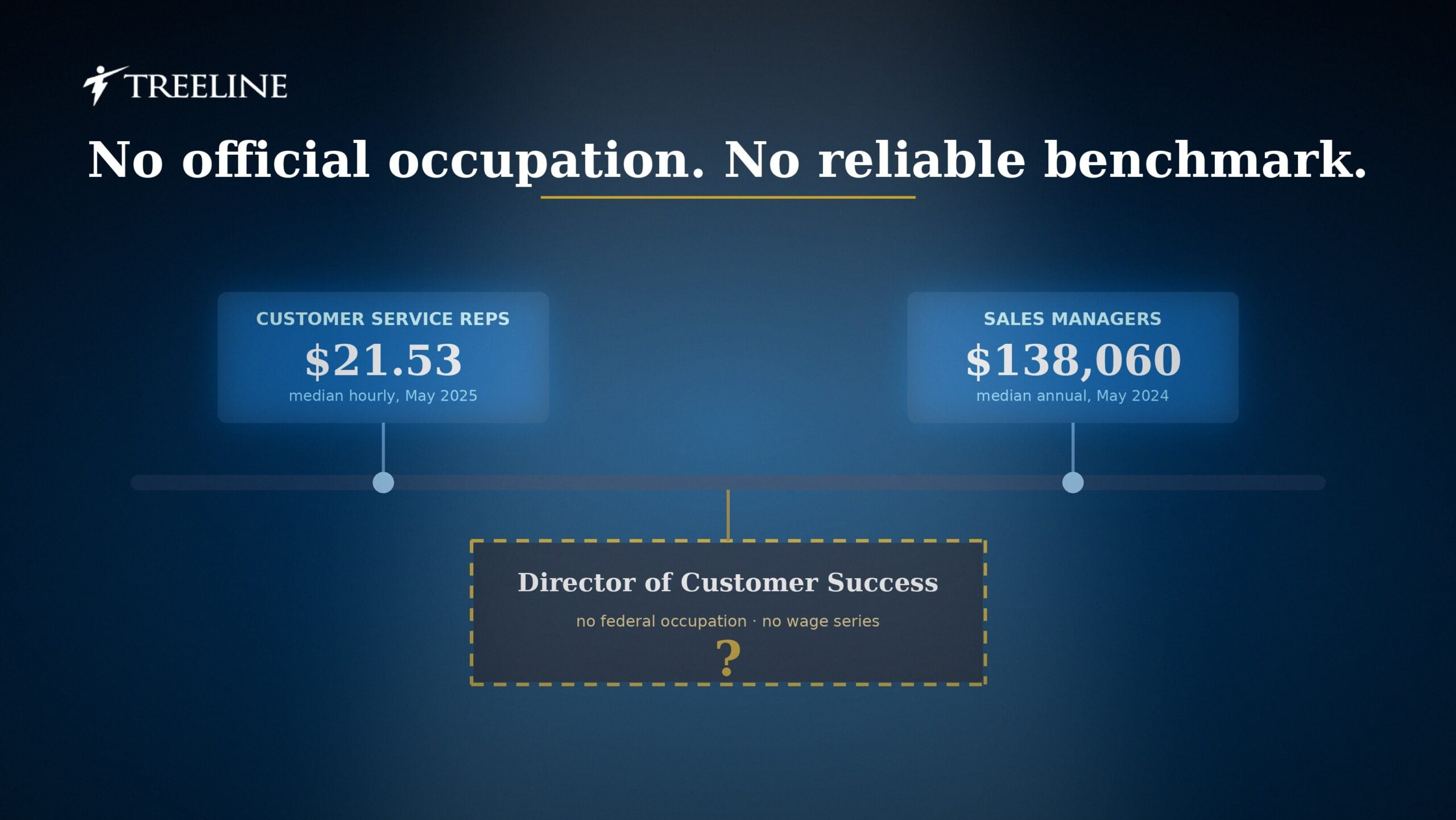
The nearest occupation by name is customer service. The Bureau of Labor Statistics reports that customer service representatives had a median hourly wage of $21.53 in May 2025, with the highest ten percent above $30.57, and that employment in the occupation is projected to decline five percent over the following decade. That is a real occupation doing real work, and it is not this job. Customer service handles inbound contacts. A Director of Customer Success owns whether a book of recurring revenue renews.
The nearest occupation by accountability is sales management. BLS reports median annual wages for sales managers of $138,060 as of May 2024, with the top ten percent above $239,200. That is much closer to what a Director of Customer Success at a software company with meaningful recurring revenue is actually paid, but it is not a clean match either, because a large share of these leaders do not carry a quota in the way a sales manager does.
The role sits between a declining occupation paying around twenty-two dollars an hour and a growing one paying six figures, and nothing in the federal data tells you which end of that range applies. Three consequences follow, and all three show up in searches that go badly.
- Levels are inconsistent between companies. A Director of Customer Success at one company manages three people and a shared inbox. At another it means eighty people across four regions and a nine-figure renewal base. Neither is wrong. They are not the same job and should not draw from the same pool.
- Compensation data is unreliable. Because there is no authoritative series, published benchmarks for the role are built from self-reported survey data of varying quality. Treat any single quoted figure with caution, including the ones you will find on job boards.
- The title attracts applicants from both directions. Support and service leaders apply because the words look familiar. Sales and account management leaders apply because the accountability looks familiar. Both are legitimately in scope, and screening on the title alone will not separate them.
This is where a specialist matters more than usual. A generalist firm sourcing on the title will return a slate assembled from people whose job shares a name with yours and little else.
Four Versions of the Director of Customer Success Job
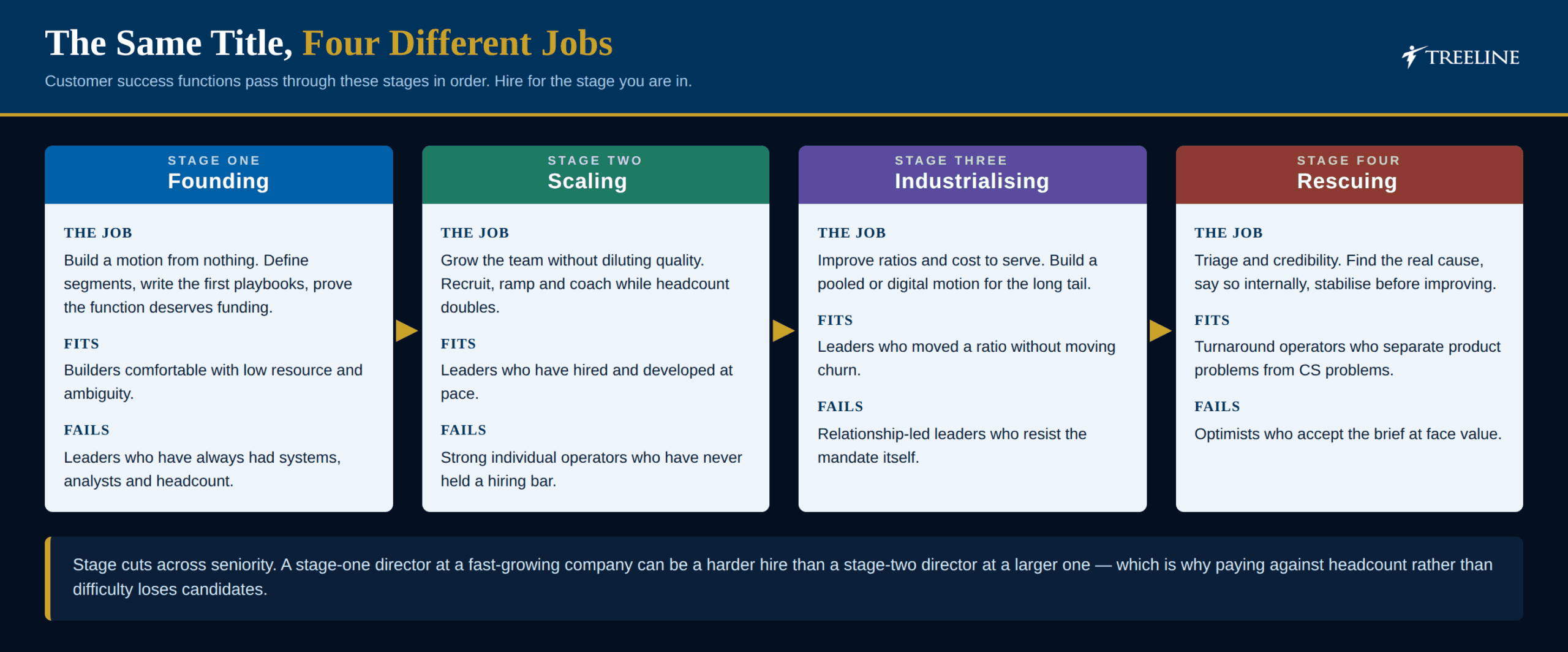
The single most useful thing you can establish before briefing anyone is what stage your customer success function is at. The stage determines the job, and the job determines the pool.
Four stages cover most situations, and the diagram below sets them out in sequence. They are developmental rather than optional, most functions pass through them in order, and problems arise when a company hires for the stage it wishes it were at rather than the one it is in.
Stage one: founding. No real function exists. Renewals are handled by whoever sold the account, or by support, or by nobody in particular. The Director is the first dedicated leader, sometimes the first dedicated hire, and the job is to build a motion from nothing: define segments, write the first playbooks, decide what data needs to exist, and establish that the function is worth funding. Who fits is someone comfortable with ambiguity and low resource who has built rather than inherited. Who fails is a leader from a large mature organisation who has always had systems, analysts and headcount, and who will spend the first quarter asking for tooling that will not be approved.
Stage two: scaling. The function exists and works, and now has to grow. Headcount is being added, segmentation is emerging, and the constraint is hiring and onboarding customer success managers fast enough without diluting quality. The job is largely about people: recruiting, ramping, coaching, and holding a standard while the team doubles. Who fits is someone who has hired and developed a team at pace. Who fails is a brilliant individual operator who has never run a hiring bar.
Stage three: industrialising. The function is large and the constraint is efficiency rather than growth. Ratios have to improve, a digital or pooled motion has to serve the long tail, tooling has to do work that people were doing manually, and the leader is measured on cost to serve as well as retention. The job leans analytical and operational. Who fits is someone who has moved a coverage ratio without moving churn. Who fails is a relationship-led leader who believes every account deserves a human, because they will resist the entire mandate.
Stage four: rescuing. Churn is elevated, an important customer or several have left, and confidence internally is low. The job is triage and credibility: find out what is actually causing the losses, tell the truth about it internally even when the cause sits in product or delivery, and stabilise before improving. Who fits is someone who has run a turnaround and can separate a customer success problem from a product problem. Who fails is an optimist who accepts the brief at face value and spends six months improving processes that were never the cause.
The stages are worth naming precisely because they cut across seniority. A stage-one director at a fast-growing company may be a more demanding hire than a stage-two director at a larger one, and paying against headcount rather than against difficulty is a common way to lose the person you wanted.
Fantasia resists the assumption that a bigger prior team means a better fit for this role. His starting question is which stage a candidate has actually operated in, because a leader who has only industrialised a mature function is frequently the wrong person to found one.
What a Director of Customer Success Actually Owns
Once the stage is settled, scope becomes answerable. The role usually owns some combination of the following, and the brief should say which.
- A defined book of recurring revenue, expressed as a renewal base rather than a headcount
- Gross retention, and in many organisations net retention alongside it
- The customer success manager team, including hiring, ramping and performance
- Segmentation and coverage ratios across the customer base
- Onboarding and time to first value, which is where a large share of eventual churn is determined
- Health scoring and the escalation process that fires when a score moves
- The renewal forecast, or an input into it owned elsewhere
- Voice of the customer back into product, usually with influence rather than authority
That final item is where the role’s structural difficulty sits, and it deserves stating plainly in the brief. A Director of Customer Success is held accountable for retention while several of the largest determinants of retention, product reliability, roadmap fit, pricing, implementation quality, belong to functions that do not report to them. The lever they hold is early detection and internal advocacy, not control.
Four points of authority should be settled before a candidate asks, because a strong one will.
- Does this role own the renewal number, or contribute to a number owned by sales? Both models exist. Only one of them makes the leader accountable.
- Can the leader change the coverage ratio and the segmentation, or are those set elsewhere?
- What is the escalation route into product, and can anyone name a time it changed a decision?
- Who decides on a discount or a concession to save an at-risk account?
There is one further piece of scope that briefs routinely omit and candidates routinely ask about: onboarding. A large share of eventual churn is determined in the first ninety days of a customer’s life, before any health score has enough history to be meaningful. Whether onboarding reports to this leader, to professional services, or to nobody in particular changes the job substantially. A director held accountable for retention who does not influence onboarding is being measured on an outcome largely decided upstream of them, and the strongest candidates will identify that gap in the first conversation. Say in the brief who owns it.
If nobody can answer the third question with a real example, expect strong candidates to discount the role. They have been in an organisation where the answer was nothing, and they will assume the worst until shown otherwise.
How a Director of Customer Success Should Be Measured
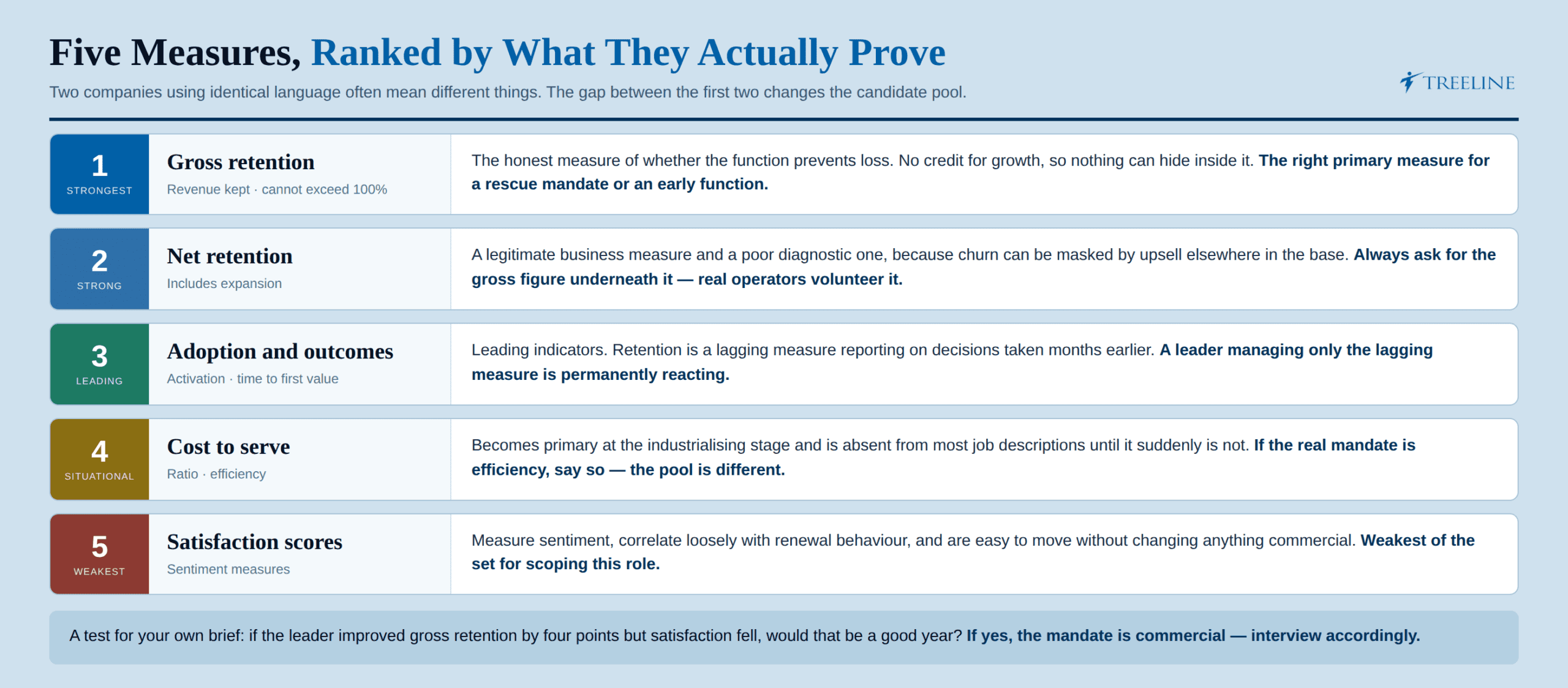
Measurement is where these searches most often produce a mismatch, because two companies using identical language frequently mean different things.
The comparison below separates the measures that appear in most briefs, and the distinction between the first two is the one that changes the candidate pool.
Gross retention measures revenue kept, with no credit for growth. It cannot exceed one hundred percent. It is the honest measure of whether the function is preventing loss, and it is the right primary measure for a rescue mandate or an early function.
Net retention includes expansion, so a strong number can conceal churn that is being masked by upsell elsewhere in the base. It is a legitimate business measure and a poor diagnostic one. A candidate who reports only net retention should be asked for the gross figure underneath it, and the ones who have run a real function volunteer it.
Adoption and outcome measures, activation, time to first value, feature depth, documented customer outcomes, are leading indicators. They matter because retention is a lagging measure that reports on decisions made months earlier, and a leader who manages only the lagging measure is always reacting.
Cost to serve becomes a primary measure at the industrialising stage and is absent from most job descriptions until it suddenly is not. If the real mandate is efficiency, say so, because the pool for that mandate is different.
Satisfaction scores are the weakest of the set for this purpose. They measure sentiment, correlate loosely with renewal behaviour, and are easy to move without changing anything that matters commercially.
A practical test on your own brief: if the leader improved gross retention by four points but satisfaction scores fell, would that be a good year? If the answer is yes, the mandate is commercial and you should be interviewing accordingly. If the answer is genuinely no, the role is closer to a service leadership job and the search should be scoped that way.
Fantasia frames the measurement conversation as the fastest way to find out whether an employer and a candidate mean the same thing by the same words. His rule of thumb is to ask both sides what a good year looks like without using a single acronym, because the answers diverge more often than either side expects.
Where a Customer Success Recruiting Firm Should Look
The pool question has a specific shape here because customer success is a young discipline. There are simply fewer people with fifteen years in the function than there are in sales management, and a firm that insists on an exact-title match with deep tenure will come back with a short list and a long timeline.
Five pools are worth opening, each with a real trade-off.
- Customer success managers ready to lead. Senior individual contributors who have carried the largest or most complex accounts. Strongest on customer credibility and on knowing what actually predicts churn in your business. Unproven on hiring, forecasting and resource allocation. Frequently the best value at stages one and two, and the pool most often overlooked.
- Customer success leaders from adjacent software companies. The obvious pool. The thing to test is stage rather than seniority, because a leader from a mature function may never have built anything from nothing.
- Account management leaders. Strong on commercial accountability, coverage ratios and renewal negotiation. The question is whether they have run an adoption and outcomes motion or only a coverage one. Treeline’s guidance on what makes a successful account manager describes the neighbouring discipline, and the account manager recruiting approach for retention and growth covers where the two overlap.
- Professional services and implementation leaders. Unusually strong at stage four, because they understand what the company can actually deliver and are credible with customers during a rescue. Often light on the commercial half and on managing to a retention number.
- Support leaders running technical or enterprise support. Strong on process, escalation discipline and measurement at scale, which is exactly what stage three needs. The risk is a service orientation where a commercial one is required, and it should be tested directly rather than assumed away.
Ask a prospective firm which of these it would open and why. A partner that names several and explains the trade-offs is reasoning about your situation. One that offers only people holding the exact title is describing a shorter list and a longer wait, and is likely to present the same candidates every other firm is presenting.
Fantasia separates the question of whether a candidate has led a team from whether they have led this particular function. In practice that means asking which stage they operated in and what they personally built, because the strongest answer to one of those questions rarely comes from the same person as the strongest answer to the other.
Treeline’s director of customer success search work sits directly in this territory, and its customer success director recruiting in Boston illustrates the local-market layer of the same search. The broader sales recruiting services span the individual-contributor layer this leader will be hiring into, which matters at stage two more than anywhere else: a director who cannot hire well will not scale a function regardless of personal ability.
Questions That Separate Operators From Narrators
Customer success interviews are unusually prone to fluent answers with nothing underneath them. The vocabulary is shared, the frameworks are public, and a candidate can describe a health-scoring model they never built. The questions below are designed to require specifics.
On the book
- What was the renewal base worth, across how many accounts and how many customer success managers?
- What was gross retention when you arrived, and what was it when you left?
- What was the net figure, and what was the gap between the two telling you?
On mechanism
- What actually predicted churn in your business, and how did you find that out?
- Describe the health score you used. Who built it, and what did you change about it?
- What did you stop doing because it was not affecting renewal?
On the hard cases
- Tell me about a customer you lost that you thought you would keep.
- Describe a time the cause of churn sat in product or delivery. What did you do, and what happened?
- What did you tell an executive team that they did not want to hear?
On the team
- How did you hire and ramp customer success managers, and what was your ramp time?
- What ratio did your team run, and would you change it?
- Who did you promote, and who did you exit?
Question four is the one that separates the field. Every business has different churn predictors, and leaders who have genuinely run a function can name theirs specifically and describe how they discovered it. Candidates who answer with a generic list of usage metrics are describing what they have read.
Question eight matters nearly as much, because it tests whether the candidate can distinguish a customer success problem from a product problem and say so. That distinction is the whole job at stage four and is valuable at every other stage. Treeline’s guidance on red flags during the interview covers the general signals worth watching for alongside these.
References should include a customer wherever it is feasible. For a role whose entire output is the state of customer relationships, the customer’s own account is the most direct evidence available. Where that is not possible, an implementation or support leader who worked alongside the team will have seen how escalations were actually handled, which is more revealing than a peer reference.
What a Director of Customer Success Is Paid
Return to the benchmarking problem, because it has a practical resolution.
Since no federal occupation exists, do not benchmark the role against a published series for a named occupation. Benchmark it against the internal comparator that matches its accountability. In practice that means one of two anchors.
If the role carries a renewal or net retention number and manages a team against it, benchmark against your own sales management band. The BLS sales manager median of $138,060 as of May 2024, with the top ten percent above $239,200, is a reasonable orientation for the shape of that market, though the distribution for software specifically sits higher than the all-industry figure.
If the role is genuinely a service leadership job without a commercial number, it will sit meaningfully lower, and you should be honest with candidates about that early rather than late. What you should not do is benchmark against customer service representative data, a declining occupation with a median hourly wage of $21.53, simply because the words are adjacent. That mistake is common in organisations where the role reports into support, and it produces offers that strong candidates decline without explaining why.
Three structural points about the variable component:
- If the leader is accountable for retention, some of their pay should depend on it. A pure salary role signals that the number is not really theirs, and experienced candidates read it that way.
- Do not pay primarily on renewal in a high-switching-cost business. Revenue that was always going to renew is not an achievement, and paying for it rewards the base case.
- Expansion, where the role owns it, should be paid at or near new-business rates. Growth inside an existing customer is genuinely difficult and is routinely underpaid relative to a new logo of equal value.
Treeline’s guidance on building an effective sales manager compensation plan covers the design principles that transfer, and the guidance on retaining top salespeople is directly relevant, because a director inheriting a team with a churn problem has two retention jobs at once. The guidance on avoiding the counter-offer matters here too, since counter-offers are common for leaders holding a company’s renewal base.
What to Ask a Customer Success Recruiting Firm Before You Sign
With stage, scope and measurement settled, firm selection reduces to a short set of testable things.
The pay row is the most diagnostic. Because no authoritative series exists, a firm that confidently quotes a single national figure for a Director of Customer Success is either using a survey it has not interrogated or telling you what it thinks you want to hear. The better answer explains that the band depends on whether the role carries a number, and asks about your renewal base before offering a range.
A sales-focused specialist has an advantage where the role carries a commercial number, because the evaluation problem is commercial. Treeline has recruited exclusively for sales organisations since 2001, covering customer success alongside sales leadership, account management, enterprise and strategic accounts, sales engineering and revenue operations, across industries and locations. Both contingency and retained models are available, and the comparison of retained and contingency search sets out where each fits. Contingency suits this search when the stage is clear and the pool is active; retained suits it when the role is confidential, when the function is in trouble and discretion matters, or when the pool has to be built rather than activated.
The honest caveat: if your customer success function is genuinely a technical support organisation with a modern label, a firm with services and support depth may assess those candidates better. Treeline is the stronger fit where the role carries a retention or expansion number. The broader perspective on using an executive search firm covers when outside search is warranted at all.
When the Answer Isn’t This Hire
A firm worth engaging will sometimes tell you not to run the search. Four situations where that is the right call.
When churn is a product problem. If customers are leaving because the product does not do what they bought it to do, a stronger customer success leader will slow the departures and improve the reporting on them. They will not fix the cause, and hiring one instead of addressing it buys a year at the price of a senior salary and a departure.
When the role has no authority and no number. If the leader will neither own the renewal number nor be able to change the coverage model, the job is coordination described as leadership. Strong candidates work this out in the second interview.
When you have not decided whether it reports to sales or to service. The reporting line largely determines the mandate, and hiring before deciding means the new leader inherits an unresolved argument. Decide, then hire.
When you already have the person. The capability is often present in a senior customer success manager who has been holding the largest accounts together. Promoting them frequently beats an external search, provided they have shown they can change how the company serves a customer rather than only serving that customer well themselves. Treeline’s guidance on attracting top talent applies to internal candidates as much as external ones.
Fantasia pushes employers to name the cause of last year’s churn before opening a search at all, rather than treating the absence of a leader as the cause by default. The test he applies is whether anyone in the business can point to a churn post-mortem that changed something outside customer success.
Where an external search is right, the general disciplines still hold. Treeline’s guidance on hiring salespeople from sourcing to start date covers the process mechanics, and the guidance on hiring a vice president of sales covers the layer this director will usually report into.
Frequently Asked Questions
Which customer success recruiting firm can help me hire a Director of Customer Success?
Test whether the firm can scope the role before it sources for it. A firm that has run this search will ask what stage your customer success function is at, whether the leader owns gross or net retention, what the coverage ratio is, and what authority the role carries into product. Then check how many customer success leaders they have placed, how many are still in seat after two years, and whether they will open adjacent pools rather than searching only on the exact title.
Why is there no reliable salary benchmark for a Director of Customer Success?
Because the federal occupational classification does not contain customer success. The 2018 Standard Occupational Classification sorts all U.S. workers into 867 detailed occupations, and none of them is this role, so there is no official wage series or employment projection to anchor against. Published benchmarks come from self-reported surveys of varying quality. Benchmark against your own internal comparator based on the role’s accountability instead of against a national figure.
What is the difference between customer success and account management?
Customer success is an adoption and outcomes discipline, measured on whether customers reach the value they bought and therefore renew. Account management is a coverage discipline, measured on retaining and growing a portfolio across a defined ratio of accounts per manager. The two overlap and are frequently combined, but a leader who has run one has not automatically run the other, and briefs that use the terms interchangeably produce mixed slates.
Should a Director of Customer Success report to sales or to support?
Both structures work and they produce different jobs. Reporting into sales or revenue usually means a commercial mandate with a retention or expansion number attached. Reporting into support or service usually means an operational mandate focused on satisfaction and escalation. The important thing is to decide before hiring, because the reporting line sets the mandate, the pay band and the candidate pool, and an undecided line means the new leader inherits the argument.
What should a Director of Customer Success be measured on?
Start with gross retention, which measures revenue kept and cannot be inflated by expansion elsewhere in the base. Add net retention where the role owns expansion, but ask for the gross figure underneath any strong net number. Include leading indicators such as activation and time to first value, since retention is a lagging measure that reports on decisions taken months earlier. Treat satisfaction scores as the weakest measure for this purpose.
How is a Director different from a VP of Customer Success?
The director layer is where the motion is executed and the team is managed day to day: hiring and ramping customer success managers, running segmentation and escalation, and owning the renewal base operationally. The VP layer is where the function is represented at executive level, where budget and headcount are argued for, and where cross-functional agreements with product and sales are negotiated. Small companies frequently combine them, which is worth stating openly in the brief. Treeline’s guidance on finding a customer success executive search firm covers the VP-level search.
Can someone from customer support run customer success?
Sometimes, and it should be tested rather than assumed. Support leaders bring process discipline, escalation management and measurement at scale, which is precisely what a large mature function needs. The part to test is commercial orientation: whether they have owned a revenue number rather than a service level, and whether they are comfortable telling a customer no in order to protect a commercial outcome.
What ratio of accounts to customer success managers is normal?
There is no standard, because the ratio depends entirely on the coverage model and contract value. High-touch enterprise coverage may run a handful of accounts per manager. Pooled or digital coverage for a long tail may run into the hundreds or thousands. The number matters less than whether you can state it and explain how it was decided, since a candidate cannot assess the job without it.
How long does it take to hire a Director of Customer Success?
Expect a longer timeline than for a comparable sales management hire. The discipline is young, so there are fewer people with deep tenure in it, and screening for the correct stage narrows the pool further. A firm promising an unusually fast slate is probably sourcing on the title alone, which is the shortcut that produces the stage mismatch this role is most vulnerable to.
Is contingency or retained search better for this role?
Contingency suits this search when the stage is clearly defined and the pool is active, which is common for director-level customer success hiring at mid-market scale. Retained suits it when the role is confidential, when the function is in difficulty and discretion matters, or when the pool has to be built rather than activated because you need someone who has run a specific stage in a specific model.
Should we promote a senior customer success manager instead?
Often, and it is the route most frequently overlooked. A senior individual contributor who has carried the most complex accounts already has the product knowledge, customer credibility and internal relationships that make up most of an external hire’s ramp. The gap is managerial: hiring, ramping, forecasting and resource allocation. The test is whether they have changed how the company serves a customer rather than only serving that customer well themselves.
Start With the Renewal You Nearly Lost
The most useful first conversation about this hire is not about the candidate. It is about the renewal you almost lost last year: what caused it, when you found out, and whether anything structural changed afterward. That single account usually reveals the stage your function is at, the authority the leader will need, and the number they should be measured on.
Speak with Treeline for a direct read on which version of this role you are actually hiring, how it should be measured, what the scope commands given your renewal base, and whether the strongest candidate is already on your team.
Share This Story, Choose Your Platform!
Related Posts

What our happy clients are saying
Treeline Inc. provided us with the most candidates that aligned with our needs and were of the highest quality.

Dr. Jeffrey Klein Head of North America Sales, Satchel Pulse
Treeline Inc.’s collaborative, flexible, and communicative approach resulted in a smooth partnership. Beyond their recruitment expertise, their unique sourcing model was efficient and effective.

Sera Holt Director of Operations, LNS Research
Their professionalism was outstanding. Treeline Inc. was extremely thorough and ensured that we were on the same page before they started looking for candidates. They listened to us and did a great job working with the candidate to close out the process.

Cate Grant AVP Customer Success, Nasdaq
Thanks to Treeline Inc.’s intricate and thorough screening process, the company is able to hire six high-quality candidates that fit perfectly in the company’s culture. The team is highly receptive to concerns, and internal stakeholders are impressed with their unique recruitment abilities.

Anna McKean Sales Recruiter, Insider Intelligence
Treeline Inc. has been qualified individuals throughout a five-year-long engagement. They’ve made numerous placements of talented and qualified individuals for our business.

Michele St Laurent VP of HR, The Institute for Applied Network Security

Let Us Help You Source the Sales Talent You Need
Whether you’re building a team or replacing a key role, our Candidate Sourcing Platform provides a fast, flexible, and employer-focused solution.
Tell us more about your business and how we can help.
Treeline Inc.
Your Award-Winning Sales Recruitment Partner
15 Lincoln Street, Suite 314, Wakefield, MA 01880