There is a mismatch at the heart of this role that almost nobody names.
Regional sales managers are usually promoted because they sold well. That is the visible evidence, it is fair, and it is the standard route. But the job they move into is measured on something they have never been asked to do: producing an accurate regional forecast from other people’s judgments, week after week, in front of leadership.
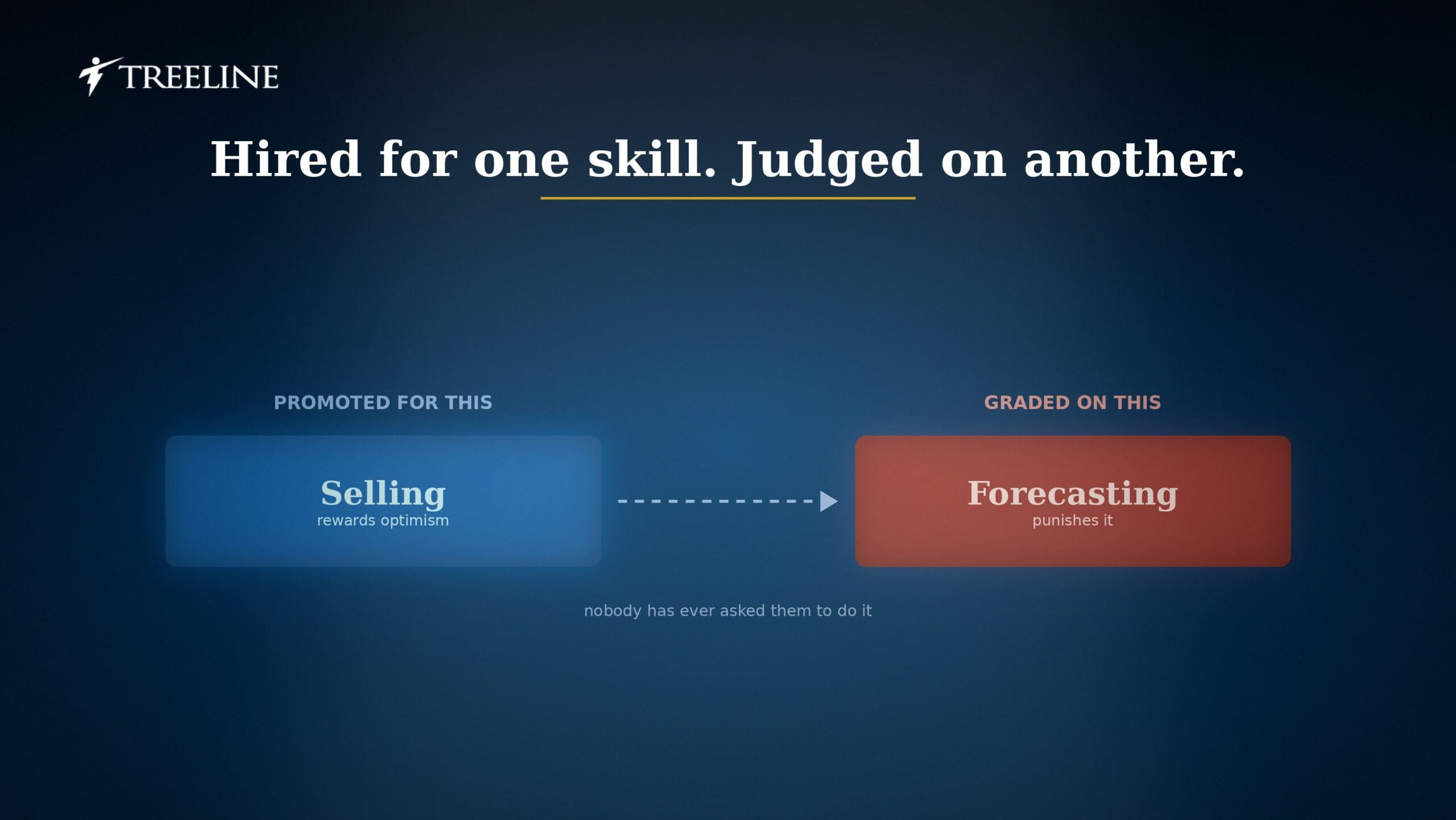
Selling and forecasting are close to opposite dispositions. Selling rewards optimism, the seller who believes the deal will close works it harder and often makes it true. Forecasting punishes optimism, because a number that is consistently high costs the company more than a number that is consistently low. Promoting your most confident seller and then asking them to be your most sceptical analyst is a real transition, and most organisations neither acknowledge it nor support it.
So the practical answer to which recruiting firm can help you recruit regional sales managers is that you want one that assesses judgment rather than track record. A firm that asks how a candidate decided which deals to believe, how their forecast accuracy moved over time, and what they did when a rep’s commit was obviously wrong is testing the actual job. A firm that screens on quota attainment as an individual contributor is screening for the previous job.
Dan Fantasia, CEO of Treeline, Inc., views the promotion from seller to regional manager as a change of discipline rather than a change of scope. From his perspective, employers should ask a candidate about a forecast they got badly wrong, because the ones who have made that mistake and corrected for it are considerably safer than the ones who have never been accountable for a number they did not personally control.
What a Regional Sales Manager Is Actually Accountable For
The regional layer sits directly above individual contributors and directly below the director layer, and it is defined by what it can and cannot change.
A regional sales director redesigns coverage, territory maps, quota distribution, where headcount goes. A regional sales manager works within those decisions and is accountable for what the team produces inside them. Their levers are individual and weekly rather than structural and annual.
What the role genuinely owns:
- The weekly forecast for the region, and its credibility upward
- Deal strategy and coaching on live opportunities
- How each rep spends their week, and which accounts get worked
- Pipeline quality, including removing things that should not be in it
- Ramp for new hires and performance decisions on existing ones
- Escalation into product, legal, security or pricing when a deal needs it
What it usually does not own: the territory map, the quota, headcount approval, pricing beyond a threshold, or the product. Treeline’s guidance on hiring a vice president of sales covers the layer where those decisions live, and the senior sales leadership job description template can be adapted downward for a manager brief.
Two things belong in the brief as a result. First, state whether the manager can request a territory adjustment and how that request is handled, because candidates will ask and a vague answer signals that the role has less authority than the title suggests. Second, state the vacancy position, a manager inheriting two open patches is producing from six reps’ worth of coverage while being measured on eight.
The Four Judgments Nobody Trains a Regional Sales Manager To Make
Here is what the week actually consists of. Four judgments, made repeatedly, none of which appear in a job description and none of which a strong selling career prepares anyone for.
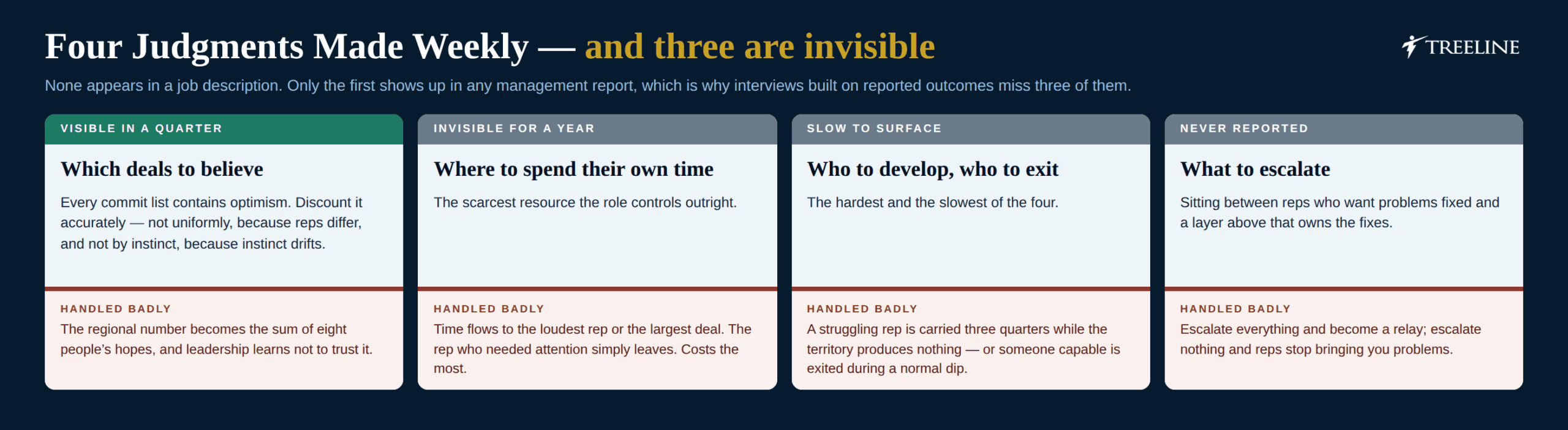
The diagram below sets them out with what each one gets wrong when handled badly.
Which deals to believe. Every rep’s commit list contains optimism. The manager’s job is to discount it accurately, not uniformly, because reps differ, and not by instinct, because instinct drifts. Handled badly, the regional number becomes the sum of eight people’s hopes, and leadership learns not to trust it.
Where to spend their own time. The scarcest resource the role controls outright. Handled badly, time flows toward the loudest rep, the largest deal, or the most enjoyable conversation, none of which is necessarily where the most value sits.
Who to develop and who to exit. The hardest and the slowest. Handled badly in one direction, a struggling rep is carried for three quarters while their territory produces nothing; handled badly in the other, someone capable is exited during a normal dip.
What to escalate. A regional manager sits between reps who want problems fixed and a layer above that owns most of the fixes. Handled badly, they either escalate everything, becoming a relay rather than a filter, or escalate nothing, and their reps stop bringing them problems.
It is worth noting how differently the four fail. A bad call on which deals to believe is visible within a quarter and costs credibility. A bad call on time allocation is invisible for a year and costs the most, because the rep who needed attention and did not get it simply leaves. A bad call on develop-versus-exit costs a territory’s output for as long as it takes to resolve. A bad call on escalation costs the manager their own information supply, because reps who stop being heard stop reporting. Only the first of those four shows up in any management report, which is why interviews that rely on reported outcomes miss three of them entirely.
Two observations. First, all four are judgment under uncertainty, which is why experience in the role predicts performance better than experience in sales does. Second, none is visible in a résumé, which is precisely why the interview has to be built around them rather than around attainment.
Fantasia weighs the second judgment most heavily when the region is underperforming but fully staffed. His reasoning is that a manager who cannot say where their own hours went has been reacting to demand rather than allocating against opportunity, and no amount of effort compensates for that.
One practical consequence for the brief. Because three of the four judgments are invisible in the numbers, the honest thing to tell candidates is what the region’s real condition is: which reps are struggling, which territories are thin, what the forecast history looks like, and what the previous manager did or failed to do. Candidates who are strong enough to be worth hiring will find all of this out in their first month anyway, and a brief that was optimistic about it costs you their trust at exactly the point you need them committed.
Forecasting Is the Skill the Role Is Actually Graded On
Of the four, the forecast is the one that determines how the manager is perceived, and it deserves its own treatment because most briefs mention it only in passing.
A regional forecast is not a prediction the manager makes. It is an aggregation of predictions other people made, each shaped by that person’s optimism, their compensation position, and how recently they were challenged on a commit. Errors do not cancel out, they compound in whichever direction the team culture leans.
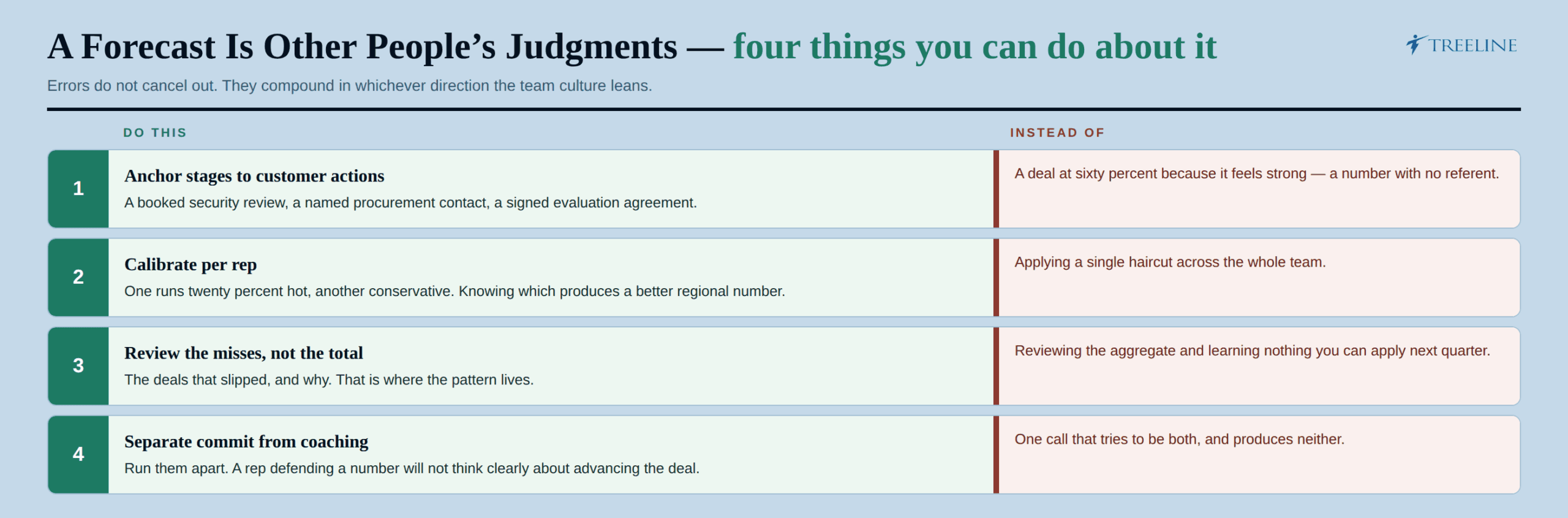
The comparison below sets out the four things a manager can actually do about that, against what weak managers do instead.
Anchor stages to customer actions, not seller confidence. A deal moves when the customer does something verifiable, a booked security review, a named procurement contact, a signed evaluation agreement. A deal at sixty percent because it feels strong is a number with no referent. Treeline’s guidance on signs a prospect is bad for business covers the qualification standard underneath this.
Calibrate per rep, not across the team. Different sellers are wrong in different directions and by different amounts. A manager who knows that one rep runs twenty percent hot and another runs conservative produces a better regional number than one applying a single haircut to everyone.
Review the misses, not just the total. The useful conversation is about the deals that slipped and why, because that is where the pattern lives. Managers who only review the aggregate learn nothing they can apply next quarter.
Separate the commit from the coaching. A forecast call that doubles as a coaching session produces neither, because a rep defending a number will not think clearly about how to advance the deal. The strongest managers run them apart.
There is a cultural dimension to this that a brief can address and rarely does. Forecast honesty is largely determined by what happens to the manager who calls a miss early. Where that is treated as useful information, managers report problems while there is still time to act on them. Where it is treated as failure, managers hold the number up until the last possible week and the organisation loses its chance to respond. Candidates at this level have usually experienced both, and asking which they worked in, and what they did about it, tells you as much about their judgment as it does about their previous employer.
A regional manager who improves forecast accuracy has done something valuable that no revenue metric will show, and it is worth asking candidates for the numbers. Those who have genuinely owned a region can usually say whether they ran hot or cold and by roughly how much.
Fantasia rates forecast honesty above forecast accuracy in a first-line manager. His view is that a manager who reliably calls a difficult quarter early is more useful than one who is occasionally precise, because the first gives the organisation time to react and the second only gives it a number.
Where Recruiting Firms Find Regional Sales Managers
The pool is large and the title is used at widely different scopes, so the screening problem is levelling before it is anything else.
Five routes, each with a real trade-off.
- Top reps stepping up. The default, and the one this article opened on. They bring credibility and product knowledge; what is unproven is every one of the four judgments. Test specifically for whether they can let a rep run a deal imperfectly rather than taking it over. Treeline’s guidance on the traits great salespeople share covers the layer they come from.
- Regional managers from comparable companies. The obvious pool, and the one where scope varies most. Screen on what they controlled: someone who received a finished territory map, a finished quota and a fixed headcount has done a narrower job than the title implies.
- Managers from an inside team moving to a regional one. They bring coaching cadence and measurement discipline that many regional teams lack, because inside management practises both daily. The adjustment is working with less direct observation. Treeline’s guidance on hiring an inside sales manager describes the discipline they come from.
- Managers from a larger company stepping into a smaller one. Often strong value: they have seen disciplined forecasting and pipeline standards that smaller organisations frequently lack. The risk is resource expectation, where someone used to enablement and sales operations struggles without them.
- Enterprise sellers with informal leadership history. Someone who has mentored, run a pod or carried a team through a manager vacancy has done a version of the job already. Frequently overlooked because the title never changed.
Ask a prospective firm which route it would prioritise given your situation, and whether it agrees with your levelling. A region that is fully staffed and flat needs a different person from one with three vacancies and an aggressive number, the first is a coaching and forecasting problem, the second is a hiring problem, and the guidance on speeding up hiring for quota-carrying roles covers that pace. Treeline recruits across industries and locations, which matters because regional managers are close enough to customers that proximity to the team and its markets affects how quickly they become effective. The broader sales recruiting services span the rep layer this manager will hire into.
Fantasia treats the informal-leadership route as the most undervalued of the five. His observation is that somebody who held a team together through a manager vacancy has already made all four judgments without the title or the support, which is a harder version of the job than the one being advertised.
Questions That Test Judgment Rather Than Attainment
Interviews at this layer are dominated by attainment stories, which describe the previous job. These questions describe this one.
On the forecast
- Were you systematically optimistic or conservative, and by roughly how much?
- Tell me about a quarter you called wrong. When did you know, and what did you do?
- How did you handle a rep whose commit you did not believe?
On time
- Where did your hours actually go last quarter, and where should they have gone?
- Which rep got the least of your time, and was that the right call?
- What did you stop doing to make room for something else?
On people decisions
- Take me through someone who was struggling and recovered. What specifically changed?
- Who did you exit, and how long between first doubt and acting?
- Who did you promote, and what did you get wrong about them?
On the layer above and below
- What did you escalate, and what did you deliberately absorb?
- Which territory was unfair, and how did you raise it?
Question four is the one that most reliably separates candidates who managed from candidates who supervised. Every regional manager’s week is claimed by other people, reps with escalations, leadership with reporting requests, customers who want the manager in the room. The ones worth hiring have noticed that this produces an allocation nobody chose, and have done something structural about it: a protected block, a rule about which deals they join, a decision to stop attending something. Candidates who answer by describing how busy they were have described the problem without recognising it.
Question one is the most efficient in the set. Any manager who has genuinely owned a regional forecast knows their own bias, because leadership will have told them. Candidates who say they were consistently accurate have either not been measured or are not being straight, and the ones worth hiring usually answer with a rueful specificity that is hard to fake.
Question three tests whether they manage upward honestly. The realistic answer involves a conversation with the rep, a decision about what to submit, and sometimes submitting a number the rep disagreed with. Candidates who say they always deferred to the rep’s judgment were passing the problem along; those who say they always overrode it were not using the person closest to the deal.
Question eight matters because performance decisions are where first-line managers are slowest, and honesty about the delay is more informative than the decision itself. Treeline’s guidance on red flags during the interview covers the broader signals worth watching.
Question nine is worth including even though it sounds soft. Promoting someone is the decision a first-line manager gets least feedback on, because the consequences land on somebody else’s team. Managers who have promoted well can usually name what they misjudged anyway, that the person was ready technically but not for the conversations, or that they had confused being liked with being respected. Candidates who say every promotion worked out have either promoted once or have not followed up.
References should include a former direct report as well as a manager. The four judgments are all experienced from below, and the view from there is the only direct evidence of how they were actually made.
What Regional Sales Managers Are Paid
There is no dependable published benchmark for this title, and quoted averages are unusually misleading here because the same words describe a first-line manager of six reps and, at some companies, a second-line leader running several teams. Price the scope.
Five things move the band:
- Whether anyone reporting in is a manager. This is the largest single determinant and the most common ambiguity in the brief.
- The ARR the region carries, which is the clearest measure of scope.
- ACV and cycle length. Coaching a multi-stakeholder enterprise sale is a different skill from coaching a transactional one at the same headcount.
- Vacancy rate. A region with three open patches is a harder job in year one and should be recognised as such.
- Whether the manager carries their own accounts, which should be priced as the two jobs it is.
It is worth being direct about the earnings comparison, because it decides more of these hires than employers expect. A strong rep on a good patch frequently out-earns the regional manager they would report to, and at first-line level there is rarely an equity component large enough to close the gap. The promotion is therefore often a pay cut taken in exchange for a title and a materially harder job. Where that is true, say so plainly rather than letting a candidate work it out during the offer conversation, and be ready to explain what they get instead, scope, a visible route to the director layer, or a base that carries less risk than a quota does.
On plan design, four points specific to this layer:
- Weight toward team output rather than the manager’s personal accounts. Where both exist, the accounts win at quarter end and the coaching stops precisely when it matters.
- Include a forecast-accuracy component, or at least review it formally. It is the skill the role is graded on informally, and leaving it out of the plan tells the manager it does not matter.
- Recognise ramp and vacancy fill. Both produce revenue two or three quarters later and neither shows in the current period.
- Do not hold them to territory outcomes they cannot influence. Where the map is unfair, a flat per-rep expectation makes the manager accountable for a design decision made above them.
Treeline’s guidance on building an effective sales manager compensation plan covers the design principles, the guidance on retaining top salespeople applies to the team being inherited, and the guidance on avoiding the counter-offer is relevant because a departing regional manager often takes a rep or two within a year.
How to Test a Recruiting Firm on a Regional Sales Manager Search
With levelling, scope and the region’s state settled, firm selection reduces to a short set of testable things.
The second row is the one worth pressing hardest. Quota attainment as an individual contributor is the most available data point and the least predictive one for this role, because it measures the job the person is leaving. A firm that leads with it is sorting by the wrong variable, and the shortlist will be full of excellent sellers.
A sales-focused specialist has the advantage because the assessment problem is about commercial judgment in specific situations rather than management in general. Treeline has recruited exclusively for sales organisations since 2001, covering regional and field sales management alongside enterprise and strategic accounts, inside sales, sales engineering, revenue operations and customer success. Both contingency and retained models are available, and the comparison of retained and contingency search sets out where each fits. Contingency suits most regional manager searches, since the pool is large and active; retained makes sense where an incumbent is being replaced discreetly or the market is thin.
The honest caveat: where the role is really a senior individual contributor with a management title, carrying a full quota with two people nominally reporting in, the assessment is closer to enterprise selling. Treeline’s guidance on hiring top account executives and the strategic account executive profile cover that search instead. The broader perspective on using an executive search firm covers when outside search is warranted at all.
When the Answer Isn’t This Hire
Four situations where a firm worth engaging will tell you to wait.
There is also a sequencing point worth raising before the search opens. This layer only works if the layer above is settled. A regional manager reporting into a director role that is vacant, newly filled, or itself under review will spend their first two quarters without the structural decisions they depend on, the territory adjustments, the quota arguments, the headcount approvals. Hiring the manager first is a common instinct because the pain is more visible at that level, and it usually means the new person inherits a set of problems nobody above them is yet positioned to resolve.
When the forecast problem is structural. If stages are defined by seller confidence rather than customer action, every manager you hire will produce an unreliable number, because the system cannot produce a reliable one. Fix the definitions first; it is cheaper than the search.
When the territories are the problem. If reps are missing because the map is wrong, a first-line manager cannot fix it. That authority sits a layer up, and hiring here puts accountability in the wrong place.
When you need a director. If the requirement is redesigning coverage, rebuilding quota or restructuring the team, that is the layer above and hiring below it will not produce those decisions.
When the team has just changed shape. If territories moved or two reps left in the last quarter, the numbers say very little about whether the region needs better management. Reps are working unfamiliar accounts and the pipeline reflects the previous arrangement. Hiring into that produces a manager assessed on data that will not mean anything for another two quarters, and usually a second round of changes that undoes the first.
When you already have the person. A rep who has been carrying a pod, mentoring newer colleagues or covering during a manager vacancy has already done a version of the job. That is stronger evidence than an interview produces. Treeline’s guidance on attracting top talent applies to internal candidates too.
Where an external search is right, the general disciplines hold. Treeline’s guidance on hiring salespeople from sourcing to start date covers the process, the guidance on prospecting that creates high-value opportunities covers a discipline this manager reinforces weekly, the guidance on negotiating without discounting covers the commercial standard they hold in deal reviews, and the guidance on what makes a successful account manager covers the post-sale discipline their reps hand into.
Frequently Asked Questions
Which recruiting firm can help me recruit regional sales managers?
The one that assesses judgment rather than track record. A firm that has run these searches will ask how a candidate decided which deals to believe, whether they ran systematically hot or cold on forecast, how they allocated their own time, and how long it took them to act on a performance problem. A firm that leads with quota attainment as an individual contributor is screening for the job the person is leaving. Then check how many regional managers it has placed and how many are still in seat after two years.
Why do strong sellers struggle as regional managers?
Because the disciplines are close to opposite. Selling rewards optimism, the seller who believes the deal will close works it harder and often makes it true. Forecasting punishes optimism, because a number that is consistently high costs the company more than one that is consistently low. Promoting your most confident seller and then asking them to be your most sceptical analyst is a genuine transition, and most organisations neither name it nor support it.
What is the difference between a regional sales manager and a regional sales director?
Authority over structure. A director redesigns coverage: the territory map, quota distribution, where headcount goes. A manager works within those decisions and is accountable for what the team produces inside them. Their levers are individual and weekly rather than structural and annual. A manager held accountable for outcomes driven by a map they cannot change has the accountability without the lever.
How should a regional manager handle a forecast they do not believe?
Calibrate per rep rather than applying one haircut across the team, anchor stages to verifiable customer actions rather than seller confidence, and keep the commit conversation separate from the coaching conversation, a rep defending a number will not think clearly about advancing the deal. Where the manager and the rep disagree, the manager should submit their own number and say so, rather than deferring or silently overriding.
What should we ask that reveals judgment?
Ask whether they were systematically optimistic or conservative and by roughly how much. Anyone who has owned a regional forecast knows, because leadership will have told them. Candidates claiming consistent accuracy have either not been measured or are not being straight. Then ask where their hours actually went last quarter versus where they should have gone, because that answer distinguishes allocation from reaction.
What should a regional sales manager be paid?
Price the scope, since the same title covers a first-line manager of six reps and, at some companies, a second-line leader running several teams. The drivers are whether anyone reporting in is a manager, the ARR the region carries, ACV and cycle length, the vacancy rate, and whether the manager also carries accounts. Published averages blend all of these and are of little use for a specific role.
Should a regional sales manager carry their own accounts?
It is more expensive than it looks. The accounts they keep are always the largest, so their attention goes there precisely at quarter end when the team most needs coaching. If the role genuinely requires it, price it as two jobs and reduce the span accordingly rather than describing it as a management role and hoping both halves get done.
How long before a new regional manager shows results?
Coaching and forecast discipline show within a quarter or two; anything involving hiring or ramp takes longer, because a rep hired in month two contributes meaningfully around month eight. Agree in advance what first-year evidence looks like, forecast accuracy, pipeline quality, vacancies filled, ramp time, rather than judging solely on a regional number that partly reflects decisions made before they arrived.
Can an inside sales manager move to a regional team?
Frequently, and it is underused. They bring coaching cadence and measurement discipline that many regional teams lack, because inside management practises both daily rather than monthly. The adjustment is losing direct observation of every conversation, which is genuinely difficult rather than a matter of getting used to it. Ask what they would put in place to replace it.
How many reps should a regional sales manager have?
Fewer than a director, and the number follows from how much coaching each rep actually needs rather than from an org-chart preference. Six to eight is common for a considered sale with a long cycle; ten or more usually signals either a transactional motion or a role that has quietly become administrative. The more useful question is how many of those reps are ramping, because a team with three new hires needs materially more of the manager than a tenured one does.
What should the first ninety days look like?
Listening and calibration rather than restructuring. A credible new regional manager spends the early weeks understanding each rep’s forecast bias, working out where the pipeline is overstated, and finding out which territories are genuinely thin versus badly worked. Changes follow once that picture exists. Be wary of a candidate who arrives with a restructuring plan before they have sat in a forecast call.
Should we hire someone from our industry?
Less important than most employers assume, and it narrows the pool sharply. What transfers is judgment under uncertainty, forecast discipline and the ability to coach a complex sale. What does not transfer is product knowledge and customer relationships, both of which a capable manager acquires faster than they acquire judgment. Screen on cycle length and deal complexity rather than on sector.
How do we know whether the problem is the manager or the region?
Compare inputs rather than outcomes. If pipeline creation and meeting activity are similar across the team but revenue differs sharply, the difference is probably the territories rather than the manager. If activity itself varies widely and the manager cannot explain why, that is a management problem. Building that comparison is itself a test of whether your current reporting is adequate.
Ask Your Managers Which Way They Lean
Before writing the job description, ask your current regional managers whether they run hot or cold on forecast, and by how much. The ones who can answer precisely are doing the job. The ones who say they are usually about right are telling you that nobody has ever checked, which is the gap the next hire needs to close.
Speak with Treeline for a direct read on whether your region needs a coach or a builder, what the level actually is, what the scope commands, and whether the strongest candidate is already carrying a patch for you.
Share This Story, Choose Your Platform!
Related Posts


What our happy clients are saying
Treeline Inc. provided us with the most candidates that aligned with our needs and were of the highest quality.

Dr. Jeffrey Klein Head of North America Sales, Satchel Pulse
Treeline Inc.’s collaborative, flexible, and communicative approach resulted in a smooth partnership. Beyond their recruitment expertise, their unique sourcing model was efficient and effective.

Sera Holt Director of Operations, LNS Research
Their professionalism was outstanding. Treeline Inc. was extremely thorough and ensured that we were on the same page before they started looking for candidates. They listened to us and did a great job working with the candidate to close out the process.

Cate Grant AVP Customer Success, Nasdaq
Thanks to Treeline Inc.’s intricate and thorough screening process, the company is able to hire six high-quality candidates that fit perfectly in the company’s culture. The team is highly receptive to concerns, and internal stakeholders are impressed with their unique recruitment abilities.

Anna McKean Sales Recruiter, Insider Intelligence
Treeline Inc. has been qualified individuals throughout a five-year-long engagement. They’ve made numerous placements of talented and qualified individuals for our business.

Michele St Laurent VP of HR, The Institute for Applied Network Security

Let Us Help You Source the Sales Talent You Need
Whether you’re building a team or replacing a key role, our Candidate Sourcing Platform provides a fast, flexible, and employer-focused solution.
Tell us more about your business and how we can help.
Treeline Inc.
Your Award-Winning Sales Recruitment Partner
15 Lincoln Street, Suite 314, Wakefield, MA 01880