Meta Title: How to Find a Customer Success Executive Search Firm Meta Description: Finding a customer success executive search firm starts with one question: does your CS organisation carry a revenue number or not? Suggested URL: https://www.treelineinc.com/blog/customer-success-executive-search-firm/ How Do I Find a Customer Success Executive Search Firm?
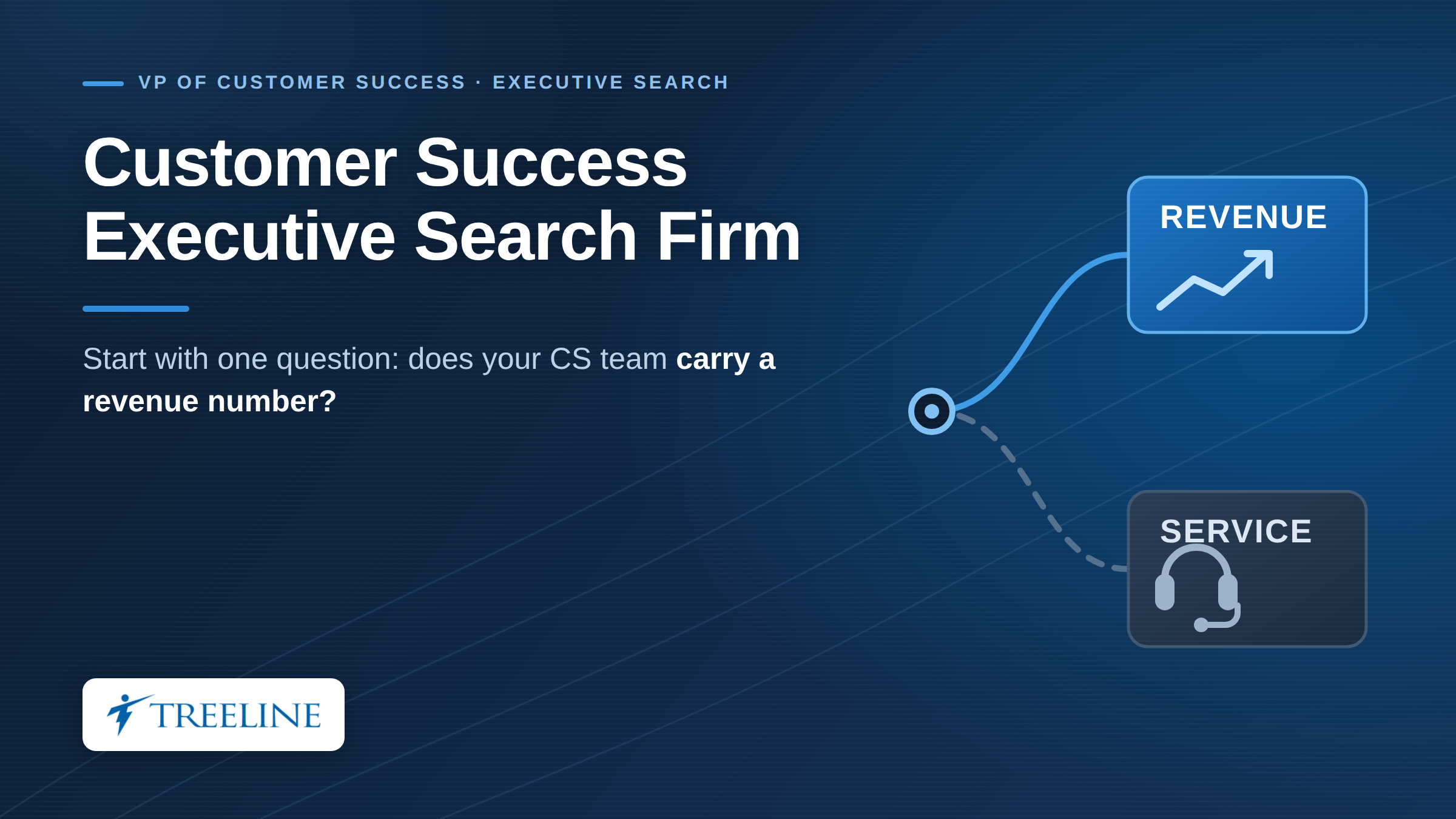
Start with a question about your own business rather than about the market: does your customer success organisation carry a revenue number? If it does, you are hiring a revenue leader who happens to sit post-sale, and you should be looking at firms that can assess renewal, expansion, and account economics. If it does not, you are hiring an operational leader responsible for adoption, satisfaction, and support quality, and the candidate pool is almost entirely different.
Most failed customer success leadership searches trace back to a company that never settled this question, briefed a firm on the title alone, and received a slate containing both kinds of person. Companies usually open this search at one of a few recognisable moments:
- Net revenue retention has drifted and nobody owns fixing it
- Renewals are being handled by whoever sold the account, inconsistently
- The CS team is growing but the ratio of accounts per manager was never designed
- Churn is being discovered at renewal rather than predicted months earlier
- Sales is closing accounts that CS cannot successfully onboard
- An investor or board has started asking for retention metrics the company cannot produce reliably
- The founder or head of support has been running
CS alongside another full-time role Dan Fantasia, CEO of Treeline, Inc., views a customer success leadership search as a revenue decision rather than a service decision. From his perspective, employers should first establish whether the role carries a retention and expansion number, because a leader who owns revenue and a leader who owns satisfaction are drawn from different populations.
The general executive-hiring economics apply here as they do elsewhere. The Society for Human Resource Management‘s 2026 recruiting benchmarking data reports that the median cost-per-hire for executive positions reached $15,000, up from $10,600 the previous year, and that the median share of executive positions filled externally was 100 percent.
What makes customer success different is not the cost of the search. It is that the discipline is young enough that the usual benchmarking shortcuts do not exist. This guide covers what the role actually owns, why the talent market behaves differently from sales or finance, how to evaluate a search partner, how a candidate should be assessed, and what to expect through the first renewal cycle.
What a VP of Customer Success Actually Owns

The title is used for at least three different jobs. Being precise costs an hour and saves a quarter. Depending on the company, a VP of Customer Success may own some combination of:
- Net revenue retention and gross revenue retention, including the renewal forecast
- Expansion revenue, either directly through a quota-carrying team or in partnership with sales
- Onboarding and time-to-value, which is frequently where churn is actually created
- Account health measurement and the early-warning system that precedes a renewal conversation
- Segmentation and coverage design, including which accounts get a named manager and which are served digitally
- Support, or a working relationship with a separate support organisation
- The product feedback loop, translating account patterns into roadmap influence
- Professional services or implementation, in companies where those sit under CS
Cost centre or revenue centre: the question that decides the search
This is the fork in the road, and it should be resolved before you speak to any firm. Revenue centre. CS owns a retention and expansion number. Renewals sit with the CS organisation. The leader is measured on NRR and GRR, forecasts like a sales leader, and sits in revenue reviews. Candidates come from CS organisations that carried quota, from account management leadership, and occasionally from sales leadership who moved post-sale.
Cost centre. CS owns adoption, satisfaction, and escalation quality, while renewals sit with sales or a dedicated renewals team. The leader is measured on health scores, ticket outcomes, onboarding time, and team efficiency. Candidates come from support leadership, professional services, and operational CS backgrounds.
Neither model is wrong. Plenty of companies run a strong cost-centre CS function alongside a renewals team and get excellent retention. The failure mode is briefing a search as one and hiring for the other, which typically surfaces four months in when the new leader is asked to forecast a renewal number they were never told they owned.
Be honest about which one you are, not which one you aspire to be. If you intend to move from cost centre to revenue centre, say that explicitly, because it changes the candidate again: you now need someone who has run that transition rather than someone who has operated in a steady state.
Should you promote from within?
Internal promotion deserves more consideration in customer success than in most functions, precisely because the external market is thin and title-noisy. The case for it is strong when your senior CSM or director already carries the largest accounts, has credibility with the product organisation, and understands why your specific customers churn.
That last item is genuinely hard to acquire from outside and takes a new hire a full cycle to learn. The case against is usually scope rather than ability. Running a book of accounts well is not the same as designing segmentation, setting coverage ratios, building a renewal forecast the CFO will accept, or negotiating with sales over who owns expansion.
The practical test is whether the internal candidate has already done something structural: changed how accounts were segmented, built a health-scoring model that altered behaviour, or renegotiated the handoff from sales. If the answer is no, the promotion is a development assignment rather than a hire, and it should be resourced accordingly.
Running an external search in parallel is defensible, provided you tell the internal candidate you are doing it.
Where the role reports, and why that changes the candidate
Reporting line is not an organisational detail here. It determines what the person can actually do. A VP of Customer Success reporting to a CRO is usually part of a revenue organisation, forecasts alongside sales, and has a realistic path to owning expansion. Reporting to a COO typically signals an operational mandate weighted toward efficiency and delivery.
Reporting to the CEO often means the function is strategically important but organisationally unsettled, which can be an opportunity or a warning depending on why. Reporting to a VP of Sales frequently means CS is treated as post-sale support for the sales motion, and strong revenue-side candidates will read that quickly.
Candidates at this level ask about the reporting line early and interpret it accurately. A vague answer is itself an answer.
Why Customer Success Leadership Is a Young Talent Market
This is the structural fact that makes the search different, and it is worth understanding before you set requirements. Customer success as a named discipline is recent. The U.S. Bureau of Labor Statistics Occupational Outlook Handbook does not publish a separate occupational profile for customer success managers. The nearest published profiles are customer service representatives, which describes a role centred on answering questions and resolving complaints, and sales managers, which covers quota, territory, and sales team leadership.
Neither maps cleanly onto a VP of Customer Success, and the gap between them is roughly the shape of the job. Three practical consequences follow. Tenure requirements should be calibrated differently. A candidate with fifteen years of customer success leadership at increasing scope is rare, because the function has not existed at scale for long enough in most industries.
Requiring it will produce an empty pool or a candidate whose title changed without the job changing. Titles are unreliable. A VP of Customer Success at one company runs eighty people and a nine-figure renewal book. At another, the same title describes a team of six handling onboarding tickets. Screening on title alone is close to meaningless here.
Adjacent backgrounds are legitimately in scope. Account management leadership, professional services leadership, and revenue operations all produce credible candidates, particularly for revenue-centre mandates. A firm that refuses to look outside people who have held the exact title is narrowing your pool for no defensible reason.
There is a fourth consequence that companies discover late: scale calibration is unusually difficult. In sales leadership you can reason about a candidate’s scope from quota and team size, and those numbers mean roughly the same thing across companies. In customer success they do not. A leader responsible for 40 accounts worth $2M each has run a fundamentally different operation from one responsible for 4,000 accounts worth $20K each, even where headcount is similar.
Ask for ARR under management, account count, and segment mix together, because any one of them alone will mislead you. Fantasia’s perspective is that the youth of the discipline changes what evidence to look for. Depth of tenure is scarce in customer success, so the useful signal is what a candidate built inside a short window rather than how many years the résumé shows.
What a Customer Success Executive Search Firm Should Understand About Your Post-Sale Model
Before sourcing anyone, your search partner should be able to explain your post-sale motion back to you. If they cannot, they will learn it on your time. They should be able to articulate:
- Whether CS owns renewals, influences them, or is separated from them entirely
- What your gross and net retention actually are, and whether you trust the measurement
- Where churn originates: onboarding failure, product gaps, champion turnover, pricing, or genuine fit problems
- How accounts are segmented, and how coverage differs across segments
- The ratio of accounts or ARR per customer success manager, and whether it was designed or accumulated
- What the handoff from sales looks like, and whether it works
- Whether expansion is a CS motion, a sales motion, or contested between them
- What tooling exists for health scoring, and whether anyone acts on it
That last pair matters more than it sounds. A great many customer success organisations have a health-score system that nobody uses to change behaviour. A candidate will find this out in week two, and a recruiter who knew about it can position the role honestly rather than setting up a surprise.
The handoff from sales is where most churn is created
If you take one diagnostic into the search, make it this one: ask where in the customer lifecycle your churn is actually decided. In a large share of subscription businesses the answer is not the renewal conversation and not even the first ninety days of usage. It is the sale itself, in what was promised, which stakeholder signed, and whether the account was ever a fit.
A customer success organisation inheriting badly-qualified accounts will produce poor retention regardless of how well it is led, and a candidate who does not raise this in an interview has probably not run a function under real pressure. This matters for the search in two ways. It changes the profile, because a leader who must fix an upstream problem needs the standing to challenge sales rather than absorb its output.
And it changes the reporting line question, since a VP of Customer Success asked to renegotiate qualification criteria while reporting into the VP of Sales is being handed a political problem rather than an operational one. Tell your search partner honestly whether this is your situation. It is one of the few pieces of context that meaningfully changes who will succeed in the role, and candidates will diagnose it in their first week anyway.
How to Find a Customer Success Executive Search Firm That Fits Your Model
Use these criteria on calls. The right-hand column separates a demonstrated capability from a claimed one.
| Evaluation area | What to examine | Evidence to request |
|---|---|---|
| Model fluency | Whether they ask if CS carries a number | Their unprompted read of your mandate |
| Post-sale economics | Whether they can discuss NRR, GRR, and expansion | How they would assess a retention claim |
| Adjacent sourcing | Willingness to look at AM, services, RevOps | Which adjacent pools they would target, and why |
| Title scepticism | Whether they screen on scope rather than title | How they size a candidate’s actual book |
| Search leadership | Who runs it day to day | Named consultant, available before signing |
| Comparable searches | CS or post-sale leadership placements | Roles filled, and how many are still in seat |
| Compensation guidance | A realistic band for your model | Indicative band before the search opens |
| Off-limits | Companies they cannot approach | Written disclosure before contract |
| Process discipline | Slate size, timeline, cadence | Written milestones and a stalled-search plan |
Ask one additional question that reveals a great deal: how would you tell the difference between a candidate who reduced churn and one who was present while churn fell? A partner who can answer that specifically understands the function. One who cannot will forward you plausible narratives. Treeline’s perspective on using an executive search firm covers the broader question of when to engage outside help at all.
Should a Customer Success Executive Search Firm Specialise in CS or in Revenue Leadership?
This deserves a direct answer, and the honest one is: it depends on which model you are hiring for, and pure customer success search boutiques are genuinely scarce. If CS is a revenue centre, a firm with depth in revenue leadership is usually the stronger partner. The evaluation problem is a revenue problem: can this person forecast a renewal book, run an expansion motion, and hold a number?
Firms that assess sales leadership every day are well positioned to test that, provided they take the post-sale specifics seriously rather than treating CS as sales with a different label. If CS is a cost centre, the evaluation problem is operational: team design, process, escalation quality, time-to-value. A firm with depth in operations or services leadership may serve you better, and a pure sales-search firm may misjudge candidates whose strength is delivery rather than commercial pressure.
If you are running the transition from cost centre to revenue centre, you want a partner who has seen that specific change, because the candidate who can lead it is rarer than either steady-state profile. What matters more than the label on the firm is whether the individual consultant asks about your retention model in the first conversation.
That single behaviour predicts the outcome better than the firm’s positioning statement. Fantasia recommends judging a search partner on whether it can assess post-sale revenue rather than on whether it uses the words customer success. A firm fluent in renewal, expansion, and account economics will evaluate the role correctly, while one treating it as a support function will produce a slate of service managers.
How a Customer Success Executive Search Firm Assesses a VP of Customer Success

Retention narratives are unusually easy to tell and unusually hard to verify. The bridge below shows why: net revenue retention is the sum of four separate movements, and a candidate can influence some without touching others. Useful questions include:
- What were gross and net retention when you arrived, and how were they measured?
- Which of those numbers did you actually own, and which did you influence?
- What was the account-to-CSM ratio, and did you change the segmentation model?
- Where was churn originating when you started, and how did you determine that?
- What specific intervention moved retention, and how did you isolate its effect?
- Which accounts did you lose anyway, and what did you conclude from them?
- How did the handoff from sales work, and what did you change about it?
- Did your team carry quota? If so, on what, and what was attainment?
- How did you forecast renewals, and how accurate was that forecast?
- What did your successor inherit, and what remained unsolved?
Question five is the one that separates candidates. Retention improves for many reasons, including a better product, a stronger sales filter on which accounts get signed, or a market that turned. A strong leader knows which portion of an improvement was theirs and says so unprompted. References should cross functions. A CRO or CEO speaks to forecast credibility and commercial judgment.
A product leader reveals whether the CS feedback loop was real. A direct report explains team design and coaching. Where possible, a customer reference is unusually informative for this function specifically. Fantasia emphasizes that assessment should distinguish a leader who reduced churn from one who happened to lead during a period when churn fell.
A strong candidate can name the segment where retention actually moved, the intervention that moved it, and the accounts that were lost anyway.
What a Customer Success Executive Search Firm Should Ask You Before Starting
A serious partner wants answers to most of the following before quoting:
- Does customer success own a renewal or expansion number, or does it not?
- What are your gross and net retention today, and do you trust the measurement?
- Who owns renewals right now, and is that changing?
- Where does this role report, and who else sits at that level?
- What is the current team size and the account-to-CSM ratio?
- Is expansion a CS motion, a sales motion, or contested?
- What happened to the last person in this seat, or is the role new?
- Which segment is hurting most, and why do you think that is?
- Who interviews, and how quickly does feedback come back?
- What would make you walk away from an otherwise strong candidate?
A firm that quotes a fee without asking the first question has told you how the search will run.
Where Customer Success Leadership Searches Go Wrong
| Failure mode | What it looks like | How to prevent it |
|---|---|---|
| Model never settled | Slate mixes revenue and operational leaders | Answer the number question before briefing |
| Screening on title | Two candidates, same title, tenfold scope difference | Screen on ARR under management and account count |
| Tenure requirement | Pool comes back empty | Calibrate to a young discipline; open adjacent pools |
| Accountability without authority | CS blamed for retention it cannot influence | Align the number with the decision rights |
| Aspirational brief | Role described as the model you want, not the one you have | Brief the current state, name the intended transition |
| Health scores as theatre | Scoring exists, nobody acts on it | Disclose it; let the recruiter position the role honestly |
| Quarterly variable on annual renewals | Leader optimises for saves over structure | Match the measurement period to the renewal cycle |
| Judged on inherited quarter | Strong hire looks like a failure at month four | Judge structure first, numbers after a full cycle |
The first row causes more failures than the rest combined. A company that has not decided whether customer success owns revenue will interview a revenue leader and an operational leader back to back, prefer whichever interviewed better, and then discover the mismatch when the first renewal forecast is due.
Compensation for a VP of Customer Success
Benchmarking is genuinely harder here than for sales leadership, because no published occupational profile covers the role and because the cost-centre and revenue-centre versions pay differently. Two anchoring points are useful. The BLS sales managers profile reports a median annual wage of $138,060 as of May 2024, with the highest 10 percent above $239,200.
A revenue-centre VP of Customer Success at a growth-stage company generally sits in a comparable range to a VP of Sales at similar scope, though usually with a smaller variable component and a longer measurement period. Structural decisions to settle before the search opens:
- Whether the role carries variable compensation, and if so whether it is tied to NRR, GRR, expansion bookings, or a blend
- The measurement period. Retention outcomes lag, so a quarterly variable plan on an annual renewal book creates perverse incentives.
- Whether the team carries quota, since that changes both the candidate profile and the comp philosophy
- Equity weighting, which tends to matter more to candidates in a function where cash variable is smaller than in sales
- Whether the role is on the executive team, which candidates at this level weigh heavily
Engagement Models and Fees
Fees are typically a percentage of the placed candidate’s base salary, and Treeline’s standard fee is 25% of base salary. The models differ in risk allocation rather than headline rate. Retained engagements are paid in installments with a portion upfront in exchange for exclusivity and systematic market mapping. Worth considering when the role is confidential, when you are running a cost-centre-to-revenue-centre transition, or when the pool needs building across adjacent functions rather than activating from a list.
Treeline’s sales executive search practice operates this way for VP-level and C-level roles. Contingency engagements are payable only on placement. Treeline’s contingency sales recruiting service is entirely performance based and explicitly covers customer success alongside sales leadership, enterprise sales, revenue operations, and sales engineering roles.
This suits a public role with a reachable pool and a decisive interview process. The mechanics of both are covered in Treeline’s comparison of retained search vs. contingency search.
The First 90 Days and the First Renewal Cycle
Customer success leadership has a longer feedback loop than sales leadership, and the onboarding plan should reflect that.
- Days 1 to 30. Meet the team and a meaningful sample of accounts, including at least two that recently churned and two that recently expanded. Review how health scores are calculated and whether anyone acts on them.
- Days 30 to 60. Assess segmentation and coverage against actual account value. Form a view on where churn originates, and test it against the data rather than accepting the internal narrative.
- Days 60 to 90. Present a plan covering segmentation, coverage ratios, the renewal forecast method, and what changes in the handoff from sales. Agree what the leader will actually be measured on.
- Through the first renewal cycle.
Judge the structure, not the number. Most of the renewals landing in the first two quarters were determined by decisions made before this person arrived. Follow-on hiring is common once the assessment is done, typically customer success managers, renewals specialists, or account management leadership. Treeline’s employer sales recruiting services cover those roles under both engagement models, and the firm’s guidance on what makes a successful account manager is a useful reference for the layer beneath the VP. Fantasia’s operating perspective is that a new customer success leader should be given a full renewal cycle before being judged on the numbers.
Retention outcomes lag the decisions that produce them, so a leader measured on the quarter they inherit will optimise for saves rather than for the structure that prevents churn.
Where Treeline Fits
Treeline recruits customer success roles as part of a revenue-organisation practice rather than as a standalone customer success specialism, and that distinction is worth stating plainly so you can judge the fit. Founded in 2001 and based in Wakefield, Massachusetts, Treeline recruits exclusively for revenue-generating organisations: sales leadership, enterprise sales, sales engineering, revenue operations, and customer success.
The firm’s contingency service explicitly covers customer success alongside those functions, and it has recruited post-sale leadership roles including Director of Customer Success searches focused on onboarding process and account management depth. Relevant to this search:
- A candidate database exceeding 200,000 revenue professionals, built through direct recruiting
- Both retained and contingency models, so the engagement matches the mandate
- Coverage across the industries where subscription and recurring-revenue models concentrate, including enterprise SaaS, cybersecurity, fintech, and digital health
- Fluency in the revenue side of the role: renewal forecasting, expansion motion, and quota-carrying post-sale teams
The honest limitation: if your customer success organisation is a cost centre weighted toward support operations, professional services delivery, and technical escalation, a firm with depth in operations or services leadership may assess those candidates better than a revenue-focused firm will. Treeline is the stronger fit when CS carries a number, when expansion is part of the mandate, or when you are moving the function from cost centre to revenue centre.
Ask directly and weigh the answer against your model.
Frequently Asked Questions
How do I find a customer success executive search firm?
Start by deciding whether your customer success organisation carries a revenue number, because that determines which kind of firm fits. If CS owns renewals and expansion, prioritise firms with genuine depth in revenue leadership assessment. If CS is an operational function, prioritise firms with operations or services leadership depth. Then evaluate the individual consultant: whether they ask about your retention model unprompted, whether they will source from adjacent functions, and whether they can explain how they distinguish a leader who reduced churn from one who was present while it fell.
Should a VP of Customer Success own the renewal number?
Both models work, and the choice should be deliberate rather than inherited. Giving CS the renewal number aligns accountability with the team closest to the customer and tends to produce earlier churn signals. Keeping renewals with sales or a dedicated renewals team can work well when the CS function is genuinely operational. The failure mode is ambiguity, where CS is blamed for retention outcomes it has no authority over.
Are there search firms that specialise only in customer success?
Pure customer success search boutiques exist but are scarce, because the discipline is young relative to sales, finance, or engineering. In practice most companies choose between a revenue-focused firm and an operations-focused firm and weigh which evaluation problem is closer to their model. The individual consultant’s fluency in post-sale economics matters more than whether the firm markets itself as a customer success specialist.
What experience should a VP of Customer Success have?
Focus on scope rather than title or tenure. Look for evidence of designing segmentation and coverage, owning or forecasting a renewal book, building an early-warning system that changed behaviour, and managing the handoff from sales. Because the discipline is young, requiring fifteen years of customer success leadership will produce an empty pool. Adjacent backgrounds in account management leadership, professional services, and revenue operations are legitimately in scope.
Why does the BLS not have a customer success occupation?
The Occupational Outlook Handbook does not publish a separate profile for customer success managers. The nearest published profiles are customer service representatives, which covers answering questions and resolving complaints, and sales managers, which covers quota and sales team leadership. Neither maps cleanly to a VP of Customer Success. The practical consequence is that standard occupational benchmarks are of limited use for scoping or compensating this role.
How long does it take to hire a VP of Customer Success?
SHRM’s 2026 benchmarking data reports a median time-to-fill of 45 calendar days for executive positions, measured from requisition opening to offer acceptance. Customer success leadership searches can run longer when the mandate is ambiguous, and materially shorter when the model is clearly defined and the firm is willing to source from adjacent functions. A realistic planning range is two to four months from kickoff to accepted offer.
How should a VP of Customer Success be compensated?
Benchmark against comparable VP-level revenue roles rather than against support or service management, particularly when CS carries a number. A revenue-centre VP of Customer Success typically sits in a similar range to a VP of Sales at equivalent scope, with a smaller variable component and a longer measurement period. Decide explicitly whether variable pay is tied to NRR, GRR, expansion bookings, or a blend, and avoid quarterly variable plans on an annual renewal book.
Can I promote an internal customer success director instead of hiring externally?
Often, and it is worth weighing seriously because the external market is thin and titles are unreliable. Internal candidates already understand why your specific customers churn, which takes an outside hire a full renewal cycle to learn. The test is whether they have done something structural rather than run a book well: changed segmentation, built a health-scoring model that altered behaviour, or renegotiated the handoff from sales. If not, treat it as a development assignment and resource it accordingly.
How do I evaluate a retention improvement claim from a candidate?
Ask what retention was on arrival and how it was measured, which portion of the number the candidate owned versus influenced, what specific intervention they made, and how they isolated its effect from product changes, sales-side filtering, or market conditions. Strong candidates volunteer which portion of the improvement was not theirs. Weak candidates present the trend line and let you infer causation.
Talk to a Revenue Recruiting Specialist
If you are hiring a VP of Customer Success and want a partner that assesses the role as a revenue position rather than a support one, schedule a conversation with Treeline. You will get a direct read on whether your mandate is scoped as a cost centre or a revenue centre, what the market will bear on compensation, and which adjacent talent pools are worth opening, before any fee is discussed.
Share This Story, Choose Your Platform!
Related Posts
What our happy clients are saying
Treeline Inc. provided us with the most candidates that aligned with our needs and were of the highest quality.

Dr. Jeffrey Klein Head of North America Sales, Satchel Pulse
Treeline Inc.’s collaborative, flexible, and communicative approach resulted in a smooth partnership. Beyond their recruitment expertise, their unique sourcing model was efficient and effective.

Sera Holt Director of Operations, LNS Research
Their professionalism was outstanding. Treeline Inc. was extremely thorough and ensured that we were on the same page before they started looking for candidates. They listened to us and did a great job working with the candidate to close out the process.

Cate Grant AVP Customer Success, Nasdaq
Thanks to Treeline Inc.’s intricate and thorough screening process, the company is able to hire six high-quality candidates that fit perfectly in the company’s culture. The team is highly receptive to concerns, and internal stakeholders are impressed with their unique recruitment abilities.

Anna McKean Sales Recruiter, Insider Intelligence
Treeline Inc. has been qualified individuals throughout a five-year-long engagement. They’ve made numerous placements of talented and qualified individuals for our business.

Michele St Laurent VP of HR, The Institute for Applied Network Security

Let Us Help You Source the Sales Talent You Need
Whether you’re building a team or replacing a key role, our Candidate Sourcing Platform provides a fast, flexible, and employer-focused solution.
Tell us more about your business and how we can help.
Treeline Inc.
Your Award-Winning Sales Recruitment Partner
15 Lincoln Street, Suite 314, Wakefield, MA 01880