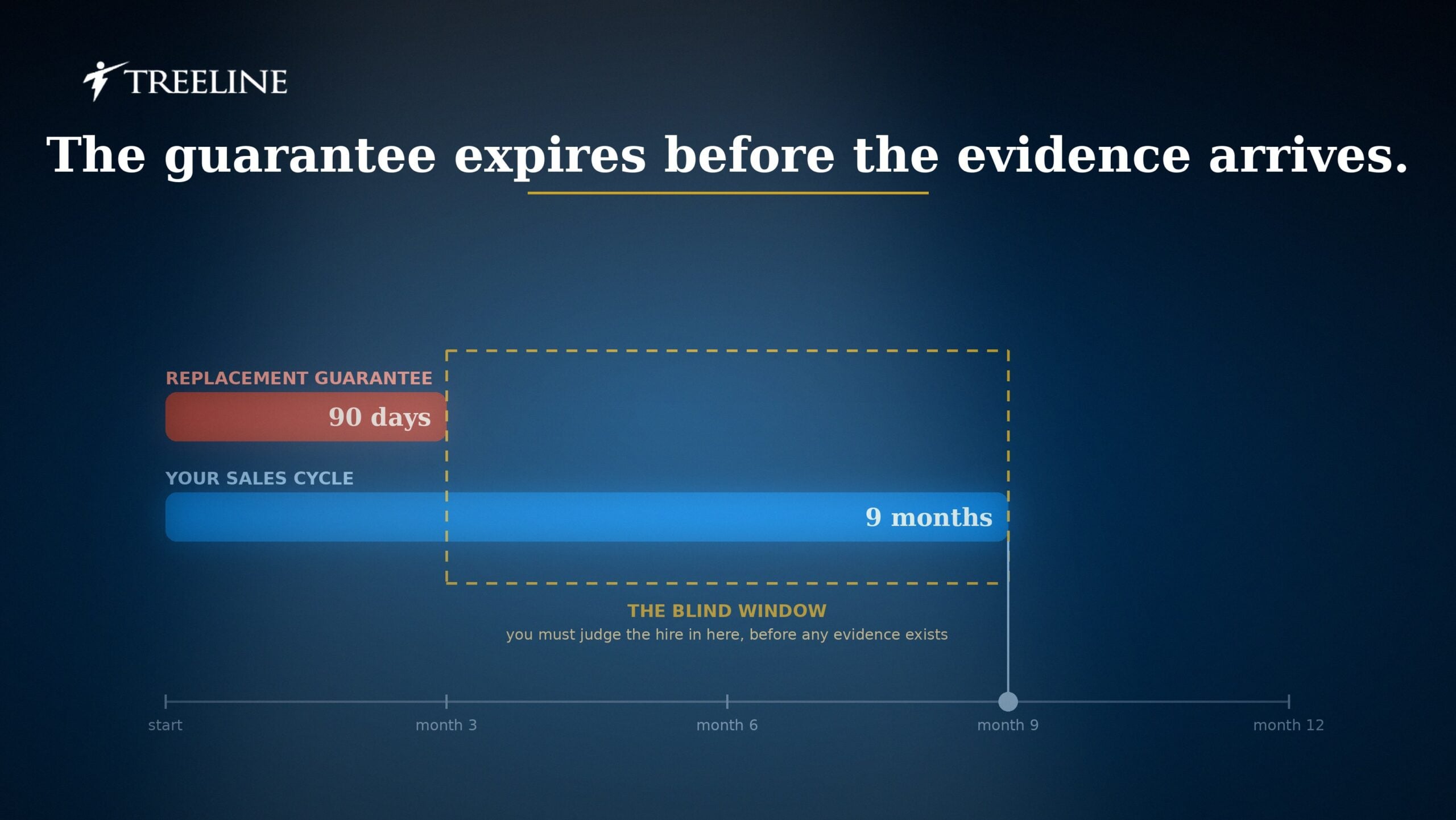
Here is the uncomfortable arithmetic behind this search. If your enterprise sales cycle runs nine months, a leader who starts in January will not close anything they personally originated until roughly October. Their first two quarterly reviews will therefore assess them on deals somebody else started, and the deals that actually test their judgment will not resolve until after most companies have already decided whether the hire worked.
You will be asked to form a view long before the evidence exists. So will they.
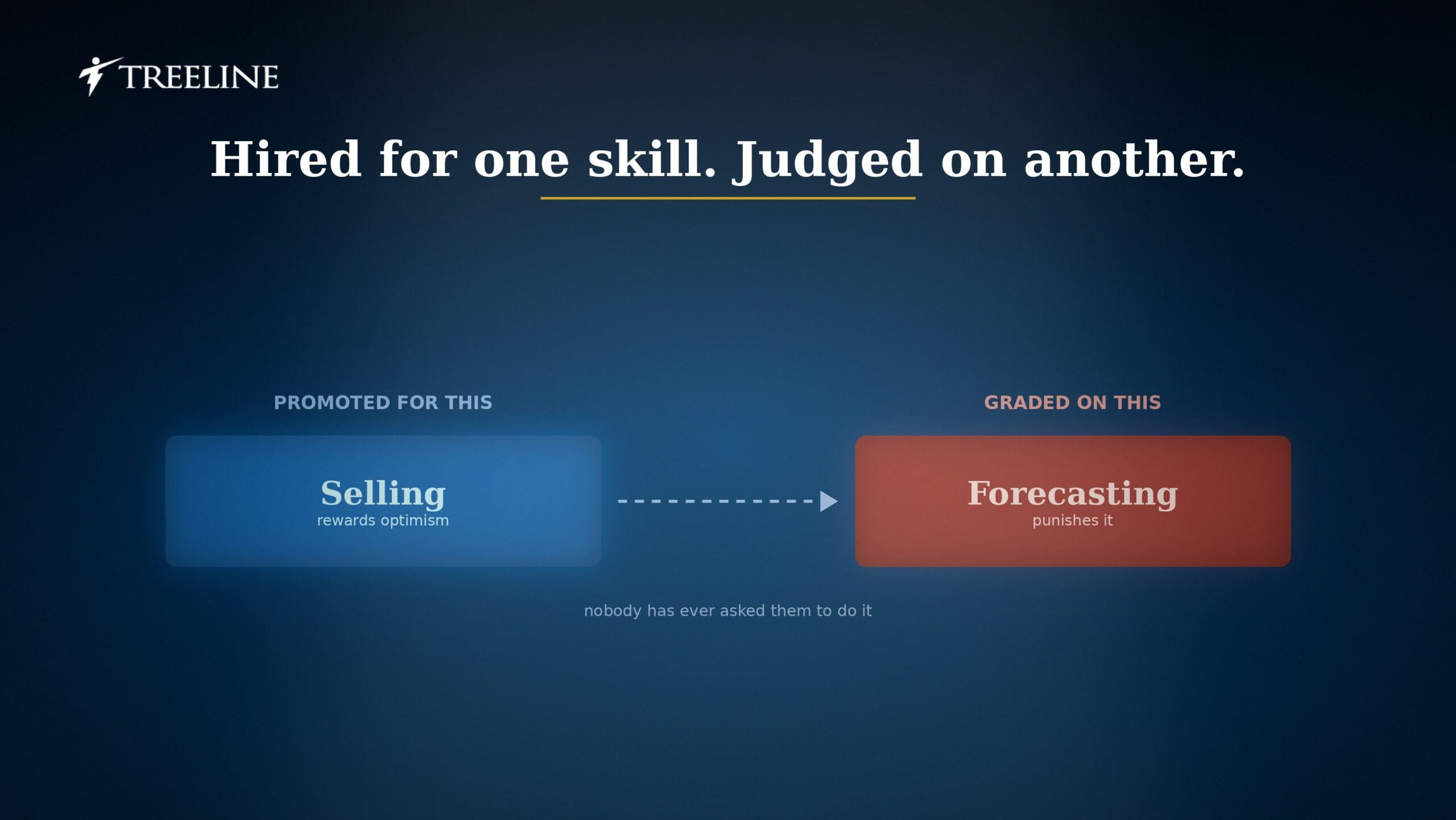
That single fact should shape how you choose a recruiting firm, and it is the thing most firms never mention. A search partner that understands enterprise selling will raise cycle length unprompted, because it changes the interview, the ramp plan, the compensation design, and the replacement guarantee. A partner that treats this like any other sales leadership search will run a process calibrated to a transactional motion and hand you a shortlist of people who close fast, which is a different skill and sometimes an opposite one.
So the practical answer to which recruiting firm can help you recruit enterprise sales leaders is: the one that asks how long your deals take, who else has to be in the room, and what happens when procurement gets involved, before it asks what experience you want. Those three answers determine the entire search.
Dan Fantasia, CEO of Treeline, Inc., views an enterprise search as a question of evidence quality rather than candidate volume. From his perspective, employers should decide in advance what proof they will accept about deals nobody can fully verify, because in a long-cycle business every candidate arrives with a narrative and very few arrive with anything that can be checked.
Why Enterprise Sales Leaders Cannot Be Judged on a Normal Timescale
Enterprise selling is not simply bigger selling. It is structurally different in ways that break the standard assessment tools.
The U.S. Department of Labor’s O*NET profile for sales representatives in technical and scientific products gives a useful picture of the underlying work. Its task list includes negotiating prices or terms of sales agreements, preparing and submitting sales contracts, computing a customer’s installation or production costs and estimating savings, consulting with engineers regarding technical problems, and providing feedback to product design teams so that products can be tailored to clients’ needs. That last pair is the tell. This is not a job that ends at persuasion. It reaches into engineering and product, which is why it takes so long and why so many people have to say yes.
The occupation is also not large. O*NET reports around 303,200 people employed in it as of 2024, with employment growing more slowly than average through 2034 and roughly 27,200 openings projected annually. The leadership layer above it is a fraction of that. When a firm tells you the pool is deep, it is describing a different occupation.
Four structural features cause most of the difficulty, and each one has a direct consequence for how you should run the search.
- The cycle outlasts the evidence. Six to eighteen months is normal. Nothing a candidate did in their last six months can be verified by anyone yet, and nothing your new hire does in their first six months will show up in a number.
- Nobody closes a deal alone. Solutions engineering, legal, security, finance and an executive sponsor all touch it. Attribution is genuinely contested, and a candidate claiming sole credit for a large win is either inexperienced or overselling.
- The buyer is a committee, not a person. Enterprise purchases involve multiple stakeholders with different incentives, at least one of whom is actively sceptical. Selling to a committee is a different competence from selling to a champion.
- Losses are invisible and expensive. A transactional rep who is failing shows it in weeks. An enterprise leader who is failing shows it in a pipeline that looks reasonable for three quarters and then produces nothing.
These are the reasons a generalist firm struggles here. Not because generalists are careless, but because the standard evaluation toolkit, recent numbers, quota attainment, references from the last twelve months, returns almost no signal in a business where the last twelve months have not finished resolving.
Walk One Deal: What Enterprise Sales Leaders Actually Do
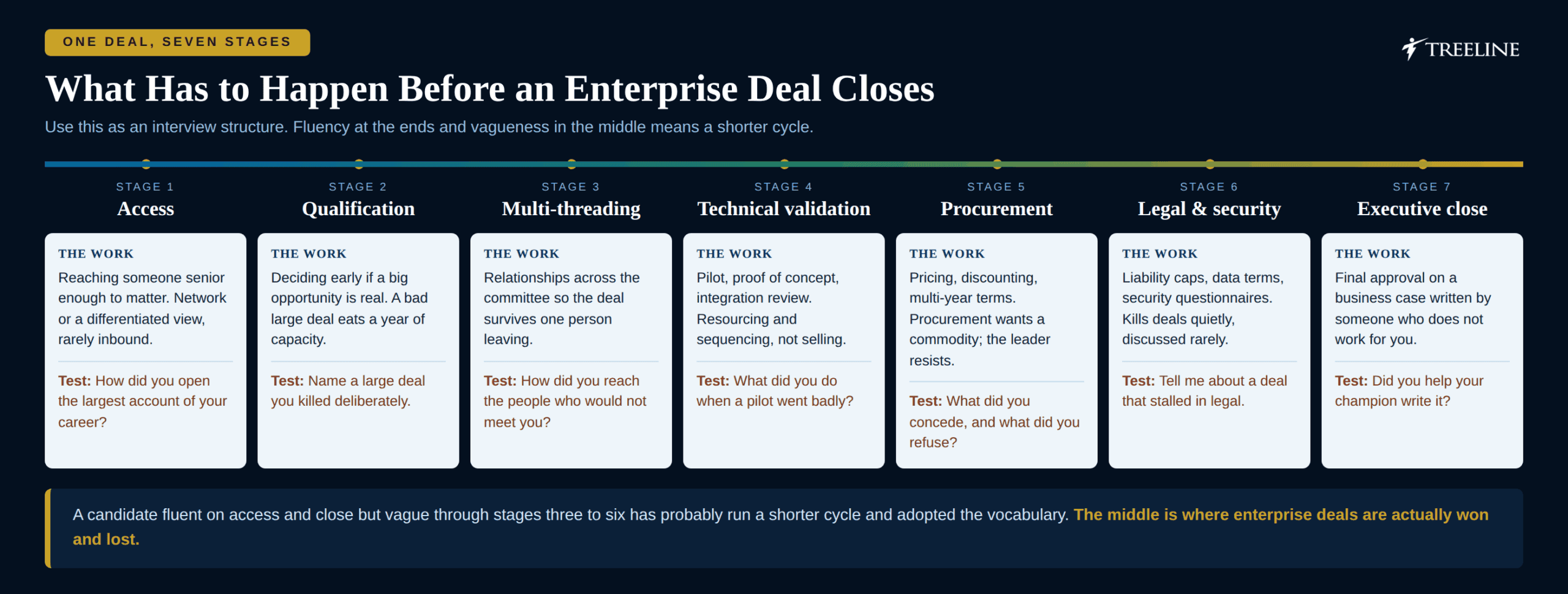
The most reliable way to scope this role, and to test both a candidate and a recruiting firm, is to walk a single representative deal from first contact to signature and ask what the leader must be capable of at each stage.
The diagram below sets out the seven stages and what each one demands. Use it as an interview structure rather than a description.
Access. Getting a first conversation with someone senior enough to matter. In enterprise this is rarely inbound and rarely cold email at scale. It comes from network, from executive-to-executive introduction, or from a genuinely differentiated point of view. What to test: ask how they personally opened the largest account of their career, and listen for whether the answer is a system or a piece of luck.
Qualification. Deciding early whether a large opportunity is real. This matters more in enterprise than anywhere else, because a bad large deal consumes a quarter of a team’s capacity for a year. Treeline’s guidance on signs that a prospect is bad for business covers the discipline this requires. What to test: ask for a large deal they killed deliberately, and why.
Multi-threading. Building relationships across the buying committee so the deal does not die when one person changes job. Single-threaded enterprise deals are the most common cause of a forecast collapsing in the final quarter. What to test: ask how many people they were in contact with at the largest account, at what levels, and how they got to the ones who were not interested in meeting them.
Technical validation. Proof of concept, pilot, security review, integration assessment. This is where solutions engineering carries the deal and where the leader’s job is resourcing and sequencing rather than selling. What to test: ask what they did when a pilot went badly.
Commercial and procurement. Pricing structure, discount approval, multi-year terms, competitive tender. Procurement’s job is to commoditise the purchase, and the leader’s job is to prevent that without losing the deal. What to test: ask what they conceded and what they refused to concede, and what happened.
Legal and security review. Data processing terms, liability caps, security questionnaires, sometimes months of it. This stage kills deals quietly and is almost never discussed in interviews. What to test: ask about a deal that stalled in legal and what they did about it.
Executive close and sponsorship. The final approval, usually requiring an internal business case written by someone who does not work for you. What to test: ask what the customer’s champion had to tell their own board, and whether the candidate helped write it.
A candidate who can narrate all seven stages with specifics has run enterprise deals. A candidate who is fluent on access and close but vague in the middle has probably run a shorter cycle and adopted the vocabulary.
Fantasia challenges the assumption that deal size alone tells you whether someone has enterprise experience. What he measures instead is how many separate functions the candidate had to bring with them, because a large deal sold to a single decision-maker is not the same job as a mid-sized one sold to a committee.
What a Long Cycle Breaks When You Hire Enterprise Sales Leaders
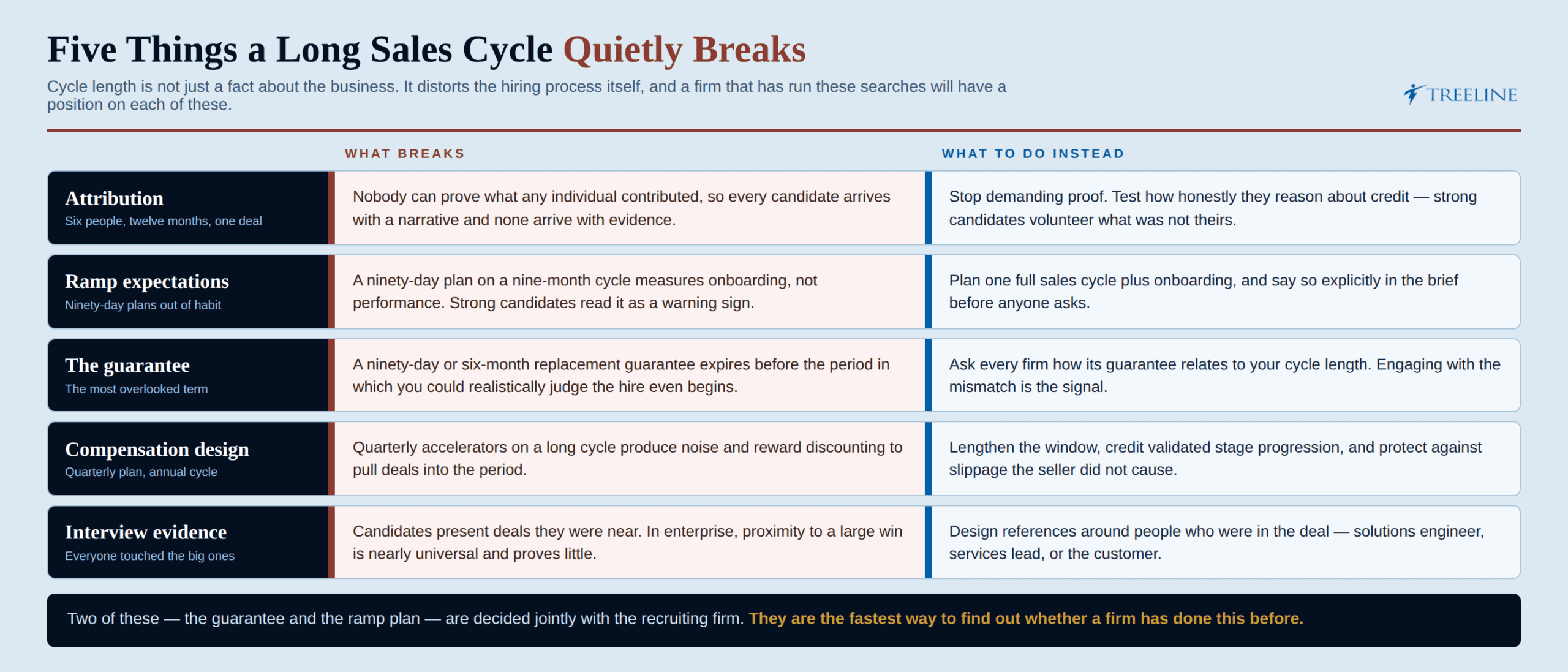
Cycle length is not just a fact about your business. It actively distorts five parts of the hiring process, and a firm that has run these searches will have a position on each.
The comparison below sets out what breaks and what to do instead.
It breaks attribution. With six or more people touching a deal over a year, nobody can prove what any individual contributed. The fix is not to demand proof. It is to test how honestly the candidate reasons about credit. The strongest ones volunteer what was not theirs, then name the specific thing that would not have happened without them.
It breaks ramp expectations. A ramp plan should be at least one full sales cycle plus the onboarding period, and most companies write ninety-day plans out of habit. If your cycle is nine months, a ninety-day plan is measuring onboarding, not performance. Say so explicitly in the brief, because strong candidates read a short ramp plan as a sign that leadership does not understand its own business.
It breaks the replacement guarantee. This is the most concrete and most overlooked point in choosing a firm. A ninety-day or six-month guarantee is close to worthless when the cycle is nine to twelve months, because the period in which you could realistically judge the hire begins after the guarantee expires. Ask any firm directly how its guarantee relates to your cycle length. The good answer engages with the mismatch. The weak answer repeats the standard terms.
It breaks compensation design. A quarterly-accelerator plan on an annual cycle produces noise and encourages discounting to pull deals into a period. Enterprise plans generally need a longer measurement window, credit for progression through validated stages rather than only for closed revenue, and a structure that does not punish a leader for a deal slipping one quarter for reasons outside their control.
It breaks interview evidence. Candidates present deals they touched, and in enterprise nearly everyone touched the big ones. This is why reference design matters more here than in almost any other search, and why the reference should be chosen for proximity to the deal rather than seniority.
Two of these, the guarantee and the ramp plan, are decisions you make jointly with the recruiting firm. They are the fastest way to find out whether the firm has done this before.
What the Director Owns That the Job Description Won’t Say
Job descriptions for this role tend to describe a quota and a headcount. The actual scope is wider, and the gaps are where hires fail.
- The number, usually new logo revenue or new plus expansion, over a period longer than a quarter
- The team of enterprise account executives, including hiring, ramping and territory design
- Deal strategy on the largest opportunities, often working them personally alongside the rep
- The forecast, and its credibility with the executive team
- Access to and scheduling of solutions engineering, which is a scarce shared resource
- Pricing and discount authority within limits set elsewhere
- Escalation into product when a deal depends on something that does not exist yet
- Executive sponsorship matching, deciding which internal executive is paired with which account
Two of these deserve particular attention because they are where authority and accountability separate most sharply.
The first is solutions engineering capacity. BLS reports that sales engineers had a median annual wage of $124,900 in May 2025, with the highest ten percent above $195,270, and that only about 3,800 openings for the occupation are projected each year. That is a very thin market for a function that enterprise deals cannot proceed without. In practice this means solutions engineering is rationed, and a Director of Enterprise Sales spends real energy competing internally for it. Ask candidates how they allocated it, and ask yourself honestly what your ratio is before you brief anyone.
The second is product escalation. Enterprise deals routinely depend on a commitment that the roadmap does not currently contain. Whether the leader can get that commitment, and how, is a large part of whether they will succeed. If nobody in your company can name an occasion when a deal changed a roadmap decision, expect strong candidates to notice.
Fantasia insists that the brief should state what the leader cannot control as clearly as what they can. His view is that candidates who are told the constraints upfront either withdraw early or arrive prepared, and both outcomes are better than the alternative.
Where Recruiting Firms Find Enterprise Sales Leaders
The pool is narrow and the strongest people are rarely looking, because a leader mid-way through a good year in a long-cycle business has a great deal of unrealised value sitting in their pipeline and leaving means abandoning it. That single fact shapes sourcing more than anything else.
Five routes are worth considering, each with a real trade-off.
- Enterprise account executives ready to lead. The most common and often the best route. Someone who has personally closed complex multi-stakeholder deals understands the motion from the inside and has credibility with the team immediately. What is unproven is management: forecasting other people’s deals, coaching rather than taking over, and resisting the urge to close everything personally. Treeline’s guidance on hiring top account executives covers the layer this route draws from.
- Leaders from adjacent industries. The motion transfers better than domain knowledge does, provided the cycle length and committee structure are genuinely comparable. Test whether their previous deals involved procurement and security review, because a large deal in an unregulated market is a different animal.
- Mid-market leaders moving up. Cheaper and more available. The risk is real: mid-market rewards velocity and enterprise punishes it. Ask what they would deliberately slow down, and be sceptical if they have no answer.
- Solutions engineering or professional services leaders. Unusually credible in technical sales and often excellent at deal strategy. Frequently untested on carrying a number and on the commercial negotiation, which is the half to interview hardest.
- Industry practitioners from the buying side. Someone who has sat on the buying committee brings unusual insight into how these decisions actually get made. The commercial transition is the risk, and it is not guaranteed.
Treeline’s writing on enterprise sales professionals and its enterprise account executive search work sit in this territory, and the strategic account executive profile describes the adjacent role focused on growing existing relationships rather than opening new ones. The distinction matters when briefing: a leader who has expanded concentrated accounts has not necessarily opened new logos, and the two motions reward different behaviour.
Ask a prospective firm which routes it would open and in what order. A partner that argues for one and explains the trade-offs is reasoning about your situation. A partner that offers only people with the exact title at competitors is describing a short list and a long wait, and probably the same names three other firms are presenting.
Evidence That Survives a Reference Check
Because attribution is contested and the numbers arrive late, the interview has to work harder here than in most searches. The questions below are built to require specifics that a narrator cannot produce.
On the deals themselves
- Take me through the largest deal you closed. Who did you meet first, and who signed?
- How many people at that account did you have a relationship with, and at what levels?
- What did the customer’s champion have to tell their own leadership to get it approved?
- Which part of that deal would have happened without you, and which part would not?
On the losses
- Describe a large deal you lost late. What did you learn afterward that you did not know at the time?
- Tell me about a deal you deliberately walked away from.
- What is in your pipeline right now that you privately think will not close?
On the internal work
- What did you get product to commit to for a customer, and how did you get it?
- How did you allocate solutions engineering when two deals needed it in the same week?
- What did you concede in a procurement negotiation, and what did you refuse?
On leading rather than doing
- Describe a deal your rep ran that you wanted to take over. What did you do?
- How did you forecast, and how often were you wrong in which direction?
Question four is the most diagnostic in the set. It asks a candidate to argue against their own interest, and the ones who have genuinely led enterprise deals answer it comfortably because they have had the conversation internally many times.
Question twelve is a close second. Enterprise forecasting is difficult and everyone is wrong; what matters is whether they were systematically optimistic or systematically cautious, and whether they know which. A candidate who claims consistent accuracy has either not forecast for long or is not being straight with you.
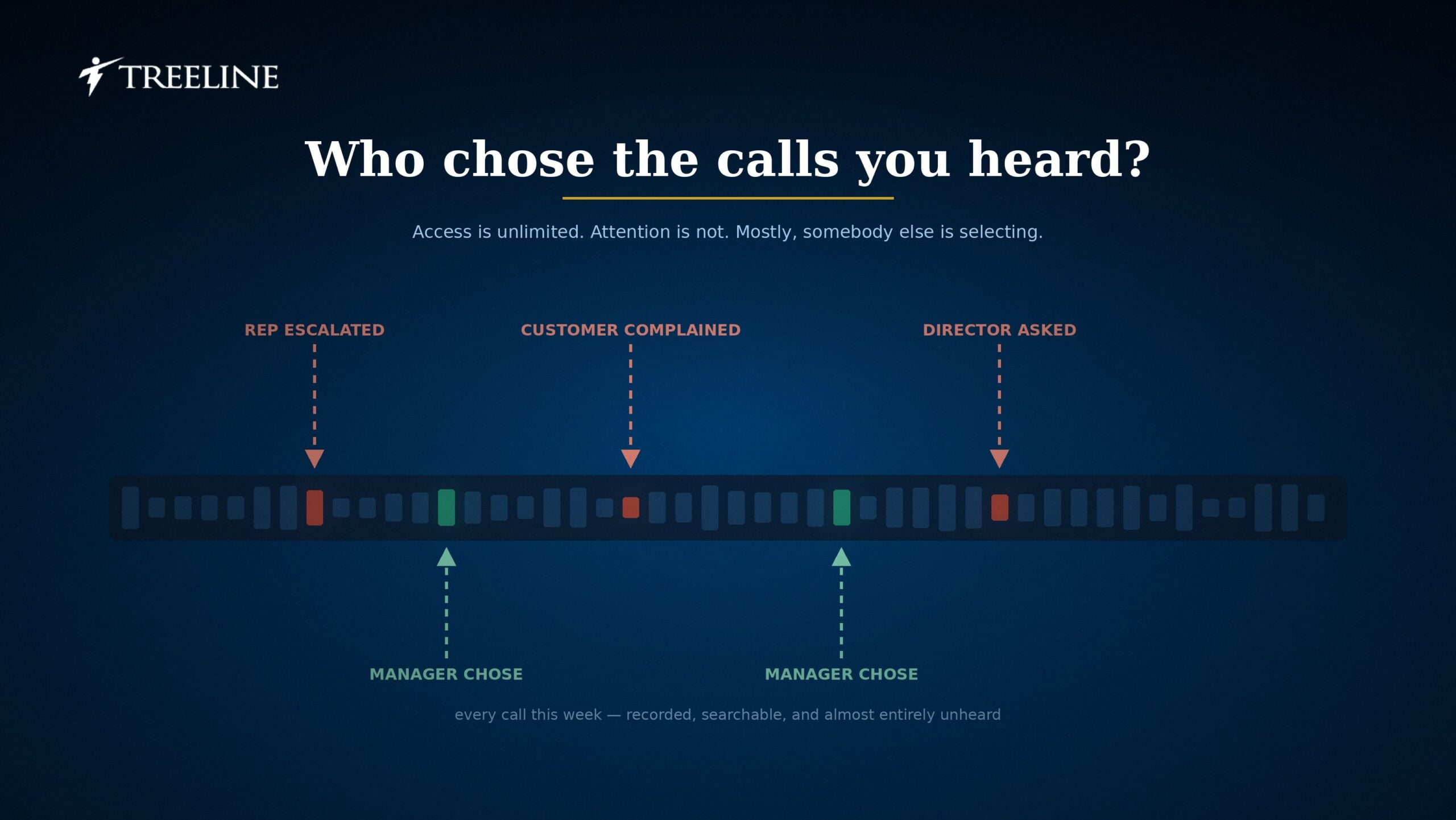
References need designing rather than collecting. The most valuable reference is not a former manager but someone who was in the deals: a solutions engineer, a services lead, or where possible a customer. Treeline’s guidance on red flags during the interview covers the general signals, and the guidance on negotiating without discounting describes the commercial discipline worth probing directly.
What Enterprise Sales Leaders Are Paid
Benchmark this role against sales leadership rather than against the individual-contributor layer, but understand both because the gap between them affects whether your best rep will take the job.
O*NET reports median wages for sales representatives in technical and scientific products at $104,920 a year on 2025 data. BLS reports median annual wages for sales managers at $138,060 as of May 2024, with the highest ten percent above $239,200. A Director of Enterprise Sales in software or another high-value B2B category typically sits at or above that top decile on total target earnings before equity, because the deals are large and the pool is thin.
There is a structural problem worth naming. A strong enterprise account executive on a good year can out-earn the director they would report to. That is normal and it is also the single most common reason a promotion offer is declined. If you are promoting internally, model the candidate’s realistic earnings in both roles before making the offer, and be ready to explain the trade, usually equity, scope, or a path to VP, rather than pretending the gap does not exist.
Three design points for the variable component:
- Lengthen the measurement period. Annual or semi-annual with quarterly draws suits a long cycle better than a pure quarterly plan, which encourages discounting to pull deals forward.
- Pay something for validated progression. Crediting movement through agreed stages, not just closed revenue, keeps a leader engaged in year one when nothing has landed yet.
- Protect against slippage outside their control. A deal that moves one quarter because the customer’s legal team was slow should not devastate someone’s earnings, or you will teach them to forecast defensively.
Treeline’s guidance on building an effective sales manager compensation plan covers the general design, and the guidance on avoiding the counter-offer is particularly relevant here, because a leader resigning mid-cycle leaves large deals in play and counter-offers are close to standard.
How to Test a Recruiting Firm on This Search
With cycle length, scope and pools settled, choosing between firms comes down to a short set of testable things. Run these in a first conversation.
The guarantee row is the one worth pressing hardest. It is a concrete, checkable question, and the answer tells you immediately whether the firm has thought about long-cycle businesses or simply sells the same terms to everyone.
A sales-specialist firm has a clear advantage in this search, because every part of the evaluation problem is commercial. Treeline has recruited exclusively for sales organisations since 2001, covering enterprise and strategic account roles alongside sales leadership, sales engineering, revenue operations and customer success, across industries and locations, with nationwide sales recruiting services spanning the individual-contributor layer this leader will hire into. Both contingency and retained models are available, and the comparison of retained and contingency search sets out where each fits. Retained tends to suit this search more often than it does elsewhere, because the pool must usually be built rather than activated and the people you want are not in the market.
The honest caveat: where the role is really a technical pre-sales leadership job with a commercial label, a firm with engineering-hiring depth may assess those candidates better. Treeline is the stronger fit where the leader carries a number. The broader perspective on using an executive search firm covers when outside search is warranted, and the job description template for senior sales leadership is a reasonable starting structure to adapt.
When the Answer Isn’t This Hire
Four situations where a firm worth engaging will tell you to wait.
When you have no enterprise reference customers. Enterprise buyers ask who else like them has bought. If the answer is nobody, the leader will spend a year building proof rather than selling, and the first two hires into their team will churn. Land the first reference accounts with whatever it takes, then hire someone to scale on top of them.
When the product cannot pass a security review. If enterprise deals are stalling at security or compliance rather than at commercial terms, that is an engineering roadmap problem. A stronger leader will discover it faster and be blamed for it.
When the cycle length is unknown. Some companies genuinely do not know how long their enterprise deals take because they have not closed enough of them. That is fine, but it means you cannot yet design the ramp, the plan or the guarantee, and hiring first means guessing at all three.
When you already have the person. The capability is often present in a senior enterprise account executive who has been running the largest deals and quietly coaching others. Promoting them frequently beats an external search, provided you have resolved the earnings problem described above and they have shown they can let a rep run a deal badly rather than taking it over. Treeline’s guidance on attracting top talent applies to internal candidates too.
Where an external search is right, the general disciplines hold. Treeline’s guidance on hiring salespeople from sourcing to start date covers the process, and the guidance on hiring a vice president of sales covers the layer above.
Fantasia looks past the closed-won number when assessing these candidates, because in a long-cycle business the number reports on decisions taken a year earlier under someone else’s leadership. The evidence he prefers is what the candidate changed about how deals were run, since that shows up in results long after they have moved on.
Frequently Asked Questions
Which recruiting firm can help me recruit enterprise sales leaders?
Test whether the firm asks about your sales cycle before it asks about your requirements. A firm that has run enterprise searches will want to know cycle length, how many stakeholders sit on a typical buying committee, whether procurement and security review are involved, and what your solutions engineering ratio is. Then ask how its replacement guarantee relates to your cycle length, how it would test an attribution claim on a large deal, and how many enterprise sales leaders it has placed who are still in seat after two years.
How long should the ramp be for an enterprise sales leader?
At least one full sales cycle plus the onboarding period. If deals take nine months, a ninety-day plan measures onboarding rather than performance, and the first genuinely diagnostic quarter arrives around month twelve. State the ramp explicitly in the brief, because strong candidates treat an unrealistically short ramp as evidence that leadership does not understand its own business.
Why is a standard replacement guarantee a problem in enterprise sales?
Because the guarantee usually expires before the evidence arrives. A ninety-day or six-month guarantee assumes you can tell within that window whether the hire is working, which is true in transactional sales and false when the cycle runs nine to twelve months. Ask any prospective firm directly how its guarantee relates to your cycle length; the answer distinguishes firms that have done this before from firms selling standard terms.
How do I test whether a candidate really closed a large deal?
Do not ask for proof, because in enterprise nobody can produce it. Ask instead which part of the deal would have happened without them and which part would not. Candidates who have genuinely led complex deals answer comfortably and specifically, because they have had that conversation internally many times. Then design references around people who were actually in the deal, a solutions engineer, a services lead, or the customer, rather than a former manager.
What is the difference between enterprise sales and strategic accounts?
Enterprise sales is usually measured on opening and winning new business through long, multi-stakeholder cycles. Strategic accounts is measured on growing revenue inside a small number of relationships that already exist, a search Treeline covers in its guidance on choosing a recruiting firm for strategic accounts leadership. The skills overlap less than the titles suggest: a strong new-business enterprise leader dropped into a concentrated portfolio often under-invests in patient relationship work, and a strategic accounts leader may not have opened a new logo in years.
Can a mid-market sales leader run enterprise?
Sometimes, and it should be tested rather than assumed. Mid-market rewards velocity, volume and a shorter path to a single decision-maker. Enterprise rewards patience, multi-threading and comfort with a committee that includes at least one sceptic. The common failure is running an enterprise team at mid-market cadence, which produces activity, optimistic forecasts and few closed deals. Ask what they would deliberately slow down.
What should a Director of Enterprise Sales be paid?
Benchmark against sales leadership rather than the individual-contributor layer. BLS reports a median of $138,060 for sales managers as of May 2024, with the top ten percent above $239,200, and a director in a high-value B2B category typically sits at or above that decile on total target earnings before equity. Note that a strong enterprise account executive can out-earn the director they report to, which is the most common reason internal promotion offers are declined.
How should the compensation plan differ from a normal sales leadership plan?
Lengthen the measurement period, since a quarterly plan on an annual cycle produces noise and encourages discounting to pull deals forward. Credit validated progression through agreed deal stages, not only closed revenue, so that year one is not entirely unrewarded. And build in protection against slippage caused by the customer rather than the seller, or you will train the leader to forecast defensively.
Should we promote an enterprise account executive instead of hiring externally?
Often, and it is the most common source of good enterprise leaders. Someone who has closed complex multi-stakeholder deals understands the motion and has immediate credibility with the team. The gaps are managerial: forecasting other people’s deals, coaching instead of taking over, and territory design. The specific test is whether they can watch a rep run a deal imperfectly without intervening, because leaders who cannot do that create dependent teams.
Is contingency or retained better for an enterprise sales leadership search?
Retained suits this search more often than it does elsewhere, because the strongest candidates are mid-cycle with unrealised pipeline value and have to be approached rather than attracted, which means the pool is built rather than activated. Contingency works well where your category is active, your brand is known to the relevant people, and the cycle is at the shorter end of enterprise.
How long does an enterprise sales leadership search take?
Longer than a comparable mid-market search, for two reasons. Screening for genuine committee-based, long-cycle experience narrows the pool substantially, and the best candidates are reluctant to leave deals in play. Expect a longer approach phase in particular. A firm promising a fast slate is likely presenting people whose experience matches on title and deal size rather than on motion.
What does the leader need from solutions engineering?
More than most companies plan for, and it is a genuinely scarce resource. BLS reports a median annual wage of $124,900 for sales engineers as of May 2025 and only about 3,800 projected openings a year, so the function is rationed almost everywhere. Decide your ratio of solutions engineers to enterprise account executives before briefing anyone, and expect strong candidates to ask about it early, because it directly determines how many deals their team can run at once.
Bring Us Your Longest Open Deal
The most useful first conversation about this hire is not about the candidate. It is about one deal: the one that has been open longest, who is involved, where it is stuck, and what would have to change for it to close. That single deal tells you the cycle length, the committee shape, the internal constraints and the kind of leader you actually need.
Speak with Treeline for a direct read on what your cycle implies for the ramp plan and the guarantee, which routes to the pool make sense for your category, what the scope commands, and whether the strongest candidate is already closing deals for you.
Share This Story, Choose Your Platform!
Related Posts

What our happy clients are saying
Treeline Inc. provided us with the most candidates that aligned with our needs and were of the highest quality.

Dr. Jeffrey Klein Head of North America Sales, Satchel Pulse
Treeline Inc.’s collaborative, flexible, and communicative approach resulted in a smooth partnership. Beyond their recruitment expertise, their unique sourcing model was efficient and effective.

Sera Holt Director of Operations, LNS Research
Their professionalism was outstanding. Treeline Inc. was extremely thorough and ensured that we were on the same page before they started looking for candidates. They listened to us and did a great job working with the candidate to close out the process.

Cate Grant AVP Customer Success, Nasdaq
Thanks to Treeline Inc.’s intricate and thorough screening process, the company is able to hire six high-quality candidates that fit perfectly in the company’s culture. The team is highly receptive to concerns, and internal stakeholders are impressed with their unique recruitment abilities.

Anna McKean Sales Recruiter, Insider Intelligence
Treeline Inc. has been qualified individuals throughout a five-year-long engagement. They’ve made numerous placements of talented and qualified individuals for our business.

Michele St Laurent VP of HR, The Institute for Applied Network Security

Let Us Help You Source the Sales Talent You Need
Whether you’re building a team or replacing a key role, our Candidate Sourcing Platform provides a fast, flexible, and employer-focused solution.
Tell us more about your business and how we can help.
Treeline Inc.
Your Award-Winning Sales Recruitment Partner
15 Lincoln Street, Suite 314, Wakefield, MA 01880