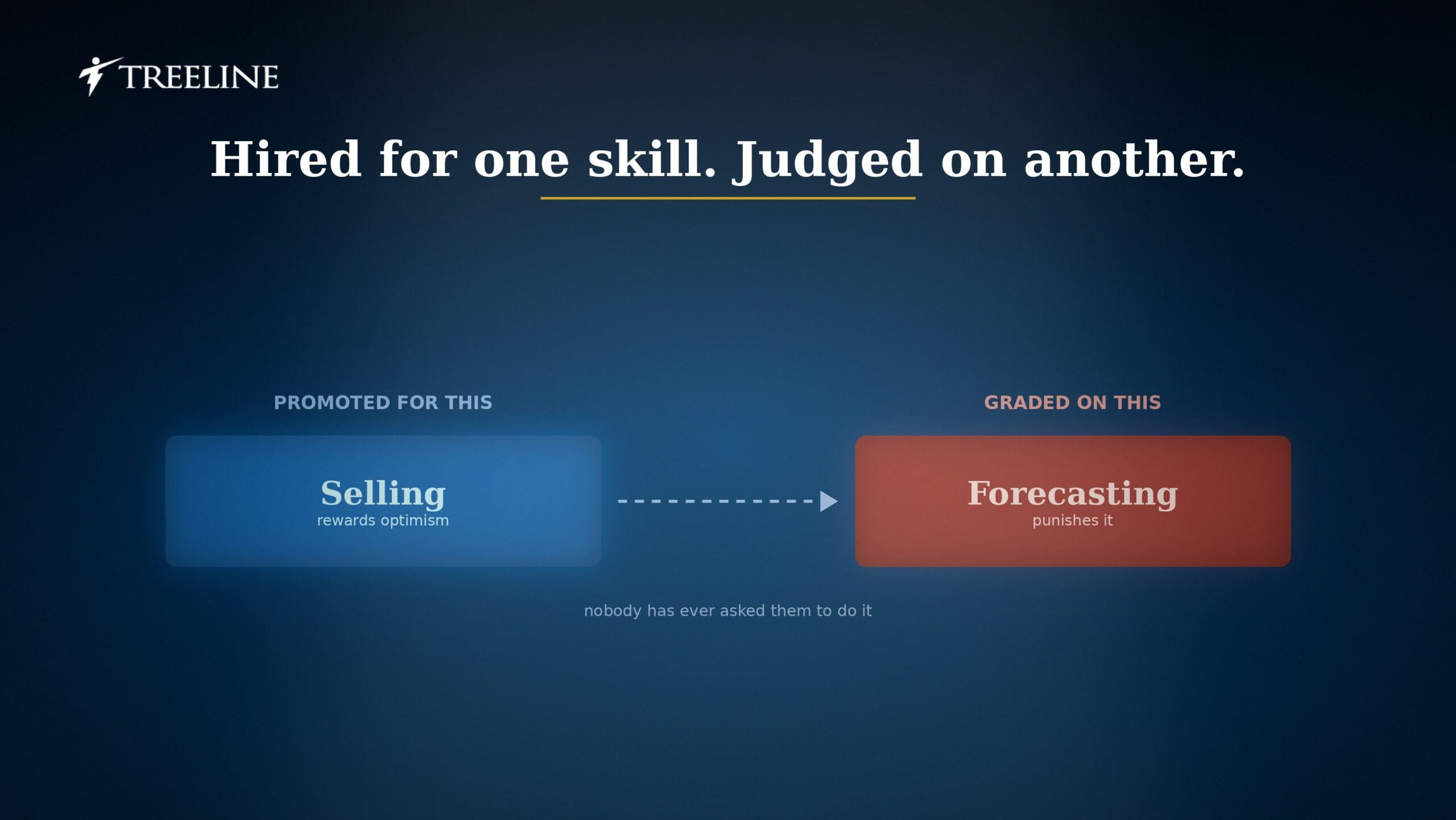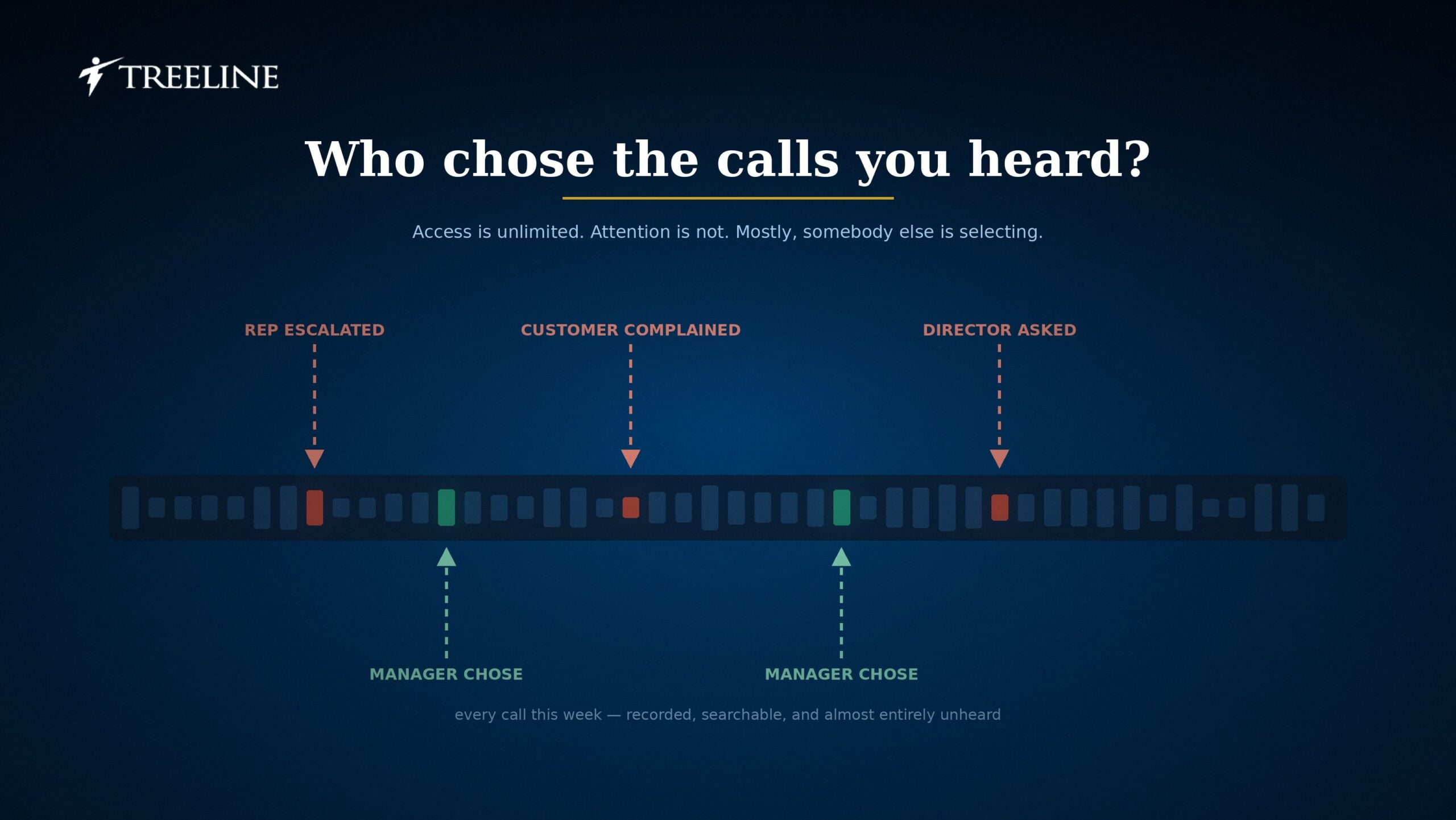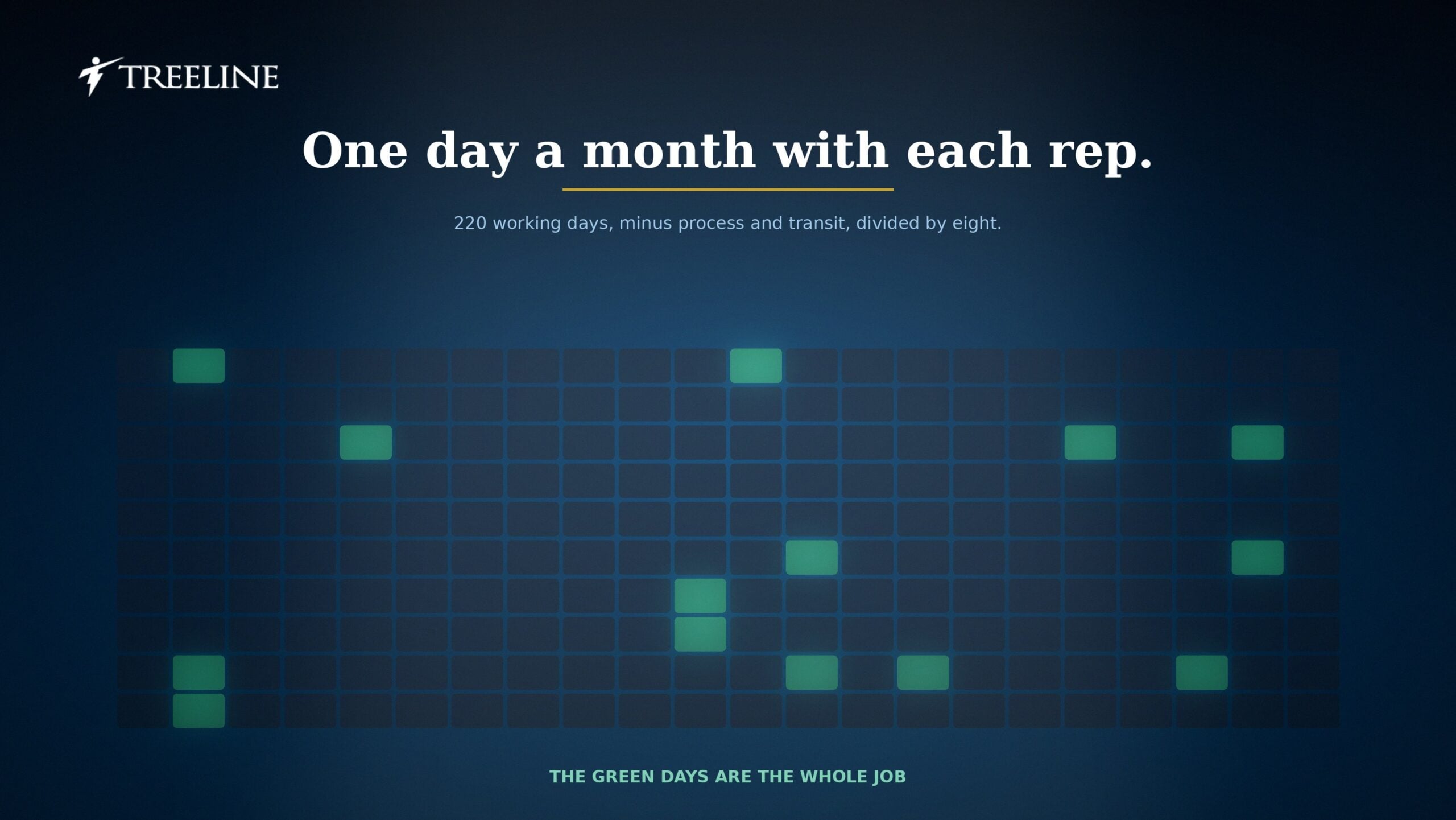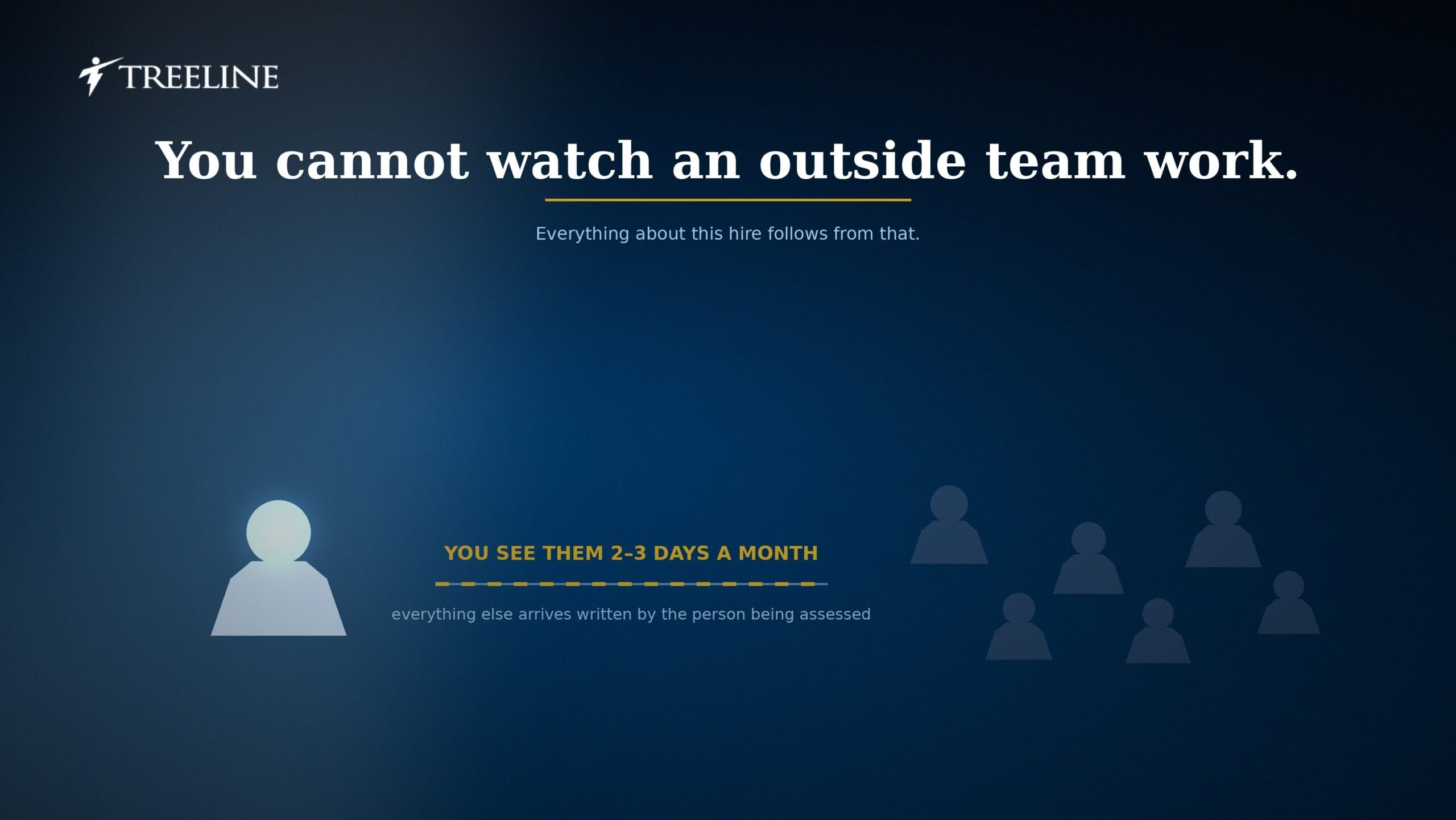
An inside sales manager can listen to any call happening right now. They can walk the floor, hear a rep handle an objection badly, and correct it before the next dial. A Director of Outside Sales sees each member of their team perhaps two or three days a month, in a car or across a customer’s parking lot, and everything else they know arrives second-hand through a CRM entry written by the person being evaluated.
That is the whole problem, and almost nothing in a standard job description acknowledges it. The role is usually described as though it were an inside sales job with more travel. It is not. It is a management job in which direct observation, the primary tool every other sales manager relies on, is mostly unavailable, and the leaders who succeed are the ones who have built something to replace it.
So the practical answer to how to choose a recruiting firm for outside sales leadership is that you are testing for one specific literacy. A firm that has run these searches will ask how big the territory is, how many days a month the leader will spend travelling, what the ride-along cadence is, and what the company knows about its team that does not come from self-reported CRM data. A firm that asks how many years of sales management experience you want will send you inside sales managers with a driving licence.
Dan Fantasia, CEO of Treeline, Inc., views an outside sales leadership search as a question about coaching at distance rather than about sales ability. From his perspective, employers should ask candidates how they knew a rep was struggling before the number showed it, because in a field organisation that gap between knowing and reporting is where the job actually lives.
Why Outside Sales Leadership Is a Different Management Problem
The federal data describes the underlying work more honestly than most job postings do.
The U.S. Department of Labor’s O*NET profile for wholesale and manufacturing sales representatives, the occupation that covers most outside sales roles, and which lists Outside Sales Representative among its reported job titles, records that 61 percent of people in it are in an enclosed vehicle every day, and that 100 percent report constant contact with others. Its work activities include operating vehicles and mechanised equipment alongside selling and influencing. Its knowledge requirements include transportation: the principles and methods of moving people or goods, including the relative costs and benefits.
Read that last one again. Transportation appears in the federal knowledge profile for this occupation, alongside sales and marketing. Driving is not incidental to the job; it is part of the job’s structure, and it is part of the leader’s cost base.
The scale is substantial: O*NET reports around 1,310,500 people employed in the occupation as of 2024, with roughly 114,800 openings projected each year through 2034 and little or no overall employment change. That is a large, stable, replacement-driven market, which shapes hiring in a specific way. There is no shortage of people who have carried an outside bag. There is a real shortage of people who have led one well.
Four structural features separate this from inside sales leadership, and each changes the search.
- Observation is scarce and expensive. A ride-along costs a day, sometimes with a flight attached. An inside manager can sample twenty calls in an afternoon. This is the single largest difference and it drives everything else.
- The data is self-reported. CRM entries are written by the person whose performance they describe. That is true everywhere, but inside sales has call recordings, dispositions and connect rates as an independent check. Field organisations frequently have nothing equivalent.
- The unit of work is a territory, not a queue. Territories differ in drive time, account density, competitive presence and existing relationships. Two reps with identical effort can produce very different numbers for reasons neither of them controls.
- Turnover is slow-burning and expensive. Replacing a field rep means losing local relationships that took a year to build, and the customer notices. The cost is higher than the salary suggests.
There is a fifth feature that has grown more important and that most briefs still ignore. A meaningful share of customer meetings that once required a drive now happen on video, which means many field organisations are no longer purely field organisations. The consequence is not that travel disappears but that it becomes a choice, and someone has to decide which meetings justify the windshield time. That decision now sits with the director, and it is a genuinely new part of the job. Candidates who have thought about it will talk about which customer conversations they insist on having in person and why; candidates who have not will treat every visit as equally valuable, which is expensive and quietly erodes the coaching budget.
This is where specialisation matters. A firm whose track record is in inside or transactional sales will screen for coaching intensity and activity management, which are the right instincts for a different job.
What Outside Sales Leadership Cannot Observe, and What to Use Instead
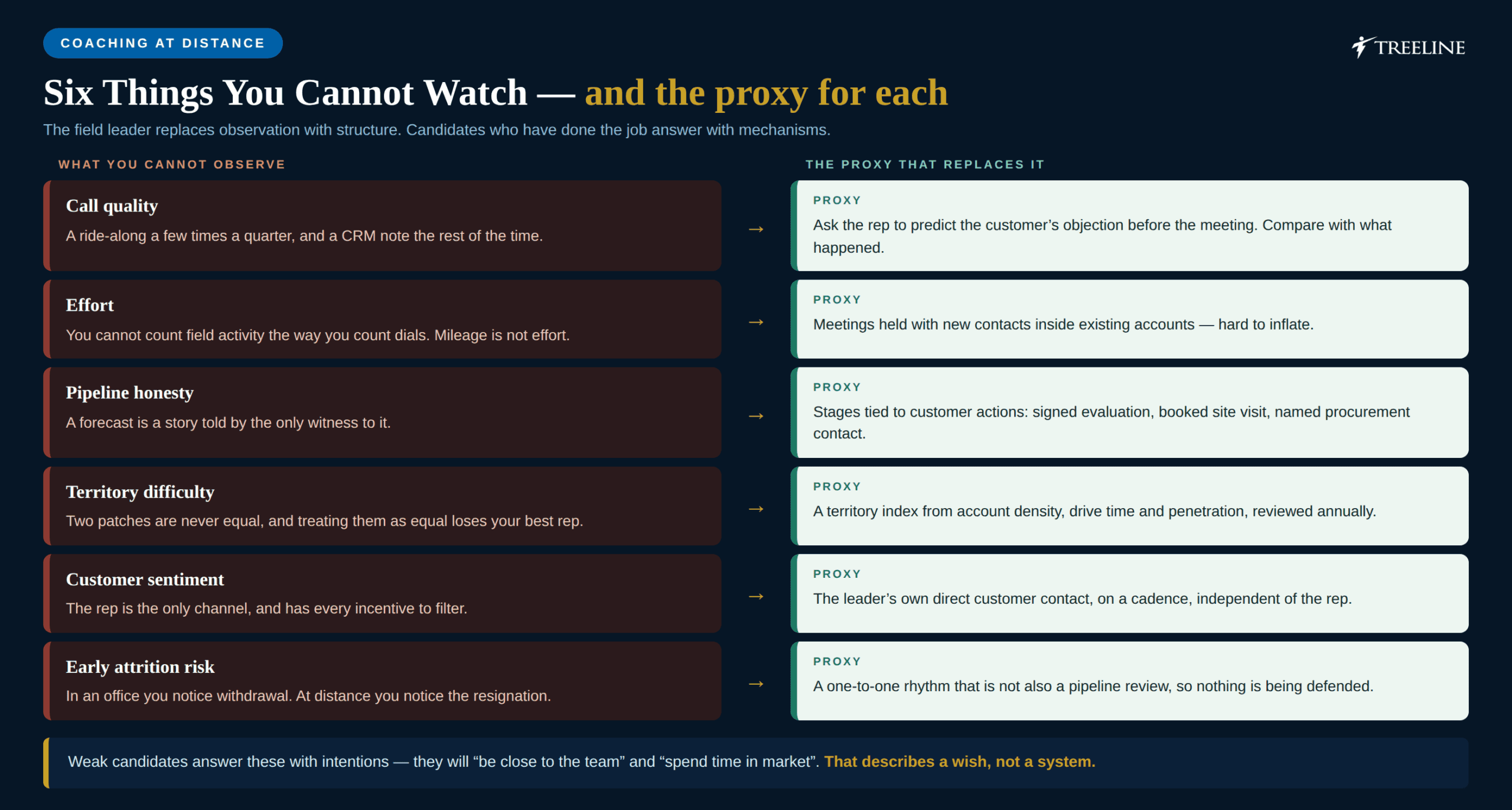
If direct observation is unavailable, the leader has to build proxies. The best candidates have done this deliberately and can describe the substitutes they used; weaker ones simply trusted the pipeline report.
The diagram below pairs six things a field leader cannot watch directly with the practical proxy for each. It doubles as an interview structure.
Call quality. Inside managers hear it. Field leaders get a ride-along a few times a quarter and a CRM note the rest of the time. The proxy: structured debriefs immediately after joint calls, plus asking the rep to predict the customer’s objection before the meeting and comparing that with what actually happened. Prediction accuracy is a better signal than the note.
Effort. You cannot count field activity the way you count dials, and mileage is not effort. The proxy: meetings held with new contacts inside existing accounts, which is hard to inflate and correlates with real work.
Pipeline honesty. A field rep’s forecast is a story told by the only witness. The proxy: stage definitions tied to customer actions rather than seller opinions, a signed evaluation agreement, a scheduled site visit, a procurement contact named, so the stage moves only when something verifiable happens.
Territory difficulty. Two territories are never equal, and the leader who treats them as equal will lose their best rep in the hardest one. The proxy: a territory index built from account density, drive time and existing penetration, reviewed annually rather than assumed.
Customer sentiment. The rep is the only channel, and the rep has an incentive to filter. The proxy: the leader’s own direct customer contact, on a defined cadence, independent of the rep.
Early attrition risk. In an office you notice someone withdrawing. At distance you notice when they resign. The proxy: a scheduled one-to-one rhythm that does not double as a pipeline review, so there is a conversation where nothing is being defended.
The pattern across all six is the same: the field leader replaces observation with structure. Candidates who have done the job well answer these questions with mechanisms. Candidates who have not answer with intentions, they will “be close to the team” and “spend time in market,” which describes a wish rather than a system.
Fantasia weighs mechanism over intention when assessing these candidates. The test he applies is to ask how they found out about a problem they could not see, because the answer either describes something they built or reveals that they were relying on the number to tell them.
The Territory Is the Real Job Description
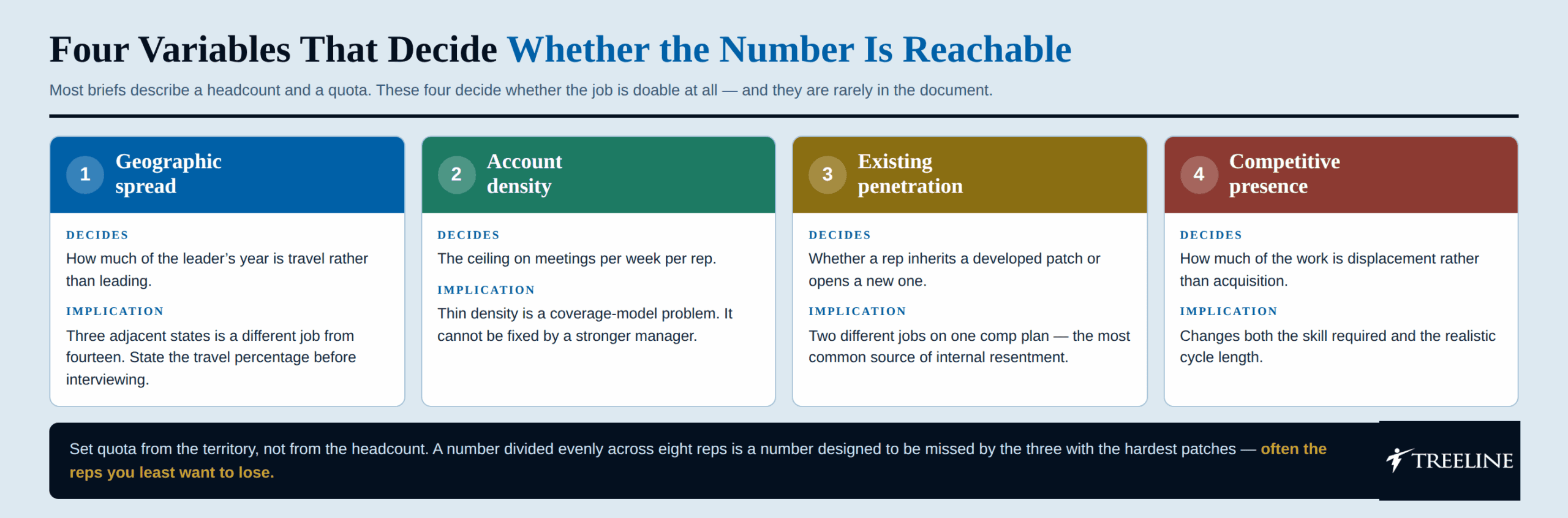
Most briefs for this role describe a headcount and a quota. The thing that actually determines whether the job is doable is the territory design, and it is rarely in the document.
The comparison below sets out the four variables that decide whether a field organisation can hit its number, and what each one implies for the hire.
Geographic spread determines how much of the leader’s year is spent travelling rather than leading. A director covering three adjacent states runs a different job from one covering fourteen. Get honest about the travel percentage before you interview, because candidates will ask and a vague answer reads as a bad sign.
Account density, how many viable accounts sit within a reasonable drive, sets the ceiling on meetings per week per rep. Thin density is not a coaching problem and cannot be fixed by a stronger leader. It is a coverage-model problem, and the honest response is a different model rather than a better manager.
Existing penetration varies enormously between territories and is the most common source of internal resentment. A rep inheriting a well-developed patch and a rep opening a new one are doing different jobs on the same comp plan.
Competitive presence decides how much of the work is displacement rather than acquisition, which changes both the skill required and the realistic cycle length.
Underneath all four sits a cost most companies never calculate: windshield time. A rep driving three hours a day is working a full day and selling for perhaps half of it, and the ratio differs enormously between a dense metro patch and a rural one. Two reps on identical plans can therefore have very different amounts of actual selling time available, which is neither of their doing. A leader who has calculated that ratio for their own team can tell you what a meeting costs in each territory. Most cannot, and the ones who can are usually the ones who have redesigned a patch and watched the number move afterwards.
Two practical consequences follow, and both belong in the brief.
The first is that quota should be set from the territory rather than from the headcount. A number divided evenly across reps because there are eight of them is a number designed to be missed by the three with the hardest patches, and those are often the reps you least want to lose.
The second is that territory redesign is a political act with a real cost. A new director who redraws boundaries in month two will be right on the analysis and will still lose people, because a territory is compensation in disguise. Ask candidates how they have handled a redesign, and listen for whether they mention the human cost at all.
Fantasia doubts any brief that specifies a quota before it specifies the territory. In his view the sequence matters: decide what the patch can produce, then decide what to ask of it, because reversing those two is the most common way a field organisation is set up to fail before anyone is hired.
Where Recruiting Firms Find Outside Sales Leadership Candidates
The pool is large and the screening problem is severe. Millions of people have carried a field bag; comparatively few have built a system for leading one at distance.
Five routes, each with a real trade-off.
- Top field reps ready to lead. The most common route and the most commonly regretted. A rep who has personally dominated a territory has credibility and product depth, but the skill that made them excellent, being the one in the room, is precisely the skill they must now stop exercising. The failure mode is a director who takes over their team’s meetings. Test whether they can describe a deal they let a rep run badly. Treeline’s guidance on the traits great salespeople share covers the individual layer this route draws from.
- Field sales managers stepping up. Already proven at first-line distance management. What is unproven is territory design, forecasting across a region, and budget ownership for travel and vehicles.
- Distribution or channel leaders. Strong on geographic coverage economics, partner relationships and territory maths, which is exactly what a spread-out organisation needs. Test whether they have carried a direct quota rather than a partner number.
- Inside sales leaders moving outward. Bring measurement discipline, cadence and data habits that field organisations often lack. The gap is the observation problem itself: they are used to seeing everything and must learn to lead without that. Treeline’s guidance on hiring an inside sales manager describes the discipline they come from, and the guidance on building an inside sales force covers the measurement habits worth importing.
- Directors from adjacent field organisations. The obvious pool. Screen on territory shape rather than title: someone who ran eight reps across two metros has not done the same job as someone who ran eight reps across nine states.
Ask a prospective firm which routes it would open for your specific geography. A partner that connects your territory shape to a pool is reasoning about your situation. One that offers only current Directors of Outside Sales at similar-sized companies is running a title match, and in a market this large a title match produces volume rather than fit.
Treeline recruits across industries and locations, which matters more here than in most searches because field hiring is inherently local, the right candidate for a Texas territory is usually already in Texas. The broader sales recruiting services span the rep layer this leader will be hiring into continuously, and Treeline’s guidance on speeding up hiring for quota-carrying roles covers the pace field organisations need to sustain.
Questions That Test Coaching at Distance
Field sales interviews reward storytellers. The candidate has spent a career persuading people in rooms, and an interview is a room. These questions require mechanisms rather than narrative.
On the observation problem
- How did you find out a rep was struggling before the number showed it?
- What did your ride-along cadence actually look like, and what did you do differently on a ride-along than on a normal day?
- What did you know about your team that did not come from the CRM, and how did you know it?
On territory
- Describe your territory design. Who built it, and what did you change?
- Which of your territories was hardest, and how did the plan account for that?
- Tell me about a redesign. Who left afterwards?
On the number
- How accurate was your forecast, and were you systematically optimistic or cautious?
- What stage definitions did you use, and what customer action moved a deal forward?
- Describe a quarter you missed. What did you know in week three that you did not act on?
On the team
- Who did you hire in a location you did not live in, and how did you assess them?
- How long did a new field rep take to reach full productivity, and what shortened it?
- Who did you exit, and how long did it take you to see the problem?
Question eight is the quiet one that separates operators from narrators. Stage definitions are the field leader’s only real defence against an optimistic forecast, because a stage tied to a customer action cannot be moved by enthusiasm. Candidates who have run a disciplined field organisation can state their definitions from memory and will usually volunteer which one they tightened and what happened to the forecast afterwards. Candidates who describe stages in terms of seller confidence, a deal is at sixty percent because it feels strong, have been managing a spreadsheet rather than a pipeline, and in an organisation where nobody can independently check the entry, that difference compounds every quarter.
Question one is the single most diagnostic in the set. Every field leader eventually has a rep whose number falls apart. The ones worth hiring can describe an early signal they built into their operating rhythm; the ones who cannot will say they “saw it in the pipeline,” which means they saw it when everyone else did.
Question twelve matters for the same reason inverted. At distance, performance problems take longer to surface, and honest leaders know their detection was slower than they wanted. A candidate who claims they always spot it early has either had a very short tenure or is describing the job they wish they had.
References should include a former direct report where possible. For a role whose entire craft is managing people you cannot see, the view from the other end of that distance is the most useful evidence available. Treeline’s guidance on red flags during the interview covers the general signals worth watching alongside these.
What Outside Sales Leadership Pays
Two federal reference points frame the range, and the gap between them is the useful part.
O*NET reports median wages for wholesale and manufacturing sales representatives at $72,080 a year on 2025 data. For the supervisory layer, the O*NET profile for first-line supervisors of non-retail sales workers reports a median of $87,520 on the same vintage. The Bureau of Labor Statistics reports median annual wages for sales managers at $138,060 as of May 2024, with the highest ten percent above $239,200.
A Director of Outside Sales running a multi-state region with managers reporting in sits toward the upper figure. A first-line field manager with six direct reports sits closer to the middle one. Three factors move the band more than the title does: the size and number of territories, whether the role manages managers or individual contributors, and average deal size.
There is a cost most briefs forget, and candidates will raise it. A field organisation carries travel, vehicle allowance or mileage, and local entertainment, real money that sits in the leader’s budget and constrains what they can do. Whether the director owns that budget or merely spends someone else’s changes the job. Say which in the brief.
There is also a levelling question that wastes interview time when it is left unresolved. Director of Outside Sales can mean a first-line manager with six reps in one region, a manager of managers across several regions, or the person who owns the entire field organisation and reports to a CRO. All three exist under the same title and they draw from different pools at different prices. Decide which you mean before briefing anyone, and say so in the posting.
On plan design, three points specific to field organisations:
- Weight the plan toward territory performance rather than absolute number. Otherwise the rep with the best patch always wins and the rep doing the hardest work always loses.
- Recognise displacement separately from acquisition where competitive presence is high, since taking business from an incumbent is slower and harder than winning open ground.
- Do not let travel cost sit only in the leader’s budget while revenue sits only in the rep’s plan. That asymmetry quietly discourages the coaching visits the job depends on.
Treeline’s guidance on building an effective sales manager compensation plan covers the design principles, the guidance on retaining top salespeople is directly relevant given how expensive field turnover is, and the guidance on avoiding the counter-offer matters because a departing field leader can take local relationships with them.
How to Test a Recruiting Firm for an Outside Sales Leadership Search
With territory, scope and pool settled, firm selection reduces to a short set of testable things.
The third row deserves weight. Field hiring is geographically constrained in a way inside hiring is not, and a firm that treats a national candidate database as sufficient will present people who would have to relocate into a territory where they know nobody. That is a slower ramp and a higher risk than the résumé suggests.
A sales-focused specialist has an advantage because the screening problem is one of discrimination rather than reach. Treeline has recruited exclusively for sales organisations since 2001, covering field and outside sales leadership alongside inside sales, enterprise and strategic accounts, sales engineering, revenue operations and customer success. Both contingency and retained models are available, and the comparison of retained and contingency search sets out where each fits. Contingency suits most field leadership searches, since the pool is large and active; retained makes sense where the territory is remote, where an incumbent is being replaced quietly, or where the role spans an unusually wide geography.
The honest caveat: if the role is really a distribution or channel management job with a sales label, a firm with channel depth may assess those candidates better. Treeline is the stronger fit where the leader runs a direct-selling team against a quota. The broader perspective on using an executive search firm covers when outside search is warranted, and the senior sales leadership job description template is a reasonable structure to adapt.
When the Answer Isn’t This Hire
Four situations where a firm worth engaging will tell you to wait.
When the territories have not been redrawn. If everyone knows the current map is wrong, hiring a director to fix it in month two means their first significant act is the one most likely to cost you people. Redraw first, then hire someone to run it.
When the real problem is account density. If reps cannot reach enough viable accounts in a day, no amount of coaching changes the arithmetic. That is a coverage-model question, possibly an inside or hybrid model, rather than a leadership hire. Treeline’s guidance on B2B inside sales covers the alternative.
When you cannot state the travel expectation. Candidates will ask in the first conversation. If the honest answer is unknown, you will either lose good people or hire someone who leaves when they discover it.
When you already have the person. A field manager who has quietly been running the hardest region is frequently the right answer. The test is whether they can stop selling personally, whether they have shown they can let a rep run a meeting imperfectly rather than taking it over. Treeline’s guidance on attracting top talent applies to internal candidates too.
Where an external search is right, the general disciplines hold. Treeline’s guidance on hiring salespeople from sourcing to start date covers the process, and the guidance on hiring a vice president of sales covers the layer above.
Fantasia anchors the whole conversation to a single artefact: a week of the candidate’s actual calendar from their last job. What that week contained, travel, ride-alongs, customer meetings, internal reporting, tells an employer more about how someone leads a field team than any competency discussion will.
Frequently Asked Questions
How do I choose a recruiting firm for outside sales leadership?
Test whether the firm understands the observation problem. A firm that has run field searches will ask about geographic spread, account density, existing penetration and the real travel percentage before discussing candidates, and will want to know how you learn anything about your team that does not come from self-reported CRM data. Then check whether they can source locally in your markets rather than sweeping a national database, and how many field sales leaders they have placed who are still in seat after two years.
What makes outside sales leadership different from inside sales leadership?
Direct observation. An inside manager can listen to any call happening now and correct it before the next one. An outside director sees each rep a few days a month and receives everything else through records written by the person being assessed. Every other difference, territory design, self-reported pipeline, slower detection of performance problems, higher cost of turnover, follows from that one constraint.
How much should the role travel?
It depends entirely on geographic spread, and the important thing is that you can state it honestly before interviewing. A director covering three adjacent states runs a materially different job from one covering fourteen. Candidates ask this in the first conversation, and a vague answer is read as either disorganisation or concealment. Both cost you the strongest people.
Should quota be set by territory or by headcount?
By territory. Dividing a regional number evenly across reps because there happen to be eight of them guarantees that the three with the hardest patches miss, and those are frequently the reps you least want to lose. Build a territory index from account density, drive time and existing penetration, then set numbers from it.
Can a top field rep become a good outside sales leader?
Sometimes, and it is the most common promotion and the most commonly regretted. The skill that made them excellent was being the person in the room, and the job now requires them to stop being that person. The specific test is whether they can describe a deal they let a rep run badly without intervening, because leaders who cannot do that build teams that never develop.
Can an inside sales leader move to outside sales?
Often yes, and they bring measurement discipline and cadence that many field organisations lack. The gap is the observation problem itself: they are accustomed to seeing everything and must learn to lead without that, which is genuinely difficult rather than a matter of adjustment. Ask what they would put in place to replace call monitoring.
What should a Director of Outside Sales be paid?
The federal reference points bracket rather than answer it. O*NET reports a median of $72,080 for wholesale and manufacturing sales representatives and $87,520 for first-line supervisors of non-retail sales workers on 2025 data, while BLS reports $138,060 for sales managers as of May 2024 with the top ten percent above $239,200. A director running a multi-state region with managers reporting in sits toward the upper end. Territory count, management layer and average deal size move the band more than the title does.
Who owns the travel budget?
State it in the brief, because it changes the job. A director who owns the travel, vehicle and entertainment budget can decide how much coaching time to buy. One who spends someone else’s budget is constrained in the exact activity the role depends on, and experienced candidates will ask about it early.
How do you assess a candidate you will manage remotely?
The same way they will have to assess their own team, which makes the interview a working sample. Ask for mechanisms rather than intentions, ask for a week of their actual calendar from the last role, and take a reference from a former direct report rather than only from a former manager. The view from the other end of the distance is the most useful evidence available.
How long does a field sales leadership search take?
Usually longer than an equivalent inside search, for a geographic reason rather than a scarcity one. The pool is large, but relevant candidates must be findable in or near your markets, and relocating someone into a territory where they have no relationships costs you the local knowledge that made the hire attractive. Budget extra time for regional sourcing.
Is contingency or retained better for this search?
Contingency suits most outside sales leadership searches because the pool is large and active. Retained makes more sense where the territory is remote and the local market thin, where an incumbent is being replaced quietly, or where the geography is unusually wide and the pool has to be assembled market by market rather than activated.
What is a realistic ramp for a new field leader?
Longer than for an inside equivalent, because the leader has to meet customers as well as staff, and the meeting takes a flight. Expect the first full territory review to be meaningful only after they have physically been through the region once. A director who presents a redesign before completing that circuit is working from a spreadsheet rather than from the market.
How do I know whether the problem is the leader or the territory?
Compare territories on inputs rather than outcomes. If meetings held with new contacts are similar across the team but revenue differs sharply, the difference is probably the patch rather than the person. If activity itself varies widely and the leader cannot say why, that is a leadership problem. Building that comparison is itself a test of whether the current reporting is adequate.
Should we hire someone who has to relocate?
Be cautious. A field leader’s value includes local market knowledge, existing relationships and the ability to reach customers without a flight. Someone relocating into the territory arrives without those and will take longer to become effective than their experience suggests. It can work where the role manages managers rather than accounts directly, but the ramp assumption should be adjusted openly.
Start With a Week of Their Calendar
Before writing a job description, look at how the person currently running your field organisation actually spends a week, travel, ride-alongs, customer meetings, internal reporting. Then decide how much of that you want the next leader to keep, and how much of it is a substitute for information you should be collecting a better way.
Speak with Treeline for a direct read on what your territory shape implies for the hire, whether the constraint is coaching or coverage, what the scope commands in your industry, and whether the strongest candidate is already running your hardest region.
Share This Story, Choose Your Platform!
Related Posts

What our happy clients are saying
Treeline Inc. provided us with the most candidates that aligned with our needs and were of the highest quality.

Dr. Jeffrey Klein Head of North America Sales, Satchel Pulse
Treeline Inc.’s collaborative, flexible, and communicative approach resulted in a smooth partnership. Beyond their recruitment expertise, their unique sourcing model was efficient and effective.

Sera Holt Director of Operations, LNS Research
Their professionalism was outstanding. Treeline Inc. was extremely thorough and ensured that we were on the same page before they started looking for candidates. They listened to us and did a great job working with the candidate to close out the process.

Cate Grant AVP Customer Success, Nasdaq
Thanks to Treeline Inc.’s intricate and thorough screening process, the company is able to hire six high-quality candidates that fit perfectly in the company’s culture. The team is highly receptive to concerns, and internal stakeholders are impressed with their unique recruitment abilities.

Anna McKean Sales Recruiter, Insider Intelligence
Treeline Inc. has been qualified individuals throughout a five-year-long engagement. They’ve made numerous placements of talented and qualified individuals for our business.

Michele St Laurent VP of HR, The Institute for Applied Network Security

Let Us Help You Source the Sales Talent You Need
Whether you’re building a team or replacing a key role, our Candidate Sourcing Platform provides a fast, flexible, and employer-focused solution.
Tell us more about your business and how we can help.
Treeline Inc.
Your Award-Winning Sales Recruitment Partner
15 Lincoln Street, Suite 314, Wakefield, MA 01880