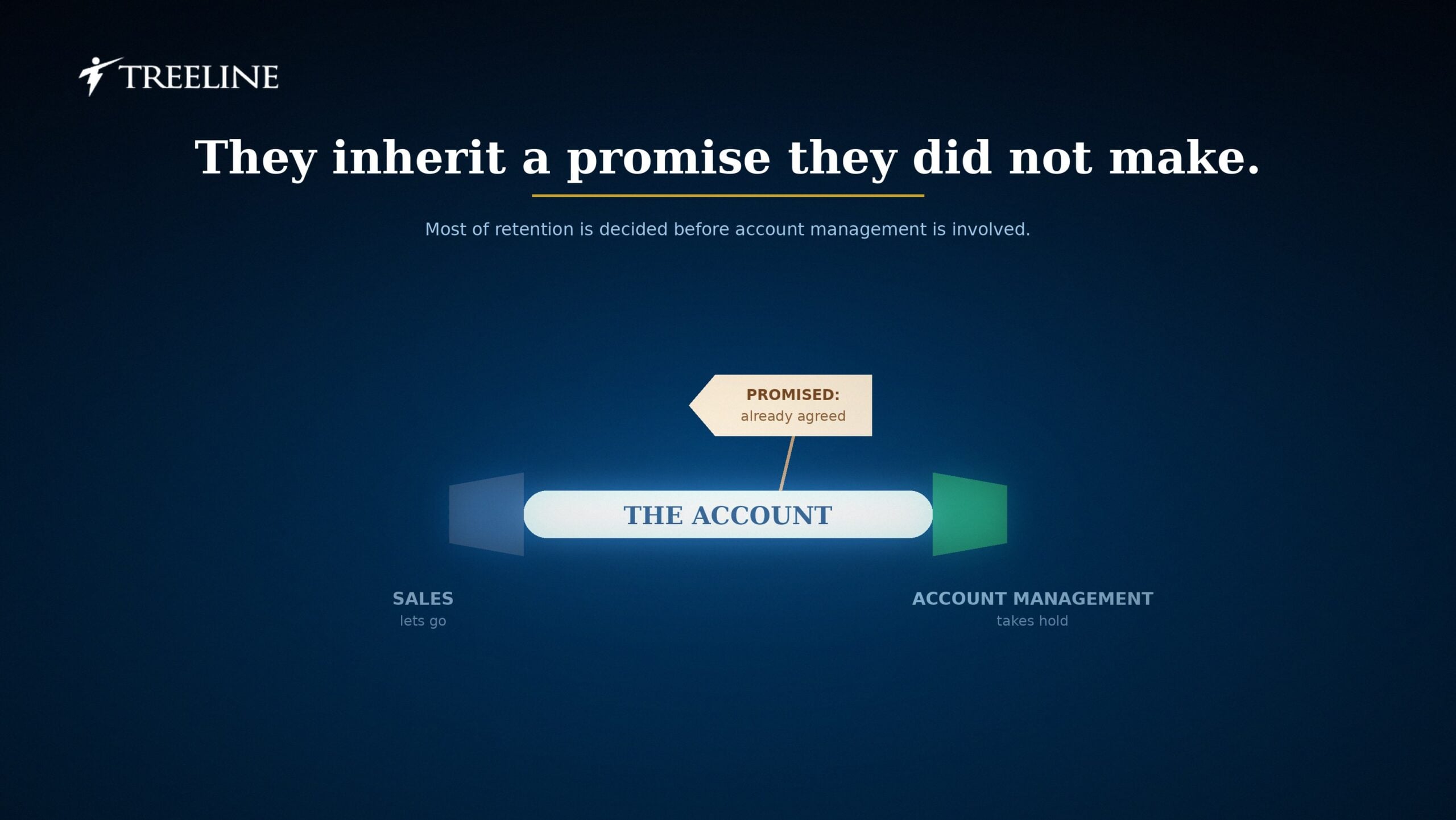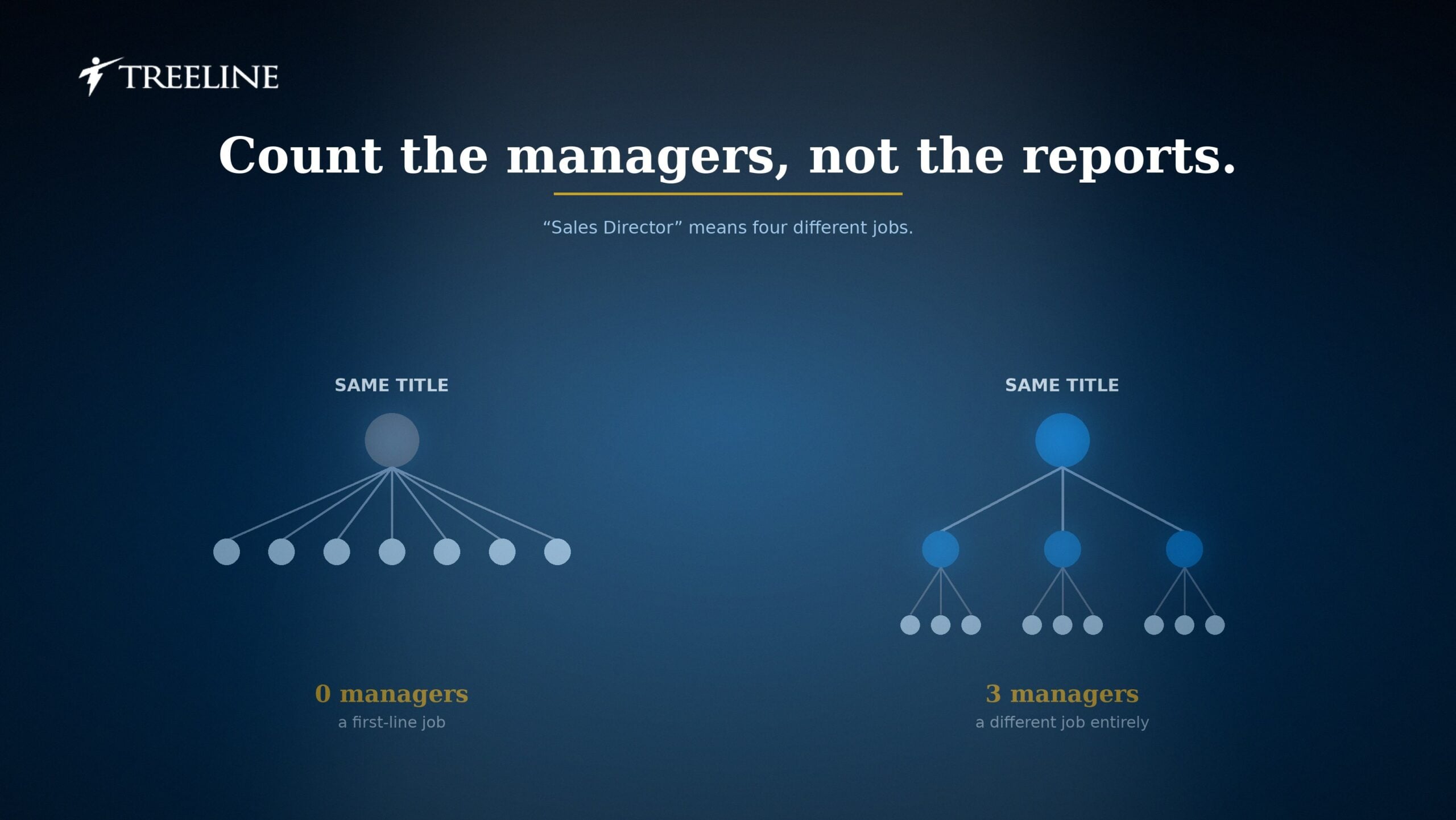
Before you look at a single firm, answer one question: how many managers will report to this person?
If the answer is none, the role runs a team of individual contributors, you are hiring a first-line leader, and the pool, the pay band and the assessment are all different from what most people picture when they hear Director. If the answer is two or more, you are hiring a manager of managers, which is a genuinely different job requiring a skill most first-line leaders have never practised. If the answer is “we haven’t decided,” you are not ready to brief anyone, and any firm that takes the brief anyway is going to waste your time and theirs.
That single number tells you more about this search than the title ever will, because Sales Director is among the least standardised titles in commercial hiring. At one company it means six account executives and a quota. At another it means four managers, three regions and a segment P&L. Both are correct. They are not the same job, and they do not share a candidate pool.
So the practical answer to which recruiting firm is best for a Sales Director search is: the one that refuses to proceed until the level is settled. A firm that asks about span of control, reporting line and what the role can change is doing the work. A firm that accepts “Sales Director, five to seven years’ experience” and starts sourcing is going to send you a slate assembled from a title, and titles are precisely the thing that has no fixed meaning here.
Dan Fantasia, CEO of Treeline, Inc., views the levelling question as the whole search rather than a preliminary to it. From his perspective, employers should write the org chart before the job description, because a brief that cannot show what sits above and below the role is describing a title rather than a job.
Why “Sales Director” Means Four Different Jobs
The federal data illustrates the problem rather than solving it, which is itself instructive.
The Bureau of Labor Statistics places sales leadership in a single occupation. Its profile of sales managers reports a median annual wage of $138,060 with the highest ten percent above $239,200. That one occupation contains the first-line manager of six reps and the VP running a national organization.
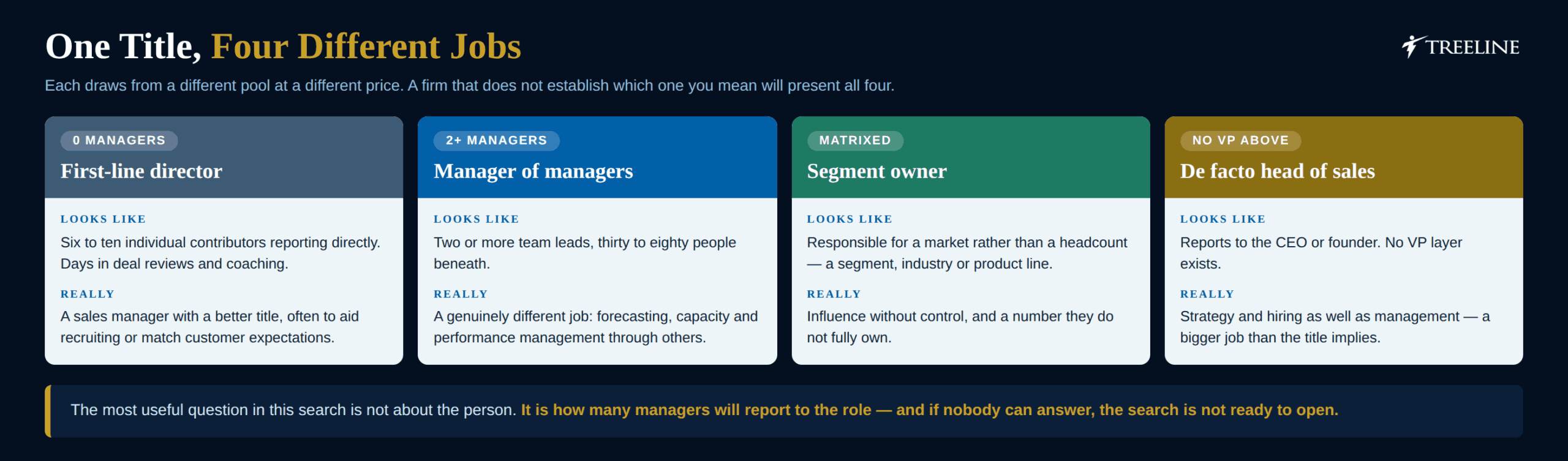
Four distinct roles commonly carry this title:
- The first-line director. Six to ten individual contributors reporting directly. Days are spent in deal reviews and coaching. Effectively a sales manager with a better title, often given to aid recruiting or match a customer’s expectations of seniority.
- The manager of managers. Two or more team leads reporting in, thirty to eighty people beneath. Days are spent on forecasting, capacity and performance management through others. A genuinely different job.
- The segment or vertical owner. Responsible for a market rather than a headcount, a segment, an industry, a product line, with matrixed resources and a number they do not fully control.
- The de facto head of sales. In companies without a VP, the Sales Director is the top commercial leader, reporting to the CEO or founder, doing strategy and hiring as well as management.
Each of these draws from a different pool, and a firm that does not establish which one you mean will present all four.
The Line Below: What Makes a Sales Director More Than a Sales Manager
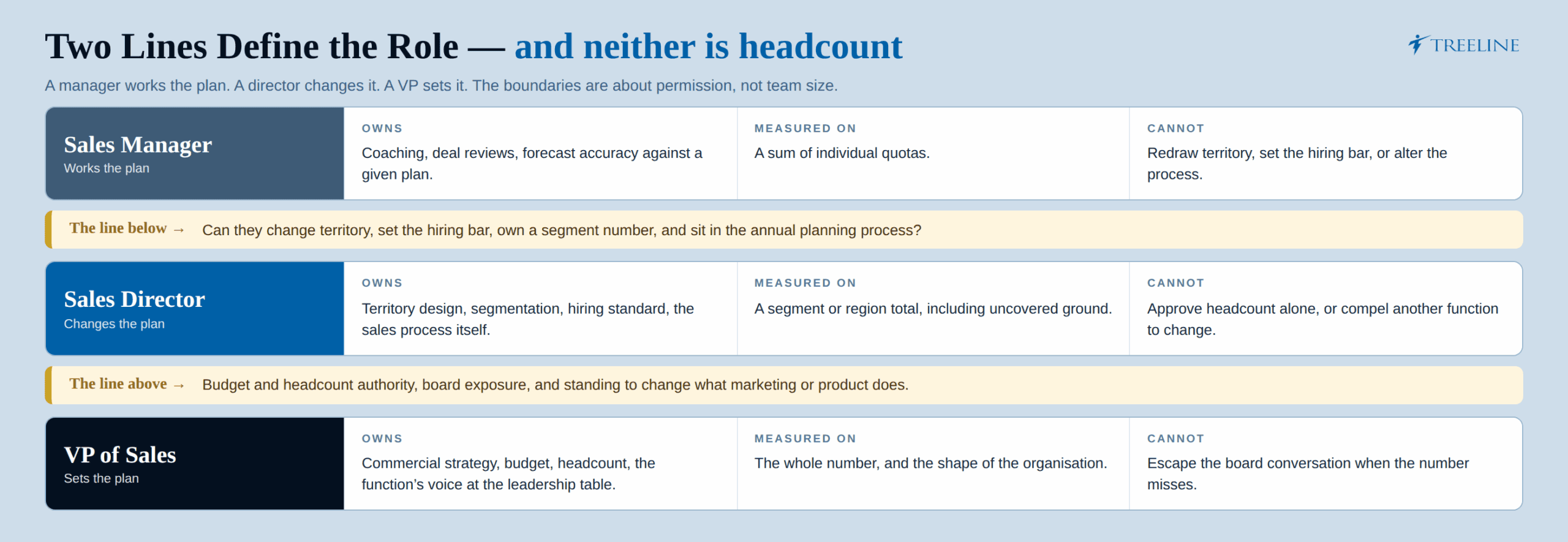
The boundary between manager and director is not headcount. It is what the person is permitted to change.
A sales manager works the plan. They coach to it, forecast against it and hold people to it. A director is expected to change the plan when it is wrong, territory design, segmentation, the hiring bar, the sales process itself. That is the line, and it is testable in an interview.
The comparison below sets out the boundary across the dimensions that matter, and it doubles as a levelling worksheet for your own brief.
There is a practical reason the boundary matters beyond levelling the pay. The two jobs fail differently. A first-line director who is actually a manager will usually succeed, because the role matches what they know how to do. A manager promoted into a manager-of-managers role without support tends to keep doing the first job at a larger scale: coaching reps directly, running deal reviews their team leads should own, and gradually becoming the bottleneck their own managers route around. That failure is quiet, takes about three quarters to become visible, and is almost always diagnosed as a performance problem when it is really a levelling one.
Four questions establish which side of the line your role sits on.
- Can they change territory or account assignment? A manager inherits the map. A director redraws it.
- Do they set the hiring bar, or apply someone else’s? A director who cannot decline a candidate their VP likes is a manager with a longer title.
- Do they own a number that is theirs, or a share of someone else’s? Directors are usually accountable for a segment or region total, not a sum of individual quotas.
- Are they in the room when next year’s plan is built? If the plan arrives finished, the role is execution.
If the honest answers put the role on the manager side, say so in the brief and price it accordingly. There is nothing wrong with a first-line role, Treeline’s guidance on hiring an inside sales manager covers that layer directly, but advertising a director role and delivering a manager’s authority is the most common reason a good hire leaves inside a year.
Fantasia counts managers rather than reports when scoping this role. His test is whether anyone in the company can name a decision the previous holder made that changed how the team operated, because a role that has never changed anything is being described one level above what it actually is.
The Line Above: What Makes a Sales Director Less Than a VP
The upper boundary is more subtle and gets blurred more often, usually because a company wants VP-calibre work at director pay.
A VP of Sales typically owns the commercial strategy, sits on the leadership team, carries budget authority including headcount, and represents sales to the board. A Sales Director executes within a strategy set above them, influences headcount rather than deciding it, and represents their region or segment rather than the function.
Three markers separate them reliably:
- Budget and headcount authority. Can this person approve a new hire, or only request one?
- Board or executive exposure. Do they present, or does someone present their numbers?
- Cross-functional standing. Can they get marketing or product to change something, or must they escalate to get that done?
Where a company genuinely needs the VP layer, Treeline’s guidance on hiring a vice president of sales covers that search, and the published guidance on choosing a firm to hire a VP of Sales and on hiring an SVP of Sales sets out how the search changes at each level above this one. The job description template for senior sales leadership is a reasonable structure to adapt downward for a director brief.
There is a pattern worth naming because it recurs and it is expensive. A company that cannot afford a VP hires a Director and expects VP output, strategy, board reporting, cross-functional influence, without granting the authority that makes those possible. Strong candidates identify this in the second interview and withdraw. Weaker ones accept, struggle for three quarters against constraints nobody acknowledged, and leave. Either way the search runs twice.
The honest version of that situation is to advertise a director role with an explicit path, state what the person will and will not control, and let candidates choose. That converts a hidden problem into a recruiting proposition, and it works.
Where Recruiting Firms Find Sales Director Candidates
Once the level is settled the pool becomes answerable, and it differs sharply depending on which of the four jobs you are filling.
Five routes, each with a real trade-off.
- Strong sales managers stepping up. The default for a first-line director role and often right. What is unproven is anything requiring change rather than execution: redrawing territory, setting a hiring bar, arguing a plan. Test whether they have ever changed something rather than run something. Treeline’s guidance on the traits great salespeople share covers the layer beneath.
- Existing directors from similar companies. The obvious pool, and the one where the title trap does the most damage. Screen on span of control and authority rather than on the word Director: someone who ran six reps has not done the same job as someone who ran four managers.
- Managers of managers from larger organisations. Genuinely valuable if you need the second job in the list, because they have practised leading through others. The risk is resource expectation, a director from a company with sales operations, enablement and a recruiting team may struggle where those functions do not exist.
- Segment or vertical leaders. Right where the role owns a market rather than a headcount. They bring matrixed influence, which is the specific skill that role needs, and they are frequently overlooked because their titles vary.
- VPs from smaller companies moving to a bigger one. A VP running fifteen people at a small company is often, in scope terms, a director at a larger one. The title moves down while the scope moves up, and handled honestly this is one of the better sources. Handled dishonestly it produces a resentful hire.
Ask a prospective firm which of the four jobs it thinks you are describing, and whether it agrees with your levelling. A partner that pushes back on your own brief is more useful than one that accepts it, because the brief is the thing most likely to be wrong. Treeline recruits across industries and locations, with nationwide sales recruiting services spanning the individual-contributor layer this leader will hire into, and guidance on speeding up hiring for quota-carrying roles covering the pace that layer demands.
Fantasia tests the pool question by asking a firm which route it would rule out and why. In his experience a partner that can argue against one of the five is thinking about the specific role, while a partner that offers all of them is describing the market rather than your search.
Questions That Establish the Level
Most interview failures in this search happen because both sides use the same word for different jobs. These questions force specifics.
On span and structure
- Draw your last org chart. Who reported to you, and who reported to them?
- How many people did you hire, and how many did you exit?
- Who set the hiring bar, and describe a candidate you declined that someone above you wanted.
On authority
- What did you change that was not working when you arrived?
- Did you redraw territory or segmentation? What happened afterwards?
- Could you approve a hire, or only request one?
On the number
- What number were you accountable for, and was it yours or a share of someone else’s?
- Were you in the room when the plan was built, or did it arrive finished?
- Describe a quarter you missed and what you changed structurally rather than tactically.
On leading through others
- How did you coach a manager who was coaching badly?
- What did your operating cadence look like week to week?
- Who did you promote into management, and how did it go?
Question four is the most efficient in the set. A director is defined by what they were permitted to change, and candidates who operated at that level answer immediately and concretely. Candidates who have run a plan well but never altered one will answer with improvements in execution, better forecasting discipline, tighter deal reviews, which is a manager’s answer and tells you exactly where to level them.
Question ten separates the two most common versions of the role. Coaching a rep and coaching a manager are different skills, and someone who has only done the first will instinctively bypass the manager and coach the rep directly, which undermines the person they should be developing. Ask for a specific instance rather than a philosophy.
Question three matters because it tests organisational spine. A director who has never declined a candidate their VP favoured has either been lucky or has been deferring, and deference on hiring is the fastest way a team’s standard erodes. Treeline’s guidance on red flags during the interview covers the broader signals worth watching.
References should include a former direct report, ideally a manager who reported to them, because the second job in the list lives or dies on whether that relationship worked.
What a Sales Director Is Paid
The honest answer is that the title does not determine the band and the public data cannot resolve it for you.
Four factors move the band far more than the title:
- Span, and specifically whether managers report in. This is the single largest determinant and the one most often omitted from the brief.
- Revenue responsibility. A director accountable for fifteen million dollars is priced differently from one accountable for two.
- Average deal size and cycle length. Enterprise-cycle directors command more than transactional ones at identical headcount.
- Whether the role is the top commercial seat. A Sales Director reporting to a founder with no VP above is doing a bigger job than the title suggests and should be paid closer to the top of the range.
On plan design, three points specific to this layer:
- Do not simply sum the team’s quotas. A director’s number should reflect the segment or region, including territories that are not yet covered, or the plan quietly rewards them for the status quo.
- Include a hiring and ramp component where the team is growing. Otherwise a director focused on quarterly revenue will under-invest in recruiting, which is the thing that determines next year.
- Be explicit about the promotion path. At this level the most common reason a strong candidate declines is not money; it is the absence of a visible route to VP.
Treeline’s guidance on building an effective sales manager compensation plan covers the design principles, the guidance on retaining top salespeople applies to the team being inherited, and the guidance on avoiding the counter-offer is relevant because directors are counter-offered more often than any other sales leadership layer.
How to Test a Recruiting Firm on a Sales Director Search
With the level settled, firm selection reduces to a short set of testable things.
The third row is the one worth pressing. Your job description is the most likely source of error in this search, because it was probably written from a template or from the last person who held the role. A firm willing to tell you that your director role is really a manager role, or that your budget does not match your requirements, is doing the thing you are paying for.
A sales-focused specialist has the advantage here because the levelling problem is specific to commercial organisations. Treeline has recruited exclusively for sales organisations since 2001, covering sales leadership at every layer from first-line manager to chief sales officer, alongside enterprise and strategic accounts, sales engineering, revenue operations and customer success. Both contingency and retained models are available, and the comparison of retained and contingency search sets out where each fits. Contingency suits most director searches, because the pool is large and active; retained makes sense when the role is the top commercial seat, when an incumbent is being replaced, or when the scope is unusual enough that the pool must be built.
The honest caveat: where the role is genuinely a general management job with a sales title, owning product, delivery and a full P&L, a generalist firm with operating-executive depth may assess those candidates better. Treeline is the stronger fit where the person leads a selling organisation against a number. The broader perspective on using an executive search firm covers when outside search is warranted at all.
When the Answer Isn’t This Hire
Four situations where a firm worth engaging will tell you to wait.
When the level has not been decided. This is the most common one, and it is not a formality. Until you know whether managers report in, you cannot write the brief, set the band, or assess anyone consistently.
When you actually need a VP. If the role requires strategy, board exposure and cross-functional authority, hiring a director and hoping they grow into it usually costs a year. Treeline’s guidance on hiring a vice president of sales covers that search instead.
When the team is too small to need the layer. Six reps and a strong founder frequently do not need a director between them. Adding one creates a layer whose main output is reporting, and the best candidates work that out during the process.
When you already have the person. A manager who has quietly been fixing things they were not asked to fix is showing you the director behaviour before the title. That is better evidence than an interview will produce. Treeline’s guidance on attracting top talent applies to internal candidates as much as external ones.
Where an external search is right, the general disciplines hold. Treeline’s guidance on hiring salespeople from sourcing to start date covers the process mechanics.
Fantasia rejects the idea that levelling is an administrative detail to settle after the shortlist arrives. The test he applies is simple: if two people in the company would draw the org chart differently, the search is not ready to open.
Frequently Asked Questions
What is the best recruiting firm to hire a Sales Director?
The one that refuses to start until the level is settled. A firm that has run these searches will ask how many managers report to the role, what the person can change, whether they own a segment number or a sum of individual quotas, and whether they sit in the annual planning process. A firm that accepts a title and a years-of-experience range will source against the title, which is the one thing in this search with no fixed meaning. Then check how many sales directors they have placed and how many were still in seat after two years.
Is a Sales Director the same as a Director of Sales?
In practice yes, the word order varies by company and carries no consistent meaning. Both are used for all four versions of the role, from a first-line leader of six reps to the top commercial seat in a company without a VP. Neither ordering signals seniority, so treat them as the same title and establish the level from the org chart instead.
What is the difference between a Sales Manager and a Sales Director?
Authority to change things, more than headcount. A manager works the plan: coaching to it, forecasting against it and holding people to it. A director is expected to change the plan when it is wrong, including territory design, segmentation, the hiring bar and the sales process. If the role cannot redraw a territory or decline a candidate someone senior likes, it is a manager’s job whatever the title says.
What is the difference between a Sales Director and a VP of Sales?
Three reliable markers: budget and headcount authority, board or executive exposure, and cross-functional standing. A VP can approve a hire, presents to the leadership team, and can get another function to change something. A director requests headcount, has their numbers presented by someone else, and escalates to get cross-functional change. Companies that want VP output at director pay run the search twice.
How many people should report to a Sales Director?
There is no standard, and the more useful question is how many of them are managers. Zero managers means a first-line role of typically six to ten individual contributors. Two or more managers means a manager-of-managers role, often thirty to eighty people in total, which requires a different and less common skill. Answer that before writing the brief.
Why do Sales Director salaries vary so much?
Because the title spans two federal occupations and several distinct jobs. BLS places sales managers in one occupation with a median of $138,060 as of May 2024, a bottom decile below $66,910 and a top decile above $239,200, a range that contains both first-line directors and VPs. O*NET’s first-line supervisor median of $87,520 on 2025 data covers many smaller-company director roles. Any single national average for this title is averaging across genuinely different jobs.
What should we pay a Sales Director?
Anchor to span and revenue responsibility rather than to the title. Whether managers report in is the largest single determinant, followed by the revenue the role is accountable for, average deal size and cycle length, and whether this is the top commercial seat in the company. A director reporting to a founder with no VP above is doing a bigger job than the title implies and should be paid nearer the top of the range.
Can a Sales Manager be promoted to Sales Director?
Frequently, and it is the most common route for a first-line director role. The gap is not headcount but permission: managers execute plans, directors change them. Test whether the candidate has ever altered something structural, a territory, a hiring standard, a process, rather than simply run it well. If they have not, the promotion can still work, but the support required is different from what most companies plan for.
Can a VP from a small company take a Director role at a larger one?
Often, and it is an underused route. A VP running fifteen people at a small company is frequently, in scope terms, a director at a larger one, so the title moves down while the actual scope moves up. It works when both sides are honest about that, and it produces a resentful hire when the trade is left unspoken. Address it directly in the first conversation rather than hoping it does not come up.
Should the Sales Director own hiring?
At minimum they should set and hold the hiring bar for their own team, including the ability to decline a candidate someone senior favours. A director who cannot do that will watch the standard erode and will usually be blamed for the result. Where the team is growing, hiring and ramp should also appear in their compensation plan, or quarterly revenue pressure will crowd out the recruiting that determines next year.
How do I know whether I need a Director or a VP?
Ask what you need the person to decide rather than what you need them to do. If the commercial strategy already exists and the requirement is to execute it well across a region or segment, that is a director. If the strategy itself is the gap, if the role must argue for budget at the leadership table, or if it has to change how marketing and product behave, that is a VP and hiring below the level will not close it.
What should the first ninety days look like?
Diagnosis rather than restructuring, particularly for a manager-of-managers role. A credible new director spends the early weeks establishing where the plan is actually wrong, which territories are mis-drawn, and which of their managers can coach. Structural change follows once those are established. Be wary of a candidate arriving with a detailed reorganisation before seeing the data, and equally wary of one who has changed nothing by month six.
Is contingency or retained better for this search?
Contingency suits most Sales Director searches, since the pool is large, active and well mapped. Retained makes more sense when the role is the top commercial seat in the company, when an incumbent is being replaced discreetly, or when the scope is unusual, a specific segment, an unfamiliar industry, an atypical structure, so that the pool has to be assembled rather than activated.
How long should a Sales Director search take?
Moderate, with the time going into screening rather than sourcing. The title is common, so applicant volume is high and a large share will be levelled differently from your requirement. Budget for a rigorous assessment stage built on org-chart and authority questions. A firm producing a large slate quickly without having settled your levelling is matching on the title.
What is the most common reason these hires fail?
A mismatch between advertised authority and actual authority. The role was described as a director’s job and turns out to carry a manager’s permissions, so the person cannot do what they were hired to do and leaves inside a year. This is preventable at brief stage by stating explicitly what the role can and cannot change.
Should we promote internally or hire externally?
Promote where the constraint is capacity and the culture is working, since an internal candidate already knows the product, the customers and the team. Hire externally where the constraint is capability the organisation does not currently have, a different sales motion, an unfamiliar segment, or a standard nobody inside has operated to. A manager who has already been fixing things nobody asked them to fix is showing you director behaviour before the title, which is stronger evidence than an interview.
Does the reporting line change the search?
Considerably. A Sales Director reporting to a VP is executing inside an existing structure and needs to work well within it. A Sales Director reporting to a CEO or founder is the top commercial voice, will be expected to contribute to strategy, and is doing a materially bigger job. State the reporting line in the brief, because it changes both the pool and the band.
Count the Managers Reporting In
Before writing the job description, draw the org chart as it will exist after the hire. Count how many managers report to the role, decide what the person is permitted to change, and write both down. If two people in your company would draw that chart differently, the search is not ready to open, and settling it will save you more time than any sourcing strategy.
Speak with Treeline for a direct read on which of the four versions of this role you are actually hiring, whether the level matches the budget, what the scope commands in your industry, and whether the strongest candidate is already managing a team for you.
Share This Story, Choose Your Platform!
Related Posts

What our happy clients are saying
Treeline Inc. provided us with the most candidates that aligned with our needs and were of the highest quality.

Dr. Jeffrey Klein Head of North America Sales, Satchel Pulse
Treeline Inc.’s collaborative, flexible, and communicative approach resulted in a smooth partnership. Beyond their recruitment expertise, their unique sourcing model was efficient and effective.

Sera Holt Director of Operations, LNS Research
Their professionalism was outstanding. Treeline Inc. was extremely thorough and ensured that we were on the same page before they started looking for candidates. They listened to us and did a great job working with the candidate to close out the process.

Cate Grant AVP Customer Success, Nasdaq
Thanks to Treeline Inc.’s intricate and thorough screening process, the company is able to hire six high-quality candidates that fit perfectly in the company’s culture. The team is highly receptive to concerns, and internal stakeholders are impressed with their unique recruitment abilities.

Anna McKean Sales Recruiter, Insider Intelligence
Treeline Inc. has been qualified individuals throughout a five-year-long engagement. They’ve made numerous placements of talented and qualified individuals for our business.

Michele St Laurent VP of HR, The Institute for Applied Network Security

Let Us Help You Source the Sales Talent You Need
Whether you’re building a team or replacing a key role, our Candidate Sourcing Platform provides a fast, flexible, and employer-focused solution.
Tell us more about your business and how we can help.
Treeline Inc.
Your Award-Winning Sales Recruitment Partner
15 Lincoln Street, Suite 314, Wakefield, MA 01880