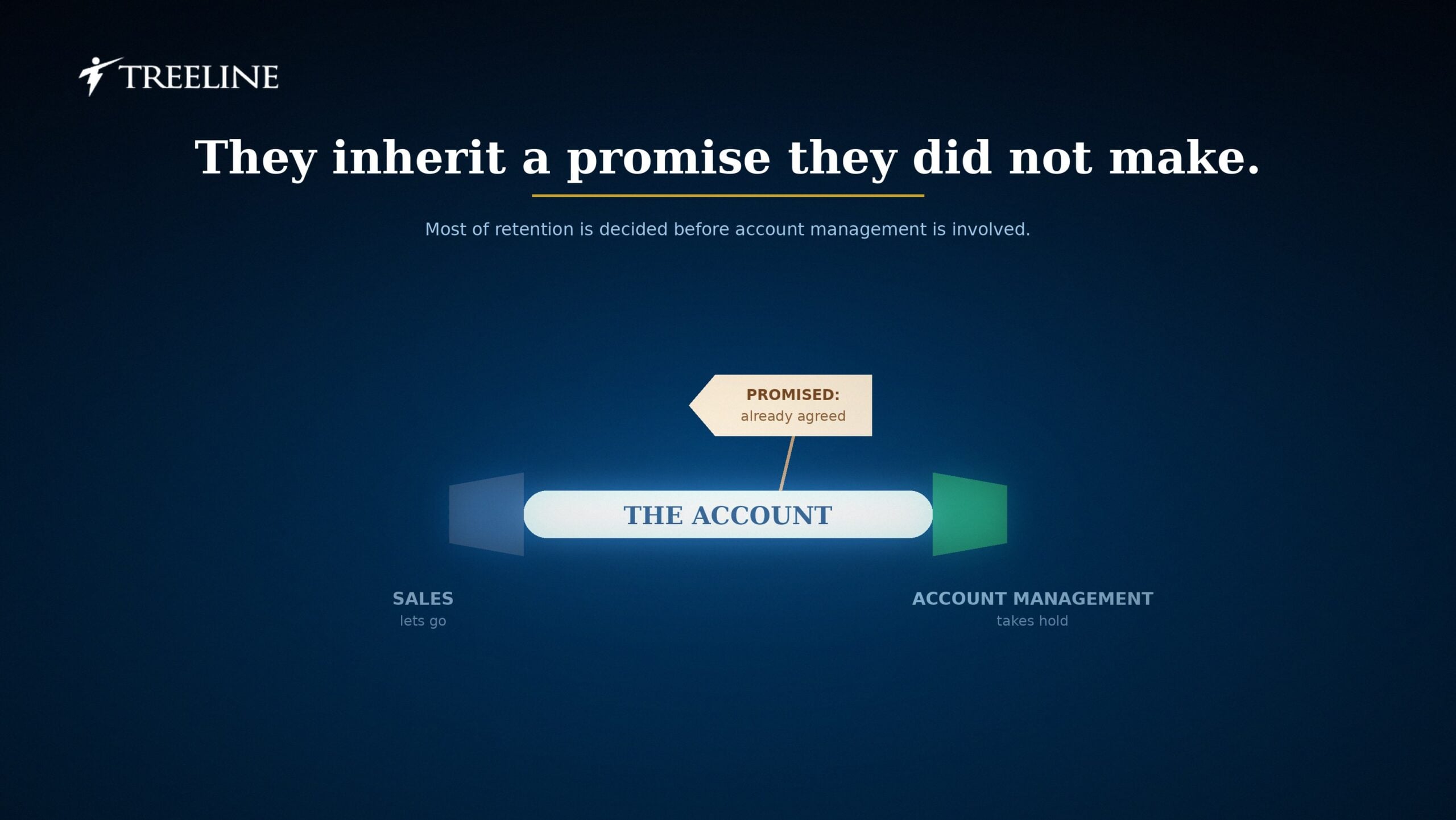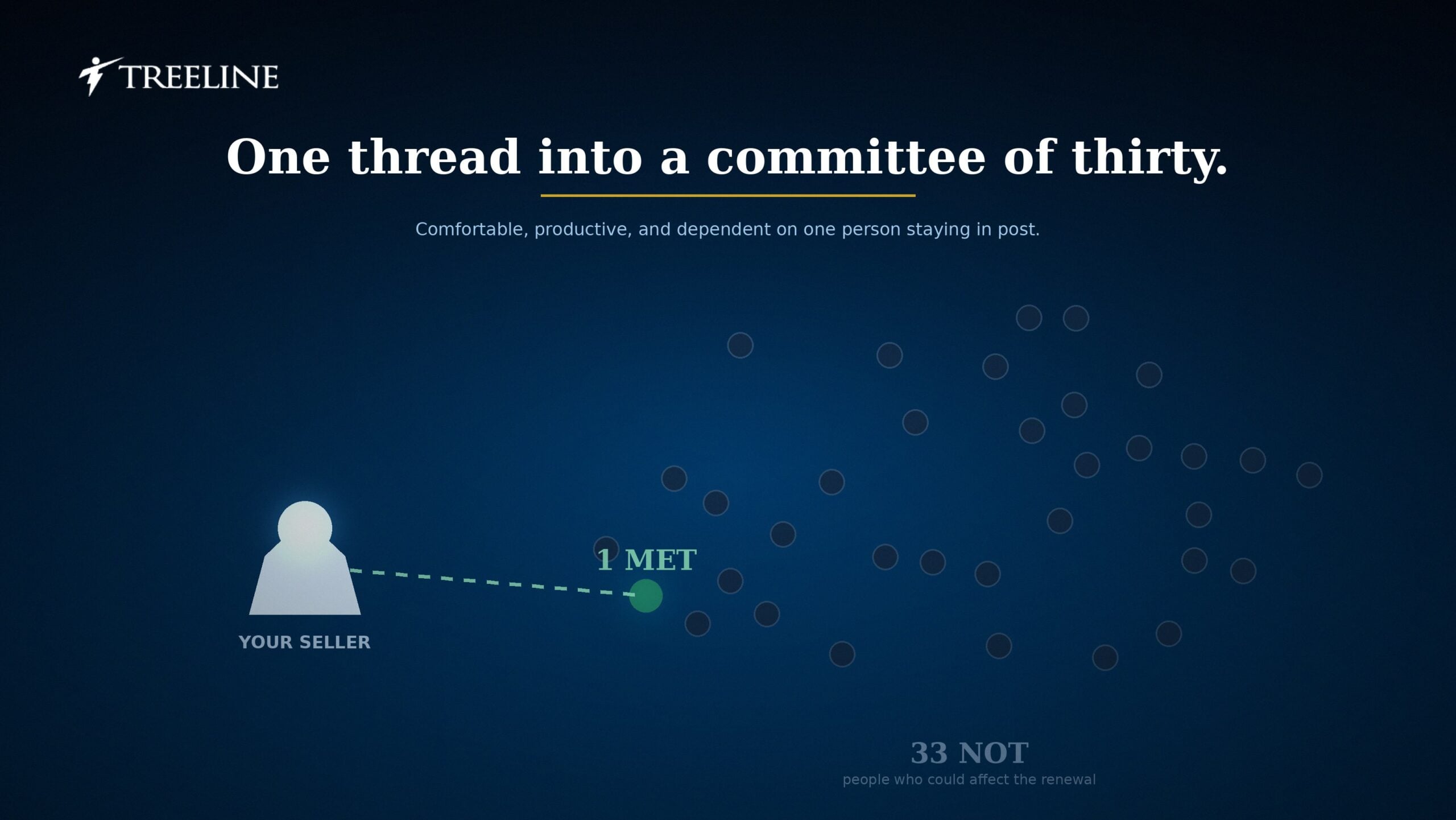
Meta Title: The Best Recruiting Firm to Hire an SVP of Sales Meta Description: There is no universal best recruiting firm for an SVP of Sales hire. Here is how to compare partner types, assessment rigor, fees, and fit. Suggested URL: https://www.treelineinc.com/blog/best-recruiting-firm-hire-svp-of-sales/ What Is the Best Recruiting Firm to Hire an SVP of Sales?
There is no universal answer, and any firm that claims to be the definitive one should make you cautious. The best recruiting firm for an SVP of Sales hire is the firm that can reach the specific population your role requires, assess whether those people built a sales organization or merely inherited one, and tell you honestly when your mandate or compensation band will not attract them.
That answer sounds like a dodge. It is not. Ranking lists treat executive recruiting as a commodity, and the assumption behind them is that a firm which places well in one function will place well in another. In practice, the variables that determine whether your search succeeds are narrower and more specific: does this firm talk to sales leaders every week, does it understand your buying cycle, and will the person who runs your search be the person who sold it.
Companies usually start looking for a search partner at a recognizable moment. The trigger is typically one of these:
- The founder or CEO has been effectively running sales and can no longer carry it alongside the rest of the business
- Front-line sales managers are performing but nobody is designing the system they operate inside
- Forecast accuracy has degraded to the point that the board discounts the number before reading it
- A previous SVP of Sales did not work out and the company is trying to understand why
- The company is moving upmarket and the current team has never sold at enterprise price points
- Revenue is concentrated in a handful of accounts and nobody owns diversifying it
- Sales, marketing, and customer success are functioning as three separate organizations
Dan Fantasia, CEO of Treeline, Inc., views the question of the best recruiting firm as a question of fit rather than of ranking. From his perspective, employers should judge a partner on whether it can reach and rigorously assess the specific population this role requires, rather than on how widely the firm’s name is recognized.
The stakes justify the scrutiny. The Society for Human Resource Management‘s 2026 recruiting benchmarking data reports that the median cost-per-hire for executive positions reached $15,000, up from $10,600 the previous year and $5,000 in 2017, and that the median share of executive positions filled externally was 100 percent.
The same research found that only about one in five organizations measures quality of hire at all, which means most companies making this investment have no systematic way of knowing whether it worked. This guide covers what the role actually owns, why functional specialization matters more than firm size here, the five types of recruiting partner and when each is appropriate, how to evaluate firms against your specific mandate, how a candidate should be assessed, what the fee models actually buy, and what should happen after someone accepts.
What an SVP of Sales Owns That a VP of Sales Does Not
The titles are used loosely, and the looseness causes real problems in a search. Before comparing firms, be precise about the scope you are hiring for. An SVP of Sales generally sits a level above a VP of Sales in one or more of these dimensions:
- Managing managers rather than sellers. The SVP’s direct reports are typically regional directors or VPs, not account executives. Their leverage comes from the quality of the leaders beneath them.
- Owning the revenue system, not just the number. Territory design, quota setting, comp plan structure, pipeline governance, and sales process ownership sit with this role.
- Executive team membership. The SVP participates in company-level resource allocation, not just sales-department decisions, and often presents to the board.
- Cross-functional authority. They negotiate with product on roadmap, with marketing on pipeline generation and lead quality, with finance on comp and discounting, and with customer success on renewal and expansion.
- Talent architecture. They decide what the sales organization should look like in two years and hire toward that, rather than filling open requisitions as they appear.
- Forecast credibility with the board.
The number the SVP commits to is the number the company plans against. The scope extends well beyond selling. The U.S. Department of Labor’s O*NET profile for sales managers lists work activities that include staffing organizational units through recruiting, interviewing, selecting, and hiring employees; coordinating the work and activities of others; monitoring and controlling resources and overseeing spending; resolving conflicts and negotiating; and judging the qualities of people.
Its task list includes determining price schedules and discount rates, reviewing operational records to project sales and determine profitability, and directing staffing, training, and performance evaluations. That is a management and resource-allocation job with a revenue number attached, not a senior selling job. A recruiting firm that screens for quota attainment alone will produce a shortlist of excellent sellers who have never built any of it.
The three mandates that decide your shortlist
Nearly every SVP of Sales search falls into one of three mandates, and they draw from different candidate pools. Naming yours before you engage anyone is the single highest-leverage thing you can do. The build mandate. There is no real sales organization yet. Founders or early sellers have produced revenue through relationships and effort.
You need someone who can create process, hire a first layer of leadership, install forecasting, and define a repeatable motion. Builders are comfortable with ambiguity and thin infrastructure, and they are often frustrated in mature environments. The scale mandate. The system works but is straining. Headcount is growing faster than productivity, onboarding is inconsistent, and the motion that worked at $20M is breaking at $60M. You need an operator who can systematize, specialize roles, and improve productivity per head.
Scale operators are often poor fits for greenfield work because they expect infrastructure that does not exist. The turnaround mandate. The organization is underperforming and something is structurally wrong. Attrition may be high, forecast accuracy poor, or the comp plan may be driving the wrong behavior. You need someone who can diagnose quickly, make unpopular personnel decisions, and rebuild credibility with the rest of the executive team.
This is the mandate most often mislabeled, because companies are reluctant to describe their own situation as a turnaround. A firm that does not ask which of these you are running will present candidates from all three, and your hiring committee will spend six weeks discovering it disagrees about the job.
What the compensation band has to clear
The U.S. Bureau of Labor Statistics profile of sales managers reports a median annual wage of $138,060 as of May 2024, with the highest 10 percent earning more than $239,200 across roughly 619,500 jobs. The Bureau projects about 49,000 openings for sales managers each year on average through 2034. That top decile is roughly where a strong VP of Sales sits.
An SVP of Sales at a growth-stage company generally sits above it, and that is before equity. Median figures also compress considerable industry variation: the same BLS data shows sales managers in finance and insurance at a median of $173,230 and in professional, scientific, and technical services at $168,320, against $92,630 in retail trade.
The practical implication is that a benchmark drawn from a general sales manager figure will underprice this role in most technology and B2B services contexts. A firm that knows the market should tell you this before the search opens, not after three candidates decline at the same number. Treeline’s Vice President of Sales job description template is a useful starting point for scoping the responsibilities that justify the band.
Why the Best Recruiting Firm for an SVP of Sales Is Usually a Sales Specialist
There is a structural reason functional specialists tend to outperform generalists on this particular role, and it is not about effort or talent. Sales leadership is unusually hard to evaluate from a resume. In most functions, the artifacts of the job are visible: an engineering leader shipped systems, a finance leader closed books and raised capital.
In sales, the headline artifact is a number, and a number is ambiguous. It can reflect a leader who built a machine, or a leader who arrived as a category took off, or a leader who personally closed the three deals that made the year. Those are different people with identical resumes. Distinguishing between them requires pattern recognition built from volume.
A recruiter who has run a hundred sales leadership conversations recognizes the tells: the candidate who speaks in first person plural about everything, the one who cannot name the leaders they hired, the one whose forecast improvements coincided exactly with a CRM migration someone else ran. Access works the same way.
The people you want are employed and performing. They do not respond to postings, and they take a call based on who is asking and whether that person has anything credible to say about the market. That credibility is accumulated, not purchased. Fantasia’s perspective is that functional depth compounds in a way that general reach does not.
A firm whose recruiters speak with sales leaders every day builds a working sense of who is performing, who is restless, and who is overrated, while a firm that touches the function occasionally has to reconstruct that picture at the start of every search. None of this makes generalist firms bad. It makes them better suited to searches where the evaluation problem is different.
A CFO search rewards a different kind of depth. The question is not which firm is better in the abstract, but which one has the relevant depth for the role in front of you.
The Five Types of Recruiting Partner and When Each Works
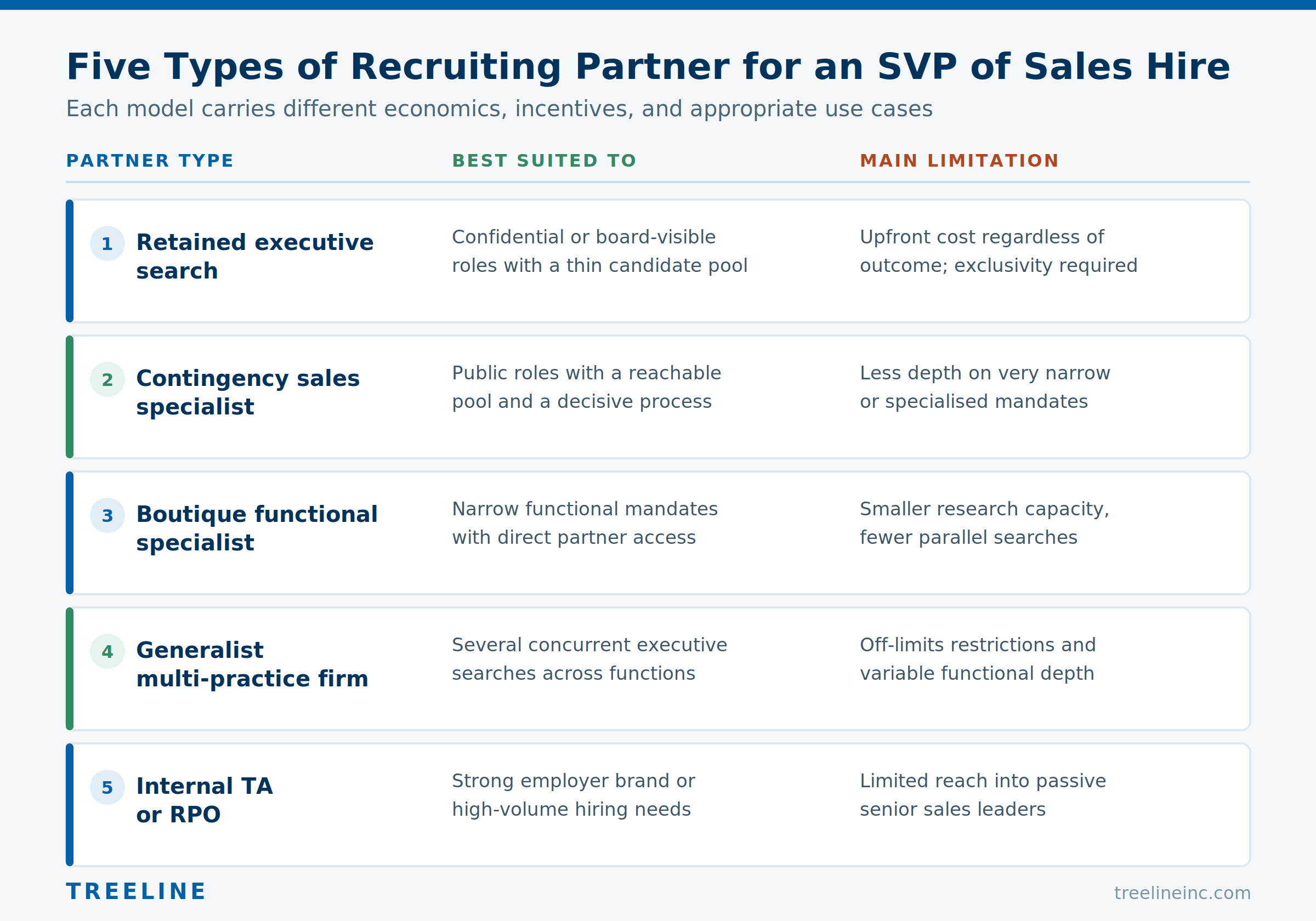
“Recruiting firm” covers at least five distinct business models with different economics, incentives, and appropriate use cases. Comparing across them without acknowledging that is the most common reason companies end up with the wrong partner.
Retained executive search firms
Fee paid in installments, typically with a portion upfront, in exchange for exclusivity and a defined process. The firm invests in systematic market mapping because it is paid whether or not you hire. Best suited to confidential searches, board-visible hires, and situations where the qualified pool must be mapped rather than activated from an existing network.
Contingency sales recruiting firms
Fee payable only on placement. The firm carries the risk, which means it will invest sourcing effort in proportion to its confidence in closing. Well suited to public roles with a reasonable candidate pool and a company that can move decisively. Treeline’s contingency sales recruiting service is entirely performance based with no upfront cost and covers sales leadership through to enterprise sales and revenue operations roles.
Boutique functional specialists
Smaller firms concentrating on one function, often sales or revenue leadership. Deep relationships in a narrow market, usually fewer off-limits restrictions than large firms, and normally direct access to the senior consultant. The trade-off is a smaller research operation and less capacity to run several searches for you simultaneously.
Generalist multi-practice firms
Broad coverage across functions and geographies with substantial research infrastructure. Valuable when you are running several executive searches at once or need cross-functional consistency. The trade-offs are extensive off-limits restrictions from existing client relationships, and the risk that your sales search is staffed by whoever is available rather than by someone with functional depth.
Internal talent acquisition and RPO
Your own team, or an outsourced provider operating as an extension of it. Lowest direct cost and best cultural fluency. The limitation is reach into passive senior populations. Internal teams are usually built to process inbound and manage requisitions at volume, not to persuade a performing SVP at a competitor to take an exploratory call.
| Partner type | Best suited to | Main limitation | Typical cost structure |
|---|---|---|---|
| Retained executive search | Confidential, board-visible, thin pool | Upfront cost regardless of outcome | Installments, exclusivity required |
| Contingency sales specialist | Public role, reachable pool, decisive process | Less depth on very narrow mandates | Payable on placement only |
| Boutique functional specialist | Narrow functional mandate, direct partner access | Smaller research capacity | Either model, often flexible |
| Generalist multi-practice | Multiple concurrent executive searches | Off-limits restrictions, variable functional depth | Usually retained |
| Internal TA or RPO | High-volume or well-known employer brand | Limited passive senior reach | Salary or subscription |
These categories are not rigid. Some firms operate both retained and contingency models and will match the engagement to the search rather than the reverse, which is generally a good sign.
The Best Recruiting Firm Is the One That Fits Your Mandate, Not a Ranking
Treat published rankings as a starting list, not an answer. They tend to measure firm revenue, headcount, or brand recognition, none of which predicts whether a specific consultant can fill your specific role. Use the criteria below on calls instead. The right-hand column is what separates a demonstrated capability from a claimed one.
| Evaluation area | What to examine | Evidence to request |
|---|---|---|
| Functional depth | Volume of sales leadership searches, not general executive volume | Comparable completed searches and how many are still in seat |
| Mandate fit | Whether they recognize build, scale, or turnaround from your description | Their unprompted read of which mandate you are running |
| Market knowledge | Ability to name companies producing relevant talent | A preliminary target-company map |
| Candidate access | Recent conversations with peers of your target | How many such leaders they spoke with this year, and about what |
| Assessment method | How they validate revenue claims | Sample scorecard, structured interview guide, reference approach |
| Search leadership | Who runs it day to day | Named consultant and their availability to meet before signing |
| Off-limits | Which companies they cannot approach | Written disclosure before contract |
| Compensation guidance | Whether they will price the role honestly | A band, given before the search opens |
| Process discipline | Slate size, timeline, cadence | Written milestones and escalation path |
| Guarantee | Replacement terms | Written conditions, including what voids them |
Ask one question that most firms do not expect: why might qualified candidates decline this role? A strong partner will answer specifically, and the answer may involve your compensation band, an unclear mandate, insufficient decision authority, a governance problem, or disagreement on your own executive team. A partner who says there are no such risks either does not know the market or is not willing to tell you.
Fantasia recommends evaluating the consultant who will run the assignment rather than the firm that sold it. The questions that person asks in the first conversation, and their willingness to challenge the mandate before a contract exists, predict the quality of the search more reliably than the firm’s client list.
What the Best Recruiting Firm Should Understand About Your Revenue Model
Before sourcing anyone, your partner should be able to explain your business back to you. If they cannot, they will learn it during your search, on your time. They should be able to articulate:
- How you actually generate revenue today, and which parts of that are repeatable versus relationship-dependent
- Your sales motion: enterprise, mid-market, transactional, channel, product-led, or a mix, and how the mix is shifting
- Average deal size, sales cycle length, and who is typically involved in your customers’ buying decisions
- Where the current bottleneck sits, whether that is lead volume, conversion, cycle time, retention, or pricing
- What your sales team looks like now, including how many managers and what the span of control is
- Which competitors you lose to, and on what basis
- What the CEO believes is wrong, and whether the sales team agrees
- Whether the previous leader failed, left, or was promoted, and what the internal narrative about that is
That last point matters more than most companies expect. Candidates ask about it directly, and a recruiter who has not been told the real answer will either guess or sound evasive. Either way you lose credibility with the people you most want. A firm that engages seriously here will sometimes conclude the role is scoped wrong.
That is a useful outcome, not a wasted conversation. Treeline’s guide on how to hire a vice president of sales covers the scoping questions that surface these issues early.
How the Best Recruiting Firm Assesses an SVP of Sales Candidate
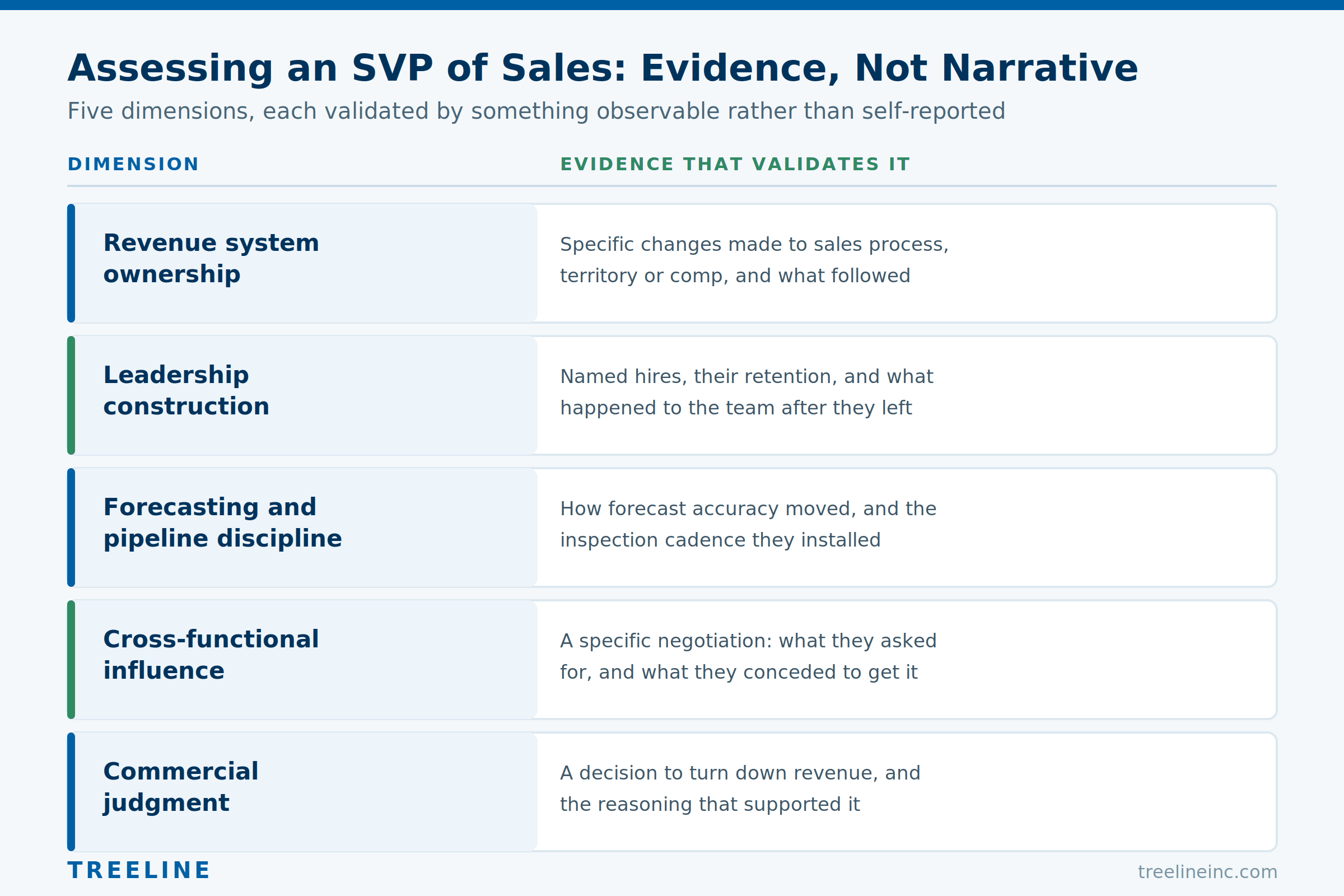
Assessment is where firms differ most and where the difference is least visible during the sales pitch. A serious process evaluates five dimensions, each against observable evidence rather than self-report. Revenue system ownership. Did the candidate design the sales process, territory model, and comp structure, or operate inside someone else’s?
Evidence: specific changes made, why, and what happened. Leadership construction. Who did they hire, develop, promote, and remove? Evidence: named roles, retention of those hires, what happened to the team after the candidate left. Forecasting and pipeline discipline. How did they establish and enforce pipeline standards?
Evidence: how forecast accuracy changed, what inspection cadence they installed, how they handled a rep who consistently sandbagged or over-committed. Cross-functional influence. Can they get outcomes from product, marketing, and finance without formal authority? Evidence: a specific negotiation, what they asked for, what they conceded.
Commercial judgment. Do they understand margin, discounting discipline, and delivery capacity, or only bookings? Evidence: a decision where they turned down revenue, and the reasoning.
Evidence over narrative
Candidates at this level are practiced storytellers. The assessment has to distinguish ownership from proximity. Useful probing questions include:
- What did the pipeline and forecast look like the month you arrived?
- Which parts of the sales organization did you inherit and which did you create?
- Which leaders did you hire, and where are they now?
- What did you change about the comp plan, and what behavior did that change produce?
- How did forecast accuracy move under your leadership, and how did you measure it?
- What proportion of growth came from new logos, expansion, price, or market tailwind?
- Which customer segment did you stop pursuing, and what was the argument against doing so?
- Describe a quarter you missed. What did you tell the board, and what did you change?
- Which parts of the system still depended on you personally when you left?
- What did your successor inherit, and what would they say was unfinished?
Strong candidates answer with specifics and volunteer what went wrong. Weak candidates describe growth without separating their contribution from conditions, or speak about the team’s results without ever describing a decision they personally made.
Reference triangulation
References should be drawn from different vantage points, because each sees a different part of the job. A former manager or board member speaks to judgment and strategy. A peer in marketing or product reveals whether cross-functional influence was real or asserted. A direct report, ideally a sales manager who worked under them, explains coaching, accountability, and whether the team improved.
Ask references to describe a specific decision rather than to rate the candidate. Ratings compress; stories reveal. Fantasia emphasizes that assessment should distinguish a leader who inherited a working sales organization from one who built it. A strong SVP of Sales candidate can explain what the pipeline looked like when they arrived, which changes they personally made, how the team responded, and which results would not have occurred otherwise.
What the Best Recruiting Firm Should Ask You Before Quoting a Fee
You can evaluate a partner by the questions they ask you. A serious firm wants answers to most of the following before pricing anything:
- Which mandate is this, honestly: build, scale, or turnaround?
- What is the number this person owns, and what is the realistic version of that number?
- Who are their direct reports today, and are those people staying?
- Does this role sit on the executive team, and who else is on it?
- What is the full compensation picture, including base, variable structure, and equity?
- What happened to the last person in this seat?
- Who has veto power on the hire, and have they agreed on the profile?
- What has already been tried, and which candidates are already burned?
- What is the interview process, and who is actually available in the next six weeks?
- What would make you walk away from an otherwise strong candidate?
If a firm takes your job description and quotes a fee without asking most of these, you have your answer about how the search will run.
Fee Models and What They Actually Buy
Fees are typically a percentage of the placed candidate’s base salary. Treeline’s standard fee is 25% of base salary. What differs between models is not usually the percentage but the risk allocation and what the firm is willing to invest before a placement exists. Retained. Paid in installments, often a third at engagement, a third at slate delivery, a third at placement.
Buys exclusivity, systematic market mapping, and structured assessment. Appropriate when the pool must be built rather than activated, when confidentiality matters, or when the hire is board-visible. Treeline’s sales executive search practice operates on this basis for C-level and VP-level roles and works directly with the executive team and human resources on role definition.
Contingency. Payable only on placement, no upfront cost. Buys reach without financial commitment. Appropriate when the role is public, the pool is reachable, and your process can move. The honest limitation is that a firm will not fund deep research for a search it may not close, so highly specialized mandates can produce shallow slates.
Container or hybrid. A smaller upfront engagement fee with the balance on placement. Splits the risk and can be a reasonable middle path when a firm wants commitment before committing research hours but you are unwilling to fund a full retainer. Treeline’s comparison of retained search vs. contingency search works through the mechanics in more detail.
Whichever model you choose, get three things in writing: the replacement guarantee period and precisely what voids it, the off-limits list, and who runs the search day to day. Verbal reassurance on any of these tends to be reinterpreted later.
Red Flags When You Compare Recruiting Firms
| Red flag | What it usually indicates |
|---|---|
| Agrees with your job description without question | Wants the engagement signed; the hard conversation is deferred |
| Leads with database size | Access is being measured by records rather than relationships |
| Cannot name companies producing relevant talent | Will learn your market during your search |
| The partner who pitched disappears after signing | Delivery is being handled by researchers with less depth |
| Vague on off-limits companies | May be unable to approach the firms you most want |
| No structured assessment method | Slate quality will depend on individual interviewer impressions |
| Reluctant to give a compensation band | Either lacks market data or is avoiding an awkward conversation |
| Promises a slate in an unusually short time | Likely presenting an existing list rather than searching |
| No plan for a stalled search | Has not run enough difficult searches to have one |
| Process ends at the accepted offer | Not accountable for whether the hire actually works |
After the Offer: The First 90 Days
A search is not complete when someone signs. The most common way a well-run search still fails is that the new leader is measured on next quarter’s number before they understand the pipeline they inherited. A workable structure gives the new SVP of Sales an explicit assessment window:
- Days 1 to 30. Meet every manager and a meaningful sample of reps. Review pipeline against actual close rates. Sit in on live customer calls rather than reading summaries. Identify where reported pipeline and real pipeline diverge.
- Days 30 to 60. Assess the leadership layer against the mandate. Form a view on comp plan behavior, territory design, and which parts of the process are followed versus documented. Meet the top accounts.
- Days 60 to 90.
Present a plan to the executive team covering what to keep, what to redesign, where the team needs to change, and what number is actually committable. Agree on the forecast methodology going forward. Hiring at this level usually reveals adjacent gaps. Once an SVP of Sales assesses the organization, follow-on hiring often involves regional directors, sales managers, revenue operations, or enablement.
Treeline’s employer sales recruiting services cover those roles under both engagement models, and the firm’s guide on how to hire salespeople from sourcing to start date covers the process for the roles that follow. Fantasia’s operating perspective is that a search should be judged by what the leader builds, not by the speed of the placement.
An SVP of Sales given a defined assessment period and clear decision authority will produce a durable organization, while one measured on next quarter before understanding the pipeline will optimise for short-term bookings at the expense of the system.
Where Treeline Fits
To answer the original question without overstating the case: Treeline is a sales-only recruiting firm, which is the relevant qualification for this particular role rather than a general claim to be the best. Founded in 2001 and based in Wakefield, Massachusetts, Treeline recruits exclusively for sales organizations, covering sales leadership, enterprise sales, sales engineering, revenue operations, and customer success.
There is no finance or engineering practice competing internally for recruiter attention. Fantasia, the firm’s founder and CEO, built it around a single function, and every relationship accumulated over more than two decades is a sales relationship. What that produces for an SVP of Sales search:
- A candidate database exceeding 200,000 sales professionals, developed through direct recruiting rather than list purchase
- Both retained and contingency models, so the engagement can be matched to the mandate
- Coverage across the industries that produce sales leadership talent, including enterprise SaaS, cybersecurity, medical devices, life sciences, fintech, and industrial technology
- A stated commitment to present qualified, interested, and available candidates within three days of partnership
- Nationwide sales recruiting services rather than a single regional network
The honest limitation is the same one that makes the specialization valuable. Treeline is a sales specialist. If you need one firm running your CFO, CTO, and SVP of Sales searches together, or if the role is really a general management position with sales in the title, a diversified firm may serve you better. The case for a specialist is strongest when the role is unambiguously sales leadership and the evaluation problem is distinguishing a builder from a beneficiary.
You can review how the firm positions itself as a sales recruiting agency and judge the fit against your own mandate.
Frequently Asked Questions
What is the best recruiting firm to hire an SVP of Sales?
There is no single best firm. The right partner is the one with demonstrated depth in sales leadership searches, genuine access to passive senior sales talent, a structured method for validating revenue claims, and a willingness to challenge your mandate before signing. Ask for comparable completed searches, the name of the consultant who will run yours, a sample scorecard, and a preliminary target-company map. Firms that specialize exclusively in sales, such as Treeline, are generally better positioned for this role than diversified firms where sales is one practice among many.
How much does it cost to hire an SVP of Sales through a recruiting firm?
Fees are typically calculated as a percentage of the placed candidate’s base salary, and Treeline’s standard fee is 25% of base salary. Retained engagements split that into installments with a portion paid upfront in exchange for exclusivity, while contingency engagements are payable only on placement. SHRM’s 2026 benchmarking data puts the median cost-per-hire for executive positions at $15,000, though that figure spans all executive roles and organization sizes rather than sales leadership specifically.
How long does it take to hire an SVP of Sales?
SHRM’s benchmarking data reports a median time-to-fill of 45 calendar days for executive positions, measured from requisition opening to offer acceptance. Sales leadership searches often run longer because strong candidates are employed and must be persuaded to engage. A realistic planning range is two to four months from kickoff to accepted offer, with notice periods adding further time before the person starts.
Should I use a retained or contingency recruiting firm for an SVP of Sales?
Use retained search when the role is confidential, board-visible, or requires the candidate pool to be systematically mapped rather than activated from an existing network. Contingency works well when the role is public, the pool is reachable, and your interview process can move decisively. Treeline offers both, so the model can be matched to the search rather than to what the firm prefers to sell.
What is the difference between an SVP of Sales and a VP of Sales?
An SVP of Sales typically manages other sales leaders rather than individual contributors, owns the revenue system including territory design, quota, and comp structure, sits on the executive team, and carries forecast credibility with the board. A VP of Sales more often manages front-line managers and sellers within a defined market or segment. The distinction matters in a search because the two roles draw from different candidate pools and require different evidence.
Can a generalist recruiting firm hire an SVP of Sales successfully?
Yes, particularly when the firm has a genuine sales practice with dedicated consultants and you are running multiple executive searches concurrently. The risk is that a sales search competes internally against finance, technology, and operations assignments, and that broad off-limits restrictions from existing client relationships block access to the companies most likely to produce your candidate. Ask specifically how many sales leadership searches the named consultant has completed and which companies are off-limits.
How do I know if my compensation band is competitive for an SVP of Sales?
Start with published benchmarks and adjust upward for scope and industry. BLS reports a median annual wage of $138,060 for sales managers as of May 2024, with the top 10 percent above $239,200, and shows meaningful variation by industry, from $173,230 in finance and insurance to $92,630 in retail trade. An SVP of Sales at a growth-stage technology company generally sits above the top decile once variable compensation and equity are included.
Should I promote an internal VP of Sales instead of hiring externally?
It is worth evaluating seriously, particularly when the mandate is scale rather than turnaround. The honest test is whether the internal candidate has built anything beyond their current scope: hired and developed managers, redesigned a comp plan, or improved forecast discipline across teams they did not personally run. SHRM’s benchmarking data indicates the median share of executive positions filled externally was 100 percent.
What should a recruiting firm deliver in the first 30 days?
Expect a written search strategy, a target-company map, a scorecard translating your requirements into observable evidence, an agreed communication cadence, and written disclosure of off-limits companies. You should also receive early market feedback on whether your compensation band and mandate are attracting the profile you described.
Talk to a Sales Recruiting Specialist
If you are hiring an SVP of Sales and want a partner whose entire business is sales leadership, schedule a conversation with Treeline. You will get a direct read on which mandate you are actually running, what the market will bear on compensation, and which engagement model fits your timeline, before any fee is discussed.
Share This Story, Choose Your Platform!
Related Posts

What our happy clients are saying
Treeline Inc. provided us with the most candidates that aligned with our needs and were of the highest quality.

Dr. Jeffrey Klein Head of North America Sales, Satchel Pulse
Treeline Inc.’s collaborative, flexible, and communicative approach resulted in a smooth partnership. Beyond their recruitment expertise, their unique sourcing model was efficient and effective.

Sera Holt Director of Operations, LNS Research
Their professionalism was outstanding. Treeline Inc. was extremely thorough and ensured that we were on the same page before they started looking for candidates. They listened to us and did a great job working with the candidate to close out the process.

Cate Grant AVP Customer Success, Nasdaq
Thanks to Treeline Inc.’s intricate and thorough screening process, the company is able to hire six high-quality candidates that fit perfectly in the company’s culture. The team is highly receptive to concerns, and internal stakeholders are impressed with their unique recruitment abilities.

Anna McKean Sales Recruiter, Insider Intelligence
Treeline Inc. has been qualified individuals throughout a five-year-long engagement. They’ve made numerous placements of talented and qualified individuals for our business.

Michele St Laurent VP of HR, The Institute for Applied Network Security

Let Us Help You Source the Sales Talent You Need
Whether you’re building a team or replacing a key role, our Candidate Sourcing Platform provides a fast, flexible, and employer-focused solution.
Tell us more about your business and how we can help.
Treeline Inc.
Your Award-Winning Sales Recruitment Partner
15 Lincoln Street, Suite 314, Wakefield, MA 01880