Meta Title: The Best Recruiting Firm to Hire a Vice President of Sales Meta Description: The best recruiting firm is the one whose process you can see week by week. What should happen at week one, three, six and ten of a VP of Sales search. Suggested URL: https://www.treelineinc.com/blog/best-recruiting-firm-hire-vice-president-of-sales/ What Is the Best Recruiting Firm to Hire a Vice President of Sales?
A mid-market software company spent five months on this search last year. They engaged a well-regarded firm on a partner’s recommendation. The first slate arrived in week four and looked reasonable. Two candidates got to final round. One withdrew after a fourth interview was added. The other received an offer, accepted, then took a counteroffer nine days before starting.
The search reopened in month five with the same brief and a different firm. Nobody involved was incompetent. The failure points were all procedural, and every one of them was visible earlier than anyone acted on it. The brief was never written down, so the slate drifted. The interview loop expanded because no one had agreed who decided.
The counteroffer succeeded because nobody had established what the candidate was actually leaving. That is why the useful answer to this question is not a firm name. The best recruiting firm for a Vice President of Sales hire is the one whose process you can see, week by week, before you sign anything. Ask a prospective partner what they will deliver in week one, what a week-three slate should look like, and how they handle week ten.
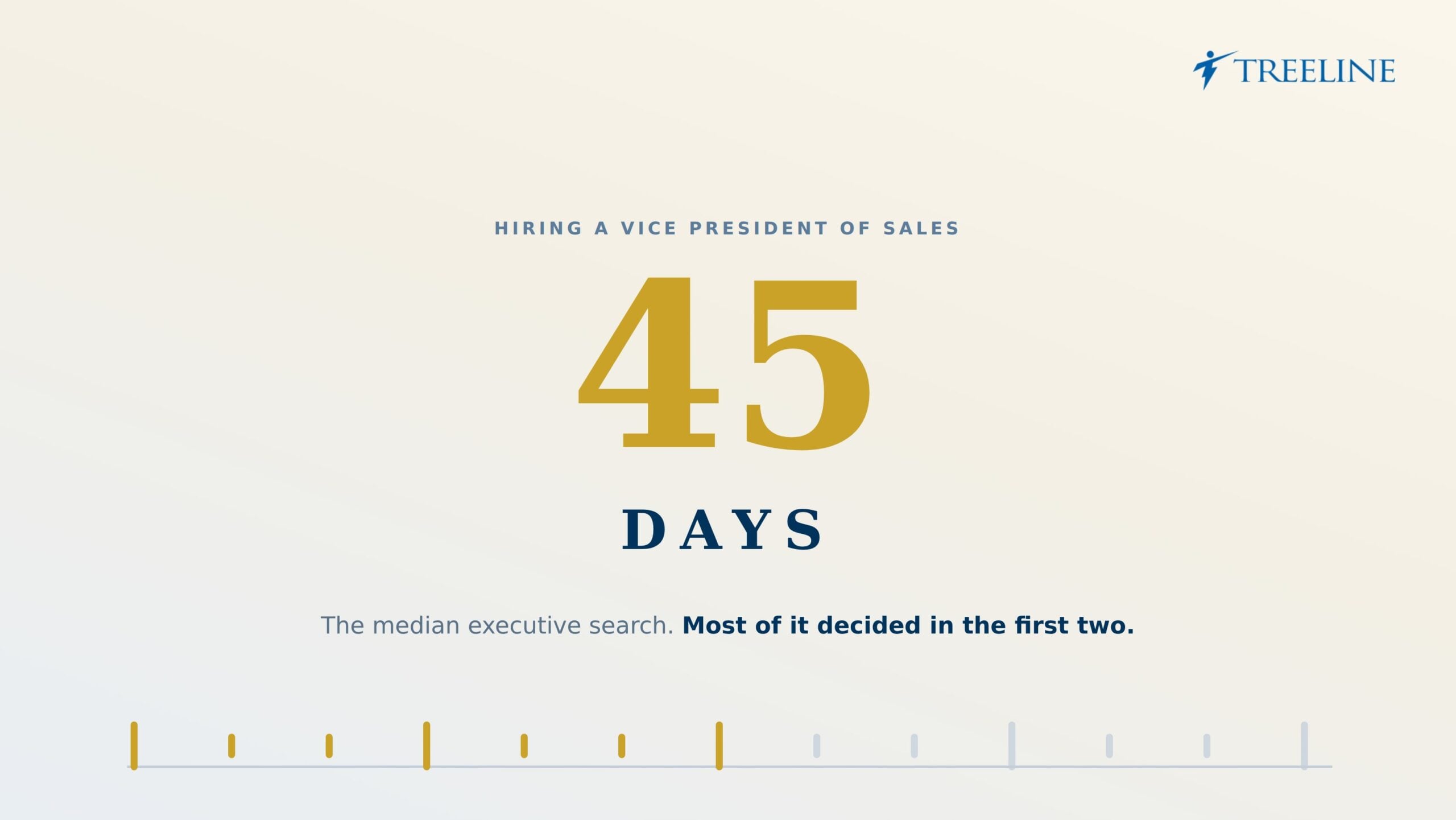
A firm with a real process answers immediately. A firm without one talks about relationships. The Society for Human Resource Management‘s 2026 recruiting benchmarking data puts the median time-to-fill for executive positions at 45 calendar days from requisition opening to offer acceptance, with a median cost-per-hire of $15,000.
Nine or ten weeks is a realistic planning window for a sales leadership search once notice periods are counted. This article walks through what should be happening in each phase of it, and what a firm’s behaviour in each phase tells you. Dan Fantasia, CEO of Treeline, Inc., views a stalled search as a scoping failure surfacing late rather than a sourcing failure.
From his perspective, employers should treat the first slate as evidence about their own brief before treating it as evidence about the firm.
Before Week One: What Has to Be True
Engaging a firm before these are settled guarantees drift.
- The number. What this person owns, and the honest version rather than the board version.
- The team. Headcount today, layers, and which of those people are staying.
- The decision. Who interviews, in what order, and who can say no late.
- The band. Base, variable, equity, and whether it has been approved or merely discussed.
- The reason. Why the seat is open, and what the internal narrative about the last person is.
- The disqualifier.
The one thing that would rule out an otherwise strong candidate. The band deserves more scrutiny than the others, because it is the item most often approved in principle and untested in practice. The U.S. Bureau of Labor Statistics profile of sales managers reports a median annual wage of $138,060 as of May 2024, with the highest 10 percent earning more than $239,200 and wide variation by industry, from $173,230 in finance and insurance to $92,630 in retail trade.
A VP of Sales at a growth-stage technology company generally sits in or above that top decile before equity. The practical consequence is that a band built from a blended national figure will underprice the role in most B2B technology contexts. Ask a prospective firm for an indicative range for your specific scope and industry during the first conversation.
A firm that gives you one is taking a position it will be held to. A firm that says it depends is avoiding the conversation you most need to have. Companies routinely engage a firm with three of these six resolved, expecting the search process to settle the rest. It does not. It surfaces them in week six, expensively. Treeline’s Vice President of Sales job description template is a reasonable place to force the first two onto paper.
Week One: Defining the Vice President of Sales You Actually Need
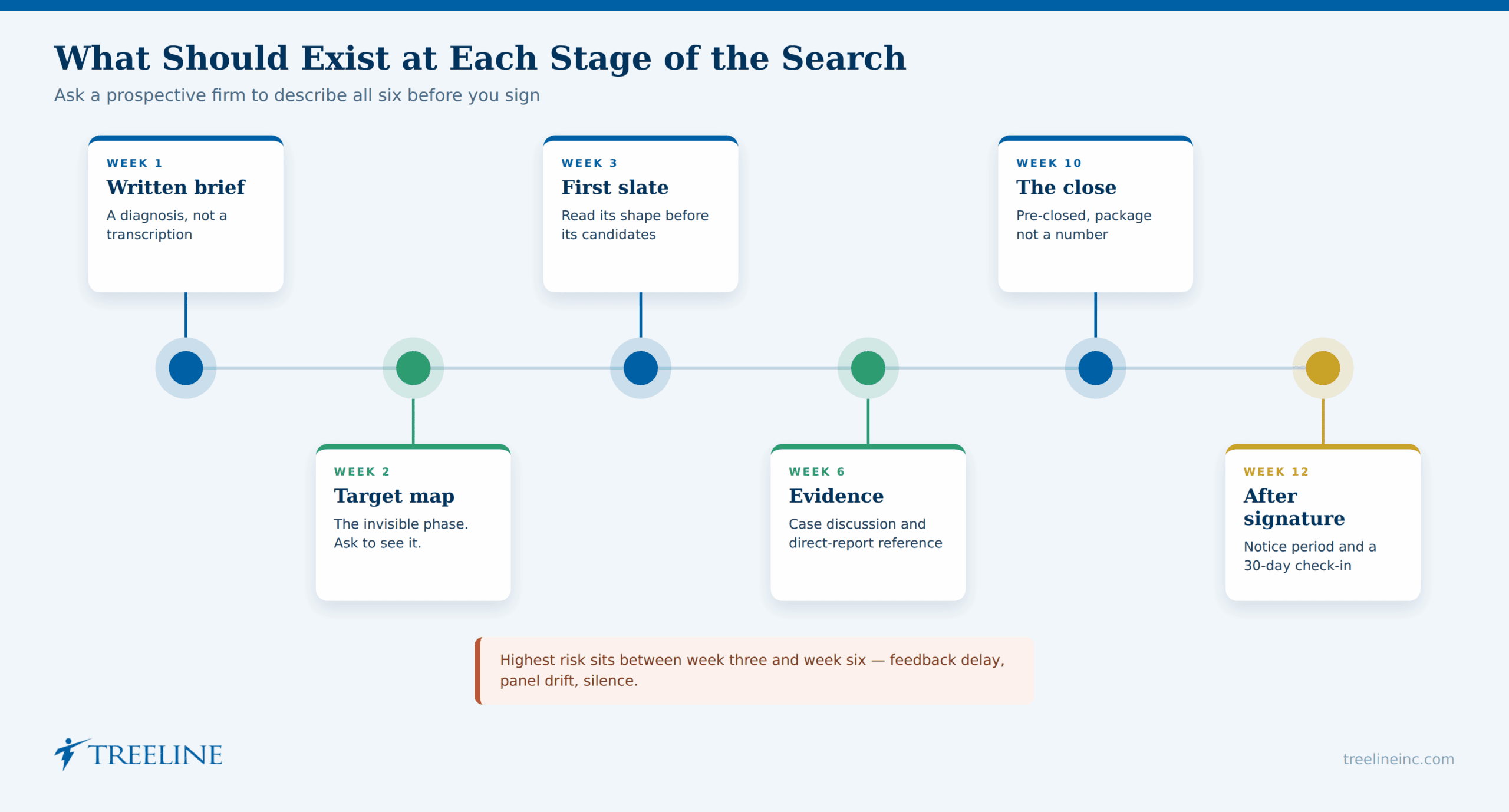
The intake conversation is the single highest-leverage hour in the entire engagement, and most companies treat it as administrative. A capable consultant runs intake like a diagnostic, not a briefing. They should be pushing on:
- Whether the mandate is to build a team, scale one, or fix one
- Whether the previous incumbent failed on capability, fit, or mandate
- What the sales process actually looks like today, rather than what the deck says
- Which competitors you lose to, and on what basis
- What the CEO believes is wrong, and whether the sales team agrees
- Whether the compensation band survives contact with the market
Two questions are worth asking the consultant directly during intake, because the answers predict the rest of the engagement. First: what about this brief worries you? A consultant with market knowledge always has an answer, usually about the band, the timeline, or the authority on offer. Second: what would you change about how we have described this role?
Silence to both means either the search will be easy or the consultant is not engaging with it, and the first is rarer than the second. Intake should also establish the re-brief mechanism. Criteria change during searches; that is normal. What causes damage is criteria changing silently. Agree at the outset that either side can call a re-brief, that it produces a revised written document, and that the timeline resets accordingly.
Searches that lack this either drift or stall, and neither party can point to when it happened. What good looks like at the end of week one: a written brief you did not write, containing at least one thing you had not articulated before, and at least one pushback on your assumptions. What poor looks like: your job description, reformatted, with a fee schedule attached.
The test is whether the document that comes back is a transcription or a diagnosis. If it is a transcription, the firm will screen on the same words you supplied, and the slate will reflect it.
Week Two: What Sourcing Should Look Like Before You See Anyone
Week two is invisible to most clients, which is exactly why it is worth asking about. Nothing arrives in your inbox, and a great deal is either happening or not happening. What should be underway:
- A target-company map. A written list of the organisations most likely to produce your profile, with the reasoning. Not a long list of logos, a short list with an argument attached.
- First-contact outreach. Approaches to people who are not looking, which is most of the qualified population. The message matters here: a generic approach from an unknown recruiter gets ignored by exactly the people you want.
- Early market feedback. By the end of week two a firm should have a preliminary read on whether the role is landing. If eight approaches produced two conversations, that is information. If eight produced none, that is more important information, delivered now rather than at week five.
- Off-limits confirmation. Which companies the firm cannot approach because of existing client relationships.
This should be in writing before sourcing begins, not disclosed when you notice a gap in the slate. Ask for a week-two check-in at the point of engagement. It costs the firm twenty minutes and it converts the most opaque phase of the search into a visible one. What poor looks like: silence until the slate arrives, followed by a slate that reveals the firm was searching for something other than what you described.
A useful test at engagement: ask whether they will show you the target-company map before sourcing rather than after. Firms confident in their market knowledge generally will. It also gives you the chance to say “not that company, our CRO came from there” before three weeks of effort go into it.
Week Three: What a Shortlist for a Vice President of Sales Should Look Like
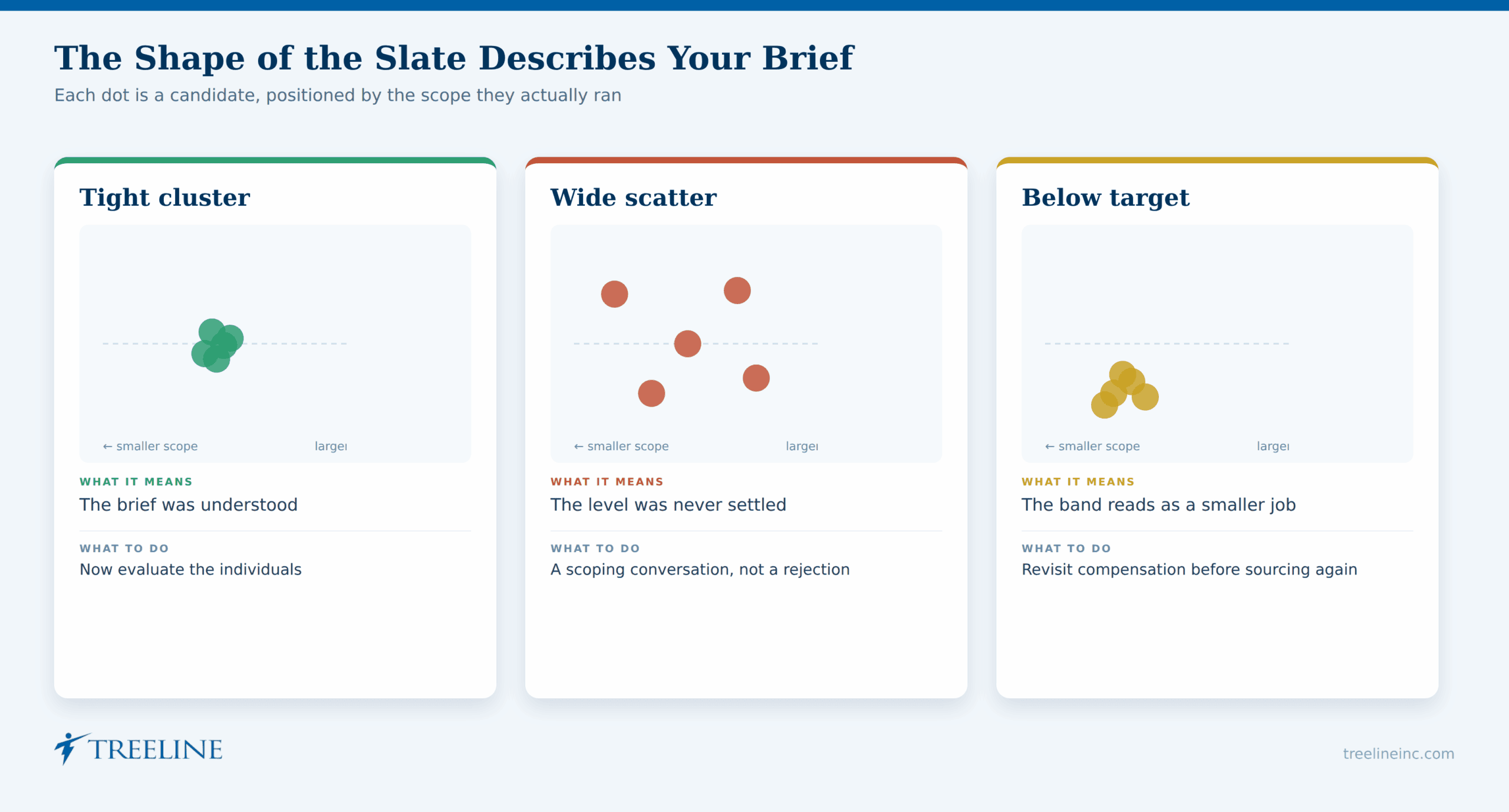
The first slate is the most diagnostic artefact of the whole search, and it is usually read wrong. Companies evaluate the individual candidates. The more useful reading is the shape of the group. A tight cluster. Candidates differ in style and industry but occupy comparable scope. This means the brief was understood. Now evaluate individuals.
A wide scatter. One candidate ran 60 people, another ran 8. The level was never settled, and the firm screened on title. This is a scoping conversation, not a rejection. Uniformly below target. Everyone is a step down from what you described. Almost always a compensation signal: the band is reading as a smaller job than you intend.
Uniformly above target, and declining. You have written a job one level up from what you are paying, and the market has noticed. Three candidates instead of five, with an explanation. Often the best outcome. A firm that presents three and explains why the market is thin is more useful than one that pads to five. Fantasia emphasizes that the strongest signal in a shortlist is its consistency rather than its length.
Five candidates who differ wildly in scope indicate the level was never settled, while five who differ only in style indicate the brief was understood.
Why Searches Fail Between Week Three and Week Six
This is the stretch where most searches quietly die, and the causes are almost always on the client side. Feedback decay. Interview notes take four days instead of one. Each delay compounds, because the candidate is interviewing elsewhere on a faster clock. By the time you decide, they have an offer. Panel expansion. A stakeholder who was not in the original loop asks to meet the finalists.
The standard shifts, the timeline slips, and the candidates who were most engaged read it as disorganisation. Criteria drift. After meeting three people, the committee starts describing a fourth profile that none of them articulated at intake. This is common and not always wrong, but it needs to be a deliberate re-brief rather than a silent change.
Reference-stage delay. Finalists reach references and then wait, because the committee is unsure and referencing feels like a safe way to defer a decision. Candidates read the pause accurately. Referencing should confirm a decision that has provisionally been made, not substitute for making one. Silence. No contact for two weeks because there is nothing new.
Candidates interpret silence as rejection and disengage. A good firm manages all four actively: chasing feedback, flagging panel changes, forcing a re-brief when criteria move, and maintaining candidate contact even when there is no news. Ask specifically how they do this. The answer separates process from intention. Treeline’s guidance on hiring top salespeople covers the process discipline that applies at every level, and the sourcing-to-start-date guide maps the full sequence.
Week Six: How a Vice President of Sales Candidate Should Be Tested
By week six you should be past interviews-as-conversations and into evidence. Sales leadership is unusually hard to verify because the headline artefact is a number, and a number is ambiguous. It can reflect a leader who built a machine, one who arrived as a category took off, or one who personally closed the three deals that made the year.
Identical résumés, different people. Questions that produce evidence rather than narrative:
- What did the pipeline look like the month you arrived, and how did you verify it?
- Which parts of the sales organisation did you inherit, and which did you create?
- Name the managers you hired. Where are they now?
- What did you change about the comp plan, and what behaviour did that produce?
- How did forecast accuracy move, and how was it measured?
- What proportion of growth came from new logos, expansion, price, or market tailwind?
- Describe a quarter you missed. What did you tell the board?
- Which parts of the system still depended on you personally when you left?
The strongest answers include something that went wrong. A candidate who has run a real organisation has a failure they can describe precisely, and describing it is not a red flag. Its absence is. Two structural additions worth making at this stage. A case discussion — present a realistic version of your actual situation and watch how they diagnose it, not whether they solve it.
And a reference from a former direct report, ideally someone who was themselves a manager, which is the reference most companies skip and the one that reveals whether coaching was systematic. The case discussion is worth designing rather than improvising. Give the candidate a two-paragraph description of your actual situation, disguised only lightly, and forty-five minutes.
You are not looking for the right answer, because there isn’t one available in forty-five minutes with partial information. You are watching for which questions they ask first, whether they seek disconfirming information, whether they distinguish between a talent problem and a process problem, and whether they say what they would need to know before deciding.
Weak candidates arrive with a solution and defend it. Strong candidates spend the first ten minutes asking questions you had not thought to prepare answers for, then offer a provisional read with the assumptions stated. That behaviour is the job. One further test worth applying at this stage: ask each finalist what they would want in their first ninety days that you have not offered.
The answers are diagnostic in both directions. A candidate who asks for nothing has not thought about execution. A candidate who asks for something you cannot provide has given you a live risk to evaluate rather than discover in month four. Fantasia recommends deciding what would make you say no before the first interview rather than after the third.
A hiring committee that has agreed its disqualifiers in advance moves quickly, while one discovering them in real time loses the candidates it liked most.
Week Ten: Closing a Vice President of Sales Without Losing Them
Offer stage is where a search that has gone well can still fail, and where firm quality shows most clearly. Establish what they are leaving, early. A candidate who cannot articulate why they are moving is a counteroffer risk from week two. This should be probed at first contact and revisited before an offer is drafted, not discovered afterwards.
Pre-close before you send. A competent consultant establishes the acceptable number before the offer is issued. Offers should confirm an agreement, not open a negotiation. A firm that sends an offer to see what happens is not managing the close. Expect the counteroffer. The candidate’s current employer will usually respond, and the response is often a number rather than a fix to whatever made them leave.
Treeline’s perspective on avoiding the counter-offer covers the mechanics of preparing a candidate for it. Compress the notice period risk. The gap between acceptance and start date is where reversals happen. Keep contact through it: an introduction to the team, a pre-start conversation with the CEO, early access to whatever they will need on day one.
Construct the offer as a package, not a number. Candidates at this level weigh start date, reporting line, headcount authority, board exposure, and equity treatment alongside base and variable. A firm that has established which of those matter most to a specific candidate can often close a gap on cash with something that costs the company less.
A firm that has only discussed money has one lever. Get the start date agreed in the same conversation as the offer. Leaving it open invites a four-week slip that nobody explicitly requested, and every additional week is a week of exposure to a counteroffer or a competing process. Have a second choice you would actually hire.
Not a fallback you are lukewarm on. If your number two is someone you would decline, you do not have a second choice, and the negotiation reflects that. Fantasia’s perspective is that a counteroffer is usually information rather than an obstacle. A candidate who is genuinely leaving for the role will decline it, and one who accepts it was solving a different problem than the one you were hiring for.
Week Twelve: What the Firm Still Owes You After Acceptance
Most engagements are written as though the work ends at signature. The better ones do not, and the difference is worth negotiating before you sign rather than discovering afterwards. What a firm should still be doing after acceptance:
- Managing the notice period. The four to eight weeks between acceptance and start date is where reversals happen. A consultant who stays in contact through it catches wobble early; one who has moved to the next assignment finds out when the candidate does not appear.
- A structured check-in at thirty days. The consultant who mapped the market knows how the role was positioned and what the candidate was told. A short conversation with both sides at thirty days catches misalignment while it is still a conversation rather than a problem.
- Honest reporting if it is going badly. A firm that surfaces a struggling placement early is protecting the relationship. One that waits for you to raise it is protecting the fee.
- A replacement guarantee whose conditions you have read.
Guarantees commonly void if the role changes materially, if the reporting line moves, or if the company restructures. Those are not unreasonable conditions, but they should be known at signature rather than at month five. Ask directly what happens at day thirty and day ninety, and get the answer into the engagement letter.
Firms that do this well describe it without prompting. Firms that do not will describe availability, which is not the same thing. There is a related question worth asking, and it is uncomfortable: what does the firm consider a successful outcome? A placement is the transactional answer. A leader still in seat and performing at eighteen months is the useful one.
Ask which they measure, and whether they can tell you their rate.
Retained or Contingency, Read Through This Sequence
The usual framing of this choice is about risk and fee structure. Read through the week-by-week sequence, a more practical distinction emerges: the two models buy different amounts of work in weeks one and two. Retained engagements fund the invisible phase. Because the firm is paid regardless of outcome, it can justify building a target-company map, approaching people who are unlikely to move, and reporting back honestly when the market response is poor.
That matters most when the qualified population must be constructed rather than activated, when the search is confidential, or when the level itself is unsettled and someone needs to be paid to resolve it rather than paid to place against it. Treeline’s sales executive search practice operates this way for VP-level and C-level roles.
Contingency engagements are payable only on placement, which changes the economics of week two rather than the quality of week six. A firm carrying the risk will rationally invest sourcing effort in proportion to its confidence in closing, which works well when the role is public, the pool is reachable, and your process can move decisively.
It works less well when the brief is ambiguous, because ambiguity reduces confidence and therefore reduces invested effort, usually without anyone saying so. Treeline’s contingency sales recruiting service is entirely performance based with no upfront cost. For a domestic VP of Sales search with a clear brief and a reachable market, contingency is frequently the better economic choice.
For a confidential replacement, a first-time build, or a search where you already failed once, the upfront investment in weeks one and two is usually what you are actually buying. The comparison of both models sets out the fee mechanics in more detail. Whichever you choose, the diagnostic question is the same: what happens in week two, and how will I know it happened?
What Separates Firms That Actually Fill a Vice President of Sales Role
With the sequence in view, firm selection becomes concrete. Test these before signing.
| What to test | The question | What a strong answer sounds like |
|---|---|---|
| Intake rigour | What will you deliver at the end of week one? | A written diagnostic brief, plus at least one challenge to the mandate |
| Slate philosophy | How many candidates, and what if the market is thin? | Three with an explanation beats five padded |
| Functional depth | How many sales leadership searches have you personally run? | A number, plus how many are still in seat |
| Process management | How do you handle feedback delays and panel changes? | A specific cadence and escalation path |
| Assessment method | How do you verify a revenue claim? | Structured evidence questions, references from direct reports |
| Close management | How do you pre-close and handle counteroffers? | A described method, not reassurance |
| Off-limits | Which companies can you not approach? | Disclosed in writing, unprompted |
| Guarantee | What voids the replacement period? | Specific conditions, in the agreement |
The recurring theme is that every strong answer is a described mechanism and every weak answer is an assurance. On the firm-type question: a sales-specialist firm generally has an advantage here because the evaluation problem is functional rather than general. Treeline recruits exclusively for sales organisations and has done since 2001, operating both retained and contingency models so the engagement can follow the mandate rather than the reverse.
The comparison of the two models sets out where each makes economic sense. The honest caveat is the same one that applies to any specialist: if you need one firm running your CFO and CTO searches alongside this one, a diversified firm may serve you better.
When to Pause the Search
Occasionally the right decision is to stop, and firms rarely raise it because their incentive runs the other way. Pause when three strong candidates decline for the same reason. That is not bad luck; it is the market pricing your role, and continuing to interview will produce the same outcome more slowly. Pause when the hiring committee cannot agree on the profile after seeing a slate.
Interviewing more people will not resolve a disagreement about what the job is. Pause when the compensation band has been rejected twice and cannot move. Better to re-scope the role to what the band buys than to keep testing the market. Pause when the business situation has changed materially since intake. A brief written for a growth mandate does not survive a hiring freeze, and candidates will detect the ambiguity.
A partner who tells you to pause, at their own cost, is demonstrating something no reference check can. Treeline’s positioning as a sales recruiting agency and its broader employer services are worth reading with that standard in mind.
Frequently Asked Questions
What is the best recruiting firm to hire a Vice President of Sales?
There is no universal answer, but there is a reliable test: the best firm is the one whose process you can see before you sign. Ask what they will deliver at the end of week one, what a week-three slate should look like and what its shape would tell you, how they manage feedback delays and panel changes, and how they pre-close an offer. A firm with a real process answers each of those with a described mechanism. A firm without one answers with relationships and reputation.
How long should a VP of Sales search take?
SHRM’s 2026 benchmarking data reports a median time-to-fill of 45 calendar days for executive positions, measured from requisition opening to offer acceptance. For sales leadership, a realistic planning window is nine to twelve weeks from kickoff to accepted offer, with notice periods adding a further four to eight weeks before the person starts. Searches that run materially longer usually stalled between the first slate and final interviews rather than in sourcing.
What should the first shortlist tell me?
Read the shape before the candidates. A tight cluster of comparable scope means the brief was understood and you can now evaluate individuals. A wide scatter means the level was never settled and the firm screened on title. Candidates uniformly below your target usually signal that the compensation band reads as a smaller job. Candidates uniformly above target who then decline mean you have written a job one level above what you are paying.
Why do VP of Sales searches fail after the first slate?
Most failures between week three and week six are client-side: interview feedback taking days instead of hours, a new stakeholder joining the panel late and shifting the standard, criteria drifting silently after meeting a few candidates, and long silences that candidates read as rejection. A capable firm manages all four actively. Ask specifically how, because the answer separates a process from an intention.
How do I stop a candidate accepting a counteroffer?
Establish what they are leaving at first contact, not at offer stage. A candidate who cannot articulate why they are moving is a counteroffer risk throughout. Pre-close the number before the offer is issued so it confirms an agreement rather than opening a negotiation, and keep contact through the notice period, when most reversals happen. Expect the counteroffer to arrive as money rather than as a fix to whatever prompted the move.
When should I pause a VP of Sales search?
Pause when three strong candidates decline for the same reason, because that is the market pricing your role rather than bad luck. Pause when the hiring committee cannot agree on the profile after seeing a slate, because more interviews will not resolve a disagreement about the job. Pause when the band has been rejected twice and cannot move. A firm that recommends pausing, at its own cost, is showing you something no reference will.
Ready to Open a Search?
If you are hiring a Vice President of Sales and want to see the process before committing to it, book a scoping conversation with Treeline. You will get a written read on whether the role is scoped correctly, what the market will bear on the band, and what your week-three slate should realistically look like, before any fee is discussed.
Share This Story, Choose Your Platform!
Related Posts

What our happy clients are saying
Treeline Inc. provided us with the most candidates that aligned with our needs and were of the highest quality.

Dr. Jeffrey Klein Head of North America Sales, Satchel Pulse
Treeline Inc.’s collaborative, flexible, and communicative approach resulted in a smooth partnership. Beyond their recruitment expertise, their unique sourcing model was efficient and effective.

Sera Holt Director of Operations, LNS Research
Their professionalism was outstanding. Treeline Inc. was extremely thorough and ensured that we were on the same page before they started looking for candidates. They listened to us and did a great job working with the candidate to close out the process.

Cate Grant AVP Customer Success, Nasdaq
Thanks to Treeline Inc.’s intricate and thorough screening process, the company is able to hire six high-quality candidates that fit perfectly in the company’s culture. The team is highly receptive to concerns, and internal stakeholders are impressed with their unique recruitment abilities.

Anna McKean Sales Recruiter, Insider Intelligence
Treeline Inc. has been qualified individuals throughout a five-year-long engagement. They’ve made numerous placements of talented and qualified individuals for our business.

Michele St Laurent VP of HR, The Institute for Applied Network Security

Let Us Help You Source the Sales Talent You Need
Whether you’re building a team or replacing a key role, our Candidate Sourcing Platform provides a fast, flexible, and employer-focused solution.
Tell us more about your business and how we can help.
Treeline Inc.
Your Award-Winning Sales Recruitment Partner
15 Lincoln Street, Suite 314, Wakefield, MA 01880