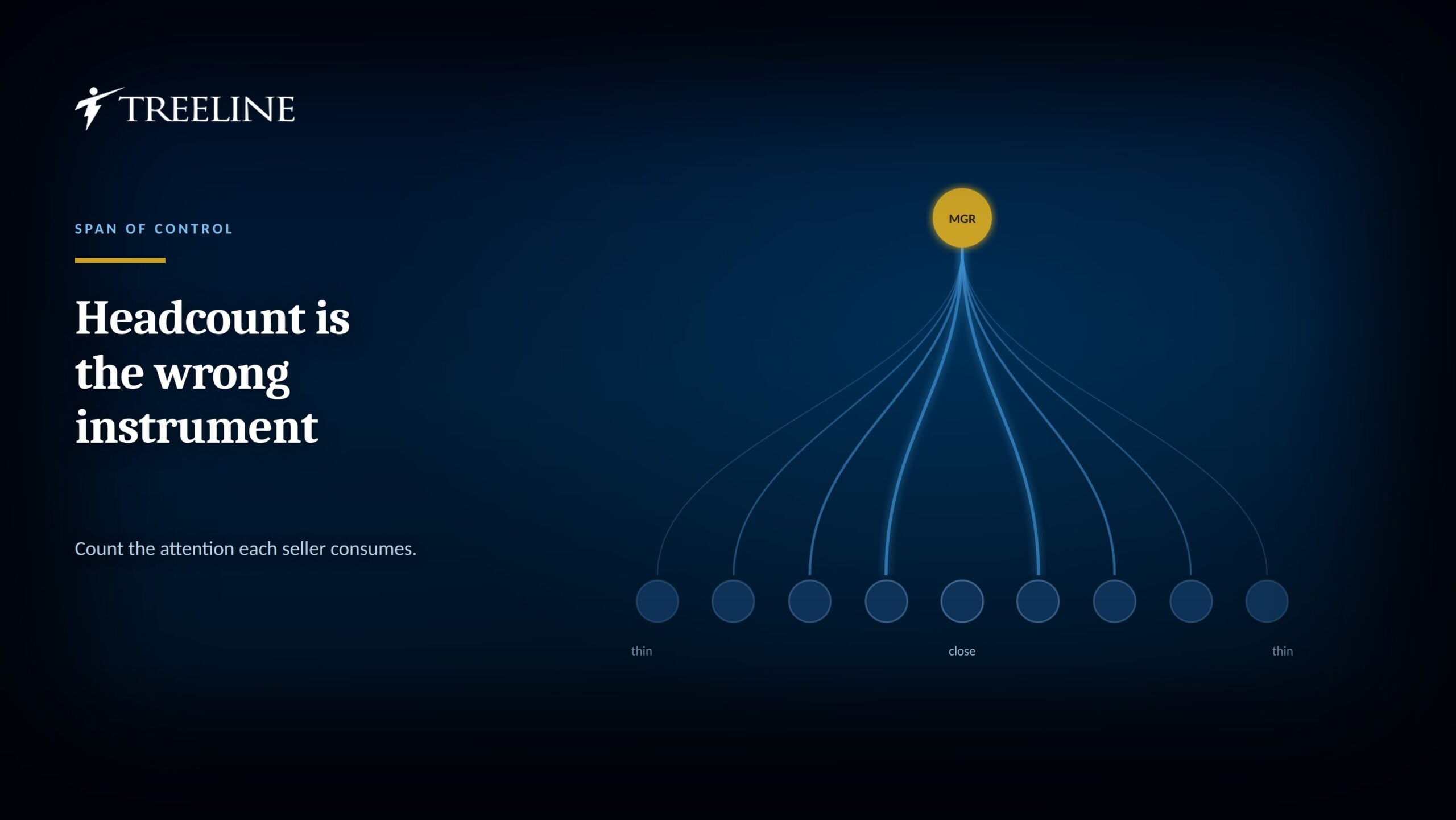
There is a number most companies reach for when this question comes up, seven, eight, sometimes ten, and it is the wrong instrument. Span of control is not a constant. The same manager who is comfortable with nine transactional sellers running short cycles will be overwhelmed by five enterprise sellers running nine-month deals with security review and procurement in them.
What determines the right number is how much of the manager’s attention each seller consumes, and that varies by cycle length, deal complexity, seller tenure and how much infrastructure exists to absorb the work. The useful approach is to measure consumption rather than count heads. Where the answer is that another manager is warranted, a contingency sales recruiting arrangement carries the risk of a search that does not close, which matters when you are not yet certain the role should exist, the trade-off against a retained structure turns on how settled the requirement is.
Dan Fantasia, CEO of Treeline, Inc., measures management capacity by what has stopped happening rather than by how many people report in. From his perspective the reliable signal is that coaching has quietly become deal inspection, because that substitution happens before anyone reports being stretched.
When to Hire Another Sales Manager: The Signals That Matter
Four indicators arrive before the numbers move, which is the point of watching them.
Coaching has become inspection. A manager with capacity spends time on how a seller works, discovery quality, how they handle a stalled deal, what they are avoiding. A manager without capacity spends the same meeting asking where each deal stands. The second is forecasting, not coaching, and the switch happens unconsciously.
Onboarding has slowed. The clearest measurable signal. If the last two hires took visibly longer to reach productivity than the two before them, and nothing else changed, the manager has run out of the attention onboarding consumes.
The weakest seller has been tolerated for two quarters. Personnel decisions are the first thing an overloaded manager defers, because they are time-expensive and emotionally costly. A manager who knows someone is not working and has not acted has usually run out of capacity rather than nerve.
One-to-ones are being cancelled. Not moved, cancelled. The meeting that produces no immediate output is the one that gets dropped when the week is full, and it is also the one whose absence compounds.
None of those appear in a revenue report, and all four are visible to anyone who asks.
When to Hire Another Sales Manager: Count Attention, Not Heads
A more precise approach is to estimate how much of a manager’s week each seller genuinely consumes, because the variance is large.
A tenured seller running a familiar motion in a stable territory might need two hours a fortnight. A new hire in month two needs several hours a week, joint calls, deal strategy, product questions, the accumulated small corrections that build judgement. A strong performer working an unfamiliar segment needs more than their record suggests. A seller in difficulty consumes more than anyone, and the time is rarely recovered.
Run that estimate across the team and the answer is frequently uncomfortable. A team of eight containing three recent hires and one struggling seller consumes considerably more management than a team of eleven who have all been there two years.
The practical consequence is that the right moment to add a manager often arrives during a hiring push rather than after it. Companies that add sellers first and management later spend two quarters with an overloaded manager and a cohort that ramps slowly, then conclude the hires were weak.
The corollary: if you are planning to add four sellers next year, the management question belongs in the same plan, not in the one after it.
What Makes One Seller Cost More Than Another
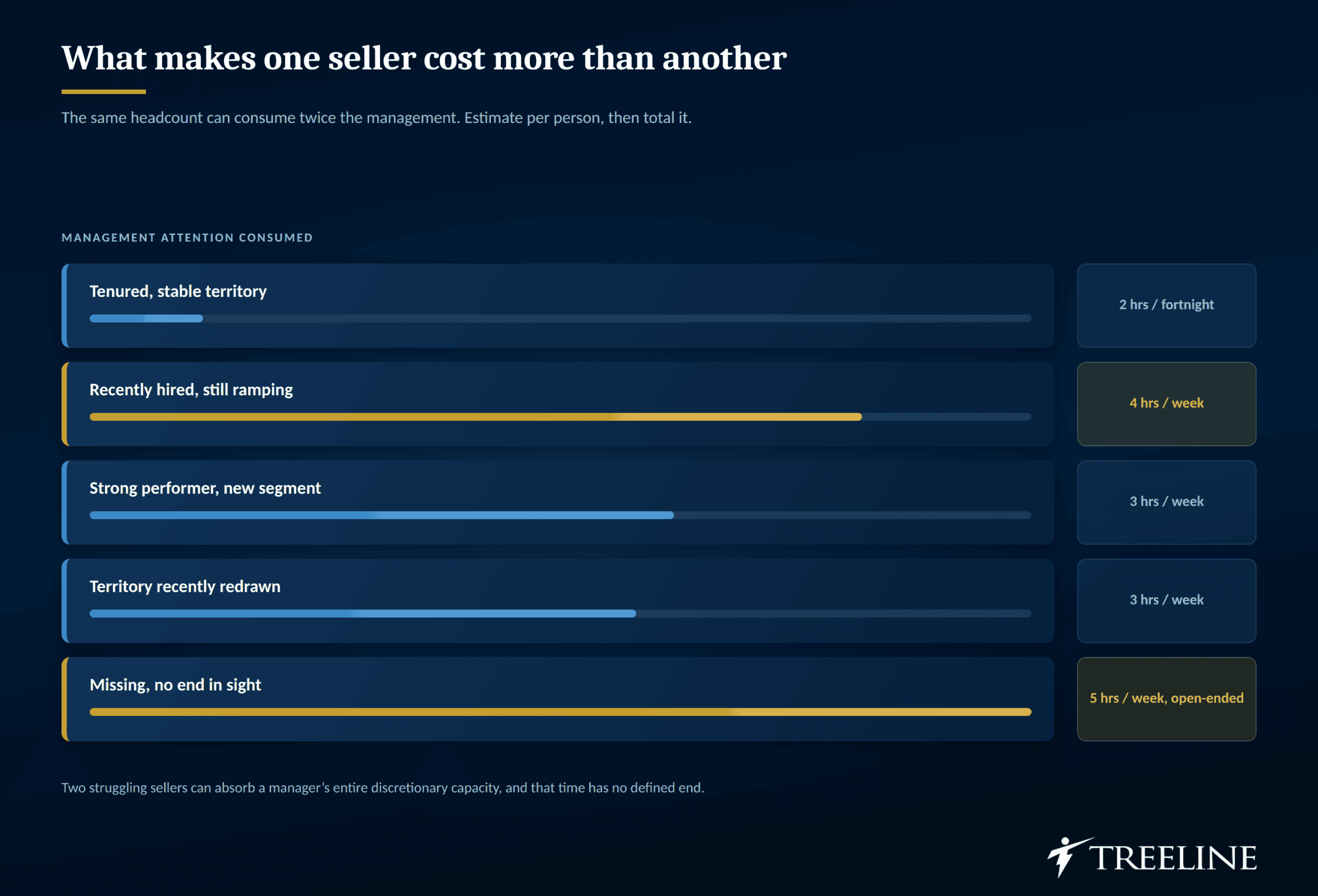
Since the whole argument rests on attention consumed rather than headcount, it is worth being concrete about what drives the variance.
Tenure in the role is the largest factor. A seller in their first six months needs joint calls, deal strategy, product coaching and the steady correction of small judgement errors. The same person at eighteen months needs a fraction of it.
Cycle length compounds everything. A ninety-day cycle produces frequent, short coaching moments and fast feedback. A nine-month enterprise cycle means a manager may only see a handful of full deal arcs a year per seller, so each one requires deeper involvement to be useful at all.
Deal complexity adds stakeholders, and stakeholders add escalations. A deal with seven approvers, a security review and a procurement negotiation will pull a manager in at several points regardless of how capable the seller is.
Territory stability matters more than expected. A seller whose patch was recently redrawn is effectively partly new, even with years of tenure.
Performance trajectory is the asymmetric one. A seller in difficulty consumes several times what a performing one does, and unlike onboarding, that time has no defined end. Two struggling sellers can absorb a manager’s entire discretionary capacity.
The practical exercise takes twenty minutes: list the team, assign each person a rough hours-per-fortnight figure, and total it. Most managers can do this from memory, and the total is usually higher than the company assumes.
How to Split a Team Without Breaking It
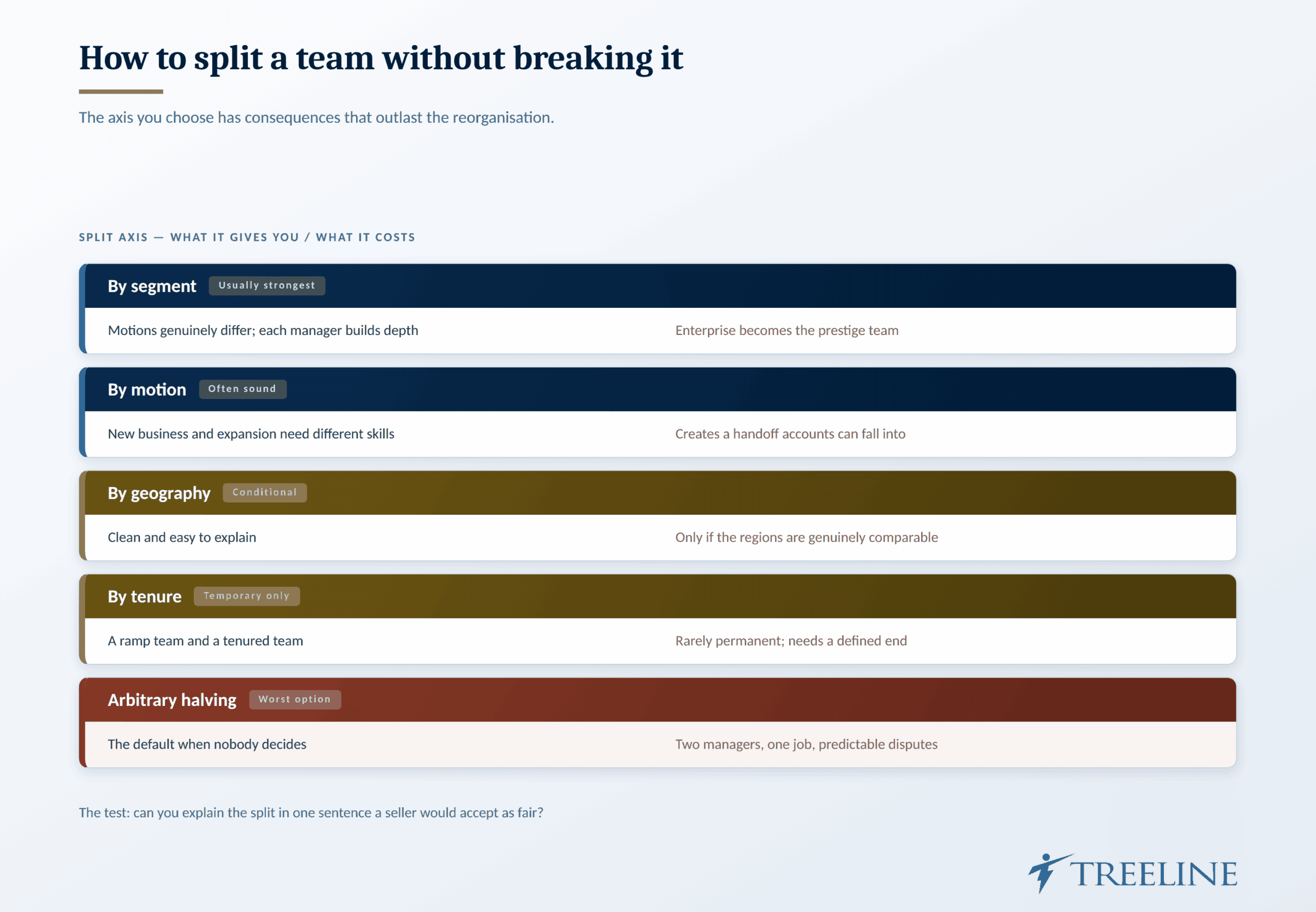
The decision to add a manager is followed immediately by a harder one, how to divide the team, and the axis you choose has consequences that last.
By segment. Enterprise under one manager, mid-market under another. This is usually the strongest split, because the motions genuinely differ and each manager develops depth in one. The risk is that the enterprise side becomes the prestige team and mid-market becomes a waiting room.
By geography. Clean and easy to explain, which is why it is popular. It only works if the geographies are genuinely comparable; splitting into a strong region and a weak one creates a manager set up to fail and a comp conversation that never resolves.
By motion. New business under one, expansion under another. Sensible where the two require different skills, and it reflects how the work actually differs. It creates a handoff point that has to be designed deliberately or accounts fall into it.
By tenure. A ramp team and a tenured team. Rarely permanent and occasionally useful during a heavy hiring period, with a defined end.
By account size within segment. A variant worth knowing about where one segment is large enough to split internally, named accounts under one manager, the rest of the segment under another. It preserves motion consistency while dividing load, and it suits organisations where a small number of accounts consume disproportionate attention.
By arbitrary halving. The default when nobody decides, and the worst option. It produces two managers running two versions of the same job with no basis for differentiation and predictable territory disputes.
The test is whether you can explain the split in one sentence that a seller would accept as fair. If the explanation requires three sentences and a caveat, the axis is wrong.
Fantasia reads an unexplainable split as a sign the decision was made for convenience rather than for the business. His suggestion is to draft the sentence before choosing the axis, on the basis that an axis which cannot be justified to the team will be relitigated every quarter. An axis needing three sentences and a caveat is the wrong axis.
Who Gets Which Team
Having chosen an axis, the allocation matters more than companies expect.
The instinct is to give the incumbent manager the stronger half and the new manager the weaker one, on the grounds that the incumbent has earned it. This is usually backwards. A new manager needs a win in the first two quarters to establish credibility, and handing them the difficult half means their first visible result is a miss they inherited.
The opposite instinct, giving the new manager the strong team to set them up, has its own cost, because the incumbent reads it as a demotion.
The workable version is to split by the axis honestly, then balance within it. If the segments are genuinely unequal, say so openly and adjust the targets rather than pretending the halves are equivalent. Sellers detect an unfair split immediately, and the resulting comp conversations consume more management time than the split saved.
One more decision that gets deferred and should not: which sellers move. People who have worked for one manager for two years and are reassigned without explanation will interpret it as a judgement. Five minutes of context per person prevents a quarter of speculation.
The Comp and Territory Work That Comes With It
Adding a manager is not only a hire; it triggers a set of adjustments that are cheaper to plan than to retrofit.
Territory boundaries have to be redrawn, and the redraw is where sellers lose accounts they have worked for a year. Every account that moves needs a reason the seller can accept and, where the account was close to closing, a decision about whether credit follows the account or stays with the person who built it. Getting that wrong once poisons the next reorganisation too.
Quota allocation changes because the teams are now measured separately. If one half is genuinely stronger, identical quotas per head will produce one manager who looks excellent and one who looks poor for reasons neither controls.
The new manager’s own compensation has to be set against the existing manager’s without creating a grievance. If the new hire is external and commands a market rate above the incumbent’s, that gap will become known, and the honest options are to adjust the incumbent or to be ready to explain the difference.
Reporting and cadence need a decision that is usually deferred. Do the two managers forecast separately and roll up, or jointly? Does the weekly pipeline review split? Left undecided, the default is that everything happens twice and takes longer than it did with one manager.
None of this is difficult. All of it is significantly harder in month two, with the new manager present and the team watching, than it is on a whiteboard in the week before the offer goes out.
Promote From Within or Hire Externally
This differs from the equivalent decision on a first manager, because now you have a working system and a bench.
The case for promoting is stronger here than it was the first time. The motion exists, the comp plan exists, the forecast cadence exists. A promoted seller is learning management rather than inventing infrastructure, which is one hard thing instead of two. They also know the product, the buyer and the deals.
The case for hiring externally is specific: when you need a capability the existing management layer does not have. If the new team is enterprise and everyone internally has run mid-market, promoting from within means nobody in the room has done the job. If you are splitting into a new geography, local knowledge may not exist internally.
One factor that decides this more often than capability: whether the internal candidate actually wants the job. A strong seller earning well on commission may take a management role out of a sense that it is the expected next step, then discover within two quarters that they miss selling and have taken a pay cut to be less happy. That conversation is worth having explicitly and early, including what their compensation will actually look like, because the alternative is discovering it after both the team and the territory have been disrupted.
There is a sequencing option that companies underuse. Promote internally into the familiar half and hire externally into the unfamiliar one. That places the person who knows the company where the company knowledge matters, and the person with the missing capability where it is needed.
The mistake to avoid is promoting your strongest seller purely because they are the strongest seller. Selling well and managing well are related but not the same, and the cost of getting this wrong is doubled: you lose a producer and gain a struggling manager.
Fantasia’s starting point on this decision is whether the candidate has ever made someone else better in a way that can be evidenced. He regards informal coaching history as the most predictive signal available internally, and it is knowable by asking the team rather than the candidate.
When to Hire Another Sales Manager and What Waiting Costs
Delay is the more common error, and its costs are diffuse enough to be missed.
The first cost lands on new hires. They ramp slowly because the person responsible for ramping them is stretched, and the organisation attributes the slow ramp to the hires rather than to the capacity.
The second lands on the weakest performer, who stays longer than they should, absorbing territory and management attention while the decision is deferred. There is a compounding element rarely traced back: the rest of the team observes the tolerance, and a standard that visibly is not enforced stops working as a standard.
The third lands on the manager. Managing beyond capacity is not sustainable, and the people who do it longest tend to be the ones who care most. Losing a good manager to burnout costs more than the salary of the one you did not hire, and it usually happens without warning.
The fourth is the one nobody counts: the coaching that did not happen. A team where nobody improved for two quarters has a performance cost that never appears as a line item, and the drift is diagnosable in specific ways. Discovery gets shallower. Deals get qualified in that should have been qualified out. Forecast optimism returns because nobody is challenging the commit.
When to Hire Another Sales Manager Is Too Early
The opposite error is less common and worth naming for balance.
Two managers with four sellers each is frequently worse than one with eight. Both are underemployed, both look for work to do, and the work they find is usually process, additional reporting, more meetings, more structure than the team needs.
It also creates a comparison. Two managers running parallel teams will be measured against each other, and on small teams a single strong or weak seller swings the comparison entirely. That produces noise interpreted as signal.
And it costs money at a point where the additional management does not yet produce a return. The salary is the visible part. The less visible part is that a capable manager hired into an underemployed role frequently leaves within the year, which makes the eventual, genuinely necessary hire harder, the market has now seen the role open twice.
The distinguishing question is whether the current manager is genuinely at capacity by the four signals above, or whether the company is anticipating growth that has not arrived. Hiring management ahead of the team is a bet; hiring it behind the team is a cost.
What the Existing Manager Should Be Asked
The incumbent manager is the best-informed person on this question and is frequently consulted last, or asked in a way that guarantees a useless answer.
Asking whether they need help produces a predictable response. Strong managers under-report strain, partly from professional pride and partly because admitting to being stretched can read as a capability question. A manager who says they are fine may be fine or may be two months from burning out.
Better questions are specific and about behaviour rather than feeling. Which seller have you not had a real coaching conversation with in the last month? What would you do with the weakest person on the team if you had the time? How long did the last hire take to reach productivity compared with the one before? Which of your one-to-ones got cancelled last month?
Those answers are checkable and they describe capacity without requiring anyone to admit to anything. They also give the manager a way to raise the problem without it reading as a complaint, which is the reason the direct question fails so reliably. A manager who says the ramp has slowed is reporting a fact about the team; a manager who says they are stretched is making a statement about themselves, and most will avoid the second even when it is true.
There is also a question worth asking about their own preference, because it affects the split. Some managers want the enterprise segment and the complexity that comes with it; others are stronger developing newer sellers at higher volume. A split that matches each manager to the work they are better at produces a better outcome than a split designed purely around fairness.
The one thing not to do is present the decision as already made and ask for endorsement. A manager who learns about a team split from an announcement will read it as a judgement on their performance, whatever the intent.
When the Answer Is a Second-Line Manager
Occasionally the right response is not another front-line manager but a layer above.
This arises when you have three or more managers reporting to a chief executive or vice president who is also doing something else. The managers get the same treatment the sellers were getting before the first manager was hired, inspection rather than development, and the quality of management stops improving.
The signals mirror the earlier ones. Managers are not being coached. Nobody is being developed toward the next level. Inconsistencies between teams, different qualification standards, different forecast discipline, go unaddressed because nobody is comparing them.
There is a related situation that looks similar and is not: one manager with three and another with nine, because growth landed unevenly. That is a rebalancing problem rather than a layering problem, and it is solved by moving sellers rather than by hiring anyone.
The distinction matters because the search is different. A second-line hire needs someone who has managed managers, which is a considerably smaller population than people who have managed sellers, and it is the point where the search genuinely becomes an executive one.
Fantasia objects to treating second-line hiring as a scaled-up version of the same search. In his reading the failure rate is higher precisely because companies promote a strong front-line manager and assume the skills transfer, when managing through someone is a different job from managing directly.
The First Ninety Days for a Second Manager
Onboarding differs from a first-manager hire in a way that is easy to miss: the system already exists, so the risk is not absence of infrastructure but friction with what is there.
The first task is calibration rather than diagnosis. The new manager needs to see how the existing manager runs forecast, what the qualification standard actually means in practice as opposed to on paper, and where the unwritten conventions sit. Two managers applying the same standard differently produces a forecast that cannot be rolled up.
The second is establishing credibility with a team that mostly did not choose them. Sellers reassigned to a new manager will spend the first month comparing. The fastest route through that is the new manager being visibly useful on a live deal early, which argues for them taking one or two escalations personally in the first fortnight.
The third is the relationship between the two managers, which nobody plans and which determines a great deal. If they are peers competing for the same promotion, that will surface. Being explicit early about how they are each measured, and about whether a second-line role is coming, prevents a quiet rivalry that the teams will detect within a quarter.
A review point at ninety days is worth scheduling at the time of hire. The question is not results, which cannot exist yet, but whether the split is working: are accounts falling into the handoff, are the two forecasts consistent, has anyone been lost to the reorganisation.
Where a Contingency Hire Fits This Search
Being precise about the contribution, because the general claim is untestable.
The definitional help is the most valuable part and arrives before candidates do. A firm that has run this search repeatedly can say that the split you are describing will create a weak team, or that the span you are reporting does not actually warrant a second manager yet, or that the profile you have written describes a director rather than a front-line manager.
The access matters because strong front-line managers are employed and performing, and the ones worth hiring are not browsing job boards. The population is reachable through relationships rather than advertising.
The honest conversation with the candidate matters more here than on a first-manager hire, because the candidate is joining an existing management layer and will want to know what the other managers are like, how the split was decided, and whether they are inheriting the difficult half. A firm that glosses that produces an acceptance and a departure at month nine.
There is one more contribution specific to this search. Because the firm is talking to front-line managers across several companies, they hold comparative information about what spans look like elsewhere, how many sellers per manager at companies running a similar motion, and what those companies found when they split. That is a base rate, and a company making this decision once every two years has no way to construct one internally.
And the commercial structure fits the uncertainty. A contingency hire carries no fee if the search produces nobody, which matters when you are not fully certain the role should exist yet. Treeline explains where that structure works and where it does not in its comparison of contingency and retained search, and sets out its own arrangement in its contingency sales recruiting service.
A Worked Example of the Arithmetic
An illustration makes the attention calculation concrete. This is constructed rather than drawn from a specific company.
A team has nine sellers reporting to one manager, and the company’s rule of thumb says eight is the limit, so the plan is to split next quarter when the tenth arrives.
The attention count tells a different story. Four sellers are tenured, running a familiar motion in stable territories: roughly two hours a fortnight each, so about four hours a week in total. Three joined in the last five months and are still ramping: closer to four hours a week each, twelve hours. One strong performer has just moved into the enterprise segment for the first time, which is effectively a new role: three hours. And one seller has missed three consecutive quarters and is consuming perhaps five hours a week with no end in sight.
That totals roughly twenty-four hours a week of direct seller support before forecast, hiring, internal meetings, escalations or anything the manager owes upwards. The manager is not approaching capacity next quarter; they passed it two months ago, which is why the last two hires ramped slowly and the underperformer has not been addressed.
The headcount rule said wait. The arithmetic says the split was already late, and the visible symptoms, slow ramp, tolerated underperformance, were being attributed to the hires and to the individual rather than to the span.
Run the same count on a team of eleven tenured sellers in stable patches and the answer reverses: roughly eleven hours a week, comfortably within capacity, and splitting would create two underemployed managers.
What Contingency Based Recruitment Cannot Settle for You
Three things sit entirely inside the company and no firm resolves them.
Whether the split axis is right. A contingency placement firm can tell you that splitting a strong region from a weak one will create problems; whether you do it anyway is yours.
Whether the incumbent manager is actually the problem. Occasionally the reported capacity issue is a performance issue in the existing management layer, and adding a second manager to compensate institutionalises it. That diagnosis has to happen internally and honestly before a search opens.
And whether the growth you are hiring against is real. A management layer added for a headcount plan that does not materialise is expensive and hard to reverse without damage.
Two Patterns That Look Like a Span Problem and Are Not
Before opening a search it is worth ruling out two situations that produce identical symptoms and have different remedies.
The tooling problem. A manager spending eight hours a week assembling a forecast by hand, chasing hygiene, and reconstructing pipeline from memory is not short of capacity; they are short of instrumentation. Adding a second manager gives you two people doing that work instead of one. The symptoms overlap almost perfectly with a genuine span problem, cancelled one-to-ones, deferred coaching, so the diagnostic question is what the manager is actually spending time on, in hours, for two weeks.
The definition problem. A team with no agreed qualification standard generates escalations continuously, because every judgement call routes upward. That consumes management attention in proportion to deal volume rather than to team size, and it does not improve with another manager. It improves when somebody writes the standard down.
Both of these are cheaper to fix than a hire, and both are frequently misdiagnosed as span because the visible symptom is an overloaded manager.
The distinguishing test: if the manager’s time is going on seller development and personnel decisions, the span is real. If it is going on assembling information or adjudicating questions that should have documented answers, the problem is elsewhere and a hire will mask it rather than resolve it.
Deciding When to Hire Another Sales Manager: A Short Sequence
Five steps, none of which takes long, and all of which are cheaper before the search than during it.
- Estimate attention consumed, seller by seller, rather than counting heads.
- Check the four signals, coaching become inspection, slower onboarding, a tolerated underperformer, cancelled one-to-ones.
- Choose the split axis and write the one-sentence explanation a seller would accept.
- Decide allocation and who moves, including what each reassigned seller will be told.
- Decide promote or hire, and if promoting, on evidence of having made someone better rather than on personal numbers.
An employer who arrives at a search with those five settled gets a materially better result from the same firm, because the definitional work that usually consumes the first three weeks has already been done.
Frequently Asked Questions
How many sellers should one sales manager have?
There is no fixed number, and the common answers of seven or eight are misleading. A manager can support more transactional sellers running short cycles than enterprise sellers running long, complex deals. Measure how much attention each seller consumes, new hires and struggling sellers consume several times what a tenured performer does.
When to hire another sales manager, in terms of actual signals?
When coaching has become deal inspection, when onboarding has visibly slowed compared with earlier cohorts, when the weakest seller has been tolerated for two quarters, or when one-to-ones are being cancelled rather than moved. All four appear before revenue moves.
How should we split the team?
By segment is usually strongest, because the motions genuinely differ. Geography works only if the regions are comparable. By motion suits companies where new business and expansion need different skills. Arbitrary halving is the worst option and the default when nobody decides. The test: can you explain it in one sentence a seller would accept as fair?
Should the new manager get the stronger or weaker half?
Neither by design. Split honestly by the chosen axis, then balance targets within it and say openly if the halves are unequal. Giving a new manager the difficult half means their first visible result is an inherited miss; giving them the strong team reads to the incumbent as a demotion.
With an existing bench, should we promote or hire in?
Promoting is a stronger option here than for a first manager, because the system already exists and the promoted person learns one hard thing instead of two. Hire externally when the new team needs a capability nobody internally has. Do not promote purely on sales performance, look for evidence of having made someone else better.
What does waiting too long cost?
Slower ramp for new hires that gets blamed on the hires, an underperformer retained longer than they should be, a good manager lost to burnout, and two quarters of coaching that never happened. None of those appear as a line item.
Can we split too early?
Yes. Two managers with four sellers each is often worse than one with eight, both are underemployed, both generate process to fill the gap, and they get compared on samples too small to be meaningful. Hiring management ahead of the team is a bet; hiring behind it is a cost.
When do we need a manager of managers instead?
When three or more managers report to someone who is also doing another job, and the managers themselves are being inspected rather than developed. That is a different search: the population who have genuinely managed managers is much smaller, and promoting a strong front-line manager on the assumption that skills transfer is the common failure.
Work Out the Span Before You Open the Role
Treeline, Inc. is a sales-only executive search firm based in Wakefield, Massachusetts, working exclusively on building sales organizations. Our contingency sales recruiting service carries no upfront cost and no fee unless you hire, and we deliver your first candidate within three days of launching a search.
If you are weighing a second or third sales manager, the conversation worth having first is about attention consumed and the split axis. Get in touch and we will tell you plainly if the role is not warranted yet.
Share This Story, Choose Your Platform!
Related Posts

What our happy clients are saying
Treeline Inc. provided us with the most candidates that aligned with our needs and were of the highest quality.

Dr. Jeffrey Klein Head of North America Sales, Satchel Pulse
Treeline Inc.’s collaborative, flexible, and communicative approach resulted in a smooth partnership. Beyond their recruitment expertise, their unique sourcing model was efficient and effective.

Sera Holt Director of Operations, LNS Research
Their professionalism was outstanding. Treeline Inc. was extremely thorough and ensured that we were on the same page before they started looking for candidates. They listened to us and did a great job working with the candidate to close out the process.

Cate Grant AVP Customer Success, Nasdaq
Thanks to Treeline Inc.’s intricate and thorough screening process, the company is able to hire six high-quality candidates that fit perfectly in the company’s culture. The team is highly receptive to concerns, and internal stakeholders are impressed with their unique recruitment abilities.

Anna McKean Sales Recruiter, Insider Intelligence
Treeline Inc. has been qualified individuals throughout a five-year-long engagement. They’ve made numerous placements of talented and qualified individuals for our business.

Michele St Laurent VP of HR, The Institute for Applied Network Security

Let Us Help You Source the Sales Talent You Need
Whether you’re building a team or replacing a key role, our Candidate Sourcing Platform provides a fast, flexible, and employer-focused solution.
Tell us more about your business and how we can help.
Treeline Inc.
Your Award-Winning Sales Recruitment Partner
15 Lincoln Street, Suite 314, Wakefield, MA 01880