Start with the uncomfortable version of the answer.
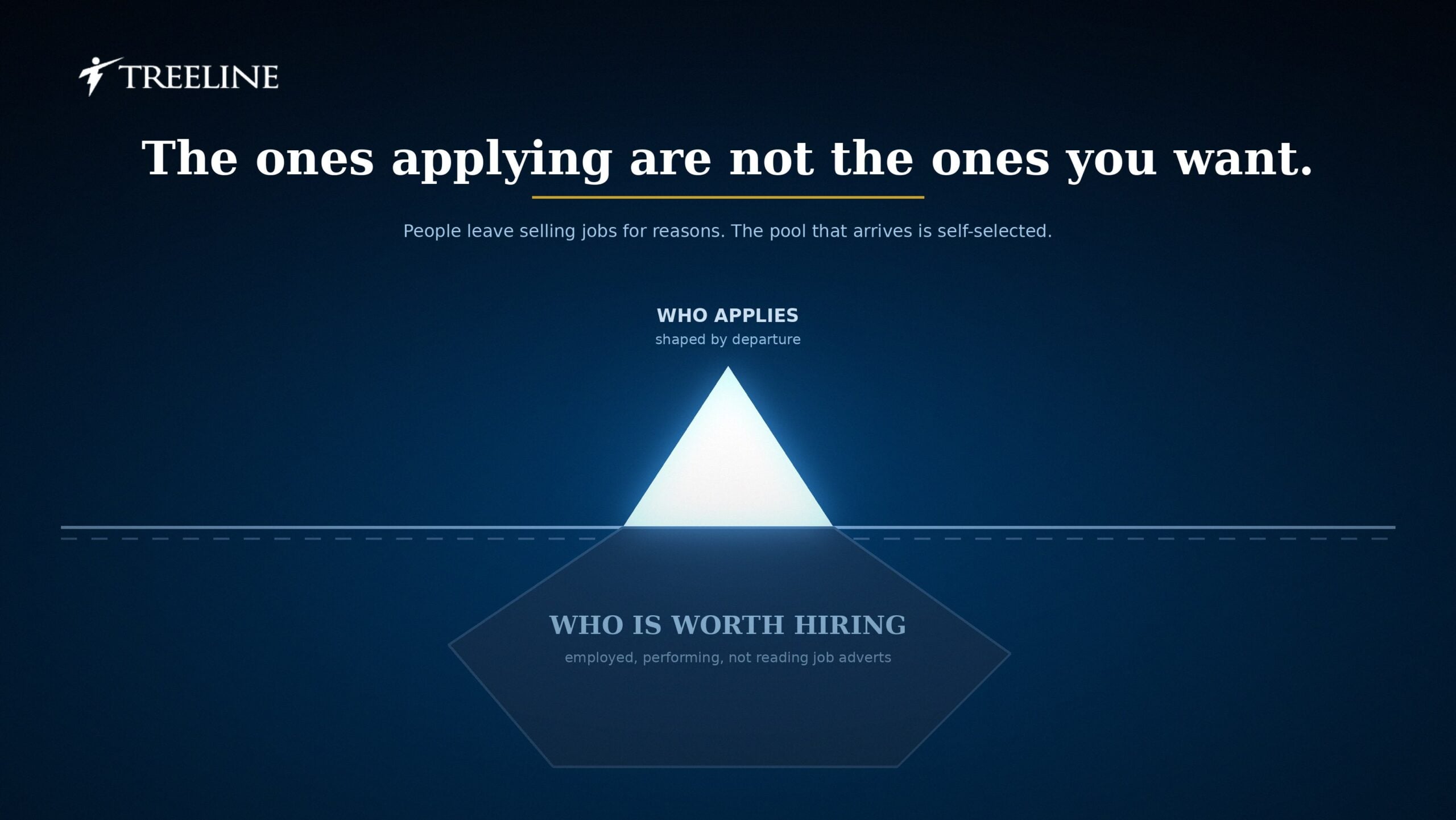
The account executives who respond to a job advertisement are, as a group, systematically different from the ones who do not. People leave a selling job for a reason, and the most common reasons are a missed number, a territory that was cut, a manager they could not work with, or a company that ran out of money. Some of those reflect on the person and some do not. But the pool that arrives unprompted is shaped by departure, and the people having their best year in a patch they built are not in it.
This is why “where can I find account executive candidates” has two different answers depending on what you mean. If you mean volume, they are everywhere, this is the most common commercial title in the market. If you mean the ones worth hiring, they are mostly employed, performing, and not reading job adverts.
So the sourcing question is really a question about reach: which pools you are willing to work, and what each one costs in time and effort. A firm that explains that trade honestly is useful. A firm that promises a shortlist of outstanding candidates quickly is describing the first pool and calling it the fourth.
Dan Fantasia, CEO of Treeline, Inc., views account executive sourcing as a selection problem before it is a volume problem. From his perspective, employers should ask where their last three good hires actually came from, because the answer is rarely the channel they are about to spend money on.
Where the question is about the hiring process rather than the sourcing, the interview, the assessment, the mistakes companies make, Treeline’s guidance on how to hire top account executives covers that ground directly.
Four Pools of Account Executive Candidates, Ranked by Cost
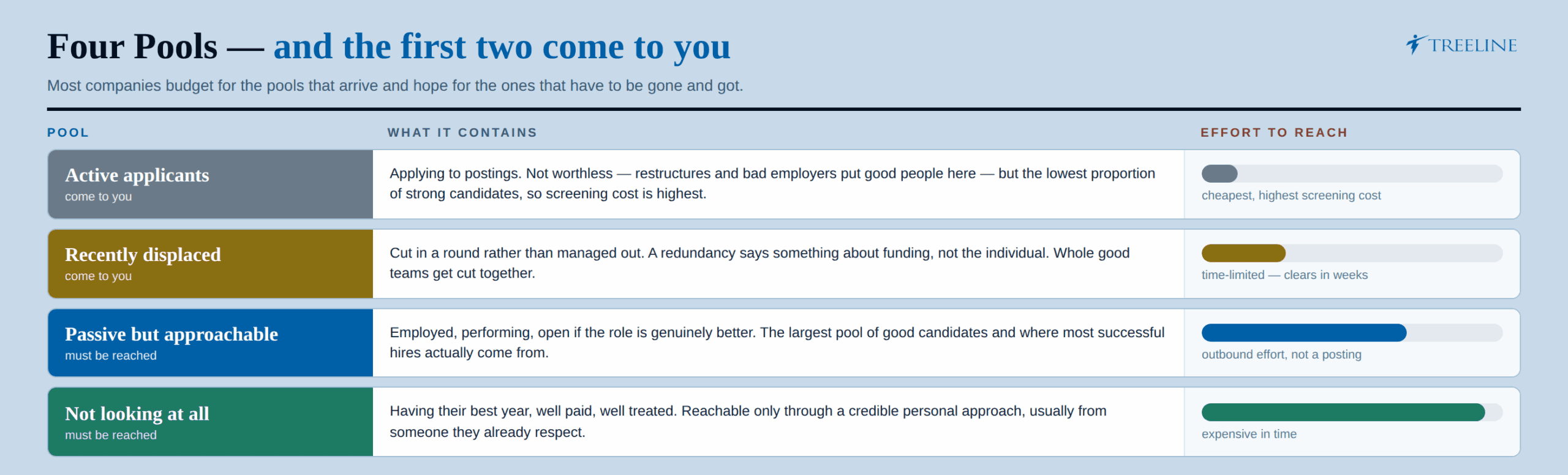
Every account executive candidate comes from one of four places. They differ in how easy they are to reach and in how much the ease costs you.
The diagram below sets them out.
Active applicants. People applying to postings. Cheapest and fastest, and the pool most affected by the selection problem above. Not worthless, restructures, relocations and genuinely bad employers put good people here, but the proportion of strong candidates is lower than in any other pool, and screening cost is correspondingly higher.
Recently displaced. Laid off in a round rather than managed out. A redundancy says something about a company’s funding, not about the individual, and whole good teams get cut together. This pool is time-limited: strong people clear it within weeks, so it rewards speed more than any other. Treeline’s guidance on speeding up hiring for quota-carrying roles covers the pace required.
Passive but approachable. Employed, performing adequately, and open to a conversation if the role is genuinely better. The largest pool of good candidates and the one most organizations never reach, because reaching it requires outbound effort rather than a posting. This is where most successful account executive hires actually come from.
Not looking at all. Having their best year, well paid, well treated. Reachable only through a credible personal approach, usually from someone they already know or respect. Expensive in time, occasionally worth it for a role that is genuinely a step up.
The practical point is that the first two pools come to you and the last two have to be gone and got. Most companies budget for the first two and hope for the last two.
Fantasia sorts candidates by how they arrived before he sorts them by anything else. His reasoning is not that applicants are weak, many are strong, but that knowing which pool someone came from tells you what else to check.
What the Visible Account Executive Pool Does Not Tell You
Three things make account executive sourcing harder than it looks, and all three mislead in the same direction.
Attainment is not comparable between companies. A rep at 140 percent may have had a soft quota, a mature patch and a product that sells itself. A rep at 85 percent may have carried an aggressive number in a new market. Without knowing the quota’s construction and the territory’s state, the percentage is close to meaningless, and candidates know which number to lead with. Treeline’s analysis of the account executive role in the SaaS marketplace covers the context behind those figures.
Tenure patterns are read wrongly in both directions. Short stints are treated as a red flag when a large share reflect companies that failed, pivoted or cut the team. Long tenure is treated as stability when it sometimes reflects a comfortable patch nobody has tested. Ask what happened at each exit rather than counting months.
The sale is not transferable by default. An account executive moving from a fast transactional sale to a long enterprise cycle with a security review and procurement in the middle is changing jobs, not companies. The reverse is equally true and less often noticed: enterprise sellers frequently struggle at volume.
The response to all three is the same: ask about the conditions, not just the outcome. Treeline’s guidance on red flags during the interview covers the broader signals.
How to Reach Account Executive Candidates Who Are Not Looking
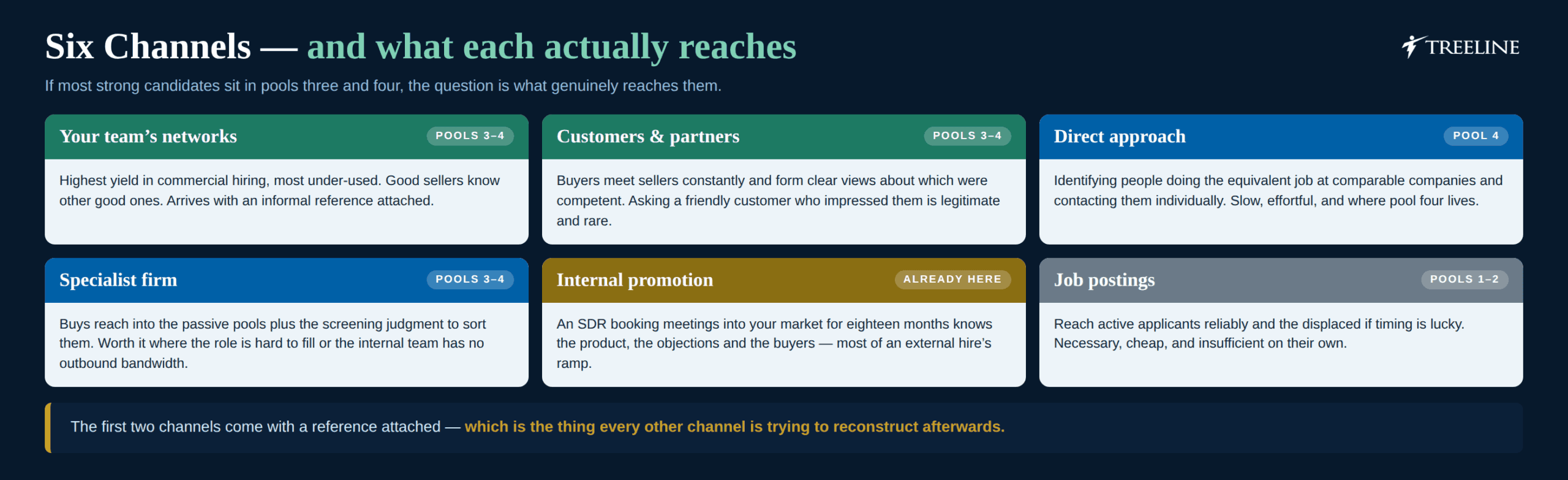
If most strong candidates are in the third and fourth pools, the practical question is what actually reaches them. The comparison below sets out the channels and what each is genuinely good for.
Your own team’s networks. The highest-yield channel in commercial hiring and the most under-used. Good account executives know other good ones, usually from a previous employer. Referral schemes work when the incentive is real and the process is fast enough not to embarrass the referrer.
Your customers and partners. Buyers meet sellers constantly and form clear views about which were competent. Asking a friendly customer who impressed them is a legitimate and underused source.
Direct approach. Identifying people doing the equivalent job at comparable companies and contacting them individually. Slow, effortful, and where the fourth pool lives. This is most of what a specialist recruiting firm is actually selling.
A specialist recruiting firm. Buys reach into pools three and four and the screening judgment to sort them. Worth it where the role is hard to fill, the market is tight, or the internal team has no bandwidth to run outbound. Treeline’s sales recruiting services cover this across industries and locations, with contingency and retained models and a comparison of the two.
Job postings. Reach pool one reliably and pool two if the timing is lucky. Necessary, cheap, and insufficient on their own.
Internal promotion from sales development. Frequently the best answer and routinely overlooked. An SDR who has been booking meetings into your market for eighteen months knows the product, the objections and the buyers. Treeline’s guidance on hiring business development representatives and SDRs covers that layer, and the guidance on the traits great salespeople share covers what to look for in the step up.
Fantasia prefers the referral and customer channels to any paid one when the role allows the time. His point is that both come with a reference attached, which is the thing every other channel is trying to reconstruct afterwards.
What Makes Good Account Executive Candidates Say Yes
Reaching pool three is only half the problem. Someone performing well in a job they do not hate needs a reason, and compensation alone is rarely it because their current earnings are already good.
Four things move strong candidates, roughly in order:
- The territory or patch. What they will actually be selling into, and whether it is better than what they have. This is the first question a serious candidate asks and the one most employers answer vaguely.
- The product’s position. Whether they will be winning or explaining. Sellers know the difference and talk to each other about it.
- The manager. People leave managers and join them. A candidate meeting their prospective manager early, and liking them, changes the odds materially.
- A credible number. Not a big number, a believable one. Strong candidates have been burned by quotas built on optimism, and they ask how it was set.
Two things that matter less than employers expect: brand recognition, which fades quickly against a weak patch, and a base salary increase, which strong candidates read as compensation for risk rather than reward for ability.
Treeline’s guidance on attracting top talent covers the employer-side work, the guidance on retaining top salespeople covers keeping them afterwards, and the guidance on avoiding the counter-offer covers the stage where these hires are most often lost, a performing account executive is exactly the person their employer will fight to keep.
Questions That Sort Account Executive Candidates Quickly
On the number
- What was your quota, how was it set, and what did you attain?
- What was your territory like when you got it and when you left?
- What was your biggest deal, and what did you personally do that others would not have?
On the motion
- Walk me through the stages of your sale and what moved a deal between them.
- Who else was in the room on your last significant deal?
- What did you do when a deal stalled at procurement or security review?
On how they got here
- Why did you leave each of your last two roles?
- What would have kept you?
On the work itself
- Where did your pipeline come from, marketing, SDR, or you?
- What proportion did you self-source, and what was your prospecting rhythm?
Question one is the most efficient in the set because it refuses to accept attainment alone. A candidate who can describe how the quota was constructed is telling you they understood the business they were in; one who only knows the percentage was executing a number somebody handed them.
Question nine is the one that separates candidates most reliably in practice. An account executive who self-sourced a meaningful share of their pipeline will keep producing when marketing has a weak quarter. One whose pipeline arrived entirely from elsewhere has a skill that only works in the conditions they left. Treeline’s guidance on prospecting that creates high-value opportunities covers that discipline, and the guidance on signs a prospect is bad for business covers the qualification judgment underneath it.
Question five is worth asking because enterprise selling is a team activity. A candidate who cannot name the sales engineer, the executive sponsor or the customer success counterpart on their biggest deal either worked alone, which is rare at size, or is taking more credit than is theirs. Treeline’s writing on enterprise sales professionals covers that end of the range, and the strategic account executive profile and channel account executive guidance cover the specialised variants.
Where to Look by Type of Account Executive Role
The pools are the same; their relative usefulness is not.
Transactional and mid-market. Volume matters, ramp is short, and pools one and two are more viable than at any other level. Sales development is the strongest internal source. Speed of process matters more than almost anything else.
Enterprise. The pool is narrow and almost entirely passive. Direct approach and referral dominate; postings produce very little that is relevant. Expect a longer search and budget for it.
Channel and partner-led. A genuinely different skill, and the pool is smaller than either of the above. Screen on whether the candidate has sold through partners rather than alongside them.
Remote or distributed. Widens the geographic pool substantially but raises the assessment bar, because self-direction matters more without a floor around them. Treeline’s guidance on virtual account executive recruiting covers that specifically, and the account executive role overview covers the role itself.
Fantasia measures a search by where the eventual hire came from rather than by how many candidates were submitted. His view is that a process producing forty applicants and one offer has told you something about the channel, not about the market.
When the Problem Is Not Where You Look
When the role is not competitive. If the patch is thin, the quota aggressive and the product behind, no channel will produce someone strong who says yes. Candidates in pools three and four are evaluating you as carefully as you are evaluating them.
When the process is too slow. Strong account executives are in process with several companies and accept the first credible offer. A four-week decision loses pool two entirely and most of pool three.
When the last three hires failed for the same reason. That is a pattern in the job or the onboarding rather than in the sourcing. Hiring from a different channel will produce the same outcome.
When you need an SDR. If the requirement is pipeline generation rather than closing, hiring an account executive to prospect produces an expensive and quickly frustrated employee.
Treeline’s guidance on hiring salespeople from sourcing to start date covers the full process, and the guidance on what makes a successful account manager covers the adjacent post-sale role these candidates are sometimes better suited to.
Frequently Asked Questions
Where can I find account executive candidates?
In four pools, which differ in how easy they are to reach. Active applicants come to you fastest and contain the lowest proportion of strong candidates. Recently displaced candidates are good and time-limited. Passive but approachable candidates are the largest pool of strong people and require outbound effort rather than a posting. Those not looking at all need a credible personal approach. Most companies budget for the first two and hope for the last two.
Why are the best account executives so hard to find?
Because they are employed and performing. People leave selling jobs for reasons, a missed number, a cut territory, a manager they could not work with, a company that ran out of money, so the pool that arrives unprompted is shaped by departure. The seller having their best year in a patch they built is not reading job adverts.
Are job postings worth running?
Yes, but not alone. Postings reliably reach active applicants and sometimes catch recently displaced candidates if the timing is lucky. They are cheap and necessary. They will not reach the two pools where most strong candidates sit, because those people are not looking, and no amount of posting improvement changes that.
What is the highest-yield sourcing channel?
Your own team’s networks, by a clear margin, and it is the most under-used. Good account executives know other good ones, usually from a previous employer, and a referral arrives with an informal reference attached. Customers and partners are a close second for the same reason, buyers form clear views about which sellers were competent.
How should I read attainment figures?
With scepticism, because they are not comparable between companies. A rep at 140 percent may have had a soft quota and a mature territory; one at 85 percent may have carried an aggressive number in a new market. Ask how the quota was constructed and what state the territory was in. Candidates know which figure to lead with.
Are short tenures a red flag?
Less often than employers assume. A large share of short stints in software sales reflect companies that failed, pivoted or cut the team rather than individual performance. Equally, long tenure is not automatically stability, it sometimes means a comfortable patch nobody has tested. Ask what happened at each exit rather than counting months.
Does account executive experience transfer between sales motions?
Less than the title suggests. Moving from a fast transactional sale to a long enterprise cycle with procurement and a security review in the middle is a change of job, not of employer. The reverse is equally true and less often noticed: enterprise sellers frequently struggle at volume, where the skill is throughput rather than orchestration.
What makes a strong candidate accept?
The patch first, what they will actually be selling into, and whether it is better than what they have. Then the product’s position, meaning whether they will be winning or explaining. Then the manager, because people join managers as readily as they leave them. Then a credible number, which matters more than a large one. Brand recognition and a base increase move strong candidates less than employers expect.
Should we promote an SDR instead?
Frequently, and it is routinely overlooked. Someone who has been booking meetings into your market for eighteen months knows the product, the objections and the buyers, which is most of an external hire’s ramp. The gap is closing experience, which is real but learnable with support. It is also a retention mechanism for the development team.
How long should an account executive search take?
It depends almost entirely on the pool you are working. A transactional role drawing on active applicants and sales development can move in weeks. An enterprise role requiring direct approach into passive candidates takes considerably longer, because the people worth hiring need a reason to have the conversation at all. Be sceptical of a fast enterprise shortlist, it usually means pool one.
Ask Where Your Last Three Hires Came From
Before spending anything on sourcing, write down where your last three good account executives actually came from, a posting, a referral, a direct approach, an internal promotion. The answer is rarely the channel you are about to fund, and it is the cheapest piece of evidence you will get.
Speak with Treeline for a direct read on which pool your role can realistically reach, what it will take to reach it, and whether the strongest candidate is already booking meetings for you.
Share This Story, Choose Your Platform!
Related Posts

What our happy clients are saying
Treeline Inc. provided us with the most candidates that aligned with our needs and were of the highest quality.

Dr. Jeffrey Klein Head of North America Sales, Satchel Pulse
Treeline Inc.’s collaborative, flexible, and communicative approach resulted in a smooth partnership. Beyond their recruitment expertise, their unique sourcing model was efficient and effective.

Sera Holt Director of Operations, LNS Research
Their professionalism was outstanding. Treeline Inc. was extremely thorough and ensured that we were on the same page before they started looking for candidates. They listened to us and did a great job working with the candidate to close out the process.

Cate Grant AVP Customer Success, Nasdaq
Thanks to Treeline Inc.’s intricate and thorough screening process, the company is able to hire six high-quality candidates that fit perfectly in the company’s culture. The team is highly receptive to concerns, and internal stakeholders are impressed with their unique recruitment abilities.

Anna McKean Sales Recruiter, Insider Intelligence
Treeline Inc. has been qualified individuals throughout a five-year-long engagement. They’ve made numerous placements of talented and qualified individuals for our business.

Michele St Laurent VP of HR, The Institute for Applied Network Security

Let Us Help You Source the Sales Talent You Need
Whether you’re building a team or replacing a key role, our Candidate Sourcing Platform provides a fast, flexible, and employer-focused solution.
Tell us more about your business and how we can help.
Treeline Inc.
Your Award-Winning Sales Recruitment Partner
15 Lincoln Street, Suite 314, Wakefield, MA 01880