On their first morning, a new Director of Account Management is handed three things: a list of accounts, a renewal calendar, and a team. Almost no job description for the role describes any of them. It describes years of experience, a software category, and a revenue figure, and it leaves the reader to guess how many accounts each person carries, whether the number is measured net of churn, and whether the leader can change any of it.
That gap is the whole problem, and it is why the search for account management leaders goes wrong more often than its seniority would predict. The people who fail in this seat are rarely unqualified. They are usually qualified for a different version of the job than the one they were hired into, a version with a different account-to-manager ratio, a different mandate, and a different amount of authority.
So the practical answer to how to find a sales recruiting firm for account management leaders is that you are not really shopping for a firm at first. You are testing whether a firm can describe your coverage model back to you before it describes a candidate. A consultant who asks how many accounts each manager carries, what the renewal base is worth, and who signs off on a discount is running a diagnostic. One who asks how many years of account management experience you want is running a keyword match, and the two produce very different shortlists.
Dan Fantasia, CEO of Treeline, Inc., views an account management leadership search as a question about the operating model rather than a question about the person. From his perspective, employers should be able to state the account-to-manager ratio, the renewal baseline and the leader’s pricing authority before a single résumé is discussed, because those three facts eliminate more unsuitable candidates than any competency framework will.
Why Account Management Leaders Are Harder to Source Than the Title Suggests
The title sits across a genuine fault line in how work is classified, and that is not a semantic curiosity. It changes the pay band, the candidate pool, and the kind of firm that can run the search.
The U.S. Department of Labor’s O*NET profile for first-line supervisors of non-retail sales workers describes the job as directly supervising and coordinating the activities of sales workers, with duties that may extend into budgeting, accounting and personnel work. Its task list includes monitoring staff performance against goals, resolving customer complaints regarding services or products, hiring and training personnel, and analysing the details of sales territories to assess growth potential and set quotas. That last task is the account management leader’s job described almost exactly, and it is the one most job descriptions omit.
At the same time, a Director of Account Management at a company with a substantial recurring revenue base is frequently classified, paid and benchmarked as a sales manager. The U.S. Bureau of Labor Statistics profile of sales managers covers people who plan, direct or coordinate the delivery of a product or service to the customer, an occupation of 619,500 jobs in 2024 with roughly 49,000 openings projected each year over the following decade.
Two federal occupations, both defensible descriptions of the same title, and a wide gap between them at the median. That gap is examined in detail further down, but its immediate consequence is a sourcing problem. A firm that searches against one definition will not find the people who fit the other. Candidates carrying the title on their profile may have run a twelve-person team against a renewal number, or supervised four coordinators handling inbound service requests, and no title-based search distinguishes between them.
Three specific things make the search harder than the seniority implies.
- The title is not standardised across companies. Director of Account Management, Director of Client Services, Director of Customer Growth, Head of Retention and Regional Account Director are sometimes the same role and sometimes four different ones. Sourcing on the title alone returns a mixed set.
- The strongest candidates are often not looking. People running a healthy book are usually compensated on retention that is already performing, which makes them harder to approach than a hunter whose quarter went badly. Approach volume matters less than approach quality here.
- The failure mode is slow. A poor new-business hire is visible within two quarters because pipeline stops. A poor account management leader is visible at the next renewal cycle, which may be a year away, by which point the damage is already booked.
That third point deserves emphasis when you are choosing between firms. A search partner whose track record is built on transactional roles may never have seen its own account management placements fail, because the feedback loop is longer than the guarantee period. Ask how many account management leaders the firm has placed and how many are still in seat two years later. The second number is the one that matters.
The Coverage Model Decides Everything Else in the Search
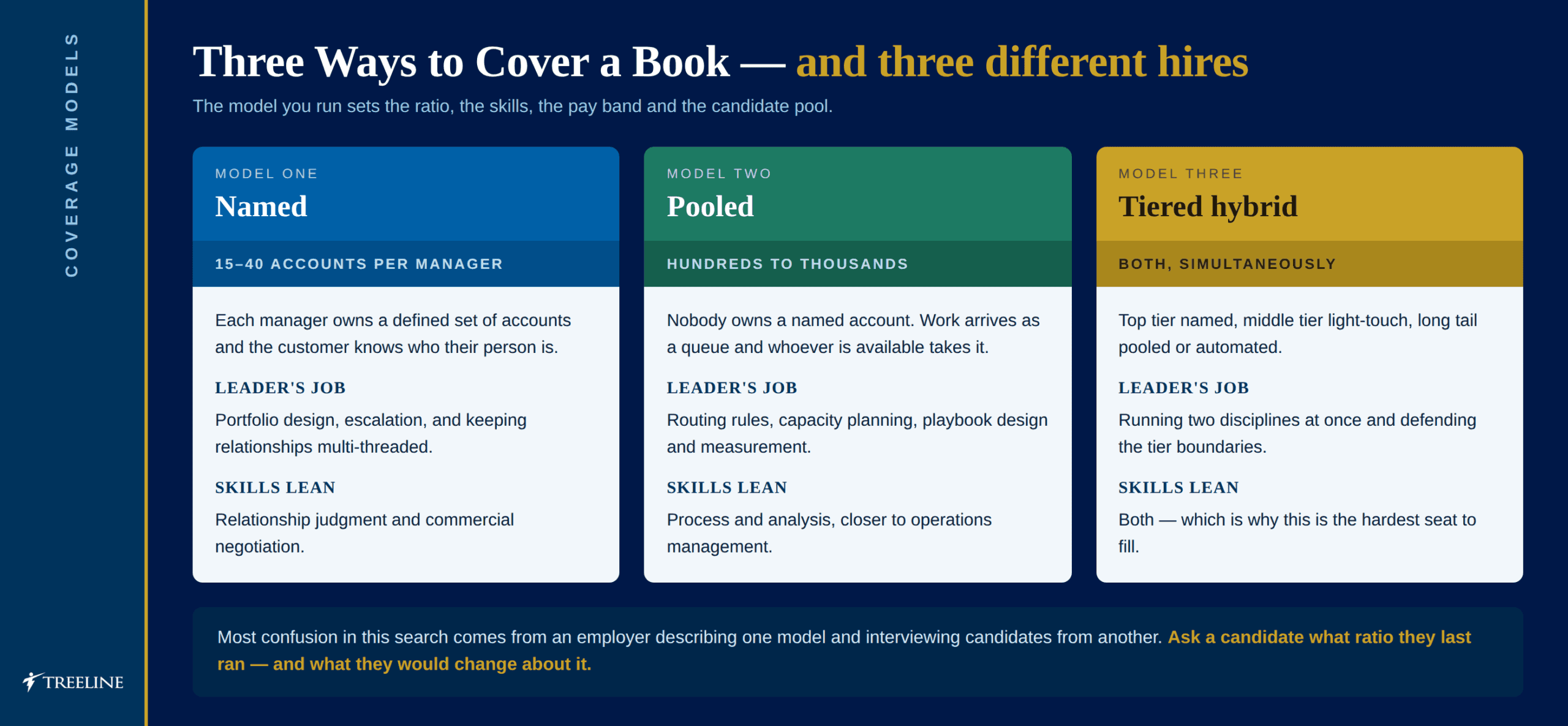
If you take one thing from this page, take this: an account management leader is hired to run a coverage model. Which model you run determines the ratio, the skills, the pay band, the pool and the interview.
Most organisations run one of three, and the diagram below sets them side by side.
Most confusion in these searches comes from an employer describing one model and interviewing candidates from another.
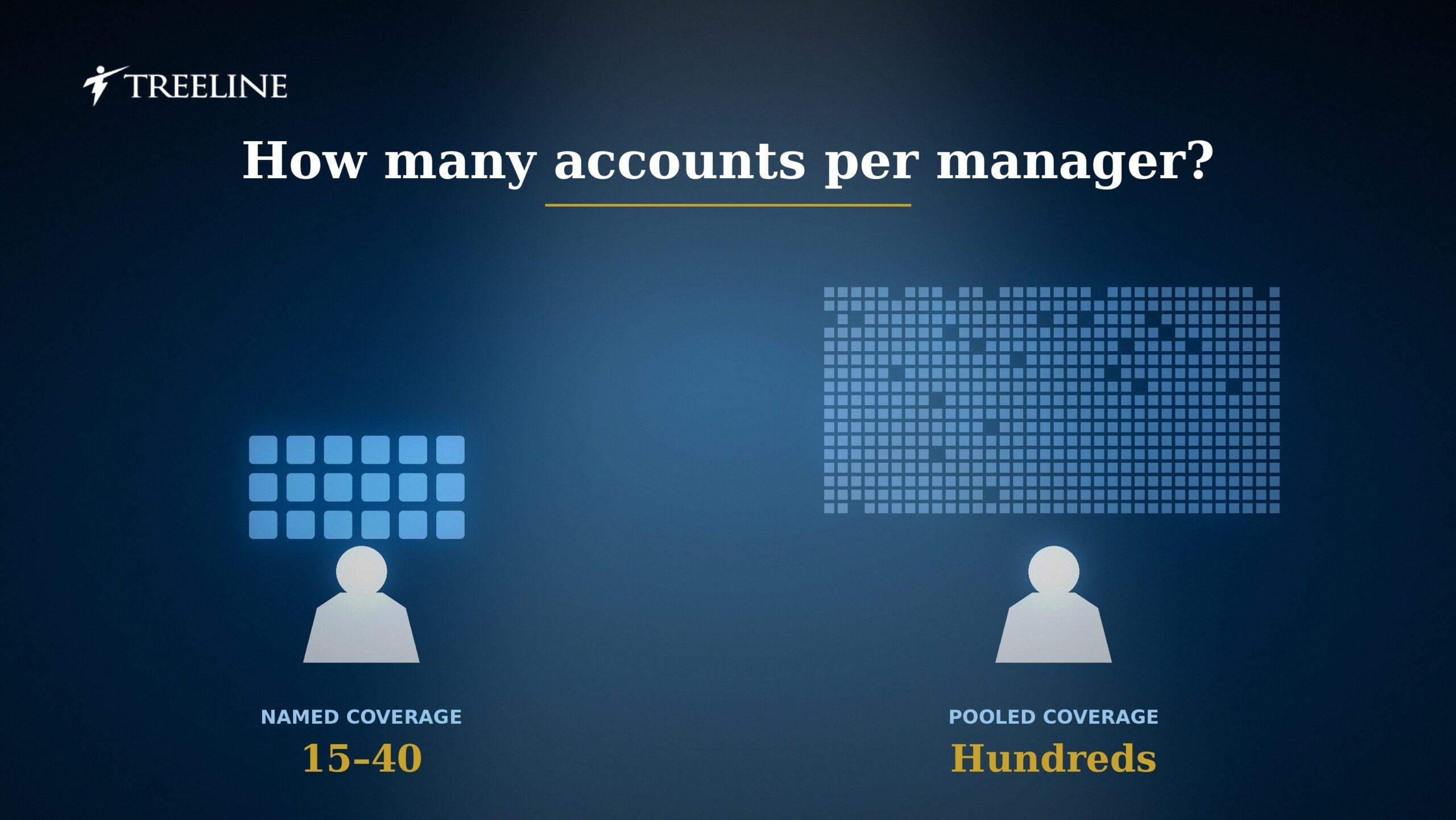
Named coverage. Each manager owns a defined set of accounts, typically somewhere between fifteen and forty depending on complexity, and the customer knows who their person is. The leader’s job is portfolio design, escalation, and making sure the named relationships are not single-threaded. Skills lean toward relationship judgment and commercial negotiation. This is the model people usually picture when they hear account management.
Pooled coverage. Nobody owns a named account. Work arrives as a queue, renewals due, health-score alerts, expansion signals, and whoever is available takes it. Ratios run into the hundreds or thousands of accounts per manager. The leader’s job is closer to operations management: routing rules, capacity planning, playbook design, and measurement of what actually moves renewal rates. Skills lean toward process and analysis. A named-coverage veteran often struggles here, because the instincts that made them good, depth, personal relationship, judgment on individual cases, do not scale to a queue.
Tiered hybrid. The top tier gets named coverage, the middle gets a light-touch named model, and the long tail is pooled or automated. This is the most common arrangement in companies past early growth, and the hardest to lead, because the leader has to run two different management disciplines at once and defend the tier boundaries against constant pressure to promote accounts upward.
The distinction matters commercially, not just organisationally. A leader who has only run pooled coverage may never have negotiated a multi-year commercial structure. A leader who has only run named coverage may never have built a routing rule or sized a team from a capacity model. Both are competent. Neither is interchangeable.
There is a fourth arrangement worth naming so it can be ruled out. Where a company has a small number of very large customers producing a disproportionate share of revenue, the role is usually not account management leadership at all, it is a concentrated-portfolio role with a different mandate and a different candidate pool. Treeline’s guidance on choosing a recruiting firm for strategic accounts leadership covers that search, and the strategic account executive profile describes the individual-contributor layer it draws from. If eight relationships represent half your revenue, you are running that search, not this one.
Fantasia argues that the account-to-manager ratio is a better predictor of fit than any line on a résumé. His test is to ask a candidate what ratio they last ran and what they would change about it, because the candidates who have genuinely owned a coverage model answer with a capacity argument rather than a preference.
Retention, Expansion, or Both: The Mandate Question a Firm Must Ask
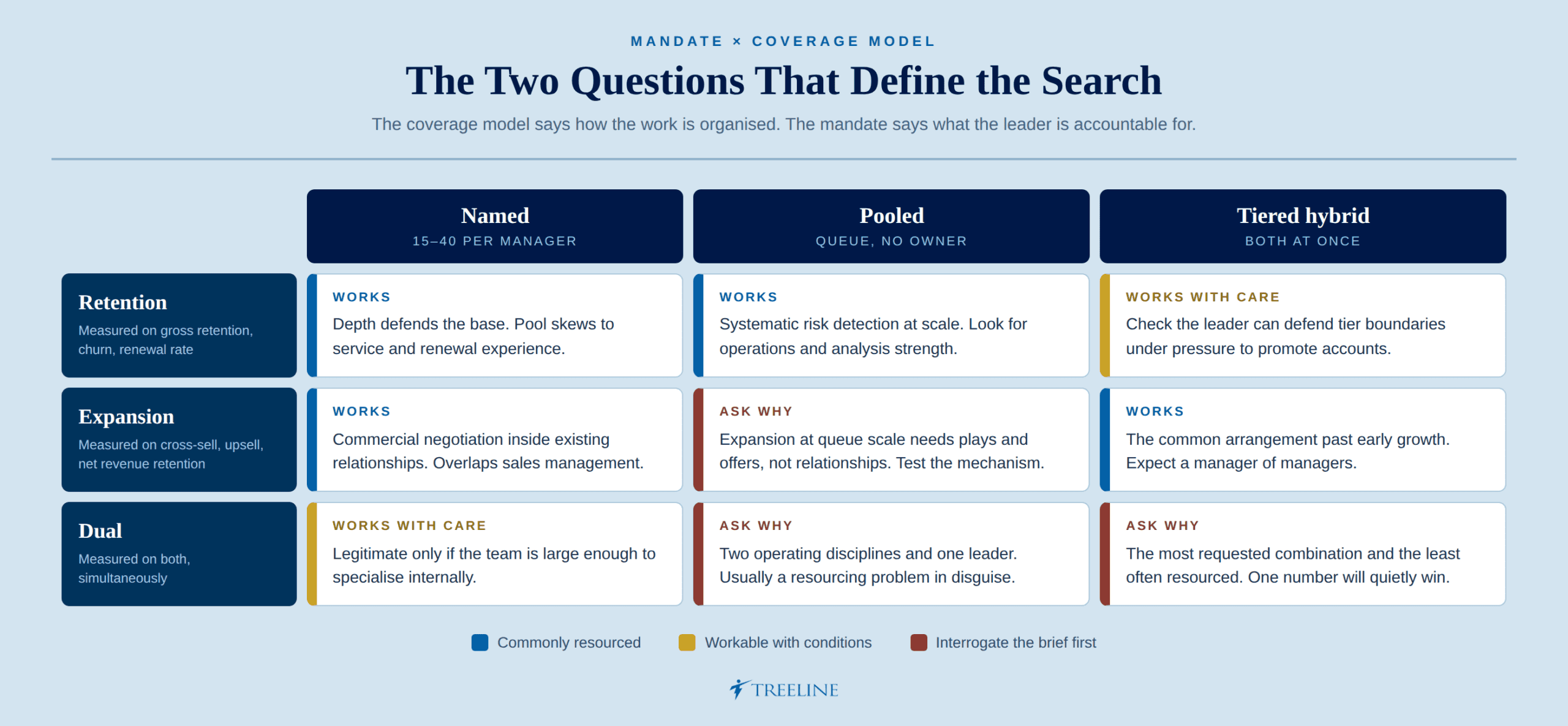
The coverage model tells you how the work is organised. The mandate tells you what the leader is accountable for, and the two together define the search.
There are three mandates in practice, and the grid below crosses them against the coverage models to show where each combination is genuinely common and where it should raise a question.
A retention mandate measures the leader on keeping revenue that already exists, gross retention, churn rate, renewal rate. It is the right mandate when the base is at risk, when a competitor has become credible, or when the product has changed in a way customers have not absorbed. The pool skews toward people with service and renewal depth.
An expansion mandate measures the leader on growth inside the installed base, cross-sell, upsell, seat growth, net revenue retention above one hundred percent. It is the right mandate when retention is already healthy and the growth constraint is that nobody is systematically asking existing customers for more. The pool skews commercial, and often overlaps with sales management.
A dual mandate measures both, which is what most job descriptions ask for and what fewest organisations actually resource. It is legitimate when the team is large enough to specialise internally, and a warning sign when it is not, because a leader given both with a team of five will quietly choose one and let the other drift.
The mandate question is where a good search partner earns its fee, because employers are frequently wrong about their own answer. A company that describes an expansion mandate but measures the team on gross retention has an expansion job description and a retention compensation plan, and it will hire someone who behaves according to the plan rather than the description.
Three checks are worth running on your own brief before any firm sees it.
- What number appears on the leader’s compensation plan? Not the job description, the plan. That is the mandate, whatever the posting says.
- What happens to a manager who grows an account by twenty percent but loses another one entirely? If the answer is that they are net positive and fine, the mandate is expansion. If the answer is that losing the account is a serious problem regardless, the mandate is retention.
- Who is accountable for the renewal forecast? If it is finance or the sales operations team rather than this leader, the role is narrower than the title implies and should be described that way.
Fantasia warns that a dual mandate on an under-resourced team is the most common structural error in this search. His view is that employers should decide which number they would defend in a board meeting if the two moved in opposite directions, and write the brief around that one.
The Authority Gap That Breaks Account Management Leadership Hires
Every commercial leader owns a number they cannot fully control. In account management the gap is unusually wide, and candidates who have not experienced it tend to underestimate it badly.
The leader is accountable for revenue retained and grown inside the installed base. But whether a customer renews depends on product reliability, support responsiveness, the outcome of an implementation that happened before this leader arrived, pricing decisions made by finance, and roadmap choices made by a product organisation that does not report to them. The leader’s own levers are narrower than the accountability: how the team is deployed, how early risk is detected, how well escalations are run, and how persuasive they are internally on behalf of a customer.
O*NET’s work-activity profile for the supervisory occupation captures this indirectly. Alongside coaching and developing others and guiding and motivating subordinates, it lists resolving conflicts and negotiating with others, and providing consultation and advice to others on process-related topics. Those last two are the internal political work, and they are a large share of how this leader actually spends a week.
Before you brief a firm, get explicit answers on four points, because a candidate will ask about all of them and a vague answer will cost you the strongest people in the process.
- Discount and concession authority. What can this leader approve alone, what needs finance, and how long does finance take?
- Headcount and structure. Can they change the ratio, or is the team size fixed by a plan they had no part in?
- Segmentation. Can they move an account between tiers, or is that set elsewhere?
- Product escalation. What is the actual route when a major customer needs something the roadmap does not include, and has it ever worked?
The fourth is the most revealing and the least often prepared. If nobody can name a case where a customer requirement changed a roadmap decision, the leader will discover that in month four rather than in the interview, and strong candidates will have already assumed the worst.
Where Sales Recruiting Firms Actually Find Account Management Leaders
The pool question is really a routing question: build, borrow, or buy. Each route has a different cost, a different risk, and a different timeline, and a firm worth engaging will tell you which one your situation favours rather than defaulting to an external search because that is what it sells.
Build, promote an internal senior account manager. Frequently the best option and the most often overlooked. The person who has held the largest relationships already understands the product, the customers and the internal politics, which is most of the ramp. What they have not done is manage, forecast, or allocate capacity across a portfolio they cannot personally service. The failure mode is a promoted individual contributor who keeps doing the individual contributor job with a bigger title, servicing their favourite accounts while the team drifts. The test is whether they have already changed how the company serves a customer, rather than simply serving that customer well themselves. Treeline’s guidance on what makes a successful account manager describes the underlying discipline this route builds on.
Borrow, hire from an adjacent function. Four adjacent pools are worth opening, each with a known trade-off.
- Customer success leaders. Strong on health measurement, onboarding and systematic risk detection. The question to test is whether they have carried a commercial number rather than a satisfaction one. Treeline’s director of customer success search work sits in this adjacent territory.
- Sales managers from renewal-heavy or long-cycle businesses. Strong on quota, forecasting and coaching to a number. The question is whether they have the patience for a job where most of the revenue arrives whether or not anyone is impressive that quarter.
- Services or delivery leaders. Strong on the operational reality of what the company can actually promise, and credible with customers. Often light on commercial negotiation and on running a growth number.
- Sales operations or revenue operations leaders. Unusually strong on segmentation, capacity modelling and measurement, which is exactly what a pooled or tiered model needs. Frequently untested on managing customer-facing people through a difficult renewal.
Buy, hire someone already holding the title elsewhere. The lowest-ramp option and the narrowest pool, and the one where the coverage-model mismatch does the most damage, because the title looks like a match and the operating reality is not. If you take this route, the ratio question and the mandate question do most of the screening work.
Ask any prospective firm which route it would recommend and why. A partner that opens with all three, and argues for one, is thinking about your situation. One that goes straight to external candidates is describing its own business model. Treeline’s broader sales recruiting services span the individual-contributor layer this leader will be hiring into, which matters because a director who cannot hire well will not fix a coverage problem regardless of how good they are personally.
Fantasia distinguishes between hiring a manager and hiring a system-builder, and considers the second the harder and more valuable find. In practice that means asking what the candidate built that outlasted them, because someone who has only held relationships leaves nothing behind when they go.
Questions That Reveal Whether Someone Has Actually Run a Book
Assessment here is unusually difficult because retention numbers are flattering by default. A book that renews at ninety percent may reflect excellent management or a product with high switching costs and a leader who did very little. The questions that separate the two are about mechanism, not outcome.
On the shape of the book
- How many accounts, across how many managers, and how was that ratio decided?
- What was the revenue concentration, did the top ten accounts represent ten percent of the base or sixty?
- What was gross retention when you arrived and when you left, and what was happening to it before you arrived?
On mechanism rather than result
- What did you change that moved retention, and how did you know it was that change rather than the market?
- Describe a renewal you expected to win and lost. What did you find out afterward?
- How did you detect risk early, and what was the first signal that actually predicted churn in your business?
On the commercial half
- What expansion revenue came from the base, and was it systematic or opportunistic?
- What was your discount authority, and describe a time you used it badly.
On the team
- Who did you promote, and who did you exit, and what did each teach you about the hiring bar?
- What did the team do differently in your last quarter compared with your first?
Question four is the one strong candidates answer differently. Retention moves for many reasons and honest operators say so, then explain the specific thing they did that would not have happened otherwise. That combination of intellectual honesty and a concrete claim is rarer and more predictive than a clean retention chart.
Question five matters disproportionately for a similar reason. Anyone who has run a book for several years has lost a renewal they expected to win. A candidate with an unbroken record has either had a short tenure, a captive market, or an edited narrative.
References are worth more here than in most searches, and the most valuable one is a customer. It is an unusual request and occasionally awkward, but for a role whose entire output is the state of customer relationships, the customer’s account of the relationship is the most direct evidence available. Where that is not feasible, a services or support leader who worked alongside the team is the next best source, because they will have seen how escalations were actually run.
What Account Management Leaders Are Paid
This is where the two-occupation problem becomes a budgeting problem, and it is worth being precise about what the public data does and does not tell you.
O*NET reports median wages for first-line supervisors of non-retail sales workers at $87,520 a year on 2025 wage data, across around 320,000 people in 2024, with little or no employment change projected through 2034 and roughly 24,800 openings a year. The Bureau of Labor Statistics reports median annual wages for sales managers at $138,060 as of May 2024, with the lowest ten percent below $66,910 and the highest ten percent above $239,200.
On the most recent published figures for each, those two medians sit roughly fifty thousand dollars apart, and both occupations legitimately contain people whose business card reads Director of Account Management. The figures come from different reference periods and are not a like-for-like subtraction, but the direction and scale of the gap are clear enough to plan around.
Which band applies to your role depends on three things:
- Whether the leader carries a commercial number. A renewal-and-service leadership role sits closer to the supervisory band. A role owning expansion revenue against a quota sits closer to the sales manager band.
- The size and value of the base. Leading a team responsible for a base worth ten million dollars is a different job from leading one responsible for two hundred million, and the market prices it that way.
- Whether the role is a first-line manager or a manager of managers. A Director with four team leads reporting in is meaningfully above a Director with eight individual contributors.
The structure of the variable component matters as much as the size of it, and it is where retention roles are most often designed badly. Three principles hold up.
- Do not pay full commission on renewal. Revenue that would have arrived anyway should not be the main earning event, or the plan rewards the base case.
- Pay expansion at or near new-business rates. Growth inside an existing customer is genuinely hard and is frequently underpaid relative to a new logo of the same value, which is precisely why it does not happen.
- Measure over a longer period than a quarter. Renewal cycles are annual or multi-year, and a quarterly plan on an annual cycle produces noise rather than motivation.
Treeline’s guidance on building an effective sales manager compensation plan covers the general design principles that apply above this, and the guidance on retaining top salespeople is directly relevant, because a leader inheriting a team with a churn problem has two retention jobs rather than one.
The Continuity Problem No Job Description Mentions
Here is a fact that reframes what you are actually hiring for.
The Bureau of Labor Statistics reports in its employee tenure release that median tenure with a current employer was 3.9 years in January 2024, down from 4.1 years two years earlier and the lowest reading since January 2002. Private-sector median tenure was 3.5 years, and for workers aged 25 to 34, the age band from which most individual-contributor account managers are drawn, the median was 2.7 years.
Set that against a customer relationship that is expected to last five, seven or ten years. The arithmetic is uncomfortable and unavoidable: the relationship will outlive the person managing it, probably more than once.
This changes what good looks like. A leader whose model depends on personal relationships between named managers and named customers has built something that degrades every time someone resigns. A leader who has built account documentation people actually maintain, multi-threaded contacts rather than single points of connection, and handover routines that survive a departure has built something that holds. The second is far less visible in an interview and far more valuable in year three.
It also changes what to ask about. Rather than asking how the candidate built relationships, ask what happened to an account when the manager who owned it left. The answer describes the system, not the person.
There is a hiring consequence too. If your book is currently held together by two long-tenured managers, that is a risk register rather than a strength, and it should be in the brief. A firm that understands this will ask about it. Treeline’s guidance on avoiding the counter-offer is relevant here for a specific reason: in account management, a counter-offer that retains someone for six more months and then loses them anyway can be worse than a clean departure, because it delays the handover past a renewal.
Fantasia cautions that the leaders who look most impressive in interviews are often the ones who personally hold the relationships, which is exactly the dependency an employer should be trying to reduce. The signal he looks for is whether a candidate can describe a customer relationship that survived their own departure intact.
How to Test a Sales Recruiting Firm for an Account Management Leadership Search
With the model, mandate and authority questions settled, choosing between firms becomes a short set of testable things. Run these in a first conversation, before any fee discussion.
The last row is worth insisting on. Off-limits restrictions are a normal part of search work, but in a narrow specialism they can quietly remove the most relevant part of the market, and a firm that discloses them without being asked is telling you something about how it operates.
A sales-specialist firm generally has the advantage in this search, because the evaluation problem is commercial rather than general and the adjacent pools are all sales-adjacent. Treeline has recruited exclusively for sales organisations since 2001, covering sales leadership and account roles across industries and locations, including account management, customer success, enterprise and strategic accounts, sales engineering and revenue operations. Both contingency and retained models are available, and the comparison of retained and contingency search sets out where each fits. Contingency tends to suit this search when the pool is active and the model is well defined; retained suits it when the role is confidential or the pool has to be built rather than activated.
The honest caveat: if your account management function is genuinely a support or service organisation with a commercial label, a firm with operations and service-leadership depth may assess those candidates better than a sales specialist will. Treeline is the stronger fit where the book carries a growth number as well as a retention one. Treeline’s broader perspective on using an executive search firm covers when outside search is warranted at all.
When the Answer Isn’t an External Hire
A firm worth engaging will occasionally tell you not to run the search. Four situations where that is the right advice.
When the churn is a product problem. If customers are leaving because the product no longer meets their requirements, a stronger account management leader will delay the departures rather than prevent them. You will have bought time at the price of a senior salary and a year.
When the segmentation has not been decided. If nobody has determined which accounts get which level of coverage, the new leader will spend two quarters negotiating that internally with no authority and no history. Decide the tiers, then hire someone to run them.
When the role is really an individual contributor. Some companies want the largest accounts personally held by a senior person and describe it as a leadership role because that is the title that attracts applicants. If there is no team, say so. Treeline’s guidance on hiring top account executives covers that search instead, and the account manager sales recruiting approach for retention and growth is the closer fit.
When you already have the person. The capability this role needs is often present in a senior manager who has been quietly holding the base together. Promoting and supporting them frequently beats an external search, provided they have demonstrated the cross-functional work rather than just the relationship work. The build route is real, and the cost of overlooking it is usually a resignation three months after the external hire starts.
Where an external search is the right call, the general disciplines still apply. Treeline’s guidance on hiring salespeople from sourcing to start date covers the process mechanics, and the guidance on hiring a vice president of sales covers the layer this leader will usually report into.
Frequently Asked Questions
How do I find a sales recruiting firm for account management leaders?
Test whether the firm can describe your coverage model before it describes a candidate. In a first conversation, a firm that has run this search will ask how many accounts each manager carries, how accounts are tiered, whether the mandate is retention or expansion, and what discount authority the leader will have. Then check three things: how many account management leaders they have placed, how many are still in seat after two years, and whether they will name adjacent pools rather than only searching on the exact title.
What is the difference between an account management leader and a strategic accounts leader?
Account management leadership is a coverage discipline: a team covering many accounts, with the leader responsible for ratio, tiering, risk detection and renewal performance across a base. Strategic accounts leadership inverts that ratio deliberately, concentrating on a small number of relationships that each represent a material share of revenue. The candidate pools overlap far less than the titles suggest, and a coverage leader dropped into a concentrated portfolio usually under-invests in the political and multi-year relationship work that role requires.
Should the role be a retention hire or an expansion hire?
Look at the compensation plan rather than the job description, because that is what the hire will actually optimise for. If the plan pays primarily on gross retention or churn, it is a retention role regardless of how the posting is written. If it pays on net revenue retention above one hundred percent or on cross-sell and upsell, it is an expansion role. A dual mandate is legitimate when the team is large enough to specialise internally and a warning sign when it is not.
What account-to-manager ratio should we expect?
It depends entirely on the coverage model rather than on any benchmark. Named coverage typically runs somewhere between fifteen and forty accounts per manager depending on complexity and contract value. Pooled coverage runs into the hundreds or thousands, because nobody owns a named account and work arrives as a queue. Tiered hybrids run both simultaneously. The number itself matters less than whether you can state it, because a candidate cannot assess the job without it.
Can a sales manager run an account management team?
Sometimes, and it should be tested rather than assumed. Sales managers bring forecasting discipline, coaching to a number and commercial negotiation, all of which transfer. The part to test is patience for a job where most revenue arrives whether or not anyone is impressive in a given quarter, and where the visible wins are losses that did not happen. Ask a candidate from that background what they deliberately slowed down.
What should an account management leader be paid?
Two federal occupations both plausibly describe the title, which is why quoted ranges vary so widely. O*NET reports median wages of $87,520 for first-line supervisors of non-retail sales workers on 2025 data, while BLS reports $138,060 for sales managers as of May 2024, with the top ten percent above $239,200. Which band applies depends on whether the leader carries a commercial number, the size of the base they are responsible for, and whether they manage individual contributors or other managers.
How do I assess a retention number in an interview?
Treat the number as the beginning of the question rather than the answer, because a high retention rate can reflect excellent management or simply high switching costs. Ask what the candidate changed that moved retention, and how they know it was that change rather than the market. Then ask about a renewal they expected to win and lost, and what they found out afterward. Candidates who reason honestly about attribution and still name a specific contribution are more predictive than candidates with a clean chart.
Is contingency or retained search better for this role?
Contingency tends to suit this search when the coverage model is clearly defined and the pool is active, which is common for account management leadership at mid-market scale. Retained suits it when the role is confidential, when the internal candidate situation is sensitive, or when the pool has to be built rather than activated, for example where you need someone who has run a specific tiered model in a specific industry. The comparison of the two models sets out where each makes sense.
Should we promote internally instead of hiring externally?
Often, and it is the route most frequently overlooked. A senior account manager who has held the largest relationships already has the product knowledge, customer credibility and internal relationships that make up most of an external hire’s ramp. The gap is managerial: forecasting, capacity allocation and hiring. The test is whether they have already changed how the company serves a customer rather than simply serving that customer well themselves, because the second is individual contribution and the first is leadership.
How long should this search take?
Plan on a longer timeline than an equivalent new-business leadership hire for two reasons. The pool is narrower once you screen for the correct coverage model, and the strongest candidates are usually performing against a healthy book rather than actively looking, which lengthens the approach phase. A search partner that promises an unusually fast slate is likely sourcing on the title alone, which is exactly the shortcut that produces the model mismatch this role is vulnerable to.
Before You Write the Job Description
The most useful first conversation about an account management leadership hire is not about the person. It is about the book: how many accounts, covered how, measured on what, and with what authority to change any of it. Get those four answers straight and the shortlist largely writes itself.
Speak with Treeline for a direct read on which coverage model your situation actually needs, whether the mandate should be retention or expansion, what the scope commands in your industry, and whether the strongest candidate is already on your team, before any fee is discussed.
Share This Story, Choose Your Platform!
Related Posts

What our happy clients are saying
Treeline Inc. provided us with the most candidates that aligned with our needs and were of the highest quality.

Dr. Jeffrey Klein Head of North America Sales, Satchel Pulse
Treeline Inc.’s collaborative, flexible, and communicative approach resulted in a smooth partnership. Beyond their recruitment expertise, their unique sourcing model was efficient and effective.

Sera Holt Director of Operations, LNS Research
Their professionalism was outstanding. Treeline Inc. was extremely thorough and ensured that we were on the same page before they started looking for candidates. They listened to us and did a great job working with the candidate to close out the process.

Cate Grant AVP Customer Success, Nasdaq
Thanks to Treeline Inc.’s intricate and thorough screening process, the company is able to hire six high-quality candidates that fit perfectly in the company’s culture. The team is highly receptive to concerns, and internal stakeholders are impressed with their unique recruitment abilities.

Anna McKean Sales Recruiter, Insider Intelligence
Treeline Inc. has been qualified individuals throughout a five-year-long engagement. They’ve made numerous placements of talented and qualified individuals for our business.

Michele St Laurent VP of HR, The Institute for Applied Network Security

Let Us Help You Source the Sales Talent You Need
Whether you’re building a team or replacing a key role, our Candidate Sourcing Platform provides a fast, flexible, and employer-focused solution.
Tell us more about your business and how we can help.
Treeline Inc.
Your Award-Winning Sales Recruitment Partner
15 Lincoln Street, Suite 314, Wakefield, MA 01880