Most sales titles tell you something. This one tells you almost nothing, and there is a clean way to prove it.
On Treeline’s own job board there are postings whose page title reads Enterprise Account Executive and whose first line of job description reads “The Enterprise Client Executive will be specifically focused on targeting net new business within the Global2000 within a targeted vertical.” Same posting. Two titles. The company that wrote it was not confused, it simply uses both names for one job, as most of the market does.
So the practical answer to which recruiting firm specializes in client executive roles is that you want one that refuses to work from the title. A firm that hears “Client Executive” and starts sending profiles has guessed. A firm that asks what proportion of the number comes from accounts you already have is doing the only piece of qualification that matters here, because that single proportion decides which candidates can do the job and which will fail at it while looking perfectly qualified.
This article covers all three of the client-prefixed titles, Client Executive, Client Partner and Client Manager, because treating them as three separate searches is the error that produces the wrong hire. They are better understood as three points on one axis.
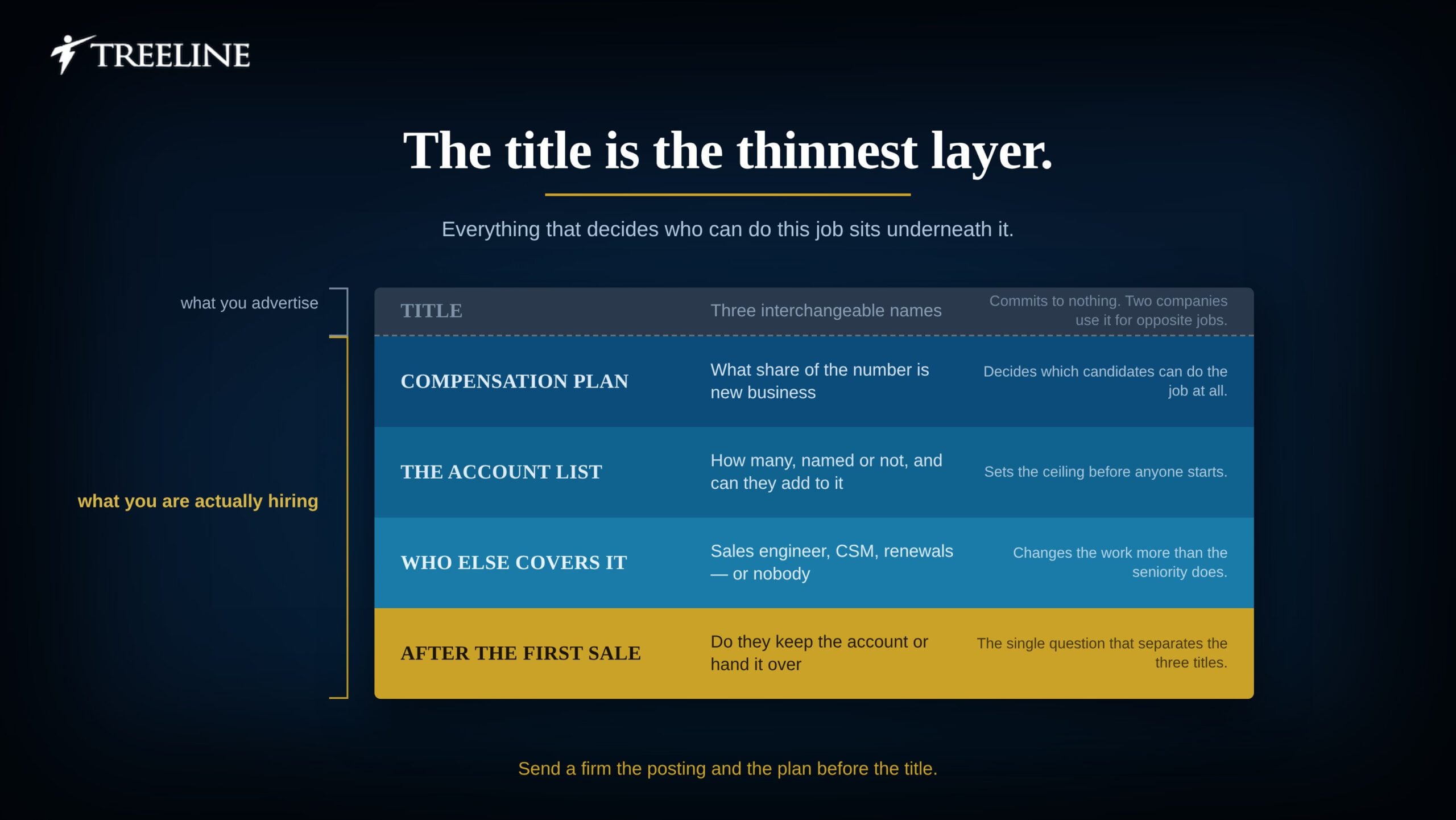
Dan Fantasia, CEO of Treeline, Inc., views an ambiguous title as a brief that has not been written yet rather than a role that needs explaining. From his perspective, the employer should send a firm the actual posting and the actual number before sending the title, because the title is the one piece of information in the search that carries no commitment.
What a Client Executive Is on Treeline’s Own Job Board
The clearest available definition is the one Treeline’s clients write for themselves.
Across live enterprise postings in banking, capital markets, financial services and insurance, and technology, the job description opens the same way: the Enterprise Client Executive is focused on targeting net new business within the Global2000 inside one named vertical, working with and closing business at C level. The page titles on those same postings say Enterprise Account Executive.
Read plainly, that is a hunter. Named target list, large organizations, one vertical, new logos, senior buyers, long cycles. The word “Client” in the title is doing no work at all, it describes who the person will eventually serve, not what they are paid to do this year.
That matters because the title reads as relationship work to almost everyone who sees it. Candidates read it that way and apply expecting an existing book. Internal stakeholders read it that way and expect coverage of current customers. The hire then arrives into a job that is cold outbound into organizations with no prior relationship, which is a different job from the one the title advertised. Treeline’s guidance on writing a sales job description that attracts top sales talent and the related piece on what happens when the job description and the job diverge both apply directly here.
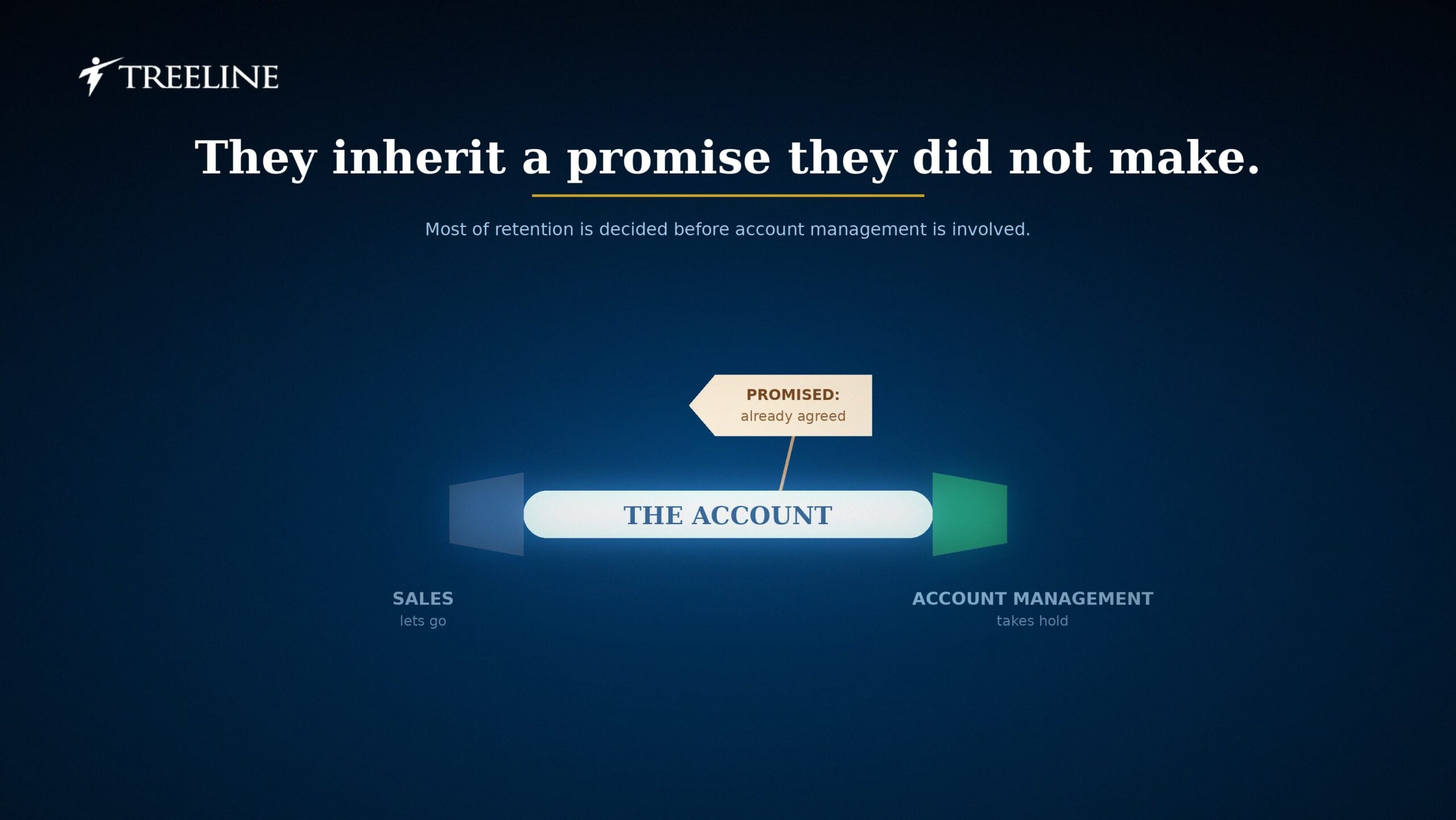
Three Titles, One Axis: New Business at One End, Retention at the Other

Put the three titles on a single line rather than in three boxes.
At one end sits pure new business: no existing accounts, a target list, and a number that is entirely dependent on logos nobody has sold before. At the other end sits pure retention and growth: a defined book, no cold prospecting, and a number built from renewal, expansion and protection of revenue that already exists. Every client-prefixed role sits somewhere between those two ends, and the position on that line is the brief. In software and SaaS businesses the two ends are even measured differently: the new-business end is run on new ARR and pipeline coverage, the retention end on net revenue retention. A role sitting between them is a land-and-expand seat, and it should be described that way rather than by a title.
Where the three titles usually fall:
- Client Executive sits close to the new-business end in most companies, as Treeline’s own enterprise postings show. Some firms use it for a named-account book instead, which is why the question has to be asked rather than assumed.
- Client Partner sits in the middle, and sits there deliberately. Treeline’s own Client Partner posting describes the role in its own words as “an Account Executive/Account Manager position that manages prospecting, discovery and deal closure while also managing and expanding closed-won accounts,” adding that the person manages a funnel of inbound and outbound leads through cold outreach, networking and partner-driven opportunities.
- Client Manager sits at the retention end when it is used at all. It is the rarest of the three by a wide margin, across roughly eight hundred pages of Treeline’s site the phrase appears exactly once, and that single instance is inside a list of unusual interview questions rather than a job posting. In practice it functions as another name for account manager, and Treeline’s guidance on what makes a successful account manager covers it better than a separate search brief would.
The useful consequence is that there is no such thing as a Client Executive search in the abstract. There is a new-business search, a retention search, or a search for someone who must do both. The title does not tell you which one you are running. The compensation plan does, and so does the account list.
Why the Middle of the Axis Is the Hardest Hire
The two ends of the axis are well-understood searches. The middle is where briefs go wrong, and the Client Partner title is the one that most often lands there.
The problem is not that the role is demanding. It is that the two motions reward opposite behavior week to week. New business rewards volume, fast disqualification and a willingness to be told no by people you will never speak to again. Retention rewards patience, availability and a reluctance to push a customer who is already paying. People are rarely equally comfortable with both, and the ones who are tend to be expensive and in demand.
What actually happens when a combined role is briefed without acknowledging the split:
- The person drifts to whichever half they prefer, usually within two quarters
- Existing accounts quietly absorb the whole week, because they generate real requests and prospects do not
- Or prospecting absorbs it, and renewals are handled late by someone who was not expecting to own them
- The number is missed in a way that looks like underperformance rather than a design fault
None of that is visible in the first ninety days, which is why it survives into the following year. Treeline’s guidance on tracking the sales hunter and on whether someone is a schmoozer or a closer both address the same underlying question of which motion a given seller actually runs when nobody is watching.
Fantasia warns against briefing a combined role without naming the split in advance. His reasoning is that a role defined as both and measured as one will be performed as whichever half is easier that week, and the employer will read the result as a hiring failure rather than a design decision they made.
What a Client Executive Search Should Specify Before It Starts

Four things settle the brief, and all four are knowable before anyone is contacted.
The revenue split. What share of the number comes from accounts that already exist. Not a sentiment, a figure. Eighty-twenty toward new business is a hunting search. Eighty-twenty the other way is a retention search. Anything near even is a combined role and should be briefed as one.
The account list. How many accounts, named or unnamed, and whether the person can add to it. A seller given six fixed logos and no ability to prospect wider has a ceiling set before they start, and candidates who are good at this will ask.
Who else touches the account. Whether there is a sales engineer, a customer success manager, a renewals function or nobody. The same title carries very different work depending on how much of the account the person covers alone.
What happens after the first sale. Whether the person keeps the account or hands it over. This single question separates a Client Executive from a Client Partner more reliably than any description either role could be given.
An employer who can answer those four has written the brief. An employer who cannot has a title and an intention, and the search will produce candidates assessed against a job nobody has defined. Treeline’s guidance on speeding up hiring for quota-carrying roles is relevant in reverse here: the time lost in these searches is almost never in sourcing, it is in the weeks spent discovering the brief through rejected candidates.
Where Client Executive and Client Partner Candidates Come From
The sourcing picture follows from the axis rather than the title, which is why searching on the title alone returns the wrong people.
For the new-business end, the pool is enterprise sellers who have carried a named-account target list in a comparable vertical, enterprise software and SaaS, medical device, or industrial technology, depending on where you sell. The relevant experience is the shape of the cycle rather than the logo: whether they have taken a deal through a security review and a procurement process, and how long that took. They are rarely looking, they are usually attached to a patch they have spent two years building, and the approach has to be specific about the territory rather than the title. Treeline’s material on enterprise sales professionals, on hiring top account executives and on the strategic account executive profile covers that end directly. The sourcing mechanics are the same ones set out in our guidance on where to find account executive candidates.
For the retention end, the pool is account managers and customer-facing commercial people, and the assessment is about what they inherited rather than what they closed. That is covered in hiring account managers, and the adjacent channel and virtual variants are covered in channel sales account executive and virtual account manager roles.
For the middle, the honest position is that the pool is small and the search takes longer. Candidates who have genuinely run both motions in the same role are uncommon, and the credible ones can usually describe how they protected prospecting time, because that is the thing that gets eaten first.
Fantasia returns to the posting rather than the title when briefing this search. His reasoning is that two companies using the same title will have written two different jobs, and the posting is the only document where that difference is visible before an offer is made.
What Client Executive and Client Partner Roles Pay
Pay follows the axis more closely than it follows the title, and that is the useful thing to understand before setting a package.
Three factors move it:
- The share of the number that is new business. New-business-weighted roles carry more variable and a higher ceiling, because the risk sits with the seller. Retention-weighted roles carry more base, because the revenue largely exists already and the job is to not lose it.
- The size and complexity of the accounts. Global2000 and C-level buying carry a different band from mid-market, regardless of what the title says. Average contract value and cycle length move the number more than the title does, and two people with the same title at two companies can sit a long way apart on both.
- Whether the role is combined. A genuine both-motions role should be paid above either pure version, because the pool is smaller and the people in it have options. Paying it as a retention role and briefing it as a hunting role is the most common way these searches stall at offer stage.
Treeline’s guidance on retaining top salespeople and on competing for talent against other employers covers what happens once the person is in seat and the market notices them, which in these roles tends to be sooner than employers expect.
How to Test a Firm on a Client Executive Search
Four tests, all runnable in a first conversation.
Do they ask for the split before they ask for the headcount? A firm that asks what share of the number is new business is working the real problem. A firm that asks how many you need and by when is working a requisition.
Do they ask to see the posting? The posting contains the compensation plan, the account language and the expectations. A firm that does not want to read it is matching on the title.
Can they tell you what the title means at three other companies? Someone who recruits into this part of the market has seen Client Executive used for both ends of the axis and can say so. Someone who cannot has not placed one.
Do they push back when the brief is internally inconsistent? A role described as relationship-led with a plan weighted eighty percent to new logos is a contradiction, and it is the firm’s job to say so before the search starts rather than after four candidates have declined.
On engagement model, the distinction between retained and contingency search matters here mainly because a combined-motion role takes longer to fill, and the interview questions worth bringing are covered in must-ask sales interview questions.
When the Title Is Hiding a Different Problem
Sometimes the ambiguity is a symptom rather than the issue.
When nobody can state the revenue split. That usually means the account model has not been decided, and a hire will not decide it. It will inherit the indecision.
When the role exists because two people left. Combining a hunter’s patch and an account manager’s book into one title is a budget decision wearing a job title. It can work, but it should be named as what it is and paid accordingly.
When the real gap is coverage, not selling. If existing customers are being lost through inattention rather than competition, the answer is an account management structure rather than a differently titled seller. Treeline’s guidance on account director roles covers the coverage question where one large account is involved.
When the role is actually early career. Companies occasionally use these titles for roles that are a first or second commercial job, which is a different search with different signals entirely, covered in hiring account representatives.
Fantasia prefers the question of what the person will be fired for over the question of what they will be responsible for. His reasoning is that responsibility lists expand to cover everything plausible, while the firing question produces one answer and that answer is the actual job.
Frequently Asked Questions
Is a Client Executive the same as an Account Executive?
Usually, yes. Treeline’s own enterprise postings carry the page title Enterprise Account Executive and describe the role in the body as the Enterprise Client Executive. Where there is a difference, it is that Client Executive is more often used in companies that expect the seller to stay with the account after the first sale. The only reliable way to tell is the compensation plan and the account list.
What is the difference between a Client Partner and a Client Executive?
Client Partner is usually the combined role: new business plus ownership and expansion of what has already closed. Treeline’s own Client Partner posting describes itself as an Account Executive and Account Manager position in a single seat. Client Executive more often sits toward the new-business end. Both vary by company, which is why the split should be stated in the brief rather than inferred.
Should I post a Client Manager role or an Account Manager role?
Account Manager, in almost every case. Client Manager is barely used as a job title, it appears once across Treeline’s entire site, and not in a posting. Candidates search the term they know, so a Client Manager posting will be seen by fewer of the right people for no benefit.
How long does a Client Executive search usually take?
It depends on which end of the axis the role sits on. A clearly briefed new-business role runs like any enterprise search. A combined role takes longer, because the pool of people who have genuinely run both motions is smaller and most of them are being paid well where they are. The delay that is avoidable is the one caused by an undecided brief.
Can one person really do both new business and account management?
Some can, and the ones who can are worth paying for. The failure mode is not the person, it is the design: a combined role with a single undifferentiated number will be performed as whichever half is easier that week. If both halves matter, both should appear in the plan.
What should I send a recruiting firm first?
The posting and the compensation plan, before the title. Those two documents contain the account list, the revenue split and the expectations, which is everything a firm needs to run the search correctly. The title is the only part of the brief that commits to nothing.
Send the Posting, Not the Title
If one thing changes as a result of reading this, make it the order in which you brief.
Take the live posting and the compensation plan, and give both to whoever is running the search before the title comes up. Then answer the four questions in this article, the revenue split, the account list, who else touches the account, and what happens after the first sale. A firm that can work from that will find the right person. A firm that wants only the title will find somebody who matches it, which is a different outcome and a more expensive one.
If you want a second read on a brief you are not sure about, send it over. Treeline has run these searches at both ends of the axis and in the middle, and the fastest part of the conversation is usually working out which one you actually have.
Share This Story, Choose Your Platform!
Related Posts

What our happy clients are saying
Treeline Inc. provided us with the most candidates that aligned with our needs and were of the highest quality.

Dr. Jeffrey Klein Head of North America Sales, Satchel Pulse
Treeline Inc.’s collaborative, flexible, and communicative approach resulted in a smooth partnership. Beyond their recruitment expertise, their unique sourcing model was efficient and effective.

Sera Holt Director of Operations, LNS Research
Their professionalism was outstanding. Treeline Inc. was extremely thorough and ensured that we were on the same page before they started looking for candidates. They listened to us and did a great job working with the candidate to close out the process.

Cate Grant AVP Customer Success, Nasdaq
Thanks to Treeline Inc.’s intricate and thorough screening process, the company is able to hire six high-quality candidates that fit perfectly in the company’s culture. The team is highly receptive to concerns, and internal stakeholders are impressed with their unique recruitment abilities.

Anna McKean Sales Recruiter, Insider Intelligence
Treeline Inc. has been qualified individuals throughout a five-year-long engagement. They’ve made numerous placements of talented and qualified individuals for our business.

Michele St Laurent VP of HR, The Institute for Applied Network Security

Let Us Help You Source the Sales Talent You Need
Whether you’re building a team or replacing a key role, our Candidate Sourcing Platform provides a fast, flexible, and employer-focused solution.
Tell us more about your business and how we can help.
Treeline Inc.
Your Award-Winning Sales Recruitment Partner
15 Lincoln Street, Suite 314, Wakefield, MA 01880