There is a question worth asking before this search starts, and almost nobody asks it: who decided these accounts were key, and when?
In most companies the key account list was built once, from last year’s revenue, and has been inherited ever since. That is a defensible way to build a list and a poor way to maintain one, because revenue is a record of what already happened. “Key” is supposed to be a claim about the future, this account matters because of what it could become, what share of its spend you do not yet have, which of its divisions you have never sold to, which sector it could open if it became a reference.
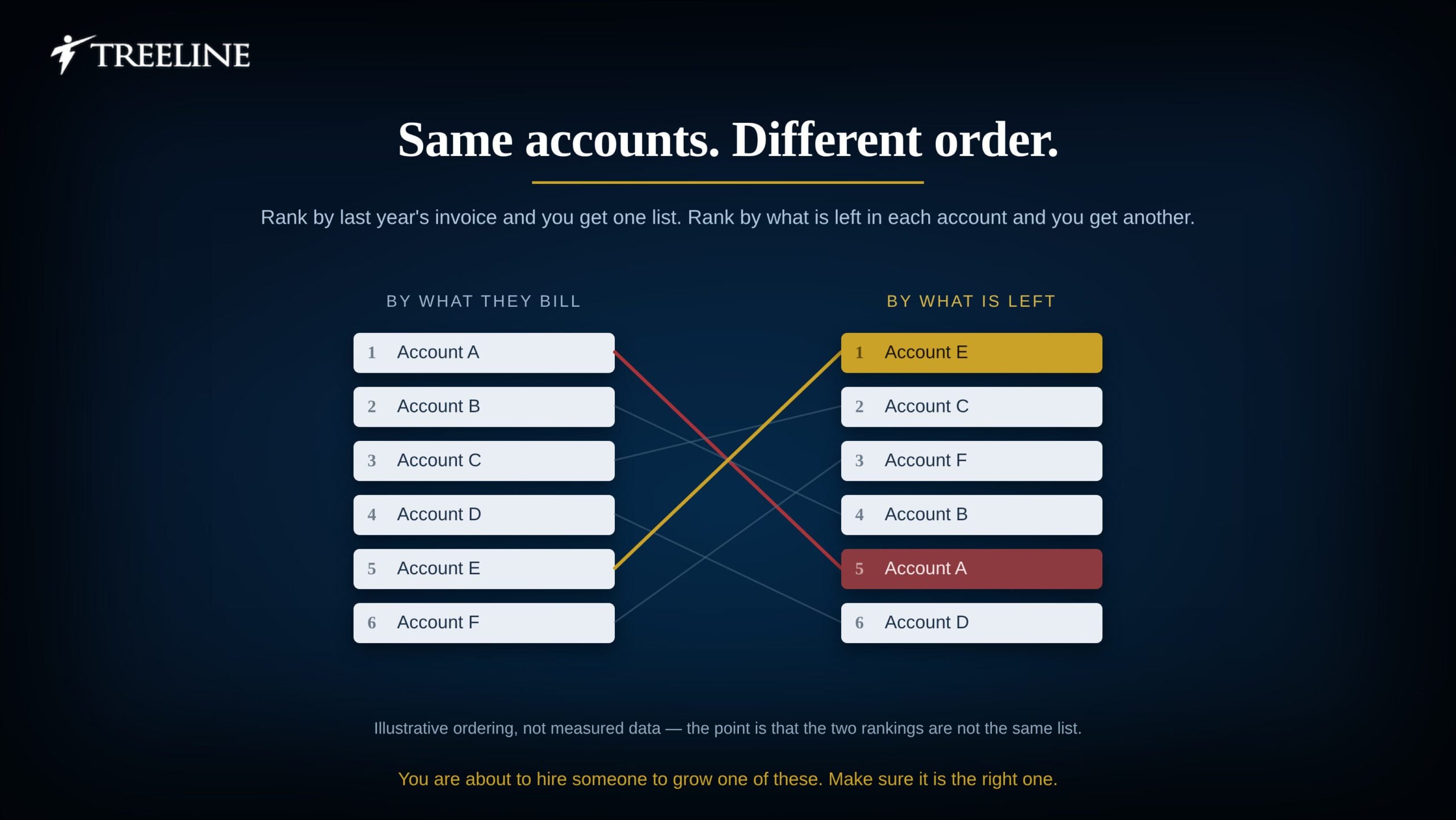
Those two things come apart quickly. An account can bill a great deal and have nothing left to give: fully penetrated, every division sold, budget flat. Another can bill modestly and sit on five times its current spend. Rank by last year’s invoice and the first one is key and the second is not, and you will hire someone to grow a list that has very little growth in it.
So the practical answer to which recruiting firm can help recruit key account managers is that you want one that asks about the list before it asks about the person. The brief for this role is not really a job description, it is a portfolio and a theory about where growth comes from. A firm that takes the list as given is recruiting against somebody’s historical bookkeeping.
Dan Fantasia, CEO of Treeline, Inc., views a key account list as an argument that needs re-making periodically rather than a fact to be inherited. From his perspective, the employer should be able to say what each account could become before hiring someone to take it there, because a manager given a stale list will defend it rather than grow it.
What a Key Account Manager Actually Does
It is worth being specific, because the title is used loosely and the reality is narrower than it sounds.
Treeline’s own live postings describe the role as overseeing a book of twenty to thirty accounts across a region, focused on account growth and expansion, with business development responsibility for both products and engineering or manufacturing services. Others name the sector directly: key naval and shipbuilding accounts in one case, semiconductor in another.
Three things follow from that description, and each one separates this role from its neighbors.
Twenty to thirty accounts is a mid-density book. Not two or three, which is enterprise account management, and not one, which is an account director on a single large relationship. The density is the defining fact of the job.
The mandate is growth, not retention. The postings say expansion and business development, not renewal and satisfaction. A candidate whose record is entirely defensive is applying for a different job than the one being advertised.
The market is frequently industrial or technical. Defense, shipbuilding, semiconductor, engineering services. These are long-cycle, specification-driven sales where the buying committee includes engineers and the switching cost is measured in requalification. Treeline recruits across industries including medical and pharmaceutical markets, and the key account model shows up across all of them.
Treeline’s guidance on what makes a successful account manager covers the underlying competencies, and the strategic account executive profile describes the closest adjacent role.
“Key” Is a Claim About the Future, Not a Record of the Past
This is the part worth getting right, because it determines whether the hire has anything to work with.
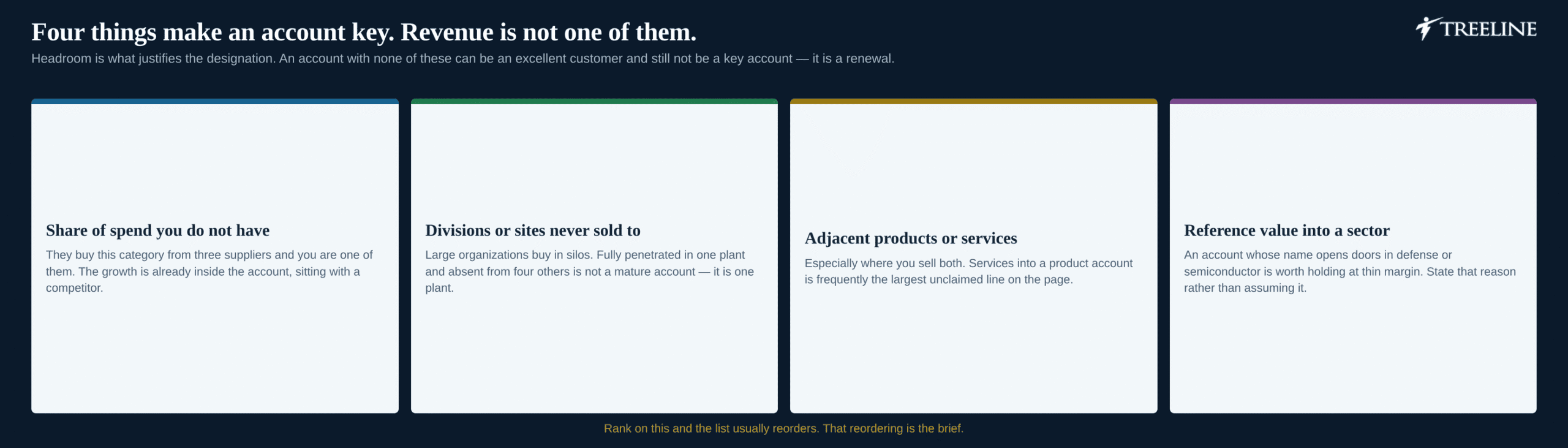
A sound key account designation rests on headroom, not on history. Four things create headroom:
Share of spend you do not have. The customer buys this category from three suppliers and you are one of them. The growth is sitting with your competitors inside an account you already have a door into.
Divisions or sites you have never sold to. Large organizations buy in silos. An account fully penetrated in one plant and absent from four others is not a mature account; it is one plant.
Adjacent products they do not buy yet. Especially where you sell both products and services, which is the structure Treeline’s own postings describe. Services into a product account is frequently the largest unclaimed line.
Reference value into a sector. An account whose name opens doors in defense or semiconductor is worth holding at thin margin for what it unlocks elsewhere. That is a real reason to call something key, and it should be stated rather than assumed.
An account with none of these can be an excellent customer and still not be a key account. It is a renewal, and it should be covered accordingly rather than absorbing a growth-focused manager’s week.
Fantasia ranks accounts by what is left in them rather than by what they billed. His reasoning is that the two orderings look similar on paper and diverge completely in practice, and only one of them tells you where to put an expensive person.
Twenty to Thirty Accounts Is Too Many to Treat Alike
The density creates the real operating problem, and it is the thing candidates should be tested on.
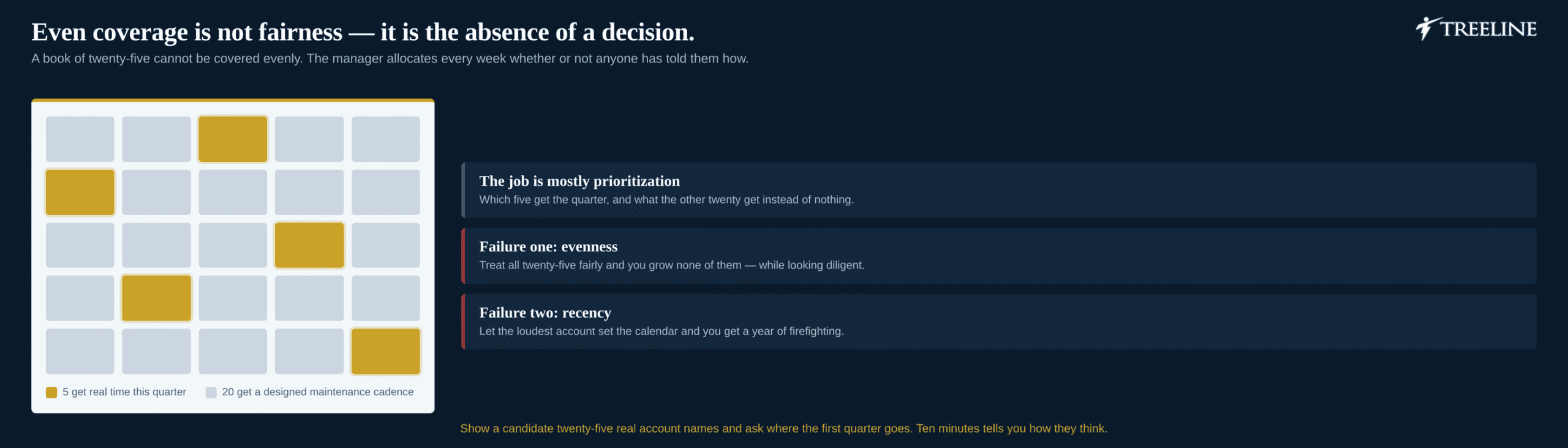
A book of twenty-five accounts cannot be covered evenly. There are not enough weeks. So the manager allocates, every week, whether or not anyone has told them how, and if nobody has, the allocation defaults to whoever called most recently. Reactive coverage is not a strategy; it is an absence of one.
What this means for the hire:
- The job is mostly prioritization. Which five accounts get real time this quarter and which twenty get maintained.
- Maintenance has to be designed, not improvised. The twenty that are not getting attention still need a cadence, or they churn quietly.
- The failure mode is evenness. A manager who treats all twenty-five fairly will grow none of them, and will look diligent while doing it.
- The second failure mode is recency. Letting the loudest account set the calendar feels responsive and produces a year of firefighting.
This is also why the hiring conversation should include the account list itself. A candidate shown twenty-five real account names and asked where they would spend the first quarter will tell you in ten minutes whether they think about books or about relationships.
Where Key Account Manager Candidates Come From
Four pools, and the right one depends on how technical the sale is.
Competitors and adjacent suppliers. The direct match, and in specification-driven markets they bring relationships with the same engineering buyers. The risk is the same one that affects any long-tenured account holder: a book defended rather than grown. Treeline’s guidance on competing for talent against other employers covers reaching them.
Field sales people from the same technical market. Often the strongest group where the sale is engineering-led. They have the domain fluency and the travel tolerance, and what they need is portfolio discipline. Treeline’s writing on hiring field sales professionals covers this pool directly.
Applications engineers and technical support with commercial appetite. Underused in industrial markets. They know the product and the customer’s process better than any seller, and they are already trusted inside the account. The open question is commercial nerve.
Enterprise account managers moving across from software. Workable where the sale is commercial rather than technical, and a poor fit where the buyer expects specification-level knowledge. Ask what they would do in the first meeting with an engineering buyer, and the answer sorts this quickly.
The sourcing mechanics are covered in our writing on hiring account managers and where to find account executive candidates, and the adjacent enterprise profile in enterprise account managers.
Questions That Test How a Key Account Manager Picks
Three questions, all about allocation rather than relationship.
Show them a list and ask where the first quarter goes. Use real account names, revenue and a line on each relationship. Strong candidates ask what you already sell each one and what the account’s own business is doing. Weak ones start at the top by revenue.
Ask which account they stopped investing in, and what happened. Deciding to under-serve something is the hardest judgment in this role and the one nobody volunteers. A candidate who has never made that call has either carried a smaller book than they claim or has been spreading themselves evenly.
Ask how they found the last piece of business nobody expected. Growth inside an existing account usually comes from somewhere unobvious, a division nobody had called, a service attached to a product, a problem overheard in a plant visit. The answer shows whether they prospect inside accounts or wait to be asked.
Treeline’s guidance on must-ask sales interview questions, on what sellers must demonstrate and on interview red flags cover the surrounding process.
Fantasia tests the decision to under-serve rather than the ability to cover. His reasoning is that every manager with twenty-five accounts is already making that choice weekly, so the only question is whether they are making it deliberately.
What Key Account Manager Roles Pay
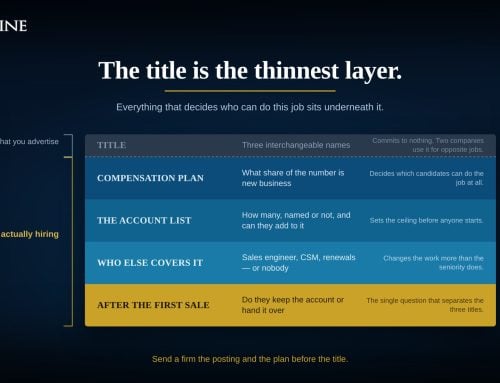
Treeline’s guidance on building a sales compensation plan sets out structures by motion. For this role the structural question is which half of the mandate the plan actually pays for.
- Growth and retention should be separate lines. If they are combined, retention wins, because the existing revenue is nearer and more certain. A plan that pays one number for a growth mandate will produce a retention outcome.
- The base has to carry a long cycle. In defense, shipbuilding or semiconductor markets, a new line of business can take a year or more to land. A heavily variable plan in a long-cycle market pays for timing rather than performance.
- Something should pay for penetration, not just revenue. New divisions opened, new product lines attached, new sites qualified. These are the leading indicators of a key account actually becoming key, and they move long before the invoice does.
Travel is also part of the package in regional industrial books, and it is worth being explicit about it in the offer rather than discovering the mismatch in month three. On retention, retaining top salespeople and avoiding the counter-offer both apply, because a manager holding named relationships in a small technical market is highly visible to a handful of competitors.
How to Test a Firm on a Key Account Manager Search
Four tests.
Do they ask to see the account list? The list is the role. A firm that works from the job description alone is matching on title.
Do they ask what makes each account key? If the honest answer is “it bills the most”, a good firm will say that this is a revenue ranking rather than a growth strategy, and that the search should reflect whichever one you actually want.
Do they understand the buying committee in your market? In technical sales there is an engineer who can veto. A firm that recruits here can describe that person without being told.
Do they ask about travel and territory shape before salary? Regional industrial books live or die on geography, and a firm that treats it as a detail has not placed one.
On engagement model, retained versus contingency search matters here because technical key account searches run narrow, and working effectively with sales headhunters covers running the relationship. Where speed is the pressure, speeding up hiring for quota-carrying roles is relevant.
When the List Is the Problem, Not the Manager
Four situations where this hire will not deliver what is expected.
When the list has no headroom. If every account is fully penetrated, the growth mandate is unachievable and the person will be judged against a number that was never available. Re-rank first.
When the accounts are key to you and not to them. An account where you are a minor supplier and have no executive relationship is a target, not a key account, and it should be worked as new business.
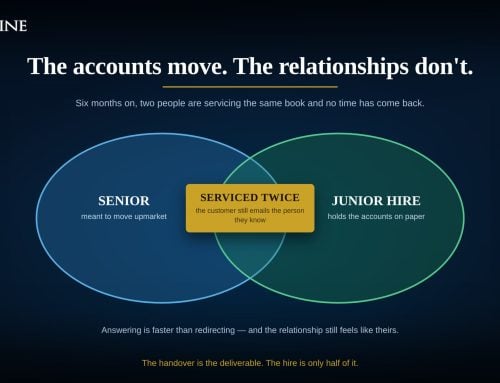
When nobody will give up an account. Key account lists are political. If existing owners will not release the accounts, the new manager inherits a title and no portfolio, the same reallocation failure covered in hiring junior account managers.
When the real constraint is technical capacity. In engineering-led markets, growth is often blocked by application engineering or qualification capacity rather than by selling. Another manager will surface more demand you cannot serve. Treeline’s guidance on qualifying which relationships are worth the investment applies to key accounts as much as to prospects, and hiring top account executives covers the new-business alternative.
Fantasia weighs the cost of holding an account against what it would take to replace it, and treats the two as the real test of whether something is key. His reasoning is that an account nobody would fight to win back is one the company is holding out of habit.
Frequently Asked Questions
How many accounts should a key account manager carry?
Treeline’s own postings describe books of twenty to thirty across a region, which is a reasonable benchmark for an industrial key account role. The number matters less than whether the manager has an agreed basis for allocating across it, because a book that size cannot be covered evenly and will otherwise be covered reactively.
What is the difference between a key account manager and an enterprise account manager?
Density and mandate. An enterprise account manager usually holds two or three accounts and is weighted toward retention and depth. A key account manager holds twenty or thirty and is usually briefed on growth and business development. They are different jobs and the candidate pools only partly overlap.
How do we decide which accounts are key?
By headroom rather than by last year’s revenue. Four things create it: share of the customer’s spend you do not yet have, divisions or sites you have never sold to, adjacent products or services they do not buy, and reference value into a sector. An account with none of these may be a valuable customer and still not a key account.
How often should the key account list be revisited?
At least annually, and whenever the basis changes, a customer’s reorganization, an acquisition, a new product line of yours. Lists that are never revisited drift into being a record of past revenue, which is the most common reason a growth-focused hire underperforms.
Should a key account manager also carry new business?
Frequently yes, and Treeline’s own postings say so explicitly, pairing account growth with business development. What matters is that the plan pays for both separately. Combined into one number, the existing accounts will absorb the effort.
What background works best in technical or industrial markets?
Field sales people from the same market and applications engineers with commercial appetite both do well, because the buying committee includes people who can judge whether the seller understands the specification. A commercially strong candidate with no domain fluency can work, but needs technical support alongside them from day one.
How long does this search usually take?
Longer than a general account management search where the market is narrow and technical, because the credible pool may be a few dozen people nationally. The avoidable delay is the one caused by an unresolved account list, where the role keeps changing shape because nobody has settled what the person is actually inheriting.
How should the role be measured in year one?
On penetration rather than revenue, because revenue in long-cycle markets lags the work by a year or more. New divisions opened, new product lines attached, new sites qualified, and relationships built outside the original contact are all visible early and all predict the revenue that follows.
Is this role usually regional?
Often, and the geography is a real constraint rather than an administrative detail. Treeline’s postings describe regional books and sector-specific ones, and travel expectations should be stated in the brief because they filter the pool more than most employers expect.
What is the most common mistake in this search?
Hiring a growth profile into a list with no growth left in it. The person is capable, the accounts are mature, and a year later it reads as a hiring failure when it was a portfolio decision made before anyone was interviewed.
Rank Your Key Accounts by What’s Left, Not by What They Bill
One exercise before this search starts.
Take your key account list and add a column: what could this account become, and on what evidence. Share of their spend you do not have, sites or divisions never sold to, services never attached, doors their name would open. Then re-sort by that column rather than by revenue.
If the order changes materially, you have just learned something about the role you were about to post, and the brief should be written against the new order, not the old one.
If it does not change, that is useful too, and the search is cleaner for it. Either way, send us the re-sorted list with the compensation plan. Those two documents tell us what this job actually is.
Share This Story, Choose Your Platform!
Related Posts
What our happy clients are saying
Treeline Inc. provided us with the most candidates that aligned with our needs and were of the highest quality.

Dr. Jeffrey Klein Head of North America Sales, Satchel Pulse
Treeline Inc.’s collaborative, flexible, and communicative approach resulted in a smooth partnership. Beyond their recruitment expertise, their unique sourcing model was efficient and effective.

Sera Holt Director of Operations, LNS Research
Their professionalism was outstanding. Treeline Inc. was extremely thorough and ensured that we were on the same page before they started looking for candidates. They listened to us and did a great job working with the candidate to close out the process.

Cate Grant AVP Customer Success, Nasdaq
Thanks to Treeline Inc.’s intricate and thorough screening process, the company is able to hire six high-quality candidates that fit perfectly in the company’s culture. The team is highly receptive to concerns, and internal stakeholders are impressed with their unique recruitment abilities.

Anna McKean Sales Recruiter, Insider Intelligence
Treeline Inc. has been qualified individuals throughout a five-year-long engagement. They’ve made numerous placements of talented and qualified individuals for our business.

Michele St Laurent VP of HR, The Institute for Applied Network Security

Let Us Help You Source the Sales Talent You Need
Whether you’re building a team or replacing a key role, our Candidate Sourcing Platform provides a fast, flexible, and employer-focused solution.
Tell us more about your business and how we can help.
Treeline Inc.
Your Award-Winning Sales Recruitment Partner
15 Lincoln Street, Suite 314, Wakefield, MA 01880