Before answering where, it is worth asking why the search is external at all.
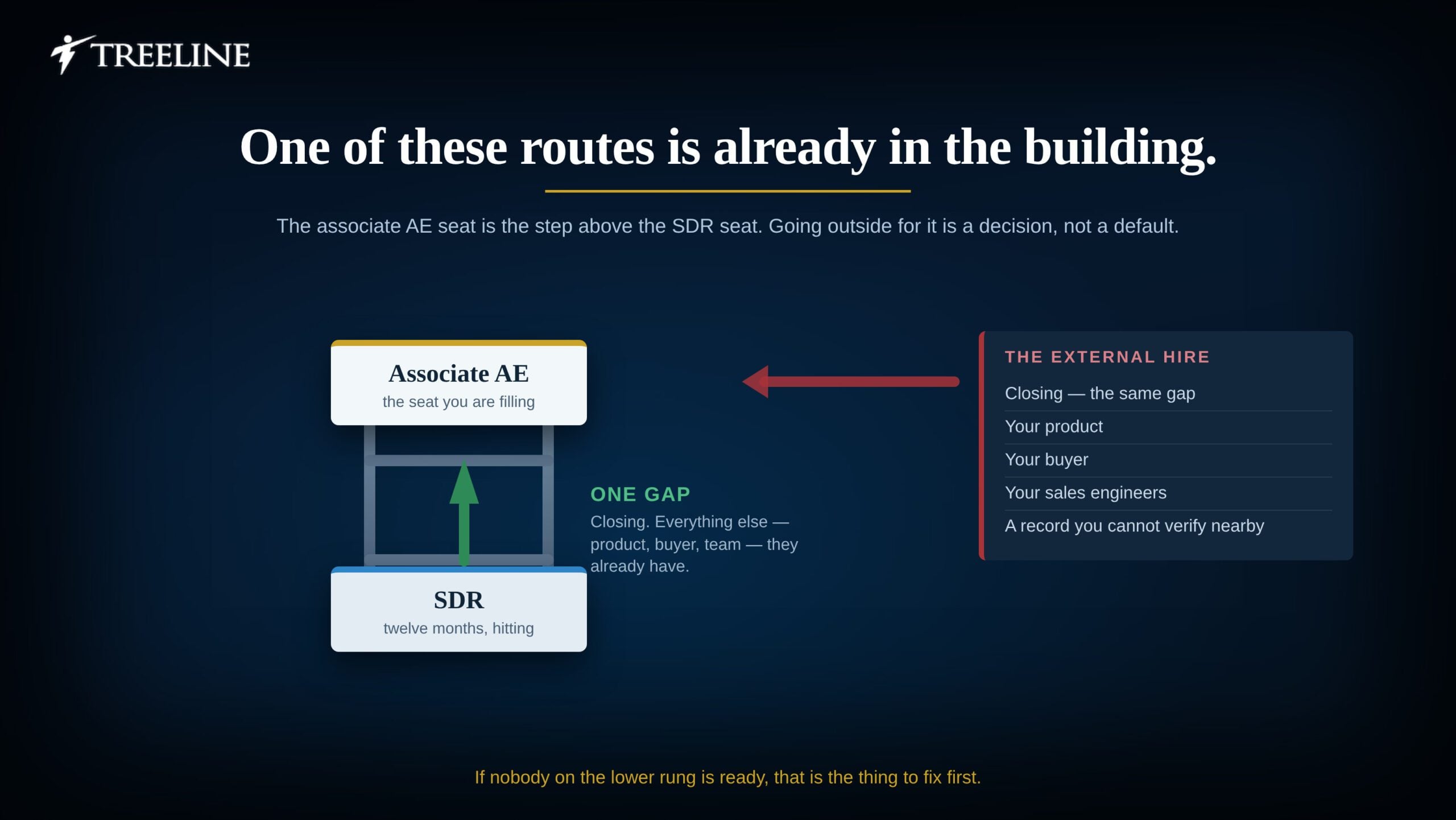
The junior account executive seat, more often called associate account executive, which is the term most of this market uses, is the natural next step for a sales development representative who has been doing the job well for twelve to eighteen months. In most companies that have an SDR function, the seat is filled by promotion. When a company goes outside for it instead, there is usually a reason, and the reason is worth knowing before a search starts.
Three reasons an employer ends up searching externally:
- There is no SDR function to promote from, which is a structural answer and a legitimate one
- There is one, but nobody in it is ready, which is a development problem wearing a hiring problem’s clothes
- There is one and somebody is ready, but nobody has told them, which is how you lose two people instead of hiring one
Only the first is a hiring problem. The other two will reproduce themselves in eighteen months regardless of who you hire now.
So the practical answer to where to find junior account executive candidates starts with counting your own bench, and then, if the search really is external, looking in the places where people one step from closing actually sit. Those are not the same places you would look for a first commercial hire.
Dan Fantasia, CEO of Treeline, Inc., views an external search for this level as a signal worth reading before it is acted on. From his perspective, an employer should establish why nobody internally is ready before opening the role, because the answer usually describes something that will still be true next year.
Before You Search: The Junior Account Executive Seat Is Usually a Promotion

The arithmetic is straightforward and most employers have not done it.
A sales development representative who has been booking qualified meetings for a year has already demonstrated the hardest part of early sales work: sustained outbound effort in the face of rejection, with enough judgment to qualify. What they have not demonstrated is closing. That is one gap, and it is a teachable one.
An external junior candidate brings the same single gap plus several others, no product knowledge, no relationships with your sales engineers, no understanding of your buyer, no track record you can verify with people who sit near you.
Four questions settle whether promotion is available:
- Who in the SDR team has consistently hit, and for how long? Twelve months is the usual threshold, not because of the number but because it covers a full cycle of good and bad quarters.
- Has anyone been given closing exposure? Sitting in on demos, running a discovery call, owning a small deal end to end. If nobody has, you cannot know who is ready and neither can they.
- Does a path exist on paper? Not a promise, criteria. People leave for a defined path elsewhere far more often than for money.
- What happened to the last person who asked? The answer tells you what the team believes about its own prospects.
Treeline’s guidance on retaining reps and eliminating churn in the SDR role and the traits that run from SDR to CEO both bear directly on this, and the complete interview process for business development reps covers how to assess the bench you already have.
What a Junior Account Executive Is Actually Expected to Do
The title is used for two different jobs, and the brief should say which.
The supported closer. They own small deals end to end but work inside a motion someone else designed, with a senior seller or manager on the larger opportunities. Most associate AE roles are this.
The full-cycle junior. They prospect, qualify, demo and close their own smaller segment without a dedicated SDR feeding them. More autonomy, longer ramp, and a different hire, this one needs the outbound muscle as well as the closing instinct.
What the role does not include at this level: pricing authority beyond a set discount band, territory design, forecast ownership, or discretion over which accounts matter. Those sit above, which is appropriate.
Where the requirement is genuinely pipeline generation rather than closing, Treeline’s guidance on hiring business development and sales development representatives covers that layer, and the business development rep profile describes the role it grows out of. For the surrounding function, B2B inside sales and building an inside sales force are the relevant pieces.
What an SDR Record Predicts About Closing, and What It Doesn’t
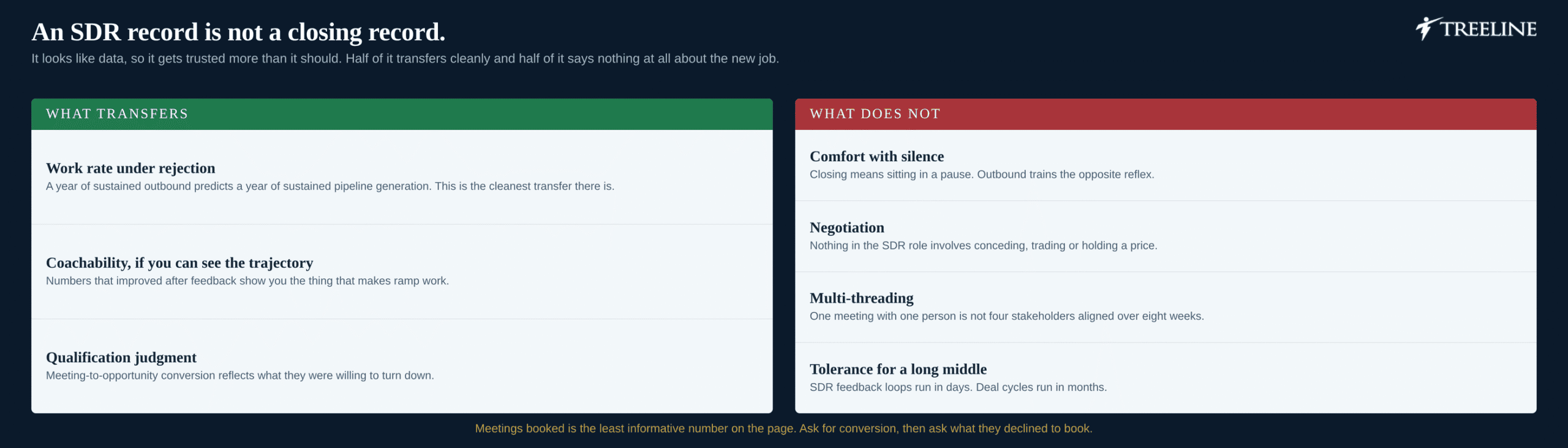
This is the part most processes get wrong, because an SDR record looks like data and is therefore trusted more than it should be.
What it does predict:
- Work rate under rejection. Someone who sustained outbound volume for a year will sustain pipeline generation as an AE. This transfers cleanly and it is the single most useful signal.
- Coachability, if you can see the trajectory. An SDR whose numbers improved after feedback has shown you the thing that makes ramp work.
- Qualification judgment. Meeting-to-opportunity conversion says more than meetings booked, because it reflects whether they were honest about what they passed on.
What it does not predict:
- Comfort with silence. Closing requires sitting in a pause rather than filling it. Outbound rewards the opposite reflex, and the transition is harder than it looks.
- Negotiation. Nothing in the SDR role involves conceding, trading or holding a price. It is genuinely new.
- Multi-threading. Booking one meeting with one person is a different skill from keeping four stakeholders aligned over eight weeks.
- Handling a long middle. SDR feedback loops are days. Deal cycles are months. Some people find the slowness intolerable and only discover it after the move.
The practical consequence is that meetings booked is the least informative number on the page. Ask for conversion to opportunity, then ask what they declined to book and why.
Fantasia measures an early-career record by what it rules out rather than what it promises. His reasoning is that a strong conversion rate removes one real doubt and leaves the others untouched, which is useful only if an employer is clear about which doubt it has removed. Treeline’s writing on what sellers must demonstrate to get hired and the must-ask sales interview questions cover the assessment mechanics.
Fantasia starts with conversion rather than volume when reading an early-career record. His reasoning is that volume describes effort, which is visible anyway, while conversion describes judgment, which is the part that has to be hired rather than managed.
Where Junior Account Executive Candidates Come From
If the search really is external, four pools, in rough order of how well they transfer.
SDRs at companies one tier larger than yours. The strongest pool. They have been trained in a more structured environment, they are often blocked on promotion because the queue above them is long, and a closing seat is exactly what they want. They are also reachable, because the frustration is specific and nameable.
Associate AEs at companies with a worse product. Already closing, already ramped, and movable for a better product to sell. More expensive than an SDR, and worth it if your cycle is short enough that ramp matters.
People closing in an adjacent, less prestigious market. Someone selling smaller contracts in a different category has done the full motion. What they need is your buyer, not the basics.
Internal non-sales staff with customer contact. Support, implementation, customer success. Underused, frequently excellent, and they arrive with product knowledge that takes an external hire six months to acquire. The gap is commercial instinct, which is testable.
The general sourcing mechanics, channels, cost per pool, reaching people who are not looking, are covered in our writing on where to find account executive candidates and are not repeated here. For the level below, hiring account representatives covers the first commercial hire where there is no record at all.
What Junior Account Executive Roles Pay
Treeline’s guidance on building a sales compensation plan sets out sample structures by motion, and the inside sales example is the relevant comparison at this level: seventy percent base and thirty percent variable, with quarterly bonuses tied to both revenue and customer satisfaction. The SaaS example alongside it runs a fifty-fifty split.
Three points specific to the junior seat:
- The base-to-variable split should sit closer to the inside sales shape than the senior AE shape. Someone who has never closed cannot forecast their own earnings, and a plan weighted heavily to variable selects for people who can absorb the risk rather than people who can sell.
- Promotion from SDR usually means a base increase and a lower earnings ceiling in year one. If that is not said out loud, the person will discover it in month four and read it as a bait and switch.
- Ramp needs a guaranteed component. The first closed deal may be two quarters out. The plan either acknowledges that or quietly asks the person to fund it.
On retention, retaining top salespeople applies with particular force here, because a newly promoted associate AE with two quarters of closing experience becomes a target for exactly the companies described in the sourcing section above.
How to Test a Firm on a Junior Account Executive Search
Four tests.
Do they ask about your SDR team first? A firm that asks whether you have a bench, and why nobody on it is ready, is working the actual problem. A firm that goes straight to candidate profiles is filling a requisition.
Do they ask which of the two jobs this is? Supported closer or full-cycle junior. The candidates are different and the brief has to pick one.
Do they talk about conversion rather than volume? A firm that discusses meetings booked as the headline SDR metric has not thought about what transfers.
Do they tell you this is a role you should expect to lose? An honest firm will say that a successful associate AE is promotable in two years and that you are hiring into a seat with turnover built in. That is not a reason to avoid it; it is a reason to plan for it.
On engagement model, retained versus contingency search matters less at this level than at senior ones, and speeding up hiring for quota-carrying roles covers where time is actually lost.
When an External Junior Hire Is the Wrong Move
Four situations.
When somebody internal is ready and has not been asked. Hiring externally over a ready internal candidate usually costs you both seats, because the internal person reads the decision accurately.
When there is no closing motion to join. If the sale is still being figured out, an inexperienced closer cannot discover it. That is work for someone who has done it before.
When nobody has time to coach. The same constraint that governs any early-career hire. A junior AE without a named coach learns by imitation, and imitates whatever is nearest.
When the real gap is pipeline. If AEs are not closing because there is nothing to close, another closer makes it worse. Treeline’s guidance on cold email fundamentals for SDRs and on attracting top talent covers the surrounding diagnosis, and hiring top account executives covers the search one level up.
Fantasia declines to treat a promotion and an external hire as interchangeable options at this level. His reasoning is that the two carry different risks, the promotion risks a gap in the pipeline team, the external hire risks everything the internal candidate already knows, and that an employer who has not named which risk they prefer has not made the decision yet.
Frequently Asked Questions
Should I promote an SDR or hire externally?
Promote if someone has twelve consistent months and some closing exposure. The internal candidate’s single gap is closing; the external candidate’s gaps include your product, your buyer and your team. If nobody internal is ready, that is worth understanding before you search, because the same condition will produce the same shortage next year.
How long does an SDR need before moving into a closing role?
Usually twelve to eighteen months, and the reason is coverage of a full cycle rather than the number itself. Someone promoted after six good months has not yet had a bad quarter, and how a person handles a bad quarter is most of what you are trying to learn.
What SDR metrics actually matter for this decision?
Conversion to qualified opportunity, and the trend in it. Meetings booked measures effort, which you can already see. Conversion measures judgment, which is the harder thing to teach and the thing a closing seat depends on.
What is the difference between a junior AE and an account representative?
An account representative is usually a first commercial role with no closing record at all. A junior or associate account executive normally has one, most often an SDR record, and is being assessed on whether that record transfers. The two searches look for different evidence.
Why does Treeline’s site say associate account executive rather than junior?
Because that is the term this market uses. Across Treeline’s site, associate account executive appears 243 times and junior account executive does not appear at all. Both titles describe the same seat, and a posting will reach more of the right people using the term candidates search for.
How long should ramp be for this role?
Work it back from the cycle. If deals take three months, expect the first self-originated close around month four or five, with earlier revenue coming from inherited or supported deals. A plan expecting closed revenue in month one is relying on a handover rather than on the hire.
Is a full-cycle junior role harder to fill than a supported one?
Yes, materially. It asks for outbound stamina and closing instinct in the same person at a level where neither is proven. If the role must be full-cycle, the brief should say so early, because it changes the pool and the timeline.
Should I worry that a good hire here will leave in two years?
Plan for it rather than worry about it. A successful associate AE becomes promotable, and the companies in your sourcing pools will notice. The useful response is a defined next step internally, not a longer notice period.
Can someone from customer success or support do this job?
Often, and this pool is underused. They arrive with product knowledge and customer fluency that an external hire takes months to build. What has to be tested is commercial instinct, whether they can ask for money and sit with the discomfort of a negotiation.
Does a sales degree or formal training matter at this level?
Very little. What predicts performance is sustained effort under rejection and visible response to coaching. Formal sales education is neither a positive nor a negative signal on its own.
What is the most common mistake in this search?
Reading an SDR record as though it were a closing record. High meeting volume demonstrates work rate, which is valuable and transferable. It says almost nothing about negotiation, multi-threading or tolerance for a long middle, and those are what the new job is made of.
Count Your SDR Bench Before You Open the Search
One thing to do before this search starts.
List everyone in your sales development team who has hit for twelve months or more. For each, write down whether they have ever run a discovery call or sat through a close, and whether anybody has told them what the path looks like. If that list has names on it and none of them have been asked, the search you are about to run is the wrong one.
If the list is genuinely empty, the external search is the right call, and the first thing to settle is which of the two junior jobs you are filling, because that decides the pool.
Send us the SDR numbers and the plan for the seat, and we will tell you which search you are actually running.
Share This Story, Choose Your Platform!
Related Posts
What our happy clients are saying
Treeline Inc. provided us with the most candidates that aligned with our needs and were of the highest quality.

Dr. Jeffrey Klein Head of North America Sales, Satchel Pulse
Treeline Inc.’s collaborative, flexible, and communicative approach resulted in a smooth partnership. Beyond their recruitment expertise, their unique sourcing model was efficient and effective.

Sera Holt Director of Operations, LNS Research
Their professionalism was outstanding. Treeline Inc. was extremely thorough and ensured that we were on the same page before they started looking for candidates. They listened to us and did a great job working with the candidate to close out the process.

Cate Grant AVP Customer Success, Nasdaq
Thanks to Treeline Inc.’s intricate and thorough screening process, the company is able to hire six high-quality candidates that fit perfectly in the company’s culture. The team is highly receptive to concerns, and internal stakeholders are impressed with their unique recruitment abilities.

Anna McKean Sales Recruiter, Insider Intelligence
Treeline Inc. has been qualified individuals throughout a five-year-long engagement. They’ve made numerous placements of talented and qualified individuals for our business.

Michele St Laurent VP of HR, The Institute for Applied Network Security

Let Us Help You Source the Sales Talent You Need
Whether you’re building a team or replacing a key role, our Candidate Sourcing Platform provides a fast, flexible, and employer-focused solution.
Tell us more about your business and how we can help.
Treeline Inc.
Your Award-Winning Sales Recruitment Partner
15 Lincoln Street, Suite 314, Wakefield, MA 01880