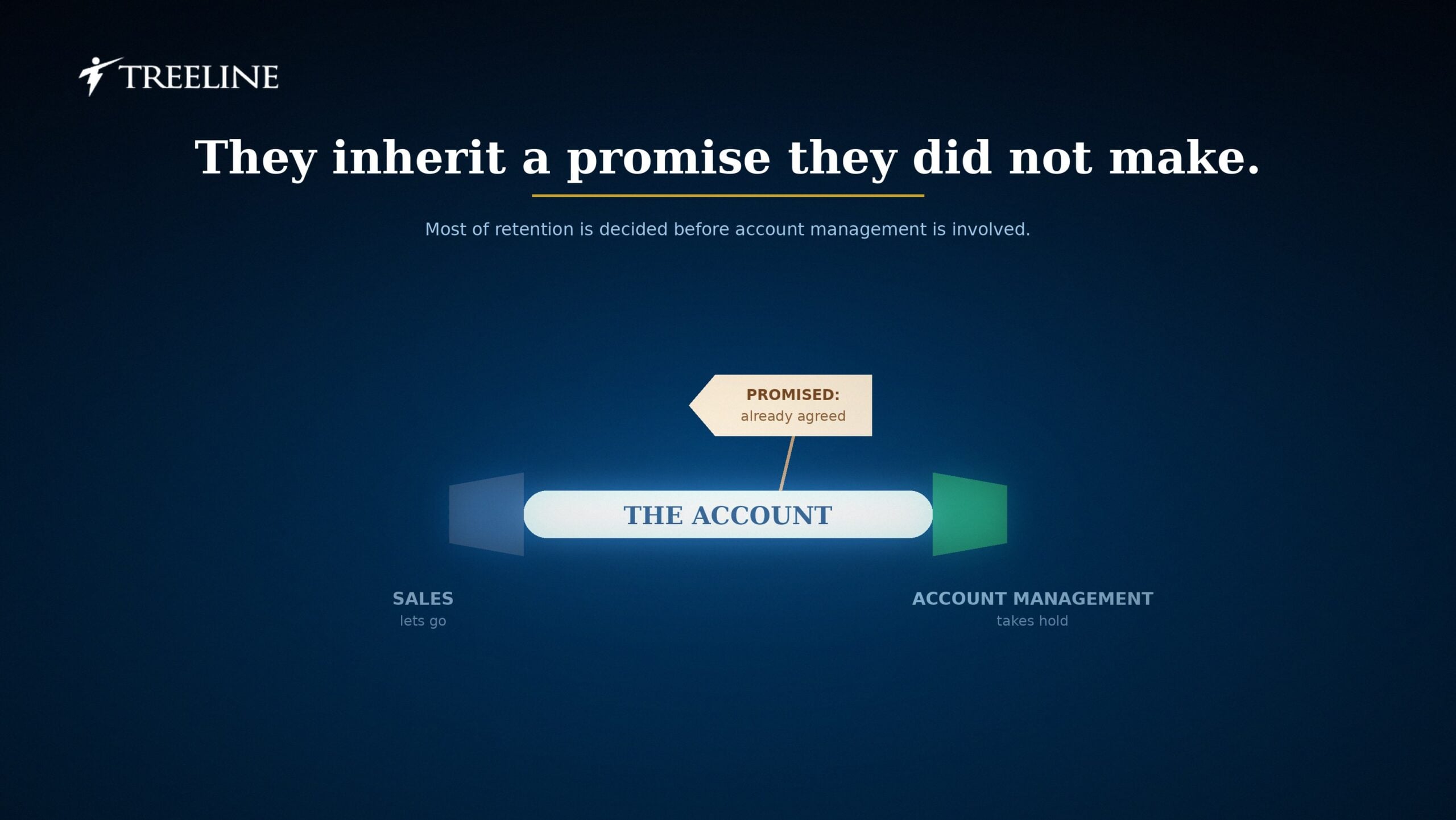
An account manager inherits a promise they did not make.
Somebody else sold the account. Somebody else scoped the implementation. Somebody in the room agreed to a timeline, or implied a capability, or let an assumption stand uncorrected because the quarter was ending. By the time the account manager meets the customer, the expectations are already set, the contract is already signed, and the gap between what was promised and what exists is already their problem.
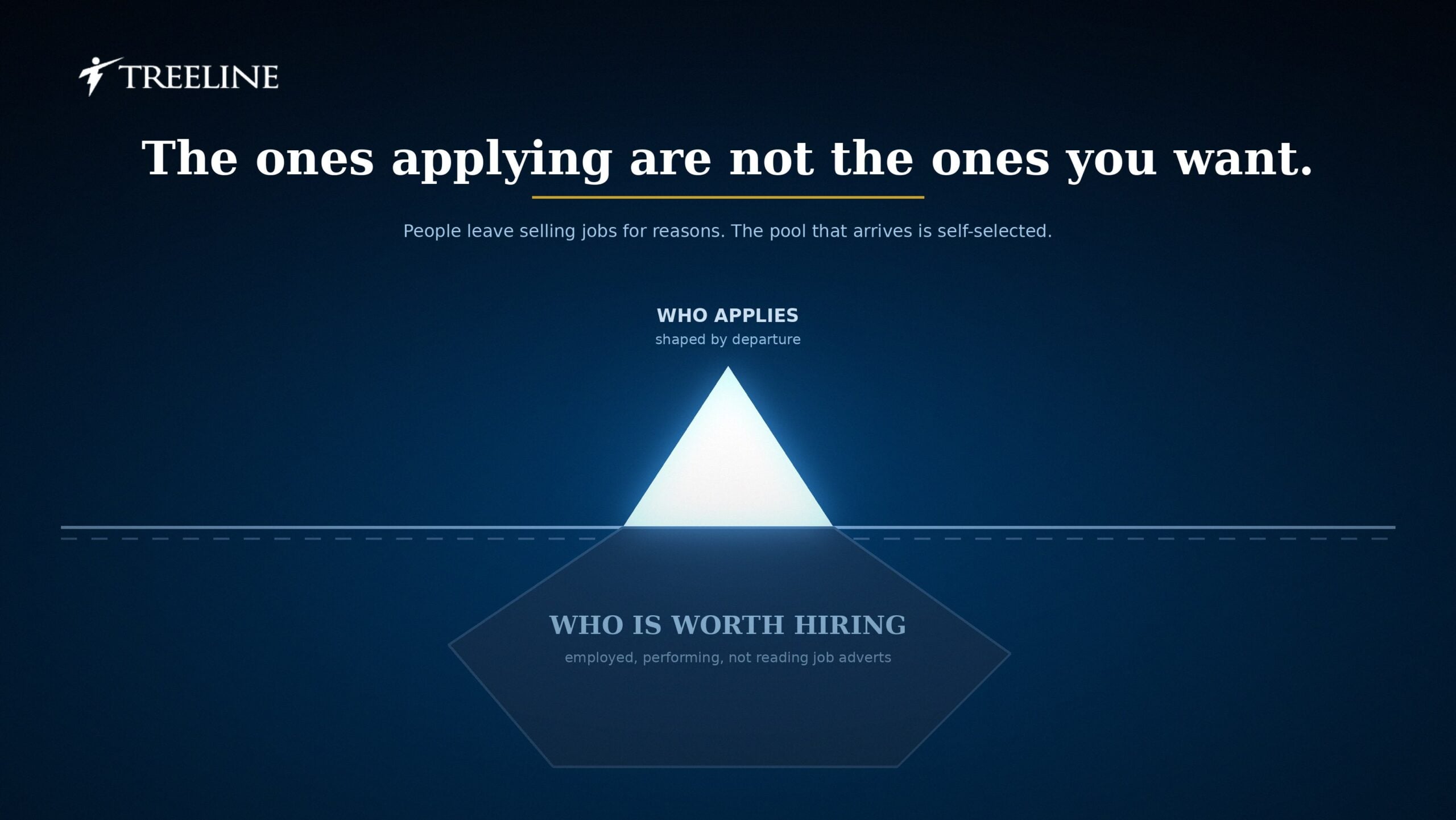
That is the structural fact of the job, and it is why hiring for it is harder than it looks. Retention looks like an outcome the account manager produces. Most of it was decided before they arrived.
So the practical answer to where you find a recruiter to hire account managers is that you want one who understands what the role actually inherits. A firm asking what your handoff from sales looks like, how often expectations arrive misaligned, and what your account manager is permitted to fix is diagnosing the job. A firm screening on retention percentages is measuring the quality of your sales process as much as the quality of the candidates.
Dan Fantasia, CEO of Treeline, Inc., views an account management hire as a question about what the person is being handed. From his perspective, employers should look at the last three accounts that churned and ask when the problem actually began, because the answer is usually before anyone in account management was involved.
What an Account Manager Actually Owns
The title is used across a wide range of scope, and the brief has to be specific or the shortlist will not be.
An account manager typically owns a book, somewhere between fifteen and forty accounts in most software businesses, more where the accounts are small, and is responsible for keeping them, growing them, and being the person the customer contacts. This is different from the two roles either side of it. An account director owns a small number of large relationships and goes deep; a customer success manager usually owns adoption and outcomes without carrying a commercial number. Treeline’s guidance on what makes a successful account manager covers the underlying discipline, and the guidance on finding a customer success executive search firm covers the adjacent function.
What the role genuinely controls:
- Where their attention goes across the book, week to week
- The quality and honesty of the relationship with each customer
- Early detection of risk, and whether it gets escalated in time
- Expansion conversations, where the mandate includes them
- The internal case for an account that needs something
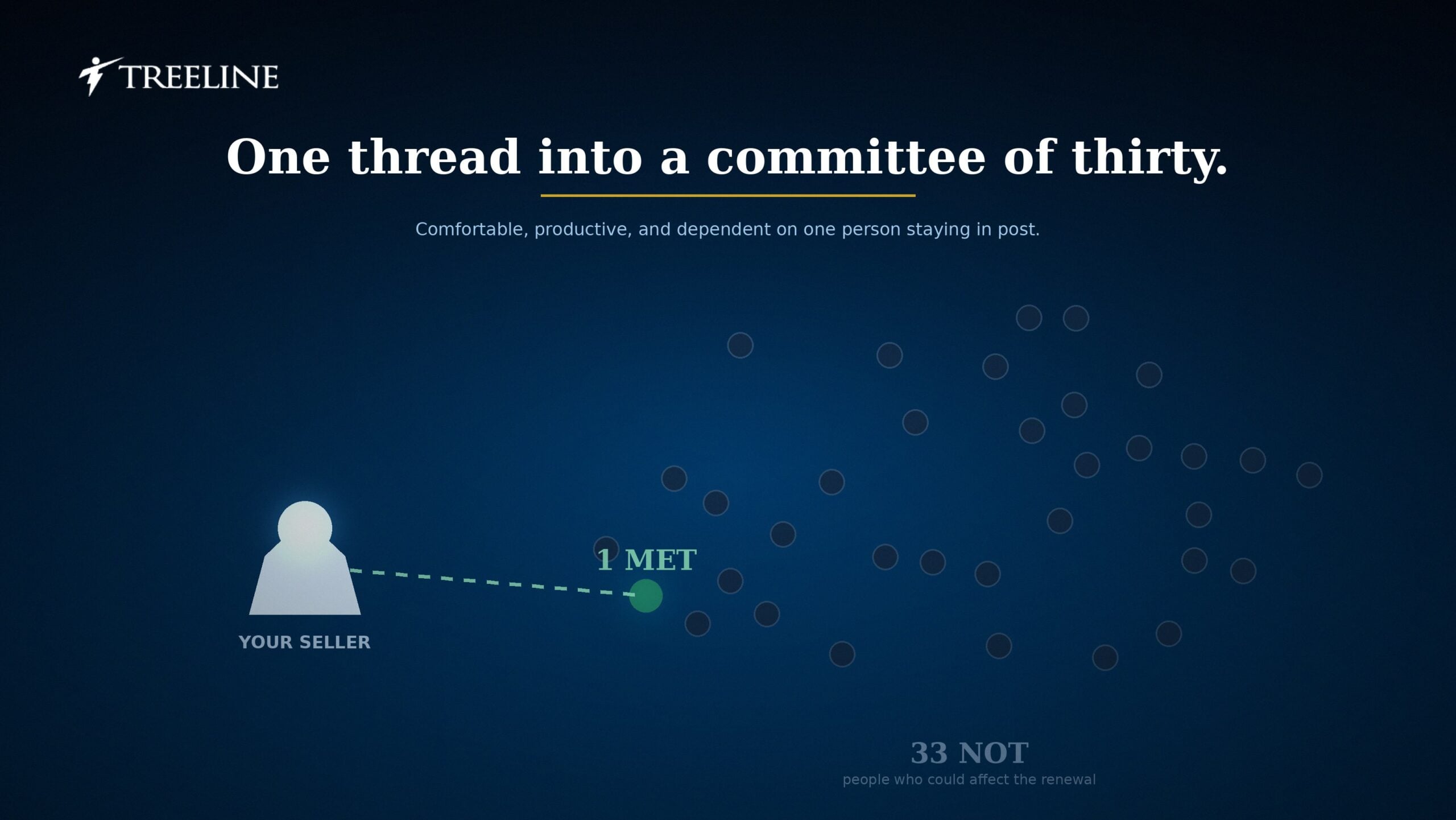
What it usually does not control: the promise made during the sale, the quality of the implementation, the product roadmap, pricing beyond a threshold, or whether the person who bought is still in post.
Four Things an Account Manager Inherits and Cannot Control
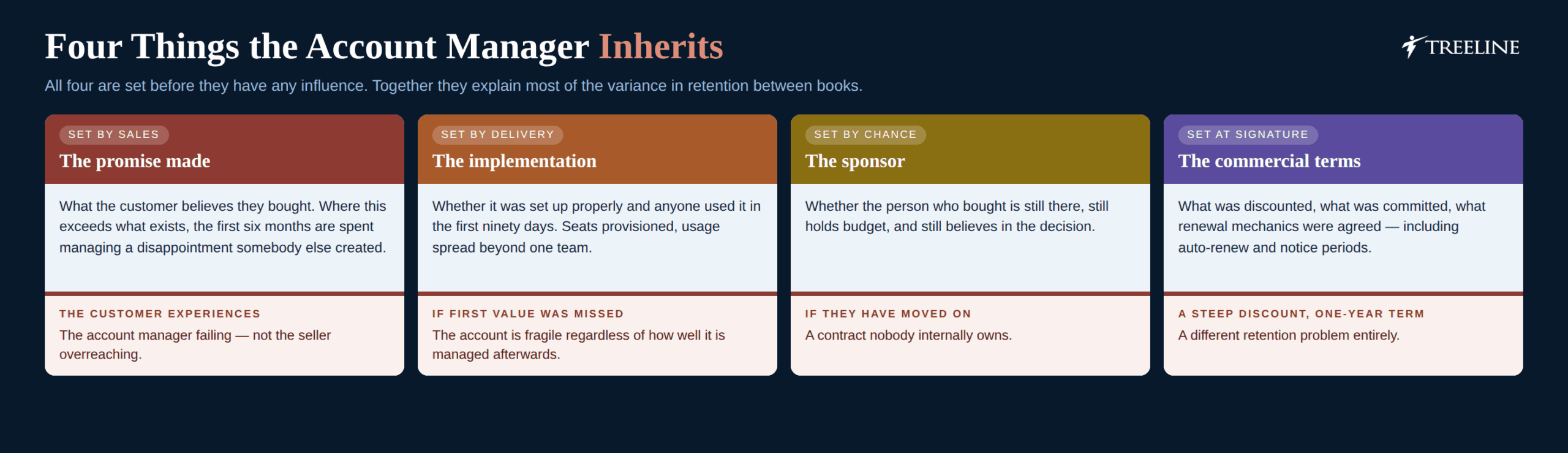
These four are set before the account manager has any influence, and together they explain most of the variance in retention between books. The diagram below sets them out with what each looks like when it has gone wrong.
The promise made in the sale. What the customer believes they bought. Where this exceeds what exists, the account manager spends their first six months managing a disappointment they did not create, and the customer experiences that as the account manager failing rather than the seller overreaching.
The quality of the implementation. Whether the thing actually got set up properly and whether anyone used it in the first ninety days. An account whose users never reached first value, low seat activation, usage concentrated in one team, is fragile regardless of how well it is managed afterwards.
The sponsor who bought. Whether that person is still there, still has budget authority, and still believes in the decision. A sponsor who has moved on leaves a contract that nobody internally owns.
The commercial terms. What was discounted, what was committed, what renewal mechanics were agreed, including any auto-renew clause and notice period. An account bought on a steep discount with a one-year term, at an ACV below the band it should have landed in, is a different retention problem from one on a three-year commitment at list.
The practical consequence for hiring is specific: retention attainment is a weak signal on its own. An account manager holding 92 percent on a book of badly sold, badly implemented accounts may be doing considerably more than one holding 98 percent on a clean book. The useful question is not what they retained but what they were handed.
Fantasia audits the inheritance before he assesses the person. The test he applies is to ask a candidate what state their book was in when they received it, because the ones who ran a real book can describe it in detail and the ones who cannot have usually not thought about the distinction.
The Handoff Is the Highest-Leverage Thing to Fix
If most of retention is decided before account management starts, the handoff from sales is where the leverage sits, and it is almost always informal.
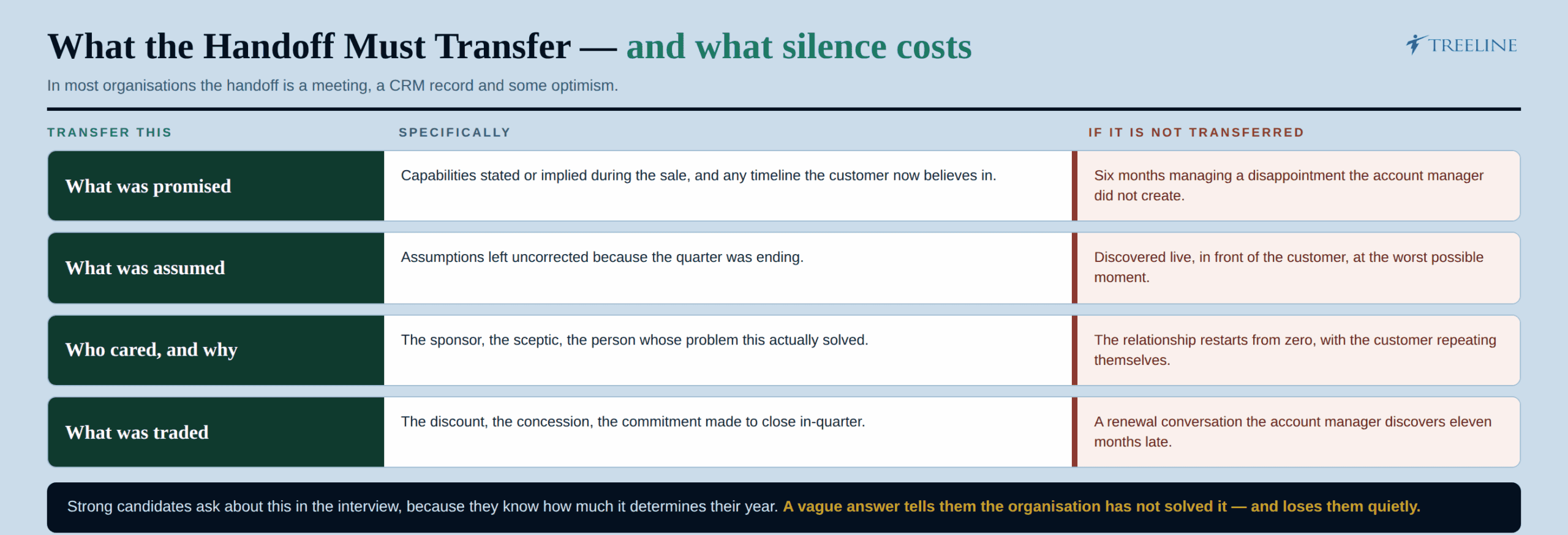
In most organizations the handoff is a meeting, a CRM record and some optimism. What it needs to be is a short, specific transfer of four things: what was promised, what was assumed, who cared and why, and what was traded to get the deal done. A seller who discounted twenty percent to close in-quarter has created a renewal conversation that the account manager will have to run, and the account manager should know that on day one rather than discovering it eleven months later.
The comparison below sets out what a working handoff transfers and what its absence costs.
Two things make this worth raising during hiring rather than after.
The first is that strong candidates ask about it. Someone who has run a book before knows how much the handoff determines their year, and a vague answer tells them the organization has not solved it. It is one of the questions that loses good people quietly.
The second is that it is cheap to fix relative to its effect. Treeline’s guidance on sales and marketing alignment covers the comparable cross-functional discipline, and the guidance on signs a prospect is bad for business covers the qualification standard that prevents the worst handoffs from existing at all.
Fantasia declines to treat handoff friction as a personality issue between sales and account management. His view is that two reasonable people will disagree indefinitely where nothing was written down, and that the fix is a defined transfer rather than better relationships.
Where to Find Account Manager Candidates
The pool is large, and the main risk is adjacency: several neighbouring roles produce people who look right on paper and are not.
Five routes, each with a real trade-off.
- Peers from comparable companies. The obvious pool. Screen on book shape rather than title: thirty small accounts and six large ones are different jobs with different skills.
- Customer success managers moving commercial. Strong on adoption, health signals, usage data and early risk detection. The gap is carrying a number, whether they have ever asked a customer for money rather than for feedback.
- Account executives moving post-sale. Strong commercially and comfortable with negotiation. The gap is patience: account management rewards consistency over months rather than a close date, and some excellent closers find it unrewarding. Treeline’s guidance on hiring top account executives covers where they come from.
- Support or service leads stepping across. They know the product deeply and the customers trust them, which is most of the credibility problem solved. The gap is commercial confidence, which is learnable with support.
- Implementation or onboarding specialists. Underrated, particularly where a sales engineer was involved in the original scoping. They have seen exactly which accounts start badly and why, which is the single most useful piece of knowledge in this role.
Ask a prospective firm which adjacency it would prioritise and why. A firm that treats customer success and account management as interchangeable has not understood that one carries a number and the other usually does not. Treeline recruits across industries and locations, with nationwide sales recruiting services covering the post-sale organization alongside the selling one, and guidance on account manager recruiting for retention and growth covering this search specifically. The guidance on speeding up hiring for quota-carrying roles applies where the role carries a commercial number.
Questions That Test What an Account Manager Inherited
On the book
- How many accounts, what was the revenue spread, and what state were they in when you got them?
- Which accounts were sold badly, and how did you find out?
- What did you inherit that you could not fix?
On the handoff
- What did you receive from sales when an account was handed over?
- Tell me about a promise made in a sale that you had to walk back.
- What would you want transferred on day one?
On the work
- Who got most of your attention, and who got least? Was that right?
- Describe an account you saved. What was the first signal?
- Describe one you lost. When did it actually start going wrong?
On the commercial half
- What did you grow, and was it your doing or the account’s?
- When did you tell a customer no?
Question three is the most efficient in the set. Every account manager has inherited something unfixable, a bad implementation, a departed sponsor, a price that should never have been agreed. Candidates who can name one and describe how they worked around it are showing judgment about what is worth fighting. Candidates who say everything was fixable have either had short tenure or are describing intentions.
Question eleven is worth more than it looks. An account manager who has never declined a customer request has been optimising for being liked, which feels like good account management and produces commitments the business cannot keep. Treeline’s guidance on negotiating without discounting covers the discipline, and the guidance on red flags during the interview covers the broader signals.
References should include someone from implementation or support who worked the same accounts. They know whether the account manager told customers the truth, which is the single most predictive thing about long-term retention.
What Account Managers Are Paid
There is no useful published benchmark, and the spread inside the title is wide. Price the book.
Four things move it:
- Book size in ARR, which is the clearest single measure and the one most often absent from the brief.
- Account count versus account value. Thirty small accounts is a throughput job; six large ones is a depth job. Both are account management and they attract different people.
- Whether the role carries a commercial number for expansion, or only a retention percentage. This is the largest single determinant of the package.
- Whether renewals sit with this role or with a separate function.
Two points on plan design:
- Do not pay primarily on gross retention. Most of the book was going to renew. A plan built on retention pays generously for the base case and teaches the account manager to protect rather than grow.
- Weight expansion at or near new-business rates. Expansion ARR inside an existing SaaS customer is genuinely hard and routinely underpaid relative to a new logo of the same value, which is exactly why it does not happen.
Treeline’s guidance on retaining top salespeople applies to the team this person joins, and the guidance on avoiding the counter-offer matters because account managers leaving take customer relationships with them in a way that is visible to the customer.
How to Test a Recruiter on an Account Manager Search
The fourth row catches the most common sourcing error in this search. Customer success and account management overlap in vocabulary and diverge in the thing that matters: whether the person has asked a customer for money. A firm that does not separate them will present capable people who have never carried a commercial conversation.
Treeline has recruited exclusively for sales organizations since 2001, covering account management and customer success alongside enterprise and strategic accounts, field and inside sales leadership, sales engineering and revenue operations. Both contingency and retained models are available, and the comparison of retained and contingency search sets out where each fits. Contingency suits most account manager searches, since the pool is large and active. The guidance on hiring salespeople from sourcing to start date covers the process, and the strategic account executive profile covers the concentrated end of the range this role sits beneath.
When the Problem Is Not the Account Manager
When the handoff does not exist. If nothing is formally transferred from sales, every account manager you hire will spend six months discovering commitments they did not know about. Fix the transfer; it is cheaper than the search.
When accounts are churning from implementation. If customers leave because they never reached first value, that is an onboarding problem. A better account manager will have a more graceful conversation about it and not change the outcome.
When the book is too large. Beyond a certain ratio the role becomes reactive by arithmetic, whoever calls gets the attention, and the quiet accounts that are drifting never do. That is a coverage decision above this hire.
When you already have the person. Someone in support or implementation who customers ask for by name has the credibility half of the job already. Treeline’s guidance on attracting top talent applies to internal candidates too, and the guidance on the traits great salespeople share covers what sits underneath.
Fantasia credits account managers who can describe an account they lost without blaming the sale. His reasoning is that the inheritance is real and also an available excuse, and the ones worth hiring can hold both ideas at once: that the account was handed over badly, and that there was still something they could have done earlier.
Frequently Asked Questions
Where can I find a recruiter to hire account managers?
Look for one that asks what the role will inherit before it discusses candidates, what the handoff from sales transfers, how often expectations arrive misaligned, and what the account manager is permitted to fix. A firm screening on retention percentages is measuring your sales and implementation process as much as the candidates. Then check that it does not treat customer success and account management as the same pool, and how many account managers it has placed who are still in seat after two years.
What does an account manager actually control?
Less than the retention number implies. They control where their attention goes across the book, the honesty of each relationship, how early they detect risk, and the internal case they make for an account that needs something from product or delivery. They do not control the promise made during the sale, the quality of the implementation, the roadmap, or whether the person who bought is still in post.
Why is retention a weak signal when hiring?
Because most of it is decided before the account manager arrives. Four things are set in advance: what was promised in the sale, whether the implementation reached first value and seats were actually provisioned, whether the sponsor is still there, and what commercial terms were agreed. Someone holding 92 percent on a badly sold book may be doing more than someone holding 98 percent on a clean one.
What should a sales-to-account-management handoff transfer?
Four things, specifically: what was promised, what was assumed, who cared and why, and what was traded to close the deal. A seller who discounted twenty percent to close in-quarter has created a renewal conversation the account manager will have to run, and they should know that on day one rather than eleven months later. In most organizations the handoff is a meeting, a CRM record and some optimism.
What is the difference between an account manager and a customer success manager?
Usually the number. Account management carries a commercial responsibility, retention expressed in ARR, with net revenue retention and expansion often attached, while customer success typically owns adoption and outcomes without carrying a quota. The vocabulary overlaps heavily, which is why shortlists get mixed. The question that separates them is whether the person has asked a customer for money rather than for feedback.
How many accounts should an account manager have?
It depends entirely on account size and complexity rather than on a benchmark. Fifteen to forty is common in mid-market, and far higher where accounts are small and the motion is light-touch. The more useful test is whether the ratio allows proactive contact: beyond a certain point the role becomes reactive by arithmetic, and the quiet accounts that are drifting never get attention.
Can a customer success manager move into account management?
Often, and it is a strong route. They bring adoption knowledge and early risk detection, which is the hardest half to teach. The gap is commercial: whether they have carried a number and asked a customer to spend more. Test for a specific instance of a commercial conversation they led rather than supported.
What should an account manager be paid?
Price the book rather than the title. The drivers are book size in ARR, whether it is many small accounts or few large ones, whether the role carries an expansion number or only a retention percentage, and whether renewals sit with this role or a separate function. Published averages blend all of these and have little bearing on a specific seat.
Should the plan pay on retention?
Not primarily. Most of the book was going to renew, so a plan weighted toward gross retention pays generously for the base case and teaches the account manager to protect rather than grow. Weight expansion at or near new-business rates instead, growth inside an existing customer is harder than a new logo of the same value and is usually paid less, which is exactly why it does not happen.
Read the Last Sales Call Before the Close
Before writing the job description, take your three most recent churned accounts and find out when the problem actually started. If the answer is consistently before account management was involved, the hire you are about to make is not the fix, and knowing that is worth more than any shortlist.
Speak with Treeline for a direct read on what your book shape demands, whether the role needs a commercial background or a service one, and whether the handoff is the thing to fix first.
Share This Story, Choose Your Platform!
Related Posts

What our happy clients are saying
Treeline Inc. provided us with the most candidates that aligned with our needs and were of the highest quality.

Dr. Jeffrey Klein Head of North America Sales, Satchel Pulse
Treeline Inc.’s collaborative, flexible, and communicative approach resulted in a smooth partnership. Beyond their recruitment expertise, their unique sourcing model was efficient and effective.

Sera Holt Director of Operations, LNS Research
Their professionalism was outstanding. Treeline Inc. was extremely thorough and ensured that we were on the same page before they started looking for candidates. They listened to us and did a great job working with the candidate to close out the process.

Cate Grant AVP Customer Success, Nasdaq
Thanks to Treeline Inc.’s intricate and thorough screening process, the company is able to hire six high-quality candidates that fit perfectly in the company’s culture. The team is highly receptive to concerns, and internal stakeholders are impressed with their unique recruitment abilities.

Anna McKean Sales Recruiter, Insider Intelligence
Treeline Inc. has been qualified individuals throughout a five-year-long engagement. They’ve made numerous placements of talented and qualified individuals for our business.

Michele St Laurent VP of HR, The Institute for Applied Network Security

Let Us Help You Source the Sales Talent You Need
Whether you’re building a team or replacing a key role, our Candidate Sourcing Platform provides a fast, flexible, and employer-focused solution.
Tell us more about your business and how we can help.
Treeline Inc.
Your Award-Winning Sales Recruitment Partner
15 Lincoln Street, Suite 314, Wakefield, MA 01880