The mid-market account executive is the only seller in most organizations who has to be both complete and fast, and that combination is why the search is harder than it looks.
Treeline’s own live posting for the role describes it plainly: spearhead outbound campaigns into upper mid-market targets, maximize inbound marketing leads, build a pipeline capable of repeatedly landing deals above one hundred thousand dollars in annual contract value, and sell consultatively to executive buyers.
Read that again as a list of jobs. Generate your own pipeline. Work the inbound queue. Run a consultative executive sale. Do it at six figures of contract value. Do it repeatedly. In an enterprise organization those are three or four people. Here they are one, and the word “repeatedly” is doing a great deal of work.
So the practical answer to how to find a recruiting firm for mid-market AEs is that you want one that counts the support around the seat before it profiles the person. The mid-market role is defined less by what it includes than by what it lacks, and a brief that does not say what is missing will produce candidates assessed against a job that does not exist.
Dan Fantasia, CEO of Treeline, Inc., views the mid-market seat as the one most often briefed from an adjacent role rather than from itself. From his perspective, an employer should write down what this person will not have, no dedicated sales engineer, no executive sponsor joining calls, no team feeding them meetings, because that list predicts who succeeds more reliably than the requirements do.
What a Mid-Market Account Executive Is Actually Being Asked to Do
Four things, and the combination is the point.
Generate pipeline. Not receive it. Treeline’s posting leads with outbound campaigns, which means prospecting is part of the job rather than a function someone else performs.
Work inbound as well. Marketing-sourced leads arrive and have to be qualified fast, which is a different rhythm from outbound and competes with it for the same hours.
Sell consultatively to executives. At six-figure contract values the buyer is senior, the evaluation involves several people, and a demo does not close it.
Repeat it. The deals are large enough to require real work and small enough that one of them will not make the year. The number comes from doing the whole motion several times over.
What the role usually does not include: territory design, pricing authority beyond a band, or a dedicated technical resource. Treeline’s writing on the account executive role and its analysis of the AE role in the SaaS market cover the wider picture of how these seats are built.
The Mid-Market Account Executive Does Enterprise Work Without Enterprise Support
This is the structural fact that makes the hire difficult, and it is worth stating to candidates rather than discovering together in month four.
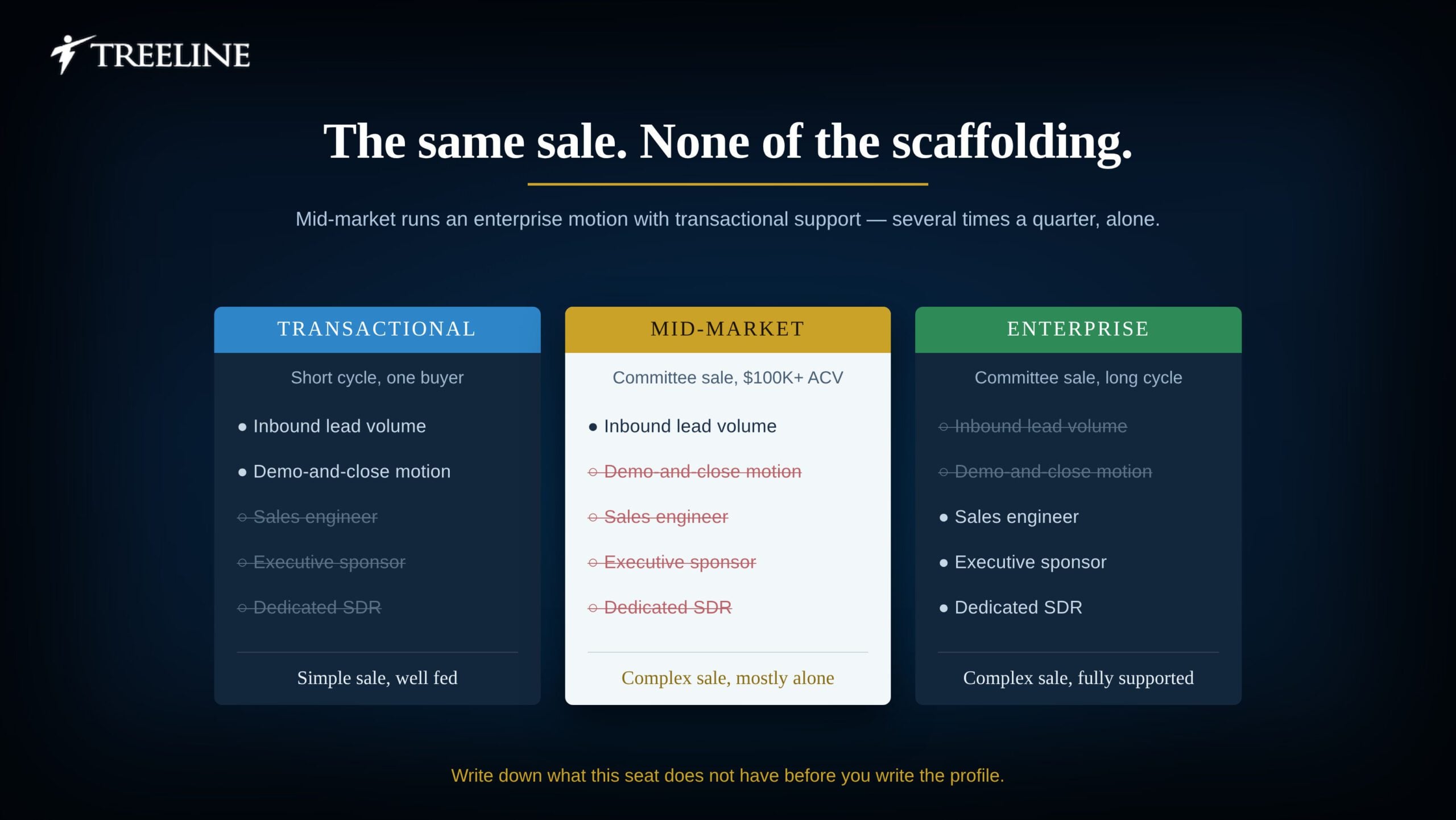
Compare the three segments on what the seller actually has around them:
- Transactional. Short cycle, single buyer, inbound-fed, a demo and a price. The support is the volume of leads.
- Enterprise. Long cycle, buying committee, security review, procurement, and a sales engineer, an executive sponsor who joins calls, sometimes a dedicated SDR, and a quota built around four to eight deals.
- Mid-market. The committee and the consultative sale of enterprise, the self-sourced pipeline of transactional, and the support structure of neither.
The mid-market seller runs a scaled-down enterprise motion alone, several times a quarter. That is a real and demanding job, and it is the reason good mid-market AEs are expensive relative to what the title suggests.
It also explains the most common disappointment in this hire. An employer sees enterprise-shaped requirements, hires an enterprise-shaped person, and then finds the new person moving at enterprise pace, thorough, multi-threaded, and producing two opportunities a quarter when the plan needed six.
Fantasia sizes the support before sizing the candidate. His reasoning is that the same person succeeds in one of these seats and fails in another depending entirely on what sits around them, so the environment has to be described before the profile is written.
The Two Hires That Fail Here, and Why
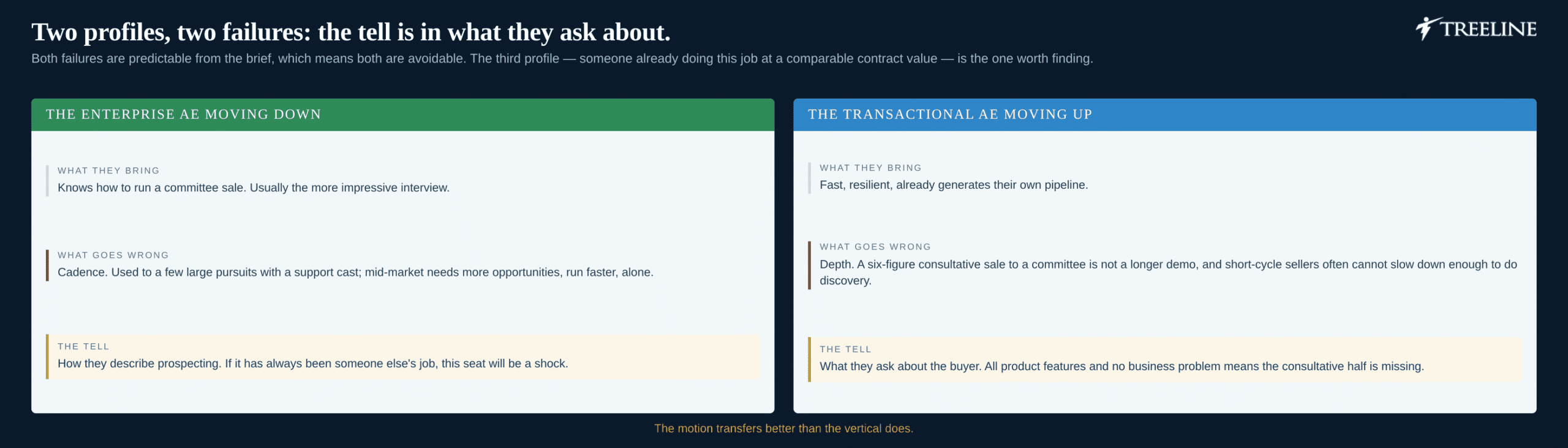
Both failures are predictable from the brief, which means both are avoidable.
The enterprise AE who moves down. They know how to run a committee sale and they are often the more impressive interview. What goes wrong is cadence: they are used to a small number of large pursuits with a support cast, and mid-market requires more opportunities, run faster, alone. The tell is how they describe prospecting. If it has always been someone else’s job, this seat will be a shock. Treeline’s material on enterprise sales professionals describes that world; the gap is not skill, it is tempo and self-sufficiency.
The transactional AE who moves up. Fast, resilient, comfortable generating their own pipeline. What goes wrong is depth: a six-figure consultative sale to an executive committee is not a longer version of a demo-and-close, and candidates who have only run short cycles frequently cannot slow down enough to do discovery properly. The tell is what they ask about the buyer. If every answer is about product features rather than the customer’s business problem, the consultative half is missing.
A third profile exists and is the one worth finding: someone already doing this job at a comparable contract value, in any category. The motion transfers better than the vertical does.
Treeline’s guidance on what sellers must demonstrate to get hired, on tracking the sales hunter and on whether someone is a schmoozer or a closer all bear on telling these profiles apart.
Where Mid-Market Account Executive Candidates Come From
Four pools, ranked by how well the motion transfers.
Mid-market AEs at companies with a comparable contract value. The direct match, and the one to prioritize. What matters is the deal size and the cycle length, not the industry, someone selling a different product to a similar buyer at a similar price has run the same motion.
Enterprise AEs who want more volume. Workable, and sometimes excellent, where the motivation is honest. People leave enterprise seats because they are tired of waiting a year to find out whether they were right. Ask what they would do differently with six opportunities instead of two.
Strong transactional AEs with evidence of depth. Look for anyone who has pulled a larger deal through a multi-person evaluation, even once. That single exception is the signal that the ceiling is higher than their current segment. The strategic account executive profile describes where they can get to.
Sales engineers and solutions consultants moving to a quota. Underused. They have sat through hundreds of consultative evaluations and know the technical objections cold. The open question is whether they will prospect, and it should be tested rather than assumed.
The general sourcing mechanics, channels, cost per pool, reaching people who are not looking, are covered in where to find account executive candidates and in hiring top account executives, with the segment above in enterprise AE candidates. For SaaS specifically, hiring SaaS sales professionals and the SaaS market-trends piece are the relevant references.
Questions That Test Whether Someone Can Do Both Halves
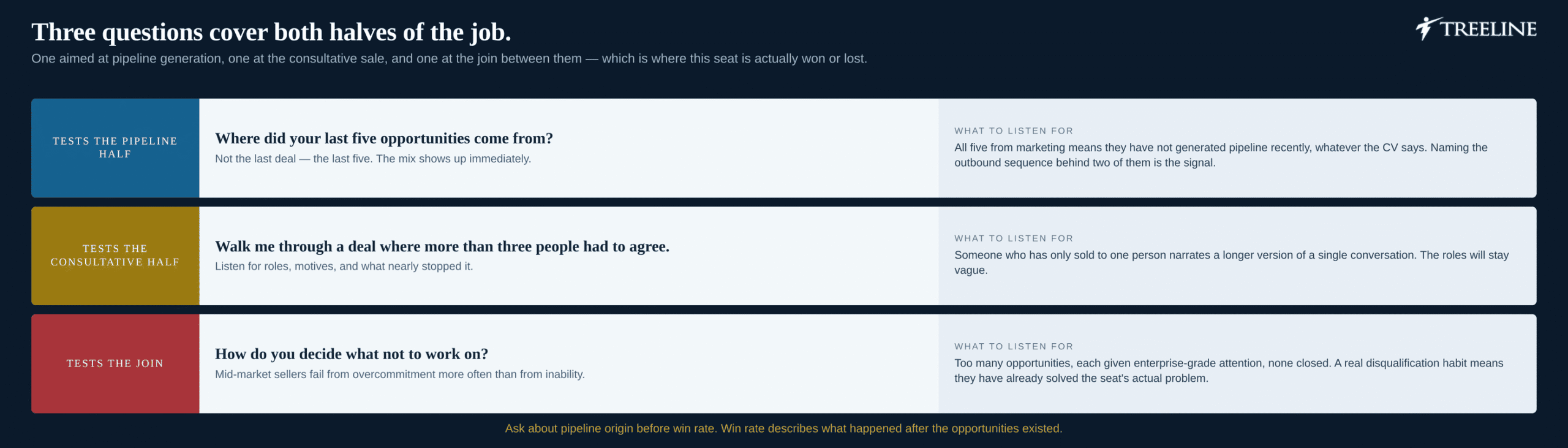
Three questions, each aimed at one half of the job and the third at the join between them.
Where did your last five opportunities come from? Not the last deal, the last five. The answer reveals the mix immediately. A candidate whose five all came from marketing has not generated pipeline recently, whatever the CV says. A candidate who can name the outbound sequence that produced two of them is showing you the half most mid-market briefs quietly assume.
Walk me through a deal where more than three people had to agree. This tests the consultative half. Listen for whether they can name the roles, describe what each one wanted, and say what nearly stopped it. Someone who has only sold to one person will narrate a longer version of a single conversation.
How do you decide what not to work on? This is the join. Mid-market sellers fail from overcommitment more often than from inability, too many opportunities, each given enterprise-grade attention, none closed. A candidate with a real disqualification habit has solved the problem the seat actually poses.
Treeline’s guidance on must-ask sales interview questions and on red flags during the interview covers the surrounding process.
Fantasia questions the pipeline-origin answer before the win-rate answer. His reasoning is that win rate describes what happened after opportunities existed, and in this seat the harder half of the job is making them exist at all.
What Mid-Market Account Executive Roles Pay
Treeline’s own job board carries live postings with published ranges, which is a better reference for this market than a benchmark site because the figures are attached to real reqs the firm is working.
On that board, a mid-market account executive role in Austin is posted at a base of eighty-five to one hundred and twenty thousand dollars, with on-target earnings of one hundred and seventy to two hundred and forty thousand. For comparison, a remote enterprise account executive posting sits at a base of one hundred and twenty-five thousand with on-target earnings of two hundred and fifty thousand, while general account executive postings on the same board run considerably lower, bases in the fifty to ninety thousand range, with totals between one hundred and ten and one hundred and fifty thousand.
Two cautions on reading that. These are individual live postings rather than a survey, so they show where this firm’s current reqs sit rather than a market distribution. And geography, contract value and whether the role is hybrid or remote all move the number more than the title does.
What the comparison does show clearly is the shape: the mid-market seat sits much closer to the enterprise seat than to the general one, and the split is roughly even between base and variable. Three structural points follow:
- A near fifty-fifty split suits this role. The seller controls their own pipeline, so variable pay is genuinely earnable, which is not true where leads are allocated.
- Accelerators matter more here than in enterprise. With more deals per year, clearing quota far enough to reach them is realistic, so the accelerator is a live incentive rather than a theoretical one.
- Ramp should be priced against the cycle, not the segment name. A mid-market cycle of three or four months means the first self-sourced deal lands in the second quarter at the earliest.
Treeline’s guidance on building a sales compensation plan sets out the structures by motion, and retaining top salespeople and competing for talent cover what happens once a strong one is producing.
How to Test a Firm on a Mid-Market Account Executive Search
Four tests.
Do they ask about average contract value and cycle length first? Those two numbers define the segment far better than the word “mid-market”, which different companies use for deals an order of magnitude apart.
Do they ask what support the seat has? Sales engineer, SDR, executive sponsor, marketing-sourced lead volume. A firm that does not ask will present enterprise candidates into an unsupported seat.
Do they ask what share of pipeline the AE must self-source? This single ratio sorts the candidate pool more than anything else in the brief.
Do they warn you about the enterprise downgrade? A good firm will tell you that the most impressive candidate on paper may be the wrong tempo, and will say so before you have interviewed four of them.
On engagement model, retained versus contingency search covers the trade-offs, and speeding up hiring for quota-carrying roles covers where time is actually lost in searches at this level.
When the Segment Is the Problem, Not the Hire
Four situations where another seller will not deliver what is expected.
When the pipeline maths does not work. If the quota divided by the average contract value demands more opportunities than one person can source and run, the problem is arithmetic. Adding a seller reproduces it.
When there is no marketing contribution at all. Treeline’s own posting pairs outbound with inbound for a reason. A mid-market seat that is purely self-sourced is really a business development role with a closing requirement attached, and should be briefed and paid as one.
When the product needs technical support the company does not have. If evaluations stall at a technical question nobody can answer, a better closer will surface the same stall sooner. Treeline’s writing on B2B inside sales covers the surrounding function.
When “mid-market” means something different in each conversation. If sales, marketing and finance each describe a different customer size, the segment is not defined, and the hire will be judged against whichever definition is convenient at review time.
Fantasia holds that an unfilled mid-market seat is frequently a design question rather than a sourcing one. His reasoning is that these searches stall most often where the number, the contract value and the support available have never been reconciled with each other, and no candidate resolves that.
Frequently Asked Questions
What actually counts as mid-market?
It varies enough between companies to be useless as a shorthand. Treeline’s own posting describes landing deals above one hundred thousand dollars in annual contract value with a consultative executive sale, which is a workable anchor. Define the segment by contract value and cycle length in the brief rather than by the word, because candidates and firms will otherwise each assume their own version.
Should I hire an enterprise AE into a mid-market seat?
Sometimes, and the question to ask is about tempo rather than capability. Enterprise sellers are used to a small number of large pursuits with support around them. If they have personally prospected recently and can describe running several opportunities at once, the move works. If prospecting has always been somebody else’s job, the seat will frustrate both sides.
How much pipeline should a mid-market AE self-source?
Decide it and state it, because the ratio changes which candidates can succeed. A seat that is seventy percent self-sourced needs a hunter who can sell consultatively. A seat that is mostly inbound needs a closer who can handle volume. Most briefs leave this unstated and then discover the mismatch in the second quarter.
What is a realistic ramp?
Work back from the cycle length. At a three-to-four-month mid-market cycle, the first deal the person originated themselves closes in the second quarter at the earliest, with anything earlier coming from inherited or inbound opportunities. A plan expecting self-sourced revenue in quarter one is relying on a handover.
How does this role differ from an enterprise account executive?
Support and tempo more than skill. The enterprise seller runs fewer, larger pursuits with a sales engineer, an executive sponsor and often a dedicated SDR. The mid-market seller runs a similar committee sale with none of those, several times a quarter. The consultative skill is shared; the self-sufficiency and the pace are not.
Can a sales engineer move into this seat?
It happens and can work well, because they have sat through hundreds of consultative evaluations and know the objections. The open question is prospecting, whether they will do it consistently without being managed into it. Test it with evidence rather than intent.
What is the most common mistake in this search?
Hiring the most impressive interview. At this level the enterprise candidate frequently interviews best and then operates at the wrong tempo. The second most common is leaving the self-sourcing ratio unstated, so nobody finds out until the pipeline review.
How long should the search take?
Comparable to a general AE search where the segment is well defined, and considerably longer where it is not. The avoidable delay is almost always definitional: the role keeps being re-described because the contract value, the number and the available support have not been reconciled.
Does industry experience matter?
Less than contract value and cycle length. Someone selling a different product to a similar buyer at a similar price has run the same motion and will transfer. Someone from your exact industry who has only closed much smaller deals has not.
Count the Support Before You Write the Profile
One thing to do before this search opens.
Write down what this person will have: how many marketing-sourced leads a month, whether a sales engineer joins calls and at what stage, whether an executive will show up for a late-stage meeting, whether anyone else prospects into the segment. Then write down what share of pipeline they are expected to create themselves.
That page is the real job description. It will tell you which of the three candidate profiles can actually succeed, and it will stop you hiring the most impressive person rather than the right one.
Send it to us with the quota and the average contract value, and we will tell you which search you are running before it starts.
Share This Story, Choose Your Platform!
Related Posts
What our happy clients are saying
Treeline Inc. provided us with the most candidates that aligned with our needs and were of the highest quality.

Dr. Jeffrey Klein Head of North America Sales, Satchel Pulse
Treeline Inc.’s collaborative, flexible, and communicative approach resulted in a smooth partnership. Beyond their recruitment expertise, their unique sourcing model was efficient and effective.

Sera Holt Director of Operations, LNS Research
Their professionalism was outstanding. Treeline Inc. was extremely thorough and ensured that we were on the same page before they started looking for candidates. They listened to us and did a great job working with the candidate to close out the process.

Cate Grant AVP Customer Success, Nasdaq
Thanks to Treeline Inc.’s intricate and thorough screening process, the company is able to hire six high-quality candidates that fit perfectly in the company’s culture. The team is highly receptive to concerns, and internal stakeholders are impressed with their unique recruitment abilities.

Anna McKean Sales Recruiter, Insider Intelligence
Treeline Inc. has been qualified individuals throughout a five-year-long engagement. They’ve made numerous placements of talented and qualified individuals for our business.

Michele St Laurent VP of HR, The Institute for Applied Network Security

Let Us Help You Source the Sales Talent You Need
Whether you’re building a team or replacing a key role, our Candidate Sourcing Platform provides a fast, flexible, and employer-focused solution.
Tell us more about your business and how we can help.
Treeline Inc.
Your Award-Winning Sales Recruitment Partner
15 Lincoln Street, Suite 314, Wakefield, MA 01880