An inside seller who misjudges an opportunity loses twenty minutes and moves to the next line on the list. An outside account executive who misjudges one loses a morning, a drive, a parking garage and the two other meetings that could have filled the same window.
That is the entire difference, and almost every brief for this role ignores it. The requirements describe closing ability, industry background and quota history, all of which matter, and say nothing about the only resource this person cannot buy more of, which is working days.
So the practical answer to which recruiting firm can help you recruit outside account executives is: one that screens for allocation before it screens for charisma. The best field sellers are not the most persuasive people in the room; they are the ones who arrive in fewer rooms, having correctly decided which rooms were worth the drive. Treeline’s general writing on hiring top account executives and on the account executive role covers the shape of these seats; what follows is specific to the ones where showing up has a cost.
Dan Fantasia, CEO of Treeline, Inc., views field seats as the ones most often filled on the strength of presence rather than planning. From his perspective, an employer should ask a candidate to account for a specific week, which meetings happened, why each one was chosen, and what was given up to make room, because that answer separates the sellers who manage a region from the sellers who merely travel around one.
What an Outside Account Executive Actually Owns
Four things, and the fourth is the one left out of the specification.
A geography, with physics attached. Not a list of accounts, a set of places, with distances between them. Two regions with identical revenue potential are different jobs if one is a city and the other is four hours of highway.
A full cycle, run alone. Our own posting for this title describes selling telecommunications solutions to a base of hospitals across a city. One person, multi-stakeholder buyers, a technical evaluation, and no colleague in the passenger seat.
A quota that assumes a meeting rate. Somebody, somewhere, modeled how many first meetings a week this produces. Usually nobody has told the seller what that number was.
A finite number of working days, which is the actual budget. Roughly two hundred and twenty of them a year, minus travel, minus administration, minus the meetings that turn out to have been a mistake. Every other item on this list is spent out of that one.
The Calendar Is the Constraint, Not the Pipeline
Worth stating plainly, because it inverts how most of these searches are run.
In an inside model, pipeline is the scarce thing and activity is cheap: more calls, more emails, more sequences. In a field model, activity is the expensive thing. A seller can only be in one place, and being in the wrong place does not merely fail to produce revenue, it consumes the slot in which revenue could have been produced.
Three consequences follow for the hire.
Qualification has to happen before the drive, not during the meeting. The skill is diagnostic phone and email work that most field sellers consider beneath them and the good ones treat as the main event.
Route and sequence matter commercially, not just logistically. Four meetings in one area on one day is not an administrative nicety; it is the difference between twelve first meetings a month and twenty.
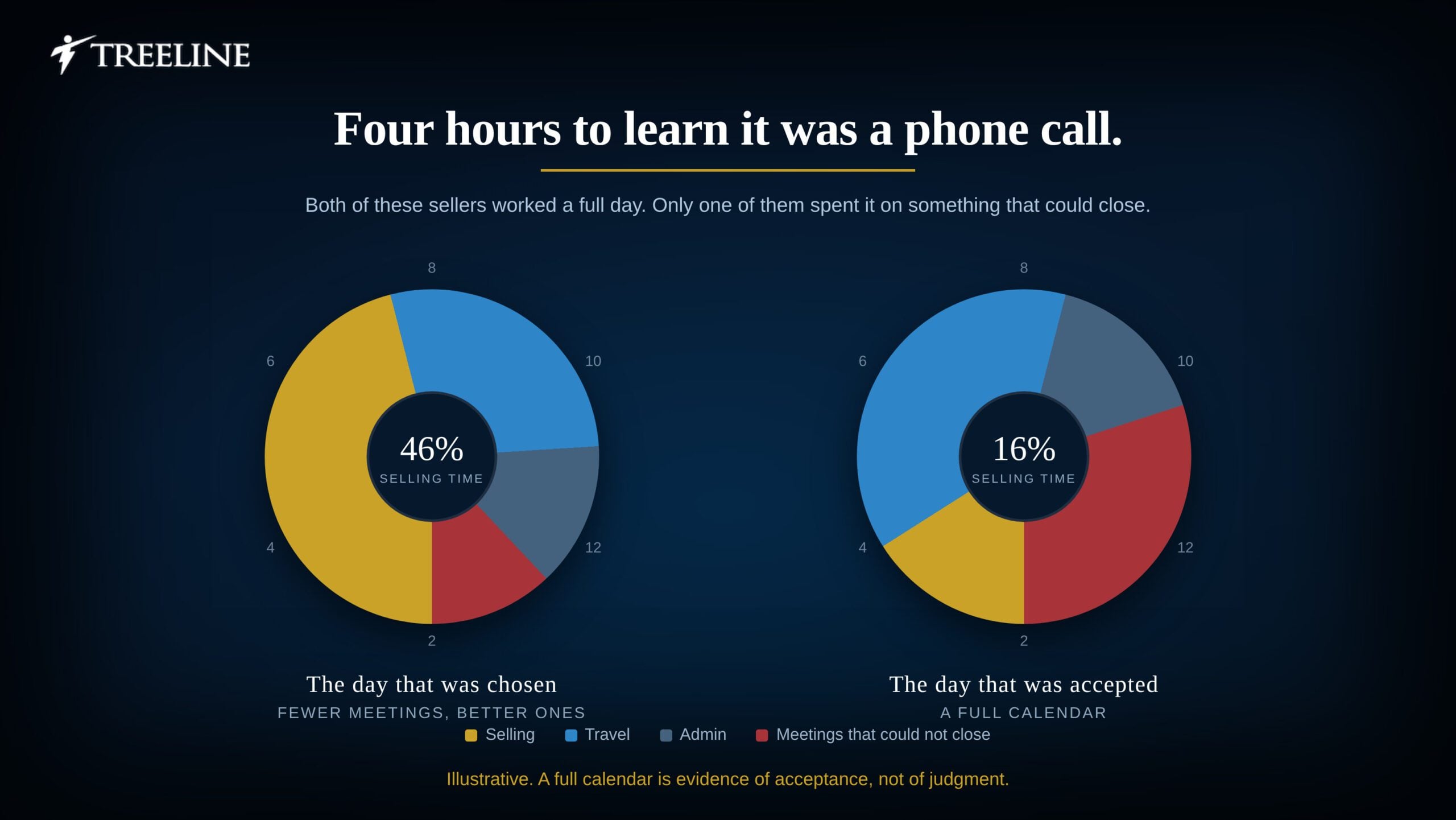
Saying no is a revenue skill. A field seller who accepts every invitation will have a full calendar, a busy-looking activity report and a thin number.
Treeline’s writing on building a pipeline the way you would run a business applies with particular force here, because in this seat the pipeline is bounded by hours rather than by effort.
Fantasia weighs a candidate’s answer about a wasted journey more heavily than their answer about a won deal. His argument is that anyone who has genuinely carried a field number can describe a trip they should not have made and what they changed afterwards, while anyone who cannot has either not been measured properly or has not been paying attention.
What Earns a Visit, and What Does Not
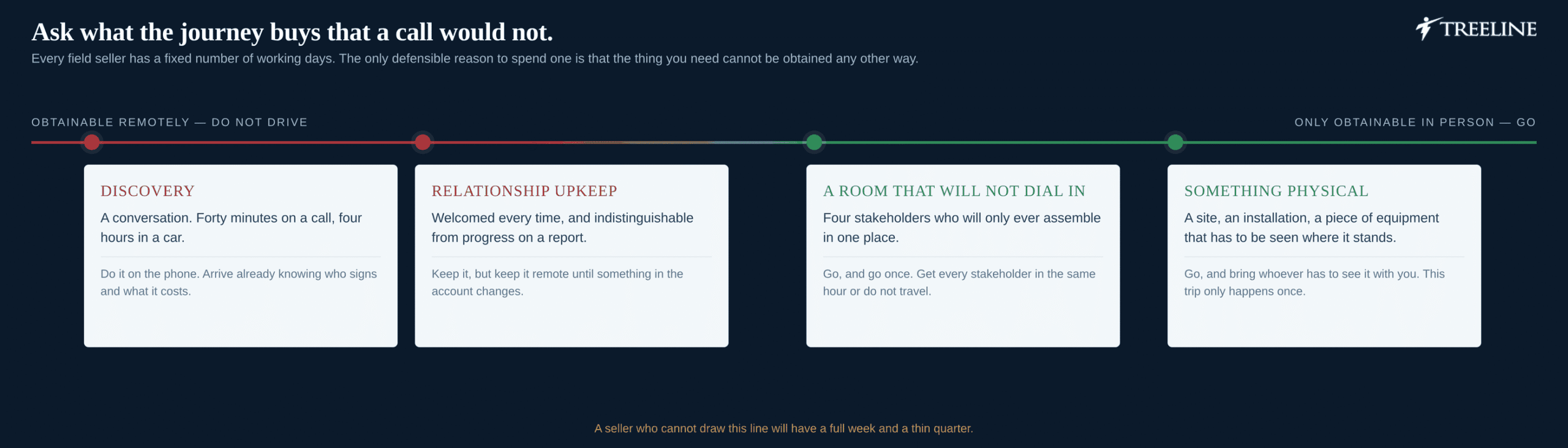
The question a strong candidate has already answered for themselves, and a weak one has never been asked.
A visit is earned when the thing you need cannot be obtained remotely. A room full of stakeholders who will not all join a call. A site walk. A piece of equipment that has to be seen in place. A relationship at a stage where presence is the message.
A visit is wasted when it is used to do discovery that a call would have done. The commonest failure, and the most expensive, because it feels productive. The seller leaves with notes and a next step, having spent four hours on a conversation worth forty minutes.
A visit is wasted when it is used to maintain a relationship that is not buying. Pleasant, welcomed, and indistinguishable on an activity report from the visit that moves a deal.
A visit is wasted when nobody with authority will be present. The meeting happens, the enthusiasm is real, and the budget sits two floors up.
A candidate who can draw these distinctions unprompted has done the job. One who treats every meeting as equally valuable has been measured on activity and will be again.
Where Outside Account Executive Candidates Come From
Four pools, in rough order of hit rate.
Field sellers already carrying a regional quota at a peer company. The obvious pool. The signal that matters is not their attainment but whether their meeting count went up while their geography stayed the same.
Inside sellers who want the field. Often excellent at qualification, which is the hard half, and genuinely motivated. The risk is autonomy, nobody will notice for three weeks if they stop working, which suits some people and dissolves others. Our page on the inside sales account executive seat is useful background on what they are leaving.
Technical field staff moving into sales. Applications engineers, service specialists and clinical staff who already travel, already understand the buyer and already know what a site visit is for. They usually need the commercial half, and they usually get it faster than a seller gets the technical half.
Account managers with field books. They know the geography and the customers. The question is whether they have ever run a competitive pursuit against a clock, which maintaining a book does not require. Our note on what makes a successful account manager sets the baseline, and our writing on territory-based selling covers the regional dimension.
Fantasia separates these pools by which half of the job each one has already been forced to practice. His position is that qualification discipline is harder to install than product knowledge, so an employer choosing between a disciplined outsider and a knowledgeable insider should be clear which gap they are funding.
A Full Calendar and a Flat Number
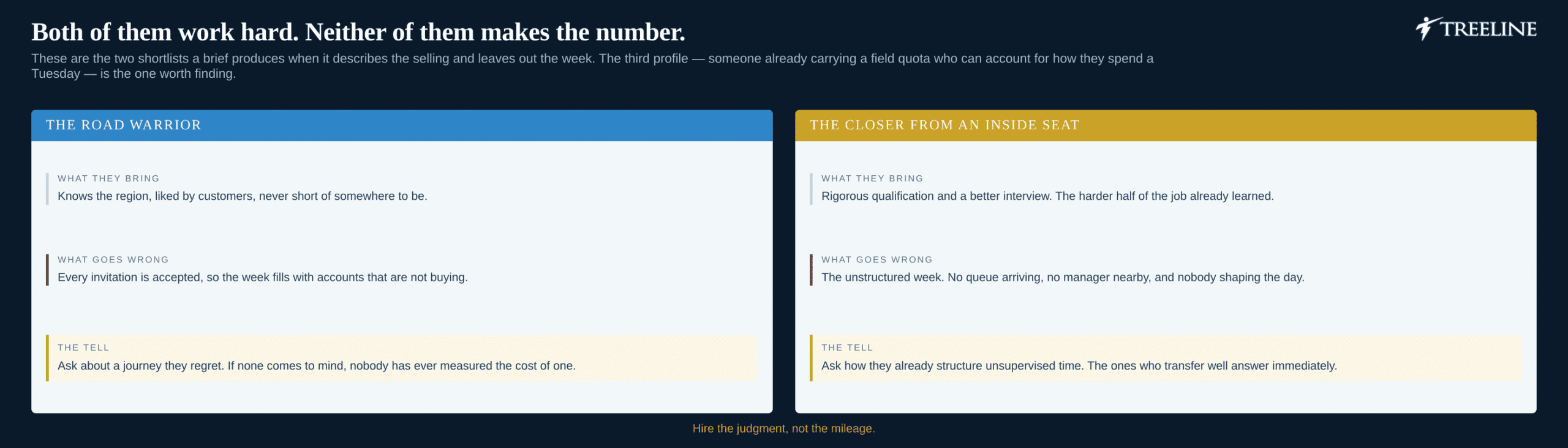
The road warrior. Impressive mileage, knows everyone in the region, genuinely liked by customers. Their calendar is always full. Examined closely, the full calendar is the problem: the meetings are evenly distributed across accounts that are buying and accounts that are not, because every invitation gets accepted. High effort, flat number.
The strong closer from an inside seat. Excellent on the phone, rigorous about qualification, an obviously better interview than the road warrior. In the field they struggle with the unstructured week, no queue arriving, no manager two desks away, and a working day that nobody shapes for them. Some make the transition well; the ones who do can usually describe how they already structure unsupervised time.
Both are defensible hires. Both fail because the brief described the selling and not the week.
Questions That Test How Someone Spends a Week
Seven questions that are hard to answer from a script.
Walk me through last Tuesday. Which meetings happened, and what did you give up to make room for them?
Describe a journey you should not have made. What did you change afterwards?
How do you decide a prospect is worth a visit rather than a call?
What is your meeting-to-opportunity rate, and how do you know?
How do you group your week geographically, and what does that cost you in flexibility?
Tell me about a customer who always wanted to see you and never bought.
What does your calendar look like four weeks out, and who put it there?
Candidates who have carried a field number answer with specifics, distances, sequencing, meetings they declined. Candidates who have not answer with enthusiasm about relationships. The difference is audible inside two questions.
What Outside Account Executive Roles Pay
No published band exists on our board for this exact title, so this is a qualitative account of what moves the number rather than a quoted figure.
Geography density. A region that can be covered from one base prices differently from one that requires overnights, because the second one costs the seller time that cannot be sold.
Deal size and cycle length. Field selling is only justified economically above a certain contract value; below it the model does not pay for the travel, and the seat tends to be restructured within a year.
Whether technical support travels with them. A seller who brings a specialist to the important meetings is doing a different job from one who has to be the specialist.
How much of the pipeline they generate themselves. A field seller working from marketing-sourced appointments and one building their own region from nothing are not comparable roles, whatever the title says.
Treeline’s material on sales compensation plans and on hiring speed for quota-carrying roles is worth reading before the search, because field candidates are frequently mid-cycle on their own deals and cannot leave at short notice.
How to Brief an Outside Account Executive Search
Four things, written down before the first candidate conversation.
The geography, described in hours rather than in states. How long from the base to the furthest account that matters. Whether overnights are routine or exceptional.
The expected meeting rate. Somebody modeled this when they set the quota. Share the number, because strong candidates will work out the implied rate anyway and will judge the role by whether it is honest.
Where meetings come from. Self-generated, marketing-sourced, inherited relationships, or some mix. State the proportions.
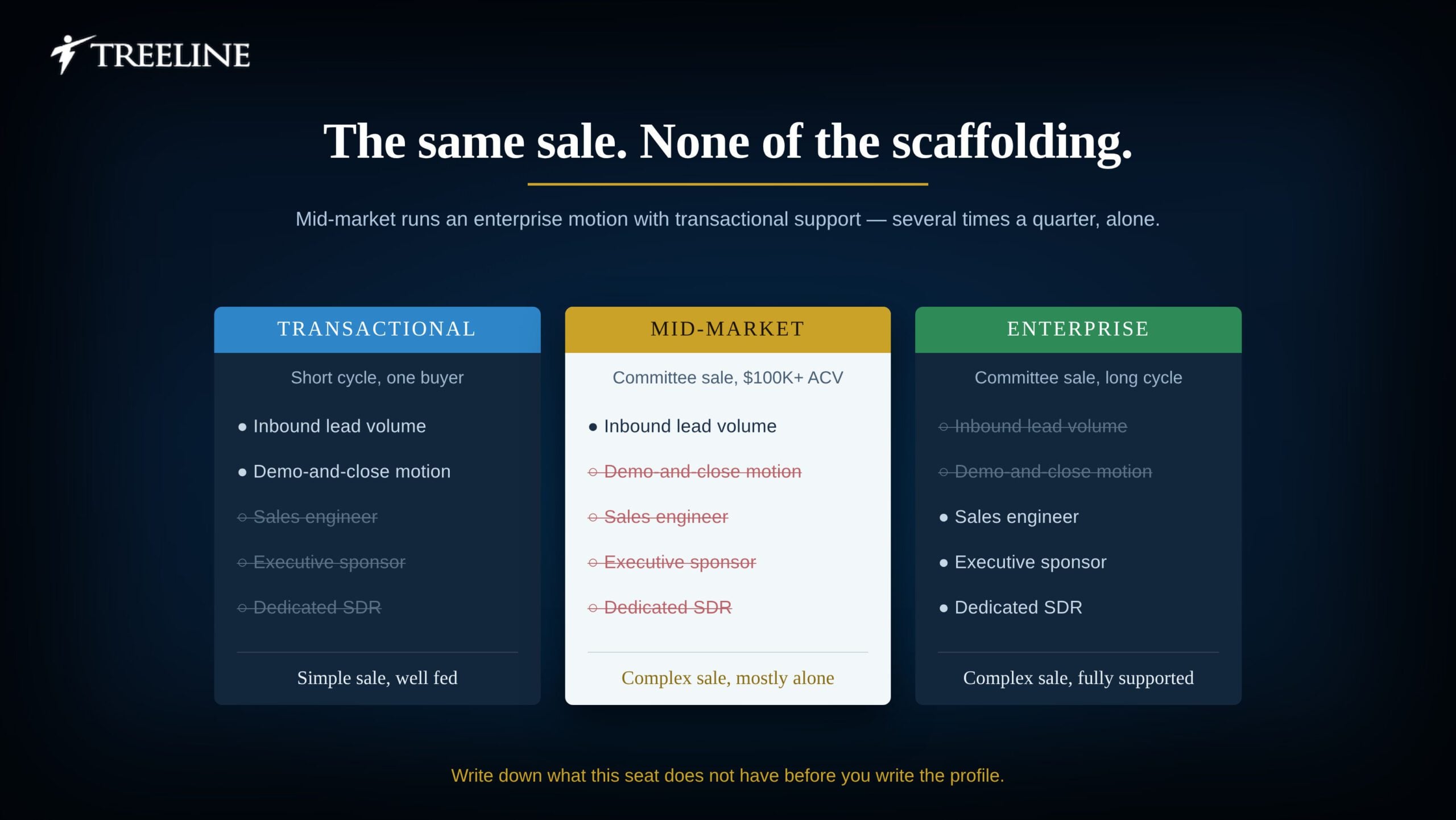
What the seller will not have. No technical resource on the road, no inside partner qualifying ahead of them, no administrative support for the proposals, whichever is true. This list predicts success better than the requirements do.
Fantasia warns that the most common failure in this search is a brief that specifies the customer and omits the commute, which produces candidates assessed against a job whose actual difficulty was never described.
How to Test a Recruiting Firm on an Outside Account Executive Search
Four questions, before you engage anyone.
Ask them what they will screen for besides quota attainment. If the answer does not involve how candidates allocate their week, they are matching on résumé surface.
Ask how they will test qualification discipline. The useful answer involves asking candidates for the trips they declined, not asking whether they are organized.
Ask what they know about your geography. A firm that has looked at the region will ask where the base is before it asks what the product does.
Ask what they would tell you if the territory, rather than the seller, is the problem. A firm that has never recommended against its own placement is not reading the mandate.
Our analysis of the account executive role in the software market, our page on field management and our field sales job description are reasonable places to check whether a firm’s published thinking matches what it says on a call.
When the Territory Is the Problem, Not the Hire
Sometimes the search should stop.
If the geography cannot produce the required number of first meetings a week at any reasonable standard of qualification, no hire fixes it, the region needs splitting, or the quota needs to come down. If the deal size does not justify travel, the economics will reassert themselves and the seat will be converted to an inside role within a year, which is an expensive way to learn. If the previous two holders both left inside eighteen months, the problem is structural and the third hire will discover it too. And if nobody can say where meetings are supposed to come from, that is the thing to fix first.
Our pages on territory-based roles and on regional field coverage deal with the structural versions of this question.
Fantasia resists opening a field search where the meeting arithmetic has not been done, on the view that a seller hired into a region that cannot support the number will spend their first year proving something the employer could have calculated in an afternoon.
Frequently Asked Questions
What is the difference between an outside account executive and an inside one?
The cost of being wrong. Both qualify, both close, both carry a number. The outside seat spends a scarce and non-recoverable resource, working days, on each attempt, which makes pre-qualification the dominant skill rather than a preliminary one.
How many first meetings a week should an outside account executive hold?
It depends entirely on geography, deal size and cycle length, so no general figure is useful. What matters is that somebody calculated it when the quota was set, and that the number is shared with candidates. Searches stall when it has not been.
Can an inside seller succeed in a field seat?
Often, and they bring the harder half with them. The thing to probe is how they handle unsupervised time, because the field removes the structure an inside role provides. Candidates who already impose their own structure tend to transfer well.
Should I hire for industry knowledge or field discipline?
Field discipline, in most cases. Product and industry knowledge installs in a quarter; the habit of declining a meeting that will not move a deal takes years and is rarely taught.
Does the territory matter more than the person?
Neither dominates, but the territory is the half that gets assumed rather than examined. Two sellers of equal ability in differently drawn regions will post different numbers, and the brief should say which region this is before it describes who should hold it.
How long should this search take?
Longer than an inside search, mainly because strong field candidates are usually mid-cycle on deals they want to close before moving, and because geography narrows the pool to people who already live within reach.
What is the single most common mistake in this search?
Hiring the person with the fullest calendar. A full calendar is evidence of acceptance, not of judgment, and in a field seat judgment is the job.
Count the Meetings Before You Count the Pipeline
Everything difficult about this search is settled before anyone is contacted. How far apart the accounts are. How many first meetings the number implies. Where those meetings come from. What the seller will not have in the car with them.
Four answers, none of which require a recruiter, all of which decide whether the recruiter can help. The candidates worth hiring will ask for them, and will take the other offer if the answers are vague.
Share This Story, Choose Your Platform!
Related Posts

What our happy clients are saying
Treeline Inc. provided us with the most candidates that aligned with our needs and were of the highest quality.

Dr. Jeffrey Klein Head of North America Sales, Satchel Pulse
Treeline Inc.’s collaborative, flexible, and communicative approach resulted in a smooth partnership. Beyond their recruitment expertise, their unique sourcing model was efficient and effective.

Sera Holt Director of Operations, LNS Research
Their professionalism was outstanding. Treeline Inc. was extremely thorough and ensured that we were on the same page before they started looking for candidates. They listened to us and did a great job working with the candidate to close out the process.

Cate Grant AVP Customer Success, Nasdaq
Thanks to Treeline Inc.’s intricate and thorough screening process, the company is able to hire six high-quality candidates that fit perfectly in the company’s culture. The team is highly receptive to concerns, and internal stakeholders are impressed with their unique recruitment abilities.

Anna McKean Sales Recruiter, Insider Intelligence
Treeline Inc. has been qualified individuals throughout a five-year-long engagement. They’ve made numerous placements of talented and qualified individuals for our business.

Michele St Laurent VP of HR, The Institute for Applied Network Security

Let Us Help You Source the Sales Talent You Need
Whether you’re building a team or replacing a key role, our Candidate Sourcing Platform provides a fast, flexible, and employer-focused solution.
Tell us more about your business and how we can help.
Treeline Inc.
Your Award-Winning Sales Recruitment Partner
15 Lincoln Street, Suite 314, Wakefield, MA 01880