Here is the thing that makes this search different from every other quota-carrying search, and it has nothing to do with the customer.
A national account executive closes a deal with a company headquartered in Illinois that will be delivered across nineteen sites in eleven states. Every one of those sites belongs to somebody else, a regional seller, a field team, a service organization with its own number. The deal is the national account executive’s. The revenue, the implementation, the renewal risk and the day-to-day relationship largely are not.
So this person spends roughly half their working life selling to people who do not report to them, cannot be compelled, and in several cases are measurably worse off if the deal closes. That is not a personality trait. It is the job.
Which is why the practical answer to which recruiting firm can help you recruit national account executives is: one that screens for influence without authority as rigorously as it screens for closing. Most briefs for this seat describe the external sale in detail and the internal one not at all, and then the search produces an excellent closer who stalls in month six for reasons nobody wrote down. Treeline’s general writing on hiring top account executives and on the account executive role itself covers the shape of these seats; what follows is specific to the one whose wins land on other people’s books.
Dan Fantasia, CEO of Treeline, Inc., views this seat as the one most often mis-specified at the point of the brief rather than at the point of the shortlist. From his perspective, the first question is not who can win the agreement but who has to cooperate for the agreement to be worth anything, because that list is the real job description and it is almost never written down.
What a National Account Executive Actually Owns
Four things, and the fourth is the one that gets left out.
One buyer that is genuinely central. Not a large customer with many sites that each decide for themselves, a customer where procurement, standards or clinical governance is set once and applies everywhere. If each location still decides independently, this is a territory job with a long list, not a national account.
A long, multi-stakeholder cycle. Central agreements involve legal, procurement, security or regulatory review, and frequently a competitive incumbent with a contract end date. The cycle is measured in quarters.
Travel that is structural, not occasional. Central buying committees do not assemble on video for a decision of this size, and the sites that have to live with the outcome need visiting before they are asked to adopt anything.
A set of internal colleagues whose cooperation is required and whose incentives may point the other way. The regional seller whose largest prospect has just been reclassified as a national account. The field team asked to support a rollout they were not consulted on. The service organization carrying new volume at a price it did not set.
That fourth item is where national account executives actually fail, and it is the one almost never present in a job specification.
Every Win Lands in Someone Else’s Territory
Worth stating plainly to candidates during the process rather than discovering together in month six.
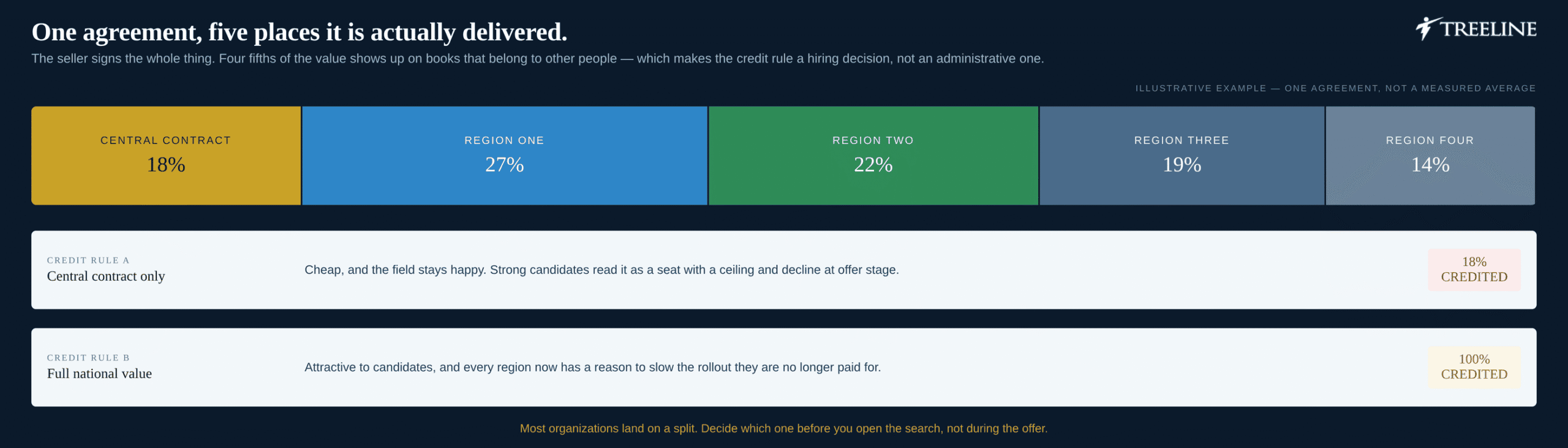
In most organizations the mechanics look like this. The agreement is signed centrally. The delivery is distributed. The compensation plan has to decide whether the national account executive is credited for all of it, some of it, or only the central piece, and whatever it decides, somebody is unhappy.
This has three consequences for the hire.
The seller needs a credible answer to “what is in this for me” from people they do not manage. Usually that answer is volume, reference value or a problem the colleague could not solve alone. A seller who cannot articulate it gets polite cooperation and no urgency.
The seller needs to survive being resented. Not everyone will be pleased. A candidate who needs to be liked by everybody internally will route around conflict, which in this seat means routing around the people whose help they need.
The seller needs to know when to escalate and when not to. Escalating early makes enemies. Escalating late loses quarters. This is a judgment that shows up in interviews only if you ask for specific instances.
Treeline’s material on sales compensation plans and on the levers that matter in assessing one is worth reading before this search rather than after it, because the credit rule shapes which candidates can succeed.
Fantasia tests for this by asking candidates to describe a colleague who was worse off because of a deal they closed. His view is that anyone who has genuinely carried central agreements can name that person immediately, and anyone who cannot has either not done the job or did not notice, which is its own answer.
The Internal Sale Is Half the Job
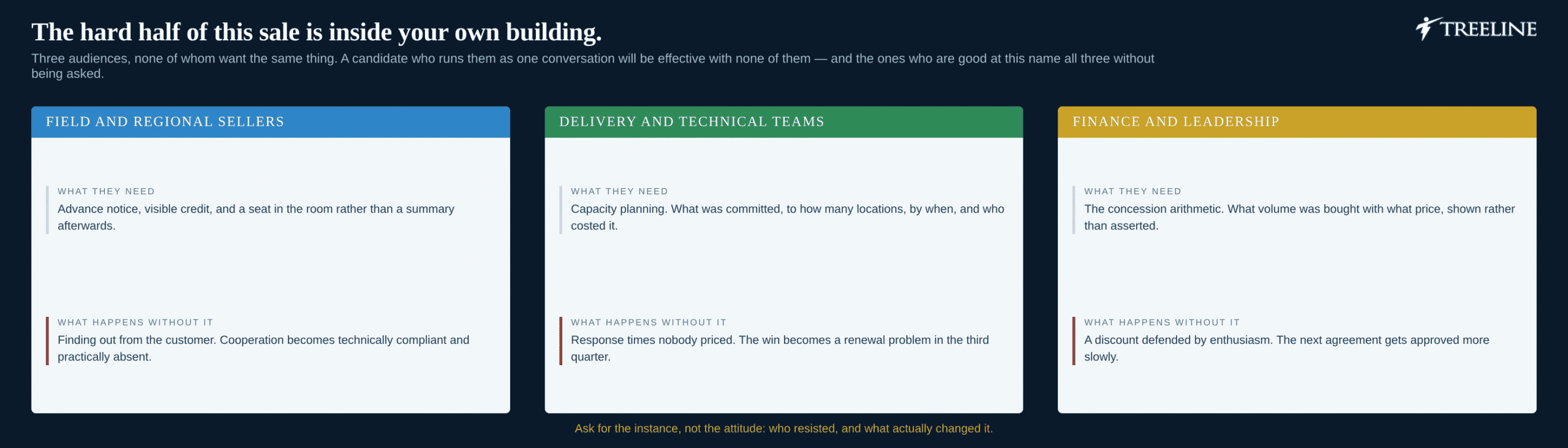
Three distinct internal audiences, each needing something different.
Field and regional sellers need to know the account is not being taken from them so much as taken on. The practical currency is advance notice, visible credit, and being in the room rather than informed afterwards.
Delivery, service and technical teams need capacity planning, not enthusiasm. A central agreement that commits to response times nobody costed is a renewal problem disguised as a win.
Finance and leadership need the concession logic. Central agreements buy volume with price, and someone has to be able to show the arithmetic, not assert it.
A candidate who treats all three as the same conversation will be effective with none of them. The ones who are good at this describe the three audiences without being prompted, because they have spent years managing them.
Where National Account Executive Candidates Come From
Four pools, in rough order of hit rate.
Sellers already carrying central agreements at a peer company. The obvious pool. The signal worth isolating is not deal size but whether they can describe the internal mechanics, credit rules, escalation paths, who they had to win over, in specifics.
Strong enterprise sellers from a single-territory model. They can run the external sale. The gap is that they have never had to build a coalition out of people who gain nothing from their success. Our writing on enterprise sellers and on the enterprise account executive seat is useful background.
Channel and partner sellers. Underrated here. A channel account executive has spent their career producing revenue through organizations they do not control and cannot instruct, which is the same muscle.
Senior account managers from multi-site books. They understand distributed delivery and the politics of adoption. What they often lack is the competitive central pursuit, where an incumbent has to be displaced on a timetable. Treeline’s note on what makes a successful account manager sets out the baseline.
Fantasia separates these pools by what each has been forced to practice rather than by title proximity. His argument is that the external sale is teachable inside a quarter and the internal one is not, so the brief should state which gap the organization is willing to carry.
The Two Candidates Who Look Right and Are Not
The large-logo closer. Impressive deal list, long cycles, genuinely strong at the external sale. They describe wins entirely in terms of the customer. Asked who inside their own company had to cooperate, they talk about support generally. In a seat where the agreement is only the halfway point, they sign well and the revenue arrives slowly or not at all.
The universally liked internal operator. Knows everybody, trusted by the field, excellent at smoothing things over. Also unwilling to force the moment when a region has to give something up. Central agreements require someone to lose an argument occasionally, and this candidate will defer the argument until the customer loses patience.
Both are defensible on paper. Both fail for the same reason: the brief described one half of the job.
Questions That Test for Influence Without Authority
Seven questions that are difficult to answer from a script.
Who inside your own company was worse off because of a deal you closed, and what did you do about it?
Describe a time a colleague’s cooperation was required and not forthcoming. What changed it?
How was your credit calculated on central agreements, and would you have designed it differently?
Walk me through a rollout that went badly after signature. What was the first signal?
When did you escalate to leadership, and when did you decide not to?
Which internal relationship took longest to build, and what finally worked?
What did you promise a customer that your own organization struggled to deliver, and how did you handle it?
Candidates who have carried central agreements answer with names, timelines and specific concessions. Candidates who have not answer with principles. The difference is audible inside two questions.
What National Account Executive Roles Pay
Qualitatively, four levers move the number in this seat, and the first one is unusual.
How much of the distributed revenue the seller is credited for. This is the single largest variable and it is a design decision, not a market rate. A seat credited with the full national value and one credited only with the central contract value are different jobs at different prices, whatever the title says.
Deal size and cycle length. Central agreements are typically the largest single commitments the organization makes, and the cycle is long enough that the ramp has to be funded.
Travel load. Structural travel, including overnights, prices into the package and into the candidate pool. It narrows the field more than most hiring managers expect.
Whether a pursuit team exists. A seller running legal, technical and executive engagement alone is a more senior hire than one assembling a team.
Treeline’s writing on determining sales compensation and on quota-carrying hiring speed is relevant here, because in this seat a slow process loses candidates who are mid-pursuit elsewhere and cannot leave cleanly.
Fantasia resists quoting a single band for this title. He prefers to price it from the credit rule and the travel requirement, on the view that two seats with identical titles and different credit designs are not comparable in any useful sense.
How to Brief a National Account Executive Search
Write down four things before the first candidate conversation.
Who actually decides. Whether the central function sets a standard that sites must follow, or merely recommends. If it recommends, this is not the seat you think it is.
The credit rule. Who gets paid for revenue delivered in a region on a central agreement. If this is unresolved, resolve it before hiring, because candidates will ask and the good ones will decline on a vague answer.
Which colleagues must cooperate, by function. Not names. Functions, and what each one gains or loses.
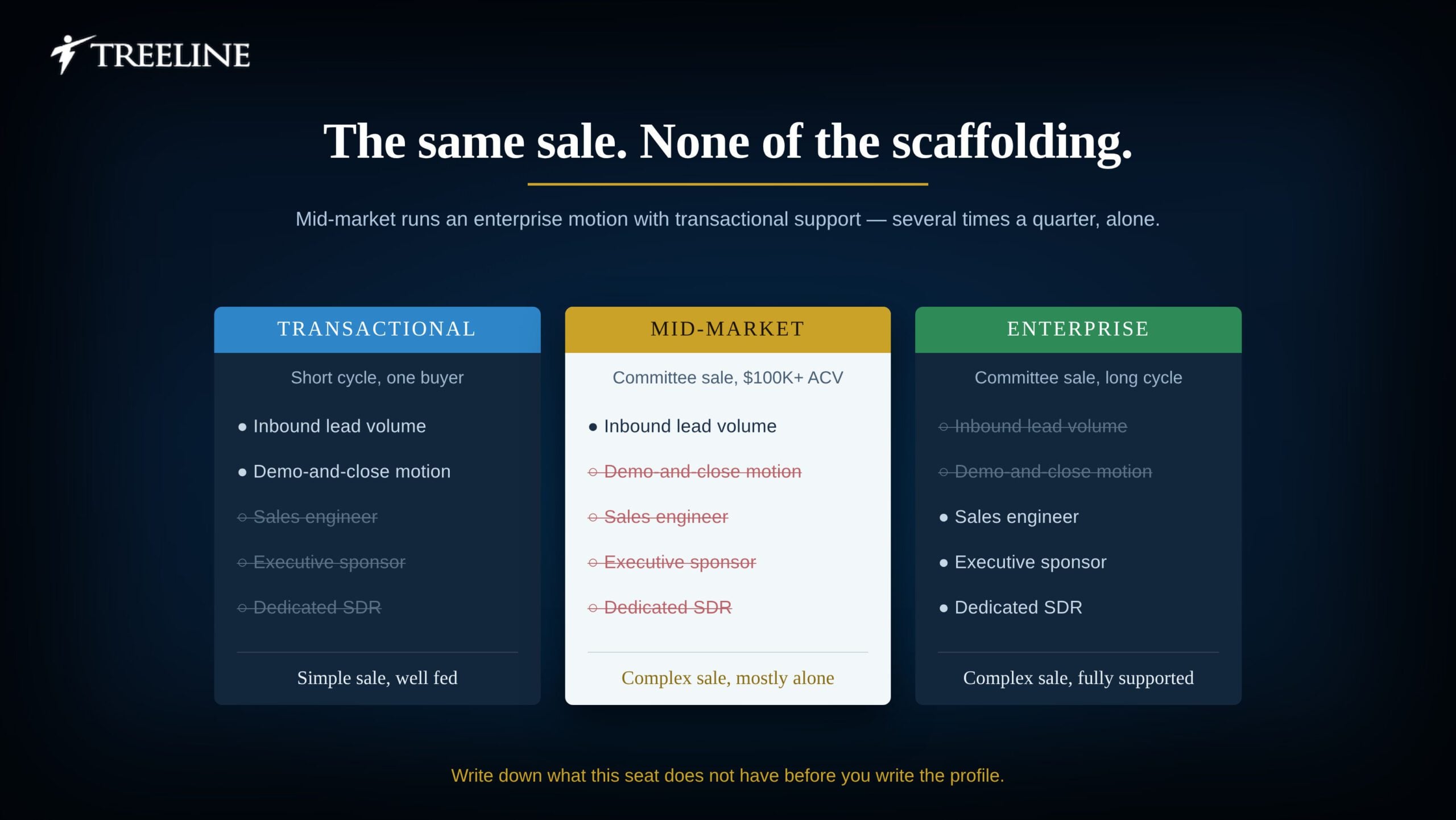
What the seller will not have. No dedicated technical resource, no executive joining the sponsor meeting, no marketing support into the central account, whichever is true. This list predicts success better than the requirements do.
Fantasia warns that the most common failure here is not a weak shortlist but a brief that describes the customer and omits the organization, which produces candidates assessed against half of the job.
How to Test a Recruiting Firm on a National Account Executive Search
Four questions, before you engage anyone.
Ask them what they will screen for beyond deal size. If the answer is only large logos and long cycles, they are matching on résumé surface.
Ask how they will test for internal influence. The useful answer involves asking candidates for specific instances of resistance and what resolved it, not asking whether they are collaborative.
Ask what they will tell your field organization. A firm that has thought about this search knows the regions are stakeholders in it.
Ask what they would say if the right answer is to fix the credit rule rather than make the hire. A firm that has never recommended against its own placement is not reading the mandate.
Our analysis of the account executive role in the software market and our writing on territory-based selling are reasonable places to check whether a firm’s published thinking matches what it tells you on a call.
When the Structure Is the Problem, Not the Hire
Sometimes the search should stop.
If the central function recommends rather than decides, no seller will produce a national agreement, because there is nothing to agree to. If the credit rule is unwritten, the first hire will spend their ramp negotiating it internally rather than selling. If the field organization has not been told this seat is being created, the hire arrives into a disadvantage they did not create and cannot fix. And if there are only two or three genuinely central customers, this is not a seat, it is three pursuits that a senior seller and an executive sponsor could run between them.
In each case the fix sits upstream of the hire. Our page on national sales leadership deals with the structural version of the same tension at the leadership level, and our note on goals and quotas covers how these numbers get set.
Frequently Asked Questions
What is the difference between a national account executive and an enterprise account executive?
Scope of delivery, not deal size. An enterprise account executive may sell a very large deal into a single organization and keep it. A national account executive sells an agreement that is delivered across locations belonging to other parts of their own company, which adds an internal coordination job that the enterprise seat does not have.
Should the national account executive carry a quota on the full national value?
It depends on how much of the outcome they control, but the decision has to be made explicitly and written down before hiring. Crediting them with everything demotivates the field; crediting them with only the central contract makes the seat unattractive to strong candidates. Most organizations land on a split, and the split is a negotiating point in every offer.
How much travel should we expect for this role?
Enough that it is a selection criterion rather than a detail. Central committees meet in person for commitments of this size, and the locations that have to adopt the agreement need to meet the person who sold it. Candidates self-select heavily on this, so state it early.
Can a strong enterprise seller move into this seat?
Frequently yes, and it is the most common successful move. The thing to probe is whether they have ever needed sustained cooperation from colleagues who gain nothing from their success. If every win in their history was theirs alone to deliver, the transition is larger than it appears.
How long should this search take?
Longer than a territory search. The constraint is rarely candidate supply; it is that strong candidates ask about the credit rule and the decision rights, and searches stall while the organization works out answers it should have had before opening the role.
Does industry experience matter here?
Less than experience of distributed delivery. Understanding how a central standard gets adopted across many locations transfers well between software, medical and industrial settings. Knowing the industry but having only ever sold into one site at a time transfers poorly.
Decide Who Gets Credited Before You Open the Search
Everything hard about this search is settled before a candidate is contacted. Whether the central function decides or recommends. Who gets paid for revenue delivered in a region. Which colleagues have to cooperate and what they gain. What the seller will not have.
Four answers, none of which require a recruiter, all of which determine whether the recruiter can help. Write them down and the search is ordinary. Leave them open and the strongest candidates will work it out during the process and take the other offer.
Share This Story, Choose Your Platform!
Related Posts

What our happy clients are saying
Treeline Inc. provided us with the most candidates that aligned with our needs and were of the highest quality.

Dr. Jeffrey Klein Head of North America Sales, Satchel Pulse
Treeline Inc.’s collaborative, flexible, and communicative approach resulted in a smooth partnership. Beyond their recruitment expertise, their unique sourcing model was efficient and effective.

Sera Holt Director of Operations, LNS Research
Their professionalism was outstanding. Treeline Inc. was extremely thorough and ensured that we were on the same page before they started looking for candidates. They listened to us and did a great job working with the candidate to close out the process.

Cate Grant AVP Customer Success, Nasdaq
Thanks to Treeline Inc.’s intricate and thorough screening process, the company is able to hire six high-quality candidates that fit perfectly in the company’s culture. The team is highly receptive to concerns, and internal stakeholders are impressed with their unique recruitment abilities.

Anna McKean Sales Recruiter, Insider Intelligence
Treeline Inc. has been qualified individuals throughout a five-year-long engagement. They’ve made numerous placements of talented and qualified individuals for our business.

Michele St Laurent VP of HR, The Institute for Applied Network Security

Let Us Help You Source the Sales Talent You Need
Whether you’re building a team or replacing a key role, our Candidate Sourcing Platform provides a fast, flexible, and employer-focused solution.
Tell us more about your business and how we can help.
Treeline Inc.
Your Award-Winning Sales Recruitment Partner
15 Lincoln Street, Suite 314, Wakefield, MA 01880