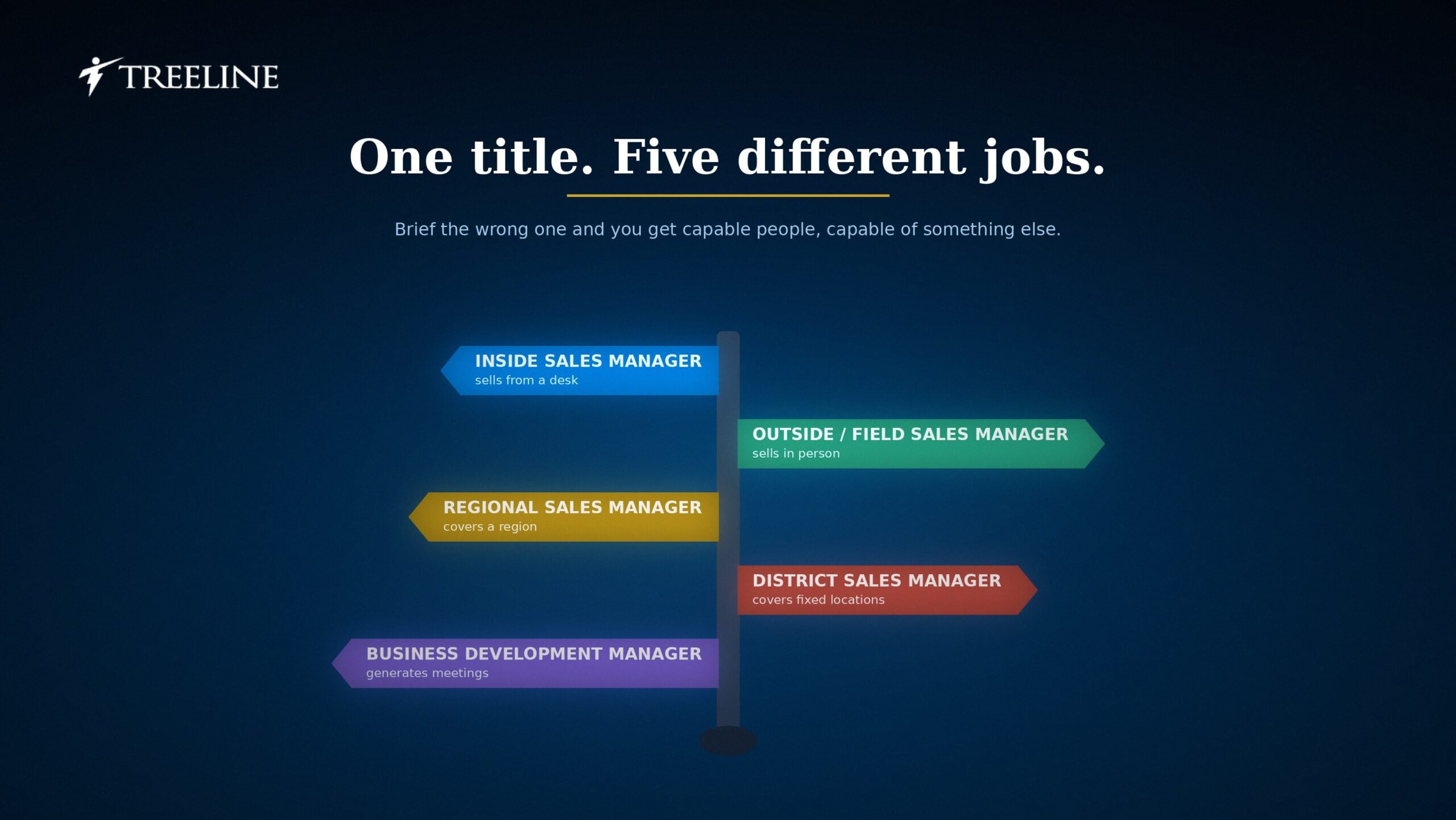
Before the firm, the job. Sales manager is the most widely used title in commercial hiring and one of the least precise. At least five distinct jobs share it, they draw from different candidate pools, they are paid differently, and the interview that works for one is close to useless for another.
The expensive error is not choosing the wrong firm. It is briefing a firm against the wrong job, which produces a shortlist of capable people who are capable of something else.
This page is a routing guide, deliberately shorter than the articles it points to. It sorts the five versions, points to the detailed article for each, and sets out what they have in common. If you already know which one you need, go straight to it.
Dan Fantasia, CEO of Treeline, Inc., views the title as a container rather than a description. From his perspective, employers should describe the team and the motion before using the word manager at all, because the word itself carries almost no information.
One Question Sorts Most Sales Manager Hires
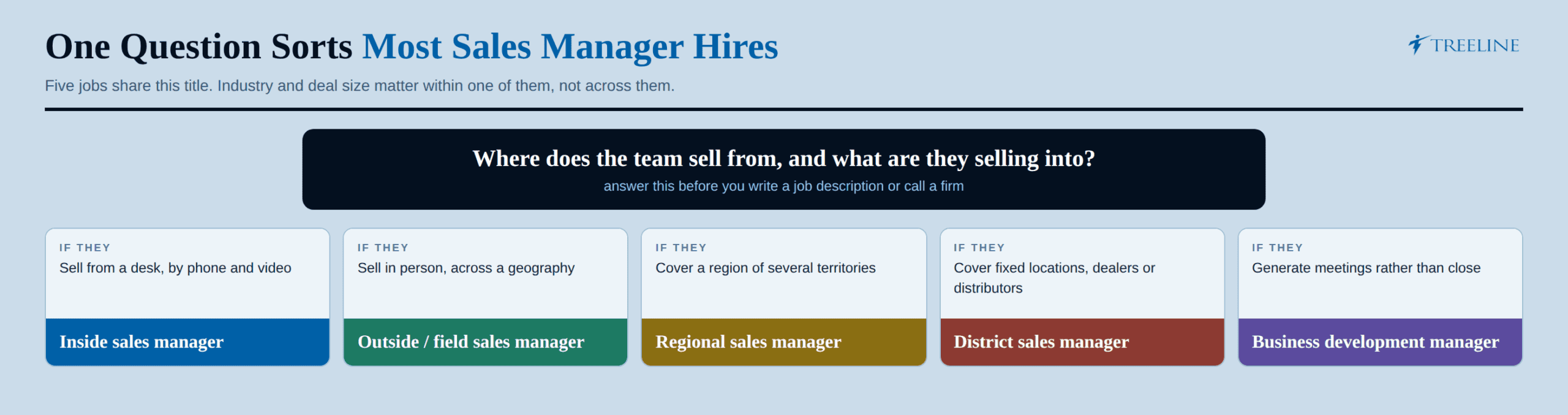
Where does the team sell from, and what are they selling into?
That single question separates the five versions more reliably than seniority, headcount or industry. The team’s selling environment determines what the manager actually does with their week, whether they can observe the work, how they coach, how far they travel, and what their scarcest resource is.
- They sell from a desk, by phone and video → inside sales manager
- They sell in person, across a geography → outside sales manager
- They cover a region with several territories → regional sales manager
- They cover fixed locations, dealers or distributors → district sales manager
- They generate meetings rather than close → business development manager
Everything else, industry, deal size, tenure requirements, matters, but it matters within one of these five rather than across them.
The Five Versions of Sales Manager
Inside sales manager
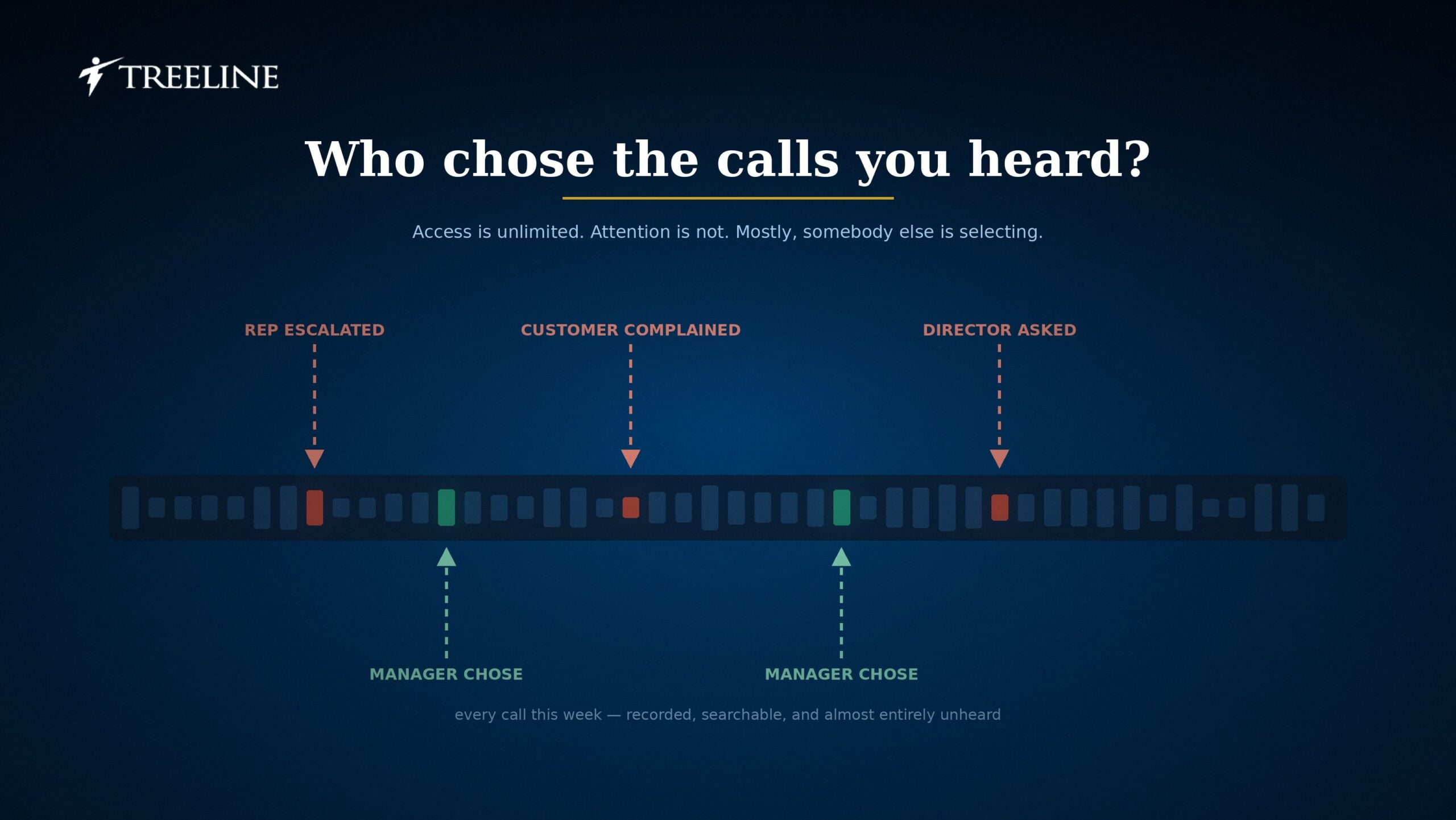
The team sells from a desk. Every call is recorded, every sequence step is logged, so the manager has total visibility and no time to use it. Their defining problem is selection: with several hundred calls a week and a couple of hours to review them, what they hear is usually whatever got escalated, which is the least representative sample available.
Hire for a deliberate listening method, not years of management. Treeline’s guidance on recruiting inside sales managers covers the assessment in detail, and the earlier guidance on how to hire an inside sales manager covers running that process yourself. The guidance on building an inside sales force and on B2B inside sales covers the surrounding function.
Outside sales manager
Also called a field sales manager, the terms are interchangeable. The team sells in person, so the manager’s constraint is the opposite of the inside manager’s: not attention, but access. Do the arithmetic and a first-line field manager has roughly 110 coaching days a year for the whole team. Across eight reps that is about one day a month each.
Hire for how they spend that budget, and specifically for whether they debrief after a joint call. Treeline’s guidance on recruiting outside sales managers sets out the full assessment.
Regional sales manager
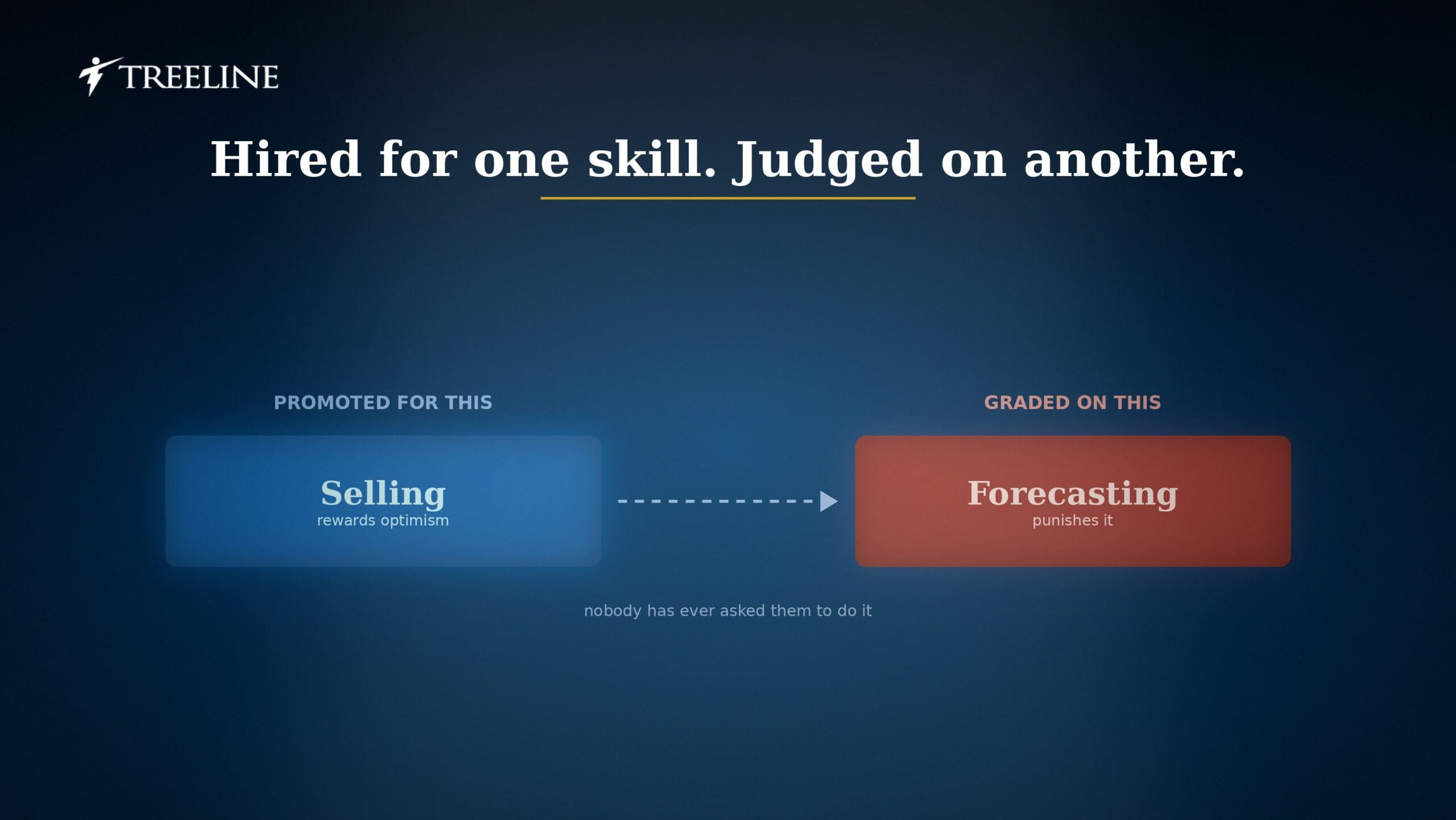
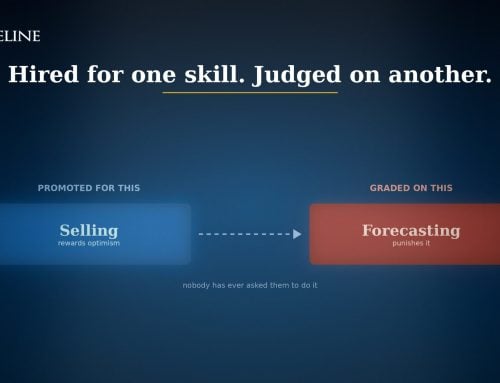
A first-line manager across several territories. The distinguishing feature is not scope but a change of discipline: these managers are promoted because they sold well, then measured on producing an accurate forecast from other people’s judgments. Selling rewards optimism; forecasting punishes it.
Hire for judgment rather than attainment. Treeline’s guidance on recruiting regional sales managers covers that assessment, and Treeline maintains city-level pages for this role in markets including Boston, Chicago, Atlanta, Austin and Denver, with the full set under locations.
District sales manager
The team covers fixed locations, dealers or distributors rather than a list of prospects. Most of the people the manager needs to influence do not work for the company at all, so the job is influence without authority.
Hire for how they have moved people they had no leverage over. Treeline’s guidance on recruiting district sales managers covers it.
Business development manager
The team creates and qualifies opportunities and hands them to someone else. That makes the role an interface, and the terms of the handoff, what counts as qualified, who can decline, how credit splits, have to be agreed before the hire rather than negotiated by them.
Hire for conversion rather than volume. Treeline’s guidance on recruiting business development managers covers the full assessment, and the guidance on hiring top account executives covers the closing layer they hand into.
Fantasia starts every manager brief with the motion rather than the person. His reasoning is that two companies using the identical job title can need people with no overlapping experience, and the only way to tell is to describe how the team actually sells.
A note on the ones that overlap. Regional and outside are the pair most often confused, because a regional manager usually has field reps. The difference is what the role is graded on: an outside manager is judged on how well they develop the people they can rarely watch, a regional manager on whether the number they submit each week turns out to be true. District and outside are the other near-pair, and there the difference is who the manager has to influence, a district manager spends most of their leverage on people who are not on your payroll at all. If your situation genuinely sits between two of the five, brief for the one whose failure mode would hurt you more.
What All Five Sales Manager Roles Share
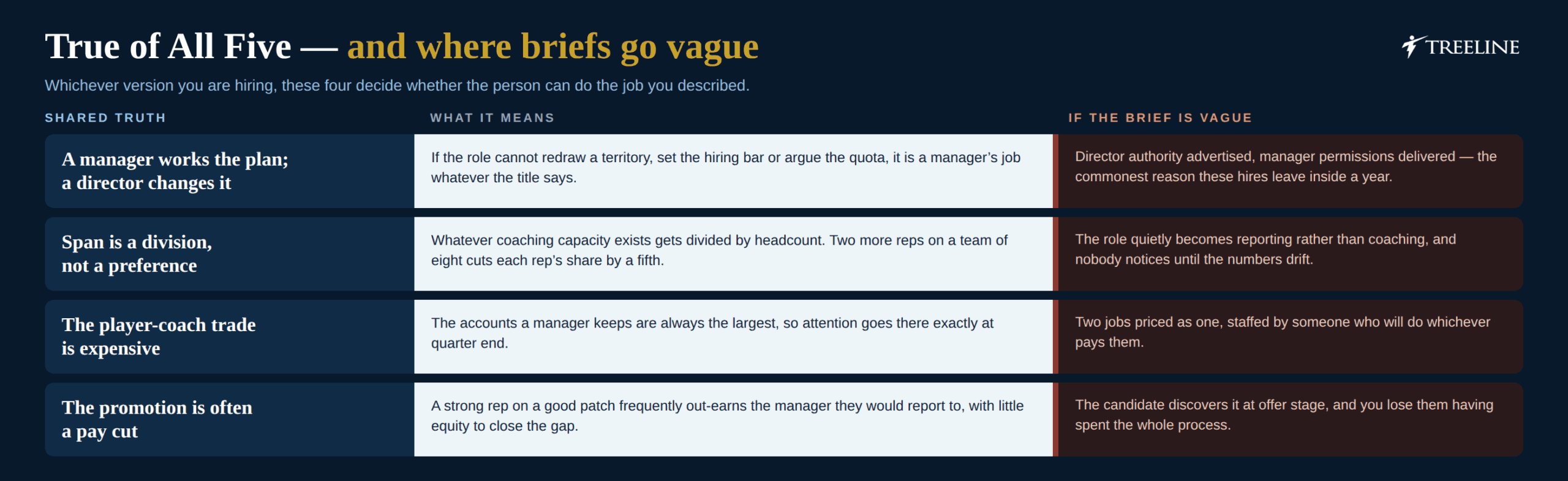
Four things hold regardless of which version you are hiring, and they are where most briefs are vague.
The manager-versus-director line. A manager works the plan; a director changes it. If the role cannot redraw a territory, set the hiring bar or argue the quota, it is a manager’s job whatever the title says. Advertising director authority and delivering manager permissions is the most common reason these hires leave inside a year.
Span is a division, not a preference. Whatever coaching capacity the role has gets divided by the number of reps. Adding two people to a team of eight cuts each rep’s share by a fifth. There is a point at which the job stops being coaching and becomes reporting, and most organizations find it retrospectively.
The player-coach trade is expensive. Where a manager carries their own accounts, those accounts are always the largest, so their attention goes there precisely at quarter end when the team most needs them. If the role genuinely requires it, price it as the two jobs it is and reduce the span.
The promotion is often a pay cut. A strong rep on a good patch frequently out-earns the manager they would report to, and at first-line level there is rarely enough equity to close the gap. Where that is true, say so plainly rather than letting a candidate discover it at offer stage.
Ramp is slower than the plan assumes. A manager hired in month two is not contributing through their team until month six or later, because their first contribution is other people’s behaviour changing. Judging them on a quarterly number before that is judging them on what they inherited. Agree in advance what first-year evidence looks like, pipeline quality, vacancies filled, forecast accuracy, ramp time, rather than on revenue alone.
Treeline’s guidance on building an effective sales manager compensation plan covers the plan design that sits under all five, and the guidance on hiring a vice president of sales covers the layer above. The senior sales leadership job description template can be adapted downward for any of them.
None of the five is a junior role. All of them involve performance decisions about other people’s livelihoods, a forecast somebody upstream relies on, and the authority to tell a colleague their work is not good enough. organizations that treat first-line management as a staging post, filled cheaply, filled quickly, filled from whoever sold most last year, discover the cost a year later, usually when the manager leaves and two of their reps follow. The title sits low on an org chart and high on the list of things that determine whether a sales organization works.
Choosing a Firm to Hire Sales Managers
With the version settled, firm selection is short. Five things to test in a first conversation.
A firm that answers the first two without being prompted has run these searches. One that opens with years of management experience is sorting on the least informative variable available.
Treeline has recruited exclusively for sales organizations since 2001, across industries and locations, with nationwide sales recruiting services spanning the rep layer every one of these managers will hire into. Both contingency and retained models are available, and the comparison of retained and contingency search sets out where each fits. Contingency suits most first-line manager searches; retained makes sense where the market is thin or an incumbent is being replaced discreetly. The broader perspective on using an executive search firm covers when outside search is warranted at all.
The process disciplines are the same across all five. Treeline’s guidance on hiring salespeople from sourcing to start date covers the mechanics, the guidance on speeding up hiring for quota-carrying roles covers the pace, the guidance on red flags during the interview covers the signals, and the guidance on attracting top talent applies to internal candidates as much as external ones.
Fantasia resists shortlists assembled before the version is settled. In his experience a firm that starts sourcing on the title alone will present four capable people from four different versions of the job, and the interviews will feel confusing for reasons nobody names.
When a Sales Manager Isn’t the Answer
Three situations worth checking first.
The team is too small to manage. Three or four reps and an engaged VP rarely need a dedicated layer. Below a certain size the role produces reporting rather than coaching, and a senior individual contributor who sets the standard by doing the work is usually better value.
You need a director. If the requirement is to redesign coverage, rebuild the quota or restructure the team, that is the layer above, and hiring below it will not produce those decisions.
You already have the person. Someone who has been mentoring newer colleagues, carrying a pod or covering during a vacancy has done a version of the job without the title. That is stronger evidence than an interview produces. Treeline’s guidance on the traits great salespeople share covers what to look for underneath.
Fantasia treats a brief that cannot name the version as unready rather than incomplete. His view is that the work of deciding which of the five you need is the employer’s, not the firm’s, and that a firm willing to start without it is selling activity rather than a hire.
Frequently Asked Questions
What is the best recruiting firm to hire sales managers?
The one that establishes which of the five versions you need before it discusses candidates. Sales manager describes an inside manager, an outside or field manager, a regional manager, a district manager and a business development manager, five jobs with different candidate pools, different pay and different interviews. A firm that asks where your team sells from and what they sell into is diagnosing. A firm that opens with years of management experience is sorting on the least informative variable available.
How do I know which kind of sales manager I need?
Answer one question: where does the team sell from, and what are they selling into? Desk-based means an inside manager; in person across a geography means outside or field; several territories in a region means regional; fixed locations, dealers or distributors means district; generating meetings rather than closing means business development. Industry and deal size matter within one of those, not across them.
Is a field sales manager the same as an outside sales manager?
Yes. The terms are interchangeable and describe the same first-line role managing reps who sell in person. Some organizations prefer one label, but there is no consistent difference in scope or seniority, and candidates move between the two titles without any change in what they do.
What is the difference between a sales manager and a sales director?
Authority to change things. A manager works the plan, coaching to it, forecasting against it, holding people to it. A director is expected to change the plan when it is wrong, including territory design, the hiring bar and the quota. If the role cannot redraw a territory or decline a candidate someone senior likes, it is a manager’s job whatever the title says.
How many reps should report to a sales manager?
Fewer than most organizations assume, and the answer comes from arithmetic rather than preference. Whatever coaching capacity the role has is divided by headcount, so adding two reps to a team of eight cuts each rep’s share by a fifth. The number differs by version, an inside manager can coach daily, a field manager perhaps one day a month per rep, which is another reason to settle the version first.
Should a sales manager carry their own accounts?
It is more expensive than it looks. The accounts a manager keeps are always the largest, so their attention goes there exactly at quarter end when the team most needs coaching. If the role genuinely requires it, price it as the two jobs it is and reduce the span accordingly, rather than describing it as a management role and hoping both halves get done.
Start With How Your Team Sells
Before you write a job description or call a firm, write one sentence describing where your team sells from and what they sell into. That one sentence determines which of the five jobs you are actually hiring, and everything else, the pool, the band, the interview, follows from it.
Speak with Treeline for a direct read on which version you need, whether the level is right, and whether the strongest candidate is already on your team.
Share This Story, Choose Your Platform!
Related Posts


What our happy clients are saying
Treeline Inc. provided us with the most candidates that aligned with our needs and were of the highest quality.

Dr. Jeffrey Klein Head of North America Sales, Satchel Pulse
Treeline Inc.’s collaborative, flexible, and communicative approach resulted in a smooth partnership. Beyond their recruitment expertise, their unique sourcing model was efficient and effective.

Sera Holt Director of Operations, LNS Research
Their professionalism was outstanding. Treeline Inc. was extremely thorough and ensured that we were on the same page before they started looking for candidates. They listened to us and did a great job working with the candidate to close out the process.

Cate Grant AVP Customer Success, Nasdaq
Thanks to Treeline Inc.’s intricate and thorough screening process, the company is able to hire six high-quality candidates that fit perfectly in the company’s culture. The team is highly receptive to concerns, and internal stakeholders are impressed with their unique recruitment abilities.

Anna McKean Sales Recruiter, Insider Intelligence
Treeline Inc. has been qualified individuals throughout a five-year-long engagement. They’ve made numerous placements of talented and qualified individuals for our business.

Michele St Laurent VP of HR, The Institute for Applied Network Security

Let Us Help You Source the Sales Talent You Need
Whether you’re building a team or replacing a key role, our Candidate Sourcing Platform provides a fast, flexible, and employer-focused solution.
Tell us more about your business and how we can help.
Treeline Inc.
Your Award-Winning Sales Recruitment Partner
15 Lincoln Street, Suite 314, Wakefield, MA 01880