Meta Title: Choosing a Recruiting Firm for Inside Sales Leadership Meta Description: Inside sales leadership is an operating discipline, not a selling one. How to choose a recruiting firm that screens for ramp, span, and system-building. Suggested URL: https://www.treelineinc.com/blog/recruiting-firm-inside-sales-leadership-roles/ How Do I Choose a Recruiting Firm for Inside Sales Leadership Roles?
Choose a firm that asks about your ramp time and your attrition rate before it asks to see the job description. Those two numbers describe the operating problem you are actually hiring against. A firm that opens with them understands that inside sales leadership is a systems job. A firm that opens with years of experience and title history is going to send you a strong field sales manager, and there is a good chance that person will struggle.
That is the central risk in this particular search, and it is not obvious from the outside. Inside sales and field sales share vocabulary, compensation structures, and CRM. The leadership disciplines are different enough that success in one predicts very little about the other. Companies usually open this search at one of a few points:
- The inside sales team has grown past what a player-coach can hold together
- Ramp time has quietly stretched and nobody owns fixing it
- Attrition in the rep layer is running high enough to consume the hiring plan
- SDRs and closing reps report to different people with no shared definition of a qualified opportunity
- Activity metrics look healthy while pipeline conversion does not
- The team has outgrown the tooling, or has tooling nobody enforces
- A field sales leader has been running inside sales as a secondary responsibility
Dan Fantasia, CEO of Treeline, Inc., views inside sales leadership as an operating discipline rather than a selling one. From his perspective, employers should establish whether the role is measured on individual deal outcomes or on the system that produces them, because the two require materially different people. The general economics apply here as elsewhere.
The Society for Human Resource Management‘s 2026 recruiting benchmarking data reports a median cost-per-hire of $15,000 for executive positions and a median time-to-fill of 45 calendar days. What is different about inside sales leadership is the downstream cost: a leader who cannot fix ramp will cost you far more in wasted rep hiring than the search fee ever represented.
This guide covers what the role involves, the four org shapes it appears in, why field experience does not transfer, the two numbers that define the job, how a candidate should be assessed, and how to choose the firm.
What Inside Sales Leadership Actually Involves
An inside sales leader is accountable for a system that produces revenue, not for a set of relationships that produce revenue. The typical scope:
- A revenue or pipeline number delivered through volume rather than through a small number of large deals
- Design of the sales process itself: cadences, call and email sequencing, qualification criteria, handoff rules
- Ramp: how quickly a new hire reaches productivity, and what the onboarding programme does to shorten it
- Coaching at scale, usually through front-line managers rather than directly
- Tooling ownership: dialer, sequencer, conversation intelligence, CRM hygiene, and whether anyone actually uses them
- Capacity planning: how many reps, at what ratio to managers, producing what
- Attrition management, which in inside sales is a planning input rather than an exception
- Frequently, the talent pipeline into field sales, since inside sales is where many companies develop future account executives
The economics of the layer beneath make the case for treating this as a systems job. The U.S. Bureau of Labor Statistics profile of wholesale and manufacturing sales representatives reports 1,613,600 jobs in 2024 with a median annual wage of $66,780 for non-technical products and $100,070 for technical and scientific products, and projects roughly 142,100 openings each year over the decade despite only 1 percent employment growth.
That last combination is the point: the churn in this layer is structural, not incidental. A leader running forty reps is managing a hiring and ramping machine whether or not anyone described the job that way.
Span of control changes the job
The single most useful question about an inside sales leadership role is how many people sit beneath it and in how many layers.
- Ten to fifteen reps, no managers. The leader is a player-coach. They listen to calls, sit in on deals, and run one-to-one coaching. Candidates from a strong individual-contributor background often thrive here.
- Twenty-five to forty reps, one manager layer. The leader now manages managers. Their leverage is in what the managers do, not in what they personally do. This is the transition most people fail.
- Fifty or more reps, multiple pods or segments.
The leader is running systems: enablement, ramp, capacity models, tooling, and reporting. Direct deal involvement is the exception. Fantasia’s perspective is that span of control changes the job more than title does. A leader responsible for twelve reps is still close to deals, while one responsible for sixty is running managers, tooling, and ramp, and the second job rewards almost none of the instincts that made the first one work.
Treeline’s guide on how to hire an inside sales manager covers the layer immediately beneath this role, which is usually the first hire the new leader will make.
Four Inside Sales Org Shapes, Four Different Leaders
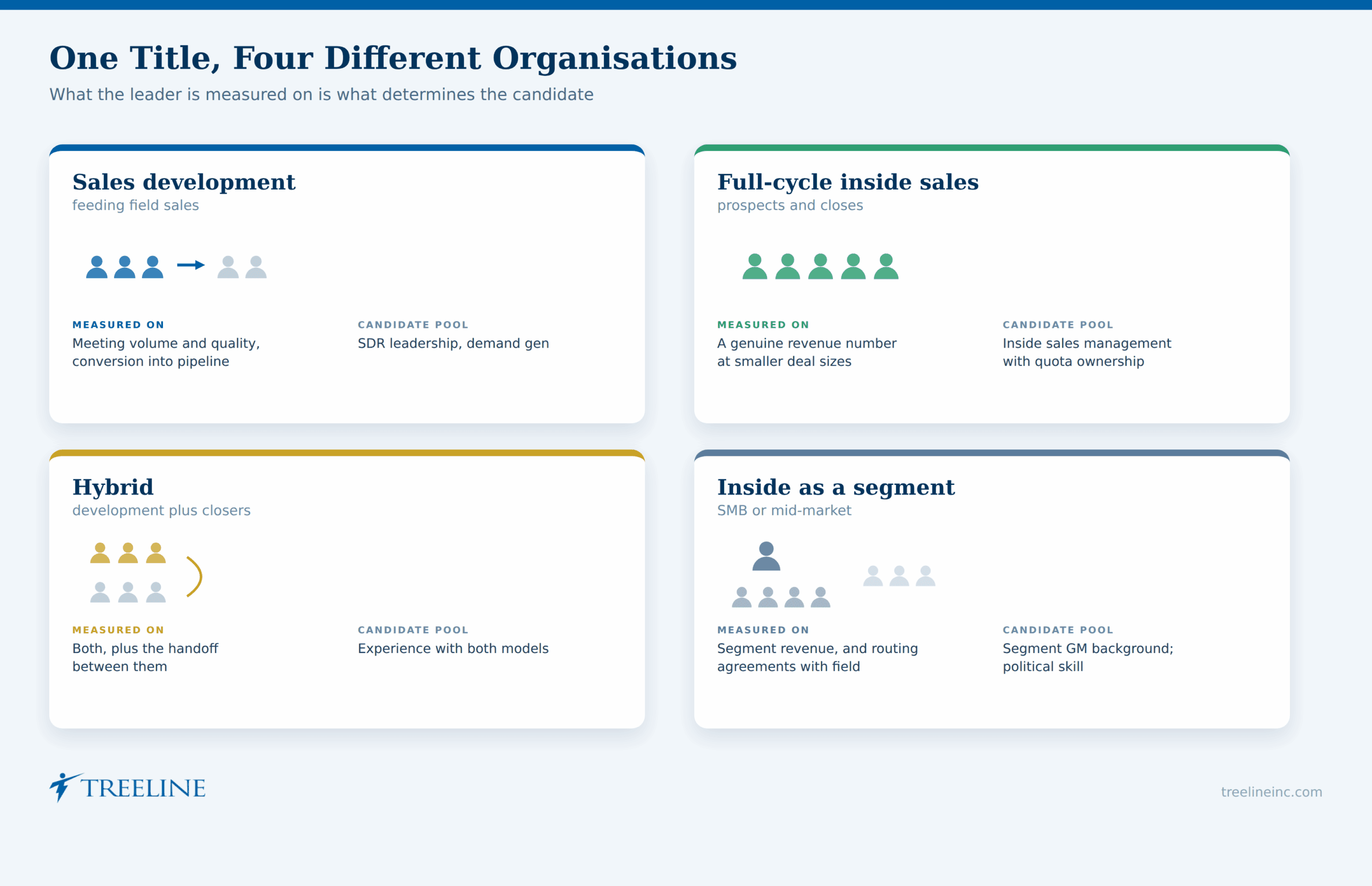
“Inside sales” describes at least four different organisations. Naming yours is the highest-leverage scoping decision available. Sales development feeding field sales. SDRs or BDRs generate qualified meetings that field account executives close. The leader is measured on meeting volume, meeting quality, and conversion into pipeline, not on closed revenue.
Candidates come from SDR leadership and demand generation. Full-cycle inside sales. Reps prospect, run the cycle, and close, usually at smaller deal sizes and shorter cycles. The leader owns a genuine revenue number. Candidates come from inside sales management with quota ownership. Hybrid. Sales development plus inside closers under one leader.
The hardest of the four, because the leader must manage two different jobs, two different comp philosophies, and the handoff between them. Candidates need experience with both. Inside sales as a segment. The inside team owns SMB or mid-market while field sales owns enterprise. The leader is effectively a segment general manager and must negotiate constantly with field sales over account ownership and routing.
Political skill matters as much as operating skill here. If a recruiting firm cannot tell you which of these you have after a twenty-minute conversation, it will screen on the words in your job description.
Why Field Sales Experience Does Not Transfer to Inside Sales Leadership
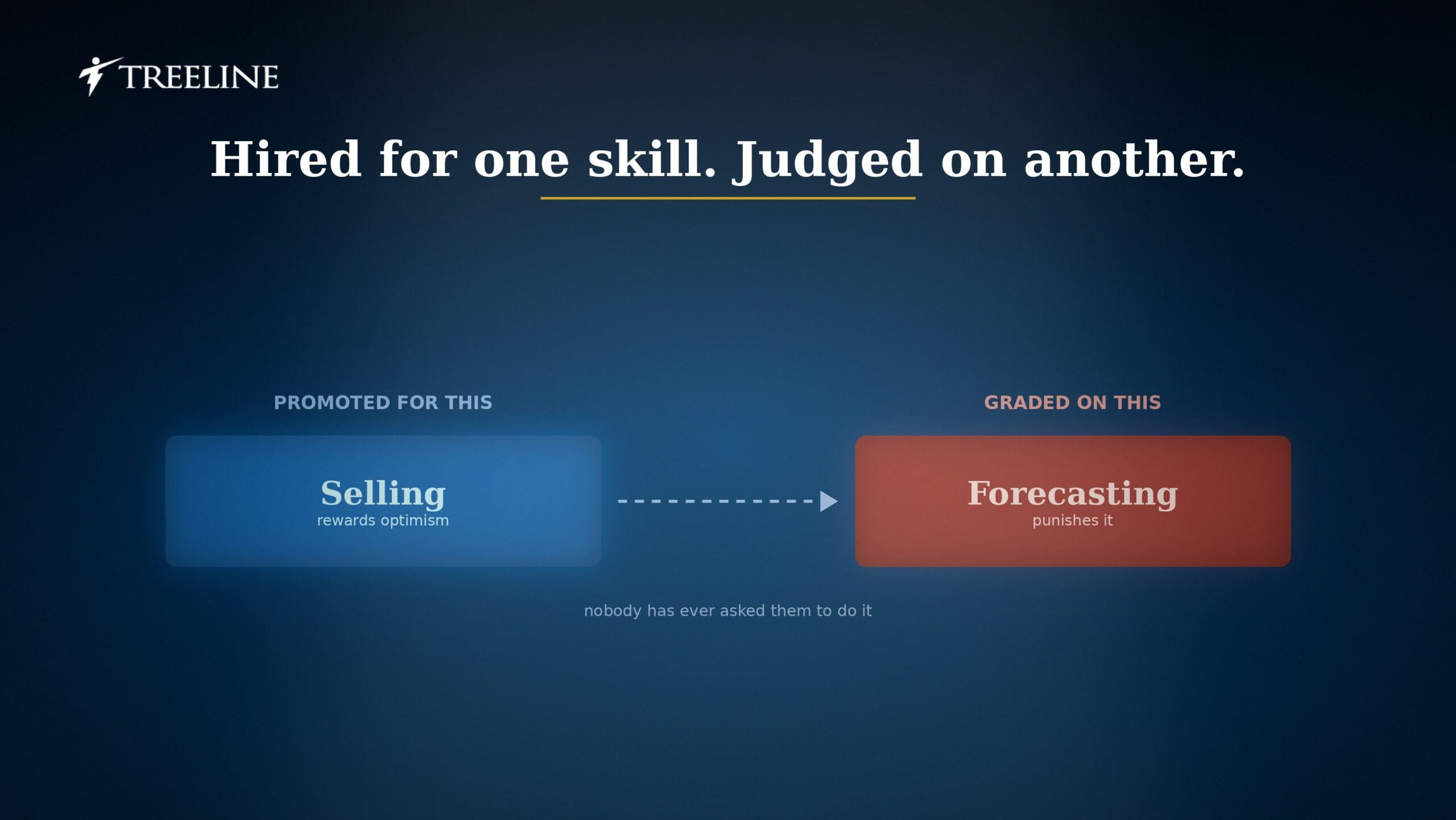
This deserves stating plainly, because it is the most common cause of a failed hire at this level and companies resist believing it. A strong field sales leader has usually been rewarded for judgement on individual deals: knowing which opportunity to invest in, which executive to bring in, when to walk away. Their instinct is to go deep on the deal in front of them.
An inside sales leader is rewarded for the opposite instinct. With sixty reps and a thousand opportunities, no individual deal is worth their personal attention. Their leverage is entirely in the system: what the cadence looks like, how quickly new hires ramp, whether managers coach consistently, whether the qualification bar holds.
Three specific failure patterns show up when field experience is imported without adaptation. Coaching one deal at a time. The new leader joins call reviews and gives excellent deal-level advice. Six weeks later the reps who got attention improved and nobody else did, because nothing changed about the coaching system. Underestimating ramp.
Field sales leaders are used to hiring experienced people who bring a network. Inside sales usually hires early-career reps who need a programme. A leader without one will hire into the same hole repeatedly. Treating attrition as a people problem. In inside sales, a portion of turnover is structural and should be planned for in the capacity model.
A leader who treats every departure as a management failure will over-invest in retaining people who were always going to leave, and under-invest in the pipeline that replaces them. None of this makes field experience disqualifying. It makes it something to test rather than assume. Some of the strongest inside sales leaders came from field roles and consciously rebuilt their operating style.
The interview should establish whether that happened.
The Two Numbers That Define the Role
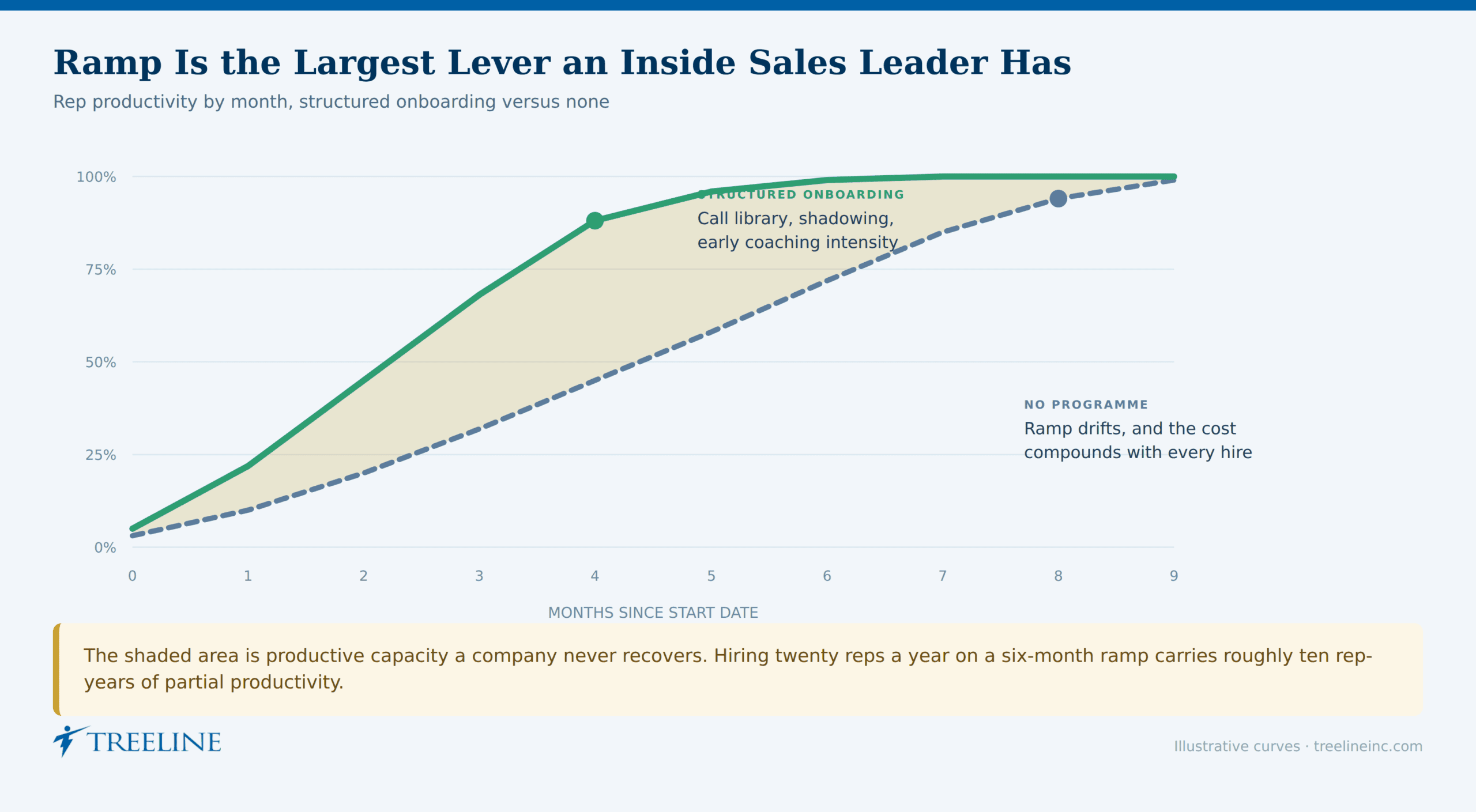
Before engaging any firm, be able to state two numbers. If you cannot, the search is not ready. Ramp time. How long from a rep’s start date to full productivity, and how you measure “full.” Most companies quote a number nobody has verified. A well-run inside sales org shortens this deliberately through structured onboarding, call libraries, and early coaching intensity.
A poorly run one lets it drift, and the cost compounds with every hire. The gap matters more than the absolute figure. If ramp is six months and you hire twenty reps a year, you are carrying ten rep-years of partial productivity annually. Cutting ramp to four months recovers roughly a third of that. No individual coaching intervention comes close to that leverage.
Rep-to-manager ratio. How many reps per front-line manager, and whether that number was designed or accumulated. Too wide and coaching stops happening. Too narrow and the cost structure breaks. The right answer depends on segment and cycle length, but having no answer is itself informative about the state of the organisation.
A recruiting firm that asks for both numbers early is going to produce a better slate, because those numbers tell it whether you need a builder, a fixer, or an operator. Treeline’s perspective on retaining reps and reducing churn in the SDR role covers the attrition side of the same equation.
What a Recruiting Firm Should Understand Before an Inside Sales Leadership Search
Your search partner should be able to describe your operation back to you before sourcing anyone. They should know:
- Which of the four org shapes you have, and whether it is changing
- Current headcount, layers, and rep-to-manager ratio
- Ramp time, and whether anyone has measured it
- Attrition in the rep layer over the last twelve months
- Average deal size and cycle length, since these determine coaching cadence
- Whether the team is on-site, remote, or hybrid, and what that has done to onboarding
- Which tools exist and whether they are enforced or ignored
- Where inside sales sits relative to field sales, and who owns the routing rules
- Whether the role is expected to feed talent into field sales
That last item is regularly omitted and regularly matters. If inside sales is your development pipeline for account executives, the leader is partly running a talent programme, and candidates should be assessed on whether they have built one.
The tooling question
Tooling literacy is a genuine screen for this role in a way it is not for field sales leadership, and it is worth being specific about what you are testing. Most inside sales organisations have accumulated a stack: a dialer, an email sequencer, conversation intelligence, a CRM, and something for enablement content. The common failure is not absence of tooling but absence of enforcement.
Sequences exist that nobody follows. Call recordings accumulate that nobody reviews. Dashboards report activity that does not correlate with outcomes. A capable leader treats the stack as an operating system rather than a shopping list. The diagnostic question is not which tools a candidate has used but what they removed, and why.
Candidates who have only ever added tooling tend to describe capability. Candidates who have removed something can usually explain what it was costing in attention. Ask your recruiting firm how it screens for this. A firm that treats tool names as keywords will match on the logos in a résumé. A firm that understands the function will ask candidates about adoption rates and enforcement.
Fantasia recommends judging a recruiting firm on whether it asks about ramp and attrition before it asks about the job description. Those two numbers describe the operating problem, and a firm that does not ask about them will screen on years of experience instead.
If inside sales is your talent pipeline
Many companies use inside sales as the development ground for future account executives. If that is true for you, say so explicitly, because it changes the role and the candidate. A leader running a talent pipeline is managing deliberate outflow. Their best reps are supposed to leave for field roles, which means the capacity model must assume it, the hiring plan must stay ahead of it, and success partly means producing people the field organisation wants.
That is a different mindset from a leader whose job is to retain top performers in seat. It also changes the political relationship. If field sales is recruiting from your team, the inside leader needs a negotiated promotion path rather than an informal one, or the arrangement degrades into field managers poaching whoever is performing.
Treeline’s perspective on whether to promote an SDR to an account executive covers the individual version of this decision, which the new leader will be making regularly.
How to Assess an Inside Sales Leadership Candidate
Assessment should establish whether the candidate built a system or inherited one that worked. Useful questions:
- How many reps and how many managers reported to you, and how did that change while you were there?
- What was ramp time when you arrived, how was it measured, and what was it when you left?
- What specifically did you change about onboarding, and which cohort proved it worked?
- What was your rep-to-manager ratio, and how did you decide it?
- How did you coach managers rather than reps? Give me a concrete example.
- What was rep attrition, and how much of it did you consider structural?
- Which tools did you introduce or remove, and what happened to adoption?
- How did you define a qualified opportunity, and how did you enforce that definition?
- What did you stop doing in order to focus the team?
- What did your successor inherit, and what was still broken?
Questions two and three carry the most signal. A candidate who can name what ramp was, what they changed, and which hiring cohort demonstrated the improvement has run the system. One who talks about culture and energy without numbers has probably been carried by a functioning organisation. Question five separates the levels.
Coaching reps is a manager’s job. Coaching managers is this job. A candidate who answers question five with a story about a rep has told you which level they actually operated at. References should include a former front-line manager who reported to the candidate. That person can say whether coaching was systematic or personality-driven, and whether the onboarding programme existed on paper or in practice.
Fantasia emphasizes that assessment should test whether a candidate built a repeatable onboarding system or simply hired well. A strong inside sales leader can describe what changed about ramp time, what they measured, and which cohort proved it.
What to Ask Before Engaging a Recruiting Firm for Inside Sales Leadership
- Based on what I have described, which of the four org shapes is this, and what does that imply about the candidate?
- How many inside sales leadership searches have you completed, as distinct from field sales leadership?
- How would you test whether a field sales candidate has genuinely adapted to an inside model?
- What is your read on our ramp time and ratio, and what do they tell you about the mandate?
- Who runs this search day to day, and can I meet them?
- What is your read on our compensation band for this scope?
- Which companies are off-limits to you?
- Why might strong candidates decline this role?
The third question is the useful one. A firm with real experience here will describe a specific test rather than an assurance. Treeline’s perspective on using an executive search firm covers the broader question of when outside search is warranted at all.
Managing a Distributed Inside Sales Team
Inside sales went remote faster and more completely than field sales did, and the leadership implications are still underestimated in job descriptions. The function was historically built around physical proximity. New reps learned by overhearing experienced ones. Managers walked the floor and heard tone, hesitation, and energy without needing a report.
Coaching happened in the ninety seconds after a call ended. Almost none of that survives distribution intact. A leader running a distributed team has to rebuild each of those mechanisms deliberately:
- Onboarding without ambient learning. Structured call libraries, shadowing schedules, and explicit certification replace the learning that used to happen by proximity. Companies that skipped this step saw ramp stretch and often did not connect the two.
- Coaching from recordings rather than from presence. Conversation intelligence becomes load-bearing rather than a nice addition, and managers need time protected for review that used to be absorbed into the working day.
- Early warning without visibility. A struggling rep in an office is visible within days. A struggling remote rep can be invisible for weeks unless leading indicators are actively monitored.
- Deliberate culture.
Inside sales teams historically ran on collective energy. Recreating any part of that remotely is real work rather than an afterthought. When scoping the role, be honest about which model you are running and how well it currently works. A candidate whose entire experience is on-site, in a company that never distributed, is a different risk from one who led a team through the transition.
Ask candidates directly what changed about their coaching system when their team distributed. Those who lived through it have a specific answer. Those who claim nothing changed either had already built a systematic approach, which is a strong signal, or never noticed the difference, which is a concerning one.
Compensation and Structure
Inside sales leadership generally pays below field sales leadership at equivalent headcount, which surprises companies benchmarking off a generic figure. The BLS profile of sales managers reports a median annual wage of $138,060 as of May 2024, with the highest 10 percent above $239,200 and substantial industry variation, from $173,230 in finance and insurance to $92,630 in retail trade.
An inside sales leader running a large team at a technology company typically sits in the upper half of that range, with a smaller variable component than a field VP of comparable headcount because the revenue per head is lower. Structural decisions to settle before the search opens:
- Variable compensation basis. Closed revenue, qualified pipeline generated, or a blend. For a sales development org, paying on closed revenue the team does not control creates predictable resentment.
- Measurement period. Ramp lags mean quarterly variable plans can penalise a leader for a hiring decision that was correct.
- Whether the role carries a headcount budget or must request it, which materially changes what the person can achieve.
- Location expectations. Many inside sales orgs are now distributed; whether the leader must be on-site with the team changes the candidate pool substantially.
- Title.
Director, Senior Director, and VP are used interchangeably at this scope across companies. Decide based on the layers managed rather than on what sounds attractive.
Where These Searches Most Often Go Wrong
| Failure mode | What it looks like | How to prevent it |
|---|---|---|
| Org shape never named | Slate mixes SDR leaders and closing leaders | Decide which of the four you run, in writing |
| Screening on years | Experienced field manager, no systems evidence | Screen on ramp changed and managers coached |
| Ramp unmeasured | Quoted figure nobody has verified by cohort | Pull the last three cohorts before briefing |
| Field instincts untested | New leader coaches deals, not the system | Ask for a manager-coaching example, not a rep one |
| Attrition treated as failure | Over-investment in retaining structural leavers | Build expected churn into the capacity model |
| Tooling as keyword match | Résumé logos mistaken for operating skill | Ask what they removed and why |
| Distributed reality ignored | On-site playbook applied to a remote team | Ask what changed when their team distributed |
| Measured too early | Judged on an inherited quarter | Judge the first cohort they onboard |
The first row causes more failures than the rest combined. A company that has not decided whether it is hiring a pipeline leader or a revenue leader will interview both, prefer whoever presented better, and discover the mismatch when the first compensation plan is written.
Engagement Models and Fees
Fees are typically a percentage of the placed candidate’s base salary, and Treeline’s standard fee is 25% of base salary. Contingency is often the better fit for inside sales leadership than for executive-level field searches. The role is usually public rather than confidential, the candidate pool is larger, and companies frequently want to move quickly because the operating problem is already costing them.
Treeline’s contingency sales recruiting service is entirely performance based with no upfront cost and covers sales management alongside enterprise sales and revenue operations. Retained engagements make sense when the role is confidential, when you are replacing an incumbent, or when the mandate involves rebuilding the function rather than running it.
Treeline’s sales executive search practice covers VP-level and C-level roles on this basis. The mechanics of both are set out in Treeline’s comparison of retained search vs. contingency search.
The First 90 Days
- Days 1 to 30. Listen to calls across the performance distribution, not only the top and bottom. Sit with the onboarding programme as it exists. Establish what ramp actually is by looking at cohorts rather than accepting the quoted figure.
- Days 30 to 60. Assess the manager layer, since that is where leverage lives. Review the qualification definition and whether it is enforced. Audit tooling adoption against tooling spend.
- Days 60 to 90.
Present a plan covering ramp, ratio, coaching cadence, and capacity. Agree what the leader is measured on and over what period. Follow-on hiring is common once that assessment lands, typically front-line managers, enablement, or additional reps. Treeline’s employer sales recruiting services cover those roles, and the complete guide to sourcing, interviewing and hiring BDRs and SDRs covers the layer the new leader will be hiring into.
Fantasia’s operating perspective is that a new inside sales leader should be judged on the cohort they onboard, not the quarter they inherit. Inside sales results lag hiring and enablement decisions by a full ramp cycle, so a leader measured too early will optimise for activity rather than for productivity.
Where Treeline Fits
Treeline recruits across the full inside sales structure rather than only at leadership level, which matters because the leader you hire will immediately need to hire beneath them. Founded in 2001 and based in Wakefield, Massachusetts, Treeline recruits exclusively for sales organisations, covering sales leadership, inside sales, sales development, enterprise sales, sales engineering, revenue operations, and customer success.
The firm has published guidance on building an inside sales force, hiring an inside sales manager, and hiring BDRs and SDRs, which is the layer most inside sales searches expand into. Relevant to this search:
- A candidate database exceeding 200,000 sales professionals, including the inside sales and sales development layers rather than leadership alone
- Both retained and contingency models, with contingency often the better economic fit at this level
- Coverage across the industries where inside sales models concentrate, including enterprise SaaS, fintech, and technology services
- Nationwide sales recruiting services rather than a single regional network
The honest limitation: if your inside sales organisation is genuinely a call-centre operation measured on contact-centre metrics rather than pipeline and revenue, a firm with contact-centre operations depth may assess those candidates better. Treeline is the stronger fit where the inside team carries quota, generates pipeline for a field organisation, or serves as the development pipeline into account executive roles.
Frequently Asked Questions
How do I choose a recruiting firm for inside sales leadership roles?
Choose a firm that asks about your ramp time and rep attrition before asking to see the job description, because those two numbers describe the operating problem. Ask which of the four inside sales org shapes it thinks you have, how many inside sales leadership searches it has completed as distinct from field sales searches, and how it would test whether a field candidate has genuinely adapted to an inside model. A firm that answers those specifically understands the function.
Can a field sales leader run an inside sales team?
Sometimes, but it should be tested rather than assumed. Field sales rewards deep judgement on individual deals; inside sales leadership rewards building a system that works across hundreds of them. The common failure patterns are coaching one deal at a time instead of changing the coaching system, underestimating ramp because field hires arrive with a network, and treating structural attrition as a management failure. Strong candidates from field backgrounds can describe how they consciously adapted.
What is the difference between the four inside sales org shapes?
A sales development team generates qualified meetings for field closers and is measured on meeting quality and pipeline conversion. A full-cycle inside team prospects and closes, and owns a revenue number. A hybrid model runs both under one leader and is the hardest to manage because it involves two comp philosophies and a handoff. Inside sales as a segment owns SMB or mid-market alongside a field enterprise team, making the leader effectively a segment general manager.
What span of control should an inside sales leader have?
It depends on segment and cycle length, but the layers matter more than the raw number. Ten to fifteen reps with no manager layer is a player-coach role. Twenty-five to forty with one manager layer means leading managers rather than reps, which is the transition most people fail. Fifty or more usually means running systems: enablement, ramp, capacity, and tooling. Screen candidates on the layers they managed, not on headcount alone.
Why does ramp time matter so much in inside sales?
Because it is the leader’s largest single lever. If ramp is six months and you hire twenty reps a year, you are carrying roughly ten rep-years of partial productivity annually. Shortening ramp to four months recovers about a third of that capacity, which no individual coaching intervention can match. A candidate who cannot tell you what ramp was when they arrived and when they left has probably not owned the system.
What should an inside sales leader be paid?
Inside sales leadership generally pays below field sales leadership at equivalent headcount, because revenue per head is lower. BLS reports a median annual wage of $138,060 for sales managers as of May 2024, with the top 10 percent above $239,200 and wide industry variation. An inside sales leader running a large team at a technology company typically sits in the upper half of that range with a smaller variable component than a field VP of comparable headcount.
Should the search be retained or contingency?
Contingency is often the better fit here than for executive field searches. The role is usually public rather than confidential, the candidate pool is larger, and companies typically want to move quickly because the operating problem is already costing money. Retained makes sense when the role is confidential, when replacing an incumbent, or when the mandate is to rebuild the function rather than run it.
How does managing a distributed inside sales team change the role?
Substantially. Inside sales historically relied on proximity: new reps learned by overhearing experienced ones, and coaching happened in the moments right after a call. Distribution removes all of that, so the leader has to rebuild onboarding through structured call libraries and certification, coach from recordings rather than presence, and monitor leading indicators because a struggling remote rep can be invisible for weeks. Ask candidates what specifically changed about their coaching system when their team distributed.
Should I promote a front-line inside sales manager into the leadership role?
Worth evaluating, particularly when the mandate is to run a functioning organisation rather than rebuild one. The test is whether the internal candidate has done something systemic: rebuilt onboarding, changed the qualification definition, or coached other managers rather than reps. Managing a pod well is not the same as designing the system the pods operate inside. If they have not done the systemic work, treat it as a development assignment and resource it accordingly.
Talk to a Sales Recruiting Specialist
If you are hiring for an inside sales leadership role and want a partner that screens for ramp, span, and system-building rather than years of experience, schedule a conversation with Treeline. You will get a direct read on which org shape you are actually running, what the market will bear on compensation, and whether a field-background candidate is worth considering, before any fee is discussed.
Share This Story, Choose Your Platform!
Related Posts

What our happy clients are saying
Treeline Inc. provided us with the most candidates that aligned with our needs and were of the highest quality.

Dr. Jeffrey Klein Head of North America Sales, Satchel Pulse
Treeline Inc.’s collaborative, flexible, and communicative approach resulted in a smooth partnership. Beyond their recruitment expertise, their unique sourcing model was efficient and effective.

Sera Holt Director of Operations, LNS Research
Their professionalism was outstanding. Treeline Inc. was extremely thorough and ensured that we were on the same page before they started looking for candidates. They listened to us and did a great job working with the candidate to close out the process.

Cate Grant AVP Customer Success, Nasdaq
Thanks to Treeline Inc.’s intricate and thorough screening process, the company is able to hire six high-quality candidates that fit perfectly in the company’s culture. The team is highly receptive to concerns, and internal stakeholders are impressed with their unique recruitment abilities.

Anna McKean Sales Recruiter, Insider Intelligence
Treeline Inc. has been qualified individuals throughout a five-year-long engagement. They’ve made numerous placements of talented and qualified individuals for our business.

Michele St Laurent VP of HR, The Institute for Applied Network Security

Let Us Help You Source the Sales Talent You Need
Whether you’re building a team or replacing a key role, our Candidate Sourcing Platform provides a fast, flexible, and employer-focused solution.
Tell us more about your business and how we can help.
Treeline Inc.
Your Award-Winning Sales Recruitment Partner
15 Lincoln Street, Suite 314, Wakefield, MA 01880