Start with something odd about this title: almost nobody uses it.
Across Treeline’s job board and content, covering roughly eight hundred pages, “account manager” appears more than eleven thousand times. “Junior account manager” appears zero times. So does “associate account manager.” For comparison, the equivalent rung on the sales side, associate account executive, appears more than two hundred times.
That asymmetry is informative rather than incidental. Account management in this market is generally not entered at a junior level. People arrive into it from somewhere else: a closing role they did not want to stay in, a sales development seat, a support or customer success function, an implementation team. The ladder has no obvious bottom rung because the role is usually a destination rather than a starting point.
Which means that when an employer decides to hire a junior account manager, one of two things is happening. Either they are creating a rung that does not normally exist, which is a legitimate and sometimes smart thing to do. Or, far more commonly, they are reallocating a portfolio: somebody senior is spending time on small accounts, and the plan is to hand those down so that person can move up.
The second case is the one worth getting right, because it is the one that usually fails, and it does not fail for hiring reasons.
Dan Fantasia, CEO of Treeline, Inc., views this hire as a decision about somebody else’s calendar as much as about the new person. From his perspective, an employer should name which accounts are moving and who is releasing them before the search opens, because a reallocation nobody has agreed to is not a role yet.
Why There Is No Standard Junior Account Manager Title
The absence of a title reflects something real about how the work is structured.
An account manager is handed a relationship that already carries revenue. That is a meaningful amount of trust to extend to someone with no record, which is why most companies fill the seat from people who have already demonstrated something adjacent, closing, qualification, technical support, onboarding. The role is entered sideways.
Three consequences follow for anyone hiring into it:
- Candidates will not search for the title you post. Someone qualified is far more likely to be looking for “account manager” than “junior account manager”, because the second term is not part of how this market describes itself.
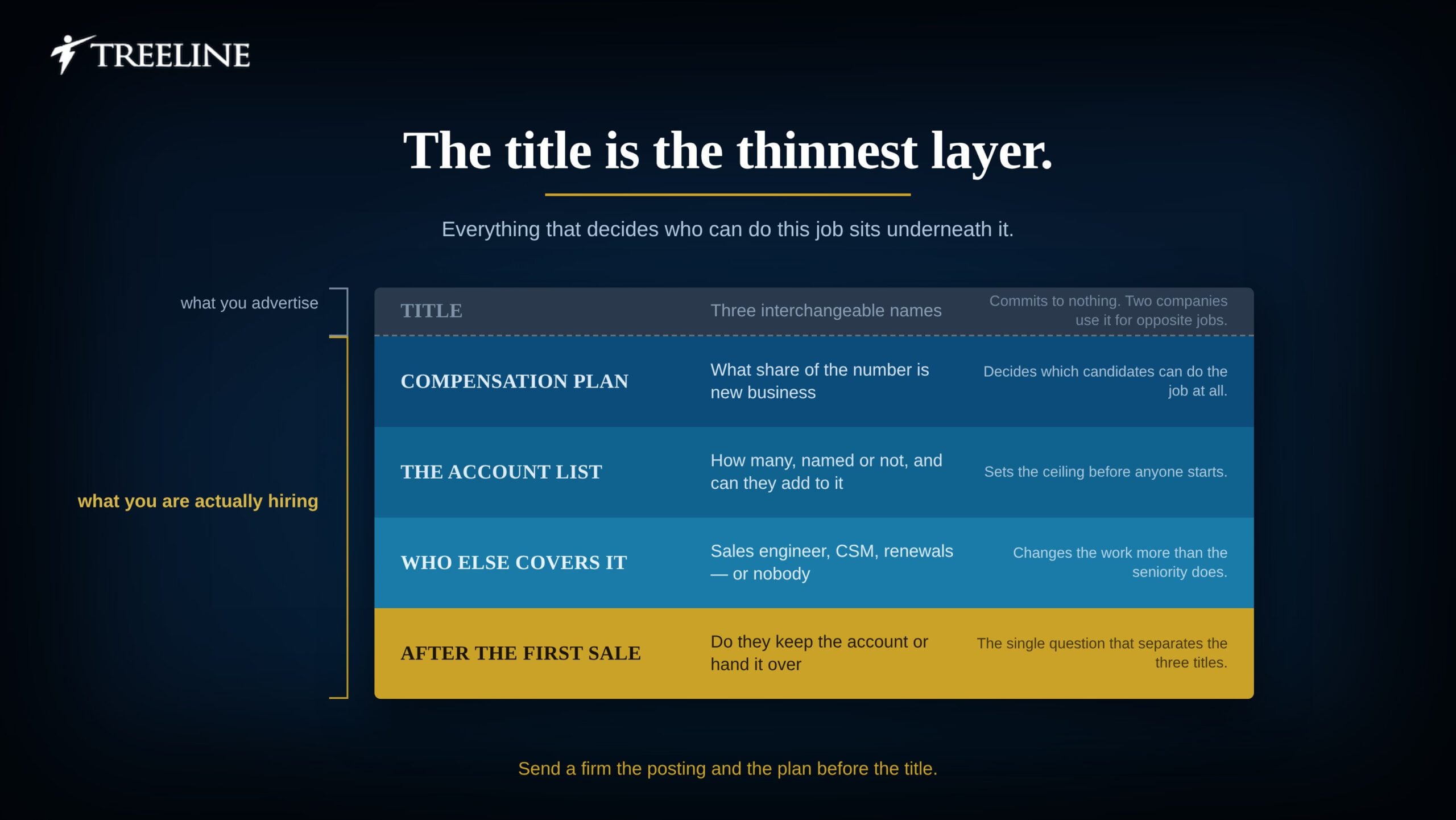
- The level has to be communicated through the account list, not the title. What makes the role junior is the portfolio and the support around it, and those belong in the description.
- Your comparison set is somewhere else entirely. It is not people already holding this title, it is AEs who want off the treadmill, CS people who want commercial responsibility, and support staff who already know your product.
Treeline’s guidance on what makes a successful account manager describes the competencies, and the virtual account manager piece covers how the market reads these roles when the work is remote.
The Junior Account Manager Hire Is a Portfolio Decision
Before this becomes a search, it is an allocation question, and it is worth doing on paper.
Somebody currently holds the accounts the new person will take. Write down which accounts those are, what they are worth in ARR or annual contract value, and who holds them today. Then write down what that person will do with the time the handover returns to them.
If the second column is empty, the hire has no business case. The value of a junior account manager is not that small accounts get managed, they are presumably being managed now, it is that someone more expensive stops managing them and does something worth more instead.
Four things to settle before opening the role:
Which accounts move, by name. Not a tier or a revenue band, a list. Vague allocations get quietly un-made.
Who releases them. A named person, who has agreed. If they have not been asked, you are about to discover their view six months from now.
What the senior person does with the recovered time. Expansion in their remaining accounts, a larger book, a move upmarket. If the answer is “more coverage of the same accounts”, the reallocation is not creating value.
When the handover happens. A date, not a phase. Handovers without dates do not complete.
What Has to Move for the Reallocation to Work
This is where these hires actually fail, and the failure is predictable enough to design around.
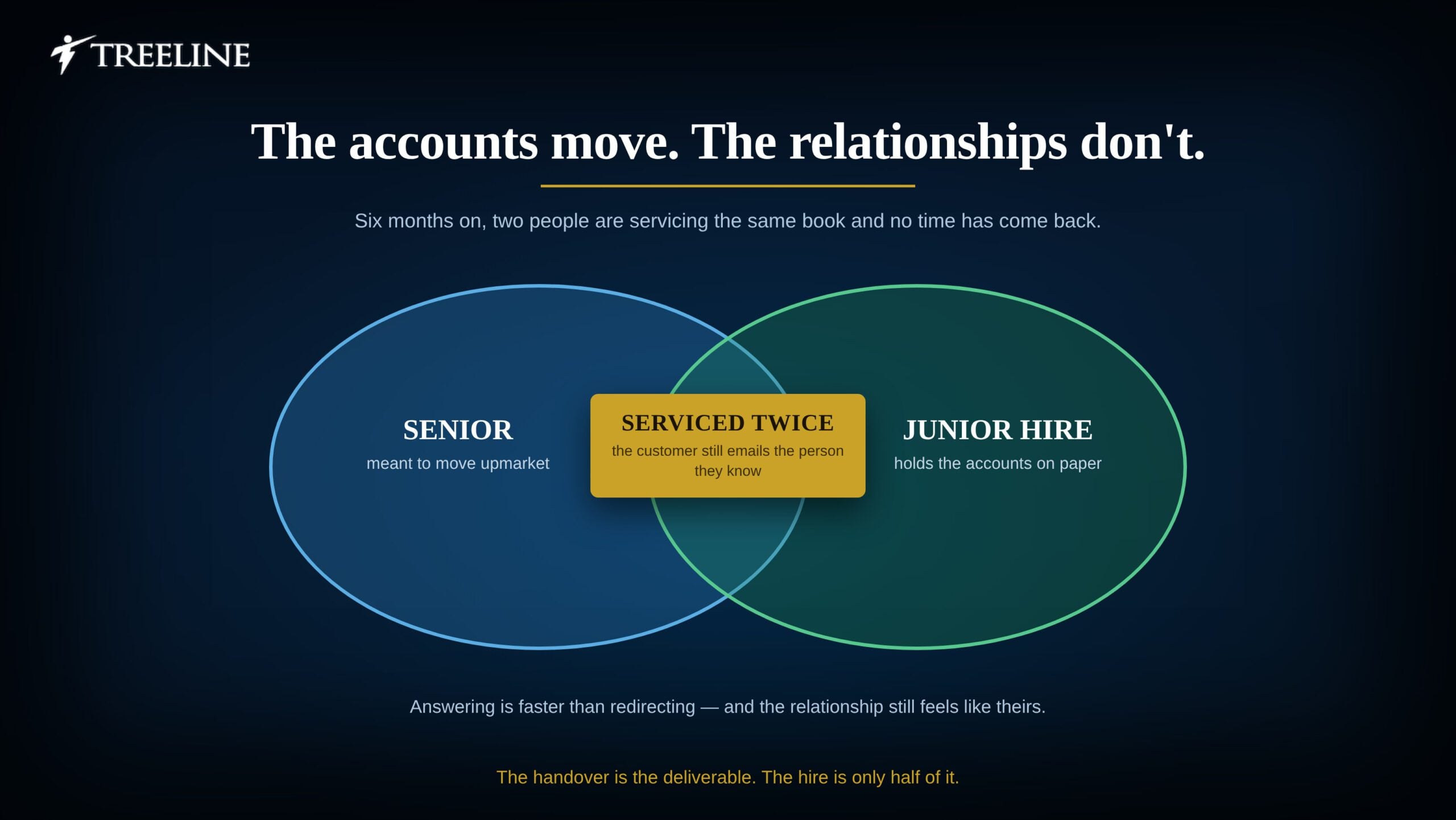
The accounts transfer on paper. The relationships do not. The customer keeps emailing the person they know, who answers because answering is faster than redirecting, and because the relationship is theirs and letting go of it feels like neglect. Six months later two people are servicing the same book, the senior person has recovered no time, and the junior hire looks underused.
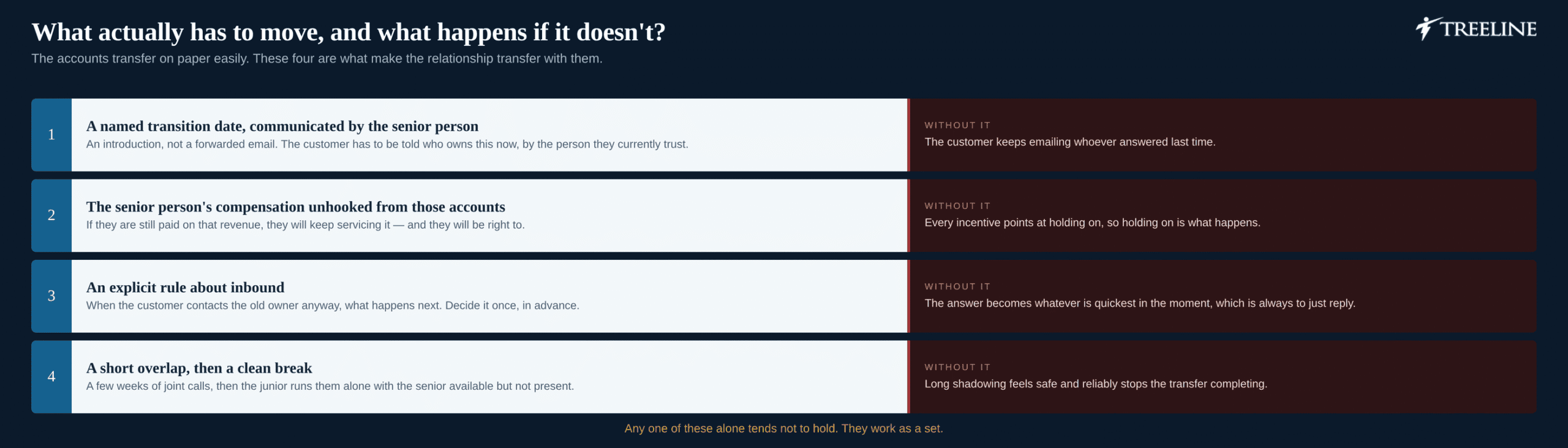
What prevents it:
- A named transition date communicated to the customer, by the senior person. An introduction, not a forward. The customer has to be told who owns this now.
- The senior person’s incentives unhooked from those accounts. If they are still compensated on that revenue, they will keep servicing it, correctly.
- An explicit rule about inbound. When the customer emails the old contact, what happens. Without a rule, the answer is whatever is easiest in the moment.
- A short overlap, then a clean break. Long shadowing periods feel safe and reliably prevent the transfer from completing.
Fantasia reframes the handover as the deliverable rather than the onboarding. His reasoning is that the new person can be perfectly competent while the reallocation still fails, because the thing being moved is a relationship and relationships do not transfer by announcement.
Treeline’s guidance on best practices for hiring managers and on retaining top salespeople both bear on the senior person’s side of this, which is the side that usually gets least attention.
What the Small-Account Book Is Actually Like
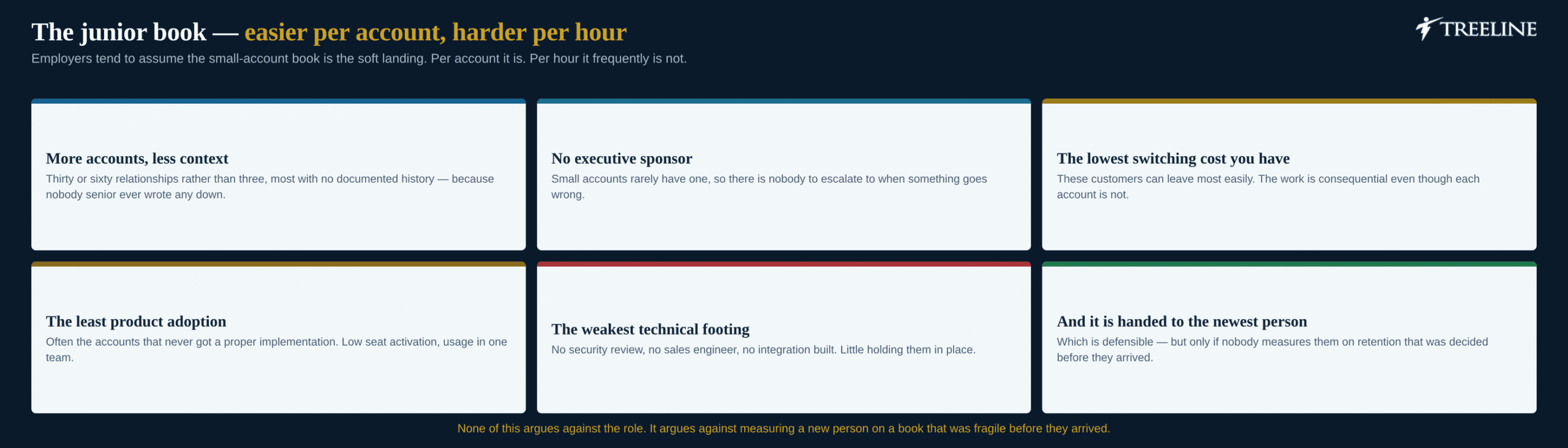
Employers tend to assume the junior book is the easy book. Per account it is. Per hour it frequently is not, and the brief should be honest about it.
- More accounts, less context. Thirty or sixty relationships rather than three, most of them with no documented history, because nobody senior ever wrote any down.
- No executive sponsor. Small accounts rarely have one, so there is no one to escalate to when something goes wrong.
- The lowest switching cost in the portfolio. These customers can leave most easily, which means the work is genuinely consequential even though each individual account is not.
- The least product adoption. Small accounts are often the ones that never got a proper implementation, which the account manager inherits without having caused. In software and SaaS this shows up as low seat activation and usage concentrated in one team, a leading indicator of churn that predates the new hire by a year.
- The weakest technical footing. Nobody ran a security review for a small deal, no sales engineer was assigned, and no integration was built. There is correspondingly little holding the customer in place.
None of that argues against the role. It argues against measuring a new person on retention in a book that was fragile before they arrived, and against assuming the job is a soft landing. Treeline’s writing on qualifying which relationships are worth the investment is relevant to deciding which of these accounts should be held at all.
Where Junior Account Manager Candidates Come From
Because the title does not exist, sourcing works by profile rather than by search term. Four pools:
Account executives who do not want to keep closing. The largest and most overlooked pool. They understand commercial conversations, they have usually carried a number, and many of them want the steadier rhythm. Ask why they are moving, and listen for whether it is attraction to the work or exhaustion with the last job.
Customer success and support people with product depth. They arrive knowing the product and the customer base, which is six months an external hire does not have. The gap is commercial: whether they can raise price, hold a term, or say no.
SDRs who have outgrown the seat but do not want to close. Underused. They have the work rate and the resilience; what they lack is account depth, which is learnable in a small book.
Implementation and onboarding staff. They have seen more accounts fail than anyone in the company and usually know exactly why. Commercial instinct is the open question, as with CS.
The sourcing mechanics themselves, channels, cost, reaching people not actively looking, are covered in our writing on hiring account managers and where to find account executive candidates, and are not repeated here. For the level below in a closing role, hiring account representatives covers the first commercial hire.
What Junior Account Manager Roles Pay
Treeline’s guidance on building a sales compensation plan sets out structures by motion, and the relevant shape here is closer to the inside sales example, seventy percent base, thirty percent variable, than to a closing plan.
Three points specific to the junior account management seat:
- Weight the base. The book is inherited, the outcomes are slow, and a heavily variable plan asks someone with no track record to carry risk they cannot price.
- Do not pay purely on retention of a fragile book. If the accounts were already at risk when they arrived, a retention-only plan pays them for the previous owner’s work in a good quarter and penalizes them for it in a bad one.
- Pay something for what they can control. Documented accounts, multi-threaded contacts, expansion conversations opened. These are the behaviors that make the book healthier, and they are visible long before net revenue retention moves.
An AE moving into this seat will usually take a lower ceiling for a higher base and a steadier week. That trade should be said out loud in the offer conversation, because a candidate who discovers it later reads it as a bait and switch.
Fantasia warns against pricing this seat against the title rather than against the candidate’s alternative. His reasoning is that the people worth hiring here are mostly employed in better-paid closing roles, so the package is competing with what they already earn, not with a junior band. The counter-offer dynamics in avoiding the counter-offer apply with particular force to people making this kind of move.
How to Test a Firm on a Junior Account Manager Search
Four tests, all answerable in a first conversation.
Do they ask which accounts are moving and from whom? A firm that treats this as a portfolio question is working the real problem. A firm that asks for a job description is filling a requisition.
Do they push back on the title? A firm that recruits here should tell you that candidates do not search for it, and suggest how to describe the level instead.
Do they ask what the senior person will do with the time? It is the business case for the hire, and a firm that never asks has not understood why the role exists.
Do they propose non-obvious profiles? If every candidate has “account manager” already on their CV, the firm is matching on title in a market where the title barely exists.
On engagement model, retained versus contingency search matters less at this level than at senior ones, and the interview mechanics are covered in must-ask sales interview questions and red flags during the interview.
When the Hire Will Not Fix the Problem
Four situations where a junior account manager is the wrong response.
When nobody senior has agreed to hand anything over. This is the most common one. The hire arrives into a book that is still being serviced by its previous owner, and nobody wins.
When the small accounts should not be held at all. Some long-tail books cost more to serve than they return. That is a coverage-model decision, and Treeline’s guidance on account management leadership covers how that decision gets made properly.
When the real problem is the handoff from sales. If accounts arrive broken, a more junior person managing them will not repair them. That is covered in hiring account managers.
When there is nobody to coach them. The same constraint as any early-career hire. An inexperienced person holding thirty fragile relationships without a weekly review learns by consequence.
Fantasia checks whether the senior person asked for this hire or was told about it. His reasoning is that a reallocation requested by the person giving something up tends to complete, and one imposed on them tends to be absorbed quietly until somebody notices the time never came back.
Frequently Asked Questions
Should I post this role as “junior account manager”?
Probably not. Across Treeline’s site the term appears zero times, against more than eleven thousand for “account manager”, candidates search for the base term. Post “Account Manager” and convey the level through the account list, the reporting line and the compensation, which is where candidates actually read seniority.
What is the difference between this and an associate account executive?
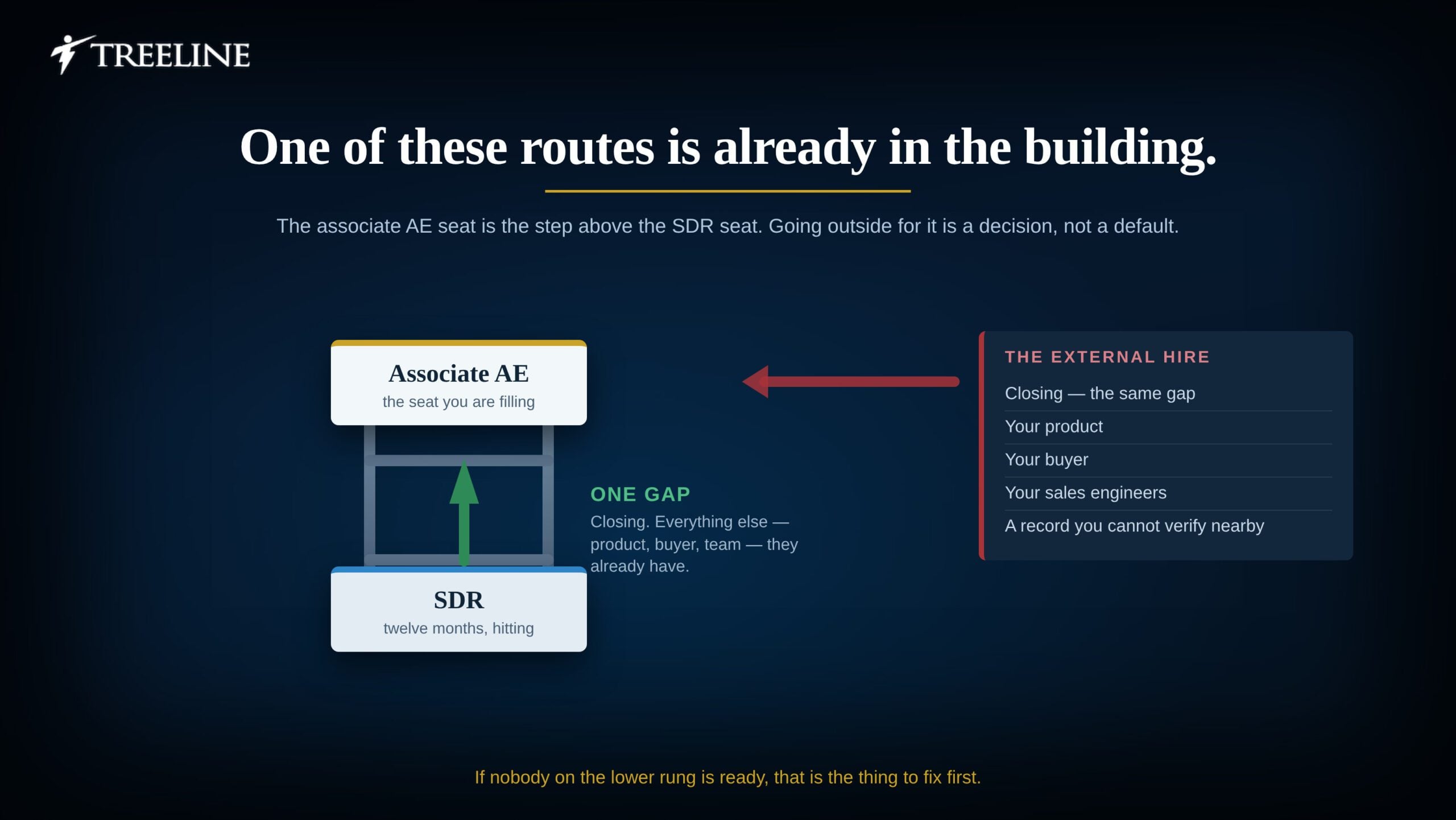
The motion. An associate account executive closes new business; a junior account manager holds existing relationships. The ladders are also shaped differently: the AE ladder has a recognized junior rung with its own title, and the account management ladder generally does not.
Who is the best candidate for a first account management role?
Most often an account executive who wants a steadier rhythm, or a customer success or support person with real product depth. The first group brings commercial instinct and needs account discipline; the second brings account fluency and needs commercial nerve. Which gap you prefer to coach should decide the brief.
How many accounts should a junior account manager carry?
Fewer than the spreadsheet suggests, because small accounts carry less context, not less work. The practical test is whether they can name four or five people inside each account. If the number of accounts makes that impossible, the ratio is wrong regardless of the revenue arithmetic.
How do I stop the senior person from keeping the relationships?
Three things, together: a transition introduction made by the senior person to the customer, their compensation unhooked from those accounts, and an explicit rule about what happens when the customer emails the old contact anyway. Any one of these alone tends not to hold.
How should I measure this hire in the first year?
Not on retention alone, because the book’s health was largely set before they arrived. Measure what they control: accounts documented, contacts multi-threaded, expansion conversations opened, escalations surfaced early. Retention follows those, with a lag.
Is this a good role for someone straight out of university?
Usually not. The role involves holding a commercial relationship that already carries revenue, which is a lot to extend to someone with no professional record. A first commercial role is better structured as a sales development or account representative seat, and the account management move comes after.
What should the job description emphasize?
The account list, the support structure and the path. Candidates at this level are choosing between a steadier job and the one they have, so what the book looks like and who they will learn from decides more than the title does.
Can this role be remote?
Commonly, yes, and the small-account book is often the most remote-friendly in the portfolio because the work runs over calls and email rather than visits. What has to be deliberate is the coaching, because an inexperienced account manager who is remote and unmanaged drifts fastest.
How long should it take to fill?
Less time than a senior account management search, mostly because the pool is wide once the brief stops insisting on the title. The delay that is avoidable is the one caused by an unresolved reallocation, where the role keeps changing shape because nobody has agreed what moves.
What if the senior person leaves during the handover?
Then the handover becomes a rescue, and the junior hire is suddenly holding relationships nobody introduced them to. This is the strongest practical argument for doing the transition introductions early rather than at the end of a long shadowing period.
Does the title matter for the candidate’s own career?
It matters to them, so it is worth asking. Some candidates will accept a junior label for a clearly better book and a named path; others will not, and would take the same job titled “Account Manager” with a smaller portfolio. That is usually negotiable and costs nothing to resolve.
Ask Who Is Giving Up Which Accounts
One thing to do before this search starts.
Write two columns. On the left, the accounts moving to the new person, by name. On the right, the person releasing each one, and what they will do with the time it returns.
If the right-hand column is empty or has not been agreed with the people named in it, the search is premature, not because the hire is wrong, but because what you are hiring for has not been decided yet.
If both columns are full, send them over with the compensation plan. Those two documents tell us more about whether this role is fillable, and whether it will work once filled, than any job description.
Share This Story, Choose Your Platform!
Related Posts
What our happy clients are saying
Treeline Inc. provided us with the most candidates that aligned with our needs and were of the highest quality.

Dr. Jeffrey Klein Head of North America Sales, Satchel Pulse
Treeline Inc.’s collaborative, flexible, and communicative approach resulted in a smooth partnership. Beyond their recruitment expertise, their unique sourcing model was efficient and effective.

Sera Holt Director of Operations, LNS Research
Their professionalism was outstanding. Treeline Inc. was extremely thorough and ensured that we were on the same page before they started looking for candidates. They listened to us and did a great job working with the candidate to close out the process.

Cate Grant AVP Customer Success, Nasdaq
Thanks to Treeline Inc.’s intricate and thorough screening process, the company is able to hire six high-quality candidates that fit perfectly in the company’s culture. The team is highly receptive to concerns, and internal stakeholders are impressed with their unique recruitment abilities.

Anna McKean Sales Recruiter, Insider Intelligence
Treeline Inc. has been qualified individuals throughout a five-year-long engagement. They’ve made numerous placements of talented and qualified individuals for our business.

Michele St Laurent VP of HR, The Institute for Applied Network Security

Let Us Help You Source the Sales Talent You Need
Whether you’re building a team or replacing a key role, our Candidate Sourcing Platform provides a fast, flexible, and employer-focused solution.
Tell us more about your business and how we can help.
Treeline Inc.
Your Award-Winning Sales Recruitment Partner
15 Lincoln Street, Suite 314, Wakefield, MA 01880