Meta Title: Sales Executive Search Firm for an SVP of Sales, Americas Meta Description: Hiring an SVP of Sales for the Americas? How to choose a sales executive search firm with real coverage across the US, Canada, Mexico, and LatAm. Suggested URL: https://www.treelineinc.com/blog/sales-executive-search-firm-svp-of-sales-americas/ Which Sales Executive Search Firm Can Help Me Hire a Senior Vice President of Sales – Americas?
The firm that can help you is one that recruits sales leadership as its core business and can tell you honestly which markets in the Americas it can source in directly. That second half matters more than most companies expect. A great many firms will accept an Americas mandate and then produce a shortlist composed entirely of U.S.-based candidates who have visited Mexico City twice.
An Americas search fails differently from a domestic one. It rarely fails because nobody applies. It fails because the scope was never defined, so the slate mixes people who have run very different jobs under the same title, and the hiring committee spends two months discovering it disagrees about what the role is. Companies typically open this search at one of a few recognizable moments:
- U.S. revenue is strong and Canada or Mexico has been handled opportunistically by whoever had the relationship
- A distributor or channel partner in Latin America is producing revenue nobody internally can forecast or explain
- Separate country managers report into different functions and no one owns the consolidated regional number
- Nearshoring or supply-chain shifts have created demand in Mexico that the current team is not structured to capture
- An acquisition brought a Brazilian or Canadian sales team that has not been integrated
- The board wants regional revenue treated with the same rigor as domestic revenue
Dan Fantasia, CEO of Treeline, Inc., views an Americas mandate as a set of distinct country operations rather than a single enlarged territory. From his perspective, employers should define which markets the leader will personally build versus which they will inherit before briefing any search firm, because that distinction determines the entire candidate population.
The investment is significant enough to warrant that precision. The Society for Human Resource Management‘s 2026 recruiting benchmarking data reports that the median cost-per-hire for executive positions reached $15,000, up from $10,600 the previous year, and that the median share of executive positions filled externally was 100 percent.
Regional leadership roles are effectively always external hires, and a poorly scoped one consumes a quarter before anyone realizes. This guide covers what an Americas mandate actually contains, why the region is not one market, where qualified leaders are located, how to evaluate a search partner’s real regional reach, the employment and compensation decisions to settle before the search opens, and how a candidate should be assessed.
What the Americas Mandate Actually Covers
“Americas” is used to mean at least three different jobs, and companies frequently brief a search without specifying which one. North America only. The United States and Canada, sometimes with Mexico attached. Largely English-speaking, similar buying processes, comparable contract structures. This is the narrowest version and the one closest to a domestic SVP of Sales role.
North America plus Mexico and Brazil. The two largest Latin American economies added to the North American base. This introduces Spanish and Portuguese, materially different procurement norms, local entity questions, and currency exposure on quota. Full hemisphere. The United States, Canada, Mexico, Central America, the Caribbean, and South America.
Often channel-heavy and distributor-dependent south of Mexico, with a much wider spread of deal sizes, payment terms, and partner maturity. These are not variations in territory size. They are different jobs requiring different operating experience. A leader who has run a strong U.S. and Canada business has not necessarily managed a distributor network in Colombia or navigated a Brazilian sales organization.
Naming the scope before you brief anyone
Write down, per country, three things: what the revenue is today, whether you sell direct or through partners, and whether the market is established or greenfield for you. That single page changes the search. It tells the recruiter which operating history to target, and it exposes internal disagreement early. It is common for a CEO to describe an Americas role while the CFO is thinking about North America and the board is thinking about Latin American expansion.
Better to find that out in week one than in week ten. If you are still sizing the role itself rather than the region, Treeline’s guide on how to hire a vice president of sales covers the underlying scoping questions that apply at every leadership tier.
Why the Americas Is Not One Sales Market
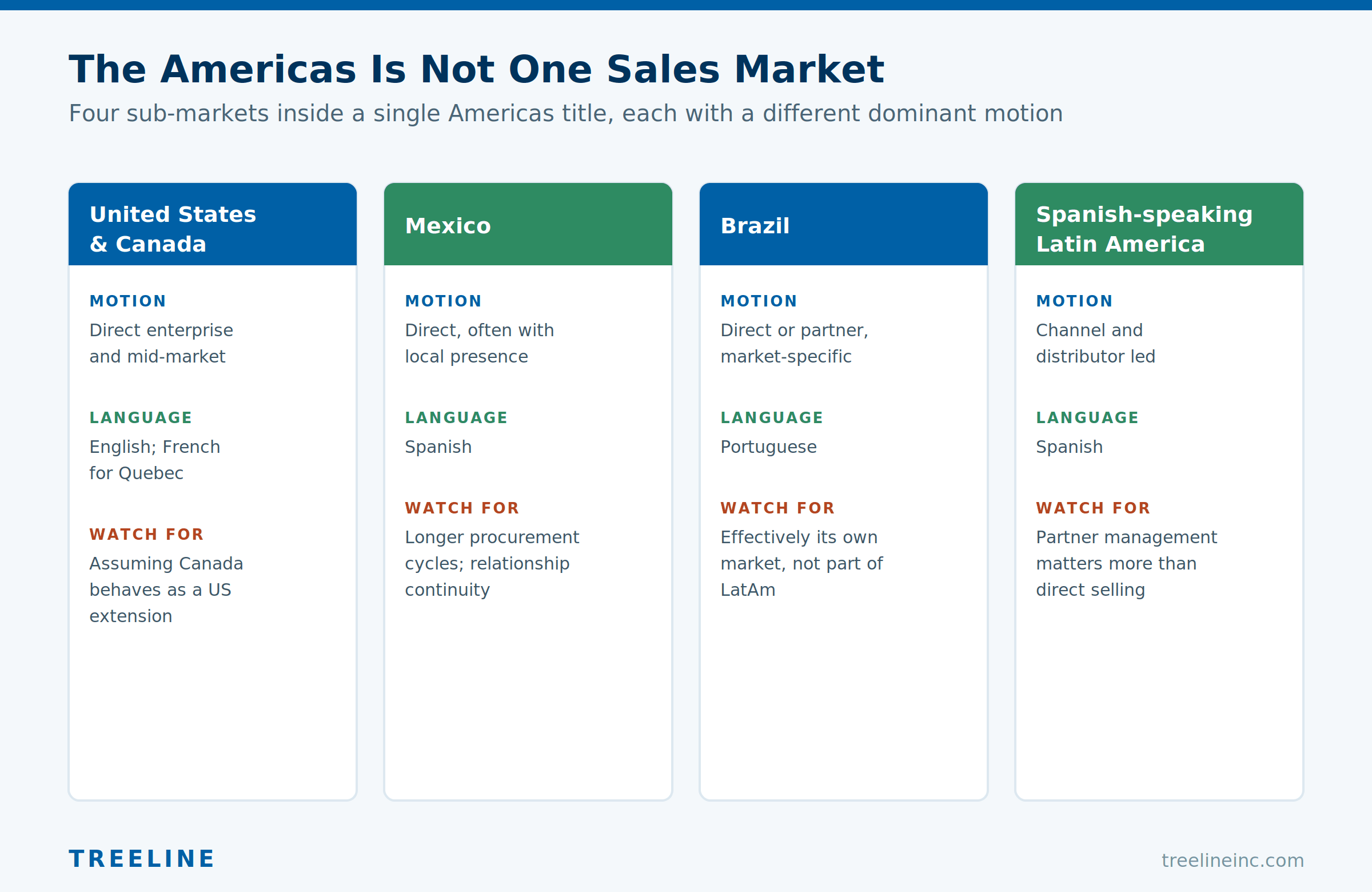
The region shares a hemisphere and very little else operationally. Treating it as a single market is the most common source of a mis-hire. United States and Canada. Similar buying processes and contract norms, though Canada adds provincial variation and, in Quebec, French-language requirements that affect both customer-facing material and hiring.
Deal sizes and sales cycles are broadly comparable to the U.S., which is why many companies underestimate the difference and over-rotate on it later. Mexico. Deep integration with U.S. supply chains and a growing base of enterprise buyers. Relationship continuity tends to matter more than in the U.S., procurement cycles can run longer, and a local presence often affects credibility with larger accounts.
Brazil. The largest Latin American economy and effectively its own market. Portuguese rather than Spanish, a distinct competitive landscape, and local operating requirements that shape whether you can realistically sell direct or need a partner. Spanish-speaking Latin America. Colombia, Chile, Argentina, Peru, and the rest span very different market sizes and levels of partner maturity.
Channel and distributor models are common, which means the leader’s skill is often partner management and enablement rather than direct enterprise selling. The commercial weight of the region is real. The U.S. Census Bureau’s profile of U.S. importing and exporting companies reports that 95,503 U.S. companies exported to Canada and 53,321 exported to Mexico in 2022, the two most common export destinations for American businesses.
Its preliminary 2024 profile identified 270,001 U.S. exporters overall, of which 262,281 were small and medium companies. For most U.S. businesses, the Americas is not an exotic expansion market. It is where their first international revenue already comes from, usually without dedicated leadership. Fantasia’s perspective is that regional titles conceal more than they reveal.
A candidate who carried an Americas number through a mature distributor network in two countries has solved a different problem than one who opened direct operations in three, and only the underlying operating history distinguishes them.
Where Americas Sales Leaders Actually Sit
Location shapes the candidate pool more than companies expect, and it is worth deciding early rather than discovering it mid-search. Qualified Americas leaders tend to cluster in a few places. Miami functions as a common hub for Latin America leadership at U.S. companies, given travel connectivity and the concentration of regional headquarters.
São Paulo and Mexico City hold most of the in-country leadership depth for their respective markets. Toronto anchors Canadian leadership. Some Americas leaders sit at U.S. corporate headquarters and travel heavily instead. Each choice has consequences:
- Headquarters-based with travel. Strongest internal alignment and executive visibility, weakest local market intuition, and travel load that becomes a retention issue within eighteen months if the region is genuinely broad.
- Miami or another regional hub. Reasonable compromise for Latin America coverage, with a real candidate pool, though it can create distance from the U.S. business if the mandate includes the U.S.
- In-country.
Deepest local credibility, but usually limits the leader’s ability to run the rest of the region and raises the question of who owns the markets they are not in.
Time zones and the coverage that is actually possible
The Americas spans a wide longitudinal range, and the practical consequence is often underestimated. A leader in Toronto and a team in Santiago have a workable overlap. A leader based on the U.S. West Coast managing Brazil loses most of the Brazilian working day. This matters for how you structure the role rather than just where the person sits.
If the mandate includes both Canada and Southern Cone markets, someone will be taking calls outside normal hours permanently, and the honest question is who. Companies that leave this unresolved tend to discover that the regional leader has quietly deprioritized whichever market is least convenient, usually the one furthest from headquarters.
Ask candidates directly how they structured their week in a previous regional role. Strong operators have a specific answer involving fixed market days, delegated authority, and a cadence they held to. Weaker candidates describe being available to everyone, which in practice means being present nowhere. Language is a genuine screen rather than a preference.
If the mandate includes Brazil and Spanish-speaking Latin America, Portuguese and Spanish are working requirements, not nice-to-haves, and a search firm that treats them as optional will present candidates you cannot use. Treeline maintains coverage across sales recruiting locations and works with companies building cross-border teams through its international sales recruiters practice.
What a Sales Executive Search Firm Must Cover for an Americas Search
Once the scope and location are settled, the question becomes whether a given firm can actually reach the people who fit. A partner working on an Americas mandate should be able to demonstrate:
- Direct sourcing capability per market in scope. Not a partner network they have never used, but people they have actually recruited or spoken with in those countries.
- Language capability on the research team. Someone who can hold a credible first conversation in Spanish or Portuguese, because senior candidates assess the recruiter before they assess the role.
- Understanding of channel versus direct models. Much of Latin America runs through partners, and a firm that only evaluates direct enterprise selling will misjudge strong candidates.
- A realistic view of relocation and work authorization. These questions shape which candidates are actually available and should be raised before a slate is built, not after an offer.
- Compensation intelligence per market. A single U.S. band applied across the region will either overpay or fail to attract, depending on the market.
- Honest disclosure of coverage gaps.
A firm that says it can source in Mexico and Canada but not in Chile is giving you usable information. Fantasia recommends asking a firm which Americas markets it can source in directly and which it cannot. A partner that names its limits is more useful than one implying hemispheric coverage, because the gap will otherwise surface at week eight when the shortlist contains only U.S.-based candidates.
How to Evaluate a Sales Executive Search Firm for the Americas
Use these criteria on calls with prospective partners. The right-hand column is what turns a claim into evidence.
| Evaluation area | What to examine | Evidence to request |
|---|---|---|
| Functional depth | Volume of sales leadership searches specifically | Comparable completed searches and current retention |
| Regional reach | Which Americas markets they source in directly | Named markets, plus which ones they do not cover |
| Language capability | Who on the team can recruit in Spanish or Portuguese | The person who will make those calls |
| Scope challenge | Whether they press on which Americas definition applies | Their unprompted read of your mandate |
| Channel fluency | Whether they can assess partner-led revenue | How they would evaluate a distributor-heavy background |
| Compensation intelligence | Per-market banding, not a single U.S. figure | Indicative bands per country before the search opens |
| Search leadership | Who runs it day to day | Named consultant, available before signing |
| Off-limits | Which companies they cannot approach | Written disclosure before contract |
| Process discipline | Slate size, timeline, cadence | Written milestones and a stalled-search plan |
| Guarantee | Replacement terms | Written conditions, including what voids them |
Ask one further question: which candidates will decline this role, and why? A partner with real regional knowledge will answer specifically, and the answer often involves relocation expectations, an unrealistic travel load, or a compensation band built from U.S. benchmarks alone. Treeline’s perspective on using an executive search firm covers the broader trade-offs between building internal capability and engaging an outside partner.
Employment Structure and Compensation Across Currencies
These questions are usually treated as post-offer administration. Settling them before the search opens materially widens the candidate pool and prevents late-stage collapses. Decide, per market in scope:
- How the person will be employed. Through a local legal entity you already have, through an employer-of-record arrangement, or as a contractor. The answer changes who you can hire and how quickly, and candidates will ask.
- Which currency the base salary is paid in, and who absorbs exchange-rate movement over the year.
- Whether quota is denominated in U.S. dollars or local currency. This is one of the most consequential design choices in the role. A quota set in dollars transfers currency risk to the leader and can make a strong operating year look like a miss.
- How variable compensation is measured. On consolidated regional attainment, on a weighted blend of country results, or on both.
- What the travel expectation actually is, expressed in nights away rather than a percentage. Candidates evaluate this precisely, and vague answers cost you finalists.
- Whether equity is available to non-U.S.
employees, and what the tax treatment looks like in their country.
Work authorization and relocation
Work authorization is the most common late-stage failure point in an Americas search, and it is entirely avoidable. Establish before the search opens whether you will sponsor, whether relocation is funded, and what the timeline looks like for each scenario. A candidate in São Paulo who would need authorization to work from Miami represents a different timeline than one who already holds it, and that difference should shape the shortlist rather than surface after a verbal offer.
Relocation carries a second consideration that companies frequently miss: family. Senior candidates at this stage of career typically have school-age children and a working partner. A relocation that looks straightforward on a spreadsheet can fail on the school calendar alone. Raising it early is not intrusive; it is the difference between a candidate who can move in June and one who cannot move until the following year.
Ask your search partner how they handle this in screening. A firm that surfaces authorization and relocation constraints in the first candidate conversation will save you weeks. On the U.S. anchor point for banding, the U.S. Bureau of Labor Statistics profile of sales managers reports a median annual wage of $138,060 as of May 2024, with the highest 10 percent earning more than $239,200.
An SVP of Sales for the Americas at a growth-stage company generally sits above that top decile once variable compensation and equity are included. That figure is a starting reference for the U.S. component only, and applying it unadjusted across the region will produce offers that miss in both directions.
How a Sales Executive Search Firm Should Assess an Americas Candidate
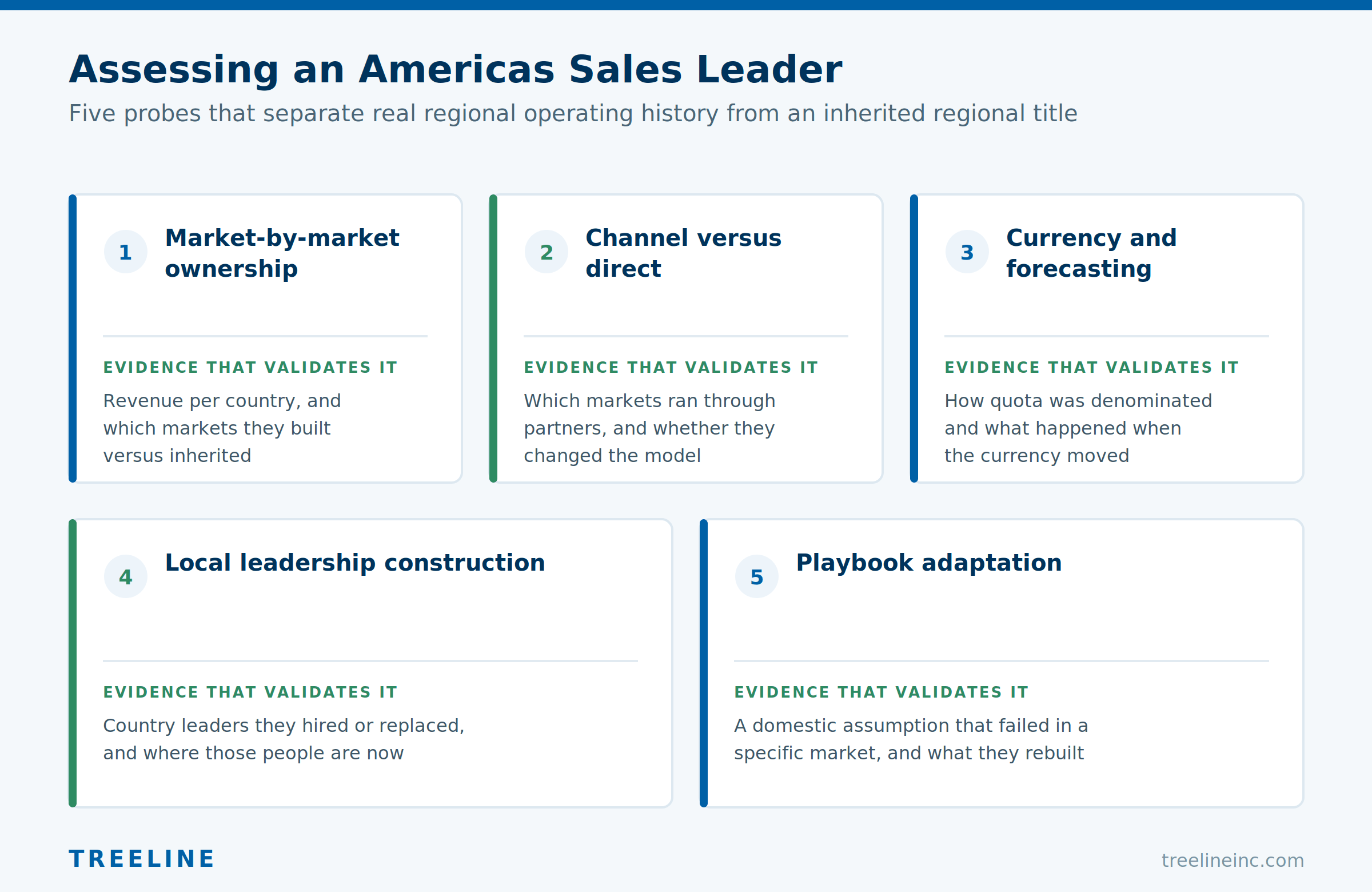
Regional candidates are practiced at describing scope. Assessment has to test what they actually built and where. Useful questions include:
- Walk me through your last role country by country. What was the revenue in each, and which did you build?
- Which markets were direct, which were channel, and did you change any of those models?
- Which country leaders did you inherit, hire, or replace, and where are they now?
- How was your quota denominated, and what happened in a year when the currency moved against you?
- How did you consolidate a forecast from teams with different CRM discipline and different definitions of a qualified opportunity?
- Which market did you decide not to invest in, and what was the argument against that decision?
- Describe a distributor or partner relationship you ended. How did you protect the revenue?
- What did you assume from your U.S. or domestic experience that turned out to be wrong?
- Which parts of the region still depended on you personally when you left?
- What did your successor inherit, and what was unfinished?
Question eight is the most diagnostic. Every credible regional leader has a story about a playbook assumption that failed in a specific market. A candidate who cannot produce one has probably not operated deeply enough in the region to have hit that wall. References should be triangulated across geography as well as seniority.
A U.S.-based manager describes executive judgment and forecast reliability. An in-country direct report reveals whether the candidate genuinely understood the local market or applied headquarters logic at volume. A channel partner, where available, is often the most candid source on how the person actually operated. Fantasia emphasizes that assessment should test how a candidate handled a market that did not respond to the domestic playbook.
A strong Americas leader can describe the assumption they brought in, the point at which it failed, and what they rebuilt in response.
What a Sales Executive Search Firm Should Ask You Before Starting
A serious partner should want answers to most of the following before quoting anything:
- Which definition of Americas applies, country by country?
- What is the revenue in each market today, and which of those numbers do you trust?
- Which markets are direct and which run through partners or distributors?
- Who currently owns each market, and are those people staying?
- Where will this person be based, and is that negotiable?
- What are the language requirements, and are they genuine requirements?
- How will the person be employed in each country, and do the entities exist?
- How is quota denominated, and who carries currency risk?
- What is the actual travel expectation in nights away per month?
- Who has veto power on the hire, and have they agreed on the scope?
A firm that takes your job description and quotes a fee without asking about entities, currency, and language has told you how the search will run.
Should You Promote a Country Manager Instead of Hiring Externally?
This is worth evaluating seriously before engaging anyone, and it is the option most companies dismiss too quickly. The case for promotion is real. An internal country manager already has customer relationships, local market intuition, credibility with the team, and knowledge of your product and pricing. Onboarding is measured in weeks rather than quarters.
If the mandate is primarily to consolidate reporting and improve forecasting discipline across markets that already function, a strong country manager may be the right answer. The case against is equally real, and it is usually about scope rather than ability. Running one market well does not demonstrate the capability to allocate investment across markets that compete for the same budget.
A country manager promoted to regional leadership frequently over-invests in the market they know and under-manages the others, because that is where their instincts and relationships are. There is also a peer dynamic to work through. If three country managers all wanted the role and one gets it, the other two become a retention question on day one.
That is manageable with a deliberate plan and unmanageable without one. The honest test is whether the internal candidate has built anything beyond their own market: hired leaders they did not inherit, changed a go-to-market motion rather than executing one, or made a resource decision that disadvantaged their own territory.
If the answer is no, the promotion is a development assignment rather than a hire, and it should be resourced accordingly with an experienced advisor or a strong second layer. Running an external search in parallel is a defensible approach, provided you are honest with the internal candidate that you are doing it. Candidates find out, and discovering it late does more damage than the search itself.
Which Sales Executive Search Firm Model Fits an Americas Search
Fees are typically a percentage of the placed candidate’s base salary, and Treeline’s standard fee is 25% of base salary. What differs between models is risk allocation and how much research a firm will fund before a placement exists. Retained engagements are paid in installments with a portion upfront, in exchange for exclusivity and systematic market mapping.
For an Americas search this is often the better fit, because the qualified pool has to be built market by market rather than activated from an existing list. Treeline’s sales executive search practice operates this way for C-level and VP-level roles. Contingency engagements are payable only on placement, with no upfront cost.
Treeline’s contingency sales recruiting service is entirely performance based. This works well when the scope is narrower, such as a North America mandate with a reachable pool, and when your process can move decisively. The honest distinction for an Americas search specifically: the wider the geography and the more languages involved, the more research hours the search requires before a single candidate is presented.
A firm asked to fund that speculatively will rationally limit its investment. Treeline’s comparison of retained search vs. contingency search works through the mechanics in more detail.
The First 100 Days for an Americas Sales Leader
The most common way a well-run Americas search still fails is that the new leader is asked to commit to a regional number before they have been to the region. A workable structure:
- Days 1 to 30. Visit each market in scope in person. Meet country leaders, key partners, and the largest accounts. Video calls do not substitute here; local teams calibrate a new regional leader on whether they showed up.
- Days 30 to 60. Assess each country’s pipeline against actual close rates. Identify where reported pipeline and real pipeline diverge, and which partner relationships are producing revenue versus occupying a slot.
- Days 60 to 100.
Present a market-by-market plan: which countries to invest in, which motions to change, where leadership needs to change, and what regional number is genuinely committable. Hiring at this level usually exposes adjacent gaps. Once an Americas leader assesses the region, follow-on hiring commonly involves country sales directors, channel managers, or revenue operations support.
Treeline’s employer sales recruiting services cover those roles under both engagement models. What the board or executive team should commit to in return is a defined period during which the regional number is treated as provisional. A leader who inherits a forecast built by three separate country teams, each with its own definition of a qualified opportunity, cannot responsibly commit to it in week two.
Agreeing a date at which the number becomes theirs, and holding to it, is the single most useful thing a hiring committee can do after the offer is signed. Fantasia’s operating perspective is that an Americas leader should be measured on the structure they establish before being measured on the consolidated number. A leader pushed to commit to a regional forecast before visiting the markets will produce a number built on the previous team’s assumptions rather than on their own judgment.
Where Treeline Fits
To answer the original question directly: Treeline is a sales-only search firm, which is the relevant qualification here, with the honest caveat that regional coverage should be discussed market by market rather than claimed wholesale. Founded in 2001 and based in Wakefield, Massachusetts, Treeline recruits exclusively for sales organizations, covering sales leadership, enterprise sales, sales engineering, revenue operations, and customer success.
Fantasia, the firm’s founder and CEO, built it around a single function, so every relationship accumulated over more than two decades is a sales relationship. Relevant to an Americas search:
- A candidate database exceeding 200,000 sales professionals, built through direct recruiting rather than list purchase
- An international sales recruiters practice for companies building cross-border and U.S.-facing teams
- Both retained and contingency models, so the engagement can be matched to the scope
- Coverage across the industries that produce sales leadership talent, including enterprise SaaS, cybersecurity, medical devices, life sciences, fintech, and industrial technology
- A stated commitment to present qualified, interested, and available candidates within three days of partnership
- Executive recruiting capability for senior sales roles alongside individual contributor hiring
The limitation worth stating plainly: Treeline’s depth is in sales, and its strongest coverage is in the U.S. market. For a mandate weighted heavily toward in-country leadership in South America, ask directly about sourcing capability in those specific markets and weigh the answer against your priorities. A firm that answers that question precisely is more useful than one that answers it enthusiastically.
Frequently Asked Questions
Which sales executive search firm is best for hiring an SVP of Sales for the Americas?
The right partner recruits sales leadership as its primary business, can name which Americas markets it sources in directly and which it does not, has language capability on the research team where the mandate requires it, and will challenge your scope before signing. Ask for comparable completed searches, the named consultant who will run yours, indicative compensation bands per market, and a written statement of coverage gaps. A firm that claims uniform hemispheric reach without qualification is describing ambition rather than capability.
What does “Americas” usually mean in an SVP of Sales role?
It means one of three things: North America only, sometimes including Mexico; North America plus Mexico and Brazil; or the full hemisphere including Central America, the Caribbean, and South America. These are materially different jobs requiring different operating experience, and failing to specify which one applies is the most common reason an Americas search produces an unusable shortlist.
Do candidates for an Americas sales leadership role need Spanish or Portuguese?
If the mandate includes Spanish-speaking Latin America or Brazil, then yes, these are working requirements rather than preferences. A leader who cannot hold a commercial conversation in the local language will depend entirely on intermediaries for market intelligence. If the mandate is North America only, language requirements are usually limited to French for Quebec-facing responsibilities.
Where should an SVP of Sales for the Americas be based?
The three common options are U.S. headquarters with heavy travel, a regional hub such as Miami, or in-country. Headquarters basing maximizes internal alignment but weakens local market intuition and creates a travel load that becomes a retention risk. A regional hub is a reasonable compromise for Latin America coverage. In-country basing gives the deepest local credibility but limits the leader’s reach across the rest of the region.
Should quota be set in U.S. dollars or local currency for an Americas role?
Both approaches are used, and the choice determines who carries currency risk. A quota denominated in U.S. dollars transfers exchange-rate exposure to the leader and can make a strong operating year read as a miss. Local-currency quota keeps the risk with the company but complicates consolidated reporting. Decide before the search opens, because candidates will ask and an unclear answer costs finalists.
How long does it take to hire an SVP of Sales for the Americas?
SHRM’s 2026 benchmarking data reports a median time-to-fill of 45 calendar days for executive positions, measured from requisition opening to offer acceptance. Regional searches typically run longer because the pool must be built market by market and language and location requirements narrow it further. A realistic planning range is three to five months from kickoff to accepted offer, with notice periods and any work-authorization steps adding time before the person starts.
What does a sales executive search firm charge for an Americas search?
Fees are typically a percentage of the placed candidate’s base salary, and Treeline’s standard fee is 25% of base salary. Retained engagements split the fee into installments with a portion upfront in exchange for exclusivity and systematic market mapping, while contingency engagements are payable only on placement. Broader multi-country mandates generally suit retained engagements, because the research investment required before presenting any candidate is substantially higher.
Can a country manager be promoted to SVP of Sales for the Americas?
Sometimes, and it is worth evaluating before running an external search. The case for promotion is strong when markets already function and the mandate is consolidation and forecasting discipline. The case against is usually scope rather than ability: running one market well does not demonstrate the capability to allocate investment across markets competing for the same budget, and promoted country managers commonly over-invest in the market they know. The practical test is whether the internal candidate has hired leaders they did not inherit, changed a go-to-market motion rather than executing one, or made a resource decision that disadvantaged their own territory.
Should I hire one Americas leader or separate country leaders?
It depends on revenue concentration and market maturity. A single regional leader makes sense when markets are related, revenue is not yet large enough to justify separate leadership, and someone needs to own a consolidated number. Separate country leaders make sense when individual markets are large enough to warrant dedicated focus, particularly Brazil, which functions as its own market. Many companies land on a hybrid: a regional leader with a dedicated in-country leader for the largest single market.
Talk to a Sales Recruiting Specialist
If you are hiring a Senior Vice President of Sales for the Americas and want a partner whose entire business is sales leadership, schedule a conversation with Treeline. You will get a direct read on how the scope should be defined, which markets are realistic to source in, and what the compensation structure needs to look like, before any fee is discussed.
Share This Story, Choose Your Platform!
Related Posts
What our happy clients are saying
Treeline Inc. provided us with the most candidates that aligned with our needs and were of the highest quality.

Dr. Jeffrey Klein Head of North America Sales, Satchel Pulse
Treeline Inc.’s collaborative, flexible, and communicative approach resulted in a smooth partnership. Beyond their recruitment expertise, their unique sourcing model was efficient and effective.

Sera Holt Director of Operations, LNS Research
Their professionalism was outstanding. Treeline Inc. was extremely thorough and ensured that we were on the same page before they started looking for candidates. They listened to us and did a great job working with the candidate to close out the process.

Cate Grant AVP Customer Success, Nasdaq
Thanks to Treeline Inc.’s intricate and thorough screening process, the company is able to hire six high-quality candidates that fit perfectly in the company’s culture. The team is highly receptive to concerns, and internal stakeholders are impressed with their unique recruitment abilities.

Anna McKean Sales Recruiter, Insider Intelligence
Treeline Inc. has been qualified individuals throughout a five-year-long engagement. They’ve made numerous placements of talented and qualified individuals for our business.

Michele St Laurent VP of HR, The Institute for Applied Network Security

Let Us Help You Source the Sales Talent You Need
Whether you’re building a team or replacing a key role, our Candidate Sourcing Platform provides a fast, flexible, and employer-focused solution.
Tell us more about your business and how we can help.
Treeline Inc.
Your Award-Winning Sales Recruitment Partner
15 Lincoln Street, Suite 314, Wakefield, MA 01880