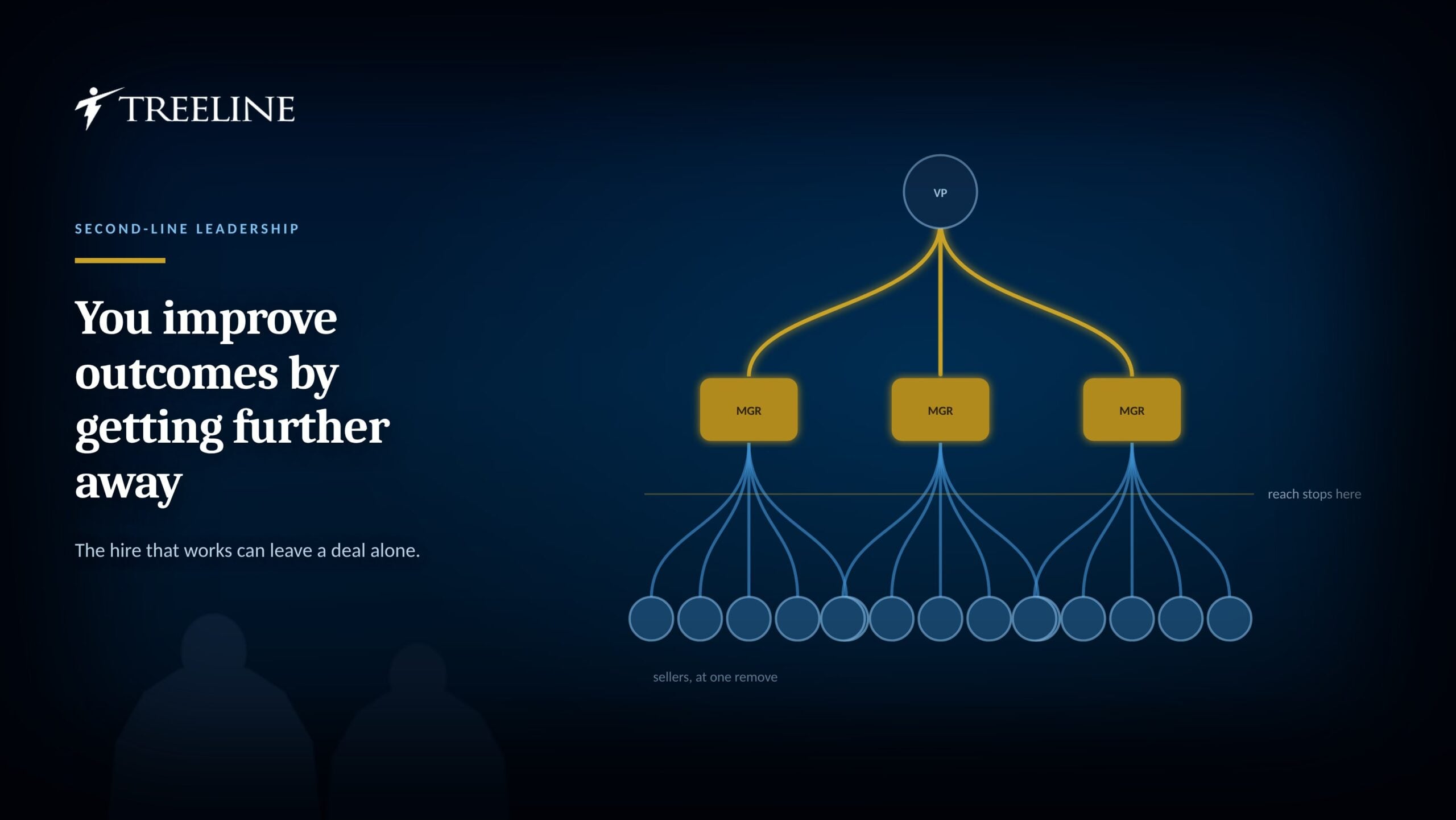
An inside seller’s week leaves a record. Calls are logged, dials are counted, conversations are recorded, and a manager who wants to know what happened on Tuesday can find out in about four minutes. A field seller’s week leaves almost nothing. There is a calendar, which is a statement of intent rather than a record of events, and there are outcomes that arrive weeks later. Between those two things sits the actual job, and nobody inside the company sees it happen.
That gap is the whole problem in outside sales recruiting. Every other sales hire can be managed into shape after the fact, a weak inside seller is visible within three weeks and correctable within six. A field seller who cannot run their own week is invisible for a quarter and expensive for two. The assessment has to do work that supervision will not be able to do later.
This article is about that assessment: what to test, where the candidates sit, and what the employer has to settle before the search opens. Companies most often run this search under a contingency sales recruiting arrangement, where the fee is payable only on a hire, and the reasoning behind that choice, against the alternative of an exclusive, fee-forward engagement, is set out in contingency hire vs retained search. The scope here is the direct field seller who owns a geography and closes in the room. Selling through partners is a different motion with a different profile, covered separately in channel sales recruiting.
Dan Fantasia, CEO of Treeline, Inc., makes a distinction worth holding onto before any of the mechanics: the field hire is the only sales appointment where a company is buying a work habit rather than a skill. Skills are teachable on a known schedule. The habit of structuring an unsupervised week is either already there or it is a project nobody has budgeted for.
What Outside Sales Recruiting Is Actually Assessing
Three capabilities carry a field seller, and none of them is what a hiring panel usually spends its time on.
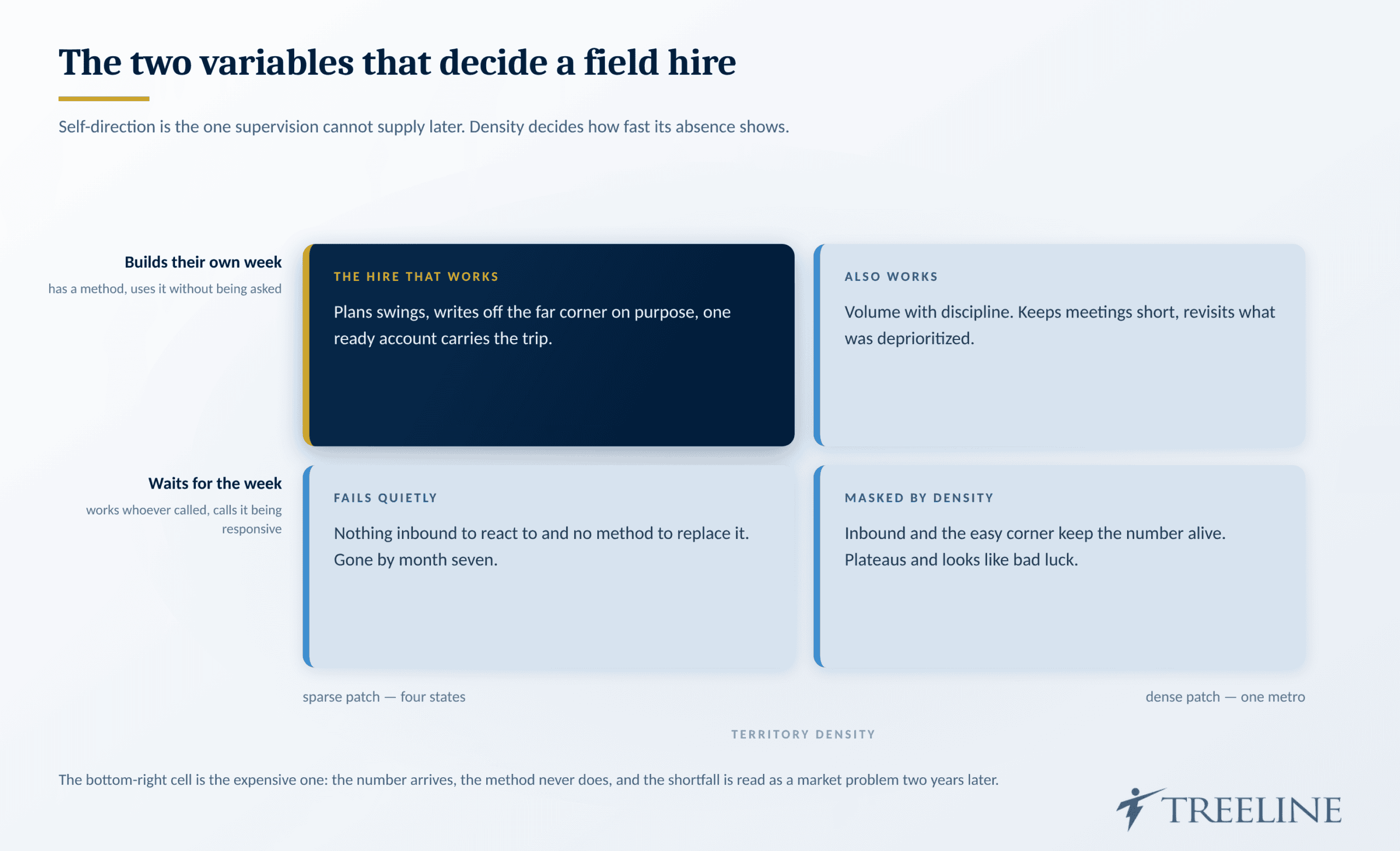
Self-direction with a long feedback loop. The seller decides on Monday morning which eleven accounts get attention this week, and finds out whether that was right in November. Nobody corrects a bad allocation in the moment. The candidates who do this well have a visible method, a way of ranking accounts, a rhythm for revisiting the ones they deprioritized, a rule for when to stop working an account that will not move. The candidates who do it badly are not lazy. They are reactive, and they spend the week on whoever called them.
The in-person close. Being effective in a room is not a louder version of being effective on a call. It involves reading a group rather than a person, handling the colleague who was not invited but came anyway, choosing when to stop talking, and knowing what to do when the decision-maker is interrupted twenty minutes in. These are specific and testable, and they are unrelated to the polish that interviews reward.
Territory economics. A field seller is spending a budget of hours against a map, and the map does not care about effort. Candidates who understand this talk about their patch in terms of trade-offs: which corner of it they wrote off, what they stopped doing to buy a day, which account was worth a four-hour round trip and which was not. Candidates who do not understand it describe their territory as a list of logos.
The second and third of those are learnable. The first is the one that decides the hire, and it is also the one that interviews are worst at detecting, because self-direction looks exactly like confidence until someone is alone with a calendar.
Why Outside Sales Recruiting Cannot Rely on the Résumé Pattern
The obvious filter, find someone who has done this, in this industry, in this geography, fails more often here than in any other sales search, for three reasons that compound.
The first is that field performance is heavily confounded by territory. Two sellers at the same company with the same title can be working patches that differ by a factor of three in reachable pipeline. The one who hit 118 percent may have inherited density and three incumbent accounts; the one who hit 84 percent may have been given a map with two cities and a lot of highway. Quota attainment on a résumé is a number without a denominator, and treating it as a performance signal rewards the accident of assignment.
The second is that the title has drifted. A large share of roles still called outside sales are now substantially remote, video-first, with travel for the late stages only. Someone who has spent four years in that version of the job may never have built the week-structuring habit, because their week was structured by a calendar full of scheduled calls. The title matched. The work did not.
The third is that the strongest available signal is usually about the wrong period. A seller’s best year is typically year three or four in a patch, when the relationships are built and the referrals compound. What the hiring company is buying is year one in a patch that is new to the candidate, and nothing about the mature-territory numbers speaks to that. The relevant question is not how good they got. It is how they behaved in the first six months of the last territory they started from nothing.
Fantasia’s view on this is unsentimental. He treats a field candidate’s cold-start history as the only part of their record that transfers, and he has long held that the single most useful thing a hiring company can do is stop reading the aggregate numbers and ask what the first ninety days of the last new patch looked like.
The Geography Problem Nobody Prices
Before a single candidate is contacted, somebody should have done the drive-time arithmetic, because it constrains who can possibly succeed in the role and almost nobody does it in advance.
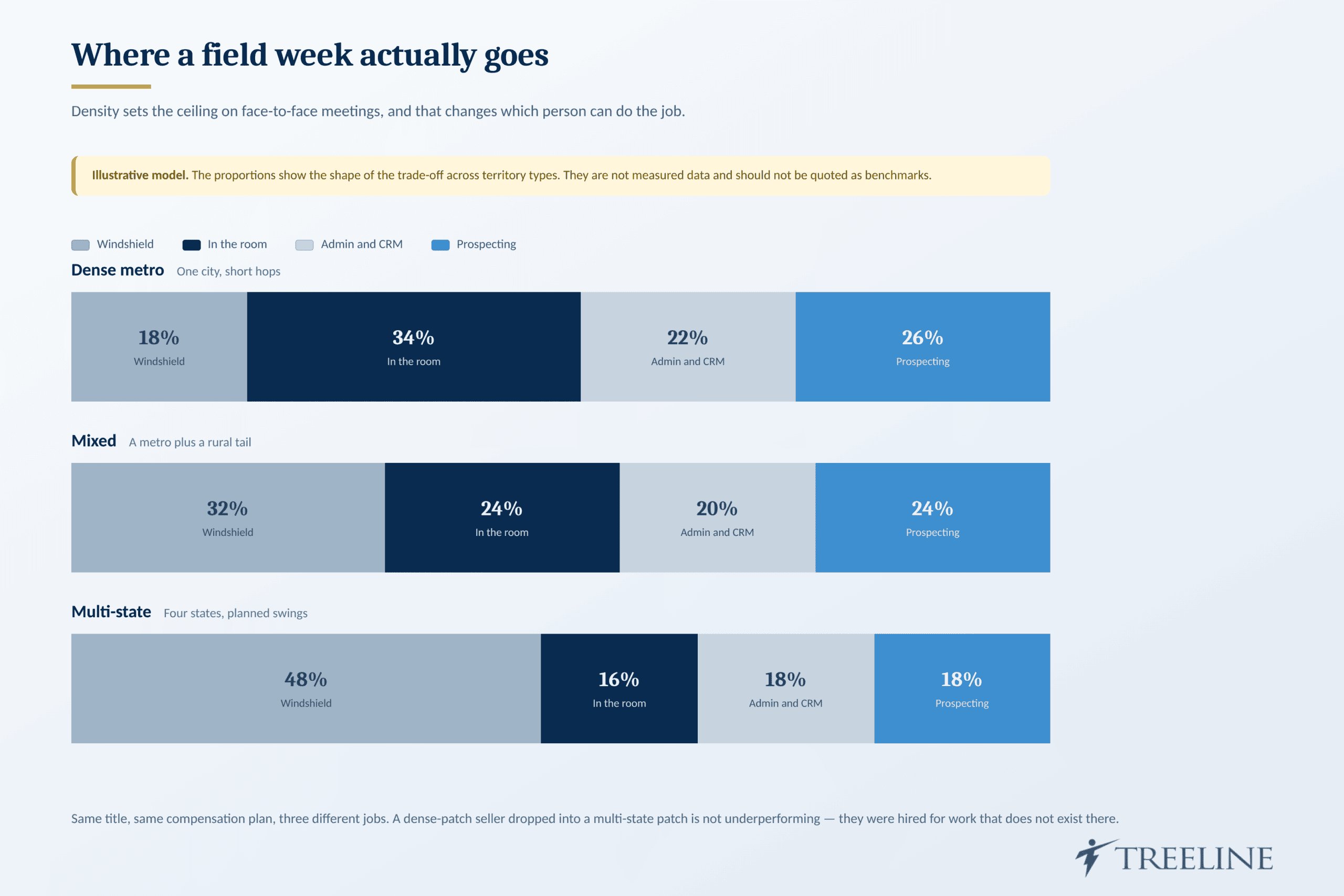
A territory has a density, and density sets the ceiling on face-to-face meetings per week. A seller covering a metropolitan area can be in four rooms on a Tuesday. A seller covering four states can be in four rooms in a week if the trip is planned well and two if it is not. These are different jobs with the same title, the same compensation plan, and completely different profiles of person who thrives in them.
The dense-patch seller needs volume tolerance, fast context-switching, and the discipline to keep meetings short. The sparse-patch seller needs trip-planning ability, comfort with long stretches of solitude, and the judgment to build a swing through five accounts where only one of them is actually ready. Hiring the dense-patch profile into a sparse patch produces someone who is frustrated by month two and gone by month seven, having correctly concluded that the job they were hired for does not exist where they live.
The home-base question follows directly. A patch with one clear population center has a right answer about where the seller should live, and hiring a strong candidate who lives ninety minutes outside it imports a permanent tax on every week of their tenure. This is not a reason to reject them. It is a reason to know the number before the offer, rather than discovering it in the first forecast review.
What Outside Sales Recruiting Should Test in Interview
The format that works here is reconstruction, not discussion. Ask the candidate to rebuild something specific that already happened, in enough detail that invention becomes visible.
Rebuild a week. Pick a week from four months ago and walk through it hour by hour. Who did they see, why those accounts, what did they move to make room, what did they cancel and what happened to it. A candidate who runs a real method can do this for any week chosen at random. A candidate who cannot will describe a representative week instead, which is a tell, and the follow-up, that’s the general shape; now tell me about the week of the fourteenth, resolves it quickly.
Rebuild a room. Take a deal that closed in person and reconstruct the meeting. How many people were in it, who was not supposed to be there, what question came from the person with no budget authority, where did the conversation nearly go wrong, what did they do with their hands when the decision-maker took a call. Detail at this grain is extremely hard to fabricate, and the shape of the answer separates people who close in rooms from people who have been present while rooms closed.
Rebuild a cold start. The last time they took over a patch with nothing in it: what did they do in week one, which accounts did they ignore on purpose, when did the first meeting happen, and what was the first thing they got wrong. This is the closest available proxy for the actual job on offer.
Rebuild an abandonment. Name an account they decided to stop working. The reasoning behind a deliberate stop is one of the cleanest signals of territory judgment available, because reactive sellers rarely stop anything, they just drift, and when asked this question they cannot produce an example.
Two conventional stages deserve less weight than they usually get. A presentation exercise tests preparation, which is not the constraint in this role. And panel agreement, where four interviewers independently liked the candidate, tends to measure how well someone performs in a room where they are the subject rather than the seller.
Where Outside Sales Recruiting Finds Candidates
The qualified population is larger than most leadership teams assume and far harder to contact, because the defining characteristic of a working field seller is that they are not at a desk.
Direct competitors. Obvious, quickly exhausted, and the pool where counteroffers are most likely. Useful, with the caveat that a seller leaving a patch they know well for a patch they do not is taking a real step backwards in year-one earnings, which has to be solved in the compensation structure or the conversation ends.
Adjacent sellers calling the same buyer. The most underused source by a wide margin. Someone who already sells capital equipment into plant managers, or services into practice administrators, brings the relationships and the room instincts; they learn the product. The transfer that matters is the buyer, not the category, and search firms that build around buyer type rather than industry label reach this pool while the rest of the market competes over the first one.
Field sellers in a consolidating category. When an acquisition collapses two overlapping field organizations, a cohort of people with intact territory knowledge becomes available on a timetable nobody planned. This is a timing source and it does not keep, which is one practical argument for having a search partner tracking a vertical continuously rather than only when a requisition opens.
Inside sellers ready to move out. Workable, but it is a development hire rather than a lateral one, and it should be priced and ramped as such. The capability being tested is whether they have ever had to build their own week, and the honest answer for most inside sellers is no, because the cadence was supplied to them. The ones who created structure where none was required are the exceptions worth pursuing. The contrast runs the other way too, and the specifics of the opposite motion are covered in inside sales recruiting.
Former field sellers now in sales engineering or account management. People who left the road for lifestyle reasons and are now ready to go back. A small pool, rarely in the market visibly, and frequently excellent.
Why the Contingency Model Suits a Field Search
Three features of this search sit well with a contingency arrangement, and one does not.
Candidate volume is genuinely moderate. A field search in a defined geography has a finite population, and the realistic submission count is small, which means the recruiting work is identification and persuasion rather than throughput. That is work a firm can do well without exclusivity, and a company paying only on placement is paying for the outcome rather than the activity.
The role is almost never confidential. There is no incumbent being replaced quietly, no board-level sensitivity, no reason the market cannot know the company is adding field coverage. Confidentiality is one of the clearest reasons to choose a retained engagement, and its absence here removes that argument.
The timeline is usually tied to a territory going uncovered, which creates real urgency without creating a deadline that money can fix. A contingency partner working several field searches in the same vertical reaches the adjacent-buyer pool faster than an internal team starting cold, and that speed is the practical value.
The case against: if the geography is genuinely thin, a specialized product into a buyer type that exists in forty companies nationally, with six of them in the patch, the search stops being a recruiting problem and becomes a mapping problem, and that work is usually better structured as a retained engagement where the firm is paid for the map rather than the hire.
Fantasia’s position on arrangement choice has stayed consistent across market cycles: the model should be chosen on the shape of the population and the sensitivity of the role, not on the seniority of the title or the size of the fee. A field seller search with a reachable population and no confidentiality constraint is close to the center of what contingency does well.
What Outside Sales Recruiting Asks of the Employer
Four decisions sit with the hiring company, and leaving them open is the most common reason a field search runs long.
The map, defined before the first conversation. Named accounts or open geography, which counties, what happens at the edges, and whether the patch overlaps anyone. Candidates ask this in the first call. A vague answer reads as an organization that has not decided, and strong field sellers, who have been burned by territory changes before, treat that as a serious risk signal.
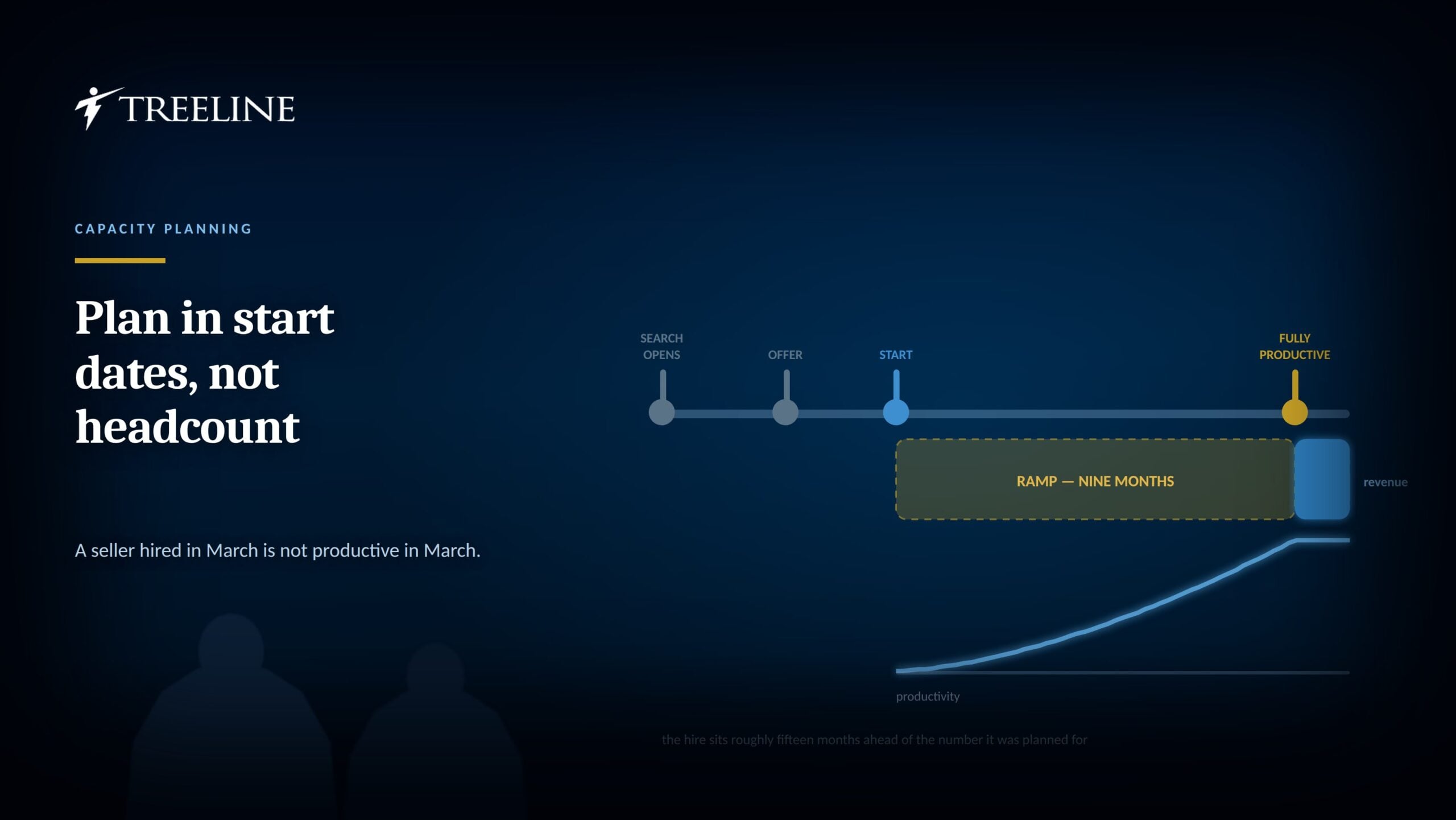
The ramp, with a number attached. Field sellers carry a real income gap while a new patch builds. The companies that win contested field hires have a guarantee or a declining draw with an explicit end date, and they can say what a realistic first-year number looks like without either inflating it or hiding behind the plan document.
Expense reality. Vehicle allowance or mileage, what travel is approved without asking, how expenses are reimbursed and how fast. These are small amounts that signal whether the organization understands the job. A seller who has to argue about a hotel in month two has learned something about the company that no recruiting message will undo.
Observability, agreed in advance. What the company will actually use to know the role is working before revenue arrives. A manager who intends to count activity should say so at offer stage, because sellers who have worked under activity surveillance and left will not accept it again, and sellers who have never experienced it should know what they are joining. Deciding this after the start date is how good field hires turn into bad relationships.
Reading the First Six Months
Field hires cannot be judged on revenue inside two quarters, because the pipeline they are building has not had time to close. What can be judged is whether the week has a shape.
By week four, there should be a prioritized account list with reasoning attached, not a list of logos, but a ranking with a why. By week eight, the calendar should be substantially self-generated rather than filled by inbound and by whatever marketing handed over. By week twelve, there should be at least one account the seller has deliberately stopped working, and they should be able to say why. By month five, early-stage pipeline should exist in the thin parts of the patch, not only in the easy corner, because the corner is what a reactive seller works first and keeps working.
The failure signatures are legible early if anyone looks. A calendar that stays reactive at week eight. A pipeline concentrated in one metro when the patch has three. An account list that has not changed since week two. None of these is a reason to end the appointment at month three, and all of them are reasons to intervene while intervention is still cheap.
The pattern a search partner should be able to speak to is what failure looked like in the field placements they have made, not only the successes. A firm that has placed field sellers across a vertical for years knows which of these signals preceded a problem and which were noise, and that is the part of the judgment that does not exist inside a company making its second field hire.
Fantasia frames the six-month review as a question about method rather than output: whether the organization can describe how this person decides what to do on a Monday. If it can, the appointment is working whether or not the number has arrived yet. If it cannot, the number arriving on time is luck that will not repeat.
Frequently Asked Questions
Why can a field seller’s week not be managed the way an inside seller’s is?
The work is unobservable between outcomes. An inside seller’s week produces a logged record a manager can inspect within days; a field seller’s week produces a calendar and a result that lands a quarter later. That means the assessment has to establish self-direction up front, because supervision will not be able to establish it afterwards.
Why is quota attainment a weak signal for a field seller?
Because it has no denominator. Two sellers with the same title at the same company can hold territories that differ several-fold in reachable pipeline, so attainment largely reports the quality of the patch they were assigned. The transferable part of the record is how they behaved in the first months of a territory they started from nothing.
How do you test self-direction in an interview?
By reconstruction rather than discussion. Pick a specific week several months back and walk it hour by hour, who they saw, why those accounts, what they moved and what they canceled. Candidates with a real method can do this for a randomly chosen week. Candidates without one describe a typical week instead, which is the answer.
Should we consider a strong inside seller for a field role?
Yes, as a development hire priced and ramped accordingly, not as a lateral move. The capability in question is whether they have ever had to build their own week; for most inside sellers the cadence was supplied by the organization. The ones who built structure that nobody required of them are the candidates worth pursuing.
Why does territory density change who we should hire?
Because it changes the job. A metropolitan patch rewards volume tolerance and short meetings; a multi-state patch rewards trip planning, tolerance for solitude, and the judgment to build a swing around one ready account. Hiring the first profile into the second patch produces a capable person who correctly concludes the role was misdescribed.
What should be settled before the search opens?
Four things: the map and what happens at its edges, the ramp with a real number and an end date, expense and vehicle treatment, and what the company will use to judge the role before revenue arrives. Field candidates ask all four in the first conversation, and a vague answer reads as territory risk.
When does a field search stop being a recruiting problem?
When the population is genuinely tiny, a specialized product into a buyer type that exists in a few dozen companies nationally, with a handful inside the patch. At that point the work is mapping rather than recruiting, and paying for the map through a retained engagement makes more sense than paying for a placement that may not be findable.
How soon can we tell whether a field hire is working?
Before the revenue arrives, by looking at the shape of the week. A reasoned account ranking by week four, a substantially self-generated calendar by week eight, at least one account deliberately abandoned with a reason by week twelve, and early pipeline in the difficult parts of the patch by month five.
Do the Drive-Time Arithmetic Before You Write the Job Description
Most field searches that run long were underspecified before they opened. The territory had not been drawn, the ramp had not been costed, and the organization had not decided whether it wanted a dense-patch seller or a sparse-patch one, so it interviewed both and could not explain to itself why the panel kept disagreeing.
Draw the map. Count the reachable meetings in a week. Decide what the first year actually pays while the patch builds. Then run a search that tests the one thing supervision will not be able to fix later, which is whether this person can structure a week that nobody is watching.
Share This Story, Choose Your Platform!
Related Posts


What our happy clients are saying
Treeline Inc. provided us with the most candidates that aligned with our needs and were of the highest quality.

Dr. Jeffrey Klein Head of North America Sales, Satchel Pulse
Treeline Inc.’s collaborative, flexible, and communicative approach resulted in a smooth partnership. Beyond their recruitment expertise, their unique sourcing model was efficient and effective.

Sera Holt Director of Operations, LNS Research
Their professionalism was outstanding. Treeline Inc. was extremely thorough and ensured that we were on the same page before they started looking for candidates. They listened to us and did a great job working with the candidate to close out the process.

Cate Grant AVP Customer Success, Nasdaq
Thanks to Treeline Inc.’s intricate and thorough screening process, the company is able to hire six high-quality candidates that fit perfectly in the company’s culture. The team is highly receptive to concerns, and internal stakeholders are impressed with their unique recruitment abilities.

Anna McKean Sales Recruiter, Insider Intelligence
Treeline Inc. has been qualified individuals throughout a five-year-long engagement. They’ve made numerous placements of talented and qualified individuals for our business.

Michele St Laurent VP of HR, The Institute for Applied Network Security

Let Us Help You Source the Sales Talent You Need
Whether you’re building a team or replacing a key role, our Candidate Sourcing Platform provides a fast, flexible, and employer-focused solution.
Tell us more about your business and how we can help.
Treeline Inc.
Your Award-Winning Sales Recruitment Partner
15 Lincoln Street, Suite 314, Wakefield, MA 01880