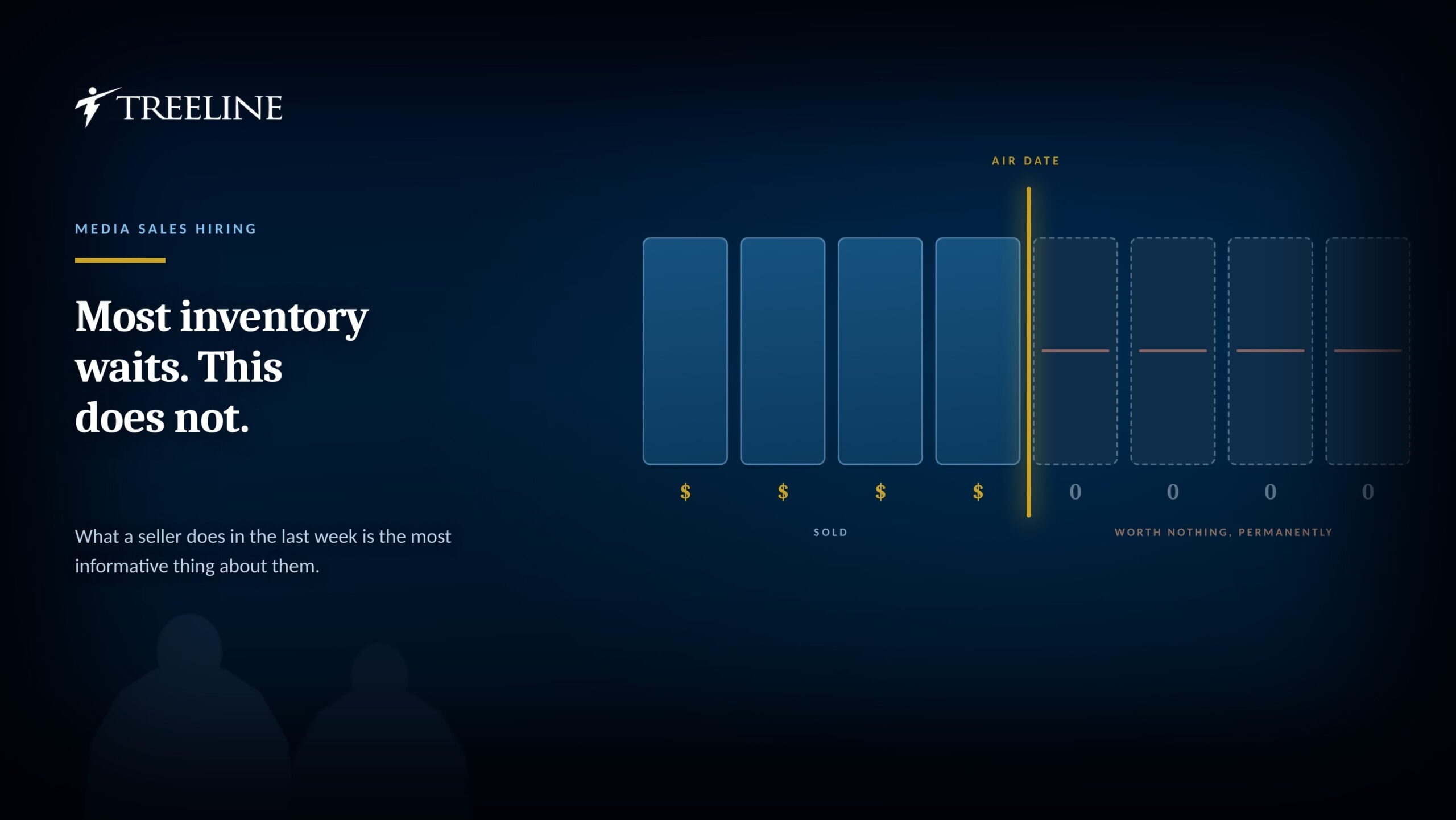
Every quota in a mature territory is built from something. Last year’s number, the installed base, the inbound that arrives whether or not anyone works it, the events the company already attends, the references a prospect can call. A new territory has none of that, and the first person hired into it is handed a number constructed from territories that do.
That mismatch is the root of most first-hire failures in a new region, and it is an employer problem rather than a candidate one. This article is about the single first hire into a region that currently contains nothing, not about redrawing territories that already exist, and not about crossing a border, which brings an entirely separate set of employment questions.
The structure is usually straightforward. A single regional hire with a describable profile is well suited to a contingency sales recruiting arrangement, where the fee is payable only on a hire, and the case for choosing a specialist firm for that work is set out in why Treeline is the best contingency sales recruiting agency. The harder decisions are what to promise the hire, what to measure them on, and which of three coverage models to use.
Dan Fantasia, CEO of Treeline, Inc., treats a first regional hire as a market-making role wearing a territory title. From his perspective the employer’s first obligation is to say out loud that the first year is about building a position rather than harvesting one, because a candidate who accepts that job will behave very differently from one who accepts a quota they were never going to hit.
What the First Sales Hire in a New Territory Is Actually Being Asked to Do
Four things are missing on day one, and each of them is doing invisible work in every other territory.
Reference customers. A prospect in a new region will ask who else nearby is using this, and the honest answer is nobody yet. National references help and they are not the same thing, because a buyer wants to call somebody who looks like them.
An installed base. There is no renewal revenue, no expansion pipeline and no existing relationship that generates a second conversation. Every opportunity is originated.
Local demand generation. No regional events, no local partner network, no awareness. Whatever marketing produces nationally arrives thinly here.
A colleague. This is the one most often overlooked. In a mature office a new seller learns by overhearing, shadowing and comparing. A lone regional hire has none of that and will develop habits, good or bad, without correction for months.
Why a Territory With No History Cannot Be Quota’d Normally
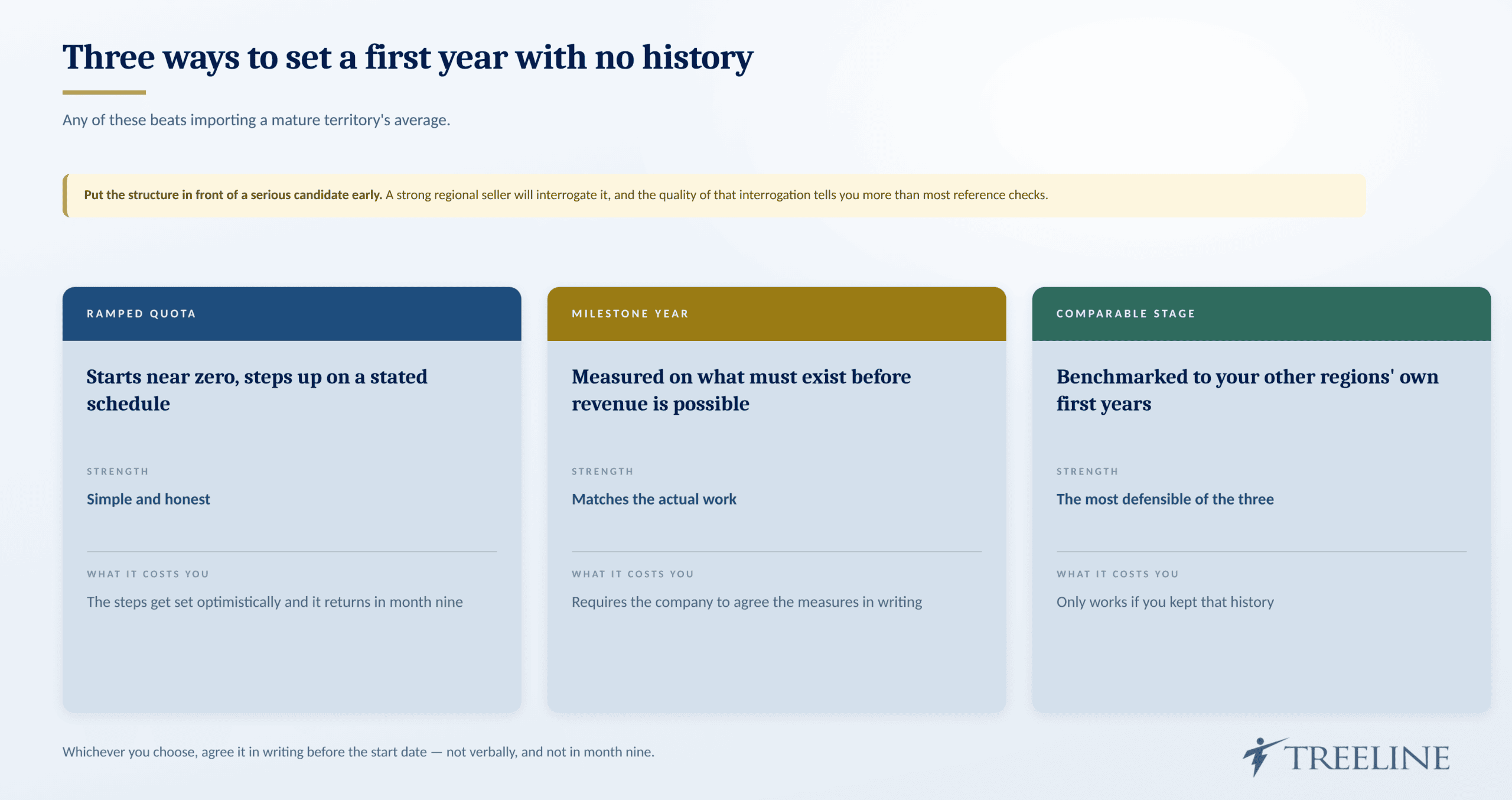
three-ways-to-set-year-one.png: Three ways to set a first year when the territory has no history, with what each one costs you
A quota is an estimate derived from evidence. With no evidence, the number is a wish, and both parties know it within about a quarter.
Three approaches work better than importing a mature territory’s average.
A ramped quota that starts near zero and steps up on a stated schedule, agreed in writing before the hire starts. This is the simplest and it is honest. The risk is that the steps are set optimistically and the problem reappears in month nine.
A milestone-based first year, where the measures are the things that have to exist before revenue is possible, named target accounts with a reason for each, first reference customer in region, a local partner or event presence, a pipeline with real stage reasoning. Revenue is a measure from the second year.
A comparable-stage benchmark, where the number is drawn from what the company’s other territories produced in their own first year rather than what they produce now. This is the most defensible approach and it requires the company to have kept that history, which many have not.
Fantasia’s perspective is that the quota conversation is the most informative part of the interview process for both sides. He recommends putting the proposed first-year structure in front of a serious candidate early, because a strong regional seller will interrogate it, and the quality of that interrogation tells you more than most reference checks.
Local, Relocated or Traveling: Choosing the First Sales Hire in a New Territory
Three coverage models are available and none of them is free.
A local hire knows the market, often arrives with relationships, and can be credible immediately. What they do not have is the company, the product depth, the internal relationships, the instinct for which promises can be kept. They are also the most isolated of the three, because nobody they work with is nearby.
A relocated employee knows the company completely and the market not at all. They can answer technical questions on the spot and route internally without friction, and they will spend their first six months building a network the local hire already had. Relocation is expensive, and the arrangement carries a flight risk that rises if the region underperforms.
A travel-based seller working the region from headquarters keeps the company connection and the management attention, and never becomes embedded. For regions where buyers expect presence this is a visible disadvantage, and the travel cost over two years frequently exceeds the cost of relocating somebody.
The useful framing is that you cannot buy both kinds of knowledge in one person, so the decision is which gap you are willing to fund. A local hire needs a deliberate program of company immersion. A relocated employee needs an introduction budget and patience. Pretending the gap does not exist is what produces a disappointing first year.
What to Test in a First Sales Hire in a New Territory
Five questions separate a market-maker from a territory-worker.
Opened versus inherited. Ask them to describe a territory they opened and what the first ninety days contained. People who have done it describe meetings that led nowhere and material they had to rewrite. People who inherited a working patch describe accounts and quota.
Selling without local proof. Ask how they handled the question of who else nearby uses this. Good answers involve constructed substitutes, a pilot, a national reference flown in, a partner who vouched. Weak answers involve persistence.
Self-direction. Ask what their week looked like when nobody was watching, in detail. The lone regional hire’s calendar is entirely self-set, and candidates who cannot describe their own structure usually do not have one.
Isolation tolerance. Ask directly how they handled being the only person in a region, and what they did to stay connected. This is a real and underrated predictor, and candidates who have experienced it answer specifically rather than reassuringly.
Local network reality. If they claim relationships in the region, ask when they last spoke to three of those people and about what. Claimed networks are common; current ones are not.
Where to Find a First Sales Hire in a New Territory
Three pools supply most of these hires.
Sellers at competitors already covering the region arrive with the market, the buyers and the credibility, and are the most expensive. Establish how much of their result came from their employer’s established position in that region rather than from their own work, because that is precisely what will not transfer into a territory where your company has no position at all.
Sellers from adjacent categories calling on the same buyers bring the relationships without the direct competitive knowledge, and are frequently the better value. The buyer overlap matters more than the product overlap for a first hire, because the first year’s work is access.
People returning to a region, who grew up or previously worked there and are moving back for personal reasons, are an underused pool. The motivation is durable, the local knowledge is real, and the main risk is that the network may be several years stale.
How to Pay a First Sales Hire in a New Territory
The compensation question follows directly from the quota question, and getting one right while
getting the other wrong produces the same outcome.
If the first year is genuinely about building a position, then a plan that pays almost entirely on
closed revenue pays this person very little for doing exactly what was asked. The usual remedy is a
guarantee, a floor on variable compensation for the first two or three quarters, and it is
cheaper than the alternative, which is losing the hire in month ten and starting the region again
from nothing.
Relocation changes the arithmetic in a way that is often underestimated. A relocated employee has
moved a household on the strength of a plan, and if the region is deprioritized the company has an
obligation it did not write down. Deciding in advance what happens to that person if the expansion
is paused is both fairer and a better recruiting position than leaving it unspoken.
Travel cost deserves an honest line in the model rather than an expenses assumption. A seller
covering a region from elsewhere accumulates a figure over two years that frequently exceeds the
one-off cost of relocating somebody, and the comparison is rarely made because the two costs sit in
different budgets.
Fantasia recommends settling the guarantee, the relocation terms and the travel model before the
first conversation with a candidate. His operating perspective is that strong regional sellers read
these three as a signal of whether the company has thought the expansion through, and that a
candidate who concludes it has not will usually keep looking while being polite about it.
Why This Search Works Without a Retainer
A first regional hire is usually a good fit for a contingency arrangement, and for specific reasons rather than general ones.
The profile is describable. Unlike a leadership appointment, the company can usually say exactly what it wants: a seller with these buyers, in this region, comfortable without infrastructure. A describable brief is what contingency work is built for.
The candidate population in a region is normally large enough to search. This is not a market of fifteen people; it is a market of a few hundred, most of whom are employed and reachable.
And expansion plans change. Regions get deprioritized when a quarter goes badly elsewhere, and a structure where the fee attaches to a hire rather than a search leaves that risk with the firm rather than the employer.
The exception is when the regional hire is really a leadership appointment, someone who will build a team, carry profit-and-loss responsibility and represent the company publicly in that market. That is a different search with a small universe, and a retained engagement serves it better.
What the First Sales Hire in a New Territory Needs From You
Three commitments should be made before the search opens, not after the hire starts.
A first-year structure in writing, using one of the three approaches above. Not a mature-territory quota with a verbal promise of flexibility.
Named management attention on a schedule. A lone regional hire needs more contact than a seller in an office, not less, and it has to be diarized because it will otherwise be displaced by whatever is nearer.
A first reference commitment. Decide in advance what the company will do to produce the first in-region reference, a discounted early customer, a flown-in national reference, a partner introduction, because the seller cannot manufacture that alone and it unlocks everything after it.
Fantasia recommends treating the reference commitment as part of the brief rather than as onboarding detail. His view is that the first local customer is the hardest sale the hire will ever make and the one that makes the rest possible, and that a company unwilling to invest in producing it is asking the territory to open itself.
Reading the First Year
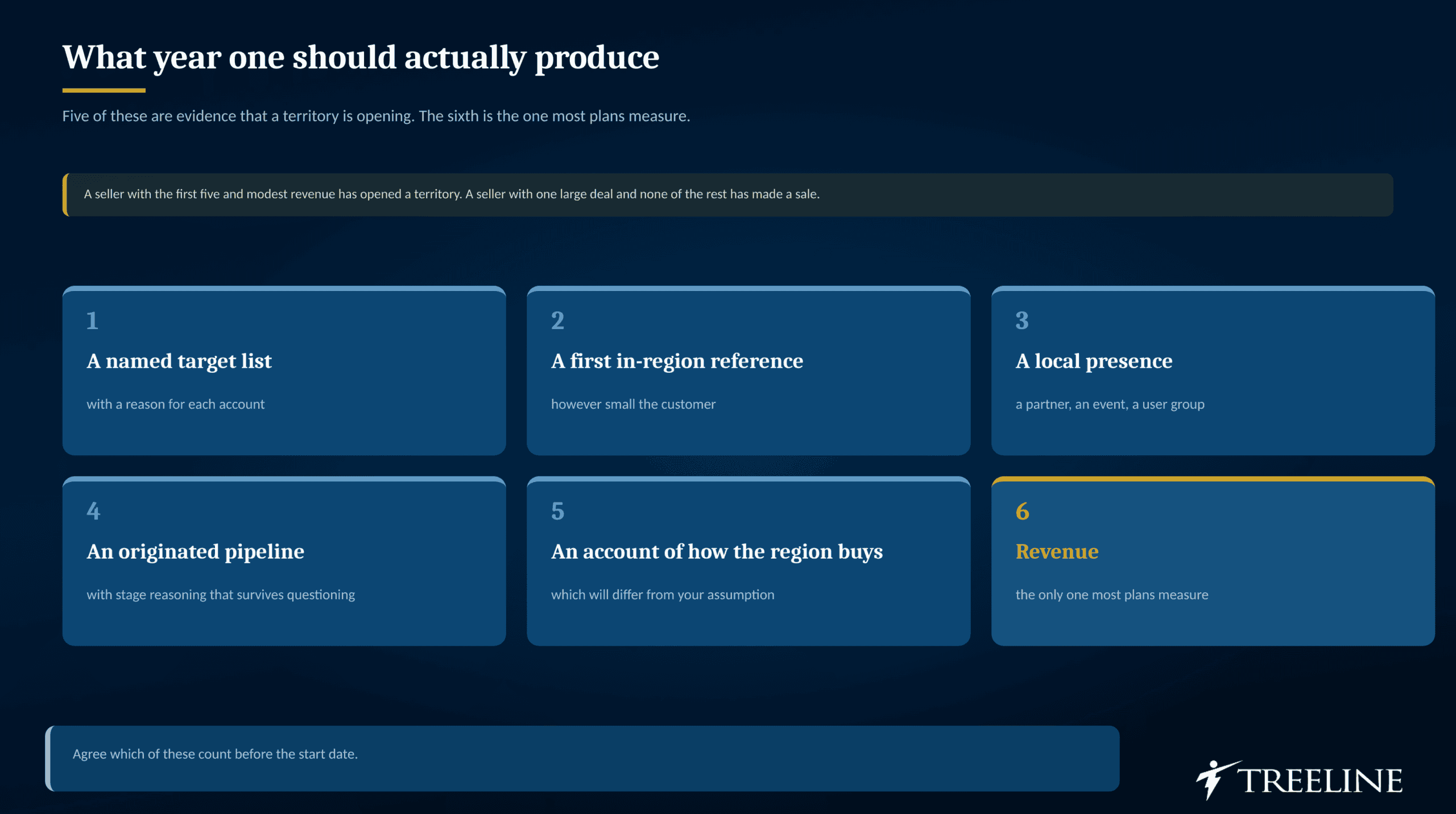
what-year-one-should-produce.png: Six things a first year should produce, five of which are not revenue
Five things should be visible at twelve months, and only one of them is revenue.
A named target list with reasoning. A first reference customer in region, however small. A local presence of some kind, a partner, an event, a user group. A pipeline the seller originated, with stage reasoning that survives questioning. And a clear account of how the region actually buys, which will differ from the assumption the company started with.
A seller with those and modest revenue has opened a territory. A seller with one large deal and none of the rest has made a sale, and the second year will show the difference.
Frequently Asked Questions
Why can’t we use a normal quota for a new region?
Because a quota is an estimate built from evidence, and a new territory has none, no installed base, no renewals, no inbound, no local references. Importing a mature territory’s average produces a number both sides stop believing within a quarter.
What should we measure in year one instead?
Either a ramped quota agreed in writing, or milestones that have to exist before revenue is possible, named targets with reasoning, a first in-region reference, a local presence, an originated pipeline. A comparable-stage benchmark from your other territories’ first years is the most defensible option if you kept that history.
Should we hire locally or relocate someone?
You cannot buy local knowledge and company knowledge in the same person, so decide which gap you will fund. A local hire needs deliberate company immersion; a relocated employee needs an introduction budget and patience; a travel-based seller stays connected to you and never becomes embedded.
How do we sell with no customers in the region?
By constructing substitutes and deciding in advance which ones you will fund: an early customer on favorable terms, a national reference made available in person, or a partner willing to vouch. The first local reference is the hardest sale in the territory and it unlocks the rest.
Is isolation really a hiring criterion?
Yes, and an underrated one. A lone regional seller has no colleague to shadow, no peer benchmark and no corrective feedback by osmosis. Candidates who have done it describe specific habits for staying connected; candidates who have not tend to answer reassuringly.
Should we hire from a competitor in that region?
They are the quickest to credibility and the most expensive. Press on how much of their result came from their employer’s established position there, because your company has no position in that region at all and that is exactly the part that will not transfer.
How much management time does this hire need?
More than a seller in an office, and it has to be scheduled. Contact that depends on proximity will not happen, and a lone hire develops habits without correction for months if nobody is deliberately looking.
Why is a retainer usually unnecessary here?
Because the profile is describable, the regional candidate population is large enough to search properly, and expansion plans change. A fee attached to a hire rather than a search leaves the risk of a deprioritized region with the firm.
Decide the First Year Before You Decide the Candidate
The first sales hire in a new territory is one of the few searches where the employer’s preparation matters more than the shortlist. A strong candidate dropped into an unstructured first year will look like a weak hire by month nine. An average candidate given a written structure, scheduled attention and a plan for producing the first local reference will often open the region.
Work out the quota approach, the coverage model and the reference commitment first. Those three decisions determine what kind of person to look for, and a search that starts after they are made is both shorter and considerably more likely to produce somebody who is still there in two years.
Share This Story, Choose Your Platform!
Related Posts



What our happy clients are saying
Treeline Inc. provided us with the most candidates that aligned with our needs and were of the highest quality.

Dr. Jeffrey Klein Head of North America Sales, Satchel Pulse
Treeline Inc.’s collaborative, flexible, and communicative approach resulted in a smooth partnership. Beyond their recruitment expertise, their unique sourcing model was efficient and effective.

Sera Holt Director of Operations, LNS Research
Their professionalism was outstanding. Treeline Inc. was extremely thorough and ensured that we were on the same page before they started looking for candidates. They listened to us and did a great job working with the candidate to close out the process.

Cate Grant AVP Customer Success, Nasdaq
Thanks to Treeline Inc.’s intricate and thorough screening process, the company is able to hire six high-quality candidates that fit perfectly in the company’s culture. The team is highly receptive to concerns, and internal stakeholders are impressed with their unique recruitment abilities.

Anna McKean Sales Recruiter, Insider Intelligence
Treeline Inc. has been qualified individuals throughout a five-year-long engagement. They’ve made numerous placements of talented and qualified individuals for our business.

Michele St Laurent VP of HR, The Institute for Applied Network Security

Let Us Help You Source the Sales Talent You Need
Whether you’re building a team or replacing a key role, our Candidate Sourcing Platform provides a fast, flexible, and employer-focused solution.
Tell us more about your business and how we can help.
Treeline Inc.
Your Award-Winning Sales Recruitment Partner
15 Lincoln Street, Suite 314, Wakefield, MA 01880