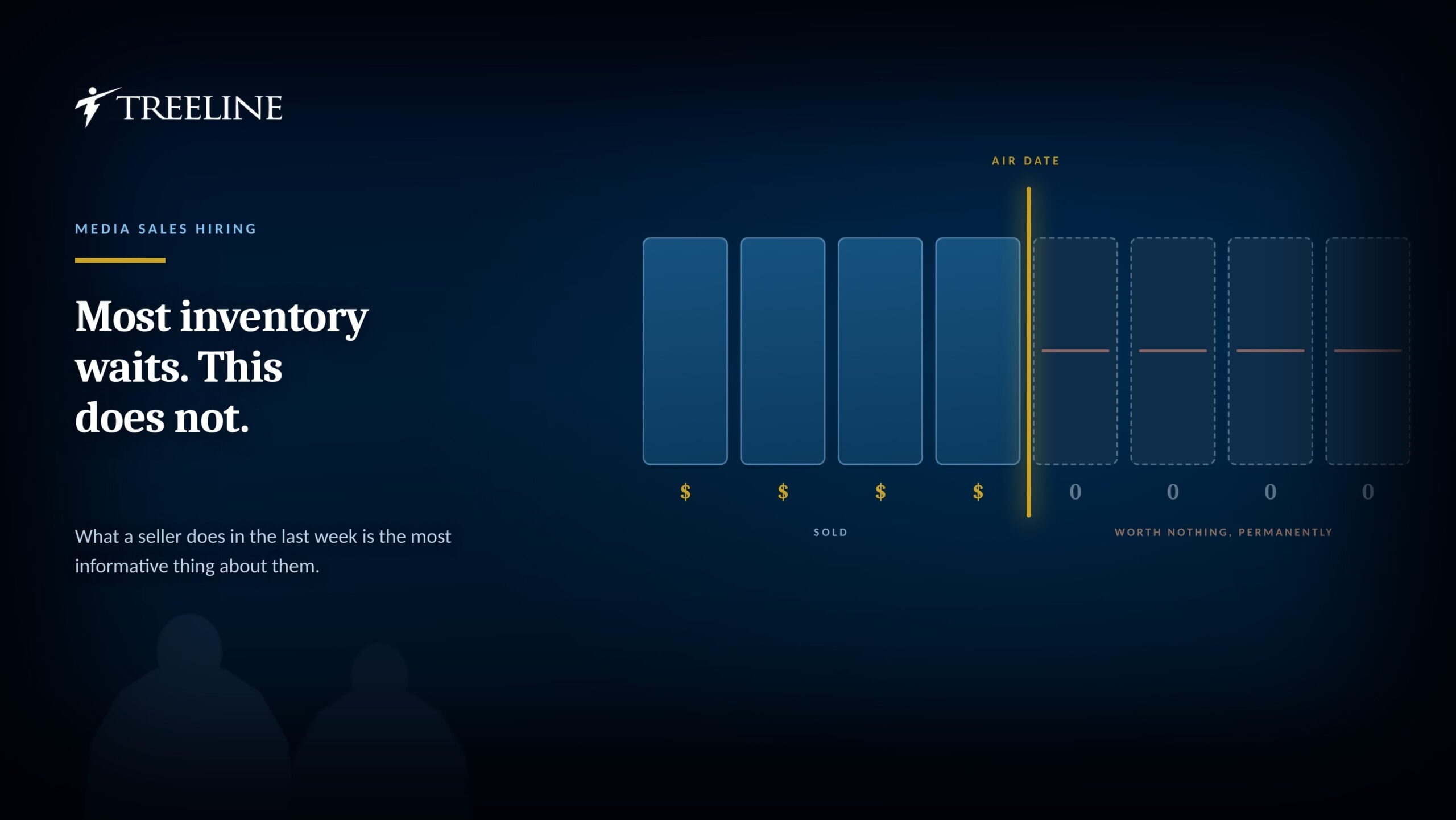
Most sales inventory waits. A software license unsold in March can be sold in April at the same price. Media inventory does not wait. A placement, a slot, a flight, an impression that goes unsold by its date is not carried forward, it becomes worth nothing, permanently, and everyone in the building knows it.
That single economic fact shapes the role more than anything a job description usually mentions. It changes what good pricing behavior looks like, what end-of-period pressure does to a seller, how renewal actually works, and which candidates will hold a number when the calendar is against them.
Searches in this category are frequently run through a contingency sales recruiting arrangement, and the reasons a specialist firm matters here are the same ones set out in why Treeline is the best contingency sales recruiting agency: the screen is category-specific, and a general enterprise sales screen will not catch what matters.
Dan Fantasia, CEO of Treeline, Inc., treats media hiring as a test of pricing character rather than relationship inventory. From his perspective the decisive question is what a candidate did in the last week of a period they were behind on, because the answer reveals whether the company is hiring revenue or hiring a discount.
What Media Sales Recruiting Is Screening For That Other Sales Searches Are Not
Three characteristics separate this from general business-to-business selling.
Inventory perishes. The seller is working against a clock that does not stop, and the marginal value of an unsold unit collapses to zero at a known moment. Rational behavior near that moment is to discount, which is why media organizations spend so much effort on pricing discipline and why a seller’s conduct under that pressure is the most informative thing about them.
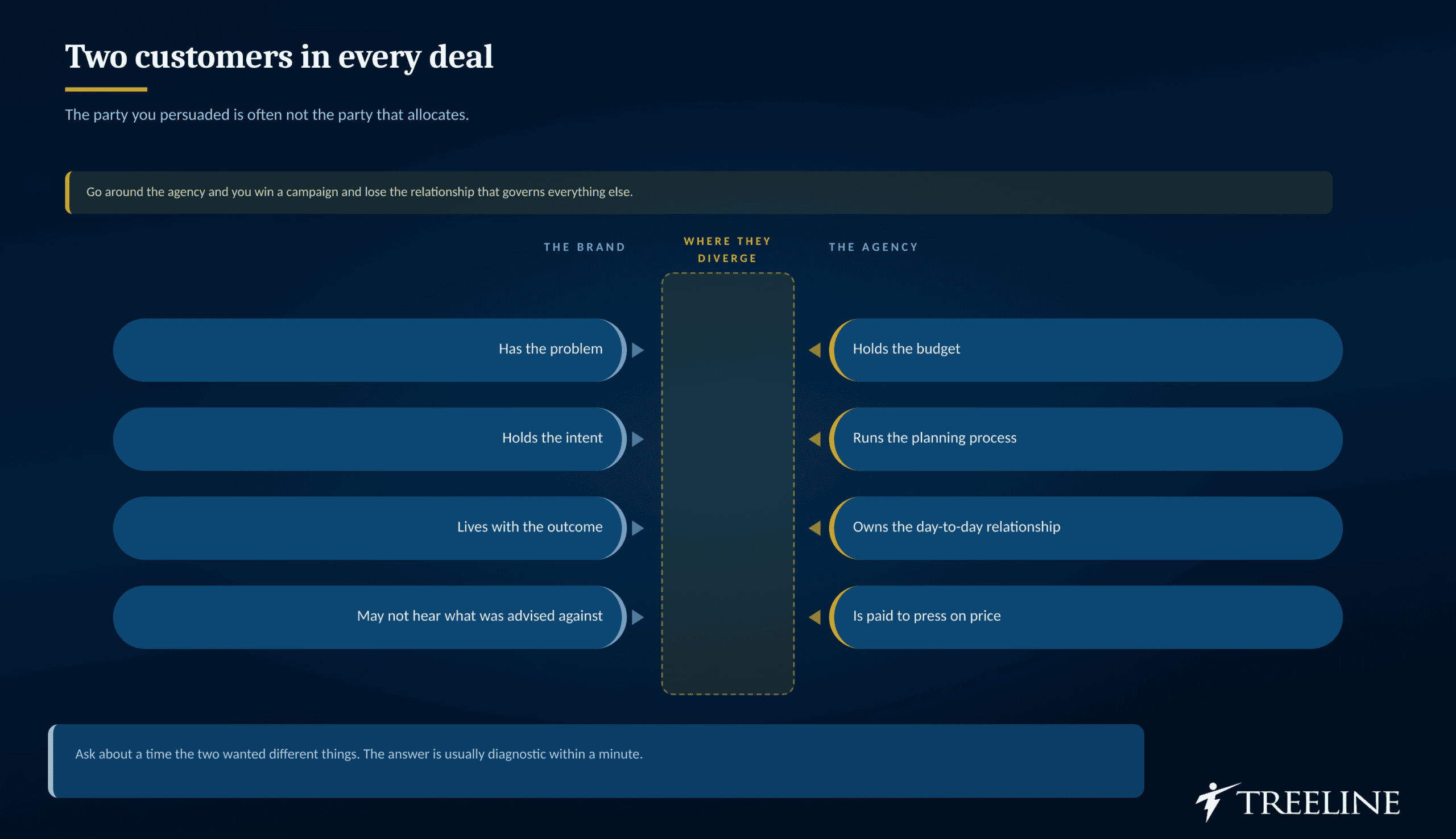
There are usually two customers. The brand has the intent and the problem. The agency holds the budget, the planning process and frequently the relationship. A seller who is excellent with one and invisible to the other will produce a pipeline that looks fine and converts poorly, because the party who was persuaded is not the party who allocates.
Part of the inventory no longer needs a seller. Automated and self-serve channels transact a share of the same inventory without anyone in the room, which means a direct seller has to justify why a buyer should transact with them at all. The answer is usually something the automated route cannot supply, guaranteed placement, a bespoke execution, first-party audience data, editorial alignment, or a commitment that spans a season. A candidate who cannot articulate that distinction is selling against a cheaper channel without knowing it, and will be pushed toward price every time.
Performance is argued after the sale. Delivery, verification, viewability and attribution are routinely disputed, and the seller is the person who defends the campaign in that conversation. In most other categories the sale ends at signature. Here a meaningful part of the job begins there, and a seller who cannot hold a numbers conversation with an analytically minded buyer will lose the renewal regardless of how the campaign actually performed.
Why Perishable Inventory Changes the Seller You Need
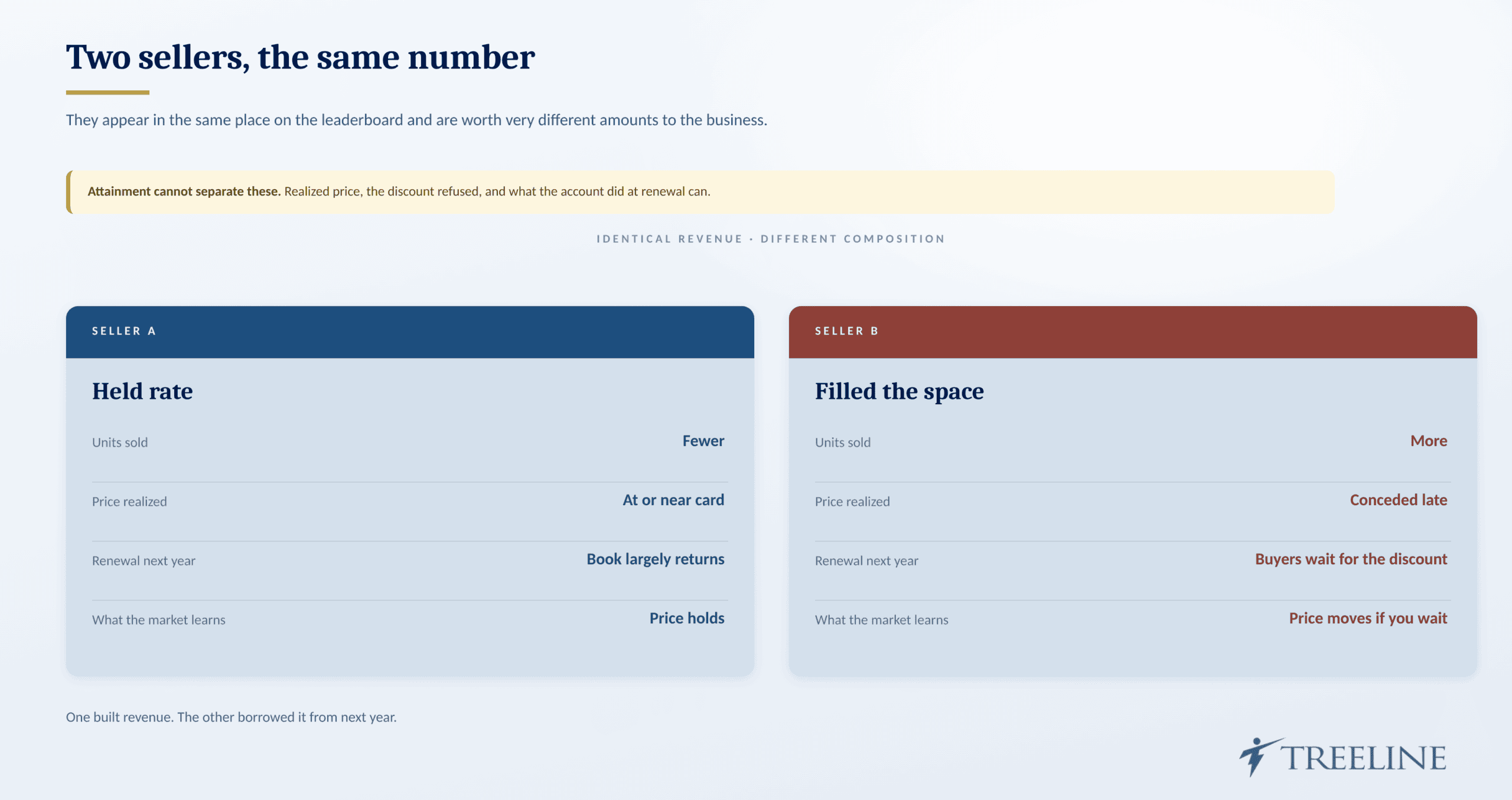
The practical consequence is that two sellers with identical revenue can be worth very different amounts to the business.
One has sold at or near rate card, built a book that renews, and held price in the last week of a quarter. The other has hit the same number by conceding on price when the calendar got close, which trains the buyer to wait, erodes the rate across the market, and makes next year harder. Both appear on the leaderboard in the same place.
A hiring process that asks only about attainment cannot tell these apart. One that asks about realized price, about the discount a candidate refused to give, and about what happened to that account afterwards usually can.
Fantasia’s perspective is that the discounting question should be asked directly and early rather than inferred. He recommends asking a candidate to describe a period they finished behind and what they did about it, because a seller who has never declined a bad deal will not be able to produce an example and will usually say so without realizing what it reveals.
How Media Sales Recruiting Should Handle the Agency Relationship
The agency relationship is where most candidate assessments are thinnest, because the dynamics are genuinely unusual.
The agency is a buyer, an advisor and a competitor for influence at the same time. It is paid to get a good outcome for the brand, which often means pressing the seller on price and terms. It also has its own commercial relationships, its own planning cadence, and in some structures its own interest in where budget is placed. The brand, meanwhile, may not know what was recommended against.
Sellers handle this in one of three ways. Some work exclusively through the agency, which is safe, keeps the relationship clean, and leaves them entirely dependent on an intermediary whose incentives are not identical to theirs. Some go around the agency to the brand, which occasionally wins a campaign and reliably damages the agency relationship that governs everything else. The ones worth hiring hold both relationships openly: the agency knows about the brand conversations, the brand understands what the agency is for, and nobody is surprised.
That is a learned skill and it is testable. Ask a candidate to describe a time the agency and the brand wanted different things, and what they did. The answer is usually diagnostic within a minute.
What Media Sales Recruiting Has to Test
Five questions carry the signal.
Pricing conduct. Describe a period you finished behind and what you did in the final week. Listen for whether a discount was given, what was asked in return, and what happened to that account at renewal.
Dual-relationship navigation. Describe a situation where the agency’s recommendation and the brand’s preference diverged. The strong answer involves having kept both parties informed rather than having picked one.
Post-sale defense. Describe a campaign that underdelivered or whose measurement was disputed, and how the conversation went. Candidates who have genuinely owned renewals will have several of these and will not be defensive about them.
Re-pitch awareness. Ask what percentage of their book renewed and what they did to earn it. In this category renewal is usually a re-pitch rather than a contractual event, and sellers who treat it as automatic lose accounts slowly and without warning.
Format change. Ask what the product looked like three years ago versus now, and how they kept up. The inventory, formats and targeting mechanics in this category change continuously, and a seller who cannot describe their own relearning is likely to be selling something that no longer exists.
Where Media Sales Recruiting Finds Candidates
Four pools supply most of these hires, each with a characteristic risk.
Sellers from direct competitors bring the category, the buyers and the pricing context, and are the fastest to productivity. The risk is that their book may have been a function of their employer’s audience or position rather than their own work, and that does not travel.
Agency-side planners and buyers moving across to sell know exactly how the buying decision is made, which is a genuine advantage and an unusual one. The risk is the commercial half, carrying a number, prospecting cold, and asking for a close are not part of the role they are leaving.
Platform and technology sellers from the surrounding ecosystem understand data, targeting and measurement, and they are comfortable with technical buyers. The gap is usually the relationship cadence and the pace, which is faster and more continuous than enterprise software.
General business-to-business sellers are the largest pool and the highest variance. Many are strong, and the two things that catch them out are the perishability of inventory, which they underestimate, and the agency triangle, which has no analogue in most categories.
With competitor hires in particular, it is worth asking which share of their book came through direct relationships and which arrived through automated channels that would have transacted anyway. The two look identical on an attainment report and represent very different skill.
Fantasia emphasizes that the choice should follow what the organization most needs protected. His operating perspective is that a publisher with strong audience and weak pricing discipline should hire for pricing character, while one with good discipline and a thin market position should hire for access and relationships, and that hiring for a famous client list usually buys neither.
Why Compensation Is the Hardest Part of Media Sales Recruiting
A plan that pays on booked revenue, in a business with perishable inventory and a quarterly clock, is a plan that pays for discounting. Everyone involved knows this, and it persists because the alternative is harder to administer.
Three adjustments help.
Pay against realized price rather than volume alone, so that a seller who holds rate is better off than one who fills the same space cheaply. This is the single most effective change and the one most often resisted.
Separate new business from renewal, because in this category renewal is a re-pitch that requires real work, and a plan that treats it as annuity income quietly underpays the people doing that work until they leave.
Set the measurement period against the campaign cycle rather than the calendar quarter, where the business allows it. Quarterly measurement in a business whose inventory expires quarterly is what creates the end-of-period behavior everyone complains about.
Fantasia recommends showing the plan structure to serious candidates early. His view is that strong media sellers read a compensation plan as a statement about whether the organization actually wants price held, and that the ones who care most about pricing discipline are the ones most likely to walk away from a plan that rewards the opposite.
Why the Contingency Model Fits a Seasonal Hiring Pattern
Media hiring is seasonal and recurring. Organizations staff ahead of selling seasons, replace through predictable churn, and often hire several similar roles across markets or categories at once. A contingency arrangement matches that pattern: the fee attaches to each hire, several roles can be worked in parallel, and the employer is not committing fees against a plan that may be revised when a season turns out differently than forecast.
The timing matters more than it does in most categories. Budget in this market is committed against calendar cycles, and a seller who joins after those commitments are made inherits a year that was largely decided before they arrived. Hiring ahead of the cycle rather than in response to a gap is the difference between a first year that builds and one that is spent waiting.
It also suits a market where good candidates move quickly and are rarely available long. A firm that can present people as they surface, across several open roles, is working the way this market actually behaves.
The honest exception is senior leadership, a head of revenue, a national sales lead, or the first commercial hire for a new product line, where the candidate universe is small and a retained engagement serves better.
Reading the First Year
Four things should be visible at twelve months, and revenue alone will not tell you whether the year went well.
Realized price on the book, not just volume, because that distinguishes revenue built from revenue bought. Renewal behavior on the accounts inherited, since those were somebody else’s relationships and keeping them is the real test. Agency standing, whether planners at the relevant agencies return calls and include the seller early. And at least one account defended through a disputed measurement conversation, because that is where renewals are actually won.
A seller with those and a modest number is building a durable book. A seller with a strong number, a collapsed average price and no agency standing has borrowed from next year.
Frequently Asked Questions
Why does perishable inventory matter so much in this hire?
Because an unsold unit becomes worth nothing at a known moment, which makes discounting the rational move as that moment approaches. How a candidate behaves in that window is the most informative thing about them, and it is invisible in an attainment figure.
Who is the real customer, the brand or the agency?
Both, with different holdings. The brand has the intent and the problem; the agency usually holds the budget, the planning process and the relationship. A seller who is persuasive with only one will build a pipeline that converts poorly.
Can an agency planner become a good seller?
Often, and it is an underused pool. They understand how buying decisions are actually made, which is difficult to teach. Test for the commercial half, carrying a number, cold prospecting and asking for a close, none of which is part of the job they are leaving.
How should we interview for pricing discipline?
Ask about a period finished behind target and what happened in the final week. Follow up on what was conceded, what was asked in return, and what that account did at renewal. Candidates who have never declined a bad deal cannot produce the example.
Why is renewal treated as a re-pitch here?
Because campaign relationships usually renew by habit and persuasion rather than by contract. A seller who treats renewal as annuity income loses accounts gradually and without obvious warning, which is why renewal and new business deserve separate treatment in the plan.
What does the measurement dispute have to do with hiring?
The seller defends delivery and attribution after the campaign runs, and that conversation decides the renewal more often than the campaign’s actual result does. A candidate who cannot hold a numbers discussion with an analytical buyer will lose business they earned.
Should the compensation plan change for this category?
Usually. Paying on booked revenue in a perishable-inventory business pays for discounting. Weighting realized price, separating renewal from new business, and measuring against the campaign cycle rather than the calendar all help.
When is retained the better structure in this market?
For senior leadership, a head of revenue, a national sales lead, or the first commercial hire on a new product line, where the candidate universe is small enough to enumerate and the appointment signals direction.
Hire the Pricing Behavior, Not the Contact List
Media sales recruiting is unusually prone to hiring on relationships, because relationships are the most visible thing a candidate brings and the easiest thing to ask about. They matter. They are also the part most likely to have belonged to the employer rather than the individual, and the part that decays fastest once the seller changes what they are selling.
The durable qualities are pricing character, the ability to hold two customers in one deal without deceiving either, and the willingness to defend a campaign after the money has been spent. Those are harder to ask about and they are what separates a seller who builds a book from one who rents one for a year.
Share This Story, Choose Your Platform!
Related Posts

What our happy clients are saying
Treeline Inc. provided us with the most candidates that aligned with our needs and were of the highest quality.

Dr. Jeffrey Klein Head of North America Sales, Satchel Pulse
Treeline Inc.’s collaborative, flexible, and communicative approach resulted in a smooth partnership. Beyond their recruitment expertise, their unique sourcing model was efficient and effective.

Sera Holt Director of Operations, LNS Research
Their professionalism was outstanding. Treeline Inc. was extremely thorough and ensured that we were on the same page before they started looking for candidates. They listened to us and did a great job working with the candidate to close out the process.

Cate Grant AVP Customer Success, Nasdaq
Thanks to Treeline Inc.’s intricate and thorough screening process, the company is able to hire six high-quality candidates that fit perfectly in the company’s culture. The team is highly receptive to concerns, and internal stakeholders are impressed with their unique recruitment abilities.

Anna McKean Sales Recruiter, Insider Intelligence
Treeline Inc. has been qualified individuals throughout a five-year-long engagement. They’ve made numerous placements of talented and qualified individuals for our business.

Michele St Laurent VP of HR, The Institute for Applied Network Security

Let Us Help You Source the Sales Talent You Need
Whether you’re building a team or replacing a key role, our Candidate Sourcing Platform provides a fast, flexible, and employer-focused solution.
Tell us more about your business and how we can help.
Treeline Inc.
Your Award-Winning Sales Recruitment Partner
15 Lincoln Street, Suite 314, Wakefield, MA 01880