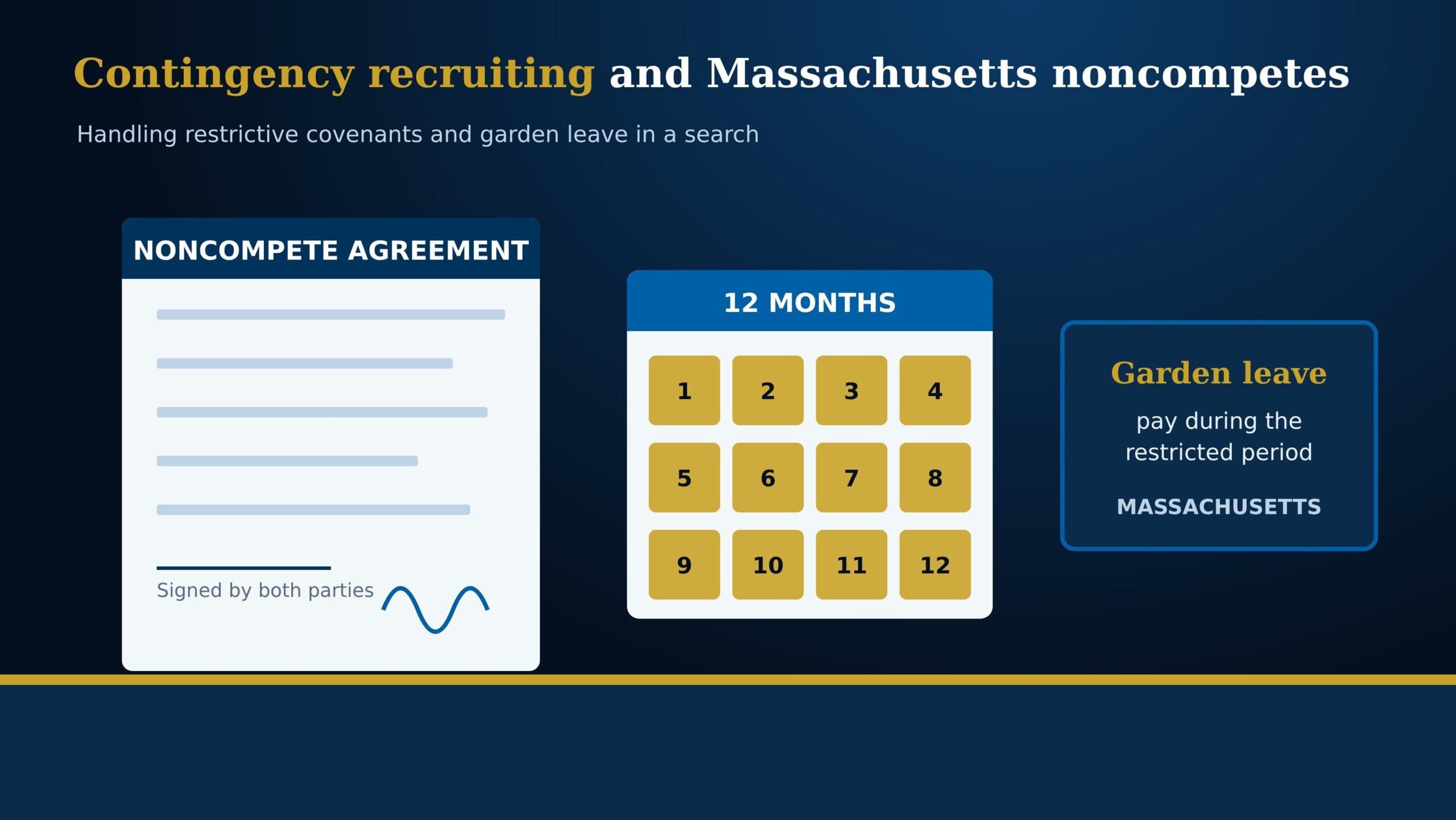
Contingency recruiting handles Massachusetts noncompete and garden leave terms by asking about them early, treating them as a fact about the candidate that can change the start date, and leaving the legal judgment to counsel. A noncompete does not stop a search, but can be a problem after an offer has been accepted. This guide explains what a contingency recruiter does about a candidate’s restrictive covenant, what the Massachusetts statute says about noncompetition agreements and garden leave, and what a hiring company should decide before the first interview.
It is a general explanation, not legal advice. The statute and the way courts apply it can change, and every agreement has its own wording. A company or candidate with a real agreement should have a Massachusetts employment lawyer read it.
In contingency recruiting, the recruiting firm is paid when a candidate is hired. Treeline, Inc. is a sales recruiting firm based in Wakefield, Massachusetts that places salespeople permanently. Its contingency recruiting service describes how it takes on a search, and its Massachusetts page describes its work in the state. Treeline does not give legal advice.
Dan Fantasia, CEO of Treeline, Inc., views a noncompete as a scheduling and trust question before it is a legal one. From his perspective, the candidates who handle it best are the ones who raise it at the first conversation, and the companies who handle it best are the ones who ask about it before they fall in love with a resume.
What Contingency Recruiting Means for a Candidate With a Noncompete
Contingency recruiting is a fee arrangement in which the recruiter earns a fee when a placement is made, not before. That structure shapes how a recruiter treats a noncompete. A candidate who cannot start for a year, or who may face a dispute with a former employer, is a placement that may not happen, so the recruiter has an interest in finding out early.
The recruiter’s role is practical, not legal. A contingency recruiter can:
- Ask the question. Does the candidate have a noncompete, a nonsolicit or a confidentiality agreement with the current employer?
- Ask for the document. A candidate who has a copy should share it with the hiring company’s counsel, not rely on memory.
- Flag the effect on timing. A restriction can change the start date, the role’s scope or the territory.
- Keep the process honest. The recruiter should not encourage a candidate to breach an agreement or to take confidential material from an employer.
- Coordinate between the parties. The recruiter can carry questions between the candidate and the company and keep the timeline visible.
What a recruiter cannot do is decide whether an agreement is enforceable. That is a question for a lawyer who has read the document.
Why the question matters more in sales
Salespeople are the employees most likely to carry restrictive covenants, because they hold customer relationships. A senior seller moving to a company in the same market is the standard situation in which a former employer takes an interest. The company hiring the seller should not discover that interest after announcing the hire.
What the Massachusetts Statute Says About Noncompetes
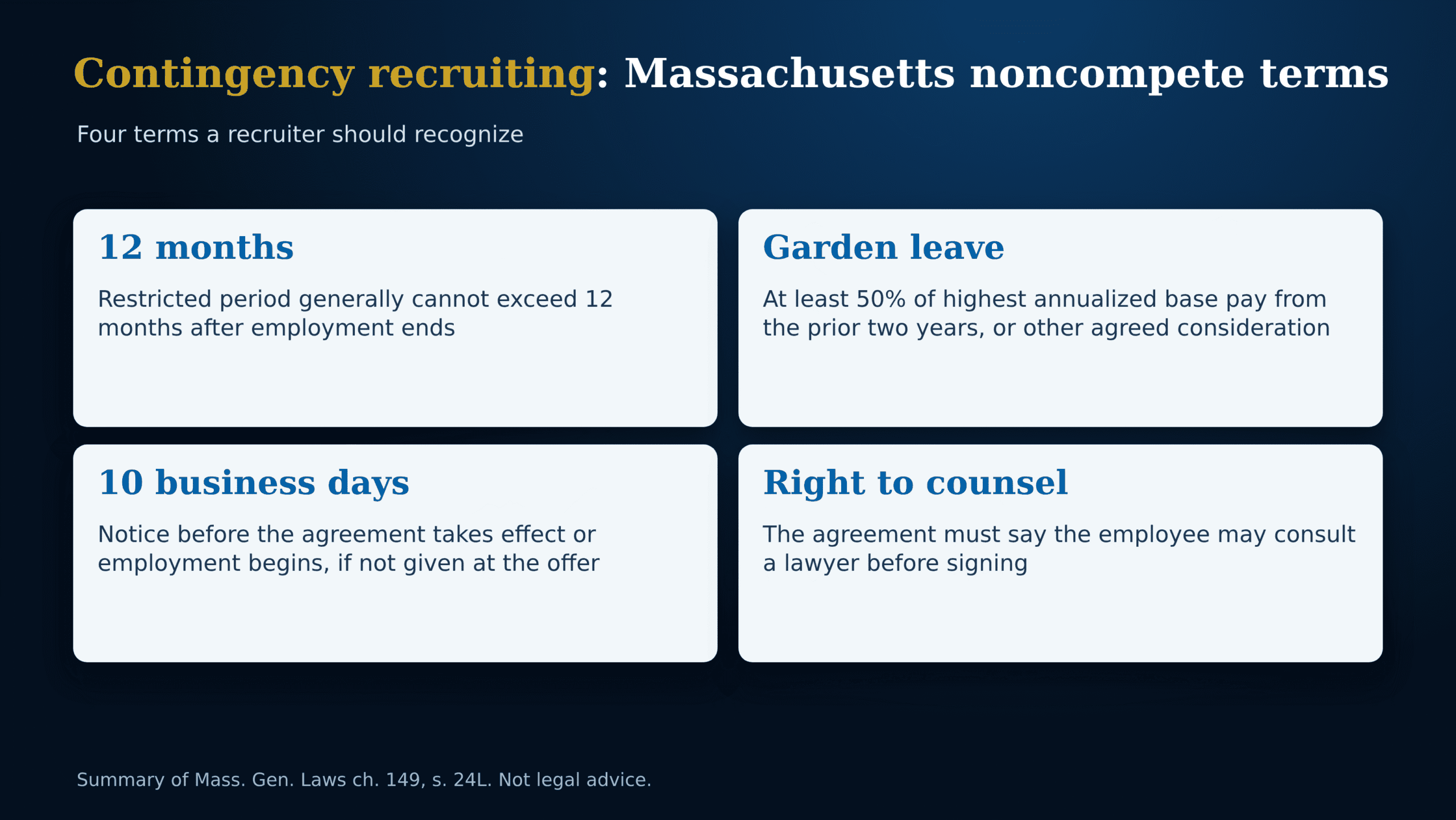
Massachusetts regulates noncompetition agreements by statute. The text of Massachusetts General Laws chapter 149, section 24L, as summarized for this article, includes the following requirements. These are paraphrases for orientation and are not a substitute for reading the statute.
- Duration. The restricted period generally cannot exceed 12 months after employment ends. It can extend to two years if the employee breached a fiduciary duty or unlawfully took employer property.
- Garden leave or other consideration. The agreement must be supported by a garden leave clause or other mutually agreed consideration stated in the agreement.
- Signed writing. The agreement must be in writing and signed by the employer and the employee.
- Notice. If signed at the start of employment, the agreement must be provided by the earlier of a formal job offer or 10 business days before employment begins. If signed after employment begins, notice must be given at least 10 business days before it takes effect.
- Right to counsel. The agreement must expressly state that the employee has the right to consult a lawyer before signing.
- Excluded workers. The statute says a noncompetition agreement cannot be enforced against employees classified as nonexempt under the Fair Labor Standards Act, students in internships or short-term employment, employees terminated without cause or laid off, and employees aged 18 or younger.
- Nonsolicitation. The statute does not treat covenants not to solicit employees or customers as noncompetition agreements.
According to the Massachusetts Bar Association overview linked below, the law was signed on August 10, 2018 and took effect on October 1, 2018. A reader who needs to know whether a particular agreement is covered should ask counsel.
The graphic below sets out the statute’s main terms as summarized above.
Key Massachusetts noncompete statute terms for contingency recruiting: 12-month limit, garden leave of at least 50 percent of highest base, 10 business days notice and right to counsel
Garden leave in plain terms
Garden leave is an arrangement in which a former employee is paid during the restricted period. The statute says a garden leave clause must pay at least 50 percent of the employee’s highest annualized base salary paid in the two years before termination, pro rata over the restricted period, and that the employer cannot unilaterally stop the payments unless the employee breached. If the restriction is extended because of a breach, no payments are owed during the extension.
A Massachusetts Bar Association overview of the 2018 law describes the same framework for practitioners, and adds that nonsolicitation agreements remain governed by Massachusetts common law. For a recruiter, the point is that garden leave changes the picture. A candidate who is receiving garden leave pay from a former employer may be in a different position from one who is not, and the hiring company may be affected by the arrangement’s timing.
Other consideration
The statute allows “other mutually agreed upon consideration” instead of garden leave. What qualifies is a legal question, and the agreement itself must state it. A recruiter cannot tell a candidate whether the consideration in their agreement is sufficient.
How Contingency Recruiting Screens for Restrictive Covenants
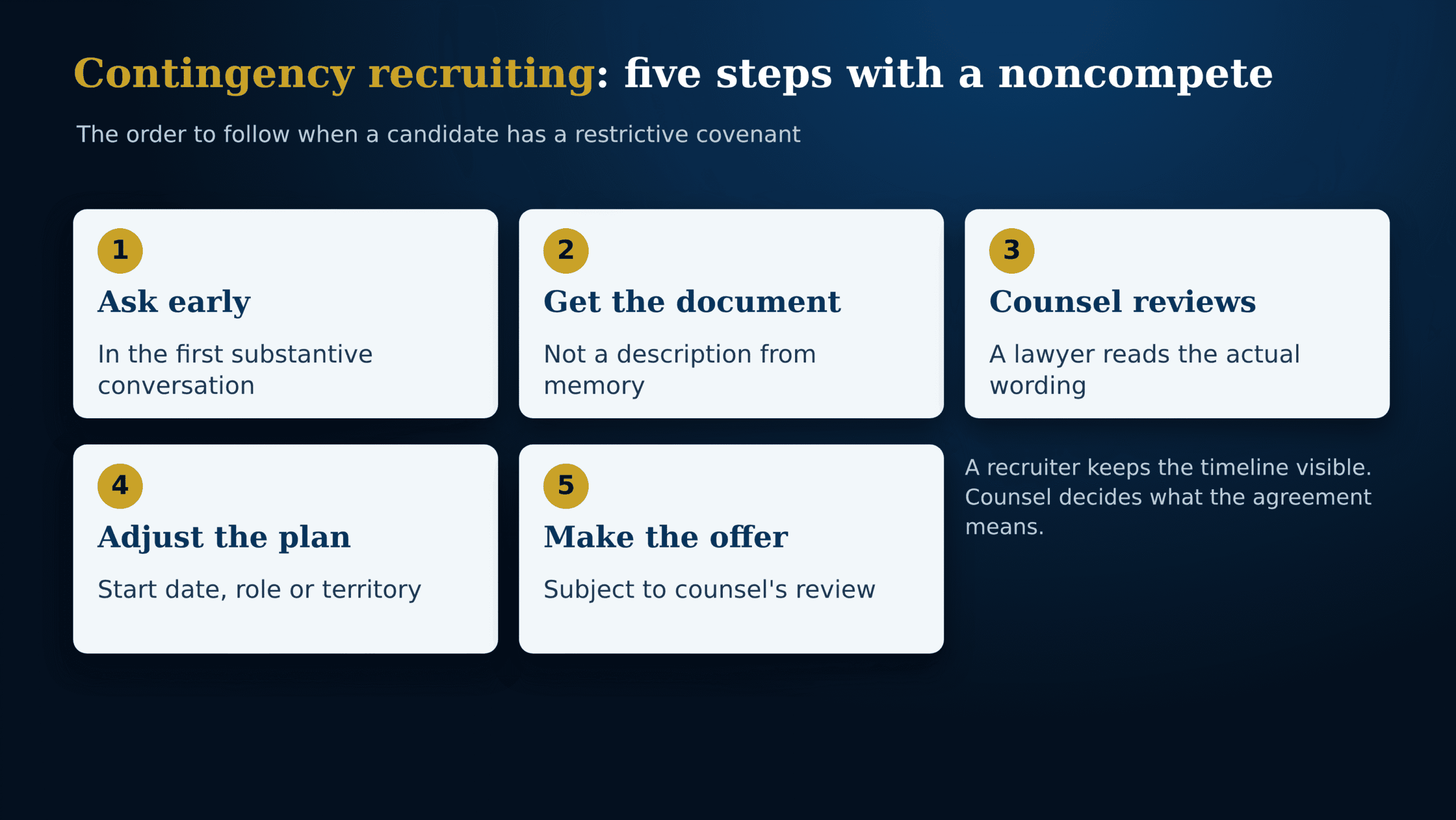
A good screening process asks about covenants in a way that is consistent and non-accusatory. Candidates should understand that the question is about planning, not suspicion.
When to ask
The best moment is early, in the first substantive conversation, before the candidate has met the hiring team. A candidate who learns that the company will need the agreement reviewed is less likely to feel ambushed later.
What to ask
A short set of questions is enough.
- Have you signed a noncompetition, nonsolicitation or confidentiality agreement with your current or recent employer?
- Do you have a copy?
- When did you sign it, and did you receive it at the start of your employment or later?
- Does your employer pay anything during a restricted period?
- Are you willing to share it with the hiring company’s counsel?
What to do with the answers
If the candidate has no covenants, note it and move on. If the candidate has one, the recruiter should tell the hiring company, without sharing confidential details, that the agreement needs review before the process goes further. The company’s counsel can then say whether the role, the territory or the start date needs to change.
Fantasia notes that the strongest candidates tend to bring the agreement with them. In his view, a candidate who has already read their own paperwork and can describe it plainly is showing the same care they would bring to a customer contract.
What a Hiring Company Should Decide Before the Search
Companies sometimes treat a candidate’s covenant as the candidate’s problem. It becomes the company’s problem when the company’s offer depends on the start date, or when a former employer sends a letter. A company hiring a sales leader in Massachusetts should decide four things up front.
- How much delay it can accept. If the role cannot wait a year, the company should say so, and the recruiter should screen accordingly.
- Whether to reshape the role. A candidate who cannot work with certain customers for a period might still fill a role with a different focus.
- Who reviews agreements. Name the counsel who will read a candidate’s covenant and agree how quickly.
- What the offer says. An offer can be made contingent on counsel’s review, and the company can decide how it wants to handle start-date uncertainty.
The graphic below summarizes how the screening and the company’s decisions fit together.
Five-step contingency recruiting process for a candidate with a Massachusetts noncompete: ask early, get the document, counsel review, adjust the start or role, then offer
The company’s own covenants
A company also writes noncompetes for its own hires. The statute’s garden leave requirement means that a company that wants the longest protection pays for it. Fantasia sees the garden leave rule as a useful discipline for employers. In his view, a company that has to decide whether a restriction is worth paying for will ask harder questions about what it is actually protecting.
A company deciding whether to ask a new sales hire to sign a noncompete should talk to counsel about whether it is needed, what it would cost under the garden leave rule or whether other consideration is appropriate, and whether a nonsolicitation agreement, which the statute treats differently, would protect what the company actually cares about.
Contingency Recruiting and the Start Date
A candidate’s restriction usually shows up as a question about when they can start. The recruiter, the candidate and the company can handle it in several ways, and counsel should decide which are appropriate.
- A later start date. The candidate waits out the restricted period or negotiates a release with the former employer.
- A different role. The candidate starts in a role that does not conflict with the restriction.
- A negotiated release. The former employer agrees to waive or narrow the restriction, sometimes at the candidate’s request.
- Walking away. If none of the options works, the candidate and the company may decide the placement is not feasible.
Each option has costs. A later start date delays the seat being filled. A different role may not be what the candidate or company wanted. A negotiated release depends on the former employer’s willingness. Because the recruiter is paid when a candidate is hired, a delayed or abandoned placement affects the recruiter, and that is one reason a contingency recruiter will want to know early.
Fantasia sees the start-date conversation as the most useful test of whether a company is realistic. From his perspective, a hiring manager who can say what delay is acceptable and what would change the plan has already thought about the hire in a way that makes the search easier.
Contingency Recruiting Compared With Other Search Models
Contingency recruiting is one of several ways to engage a recruiter. In a contingent arrangement the fee is due on a successful hire. In other arrangements, a company may pay a portion up front or throughout the search. Treeline’s executive search page for Illinois says it charges no upfront fees and collects a fee only after a suitable candidate is hired. A company comparing models should confirm the terms in writing with any recruiter it considers.
The model affects the way a noncompete issue is handled in one respect: where a recruiter is paid only on a placement, it has a direct reason to identify obstacles early. It does not change the fact that the recruiter cannot give legal advice or decide enforceability.
Fantasia also draws a line between what a recruiter can offer and what it cannot. From his perspective, a recruiter who stays out of the legal judgment and keeps the timeline visible is more useful to both sides than one who tries to resolve the agreement alone.
Mistakes Contingency Recruiting Teams Make With Noncompetes
Asking too late. A covenant discovered after the offer is accepted can unwind the hire.
Relying on a candidate’s memory. Candidates often describe an agreement from memory, and the details matter. The document should be read.
Treating a nonsolicit as the same as a noncompete. The statute treats them differently, and the agreement’s wording decides what applies.
Giving legal opinions. A recruiter who tells a candidate that an agreement is unenforceable has stepped outside the role.
Encouraging a breach. A recruiter must not suggest that a candidate take customer lists or other confidential material.
Ignoring the company’s own template. A company that asks every new seller to sign an old template may be creating its own problem.
A Checklist for Handling a Massachusetts Noncompete in a Search
- Ask the candidate early about any restrictive covenant.
- Request a copy and share it with the hiring company’s counsel, with the candidate’s consent.
- Ask counsel what the agreement says about duration, geography, customers and consideration.
- Check whether the agreement provides garden leave pay and what the statute requires.
- Decide whether the start date, the role or the territory should change.
- Make any offer subject to counsel’s review.
- Keep the recruiter informed of timing without sharing confidential details.
- Do not encourage the candidate to take confidential material from the former employer.
- Review the company’s own covenant templates before the next hire.
Frequently Asked Questions About Contingency Recruiting and Massachusetts Noncompetes
What is contingency recruiting?
Contingency recruiting is an arrangement in which the recruiter is paid a fee when a candidate is hired, not before. The company should confirm the fee terms in writing.
Can a contingency recruiter place a candidate who has a noncompete?
Sometimes. Whether a placement is feasible depends on the agreement’s terms and counsel’s advice. The recruiter’s role is to ask early, flag the effect on timing and avoid giving legal advice.
What does Massachusetts law say about how long a noncompete can last?
The statute, as summarized in this article, says the restricted period generally cannot exceed 12 months after employment ends, with a possible extension to two years if the employee breached a fiduciary duty or unlawfully took employer property. Counsel should confirm how it applies to a particular agreement.
What is garden leave under the Massachusetts statute?
Garden leave is pay during the restricted period. The statute says a garden leave clause must pay at least 50 percent of the employee’s highest annualized base salary from the two years before termination, pro rata, and the employer cannot unilaterally stop paying unless the employee breached. The statute also allows other mutually agreed consideration stated in the agreement.
Does the statute cover nonsolicitation agreements?
According to the statutory summary used in this article, covenants not to solicit employees or customers are not treated as noncompetition agreements. A nonsolicit may still be enforceable or limited under other law, so counsel should read the agreement.
Who is excluded from noncompetes under the statute?
The statute says a noncompetition agreement cannot be enforced against nonexempt employees under the Fair Labor Standards Act, students in internships or short-term employment, employees terminated without cause or laid off, and employees aged 18 or younger.
Is this article legal advice?
No. It summarizes a statute and a bar-association overview for orientation. A company or candidate should ask a Massachusetts employment lawyer to read the actual agreement.
Share This Story, Choose Your Platform!
Related Posts


What our happy clients are saying
Treeline Inc. provided us with the most candidates that aligned with our needs and were of the highest quality.

Dr. Jeffrey Klein Head of North America Sales, Satchel Pulse
Treeline Inc.’s collaborative, flexible, and communicative approach resulted in a smooth partnership. Beyond their recruitment expertise, their unique sourcing model was efficient and effective.

Sera Holt Director of Operations, LNS Research
Their professionalism was outstanding. Treeline Inc. was extremely thorough and ensured that we were on the same page before they started looking for candidates. They listened to us and did a great job working with the candidate to close out the process.

Cate Grant AVP Customer Success, Nasdaq
Thanks to Treeline Inc.’s intricate and thorough screening process, the company is able to hire six high-quality candidates that fit perfectly in the company’s culture. The team is highly receptive to concerns, and internal stakeholders are impressed with their unique recruitment abilities.

Anna McKean Sales Recruiter, Insider Intelligence
Treeline Inc. has been qualified individuals throughout a five-year-long engagement. They’ve made numerous placements of talented and qualified individuals for our business.

Michele St Laurent VP of HR, The Institute for Applied Network Security

Let Us Help You Source the Sales Talent You Need
Whether you’re building a team or replacing a key role, our Candidate Sourcing Platform provides a fast, flexible, and employer-focused solution.
Tell us more about your business and how we can help.
Treeline Inc.
Your Award-Winning Sales Recruitment Partner
15 Lincoln Street, Suite 314, Wakefield, MA 01880