The customer is a scientist. That sentence looks obvious and it reorganizes everything about the hire.
A research buyer is not evaluating a vendor’s business case in the way a commercial buyer does. They are deciding whether to introduce a variable into work whose credibility depends on reproducibility. If a reagent, an instrument or an assay changes, the results it produces have to be defensible to reviewers, collaborators and in some cases regulators. That makes switching expensive in a currency the seller cannot discount: scientific risk.
Searches in this category are commonly run through a contingency sales recruiting arrangement, and the structural comparison against a retained engagement is set out in contingency hire versus retained search. The model fits well here for reasons covered below. What decides the outcome is whether the screen is calibrated to a technical buyer or borrowed from general business-to-business selling.
This article is about the research and laboratory market, instruments, consumables, reagents and the services around them. Hospital-facing device selling is a genuinely different job with different gatekeepers, and it is treated separately.
Dan Fantasia, CEO of Treeline, Inc., treats this category as a credibility hire before a commercial one. From his perspective the first thing to establish is whether a candidate can hold a technical conversation with someone who knows more than they do without either bluffing or retreating, because a scientist decides very quickly which of those is happening.
What Life Sciences Sales Recruiting Is Screening For
Three features distinguish the research market from general enterprise selling.
The buyer judges competence by method, not outcome. A scientist asks how something works, what its limits are, and what it does badly. A seller who answers with positioning rather than mechanism has told them the answer to a different question, and the conversation usually ends politely and permanently.
The person who decides is often not the person who uses. A growing share of research instrumentation sits in core facilities and shared resource centers rather than in an individual investigator’s laboratory, which means the purchase is made by a facility manager balancing the needs of many research groups, and justified on utilization rather than on one project’s requirements. A seller whose entire method is winning over a single enthusiastic scientist will find that enthusiasm is necessary and nowhere near sufficient.
Money arrives on external calendars. A great deal of research purchasing is funded by grants, institutional capital allocations or year-end budget release, none of which respond to a sales quarter. A seller who does not know when their accounts’ funding decisions happen is forecasting from the wrong calendar, and will routinely be surprised in both directions.
Switching carries scientific cost. Changing a consumable or platform can mean revalidating an assay, re-running controls, and explaining the change in a paper or a filing. The seller’s real competition is often not another vendor but the cost of disruption, and the argument that wins is about transition support rather than specification.
Why the Instrument, the Consumable Stream and the Service Sale Are Different Jobs
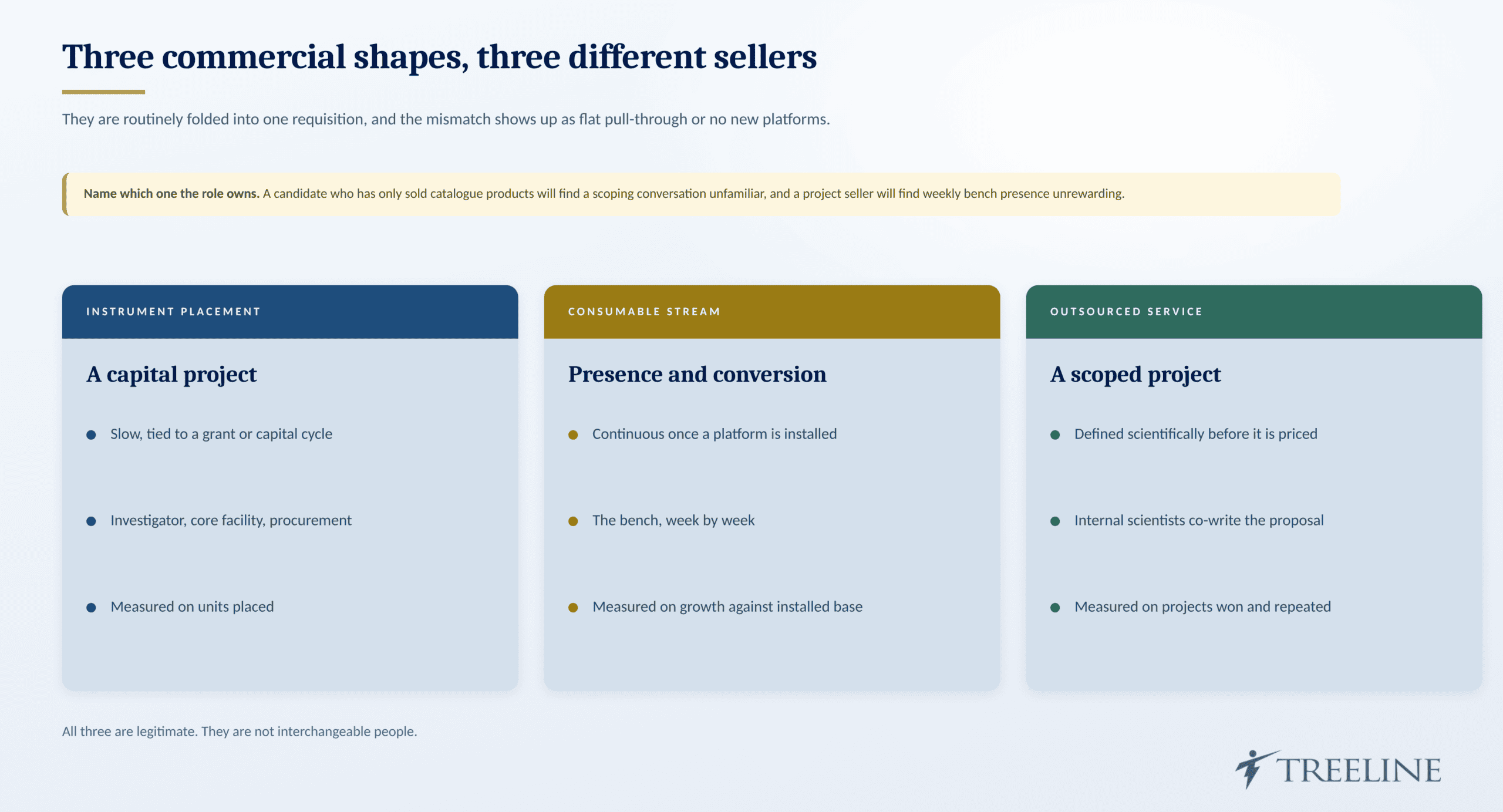
two-jobs-one-territory.png: The capital placement role and the installed-base growth role compared by cycle, buyer and what each is measured on
The commercial shape of this market is distinctive and it is frequently mishandled in the brief.
An instrument placement is a capital event. It is slow, it involves a principal investigator, a core facility manager, institutional procurement and often a committee, and it may hinge on a grant being awarded. It is a project, and the seller’s work is building a case and surviving a budget cycle.
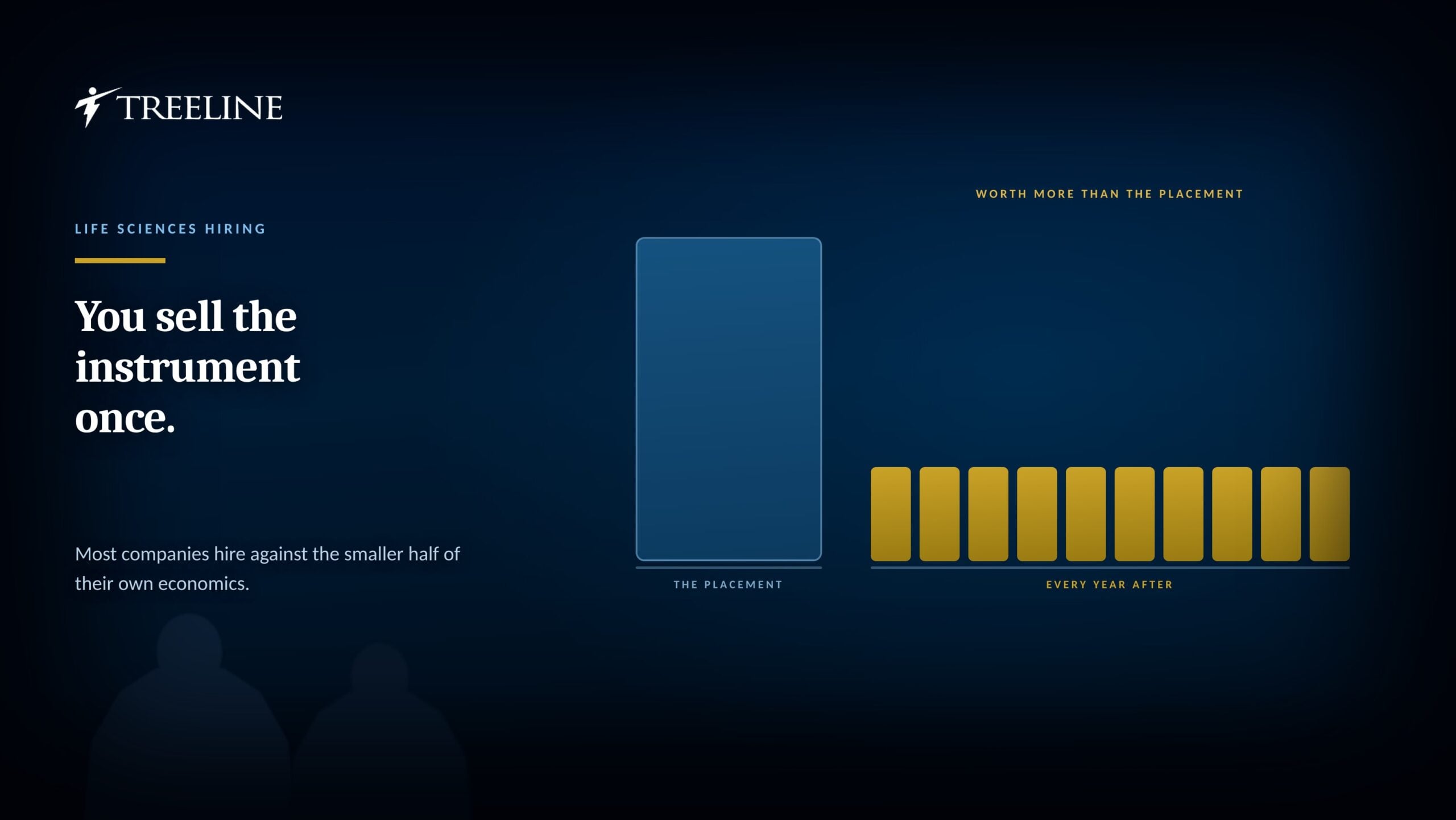
What follows is the part that matters financially. An installed platform generates consumables, reagents, service contracts and upgrades for years, and that stream is worth considerably more than the placement that started it. Growing it is a different activity: being present in the lab, converting more of the workflow, defending against a competitor offering a cheaper equivalent, and keeping the instrument used rather than idle.
A third shape sits alongside those two and is often folded into the same requisition by mistake. Outsourced research and manufacturing services, contract research, process development, analytical work, are sold as projects rather than products. The deal is scoped scientifically before it is priced, the proposal is itself a technical document, and the seller works with internal scientists to define what is being bought. That is closer to professional services selling than to either of the other two, and a candidate who has only sold catalogue products will find the scoping conversation unfamiliar.
Companies routinely hire a capital seller and then wonder why pull-through is flat, or hire an account grower and wonder why no new platforms are landing. Both are legitimate hires. They require different people and should be named separately in the requisition.
Fantasia’s perspective is that the brief should state which half of the economics the hire is accountable for. He recommends asking a candidate directly which they were measured on, because the answer is usually unambiguous and candidates rarely volunteer it unprompted.
What Life Sciences Sales Recruiting Has to Test
Five questions carry most of the signal, and strong candidates generally enjoy them.
Mechanism. Ask the candidate to explain how their product works to a non-specialist, then to say where it performs poorly. Fluency plus a willingness to name limitations is the pattern you want. Fluency without limitations usually means a memorized deck.
Funding literacy. Ask how they learned when an account’s money would be available, and what they did with that information. Strong answers involve knowing grant timing, institutional fiscal year ends and capital request cycles, and planning around them rather than discovering them.
Validation handling. Ask about a customer who wanted to switch but was worried about disrupting established work, and what the seller actually offered. The good answers involve side-by-side evaluation, transition support and patience. The weak answers involve discount.
Pull-through evidence. Ask what happened to an account in the two years after they placed an instrument. Sellers who own the whole lifecycle can describe usage growth, workflow expansion and competitive defense. Sellers who only place will describe the sale and then stop.
Institutional navigation. Ask who else had to agree besides the scientist. Core facility managers, procurement, environmental health and safety, and in some settings regulatory functions all shape what can be bought. A candidate who has only ever persuaded the end user will not know the route.
Where Life Sciences Sales Recruiting Finds Candidates
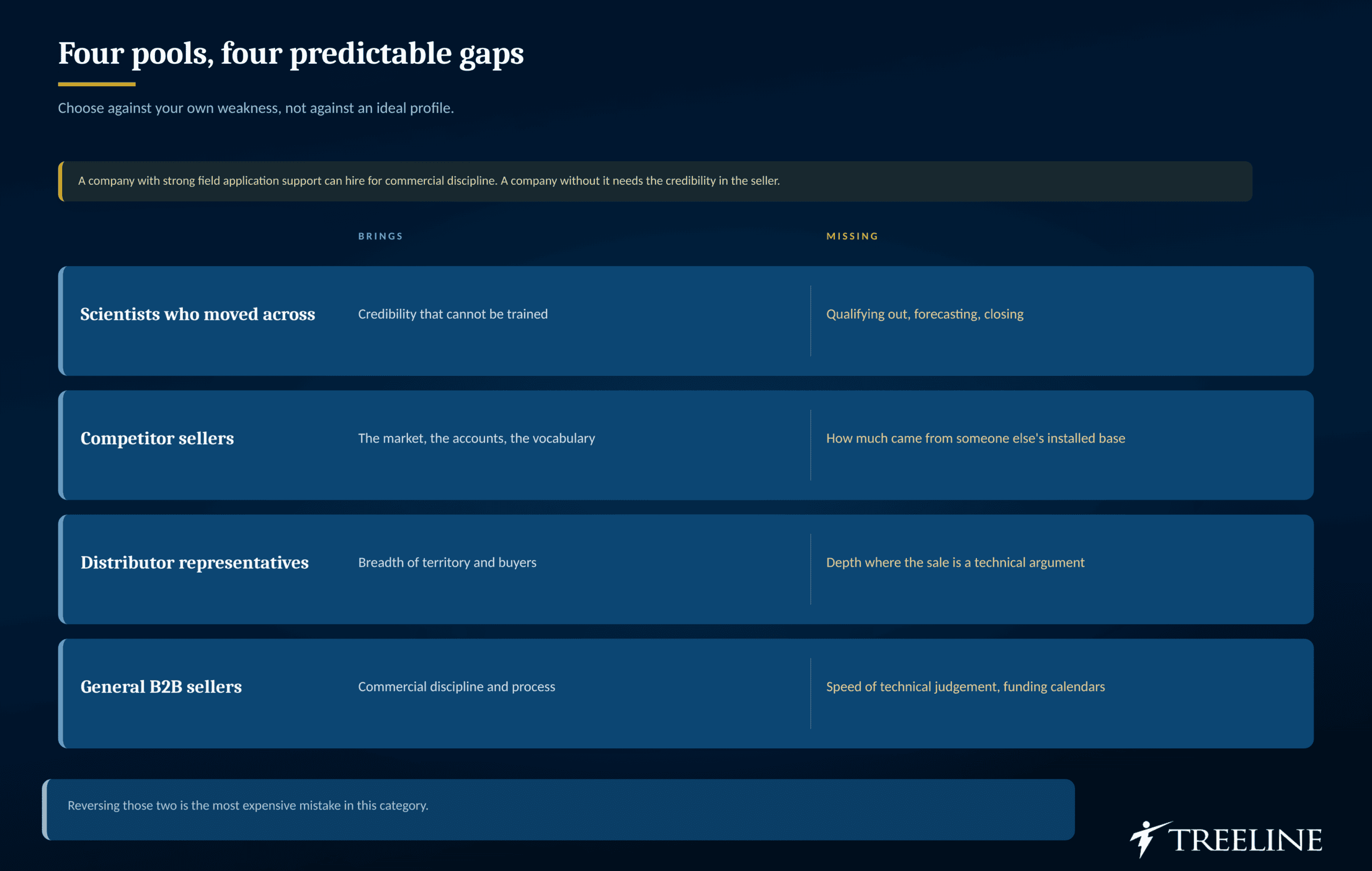
four-pools-four-gaps.png: Four candidate pools with what each one brings and what it is missing
Four pools supply most of these hires, and the risk in each is predictable.
Scientists who moved into commercial roles, often through field application or technical support positions, bring credibility that cannot be trained. They are frequently the strongest hires in this category. The gap is the commercial half: qualifying out, forecasting, negotiating and asking for a decision are new skills, and the first year should be supported deliberately.
Competitor sellers arrive with the market, the accounts and the technical vocabulary, and are the fastest to productivity. The question worth asking is how much of their performance came from an installed base somebody else placed, because that part does not move with them.
Distributor representatives know a wide swathe of the territory and many buyers, but usually at lower depth per product. They convert well where the product is simple and less well where the sale is a technical argument.
General business-to-business sellers are the largest pool and the highest variance. Many are capable, and the two things that catch them out are the speed at which a technical buyer assesses credibility and the external funding calendar, which does not bend to effort.
Fantasia emphasizes that the pool should be chosen against the company’s own weakness rather than an ideal profile. His operating perspective is that a company with strong technical support can hire for commercial discipline and train the science, while a company whose support function is thin needs the credibility in the seller, and that reversing those two is the most expensive mistake in this category.
How Life Sciences Sales Recruiting Should Handle Compensation
The commercial shape creates a compensation problem that general plans do not anticipate.
Placements are lumpy and infrequent; consumable revenue is steady and compounding. A plan weighted entirely to new placements underpays the person growing an installed base, who is generating most of the margin. A plan weighted entirely to territory revenue pays the current holder for placements somebody else made years ago.
Three adjustments usually help. Separate placement incentives from pull-through growth, so both activities are visible and paid. Measure pull-through as growth against the installed base rather than as absolute revenue, which removes the inherited-territory distortion. And set the measurement period against the funding calendar where the business allows, because quarterly measurement in a market with annual budget releases manufactures artificial pressure at predictable moments.
Fantasia recommends being explicit with candidates about which half of the plan is weighted more heavily. His view is that experienced people in this market read the plan as a statement of what the company actually wants, and that a mismatch discovered in month four is usually the start of a departure.
What Changes When the Buyer Is a Company Rather Than an Institution
A meaningful share of this market is commercial rather than academic, and the two behave
differently enough to be worth separating in the brief.
Academic and institutional buyers are grant-funded, committee-influenced and often price-sensitive
in ways that look irrational until the funding mechanism is understood. A principal investigator
spending awarded money has constraints on what the award may be used for and when it must be spent.
Industry buyers, biotechnology companies, pharmaceutical research groups, diagnostics developers —
have faster decisions, larger budgets and a different anxiety. Their concern is usually continuity
of supply, documentation and whether a vendor can support work that may later sit inside a
regulatory filing. A seller strong with academic laboratories can struggle with the quality and
supply-chain questions an industrial buyer asks early, and the reverse happens too.
Most territories contain both. The question for the brief is which mix this territory actually
holds, because a candidate’s history will usually lean heavily one way.
Why the Contingency Model Fits This Market
Life sciences field roles are territorial, recurring and comparatively numerous. A company covering a region is hiring across several territories at similar levels on a rolling basis as people move, which suits an arrangement where the fee attaches to each hire and several territories can be worked in parallel.
The market also moves quickly at the candidate level. Strong technical sellers are rarely available long, and a structure that allows a firm to present people as they surface rather than running a single sequential search matches how the market actually behaves.
The honest exception is leadership and market entry. A commercial director, a first field leader for a platform launch, or a national accounts role negotiating directly with large institutions are small-universe searches, and a retained engagement generally serves those better.
What Life Sciences Sales Recruiting Asks of the Employer
Three things should be settled before candidates are in process.
Which half of the economics the role owns, placement, pull-through, or an explicit split with the weighting stated.
What technical support the seller will have. A company with field application scientists can hire a commercially strong seller and let support carry the depth. A company without them is asking the seller to be both, which narrows the pool considerably and should be priced accordingly.
A realistic first-year expectation that accounts for funding cycles. If the territory’s major accounts make capital decisions once a year and that decision has passed, the first year is a relationship-building year regardless of who is hired.
Reading the First Year
Four things should be visible at twelve months, and placement revenue is only one of them.
A map of the territory’s funding rhythm, which accounts decide when, and what triggers a purchase. Technical standing, visible in whether scientists call the seller with questions rather than only responding to outreach. Pull-through movement on the existing installed base, which is the clearest early indicator of whether the relationship is real. And at least one evaluation run against an incumbent, won or lost, because that is where the seller’s handling of validation risk is actually tested.
A seller with those and modest placement revenue is building a territory. A seller with one large placement and none of the rest has won a project, which is useful and not yet a book.
Frequently Asked Questions
Why does switching cost so much in this market?
Because the cost is scientific rather than financial. Changing a reagent, platform or assay can require revalidation, re-running controls and explaining the change to reviewers or regulators. The seller’s real competition is often the disruption itself, which is why transition support argues better than price.
Can a bench scientist carry a quota?
It works more often than people expect, and this pool produces some of the strongest performers in the category. Credibility with a technical buyer is very hard to train. Plan deliberately for the commercial half, qualifying out, forecasting and closing, and support the first year.
What is pull-through and why does it decide the hire?
Pull-through is the consumable, reagent and service revenue that follows an installed instrument, and it is usually worth more than the placement. A company that hires a capital seller and expects installed-base growth, or the reverse, has hired against the wrong half of its own economics.
How do grant and budget cycles change forecasting?
They put the decision date outside the seller’s influence. Money becomes available when a grant is awarded, a capital request is approved or a fiscal year closes. A seller who does not know those dates for their major accounts is forecasting on the company’s calendar rather than the customer’s.
How much of a rival rep’s number is really theirs?
They are the quickest to productivity and the most expensive. Establish how much of their number came from an installed base that somebody else placed, since that revenue stays behind when they leave.
How do we pay for placements and reorders at once?
Separate placement from pull-through so both are visible, measure pull-through as growth against the installed base rather than absolute revenue, and align the measurement period to funding calendars where the business allows.
What has to be true about our technical support?
A decision on which half of the economics the role owns, clarity on what technical support the seller will have, and a first-year expectation that accounts for when the territory’s accounts actually make funding decisions.
Which life sciences roles justify a retainer?
For a commercial director, a first field leader on a platform launch, or a national accounts role negotiating with large institutions, searches where the candidate universe is small enough to enumerate.
Hire for the Conversation the Scientist Is Having
Life sciences sales recruiting goes wrong most often when the process tests selling and the market tests understanding. A candidate who presents well, qualifies cleanly and forecasts accurately can still be unable to hold the ten-minute technical exchange that decides whether a laboratory takes them seriously.
The inverse failure is real too, and quieter. A deeply credible scientist who never asks for a decision will be liked by every account and close very little. The hire that works sits between those, and the way to find it is to test both halves explicitly rather than hoping one implies the other.
Share This Story, Choose Your Platform!
Related Posts

What our happy clients are saying
Treeline Inc. provided us with the most candidates that aligned with our needs and were of the highest quality.

Dr. Jeffrey Klein Head of North America Sales, Satchel Pulse
Treeline Inc.’s collaborative, flexible, and communicative approach resulted in a smooth partnership. Beyond their recruitment expertise, their unique sourcing model was efficient and effective.

Sera Holt Director of Operations, LNS Research
Their professionalism was outstanding. Treeline Inc. was extremely thorough and ensured that we were on the same page before they started looking for candidates. They listened to us and did a great job working with the candidate to close out the process.

Cate Grant AVP Customer Success, Nasdaq
Thanks to Treeline Inc.’s intricate and thorough screening process, the company is able to hire six high-quality candidates that fit perfectly in the company’s culture. The team is highly receptive to concerns, and internal stakeholders are impressed with their unique recruitment abilities.

Anna McKean Sales Recruiter, Insider Intelligence
Treeline Inc. has been qualified individuals throughout a five-year-long engagement. They’ve made numerous placements of talented and qualified individuals for our business.

Michele St Laurent VP of HR, The Institute for Applied Network Security

Let Us Help You Source the Sales Talent You Need
Whether you’re building a team or replacing a key role, our Candidate Sourcing Platform provides a fast, flexible, and employer-focused solution.
Tell us more about your business and how we can help.
Treeline Inc.
Your Award-Winning Sales Recruitment Partner
15 Lincoln Street, Suite 314, Wakefield, MA 01880