Security software is sold to the most heavily prospected function in the enterprise, by sellers whose credibility is assessed in the first few minutes of a technical conversation, through an evaluation run by engineers, into a procurement process that audits the seller’s own company before it will buy anything. Each of those is a filter. A candidate can pass the ordinary enterprise sales interview comfortably and fail at any one of them.
That is why these searches reward a firm that understands the category. The structural case for running one on contingency, fee payable on a hire, risk carried by the firm, is set out in contingency hire versus retained search, and the mechanics of the arrangement itself are described on the contingency sales recruiting page. The structure is the straightforward part. The difficulty is that most briefs for these roles describe an enterprise seller and leave out everything that makes this one different.
This article is about the quota-carrying seller. The sales engineer who supports them is a related and genuinely distinct search, and the partner-led motion through resellers and managed security providers is a third.
Dan Fantasia, CEO of Treeline, Inc., frames security hiring as a question of admission rather than persuasion. From his perspective the useful early test is how a candidate has historically reached a chief information security officer who was not looking for them, because in this category the ability to get into the conversation discriminates between candidates far more sharply than the ability to run one.
What Cybersecurity Sales Recruiting Is Really Screening For
Three characteristics separate this from general enterprise software selling, and all three are assessable.
The buyer is saturated. Security leaders receive more unsolicited outreach than almost any other role in a company, much of it automated and most of it indistinguishable. The practical consequence is that cold volume does not work, and a candidate whose entire method is sequence-and-persist will produce activity and no meetings. The sellers who succeed arrive through something else: a practitioner community, an analyst relationship, a former colleague now in seat, a conference where they were a participant rather than a sponsor.
Credibility is binary and immediate. A security practitioner can tell within a few minutes whether the person opposite understands the problem they actually have. There is no partial credit. A seller who can describe the threat model, name what the product does not do, and say honestly where a competitor is stronger will be given time. One who recites positioning will not get a second meeting, and will often not know why.
The purchase is justified by risk rather than return. Security spend competes against projects that generate revenue, and it is defended in terms of what might happen rather than what will. This makes the business case harder to construct, more dependent on the buyer’s own internal narrative, and much more sensitive to whether a budget cycle, an audit or an incident is driving the timing.
Why the Security Buyer Is the Hardest Audience to Reach
The saturation problem deserves to be treated as a structural feature of the role rather than a difficulty the hire will overcome with effort.
A seller entering this market without a route in has to build one, and building one takes quarters rather than weeks. That is why candidates who arrive with standing in the practitioner community are worth a premium, and why the premium is justified: they are being paid for access that cannot be manufactured quickly.
It also means the company’s own position matters more than it does elsewhere. A vendor with analyst coverage, an active user community, credible published research or a recognizable name in the category hands its sellers a route in. A vendor with none of those is asking a seller to supply it personally, which is a different and much harder job that should be reflected in both the brief and the compensation.
Fantasia’s perspective is that employers routinely misread this as a prospecting-effort problem. He recommends asking a candidate to describe, concretely, the last three security buyers they reached who did not already know their company, and how each of those conversations actually began, because the answer distinguishes a seller who has solved the access problem from one who has only ever worked a warm territory.
How Cybersecurity Sales Recruiting Should Treat the Technical Evaluation
The real sales cycle in this category is the technical evaluation, and it is run by people who are not the economic buyer.
A proof of concept or bake-off is usually scoped by the buyer’s engineers, measured against criteria the buyer sets, and frequently run against an incumbent that the organization has already paid for. The seller’s job during that window is not to sell. It is to make sure the evaluation measures the things the product is actually good at, that the success criteria are agreed in writing before it starts, and that the engineering team on the customer side has what it needs to produce a clean result.
Sellers who are weak here lose deals they appeared to be winning. They allow a scope that favors the incumbent, let criteria stay vague, or hand the entire evaluation to their sales engineer and reappear when it is finished. Sellers who are strong treat the evaluation as the part of the deal where it is actually decided, and they can describe exactly how they shaped one.
There is a second technical gate that candidates outside the category often do not know exists. Before a security product is purchased, the buyer’s own security and procurement functions will assess the vendor: compliance attestations, penetration test summaries, architecture review, and a questionnaire that can run to hundreds of items. The seller does not complete that work, but they do shepherd it, and a deal can stall for a quarter because nobody chased an internal team for a document. Candidates who have done this will mention it unprompted.
What Cybersecurity Sales Recruiting Has to Test
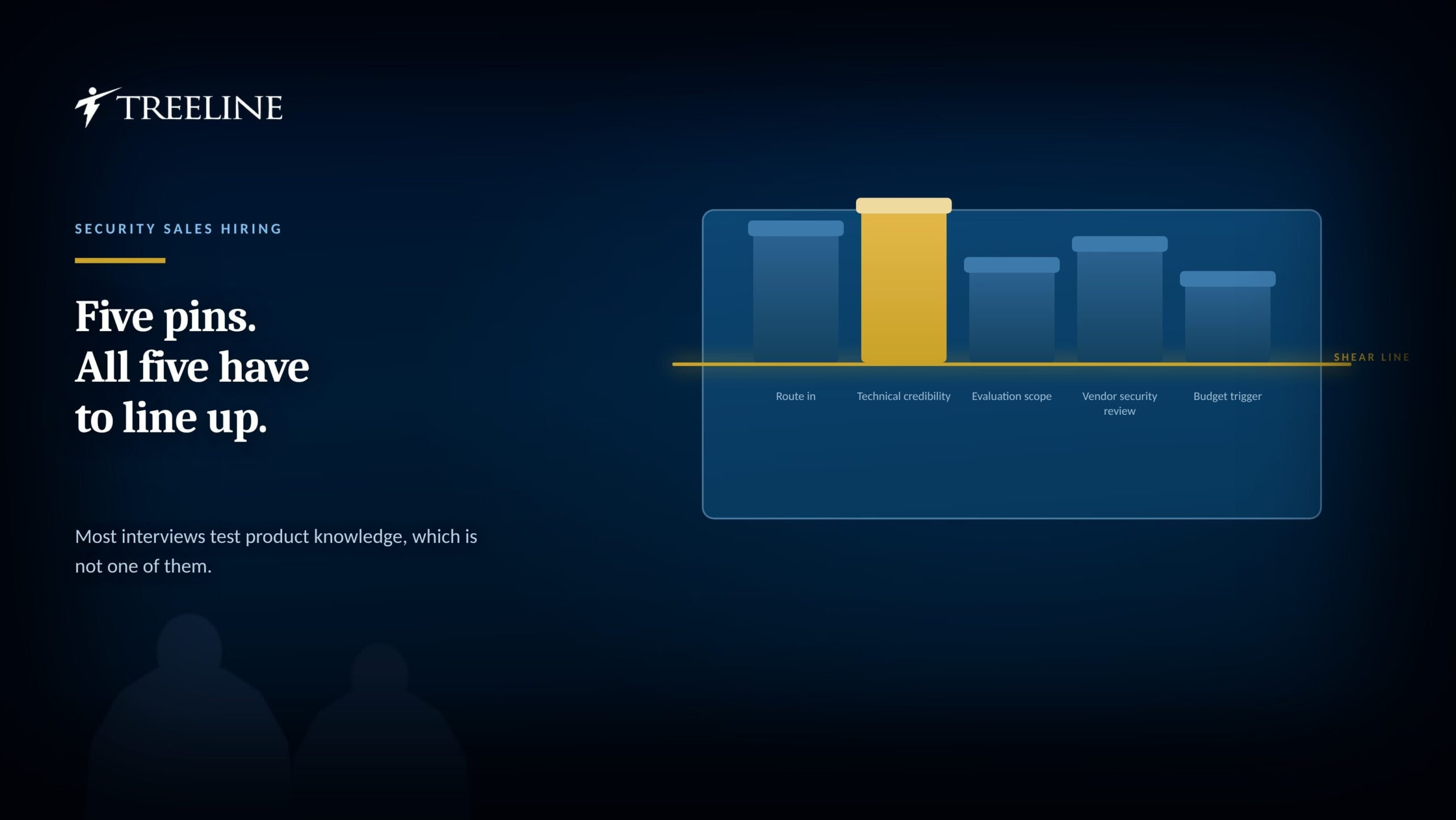
Five questions carry most of the signal.
Route in. Name the last three security buyers you reached who had never heard of your company, and describe how each conversation started. Listen for specific mechanisms rather than channels in the abstract.
Technical honesty. Ask the candidate to explain what their product did not do well, and how they handled a buyer who raised it. Candidates who cannot name a weakness have either not been in enough technical conversations or have not survived them.
Evaluation control. Ask them to describe a bake-off they were part of, how the success criteria were set, and what they did to influence the scope. The weak answer describes the outcome. The strong answer describes the setup.
The reverse audit. Ask what happened the last time a buyer’s security team assessed their company, and what slowed it down. This is a question most candidates from outside the category cannot answer at all, and it is a reliable discriminator.
Trigger literacy. Ask them to describe a deal driven by an audit deadline and one driven by an incident, and how the two differed. The answers should be structurally different, and a candidate who treats them the same has probably worked only one of them.
Why Compliance Deals and Breach Deals Are Different Searches
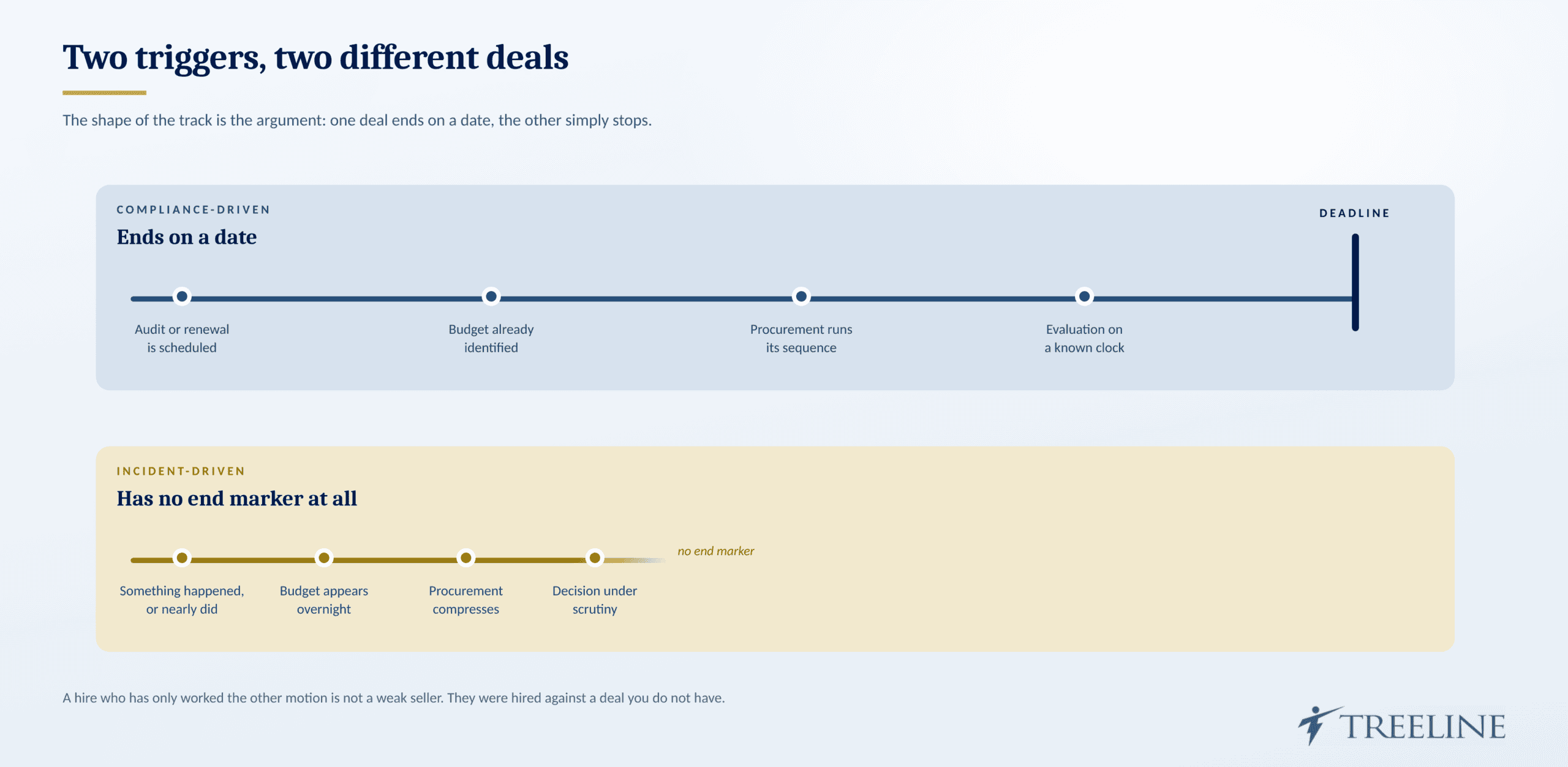
Security purchases arrive through two quite different doors, and sellers are not equally good at both.
A compliance-driven deal has a date. An audit, a certification renewal, a customer contract requirement or a regulatory deadline creates a fixed point, budget is usually identified, and the buying process is procedural. The seller’s work is to be the lowest-friction way to satisfy a requirement by a known date, which rewards precision, documentation and patience with process.
An incident-driven deal has no date and enormous urgency. Something has happened, or nearly happened, and the organization wants capability quickly. Budget appears that did not exist the week before, the usual procurement sequence compresses, and the decision is made by people who are tired and under scrutiny. The seller’s work is to be credible, fast and calm, which rewards a different temperament entirely.
A company whose pipeline is mostly compliance-driven and whose new hire has only ever worked incident response will find that the hire is frustrated by the pace. The reverse mismatch produces someone who cannot operate when the process disappears. Neither is a bad seller; they were hired against a motion the company does not run.
Where Cybersecurity Sales Recruiting Finds Candidates
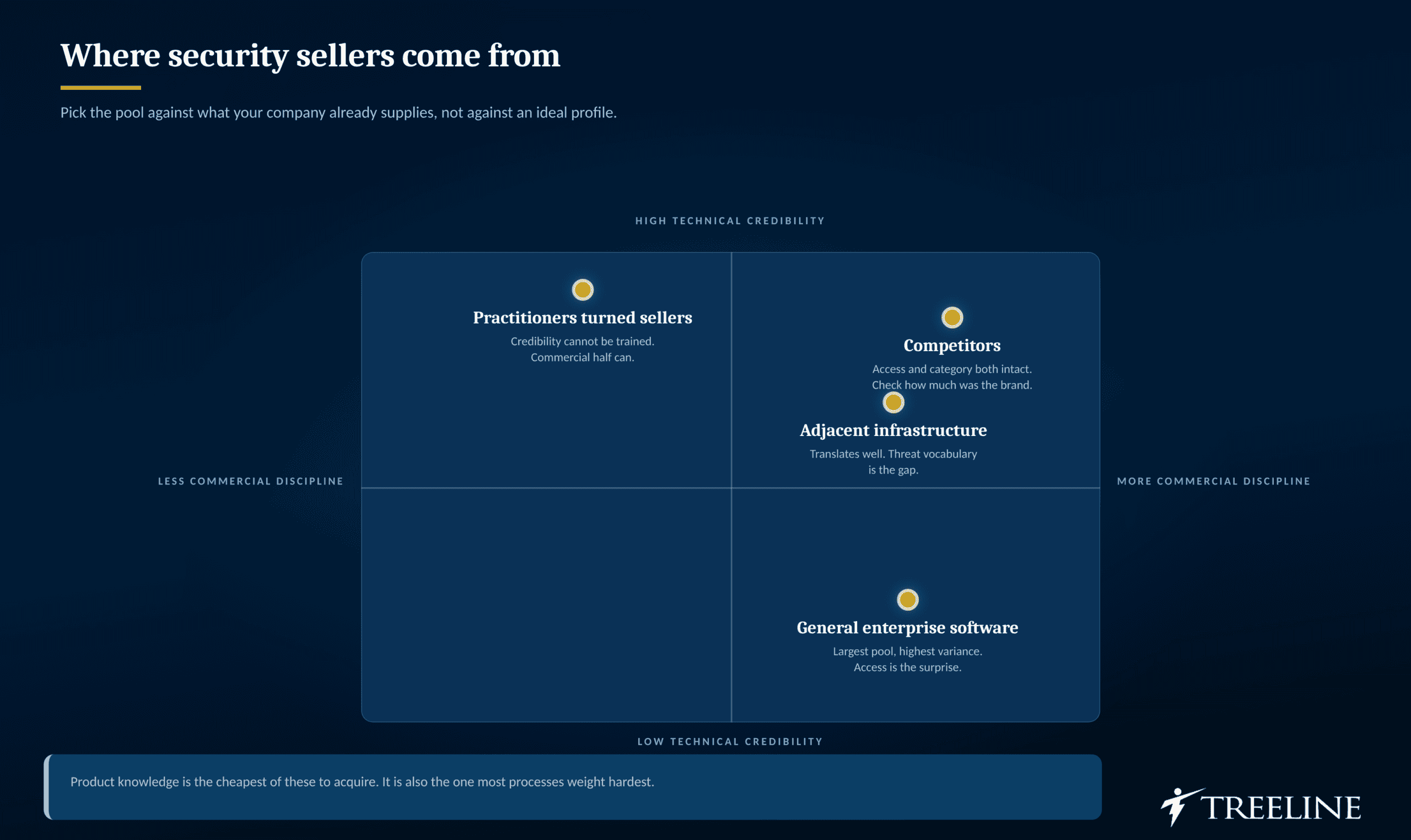
Four candidate pools plotted by technical credibility against commercial discipline
Four pools supply most of these hires.
Sellers from direct competitors arrive with the category understanding and often the buyer relationships, and they are priced accordingly. The question worth asking is whether their results depended on the employer’s brand and analyst position, since that part does not travel.
Sellers from adjacent infrastructure software, identity, networking, observability, data platforms, understand technical buyers and long evaluations, and they usually translate well. The gap is the threat vocabulary, which is learnable, and the practitioner credibility, which takes longer.
Practitioners who moved into commercial roles, including former analysts and engineers who became sales engineers and then sellers, carry credibility that cannot be trained. The risk is the commercial half: forecasting discipline, negotiation, and the willingness to ask for a decision.
Sellers from general enterprise software are the largest pool and the highest variance. Some adapt quickly. Many underestimate how different the access problem is, and discover in month four that the method which worked in their previous category produces nothing here.
Fantasia emphasizes that the right pool depends on what the employer already has. His operating perspective is that a company with strong category presence should hire for commercial discipline and let its own position supply the access, while a company nobody has heard of should hire for access and accept paying for it, and that the common error is hiring for product knowledge, which is the cheapest of the three to acquire.
What Cybersecurity Sales Recruiting Asks of the Employer
Three things should be settled before candidates are in process.
An honest assessment of the company’s own position. Does the company have analyst coverage, published research, a user community, a recognizable name? If not, the seller is being asked to supply the route in personally, and the brief and the package should say so.
The dominant trigger. Is the pipeline compliance-driven, incident-driven or genuinely both? This determines which candidates will thrive and which will be frustrated.
Readiness for the reverse audit. Someone inside the company should own compliance attestations, architecture documentation and questionnaire responses, and they should be current before the first deal reaches that stage rather than assembled under time pressure during it.
Fantasia recommends treating the last of these as a sales enablement question rather than a compliance one. His view is that a company which cannot answer a buyer’s security questionnaire promptly is adding a quarter to its own sales cycle, and no hire will compensate for that.
Reading the First Year
Revenue in year one is a weak signal in this category, because the evaluation cycles are long and the access problem is front-loaded.
Four things should be visible instead. Routes in that did not exist before the hire, named communities, analysts, events, former colleagues now in seat. Evaluations shaped rather than merely survived, with criteria the seller influenced. Clean passage through at least one buyer-side security review, with the internal bottlenecks identified. And a forecast that distinguishes compliance-driven from incident-driven deals, because the two behave differently and a forecast that mixes them is not telling anyone much.
A seller with those and modest closed revenue is building a territory. A seller with one large incident-driven deal and none of the rest has caught something, which is good luck and not yet a pattern.
Frequently Asked Questions
Why does cold outreach work so poorly on security buyers?
Because they receive more unsolicited contact than almost any other enterprise role, most of it automated and much of it identical. Volume does not distinguish a seller. The ones who get meetings arrive through practitioner communities, analyst relationships, former colleagues or events where they participated rather than sponsored.
Will a generalist SaaS seller adapt to this category?
Some do well and many underestimate the change. The product knowledge is the easy part. The difficult parts are the access problem and the speed at which a technical buyer judges credibility, and both tend to surface around month four rather than during interviews.
What is the reverse audit candidates should know about?
Before buying a security product, the buyer’s own security and procurement teams assess the vendor, compliance attestations, penetration test summaries, architecture review and a questionnaire that can run to hundreds of items. The seller shepherds it rather than completing it, and deals stall here routinely.
How much does the technical evaluation really matter?
It is usually where the deal is decided. Scope and success criteria are set by the buyer’s engineers, often against an incumbent. A seller who lets criteria stay vague or hands the whole evaluation to a sales engineer loses deals that looked winnable.
Are compliance deals and breach-driven deals the same sale?
No. A compliance deal has a fixed date, identified budget and a procedural path, rewarding precision and patience. An incident-driven deal has urgency, budget that appears suddenly and a compressed process, rewarding speed and composure. Sellers are rarely equally good at both.
Should we hire a practitioner and teach them to sell?
It works more often than people expect, because credibility in a technical conversation cannot be trained quickly. Test deliberately for the commercial half, forecasting discipline, negotiation and willingness to ask for a decision, and support it for the first year.
How does the company’s own reputation shape the hire?
Substantially. A company with analyst coverage and a known name supplies the route in, so hire for commercial discipline. A company nobody recognizes is asking the seller to supply access personally, which is a harder job and should be reflected in the brief and the package.
What does a good first year look like without much revenue?
Routes in that did not exist before, evaluations whose criteria the seller shaped, clean passage through at least one buyer-side security review, and a forecast that separates compliance-driven from incident-driven deals.
Hire for Admission, Then for Persuasion
Cybersecurity sales recruiting goes wrong in a consistent way: the brief describes a strong enterprise seller, the interview tests selling, and the hire turns out to be unable to get in front of the people who matter. Product knowledge is the cheapest of the required capabilities to acquire and the one most heavily weighted in most processes.
The sequence that works is the opposite. Establish how the candidate gets admitted to a conversation, then whether they survive the first technical fifteen minutes, then whether they can shape an evaluation they do not control. A candidate who clears those three will learn the product. A candidate who knows the product and cannot clear them will spend a year generating activity that does not become pipeline.
Share This Story, Choose Your Platform!
Related Posts
What our happy clients are saying
Treeline Inc. provided us with the most candidates that aligned with our needs and were of the highest quality.

Dr. Jeffrey Klein Head of North America Sales, Satchel Pulse
Treeline Inc.’s collaborative, flexible, and communicative approach resulted in a smooth partnership. Beyond their recruitment expertise, their unique sourcing model was efficient and effective.

Sera Holt Director of Operations, LNS Research
Their professionalism was outstanding. Treeline Inc. was extremely thorough and ensured that we were on the same page before they started looking for candidates. They listened to us and did a great job working with the candidate to close out the process.

Cate Grant AVP Customer Success, Nasdaq
Thanks to Treeline Inc.’s intricate and thorough screening process, the company is able to hire six high-quality candidates that fit perfectly in the company’s culture. The team is highly receptive to concerns, and internal stakeholders are impressed with their unique recruitment abilities.

Anna McKean Sales Recruiter, Insider Intelligence
Treeline Inc. has been qualified individuals throughout a five-year-long engagement. They’ve made numerous placements of talented and qualified individuals for our business.

Michele St Laurent VP of HR, The Institute for Applied Network Security

Let Us Help You Source the Sales Talent You Need
Whether you’re building a team or replacing a key role, our Candidate Sourcing Platform provides a fast, flexible, and employer-focused solution.
Tell us more about your business and how we can help.
Treeline Inc.
Your Award-Winning Sales Recruitment Partner
15 Lincoln Street, Suite 314, Wakefield, MA 01880