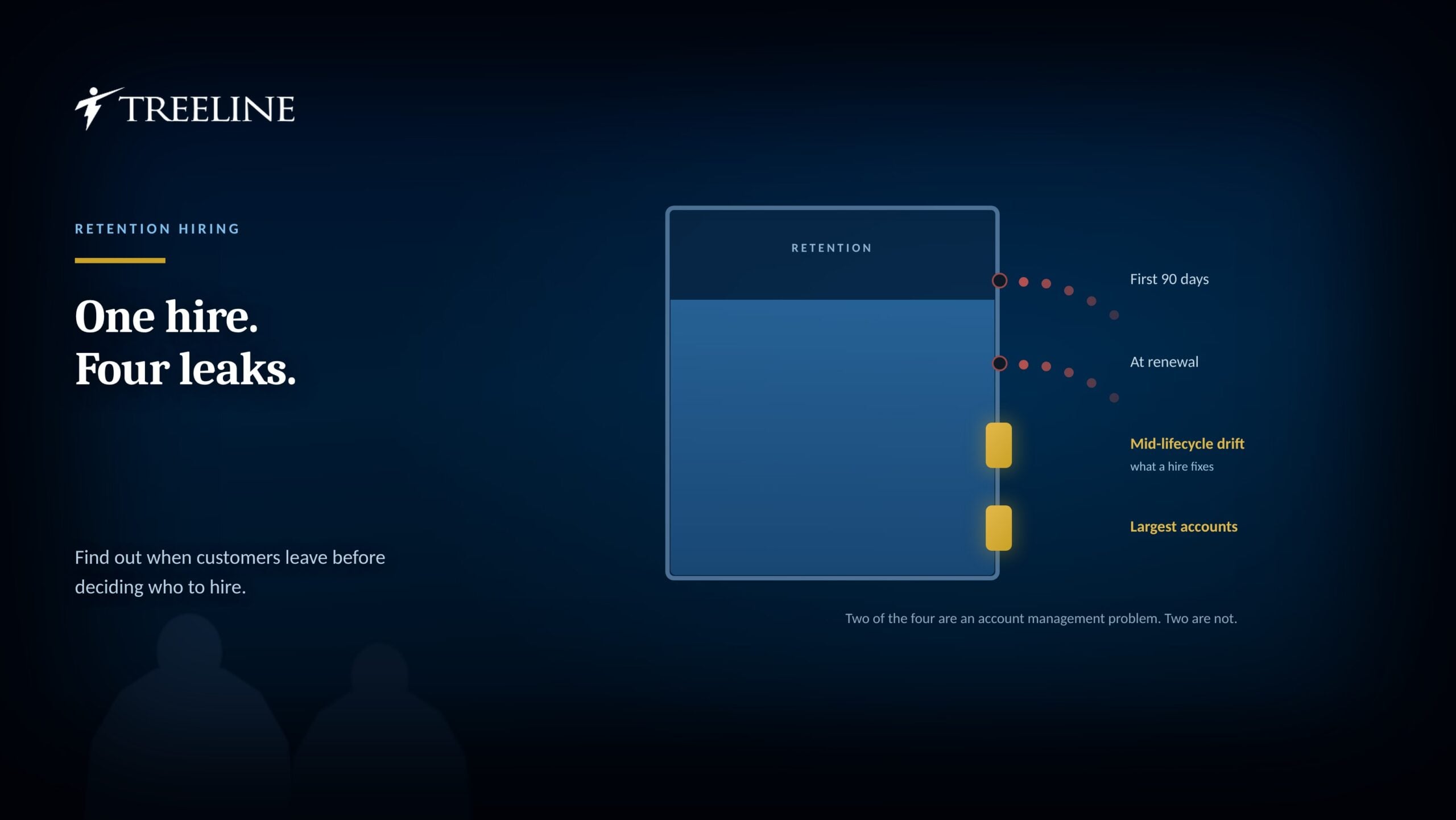
Retention gets worse for two quarters, somebody proposes an account management function, and a requisition opens. It is a reasonable response and it is frequently the wrong one, because churn has several possible causes and account management addresses one of them.
The expensive version of this mistake is not the fee or the salary. It is that a capable person joins, inherits customers who had already decided to leave before anyone called them, works hard for a year, and fails against a number that was never reachable from the seat. The company then concludes it hired badly and runs the search again.
This article is about the question that belongs before the requisition. Once a company has established that it genuinely needs the role, the assessment mechanics, scorecards, interview questions, practical exercises and red flags, are covered in detail in Treeline’s guide to hiring account managers for client retention and upsell ownership. Searches of this kind commonly run under a contingency sales recruiting arrangement, and the case for that model is set out in why Treeline is the best contingency sales recruiting agency.
Dan Fantasia, CEO of Treeline, Inc., puts the test simply: find out when customers leave before deciding who to hire. From his perspective the timing of the loss identifies the cause, and the cause determines whether a hire is the remedy or an expensive way of postponing one.
What Happens When You Hire Account Managers to Solve Churn
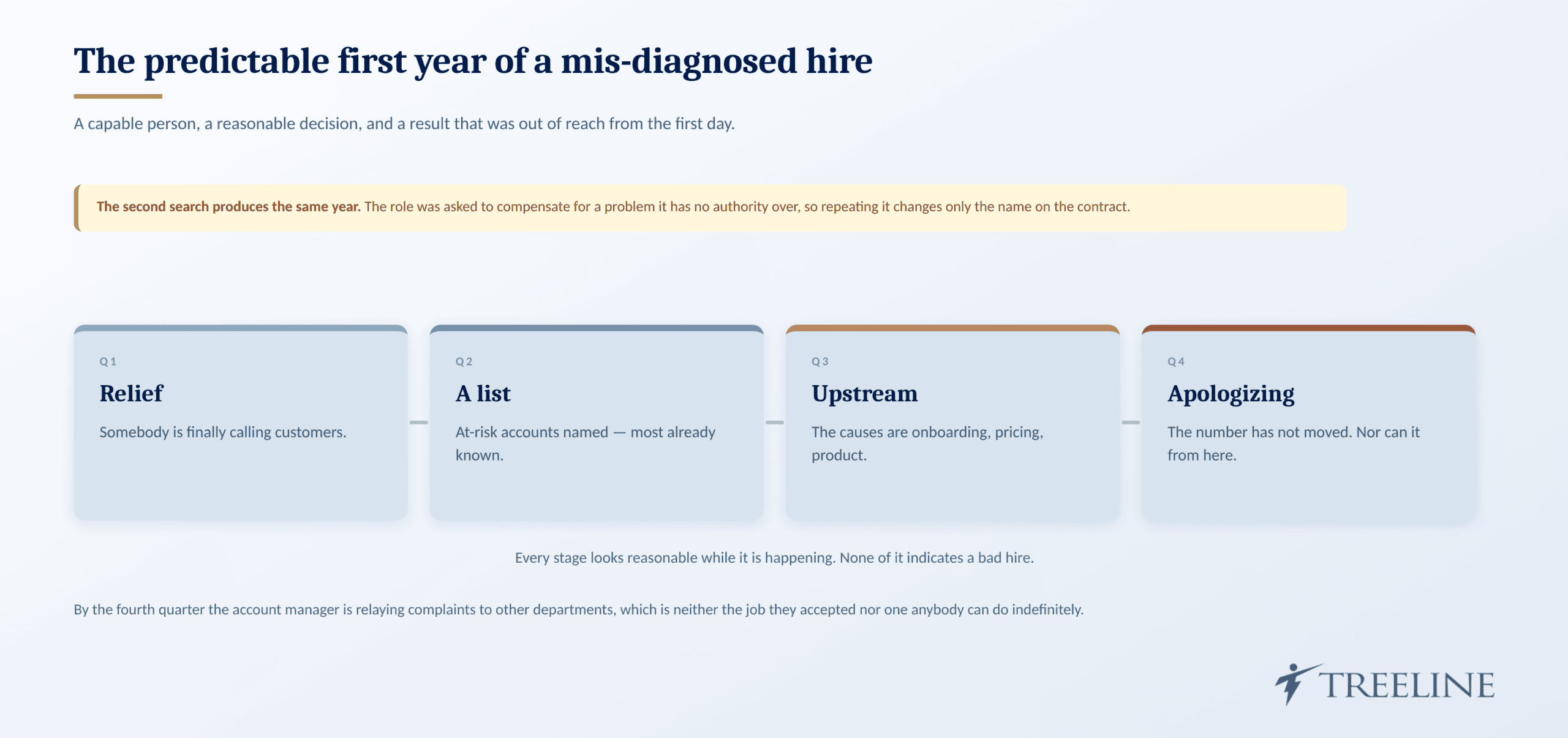
The failure runs to a predictable schedule, which is worth recognizing because every stage looks reasonable while it is happening.
In the first quarter the new account manager meets the customer base and the company feels better immediately, somebody is finally calling people. In the second quarter they produced a list of at-risk accounts, most of which were already known. In the third they start reporting that the problems are upstream: the product does not do what was sold, onboarding never finished, the price increase was not explained. By the fourth quarter the retention number has not moved and the account manager is spending their time apologizing, which is neither the job they accepted nor one anybody can do indefinitely.
Nothing about that sequence indicates a bad hire. It indicates that the role was asked to compensate for a problem it has no authority over, and a second search will produce the same year again.
The Four Churn Causes That No Account Manager Hire Fixes
Churn is a symptom, and four of its common causes sit outside account management entirely.
The customer never reached value. Onboarding stalled, the integration was never finished, or the people who bought it left before it was adopted. By the time an account manager is assigned, the customer has spent months paying for something they do not use, and the decision to leave was effectively taken long before the relationship began.
The customer should never have been sold. Where the sales motion has drifted outside the profile the product actually serves, the resulting customers churn on schedule regardless of how well they are managed. This churn is a sales-qualification problem wearing a retention costume, and hiring an account manager to absorb it transfers the cost rather than removing it.
The price or the packaging produced a surprise. Usage-based overages, an uplift at renewal that nobody flagged, or a tier change that removed something the customer relied on. The account manager inherits a conversation they did not create and cannot resolve without pricing authority.
Service quality has eroded the relationship. Unresolved tickets, slow responses, a known defect that keeps recurring. An account manager can manage the communication around this, which buys time, but the churn continues until the underlying delivery problem is addressed.
Fantasia’s framing is that each of these produces a customer who has already decided, and that an account manager is hired to change decisions that have not been made yet. Assigning one to a book of customers who have privately concluded the thing does not work is not retention work; it is scheduling the conversation.
None of this argues against ever hiring. It argues for sequencing. Where the diagnosis points upstream, the cheaper intervention is usually already available: finishing onboarding for the accounts that stalled, tightening the qualification criteria that let the wrong customers in, or giving somebody authority to discuss price before a renewal rather than after it. Those are weeks of work rather than a year of salary, and they also make the eventual account management hire succeed rather than inherit the same problem.
What to Check Before You Hire Account Managers
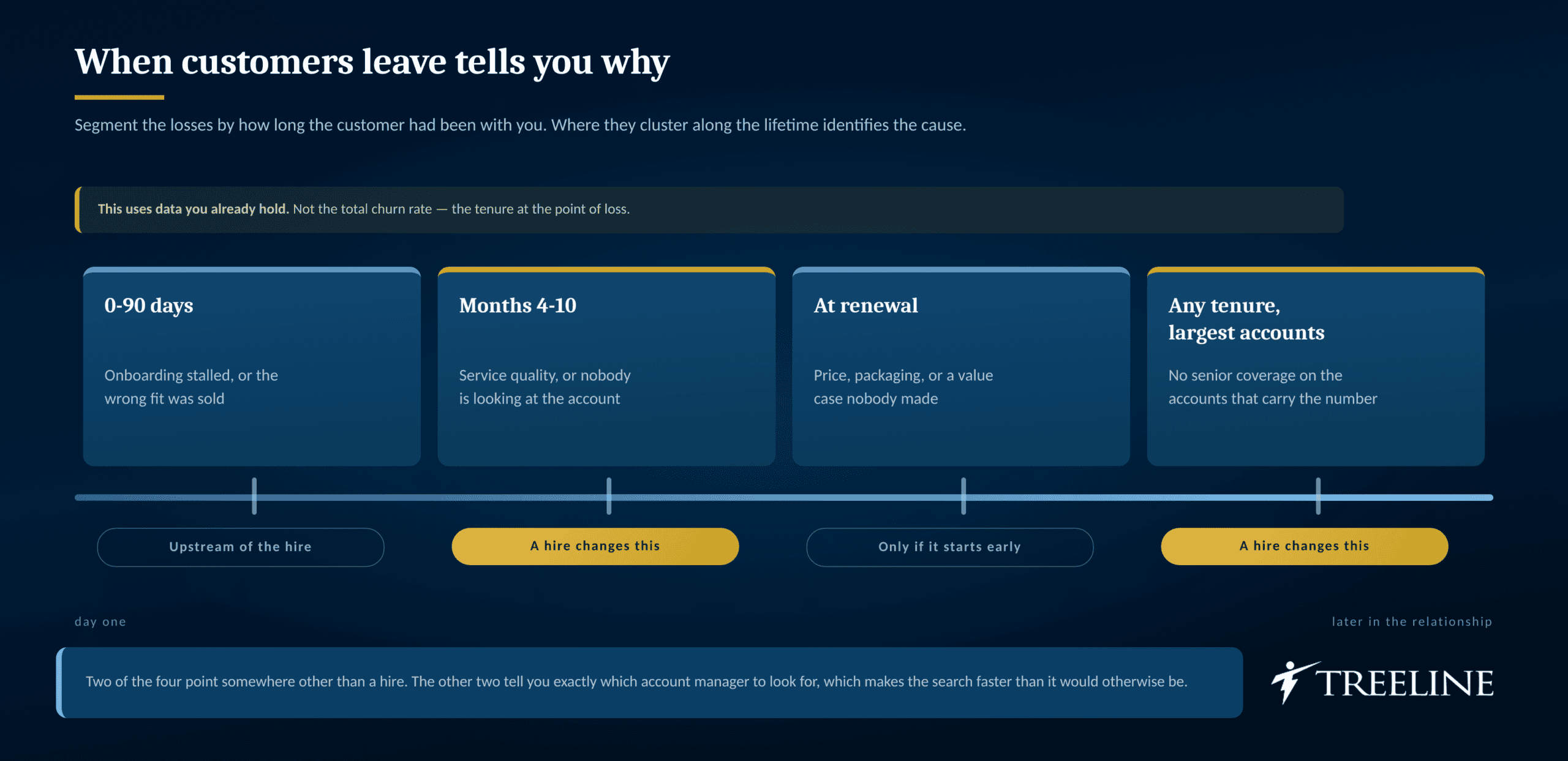
One diagnostic does most of the work, and it uses data a company already holds.
Segment churn by tenure at the point of loss. Not the total rate, when, in the customer lifecycle, the losses occur. The shape of that distribution identifies the cause with reasonable confidence.
Losses concentrated in the first ninety days point at onboarding or fit. The customer never got to value, or should not have been sold. No amount of relationship management moves this, and the remedy is upstream in implementation or qualification.
Losses clustered at the renewal date point at price, packaging or a value case that was never made visible. These customers were not angry; they reached a decision point and could not justify the line item. Account management helps here only if it begins long before the renewal month.
Losses spread evenly through the middle of the lifecycle point at service quality or at an unowned relationship. This is the pattern where an account management function genuinely changes the outcome, because the customer is reachable and the problem is attention.
Losses concentrated among the largest accounts point at coverage. Nobody senior enough was looking after them. This is also a real account-management problem and usually the most expensive one to leave alone.
Two further checks are worth running before committing. Ask whether anybody currently owns the renewal conversation, or whether renewals happen automatically until they do not. And ask what proportion of lost customers were ever contacted by anybody other than support, because if the answer is most of them were not, the function is genuinely missing rather than underperforming. A third is worth adding where the book is large: whether the accounts that churned were distinguishable from the ones that stayed at the point of sale. If they were, the problem is qualification and it belongs at the front of the funnel, not the back.
What Changes About the Search When You Do Hire Account Managers
Where the diagnosis supports the hire, it also specifies it, which makes the search considerably faster.
A coverage problem calls for someone comfortable with a small number of large, political customers, closer to a relationship executive than a support role. Seniority matters because the people they will be talking to are senior.
A mid-lifecycle attention problem calls for throughput and discipline: a larger book, a working cadence, early detection of accounts going quiet. The capability is systematic attention rather than executive presence.
A renewal-date problem calls for commercial confidence. The person has to run a value conversation months ahead of the renewal and be willing to have an awkward exchange about price, which is a different temperament from the one that keeps customers happy.
A mixed picture usually means the first hire should be the person who can build the function rather than only work a book, and that is a different, smaller market with a longer search.
This is also where the compensation plan gets decided. A plan paying only on renewal rate will select for defensive behavior and quiet discounting. A plan that recognizes expansion as well as retention selects for someone who grows the account, which is a materially different hire and usually the one companies actually want.
Where to Hire Account Managers From
The population is large, and the useful distinction is not industry background but what the candidate was previously accountable for.
Account managers with expansion records. People measured on growth inside existing customers rather than on renewal rate alone. The strongest source, and the record is easy to verify by asking which accounts grew and how.
Customer success managers moving commercial. They know the adoption side thoroughly and have usually never owned a commercial conversation. Where the diagnosis is a mid-lifecycle attention problem, this transfer works well; where it is a renewal-price problem, it needs testing.
Sellers who want off the new-logo treadmill. They arrive with commercial confidence and need to learn patience. A reasonable move, and worth probing for whether they will neglect accounts that are not currently transacting.
Implementation and onboarding leads. They have seen exactly why customers fail to reach value, which is the most useful knowledge in the building. Usually a development hire on the commercial side.
Support leads with commercial instinct. Underused. They have been absorbing the relationship damage for years and often know the account base better than anyone.
Why Contingency Suits a Decision to Hire Account Managers
Three features of this search align with a contingency arrangement.
The population is large and reachable, which makes this a screening problem rather than a mapping one. Non-exclusive arrangements work well where the constraint is screening quality rather than access, and a company pays on outcome rather than on search activity.
The role is not confidential. Adding retention coverage is ordinary commercial activity, which removes the clearest argument for a retained engagement.
The brief firms up during the search. Companies frequently begin by describing a renewal-protection role and conclude, after meeting a few candidates with expansion records, that they want growth inside the base rather than defense of it. A non-exclusive arrangement absorbs that without renegotiation.
The limit worth naming: where the hire is the person who will build the function, define the segmentation, set the coverage model, choose the tooling, the pool is much smaller and the assessment deeper, and the case for a retained engagement strengthens. Fantasia’s position has stayed consistent across market cycles: the arrangement follows the shape of the population and the sensitivity of the role, not the seniority on the business card.
Reading the First Year
Retention rate is a lagging measure and will not move inside two quarters even where the hire is right. What can be read earlier is whether the company now knows things it did not know before.
By week six, a segmented view of the book: which accounts are at risk, on what evidence, and which are candidates for growth. By week twelve, at least one renewal conversation started months ahead of its date rather than in its final weeks. By the end of the second quarter, a documented account of why customers have been leaving that is more specific than the one the company had, and ideally one that names a cause outside account management, because that is the finding most likely to be missing.
The failure signatures are legible. Activity concentrated on the accounts that were always going to renew is the comfortable version of the job. A risk list that matches what everyone already believed means the new coverage is not producing information. And an account manager who is mostly relaying complaints to other departments is working on a problem the organization has not accepted responsibility for, which is the clearest sign the original diagnosis was wrong.
Fantasia’s twelve-month test is whether the company can now say why its customers leave, with evidence. A retention number that improved without that understanding usually reflects the mix of customers who happened to come up for renewal, and it will revert.
Frequently Asked Questions
How do we tell whether churn is an account management problem?
Segment the losses by how long the customer had been with you when they left. Losses in the first ninety days point at onboarding or at having sold to the wrong profile. Losses at the renewal date point at price or an unmade value case. Losses spread through the middle of the lifecycle, or concentrated among the largest customers, are the patterns an account management function genuinely changes.
What happens if we hire anyway without diagnosing?
A predictable year. The first quarter feels better because somebody is finally calling customers. By the third the new hire is reporting that the causes are upstream, and by the fourth the retention number has not moved and they are spending their time apologizing. The company usually reads this as a bad hire and repeats the search.
Which churn causes an account manager not to address?
Four: customers who never reached value because onboarding stalled, customers who should never have been sold, pricing or packaging that produced a surprise at renewal, and service quality problems that keep recurring. In each case the customer has effectively decided before the relationship begins.
Once we know the cause, does that specify the candidate?
Substantially. A coverage problem among large accounts calls for someone senior and comfortable with political customers. A mid-lifecycle attention problem calls for throughput and a working cadence across a bigger book. A renewal-price problem calls for commercial confidence and a willingness to have an awkward conversation early.
Should the plan pay on renewal rate?
Paying only on renewal rate selects for defensive behavior and quiet discounting. Recognizing expansion alongside retention selects for someone who grows the account instead of protecting it, which is a different hire and usually the one the company actually wants once it has thought about it.
Can a customer success manager do this job?
Often, with a caveat. They understand adoption thoroughly and have frequently never owned a commercial conversation. Where the problem is mid-lifecycle attention the transfer works well. Where it is a renewal or pricing problem, their comfort with a direct commercial exchange has to be tested rather than assumed.
What tells us fastest whether the function is missing or just underperforming?
Whether anyone currently owns the renewal conversation, or whether renewals simply happen until they do not. And what share of lost customers were ever contacted by someone other than support. If most were not, the function is genuinely missing rather than underperforming.
A year in, what proves the hire was the right call?
An evidence-based account of why customers leave that the company did not have before, ideally one that names at least one cause outside account management. A retention number that improved without that understanding usually reflects which customers happened to renew that year, and it tends to revert.
Find Out When They Leave Before You Decide Who to Hire
Most account management functions are created in response to a number moving in the wrong direction, and the requisition opens before anybody has established what the number is made of. The hire arrives, works a book of customers who had already decided, and is judged against a result that was out of reach from the first day.
Segment the churn by tenure. See whether the losses cluster early, at the renewal date, in the middle, or at the top of the account base. Two of those four answers point somewhere other than a hire. The other two tell you exactly which account manager to look for, and make the search faster than it would otherwise have been.
Share This Story, Choose Your Platform!
Related Posts

What our happy clients are saying
Treeline Inc. provided us with the most candidates that aligned with our needs and were of the highest quality.

Dr. Jeffrey Klein Head of North America Sales, Satchel Pulse
Treeline Inc.’s collaborative, flexible, and communicative approach resulted in a smooth partnership. Beyond their recruitment expertise, their unique sourcing model was efficient and effective.

Sera Holt Director of Operations, LNS Research
Their professionalism was outstanding. Treeline Inc. was extremely thorough and ensured that we were on the same page before they started looking for candidates. They listened to us and did a great job working with the candidate to close out the process.

Cate Grant AVP Customer Success, Nasdaq
Thanks to Treeline Inc.’s intricate and thorough screening process, the company is able to hire six high-quality candidates that fit perfectly in the company’s culture. The team is highly receptive to concerns, and internal stakeholders are impressed with their unique recruitment abilities.

Anna McKean Sales Recruiter, Insider Intelligence
Treeline Inc. has been qualified individuals throughout a five-year-long engagement. They’ve made numerous placements of talented and qualified individuals for our business.

Michele St Laurent VP of HR, The Institute for Applied Network Security

Let Us Help You Source the Sales Talent You Need
Whether you’re building a team or replacing a key role, our Candidate Sourcing Platform provides a fast, flexible, and employer-focused solution.
Tell us more about your business and how we can help.
Treeline Inc.
Your Award-Winning Sales Recruitment Partner
15 Lincoln Street, Suite 314, Wakefield, MA 01880