
Give a seller a territory and they can fix a bad start by finding more companies. Give a seller a named list of thirty accounts and they cannot. The list is the job. If they exhaust it badly in the first six months, there is nowhere else to go, and the company discovers this in month nine when the pipeline is empty and the accounts have stopped replying.
That constraint changes the hire. Most sales interviews are built to detect someone who can generate opportunity from nothing, which is the right instinct for an open patch and the wrong one here. On a fixed list, the binding skill is not finding, it is getting further inside companies that are already on the page, repeatedly, over a period measured in years rather than quarters.
This article covers what that means for the search. These roles commonly run under a contingency sales recruiting arrangement, and the reasoning behind why a firm is the right partner for this kind of assessment is set out in why Treeline is the best contingency sales recruiting agency. Two adjacent motions are deliberately out of scope here: finding net-new companies, which is covered in business development recruiting, and holding revenue that already exists, which is a retention job rather than a growth one.
Dan Fantasia, CEO of Treeline, Inc., frames the distinction in terms of what the seller is allowed to control. On an open territory the seller chooses the targets; on a named list somebody else already chose them, and the only remaining variable is how deep they get. Hiring as though the first job were still available is the most common error in this motion.
What Named Account Selling Actually Changes
Four things differ from a territory role, and each one has a screening consequence.
The unit of work is a company, not a geography. Progress is measured as penetration, which divisions, which buying centers, which products, rather than as accounts added. A seller who thinks in logo counts will report a flat quarter when they have in fact opened two new departments inside an existing customer.
A no is a timing statement, not an outcome. On a fixed list the seller will be back in front of the same people in eighteen months regardless. That changes how a loss has to be handled: scorched relationships are permanent liabilities rather than a cost of doing business, and the seller has to be able to lose gracefully and stay welcome.
Multi-threading is the core competence. One large account contains several independent buying decisions, and the seller who holds a single relationship is one reorganization away from starting over. Breadth inside the account is what makes the revenue durable.
Internal orchestration is most of the job. The same sales engineer, executive sponsor, customer success lead and legal reviewer get pulled into the same accounts repeatedly. A seller who cannot mobilize colleagues without authority will move slowly for reasons that never appear in a pipeline review.
Why Named Account Selling Breaks the Usual Hunter-Farmer Split
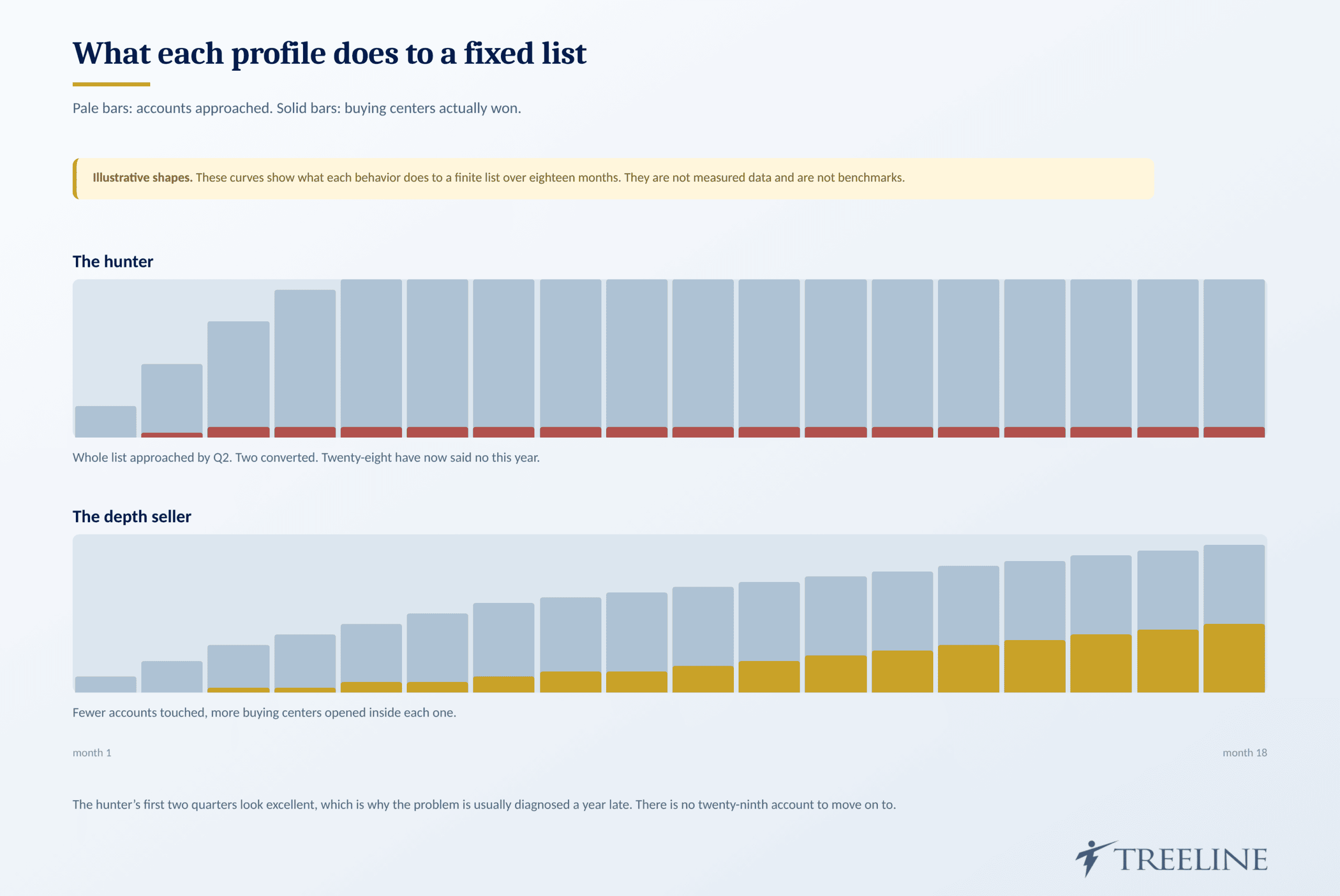
The hunter-and-farmer framing is the default shorthand in sales hiring, and on a named list it misleads in both directions.
The hunter burns the list. Someone optimized for volume and speed works every account hard, gets through the first round of conversations in two quarters, converts the two that were ready, and then faces twenty-eight companies that have already said no this year. Their instinct is to ask for more accounts. There are none. Activity stays high and produces nothing, and because the early quarters looked excellent the problem is usually diagnosed a year late.
The farmer never expands. Someone optimized for relationship safety protects what exists, becomes genuinely well liked, and does not risk the awkward conversation that opens a second department. Revenue is stable and flat. This failure is slower and quieter than the first, and it is often mistaken for a market problem.
What the role actually needs is someone who will push into an unfamiliar part of a familiar company, which requires the hunter’s willingness to be told no and the farmer’s instinct to protect the relationship while being told it. That combination is uncommon enough to be worth screening for directly rather than hoping it emerges from a profile label.
Fantasia’s view is that the useful question is not whether a candidate hunts or farms, but how they behave on their second visit to a buyer who already declined them once. That moment separates the two failure modes faster than any assessment of selling style.
What Named Account Selling Should Test For
Reconstruction works better than discussion, and the subject should be one account rather than one deal.
Map an account they held for three years. Not the deal, the company. How many buying centers, which ones they were in at the start, which ones they opened, how they got in, and which one they never cracked. People who have done this draw an org chart from memory. People who have not describe a sequence of transactions.
Ask how they recovered a relationship after losing a deal. Who was angry, what they did in the months afterwards, and whether they were still invited to the next evaluation. This is the clearest single predictor of whether someone can survive a fixed list.
Ask what they stopped working inside an account, and why. Good named-account sellers deprioritize a division deliberately. Sellers who treat the whole logo as uniformly worth pursuing will spread themselves until nothing goes deep.
Test internal mobilization. Describe a situation where a sales engineer and a customer success manager both have reasons not to help this week, and ask how they would proceed. The answers separate people who escalate from people who trade.
Ask about an account that produced nothing for a year and then did. What kept it alive, what the trigger was, and whether they saw it coming. The named-account motion rewards patience that is not passive, and this question surfaces the difference.
Two conventional stages carry less weight here than usual. A cold-calling exercise tests a skill the role barely uses. And a volume-based pipeline-generation metric, if it appears in the scorecard at all, will reward exactly the behavior that burns a fixed list.
Where Named Account Selling Candidates Come From
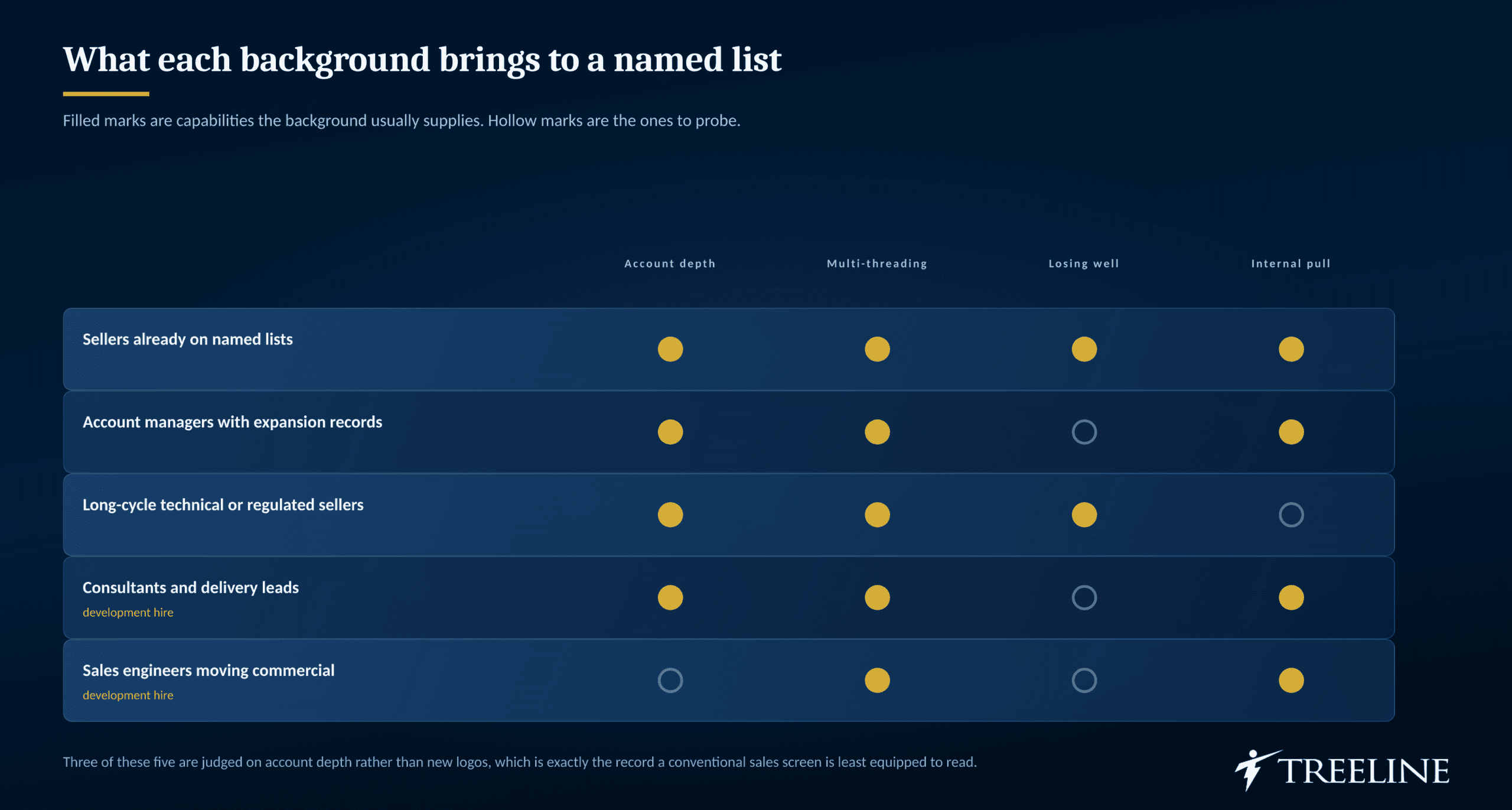
The population is larger than it looks, because several strong sources do not currently hold an account-selling title.
Sellers already working named lists. The obvious pool. The question worth asking is how big their list was and how long they held it, because someone with eight accounts over four years has a different skill set from someone with eighty for one.
Account managers with expansion records. People who have been responsible for growth rather than renewal inside existing customers. The capability transfers almost completely; what they may lack is comfort with a competitive displacement.
Sellers from long-cycle technical or regulated markets. Patience and multi-threading are already habits. The product knowledge is the gap, and it is the smaller one.
Consultants and delivery leads from professional services. They have lived inside a small number of large clients, know how those organizations actually make decisions, and have usually sold follow-on work. Many have never carried a quota, which makes this a development hire.
Sales engineers moving commercial. They already have standing inside accounts and have watched the full cycle from the technical seat. A smaller pool than the others and frequently excellent.
The common thread worth noticing is that three of these five sources are judged on account depth rather than on new logos, which is precisely the record a conventional sales screen is least equipped to read.
Why Named Account Selling Searches Suit the Contingency Model
Three features of this search align with a contingency arrangement.
The population is identifiable but passive. Sellers who are deep inside a handful of large accounts are rarely in the market, because their value is tied to relationships they are not keen to abandon. Reaching them is direct-approach work rather than volume work, and a company paying on placement pays for that reach only when it produces a hire.
The role is not usually confidential. Adding or replacing coverage on an account list is ordinary commercial activity, which removes the clearest argument for a retained engagement.
The brief sharpens during the search. Companies often start by asking for industry experience and discover, after meeting a few account managers with real expansion records, that depth behavior matters more than category familiarity. A non-exclusive arrangement absorbs that without renegotiation.
The limit worth naming: where the list itself is the strategy, a handful of accounts that represent most of the company’s future revenue, the appointment becomes closer to an executive hire, with a smaller pool and a longer assessment, and the case for a retained engagement strengthens. Fantasia’s position has stayed consistent across market cycles: the arrangement follows the shape of the population and the sensitivity of the role, not the seniority on the business card.
What the Employer Has to Settle Before the Search
Four decisions belong to the hiring company, and the first one is the one most often skipped.
Decide how many accounts, and say so. Thirty is a different job from eight, and both are different from eighty. Candidates evaluate this number immediately, because it tells them whether the role is depth or coverage wearing a named-account label.
Say what is already in those accounts. Existing revenue, existing relationships, past losses, and who the incumbent vendor is. A seller discovering in month three that four accounts have a live grievance has been mis-sold the role, and the strong candidates ask about this in the first conversation.
Build a plan that rewards penetration. If the compensation plan only pays on closed revenue measured quarterly, it will select for the hunter behavior that burns the list. Recognizing a new buying center opened, or a division that moved from zero to pipeline, is what aligns the plan with the motion.
Agree the review horizon. A named-account seller’s first year frequently produces less closed revenue than a territory seller’s, and more durable revenue in years two and three. Setting that expectation at offer stage prevents a good appointment being judged against the wrong curve.
Reading the First Year
Early revenue is a weak measure here. What can be read is whether the account positions are getting better.
By week eight, an account map for the top five on the list, buying centers, who is in each, where the current relationship actually sits. By week sixteen, at least one conversation inside a part of an account the company had no presence in. By the end of the second quarter, a deliberate deprioritization: a division or account the seller has decided not to work this year, with a reason. By month nine, pipeline distributed across several accounts rather than concentrated in the one that was always going to buy.
The failure signatures are specific and early. All activity inside the accounts that were already customers is the farmer pattern. A sharp spike of first meetings across the whole list in the first quarter, followed by silence, is the hunter pattern and the more expensive of the two. Relationships that have gone quiet after a loss indicate the recovery behavior is missing, and that will compound for as long as the seller holds the list.
Fantasia’s twelve-month test is whether the company is in more rooms than it was a year ago. If it is, the appointment is working whether or not the revenue has arrived, because on a fixed list access is the asset that produces everything later. If it is not, a number that landed on time probably came from an account that was already going to buy.
Frequently Asked Questions
How is a named account list different from a territory?
A territory can be worked around. If the first conversations go badly, a seller can find more companies. A named list cannot be escaped, so a seller who exhausts it in the first six months has nowhere left to go, and the only remaining variable is how deep they get inside companies that were chosen for them.
Why does the hunter-farmer framing mislead here?
Because both archetypes fail, in opposite directions. The hunter works the whole list hard, converts whatever was ready, and then faces a page of companies that have all just declined. The farmer protects what exists and never risks the conversation that opens a second department. The role needs the hunter’s tolerance for being told no and the farmer’s instinct to stay welcome afterwards.
What is the single most revealing interview question?
How they behaved on the second visit to a buyer who had already declined them. On a fixed list every relationship recurs, so a seller who cannot lose gracefully accumulates permanent liabilities. The specifics of that answer separate the two failure modes faster than any assessment of selling style.
How should we read an account manager’s record?
By expansion rather than renewal. Someone responsible for growth inside existing customers has most of the capability already; what they may lack is comfort displacing a competitor. Retention-only records are a different job and should not be read as evidence for this one.
Does the size of the list change the profile we need?
Considerably. Eight accounts is a depth role closer to an executive relationship job. Eighty is coverage work wearing a named-account label and will reward quite different behavior. Candidates work this out in the first conversation, so a company that has not decided reads as one that has not thought it through.
What should the compensation plan reward?
Penetration as well as closed revenue. A plan paying only on quarterly closings selects for the behavior that burns a fixed list, because speed is rewarded and patience is not. Recognizing a new buying center opened, or a division moving from nothing to real pipeline, aligns the plan with how the motion actually produces revenue.
What do candidates most need to be told up front?
What is already inside those accounts, existing revenue, existing relationships, past losses and the incumbent vendor. Discovering in month three that several accounts carry a live grievance converts a good hire into a short tenure, and strong candidates ask about it before they ask about money.
Nothing has closed by month six. Is that a problem?
Not necessarily, provided the positions have improved. Expect an account map for the top of the list by week eight, a conversation inside a previously untouched part of an account by week sixteen, and by the end of the second quarter a deliberate decision about what not to work this year.
Decide the Length of the List Before You Write the Scorecard
Most named-account searches are specified as though they were territory searches and then assessed with a territory scorecard. The panel screens for pipeline generation, rewards the candidate who sounds most energetic about volume, and hires the profile most likely to exhaust the list before the second year begins.
Say how many accounts. Say what is already inside them. Build a plan that pays for getting further in, not only for closing fast. Then run a process that tests the behavior the motion genuinely rewards, which is whether this person can be told no by someone they will have to sit with again next year.
Share This Story, Choose Your Platform!
Related Posts



What our happy clients are saying
Treeline Inc. provided us with the most candidates that aligned with our needs and were of the highest quality.

Dr. Jeffrey Klein Head of North America Sales, Satchel Pulse
Treeline Inc.’s collaborative, flexible, and communicative approach resulted in a smooth partnership. Beyond their recruitment expertise, their unique sourcing model was efficient and effective.

Sera Holt Director of Operations, LNS Research
Their professionalism was outstanding. Treeline Inc. was extremely thorough and ensured that we were on the same page before they started looking for candidates. They listened to us and did a great job working with the candidate to close out the process.

Cate Grant AVP Customer Success, Nasdaq
Thanks to Treeline Inc.’s intricate and thorough screening process, the company is able to hire six high-quality candidates that fit perfectly in the company’s culture. The team is highly receptive to concerns, and internal stakeholders are impressed with their unique recruitment abilities.

Anna McKean Sales Recruiter, Insider Intelligence
Treeline Inc. has been qualified individuals throughout a five-year-long engagement. They’ve made numerous placements of talented and qualified individuals for our business.

Michele St Laurent VP of HR, The Institute for Applied Network Security

Let Us Help You Source the Sales Talent You Need
Whether you’re building a team or replacing a key role, our Candidate Sourcing Platform provides a fast, flexible, and employer-focused solution.
Tell us more about your business and how we can help.
Treeline Inc.
Your Award-Winning Sales Recruitment Partner
15 Lincoln Street, Suite 314, Wakefield, MA 01880