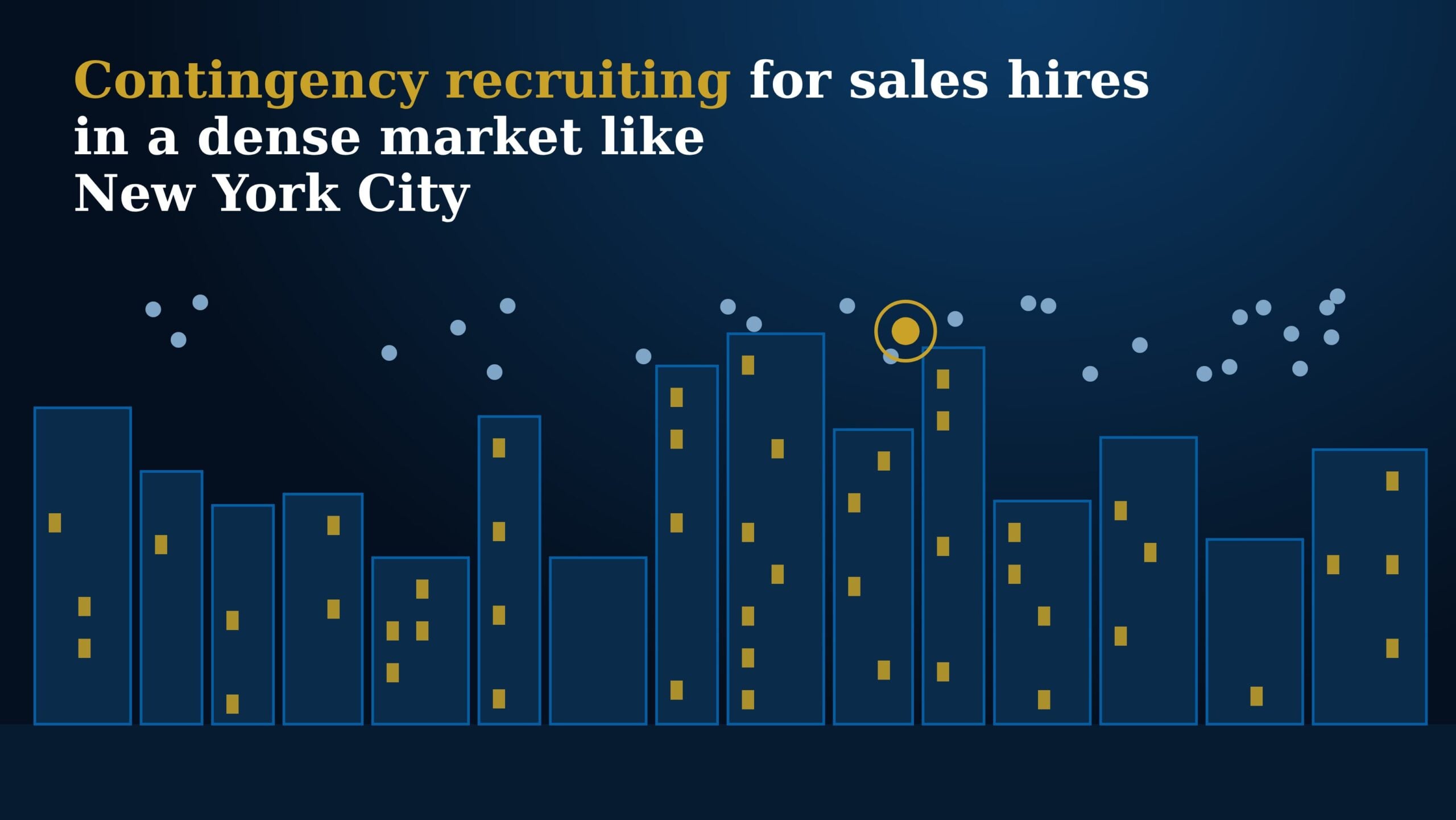
New York City skyline with many candidate and employer markers, headline Contingency recruiting for sales hires in a dense market like New York City
Contingency recruiting is a hiring arrangement in which the recruiter is paid only if the company hires a candidate the recruiter presented. In a dense market like New York City, where many employers are chasing the same experienced sellers, how a contingency search is run matters as much as the fee model. A clear brief, fast feedback and a recruiter who can reach candidates the company cannot find on its own decide whether the arrangement works. This guide explains how contingency recruiting works for sales hires, what a crowded market changes, and how a hiring company can get better results from it.
It is written for founders, sales leaders and hiring managers at New York companies that need to add salespeople, from business development reps to senior sales leaders. It is general information and not legal or financial advice. Fee terms differ between firms, so any arrangement should be confirmed in a written agreement.
Treeline, Inc. is a sales recruiting firm in Wakefield, Massachusetts that places salespeople permanently. Its contingency recruiting service is its main way of taking on a search, and its New York sales executive recruiting page describes New York as “a thriving center for technology, startups, and financial services.”
Dan Fantasia, CEO of Treeline, Inc., would describe a contingency search in a dense market as a race that the company does not have to run alone. From his perspective, the advantage of the model is that a company can put a recruiter’s effort and network to work without paying before there is a hire, but the company still has to do its part, which is to be ready to move when good candidates appear.
What Contingency Recruiting Means
Contingency recruiting is defined by when the recruiter is paid. A Cowen Partners guide to executive search fee structures, whose page was last modified on October 31, 2026, says that contingency search firms “are only paid once you hire a candidate they have presented to you.” Cowen Partners is a retained-search firm, so its comparison favors that model, and the definition above is the part of the page that the whole industry would recognize.
Treeline describes its own version in similar terms. Its contingency page says the service “has no upfront cost and is free of charge unless a hire is made,” and that a fee is collected only when a suitable candidate is hired. Those statements are Treeline’s own, and the specific terms should be confirmed in a written agreement.
How it differs from retained search
In a retained search, the company pays the firm for work during the search, often in installments. In a contingency search, the company pays on a successful hire. The Cowen Partners guide says contingency firms typically focus on mid- to lower-level positions, while retained firms focus on upper-level and highly specialized roles. Those are one firm’s generalizations, and plenty of firms work outside them. Neither model is better in every case. The choice depends on the role, the urgency and how much the company wants the recruiter to commit up front.
How Contingency Recruiting Works Step by Step
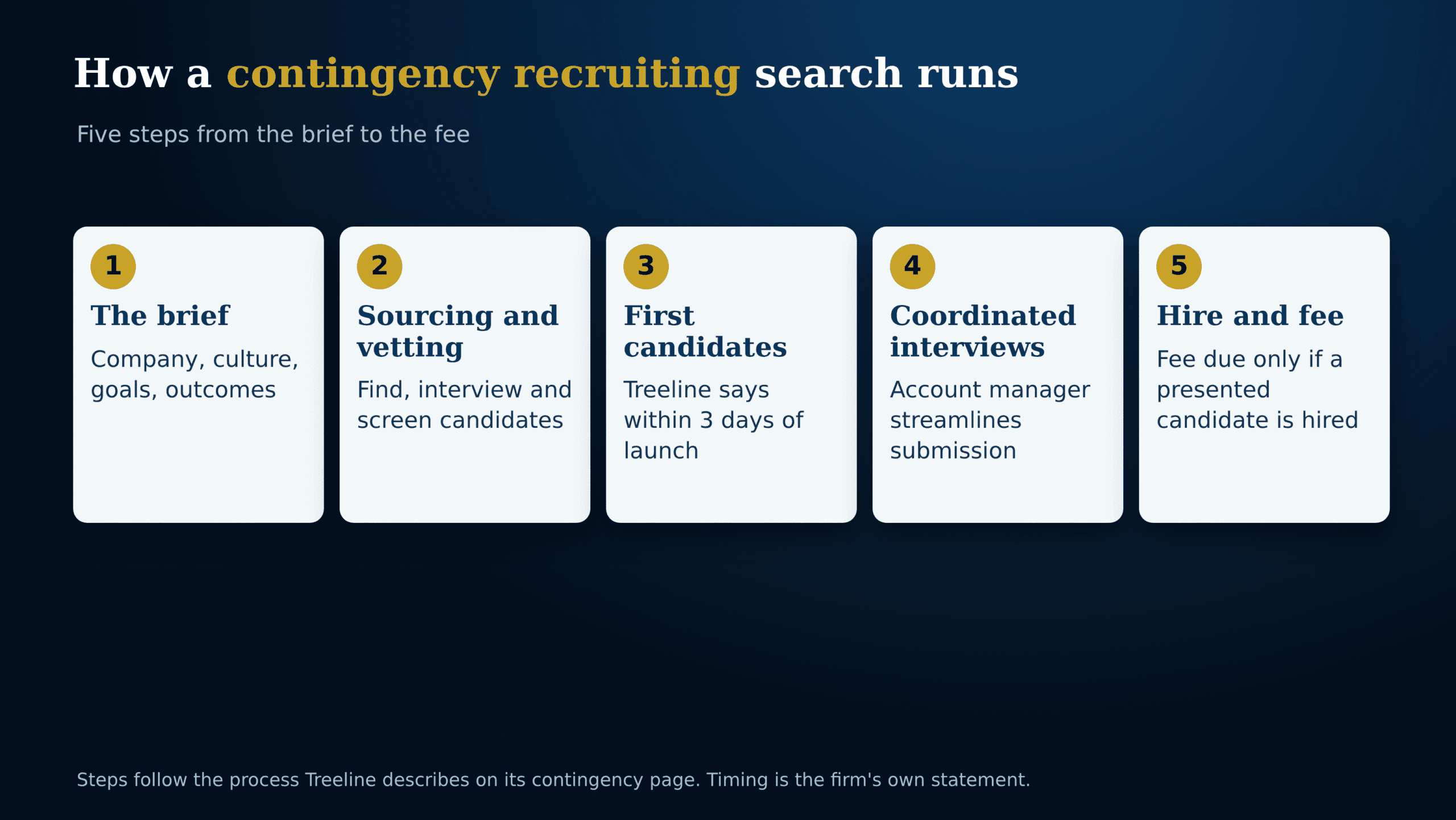
How a contingency recruiting search runs for a sales hire: brief, vetting, first candidate, coordinated interviews, hire and fee
The steps above follow the process Treeline describes on its contingency page, and most contingency searches follow a similar shape.
- The brief. The recruiter learns about the company, the culture, the goals and the outcomes the sales hire is meant to produce. Treeline’s page says every search requires a detailed understanding of those points.
- Sourcing and vetting. The recruiter finds candidates, interviews them and screens them against the brief.
- The first candidates. The recruiter presents candidates to the company. Treeline says that within 3 days of launching a search it will deliver the first candidate, and its page describes that as guaranteed. That is the firm’s own commitment.
- Coordinated interviews. The company interviews, gives feedback and decides. Treeline says a dedicated account manager works with its recruiters to streamline submission and interviews.
- The hire and the fee. If the company hires a presented candidate, the fee is due. If it does not, the fee generally is not.
What the company controls
The company controls more of the outcome than the “no hire, no fee” framing suggests. It controls the clarity of the brief, the speed of feedback, the quality of the offer and the decision. A contingency search can stall if the company is slow, vague or unsure about what it wants.
Why a Dense Market Changes How Contingency Recruiting Works
A dense market has many employers, many candidates and many recruiters in one place. That affects a sales search in several ways. These are reasoned observations, not statistics, and none comes from a source that measured them.
- Strong sellers get many approaches. A seller who is performing well in a large metro is likely to hear from several recruiters and employers, so a message has to be specific to earn a reply.
- Speed matters more. A candidate who is interviewing with several companies will move on if one process drags.
- Differentiation matters. In a market with many companies that sell similar products, the candidate needs a clear reason to choose one, such as the territory, the product, the team or the pay plan.
- Noise is high. A company’s posting may sit among many similar postings, so reaching passive candidates directly can matter more than waiting for applicants.
- Competing offers are common. The company should be ready to discuss compensation and start dates early.
Dan Fantasia, CEO of Treeline, Inc., sees speed as the discipline that separates companies that win sales hires in crowded markets from those that merely run searches. From his perspective, a company that can interview within days and decide within a week gives a recruiter something to work with, because a strong candidate who is delayed is often a candidate who accepts another offer.
How Contingency Recruiting Works With Sales Roles Specifically
Sales roles have features that shape a contingency search.
- Performance can be evidenced. A seller’s results, quota history and deal examples give the recruiter and the company something concrete to assess.
- Roles vary widely. A business development rep, an account executive and a head of sales need very different profiles, so the brief must say which one is being hired.
- Compensation is complex. Base pay, commission, quota and ramp all influence whether a candidate says yes, so they should be settled early.
- Fit with the sales motion matters. A candidate who sold small, quick deals may struggle with long, complex ones, and the reverse.
- Time to revenue is a cost. An open sales seat usually means missed pipeline, which is why a contingency search is often a company’s answer to urgency.
Treeline’s Sales Compensation Assessment page describes a seven-step review of a compensation plan, which can help a company confirm that its pay structure will make sense to candidates before the search begins.
When Contingency Recruiting Fits a New York Sales Search
Contingency recruiting is often a good fit when:
- the company needs to fill a sales seat soon;
- the role is defined and the company can describe the profile;
- the company wants to avoid paying before there is a hire;
- the company can interview and decide quickly;
- the company is willing to work with a recruiter as a partner.
It may be less suitable when the role is not yet defined, when the company wants a recruiter to commit exclusively and visibly over a long period, or when confidentiality requires a different arrangement. In those cases a company may prefer a retained or engaged model. Some companies also use both, depending on the role.
Questions to ask a contingency recruiter
- How will you reach candidates who are not applying?
- Which sales roles and levels have you placed, and how recently?
- How quickly will I see the first candidates, and what is the basis for that estimate?
- What do you need from us to move quickly?
- How are fees calculated, and what happens if a hire leaves early?
These questions apply to any firm. Treeline’s New York page also states that the firm collects a fee only once a suitable candidate is hired, but it does not give fee amounts, so a company should ask for terms in writing.
Getting Better Results From Contingency Recruiting in a Crowded Market
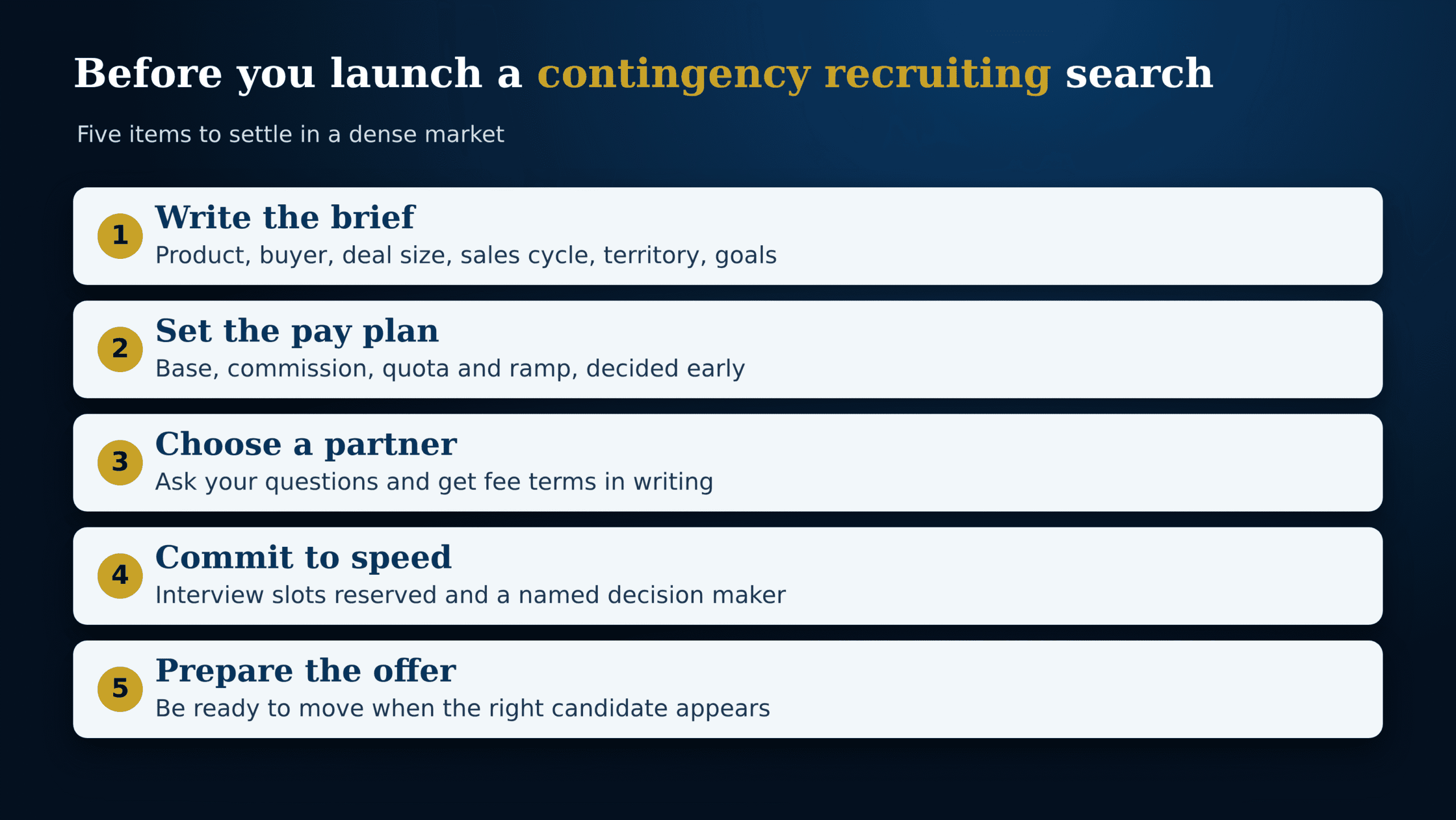
A company can improve a contingency search with a few habits. The checklist below collects the items to settle before the search launches.
Checklist for a contingency recruiting search in a dense market: brief, pay plan, partner, speed and offer
- Write a real brief. Describe the product, the buyer, the deal size, the sales cycle, the territory and the first-year goals. A brief that says “a strong closer” leaves too much to guess.
- Decide the compensation early. State base, commission, quota and ramp, and be ready to explain them.
- Interview fast. Offer interview slots within days of receiving a candidate.
- Give specific feedback. A recruiter who learns why a candidate was rejected can improve the next round.
- Keep the process honest. Tell candidates what to expect and when, and keep the promise.
- Decide who decides. A search with too many opinions can stall.
- Be ready for counteroffers. A candidate may be offered more to stay, so the company should explain why the role is worth taking.
Dan Fantasia, CEO of Treeline, Inc., stresses that feedback is the most underrated input. From his perspective, a hiring manager who explains in two sentences why a candidate was not a fit gives the recruiter more to work with than any amount of additional searching, because it sharpens the profile.
A Worked Example of Contingency Recruiting in a Dense Market
The following example is hypothetical. The company, the roles and the timing are invented to show how the steps connect, and they are not a benchmark or a result from any real search.
A New York software company needs two account executives to sell to mid-sized customers. The sales leader writes a one-page brief that names the product, the typical buyer, a rough deal size and the sales cycle. She adds a draft pay plan with base, commission and quota, and she names herself and the CEO as the only decision makers. She blocks two afternoons a week for interviews.
The recruiter reads the brief and asks three questions. Does the company prefer candidates from direct competitors or from adjacent products? Will it consider candidates who live outside the city and travel in? How firm is the pay range? The answers change the search. The company decides to include adjacent-product sellers and to consider hybrid arrangements, which widens the pool without lowering the bar.
The first candidates arrive and the sales leader interviews them within days. She tells the recruiter that one candidate was strong on discovery but had never run a long cycle, and that another had the right cycle experience but wanted a higher base than the plan allows. That feedback is more useful than a simple yes or no. The recruiter adjusts the next round, and the company decides whether the base is worth revisiting.
When a candidate is a fit, the company moves to an offer quickly, with the pay plan and start date in writing. Under a contingency agreement, the fee becomes due when a presented candidate is hired. If no presented candidate is hired, the company generally owes no fee, though it has still spent time. The example shows why the company’s own speed and clarity are part of the process and not extras.
Dan Fantasia, CEO of Treeline, Inc., would point out that the most useful moment in a search like this is the first piece of honest feedback. From his perspective, a company that tells its recruiter what it truly values, and which tradeoff it will accept, usually reaches the right hire sooner than one that waits to see more candidates before deciding.
Common Mistakes in Contingency Recruiting for Sales Hires
- Treating “no fee unless hired” as “no cost.” Delay, a vague brief and a failed search all cost the company time and pipeline.
- Working with too many firms at once without a plan. Competing recruiters may chase the same candidates, and candidates may be approached more than once.
- Slow feedback. Candidates lose interest, and the recruiter cannot adjust.
- An unclear pay plan. Candidates cannot assess the offer, or they discover problems late.
- No plan for the first ninety days. A new seller who is hired quickly still needs onboarding.
- Ignoring restrictive agreements. Candidates may have noncompete or nonsolicitation terms, which counsel should review before an offer.
For companies that need sales leadership while they search or onboard, Treeline’s fractional CRO service page describes an ongoing engagement that covers pipeline reviews, coaching and reporting.
A Simple Plan for Contingency Recruiting in New York
- Define the role. Write the profile, the sales motion and the outcomes.
- Set the pay plan. Decide base, commission, quota and ramp.
- Choose a partner. Ask the questions above and get terms in writing.
- Commit to speed. Reserve interview time and name the decision maker.
- Review and adjust. After the first candidates, give feedback and refine the brief.
- Prepare the offer. Be ready to move when the right candidate appears.
- Plan onboarding. Make the first ninety days clear before the start date.
Treeline’s technology sales recruiters and business-to-business sales recruiters pages describe the industries the firm lists, which is a useful check for a New York company in either field. Treeline’s Sourcing as a Service page describes its sourcing offering.
Frequently Asked Questions About Contingency Recruiting
What is contingency recruiting?
Contingency recruiting is an arrangement in which the recruiter is paid only if the company hires a candidate the recruiter presented. There is generally no payment during the search itself.
How does contingency recruiting work for sales hires?
The recruiter learns the brief, sources and vets candidates, presents them, and coordinates interviews. If the company hires a presented candidate, the fee is due. The company’s speed and clarity affect the result.
Why does a dense market like New York City change contingency recruiting?
Strong sellers receive many approaches and may interview with several companies, so speed, a clear role and a specific outreach message matter more. This is a reasoned observation and not a measured statistic.
How is contingency recruiting different from retained search?
In retained search the company pays during the search, often in installments. In contingency recruiting payment depends on a hire. A Cowen Partners guide, from a retained-search firm, says contingency firms typically focus on mid- to lower-level roles and retained firms on senior and specialized ones.
Does contingency recruiting cost nothing until I hire?
Under a typical contingency agreement there is no fee until a hire is made, but delay and a stalled search carry their own costs. Fee amounts and terms differ between firms and should be confirmed in writing.
What does Treeline say about its contingency recruiting service?
Treeline’s contingency page says the service has no upfront cost, that a fee is collected only when a suitable candidate is hired, and that it will deliver the first candidate within 3 days of launching a search. Those are the firm’s own statements.
What should I give a recruiter to start a sales search?
A clear brief covering the product, buyer, deal size, sales cycle, territory, compensation and first-year goals, plus a named decision maker and interview availability.
Share This Story, Choose Your Platform!
Related Posts


What our happy clients are saying
Treeline Inc. provided us with the most candidates that aligned with our needs and were of the highest quality.

Dr. Jeffrey Klein Head of North America Sales, Satchel Pulse
Treeline Inc.’s collaborative, flexible, and communicative approach resulted in a smooth partnership. Beyond their recruitment expertise, their unique sourcing model was efficient and effective.

Sera Holt Director of Operations, LNS Research
Their professionalism was outstanding. Treeline Inc. was extremely thorough and ensured that we were on the same page before they started looking for candidates. They listened to us and did a great job working with the candidate to close out the process.

Cate Grant AVP Customer Success, Nasdaq
Thanks to Treeline Inc.’s intricate and thorough screening process, the company is able to hire six high-quality candidates that fit perfectly in the company’s culture. The team is highly receptive to concerns, and internal stakeholders are impressed with their unique recruitment abilities.

Anna McKean Sales Recruiter, Insider Intelligence
Treeline Inc. has been qualified individuals throughout a five-year-long engagement. They’ve made numerous placements of talented and qualified individuals for our business.

Michele St Laurent VP of HR, The Institute for Applied Network Security

Let Us Help You Source the Sales Talent You Need
Whether you’re building a team or replacing a key role, our Candidate Sourcing Platform provides a fast, flexible, and employer-focused solution.
Tell us more about your business and how we can help.
Treeline Inc.
Your Award-Winning Sales Recruitment Partner
15 Lincoln Street, Suite 314, Wakefield, MA 01880